

Drafted in Westminster, carried into American law — four documented instances, and almost no one who voted was told.
Story at a glance
A New Jersey bill (AB 1146) now pending adopts a definition of “Islamophobia” for civil and criminal purposes — and its own official statement says it is “modeled in part after the All-Party Parliamentary Group” of the British House of Commons and House of Lords.
California’s children’s-design law (AB 2273), copied since into Maryland and Vermont, was — in the sponsoring organization’s own words — “sponsored by 5Rights” and “modelled on the UK legislation.” 5Rights is a British foundation chaired by a member of the House of Lords.
The Sanders–Casar bill to ban “superintelligence” was, per TIME, written as a UK bill and “consulted on” for the US one by the same London group — a UK company that was still registered under a different name, Secure Future Research Ltd, until two days after the UK bill’s first reading.
A related case sits outside the template and is noted as such: the IHRA definition of antisemitism — drafted by a 35-nation intergovernmental body, adopted early by the UK — has been adopted by more than half of US states. International, not British; the same transplant mechanism, wider than London.
The “duty of care” model behind Britain’s Online Safety Act, authored at a UK think tank, echoes through the US Kids Online Safety Act.
No conspiracy required. Different organizations, different funders, different causes — one repeating architecture. That is what should concern you: a plot has to stay hidden and can be exposed. A pipeline that operates in the open, answers to no one, and never has to disclose itself just keeps running.
 Sayer Ji@sayerjigmi🚨New Jersey’s A1146 would put a British-influenced definition into police decisions. Sanders’ AI bill has a UK consulting link and penalties up to 20 years. Here's the paper trail. 🧵👇
 2:53 AM · Nov 9, 2026 · 379 Views1 Reply

What I am claiming
Five times in five years, the text of American law — or the definition that governs its enforcement — was manufactured in a British institution and carried across the Atlantic. In the most consequential cases, no sponsor disclosed the drafter. That is the claim, and it is the whole claim.
That claim requires no hidden coordinator, and the record shows none. It does not require any of these causes to be illegitimate — one can grant that anti-Muslim hatred is real, that children deserve protection online, and that AI carries genuine risk, and still insist on knowing who is writing the laws. And it specifically does not rest on the rumor now circulating that a named activist group secretly authored the New Jersey bill; the record contradicts that, and I follow the record.
Where I can show the drafter, I show the drafter. Where I cannot, I say so — because the pattern is strongest told at exactly its true size.
Instance one: a definition of a crime, written in Westminster, pending in Trenton
New Jersey Assembly Bill A1146 adopts a state definition of “Islamophobia.” It is not symbolic. Its text directs that “a public official or law enforcement officer shall take into consideration the definition of Islamophobia” when deciding “whether there has been a violation of any policy, law, or regulation” under “the civil or criminal laws of this State.”
Where did the definition come from? The bill tells you itself, in its own closing statement:
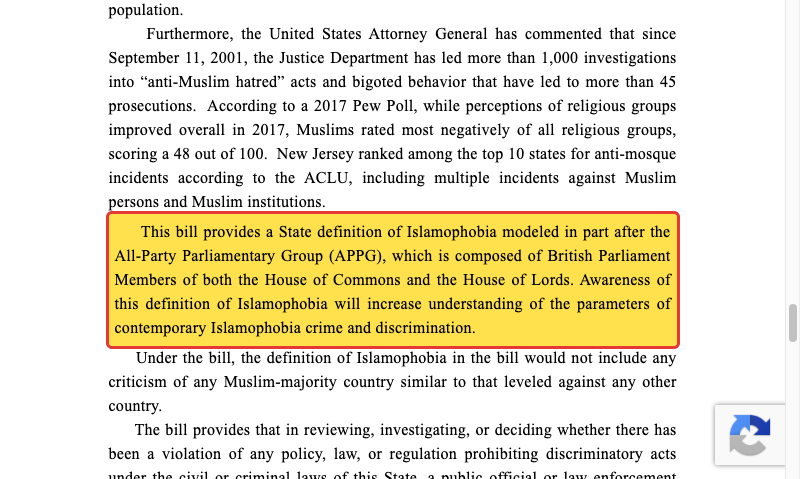
The New Jersey bill’s own statement — a definition that will inform criminal-intent determinations, “modeled in part after” a group of British parliamentarians. Source: njleg.state.nj.us, bill A1146.
Author’s analysis. Read the definition’s own enumerated examples and the civil-liberties concern writes itself. Among the listed manifestations of “Islamophobia” are “conspiracies about Muslims[’] entry into politics, government, or other societal institutions” and accusations of dual loyalty. Those are categories that can capture ordinary — and constitutionally protected — political argument about immigration, foreign funding, or religion. The bill does carry a First Amendment savings clause, and that clause deserves to be quoted: it says nothing in the act “shall be construed to diminish or infringe upon any right protected under the First Amendment.” But a sentence promising not to chill speech does not, by itself, prevent the chill once an enforcement officer is instructed to weigh a British-drawn definition when judging intent. That is the mechanism to watch — not the preamble, but the instruction.
What A1146 is not is the thing being claimed about it on social media — that it was secretly written by a named activist NGO. The bill’s cited sources are the APPG, the FBI, Pew, and the ACLU. The British influence here is real because the bill admits it. The activist-group attribution is not in the record, and I am not going to put it there.
Instance two: the UK charity that said so itself
In 2022 California passed AB 2273, the Age-Appropriate Design Code Act, requiring online services to build for children’s privacy and safety by default. It was the template: Maryland passed its own version in 2024, Vermont followed, and the model is still moving state to state.
Here, we do not have to infer the British origin. The sponsoring organization announced it:
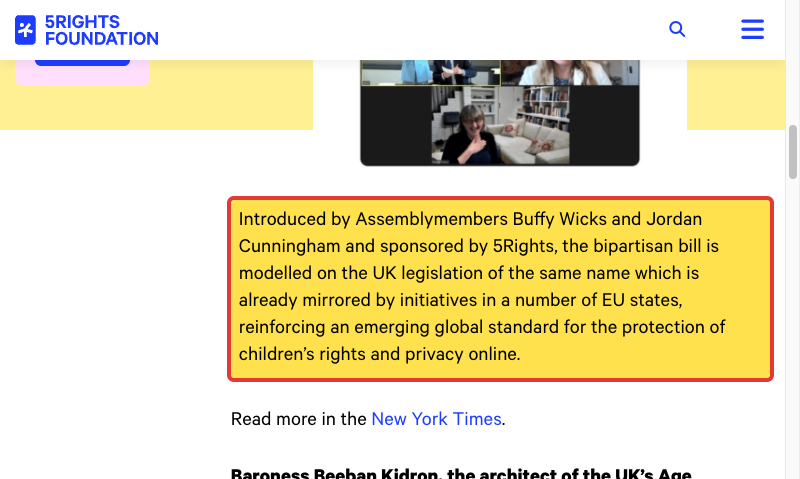
5Rights Foundation’s own words on its own website: “sponsored by 5Rights… modelled on the UK legislation.” 5Rights was founded by Baroness Beeban Kidron of the UK House of Lords. Source: 5rightsfoundation.com.
Author’s analysis. To its credit, 5Rights has been open about this; the transplant was advertised, not hidden. That makes it the clean, documented base case of the pattern — a UK statutory code, a UK peer, a US state law carrying the same DNA, and then a cascade to other states. It is the honest end of the spectrum. Hold it in mind as the control sample, because the next instance is the opposite.
Instance three: a “public-relations” company that wrote two national bills
On September 3, Senator Sanders and Representative Casar announced the Ban Artificial Superintelligence Act. Five days later, its UK companion had its first reading in Parliament. TIME asked who wrote them, and the answer is on the record:
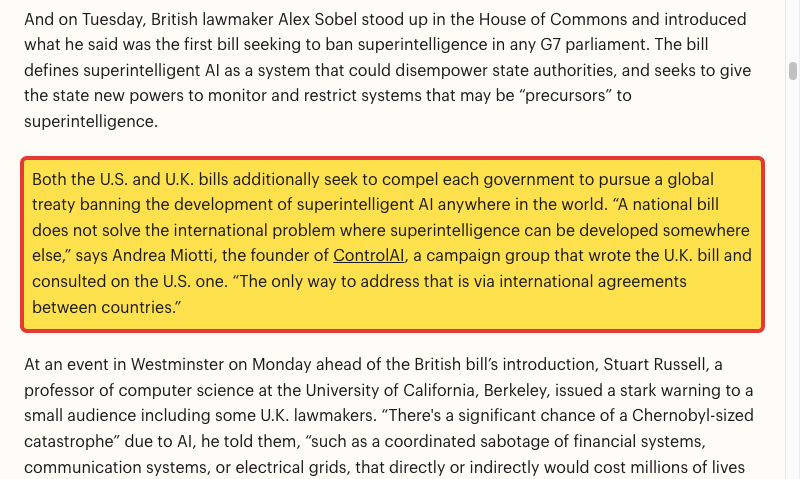
TIME, Sept. 8, 2026. One organization — ControlAI — wrote the UK bill and “consulted on” the US one. Source: time.com.
Who is ControlAI? Legally it is a UK company, number 15088415, incorporated in August 2023 as Secure Future Research Ltd — and it still carried that name when both bills appeared. The change to ControlAI was not certified until September 10, 2026, two days after the UK bill's first reading. (Its filed classification, SIC 70210 — public relations and communications — is the standard Companies House category for campaign organizations; the name timing, not the code, is the detail that matters.)
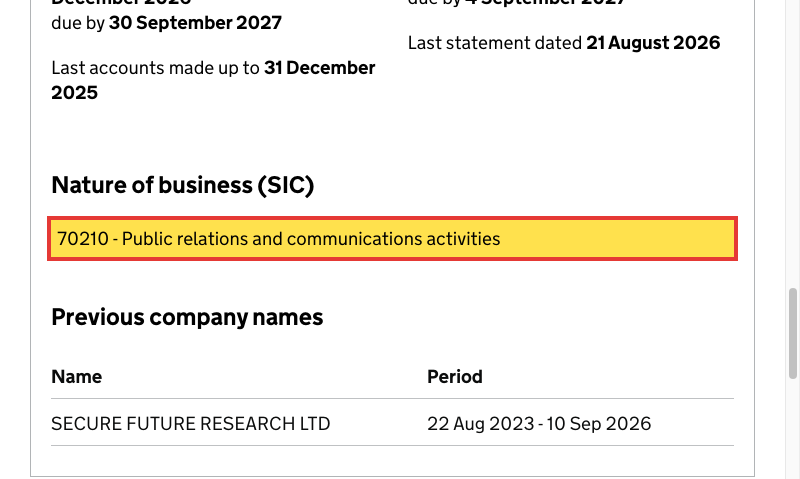
The UK Companies House record: the company was still registered as Secure Future Research Ltd when both bills appeared; the rename to ControlAI was certified Sept. 10, 2026 — two days after the UK bill’s first reading. Source: Companies House.
Author’s analysis. Sanders’ press release and his summary document name neither ControlAI, its founder Andrea Miotti, nor its US lead Connor Leahy. In the UK, the bill’s sponsor Alex Sobel did thank ControlAI on the floor of the Commons — “I also would like to thank ControlAI for its support with the Bill” — but neither sponsor’s press materials disclosed who actually wrote the legislative text. The American public would learn it only because two reporters asked, and ControlAI, to its credit, answered honestly. As I documented in the fuller piece, ControlAI’s only publicly named funder is the billionaire Jaan Tallinn — who led the Series A financing round of the frontier AI lab Anthropic and sits on its board as an observer — and the bills’ definitional structure, reaching any system that “can easily be modified to exhibit” the banned capabilities, would fall hardest on open-weight developers while sparing the closed-weight incumbents. Coordination is not the claim — the record does not show it, and the scandal does not need it. A documented drafter, a documented funder with a board observer’s seat at the architectural beneficiary, and two national sponsors who disclosed none of it: that stands on its own terms.
This is the opaque end of the same pattern whose honest end was 5Rights. Same shape — British drafter, American bill. Opposite disclosure.
Instance four: the duty of care
Stated at its true strength and no higher.
The “duty of care” model for regulating online platforms was authored at the British think tank Carnegie UK, became the backbone of the UK’s Online Safety Act, and its structure echoes through the US Kids Online Safety Act. This is the weakest rung, and I grade it honestly: I have not established that any British party drafted KOSA. What I can show is the migration of a regulatory concept from a Westminster proposal into a Washington bill. Structural resemblance — reported, not proven. I include it because the pattern is incomplete without it and I would rather show you the soft rung than hide it.
One related case deserves naming precisely because it does not belong in this list. The IHRA working definition of antisemitism was not manufactured in a British institution: the IHRA was founded in Stockholm in 1998, its definition was adopted in Bucharest in 2016 by a 35-nation body, and its base text derives from a 2005 EU working definition drafted in Vienna. The UK was an early adopter — December 2016 — not the drafter. I note it anyway, at its true size, because its form — a short, non-binding “working definition” followed by enumerated examples, later adopted by more than half of US states — is the same transplant mechanism operating at international rather than British scale, and because the APPG’s Islamophobia definition, which New Jersey’s A1146 adopts, follows that same form. A family resemblance, not identical wording. International, not London. Structure, not scandal.
The pattern, named
Call it the London template.
A model is manufactured in a British institution. It is carried into American law. Disclosure is optional, and increasingly waived. And in every instance the transplanted instrument does the same constitutional work: it routes a foreign-authored definition or licensing scheme into the machinery of American enforcement — against what Americans may say, or what Americans may build.
Five instances. Four domains. Five years.
In 2021, the Center for Countering Digital Hate — another UK nonprofit — produced the “Disinformation Dozen,” a list the Biden White House invoked while pressing platforms to throttle the accounts of six Americans. I was one of the twelve. That case became a federal lawsuit; it was dismissed in July 2026 on a pleading defect, without ever reaching the merits. I have watched this mechanism operate on my own name. That is not why I report it. It is how I recognized it.
I have traced that single pipeline — from a Labour-adjacent London startup called Brixton Endeavours to a bipartisan American ban on open-source AI — across eight years and some fifty primary sources in The Eight-Year Influence Operation. It is the worked example of everything this piece names.
You do not need to believe in a conspiracy. You need only read four public records — Companies House filings, a bill’s own statement, a foundation’s own press release, a magazine’s own reporting. The architecture is sitting in plain sight. The drafters are not hiding. The sponsors are. And the one question every American legislator carrying one of these bills owes the public is the simplest one there is:
Who actually wrote this — and why weren’t we told?
The coalition organizing against this mechanism — federal and state licensing of the tools of speech — is Restore the First (restorethe1st.com). Its case for why this is a First Amendment question is laid out there.
Sources
Every claim above traces to one of these. Primary records first.
New Jersey A1146:
NJ Assembly Bill A1146, full text and statement — njleg.state.nj.us (the APPG admission is in the closing STATEMENT)
APPG on British Muslims, “Islamophobia Defined” (2018) — the British definition the bill models
The Age-Appropriate Design Code:
California AB 2273, official bill text — leginfo.legislature.ca.gov
5Rights Foundation: “California Passes Landmark Child Data Protection Law” — “sponsored by 5Rights… modelled on the UK legislation,” in its own words
ControlAI and the twin superintelligence bills:
TIME, Sept. 8, 2026: “The Growing Push to Ban Superintelligent AI” — “wrote the U.K. bill and consulted on the U.S. one”
Wired, Sept. 9, 2026 — bill “crafted by” ControlAI; Leahy input on Sanders–Casar
Companies House: ControlAI / Secure Future Research Ltd, no. 15088415 — SIC 70210, name history
Sanders–Casar announcement, Sept. 3, 2026 — names no drafter
The Guardian, Sept. 11, 2026 — ControlAI “funded by the billionaire Skype co-founder… Jaan Tallinn”
IHRA and the duty of care:
IHRA working definition of antisemitism — including national adoptions
Carnegie UK, online harms programme — the Perrin/Woods duty-of-care proposal that became the Online Safety Act
The CCDH instance and the fuller record:
Companies House: CCDH / Brixton Endeavours Ltd, no. 11633127 — name history, directors
The Eight-Year Influence Operation — the full pipeline, ~50 primary sources
The CCDH Rebrand Nobody Noticed — the Coxon launch mechanics
The AI Bill Bernie Sanders Introduced Was Drafted in London — Piece 4, the ControlAI deep file
Coalition:
Restore the First — why licensing the tools of speech is a First Amendment question
I’m not sure that just because legislation is born outside of the U.S. it is necessarily bad. It must follow the U.S. Constitution, of course, but words are words, regardless of who writes them. The biggest problem, as I see it, is that our Congress is predominantly useless. Especially Republicans in the Trump era. They could not pass legislation to require photo ID before voting or even to stop the Daylight Savings time change, which an overwhelming percentage of Americans support. They sat immobilized while Trump imposed tariffs on the world (which is Congress’ job!), declared war on a foreign country (which is Congress’ job!), kidnapped the president of Venezuela, and acted as judge, jury, and executioner for small boats traveling in international water.
Congress is useless, which is why Trump rules the world by Executive Order — which will be overturned on Day 1 by the next Democrat president, just like his first administration’s EOs were overturned by Biden.