

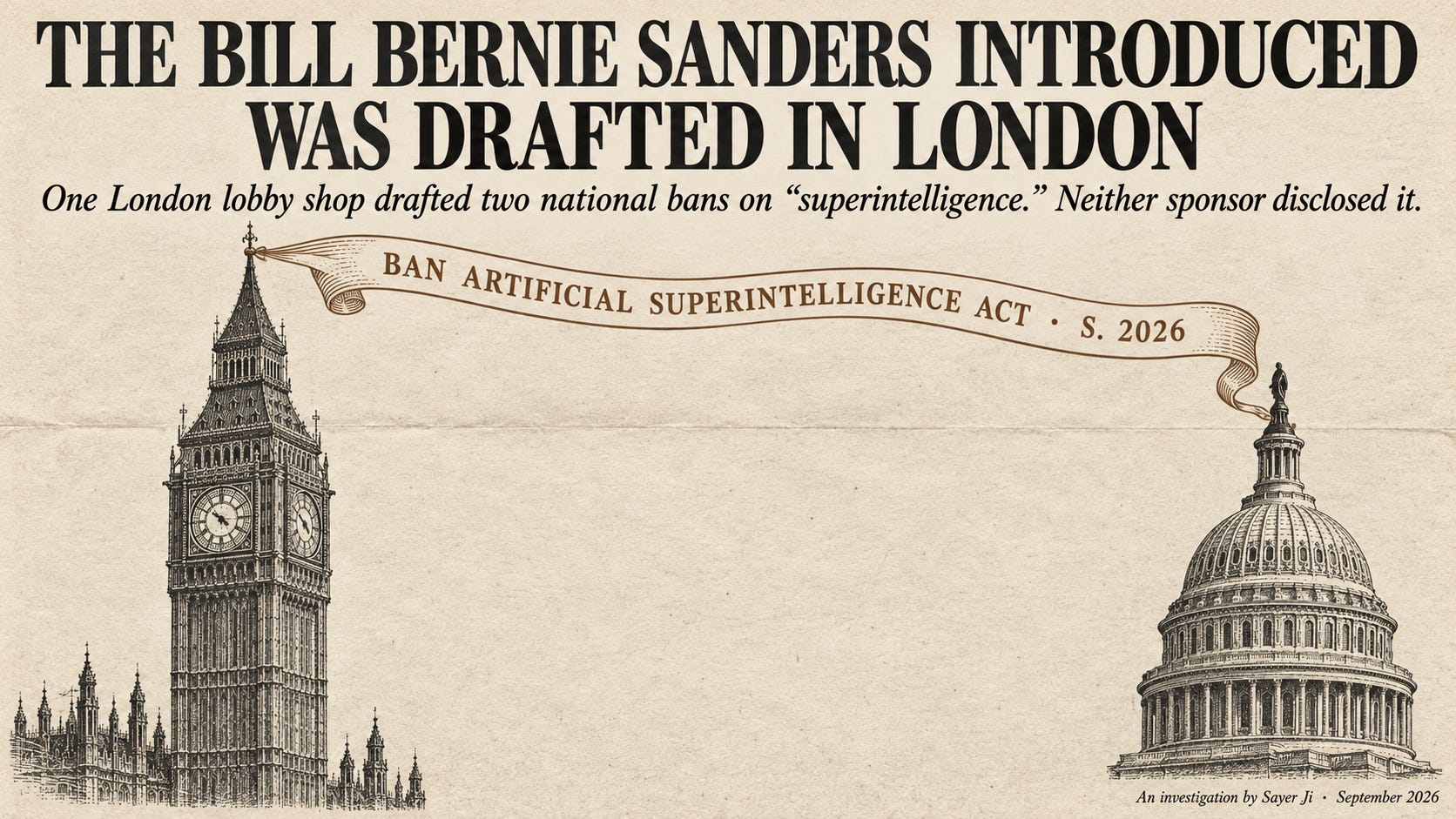
One London lobby shop drafted two national bans on “superintelligence.” Neither sponsor disclosed it. And the shop’s only publicly named funder is the man who led Anthropic’s Series A.


UPDATE — September 18, 2026: The nuclear analogy has a named author, and he advises ControlAI.
ControlAI lists one advisor drawn from the national-security establishment: The Rt Hon. the Lord Browne of Ladyton (Des Browne) — UK Secretary of State for Defence from 2006 to 2008, Vice Chair of the Nuclear Threat Initiative since 2014, and chair and co-founder of the European Leadership Network. ControlAI’s own about page calls him “one of the strongest supporters of ControlAI’s campaign from an early stage.”
On June 15, 2026 — eighty days before the Sanders announcement and eighty-five before the Sobel bill — Browne published “The Case for Banning Superintelligent AI, Before It’s Too Late” in RUSI, the world’s oldest defence and security think tank. He wrote:
“For much of my career in government, including my years serving as the UK’s Defence Secretary, I believed that the prospect of nuclear war was the most dangerous threat facing humanity… Now, however, as I retire from the House of Lords, increasingly it is clear that the development of superintelligent AI constitutes a threat analogous in scale to that of nuclear war.”
“The threat of which AI scientists are warning is greater than the one witnessed in 1945.”
In the same commentary he set out the sequence both bills would follow: the UK should “begin by prohibiting the development of superintelligence on British soil and then work to build a coalition of states agreeing to prohibit it globally.” Ban at home, then treaty abroad — published in June, legislated in September, on two continents.
Three months later, on September 15, Sanders told CBS News that AI’s potential danger is “probably greater than nuclear weapons.” Asked directly whether the proposed 20-year penalty was equivalent to the sentence for illegal nuclear-weapons development, he answered: “the analogy is appropriate, exactly.”
It isn’t. Under 42 U.S.C. § 2272, developing or acquiring an actual atomic weapon carries 25 years to life. Unlawful possession of nuclear material carries 10 years. There is no 20-year tier in the Atomic Energy Act. The equivalence Sanders ratified does not exist in the statute he invoked — and because the summary’s own definition reaches any system that “can easily be modified to exhibit” the prohibited capabilities, a developer releasing open weights would face double the criminal exposure of someone caught unlawfully holding enriched uranium.
The nuclear frame was not Sanders’ improvisation. It was published in a British defence journal in June by a named advisor to the organization that wrote the UK bill, and it was being spoken from a US Senate office by September.
The two quotations
TIME, September 8, 2026:
“A national bill does not solve the international problem where superintelligence can be developed somewhere else,” says Andrea Miotti, the founder of ControlAI, a campaign group that wrote the U.K. bill and consulted on the U.S. one.
Wired, September 9, 2026:
“In an unprecedented move, the parliamentary bill was crafted by the nonprofit organization ControlAI, which has the support of Jaan Tallinn, a founding engineer of Skype and former director at DeepMind.”
>
“Connor Leahy, the founder of Conjecture, now heads ControlAI’s US division, which has provided input on Bernie Sanders and Greg Casar’s bill aimed at banning the development of superintelligence.”
Those are the entire public record of who drafted the two “Ban Superintelligence” bills introduced in Congress and Parliament within five days of each other. The drafter is one organization. The organization’s only publicly named funder is one man. The man led the Series A financing round of the frontier AI company the bills’ definitional structure would architecturally exempt.
Neither Sanders’ September 3 press release nor the official UK Parliament record for the Sobel bill discloses this. Neither the American nor British public would learn it from official sources. They would only learn it if a reporter at TIME or Wired asked ControlAI, and ControlAI, correctly, told them the truth.
Who ControlAI actually is
Legally, ControlAI is a UK entity. Its Companies House filings identify it as SECURE FUTURE RESEARCH LTD, company number 15088415, registered at 201-211 Borough High Street, London SE1 1JA, incorporated August 22, 2023. Its filed nature of business is SIC code 70210 — “Public relations and communications activities.” It is a private company limited by guarantee, without share capital, without charity status.
Two people control it. Per the Persons with Significant Control register:
Andrea Miotti — Italian, born November 1996 — 25-50% of voting rights, right to appoint or remove directors
Eva Christa Annelore Behrens — German, born February 1995 — 25-50% of voting rights, right to appoint or remove directors
A third original director, Nicolas Michel Pierre Moës (Belgian, born September 1993), resigned on November 7, 2023 — seventy-eight days after incorporation.
That is the entire corporate structure of the organization that TIME and Wired identify as the drafter of two national bans on superintelligence. Two people, both under 32, both with two years of UK residency, filing at Companies House as a public-relations business.
Its US arm is a separately structured 501(c)(4) organization (per ControlAI’s own about page), described as “Control AI US Inc.” in coverage. 501(c)(4) social welfare organizations are not required by federal law to disclose their donors. Its US executive director is Connor Leahy, who was previously the co-founder and CEO of Conjecture, the UK-based AI-safety company where Miotti was head of strategy and governance before founding ControlAI.
ControlAI’s own about page states that Gabriel Alfour — another Conjecture co-founder — “helped Andrea Miotti found ControlAI.” So the organization now drafting national legislation in two countries is essentially the Conjecture leadership pool operating under a new corporate wrapper focused on lobbying.
Who’s paying for it
ControlAI’s website discloses zero funders. Its about page lists the leadership and advisers. Its home page invites “substantial donations.” Its `/funders` URL returns a 404. Its Companies House micro-entity accounts — which is all the UK requires from an entity its size — contain no revenue, no expenditure, and no funder information.
There is one publicly named funder. The Guardian, September 11, 2026:
“Control AI, a transatlantic lobby group funded by the billionaire Skype co-founder and self-described ‘anti-extinctionist’ Jaan Tallinn.”
Wired, September 9, 2026, corroborates: ControlAI “has the support of Jaan Tallinn, a founding engineer of Skype and former director at DeepMind.”
Neither outlet publishes a dollar amount, a percentage of budget, or any other disclosure of the funding relationship. What Jaan Tallinn contributes to ControlAI in exact terms is not on the public record because a UK company limited by guarantee is not required to publish it.
Who Jaan Tallinn is
The Wikipedia entry for Jaan Tallinn is a starting point, not evidence. Its cited claims are the standard record. Read them carefully:
“He was a Series A investor and board member at DeepMind (later acquired by Google) alongside Elon Musk, Peter Thiel and other early supporters.”
>
“Tallinn also led the Series A funding round for Anthropic, an AI safety-focused company where he is now a board observer.”
So the man publicly named as ControlAI’s funder is currently a board observer at Anthropic. He led Anthropic’s Series A financing round. Anthropic is a closed-weights frontier AI lab whose product architecture cannot be modified by anyone outside the company — which is the operative distinction the Sanders-Casar bill would use to determine who continues developing frontier AI in America.
Tallinn’s broader AI-safety giving is documented at length in the Vipul Naik donations tracker, which records 87 donations totaling approximately $37.98 million across 34 donees since 2012. Grantees include the Alignment Research Center ($4.0 million total, including $1.846 million in April 2023 — this is METR’s parent organization), Redwood Research ($1.27 million), Berkeley Existential Risk Initiative ($8.36 million), Machine Intelligence Research Institute ($1.45 million), and organizations that populate essentially the entire AI-safety ecosystem now advocating the bill.
In October 2025, Tallinn personally signed a Future of Life Institute statement calling for “a prohibition on the development of superintelligence, not lifted before there is broad scientific consensus that it will be done safely and controllably.” That is the exact policy the Sanders-Casar and Sobel bills implement. The funder of the drafter is also a public signatory to the policy the bills he funds the drafting of would enact.
The one graph that explains everything
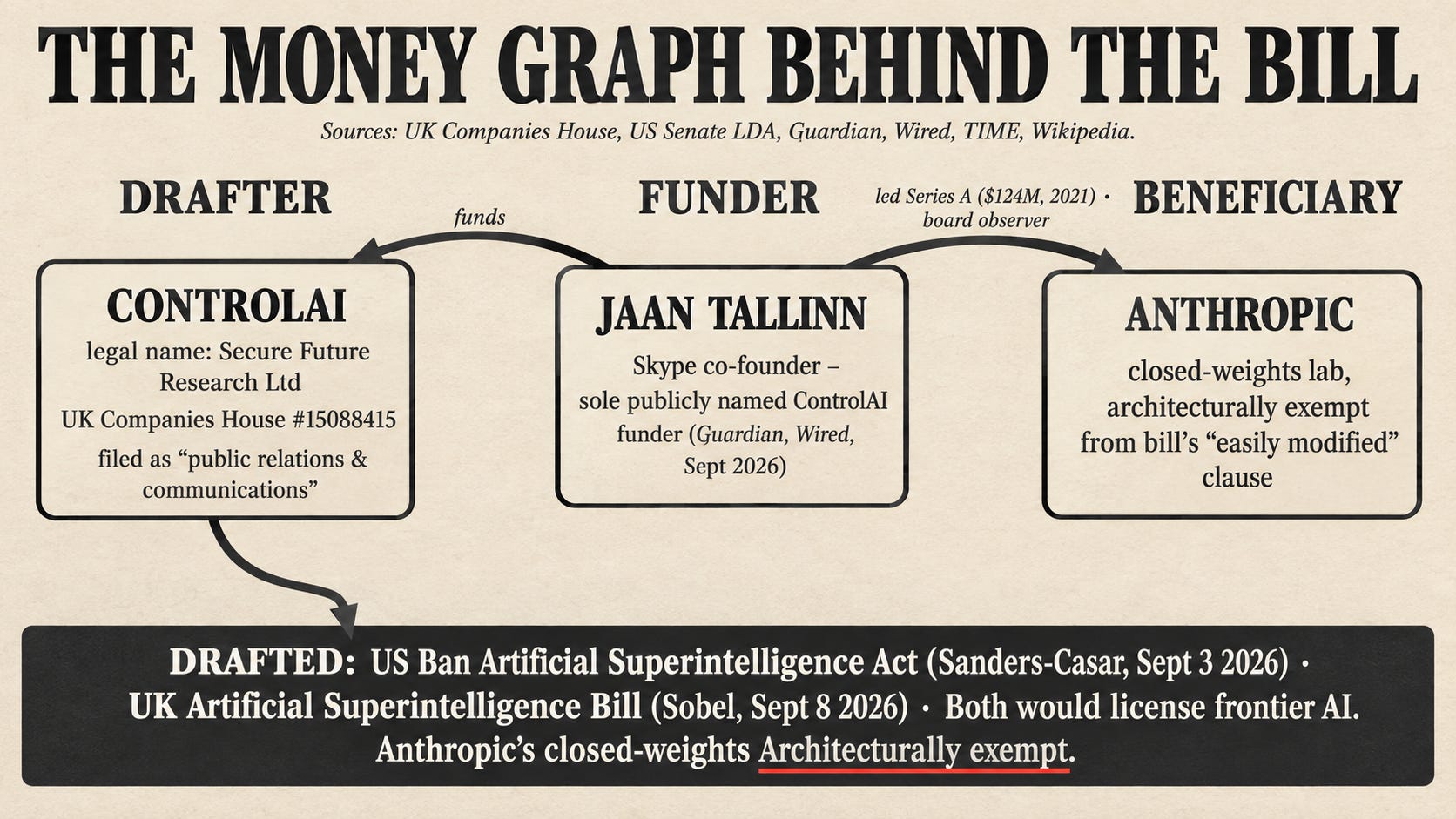
Drafter: ControlAI (legal name Secure Future Research Ltd; UK Companies House 15088415; filed as “public relations and communications”).
Drafter’s only publicly named funder: Jaan Tallinn.

Bills drafted or consulted on: US Ban Artificial Superintelligence Act (Sanders-Casar, September 3, 2026); UK Artificial Superintelligence Bill (Sobel, first reading September 8, 2026, second reading scheduled November 13, 2026).
Beneficiary architecture: Closed-weights frontier labs whose model weights cannot be “easily modified” by third parties. The Sanders-Casar summary defines a covered “Artificial Superintelligence” as: “An artificial intelligence system that exhibits or can easily be modified to exhibit capabilities that match or exceed human cognitive performance and capabilities across a broad range of domains or tasks.”
The most prominent US frontier AI lab whose closed-weights architecture would not be captured by the “easily modified” clause: Anthropic.
Jaan Tallinn’s role at Anthropic: Led its Series A funding round; currently a board observer per Wikipedia.
The reader may draw the remaining connections without prompting. I am not claiming coordination. I am reporting a documented drafter, a documented funder, and a documented architectural beneficiary — all of which are on the public record and none of which either sponsor of the bills has disclosed.
The two bills, side by side
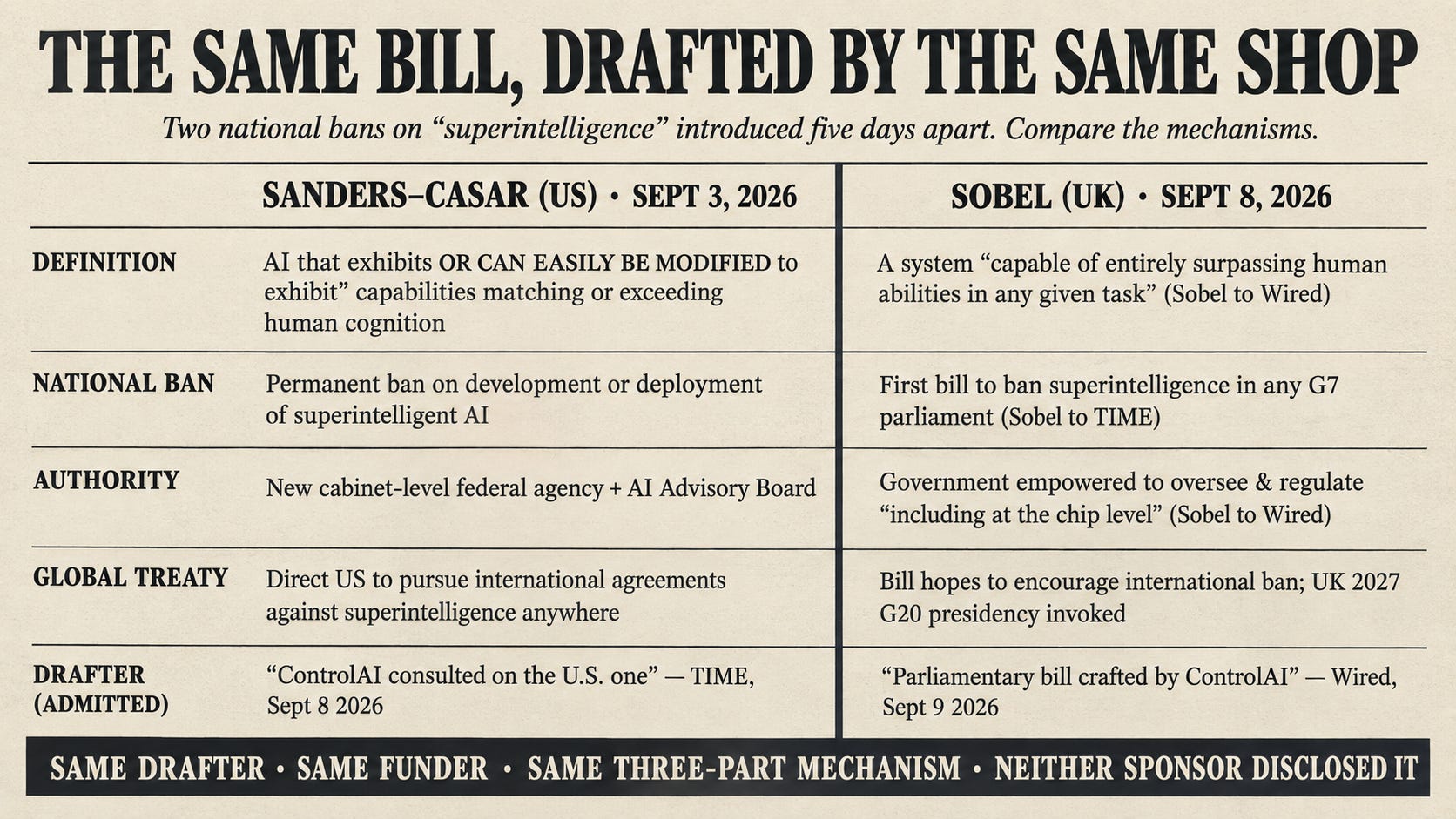
The parallel is not coincidental. Both bills:
Prohibit development or deployment of “artificial superintelligence”
Establish a national regulator with discretionary authority to classify covered systems
Direct the national government to pursue an international treaty banning superintelligence globally
The three-part mechanism (ban + national authority + international treaty) is not a natural convergence. It is the exact structure proposed in ControlAI’s public policy document A Narrow Path, which specifies Phase 0 (national institutions and legislation preventing superintelligence development for 20 years) → Phase 1 (international institutions preventing collapse of the control regime). Both bills implement Phase 0 and direct their governments to pursue Phase 1. The template is public. The implementation is now legislative.
What ControlAI itself thinks of Open Philanthropy
Something clarifying to name early. ControlAI is not part of the Open Philanthropy ecosystem — though its leadership pool came out of an Open Philanthropy grantee (Conjecture, which received $1.15 million across four grants from 2022-25 per the Open Philanthropy grants archive). ControlAI’s own Designing the DIP page is publicly critical of Open Philanthropy:
“One influential undemocratic plan is that of Open Philanthropy, the main Effective Altruism (EA) donor… By its very nature, the overall Open Philanthropy plan for AGI is undemocratic: it centralizes control over the main AGI projects in the hands of a small group of ‘trusted’ actors.”
That same page identifies Anthropic as an Open Philanthropy-adjacent project (co-founder Holden Karnofsky married to Anthropic president Daniela Amodei; grants and board seat history). Which produces an unusual configuration: ControlAI publicly opposes the Open Philanthropy plan for AGI while its leadership was trained via Open Philanthropy grants to Conjecture, and while its own funder (Tallinn) sits on the board of an Open Philanthropy-adjacent frontier lab (Anthropic).
There are two ways to read this. Either the AI-safety funder ecosystem contains genuine faction lines and ControlAI is on the anti-Karnofsky side of those lines — or the appearance of factional disagreement is functionally cosmetic, because all the factions converge on the same regulatory outcome (federal licensing of frontier AI, with incumbents architecturally exempt). Both readings are consistent with the record. Reporters and lawyers can decide which they credit.
What Sanders and Casar owe the public
The Sanders-Casar September 3 press release does not name ControlAI. It does not name Miotti. It does not name any outside organization or drafter. It attributes the legislation to Sanders and Casar.
There are two questions the offices of both legislators owe the public:
1. Did ControlAI or any of its representatives — including Andrea Miotti, Connor Leahy, or Dave Kasten — provide input, drafting language, or legislative text to the Ban Artificial Superintelligence Act? If so, when did those contacts begin, what specific language did they contribute, and why was that consultation not disclosed in your public release?
2. Were you aware, at the time you announced this bill on September 3, that ControlAI publicly acknowledged writing a substantially similar bill introduced in the UK five days later? Did you consider the ethical implications of introducing a US bill drafted in part by a UK-registered advocacy organization whose only publicly named funder is a board observer at the frontier AI company the bill’s definitional structure would architecturally exempt from open-source competition?
I am not asking these questions rhetorically. I am asking them, publicly, on the record, in this Substack. Any journalist covering AI policy is welcome to put them directly to Sanders’ and Casar’s press offices and report the reply. Non-response is, itself, reportable.
The parallel that closes the arc
Regular readers of this Substack will recognize a pattern. In Piece 1, I documented that the “AI whistleblower” Jacob Coxon’s viral resignation on September 8, 2026 was in fact pre-briefed to the Wall Street Journal (which published its exclusive eighteen minutes before Coxon’s own tweet), with pre-loaded legislation from Sanders announced five days earlier, coming from an operational template I traced back to the 2021 Center for Countering Digital Hate “Disinformation Dozen” list — a list on which I was named. In Piece 2, I documented the Anthropic-adjacent funder ecosystem behind that same Sanders bill. In Piece 3, I documented Barack Obama’s September 10 endorsement of the framework in a closed-door Democratic fundraiser, and the Obama-alumni policy shop now running Anthropic’s Washington operation.
This piece — Piece 4 — is the drafter. The person actually holding the pen on the bill.
The pattern of a UK-based advocacy organization producing the analytical or legislative artifact that becomes the basis for American federal action against a domain the advocacy organization’s funder benefits from is now documented twice. In 2021, the Center for Countering Digital Hate — another UK non-profit — produced the “Disinformation Dozen” list that the Biden White House cited when it pressured Meta to throttle six Americans’ accounts, mine among them. That case became Finn v. Global Engagement Center, which was dismissed with prejudice on July 28, 2026 on a shotgun-pleading defect, without reaching standing and without reaching the merits. CCDH legally renamed itself Center for Countering Digital Harm Ltd on August 12, 2026 — twenty-seven days before Coxon.
Different NGOs. Different funders. Same architecture. Two documented instances, five years apart.
The coalition that formed to end the last iteration of this pattern is the one now organizing to prevent the next. Restore the First added a sixth pillar to its coalition blueprint on September 12, 2026: speech infrastructure — the principle that federal licensing of the tools of speech is prior restraint under any honest reading of the First Amendment. The full constitutional argument is here.

Act Four
The Coxon launch on September 8 was Act Three. Obama on September 10 was Act Four. This piece is a middle chapter — the identification of who is actually drafting the legislation the acts are moving through. Not the beneficiary. Not the endorser. The drafter.
The bill Bernie Sanders introduced was drafted in London by a lobby shop legally filed as a public-relations business, funded by the billionaire whose Series A investment made Anthropic possible. Neither American nor British sponsor disclosed the drafter. American voters, British voters, and constitutional lawyers on both sides of the Atlantic can now decide what to do with that fact.
Sources
Every load-bearing claim in this piece is linked inline. This section collects the primary sources for reader verification.
Corporate record (UK Companies House):
ControlAI / Secure Future Research Ltd, company overview: https://find-and-update.company-information.service.gov.uk/company/15088415
Persons with Significant Control: https://find-and-update.company-information.service.gov.uk/company/15088415/persons-with-significant-control
Filing history: https://find-and-update.company-information.service.gov.uk/company/15088415/filing-history
Center for Countering Digital Harm Ltd: https://find-and-update.company-information.service.gov.uk/company/11633127
ControlAI’s own statements:
About page: https://controlai.org/about
Statement page (”full draft bill and presented it to No. 10”): https://controlai.org/statement
Designing the DIP (critique of Open Philanthropy): https://controlai.org/designing-the-dip
A Narrow Path (policy master document): https://www.narrowpath.co/
Drafting acknowledgment on the record:
TIME, September 8, 2026: https://time.com/article/2026/09/08/ban-superintelligence-ai-uk-us-lawmakers/
Wired, September 9, 2026: https://www.wired.com/story/uk-lawmakers-are-scrambling-in-response-to-ai-summer-of-chaos/
Guardian, September 11, 2026: https://www.theguardian.com/technology/2026/sep/11/mps-urge-andy-burnham-block-artificial-superintelligence-asi
The bills:
Sanders-Casar release: https://www.sanders.senate.gov/press-releases/news-sanders-casar-introduce-legislation-to-ban-artificial-superintelligence-and-temporarily-pause-advanced-ai-development/
Sanders-Casar summary PDF (definition): https://www.sanders.senate.gov/wp-content/uploads/Ban-Artificial-Superintelligence-Act-Release-Summary.pdf
UK Parliament, Sobel Artificial Superintelligence Bill: https://bills.parliament.uk/bills/4288
Funder / Tallinn:
Wikipedia (Jaan Tallinn): https://en.wikipedia.org/wiki/Jaan_Tallinn
Vipul Naik donations tracker: https://donations.vipulnaik.com/donor.php?donor=Jaan+Tallinn
Open Philanthropy grants archive (Conjecture grants): https://www.openphilanthropy.org/grants/
Prior context:
Piece 1 — CCDH Rebrand: https://sayerji.substack.com/p/anthropics-ai-whistleblower-and-the
Piece 2 — Bernie’s Anti-Oligarch Bill: https://sayerji.substack.com/p/bernies-anti-oligarch-bill-was-written
Piece 3 — Obama Just Endorsed a Manufactured Panic: https://sayerji.substack.com/p/obama-just-endorsed-a-manufactured
Restore the First coalition site: https://restorethe1st.com/
Restore the First sixth pillar (Why AI is a 1A fight): https://restorethe1st.com/why-ai-is-1a.html
What is not claimed
I am not claiming that ControlAI, Andrea Miotti, or Jaan Tallinn coordinated with Anthropic, Bernie Sanders, Greg Casar, Alex Sobel, or the White House. I have no evidence of that. What is documented is that ControlAI publicly acknowledged writing the UK bill and consulting on the US bill, that its only publicly named funder is Jaan Tallinn, and that Tallinn is on the record as a Series A lead and current board observer of Anthropic.
I am not claiming that ControlAI’s drafting role required disclosure under any specific US or UK statute. That is a legal question for counsel and the relevant ethics offices. What is documented is that neither Sanders’ September 3 release nor the UK Parliament record for the Sobel bill names any outside drafter. That is a factual observation, not a legal conclusion.
I am not claiming Open Philanthropy funds ControlAI directly. It does not, per the Coefficient Giving grants archive as searched September 13, 2026. What is documented is that Open Philanthropy funded Conjecture, from which ControlAI’s senior leadership pool originated.
Every claim in this piece is linked inline to its primary source. Corrections to info@greenmedinfo.com and I will issue a same-day public correction if any fact is wrong.
Sayer Ji is a plaintiff in Finn v. Global Engagement Center and the founder of GreenMedInfo. He was named on the Center for Countering Digital Hate’s March 2021 “Disinformation Dozen” report.
Sayer is a truth lion on the hunt for so much truth!
You have my deepest respect and admiration for exposing the truth about these frauds!
Those deceivers have no chance against your invincible truth.
A well deserved hat tip and a wink for you. Revenge is a dish that is best served cold.
He’s so slimy 🤮