

The released file shows how USAID’s lawyers navigated the Missouri v. Biden injunction — the safeguards they wrote, the contacts they cleared to resume, and the question only Congress can now answer: was the guidance followed?
Story at a Glance
Among the 248 USAID Files is a 19-page compilation of internal talking points and General Counsel guidance notes — drafts, with repetitions and comments, spanning 2023–2024 — on how agency staff should operate during Missouri v. Biden, the litigation over government pressure on social-media platforms.
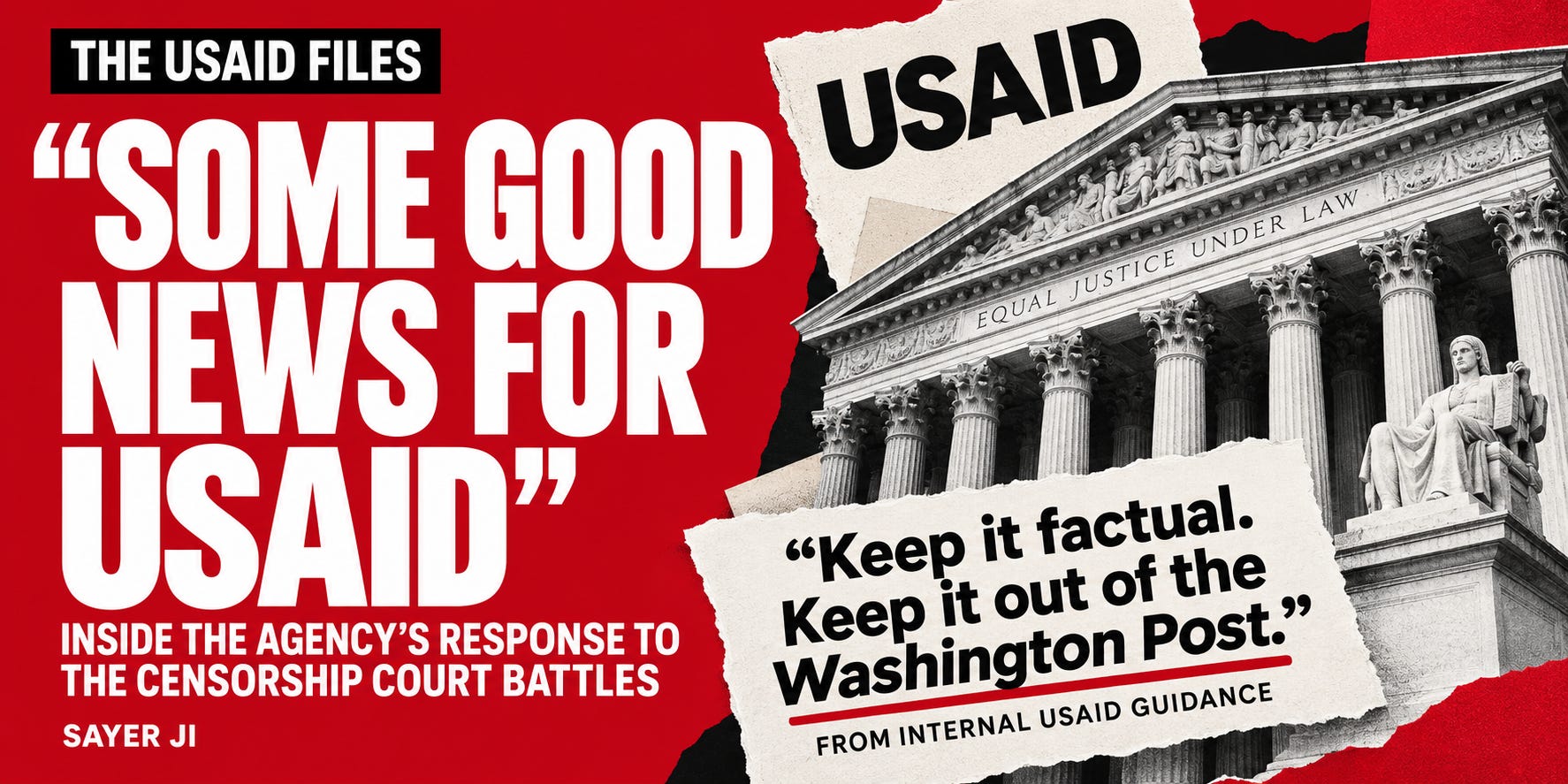
One line has gone viral: staff advised to avoid “buzzwords” in written notes and to “Keep it factual. Keep it out of the Washington Post.”
The fuller record is more consequential. When the Fifth Circuit narrowed the injunction in September 2023, the internal summary called it “some good news for USAID”: the agency was “no longer prohibited from engaging in activities touching on content moderation in concert with State.”
After the Supreme Court resolved Murthy v. Missouri on standing in June 2024, staff asked whether the guidance still applied. The lawyers’ written answer: “No change for now. Continue to follow the guidance” — and, elsewhere: for activities not involving content moderation, “it is largely business as usual.”
The file documents legal clearance and communications strategy. What it does not document is conduct: what was actually said to platforms afterward, what was requested, and what happened to the content. Those records exist — and Congress can demand them.
Two legislative vehicles are relevant: the GRANITE Act (H.R. 10174 / S. 5478), which targets foreign censorship enforcement, and proposals for an express statutory remedy for federally pressured censorship, including the introduced JAWBONE Act (S. 4749) and Restore the First’s model First Amendment Remedies Act. The 119th Congress ends January 3, 2027.
1. What the file is — and what it is not
The document sits on usaid.gov, released as part of the USAID Files. It is not a single, final memorandum: it is a compilation of draft talking points and guidance notes, repeated in places, with internal comments, prepared for congressional-facing staff (”the committee folks”) as Missouri v. Biden and a House Judiciary investigation unfolded. Its contents concern 2023 and 2024; the release is current, but the records do not establish what the agency’s successors are doing today.
One point of precision the viral coverage has missed: USAID was not itself named in the injunction. The file says so directly — “USAID was not named in the injunction, but its activities were impacted in certain circumstances, such as when USAID collaborated on activities with the State Department or other federal agencies named in the injunction.” What the file documents is how a non-enjoined agency, working alongside enjoined ones, lawyered its way through the restrictions.
Disclosure of my own stake: I am one of the twelve people named in the “Disinformation Dozen” — the list a federal district court found was followed by White House pressure and platform enforcement — and I was a plaintiff in Finn v. Global Engagement Center. The sworn record of how that list entered the government is published separately. Weigh what follows accordingly.
2. What changed as the court restrictions changed
The file tracks three moments, in its own words.
July 2023 — the injunction lands. Judge Doughty’s preliminary injunction prohibits named agencies from “urging or pressuring social media companies to remove or suppress ‘protected free speech.’” USAID, though unnamed, receives State and GC guidance for any activity touching the enjoined agencies’ space.
September 8, 2023 — the Fifth Circuit narrows it. The appellate court found the injunction “vague and overbroad,” vacated most of it, and confined it to the White House, the Surgeon General, the CDC, and the FBI. USAID’s internal summary: “This was some good news for USAID because it meant the agency was no longer prohibited from engaging in activities touching on content moderation in concert with State.”
June 2024 — Murthy is decided. The Supreme Court held the plaintiffs had not established standing for the injunction they sought — they had not sufficiently connected a substantial risk of future platform restrictions to particular government defendants. The Court did not decide the First Amendment merits, and it criticized aspects of the lower courts’ factual and causation analysis, calling some findings into question. Inside USAID, staff asked whether the GC FAQs still applied. “The answer? No change for now. Continue to follow the guidance. There are other cases still pending before the supreme court regarding USG interactions with social media companies. If there are any changes we will let you know.”
Read precisely, that instruction preserved the existing guidance — including its restrictions. It is not, by itself, proof that anything unlawful continued. What it establishes is narrower and still significant: platform engagement resumed under legal clearance, with “largely business as usual” for non-moderation work, and the agency’s posture toward the court battles was navigational, not reformative. Whether officials complied with their own safeguards is a separate question — the question.
3. What the lawyers told staff to do
The guidance has two faces, and honesty requires showing both.
The safeguards. “Due to first amendment legal considerations, any USAID work in this space must be viewpoint neutral... People are allowed to say bad things about USAID and its work. People are allowed to speculate about the USG’s motivations even if they are wrong. USAID cannot make decisions based on viewpoints of the speaker.” And: “USAID cannot tell social media and tech companies what to do or how to spend their money.” These are correct statements of constitutional law, in writing, circulated to staff. They now form the standard against which the agency’s actual conduct can be tested.
The communications advice. “Keep it factual. Keep it out of the Washington Post.” Avoid “buzzwords, especially in CNs and consult notes because it is likely to result in follow up questions and holds.” “No DOD-style threat language that suggests ordinary citizens are a threat.” And for platform meetings: if the conversation “veers toward discussions about having specific posts or content removed, retained, posted, or promoted, USAID should redirect the conversation... redirect or table anything that is potentially a landmine or complicated.”
I will not claim to know the authors’ intentions, and preventive guidance can warn against conduct that never occurred. But the advice raises a documented, answerable question: if substantive platform discussions were steered away from paper and toward “general issues or trends,” how were they documented — including conversations conducted by phone? Congress can compare the written safeguards with the records of what was actually requested, and with what the platforms subsequently did. The public needs that comparison to know whether the safeguards were honored or merely filed.
4. What remains unproven — the records Congress should demand
The file establishes legal clearance and communications strategy. It does not establish implementation. The missing record — the one that would turn questions into findings, in either direction — consists of:
USAID’s platform contacts after September 2023 and after Murthy: who initiated them, what was discussed, what was requested;
how undocumented or lightly documented discussions (calls, “redirected” conversations) were memorialized, if at all;
platform responses and any resulting moderation, demonetization, or ranking decisions;
the same records for activities run “in concert with State,” where the injunction’s reach applied.
The same evidentiary standard applies to the week’s other viral document: the UK-based Global Disinformation Index’s August 2022 concept note proposing a USAID pilot — defunding, downranking, and deplatforming in Moldova, Zambia, and Armenia. A proposal received is not a proposal approved, funded, or implemented; no released document shows USAID adopted it. The follow-on correspondence is precisely what a records demand — or a FOIA — can surface. (The wider British dimension — CCDH, the UK Counter Disinformation Unit’s 2021 briefing of the NSC, GDI’s UK Foreign Office funding — is documented in my separate investigation and on the Targeting Tracker; this article stays with the USAID file.)
5. Why the court cases left the questions unresolved
Three dispositions, stated precisely, because precision is what makes the accountability argument land:
Murthy v. Missouri (2024): reversed and remanded on standing. The merits were never decided. The Court also criticized parts of the lower courts’ factual analysis — so the district court’s findings cannot be cited as judicially settled fact, and I do not cite them that way. What survives is the underlying documentary record itself: depositions, emails, and productions that anyone can read.
Egbert v. Boule (2022): foreclosed Bivens damages actions for First Amendment retaliation by federal officers. It did not eliminate all relief — nonmonetary challenges to agency action remain available in qualifying cases — but it removed the damages deterrent for this class of violation.
Finn v. Global Engagement Center (2026): our complaint was dismissed with prejudice for pleading defects, after an opportunity to amend; the court held the defects prevented it from reaching even the threshold standing question. It did not decide the censorship allegations.
None of these cases vindicated the government’s conduct, and none validated every allegation against it. Together they mean something narrower and more actionable: the existing doctrines — standing for prospective relief, the absence of a statutory damages remedy, and plaintiffs’ lack of access to the evidence held by the government — have so far prevented any court from reaching the merits. That is an evidence-and-remedies gap, and it is Congress’s to close.
6. What Congress should do
First, the records. Congress should require a documented accounting of USAID’s platform contacts in 2023–2024: who made them, what was requested, what happened afterward, and whether the agency followed its own written safeguards. Where the file says conversations were to be “redirected,” Congress should ask what was discussed after the redirect. Put the guidance beside the conduct, and let the public judge the record.
Second, the remedies. Americans seeking redress face identifiable obstacles: prospective relief requires a concrete, traceable threat of future injury; Egbert forecloses Bivens damages for First Amendment retaliation; and the proof needed to establish traceability sits in government files plaintiffs cannot reach. The legislative answers on the table:
The GRANITE Act (H.R. 10174 / S. 5478) — addressed to the foreign layer: blocking U.S. enforcement of qualifying foreign censorship judgments, orders, and demands, and giving affected Americans a path to have them declared unenforceable.
The JAWBONE Act (S. 4749, as introduced) — addressed to the domestic layer: federal coercion of speech intermediaries, with cause-of-action and communication-record provisions in its introduced text.
Restore the First’s First Amendment Remedies Act — a model discussion draft seeking introduction: an express statutory damages remedy for proven federal speech violations, with the records-preservation and notice provisions that would make the next “keep it out of the Washington Post” memo a liability rather than a strategy.
The 119th Congress ends January 3, 2027. The file gave the country the government’s own words: “some good news for USAID,” “no change for now,” “largely business as usual.” The question those words leave open — was the guidance followed? — has a documentary answer sitting in federal records right now. Tell your lawmakers to demand it.
Sayer Ji is the founder of GreenMedInfo.com, co-founder of Stand for Health Freedom, and was a plaintiff in Finn v. Global Engagement Center. Primary documents: USAID injunction talking points · GDI–USAID concept note · Targeting Tracker.