

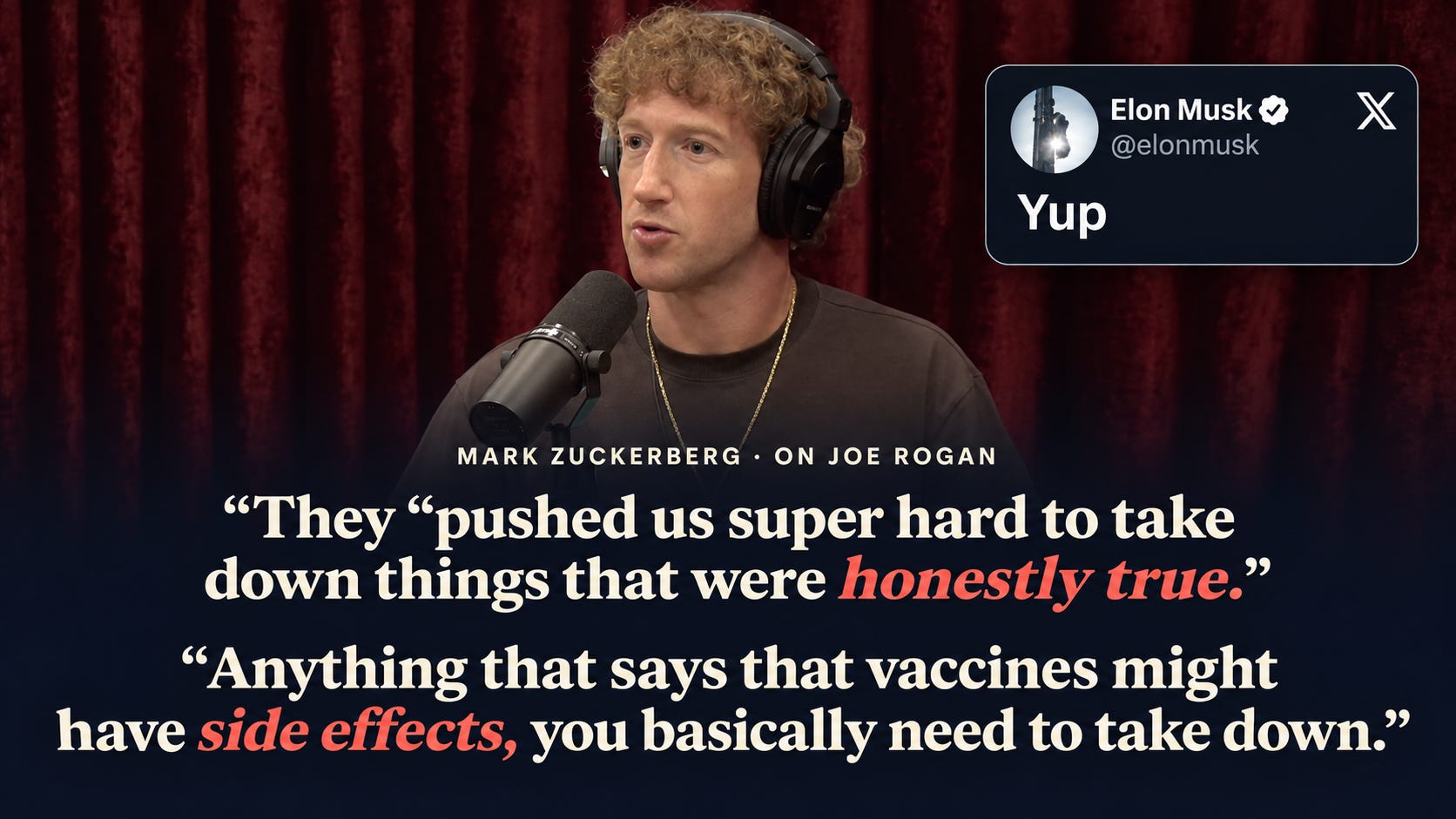
Mark Zuckerberg admitted the government made Meta delete true speech — sixty-one days after the Supreme Court ruled the people it was deleted from had no standing to sue. The admission is not the scandal. The timing is.
The admission is on the record. The remedy is not. restorethe1st.com
Disclosure: I am one of the twelve Americans the Center for Countering Digital Hate named in its 2021 “Disinformation Dozen” report, a plaintiff in Finn v. Global Engagement Center, and the founder of Restore the First. I have a personal stake in this story. Every claim below is tied to a recording, a filing, or a document you can check yourself.
Story at a Glance
On 26 August 2021, Facebook’s own misinformation policy lead told a Stanford conference the company had looked into the case against the twelve named Americans and was not sure it held up, and put us at 0.05% of all views of vaccine content. Then: “All that said, we have taken action against these people.”
On 8 June 2022, Egbert v. Boule foreclosed damages against federal officers.
On 26 June 2024, Murthy v. Missouri held that the censored plaintiffs had not established standing.
Sixty-one days later — 26 August 2024, three years to the day after that Stanford panel — Zuckerberg wrote to the House Judiciary Committee describing the pressure campaign.
On 10 January 2025 he said it plainly on The Joe Rogan Experience.
This November, Meta began removing posts again — hours after a Guardian article catalogued the exact posts.
Congress has both fixes in front of it. It adjourns 3 January.
What a confession is worth depends entirely on when it arrives

View and share this viral tweet on X.
There is a kind of admission that costs the person making it nothing. It arrives after the statute has run, after the court has closed, after the only people who could have used it have been told they have no standing to walk through the door. It is true. It is on the record. And it is safe.
Call it the safe confession. Once you can see it, you cannot stop seeing it.
Nobody has handed me a document showing this was agreed in a room, and I will not invent one. But a calendar is evidence too, and this one runs in a single direction: the words arrive after the doors shut. A confession costs nothing once no one can bill you for it. That is the whole problem, and the only people who can fix it work in the Capitol.
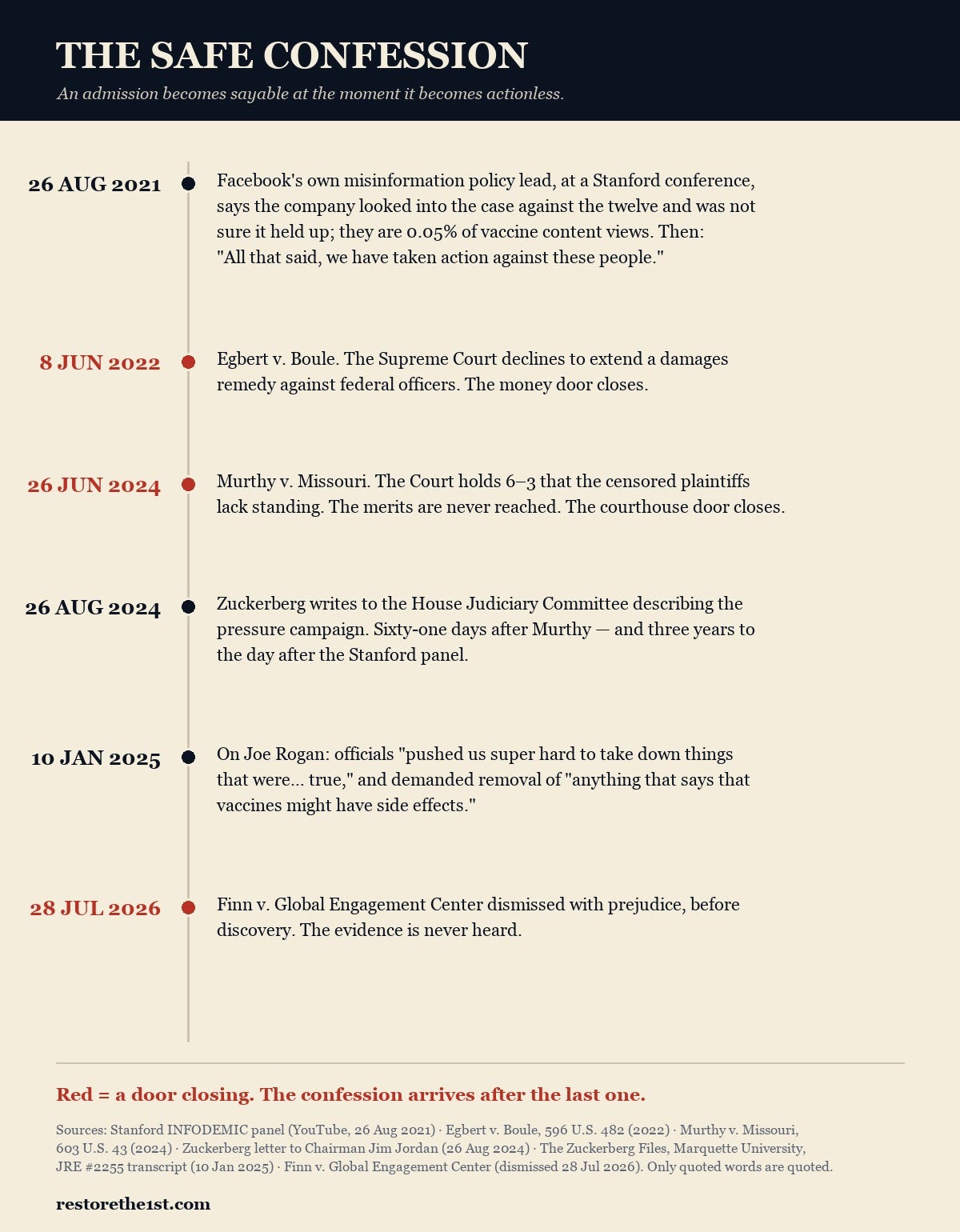
Red marks a door closing. The confession arrives after the last one.
First, the part that is not contested at all
On 26 August 2021, Facebook sent Aaron Berman, a lead on its misinformation policy team, to INFODEMIC, a Stanford conference on COVID-19 misinformation. Someone asked about the Disinformation Dozen. His answer ran under a minute. Stanford put the whole thing on YouTube, where it has sat ever since.
He said Facebook had looked into the claim against the twelve of us and was not sure it held up. He gave the company’s own measurement: the twelve accounted for 0.05% of views of vaccine-related content, true or false. Then he said this:
“All that said, we have taken action against these people.”
“All That Said”: What Facebook’s Misinformation Policy Lead Admitted About the Disinformation Dozen

At a 2021 Stanford conference, Facebook’s misinformation policy lead said there was no consensus behind the case against the twelve, and that they accounted for 0.05% of vaccine-content views. Then he defended removing them anyway. Here is the full transcript, and what the company’s own files show.
Author’s analysis. Read the order of those clauses again. The doubt comes first. The number comes second. The removal comes third, introduced by a phrase that exists to set aside everything before it. This is not a company misled by someone else’s bad data. It is a company stating its own findings at a university conference, on video, and then acting against them. Five years later, a feature film called Social Reckoning, which failed miserably at the box office, and the people who built that list are telling the public Facebook should have done more.
Then the doors closed, one at a time
Three routes to a remedy. All three closed between 2022 and 2026.
An American censored through government pressure has, in principle, three ways to be heard: sue for damages, sue to stop it, or get the facts into discovery. Between 2022 and 2026, each route was shut.
8 June 2022 — Egbert v. Boule. The Supreme Court declined to extend a damages remedy against federal officers. No money, no matter the violation.
26 June 2024 — Murthy v. Missouri. The Court held, 6–3, that the plaintiffs — states and five censored individuals — had not established standing. The merits went unreached.
28 July 2026 — Finn v. Global Engagement Center. Dismissed with prejudice on procedural grounds, before discovery. Our case. The evidence was never heard.
A federal judge had already found, in the litigation that produced Murthy, that the pressure campaign “had its intended effect,” and that “all twelve members… were censored.” Hold those two facts side by side. A court has found that we were censored. No court will give us a remedy for it. The finding exists. The remedy does not.
And then, and only then, the confession
On 26 August 2024 — sixty-one days after Murthy, and three years to the day after the Stanford panel — Zuckerberg wrote to Chairman Jim Jordan of the House Judiciary Committee and described the pressure campaign in his own words.
On 10 January 2025, he put it less carefully, to Joe Rogan:
“They pushed us super hard to take down things that were… true. … They basically pushed us and said, anything that says that vaccines might have side effects you basically need to take down. And I was just like, well, we’re not going to do that.”
And on who was calling:
“These people from the Biden administration would call up our team and scream at them and curse.”

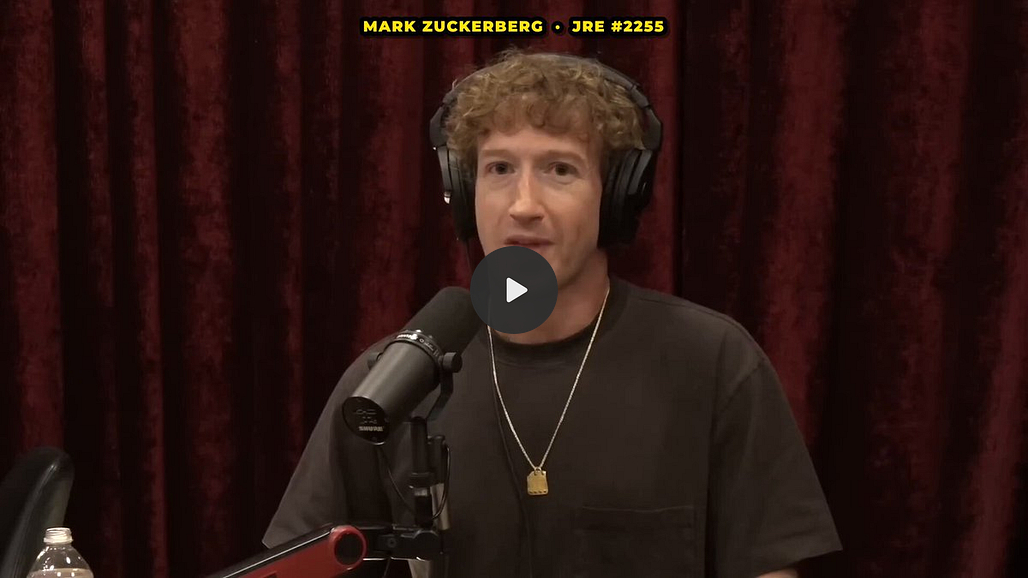
Both quotations are verbatim from the transcript archived in The Zuckerberg Files at Marquette University. The ellipsis in the first marks a spoken repetition, not an omission of meaning. I am flagging that because the cleaned-up version of this quote has circulated widely, including in my own posts, and anyone who pulls the transcript deserves to find the paraphrase acknowledged rather than defended.
Author’s analysis. I cannot tell you that Meta waited. I can tell you what the calendar says, and that the admission arrived into a world where it could not be used against anyone. In 2021, the same facts in a sworn deposition would have been evidence. In 2025, on a podcast, they were content.
It is not history. It restarted this month.
If the safe confession were only about the past, it would be a grievance. It is not.
Over twelve weeks this autumn, a sequence ran in public view. A Guardian reporter published claims about Robert F. Kennedy Jr.’s Senate testimony on 27 August; a senator called for a criminal investigation the same day, and the paper’s own headline recorded the trigger — “after Guardian report.” On 11 November, Senators Ron Wyden and Angela Alsobrooks sent Children’s Health Defense a records demand, six categories of documents, response due 4 December, citing that August reporting as its evidentiary basis. On 12 November the investigation became public, reported by the same byline that generated it. On 18 November at 12:13 p.m., that reporter published a review of CHD’s restored Facebook and Instagram accounts, catalogued specific posts as policy violations, and asked Meta on the record why they were still up. By that evening, Meta had removed them. On 19 November, the Guardian reported the removals its own article preceded.
The Circuit: How a Guardian Reporter, a Senate Letter, and Meta Closed a Loop Around RFK Jr.'s Former Nonprofit in Twelve Weeks

No conspiracy required. Censorship now has a workflow — and for twelve weeks this fall, it ran in plain sight.
Author’s analysis. Every link in that chain is a public document, and every actor can defend its own step as ordinary practice. That is what makes it durable. Censorship no longer needs a directive. It has a workflow. I documented the whole chronology here.
Why one word from Elon Musk did what five years of documents could not
On 27 November I posted Zuckerberg’s admission. Musk replied with one word: “Yup.” It has been seen roughly 2.6 million times. And is dominating three top trending X news topics simultaneously right now.
Nothing in that post was new. The Rogan interview was two years old. The Stanford video had been public since 2021. What the reply measured was not information. It was recognition — millions of people who already knew, confirming it to each other.
The same week, the USAID Files sent Americans into federal records on their own; X’s trending data recorded more than a million posts on the files in the first day. The Global Disinformation Index’s own August 2022 concept note describes a “Dynamic Exclusion List” of “the 2500+ worst offending disinformation sites,” “currently embedded in the systems of thirteen global ad tech companies,” targeting “adversarial narratives” rather than falsehoods. Not true or false. Adversarial.
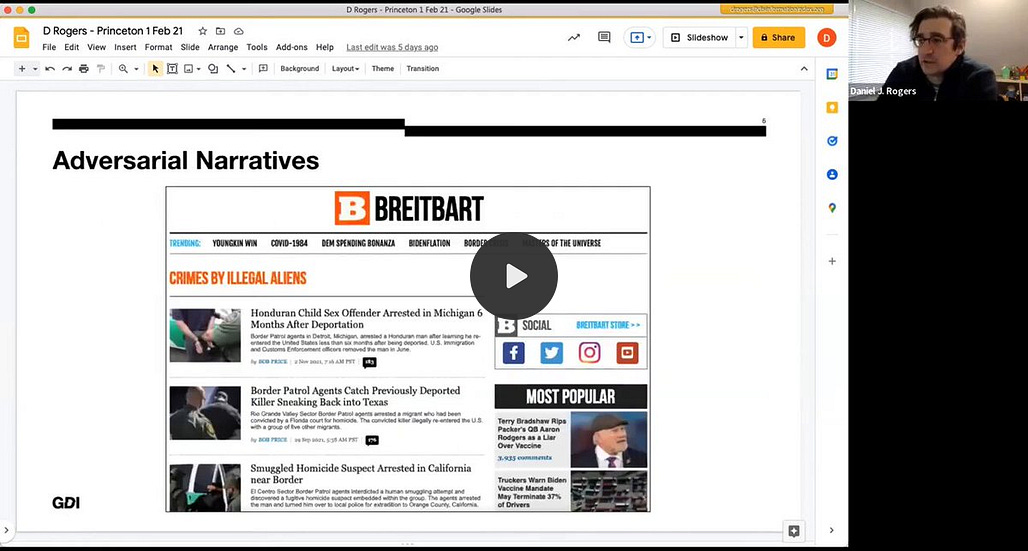
So the country is not confused about this. It is fed up. And fed up, by itself, has never restored anyone’s reach, reputation, or business.
What converts an admission into a remedy
Thirty-six days until this Congress adjourns.
This is the part I actually care most about, and the reason I am writing instead of posting.
An admission is evidence without a forum. A remedy is a forum with teeth. Three things turn one into the other, and all three are within this Congress’s power right now.
Put the harm on the record, with names. The reason Murthy turned on standing is that courts kept asking who, specifically, was injured and how. We are compiling first-person accounts for submission to the House Judiciary Committee in support of our demand for hearings. If you were censored, throttled, deplatformed, or demonetised, tell us what happened. Not as catharsis. As the answer to the question that sank the last case.
An express private right of action. When federal pressure suppresses protected speech, Americans should be able to go to court — with records retention, notice, and appeal rights attached. This is the fix that would have let Murthy, Egbert, and Finn be heard on their facts. Our model text is the First Amendment Remedies Act.
Pass GRANITE and HOMEFRONT. The GRANITE Act (H.R. 10174 / S. 5478) would bar American courts from enforcing a foreign government’s censorship order against an American; the HOMEFRONT Act (H.R. 10309) is built on the same design. GRANITE has one House cosponsor and none in the Senate. Both die when this Congress adjourns on 3 January. Read the bills.
I will not promise an outcome. Congress can create causes of action; it cannot override Article III, and I have learned not to tell people a courthouse is open when it is not. What I can promise is that an account given to us is recorded accurately, sourced, and placed in front of the committee with jurisdiction.
The ask
They admitted it. Whether that admission stays a podcast anecdote or becomes the first line of a hearing record depends on how many Americans put their names next to it in the next five weeks.
Two minutes: tell your censorship story. Then message your Representative and both Senators and ask for a private right of action and a vote on GRANITE.
Finally, share this post. After being globally deplatformed, the only reasons journalists and activist have remained standing, is because you BECAME the algorithm by sharing what is important to you with friends, families, colleagues, and your elected officials. Together We Rise!
The whole record — the documents, the funders, the twelve names, the misses we have published against our own interest — is at restorethe1st.com.
They tried to make us disappear. Let’s make ourselves impossible to ignore.
Awesome Sayer keep the truth shining! LOL
THAT little creep banned me for telling the truth - I wear that as a badge of honour and will NEVER return to his crap FB