

At a 2021 Stanford conference, Facebook’s misinformation policy lead said there was no consensus behind the case against the twelve, and that they accounted for 0.05% of vaccine-content views. Then he defended removing them anyway. Here is the full transcript, and what the company’s own files show.
Sayer Ji · On the Record
🧵View and share the X thread dedicated to this story.
Disclosure: I am one of the twelve people the Center for Countering Digital Hate (CCDH) named in its 2021 “Disinformation Dozen” report, a plaintiff in Finn v. Global Engagement Center, and the founder of Restore the First. I have a personal stake in this story. That is why every claim below is tied to a recording or a document you can check yourself.
On August 26, 2021, Facebook sent one of its misinformation policy leads to a Stanford conference on COVID-19 “misinformation.” Someone asked him about the twelve of us. His answer took less than a minute, and it deserves to be on the record word for word.
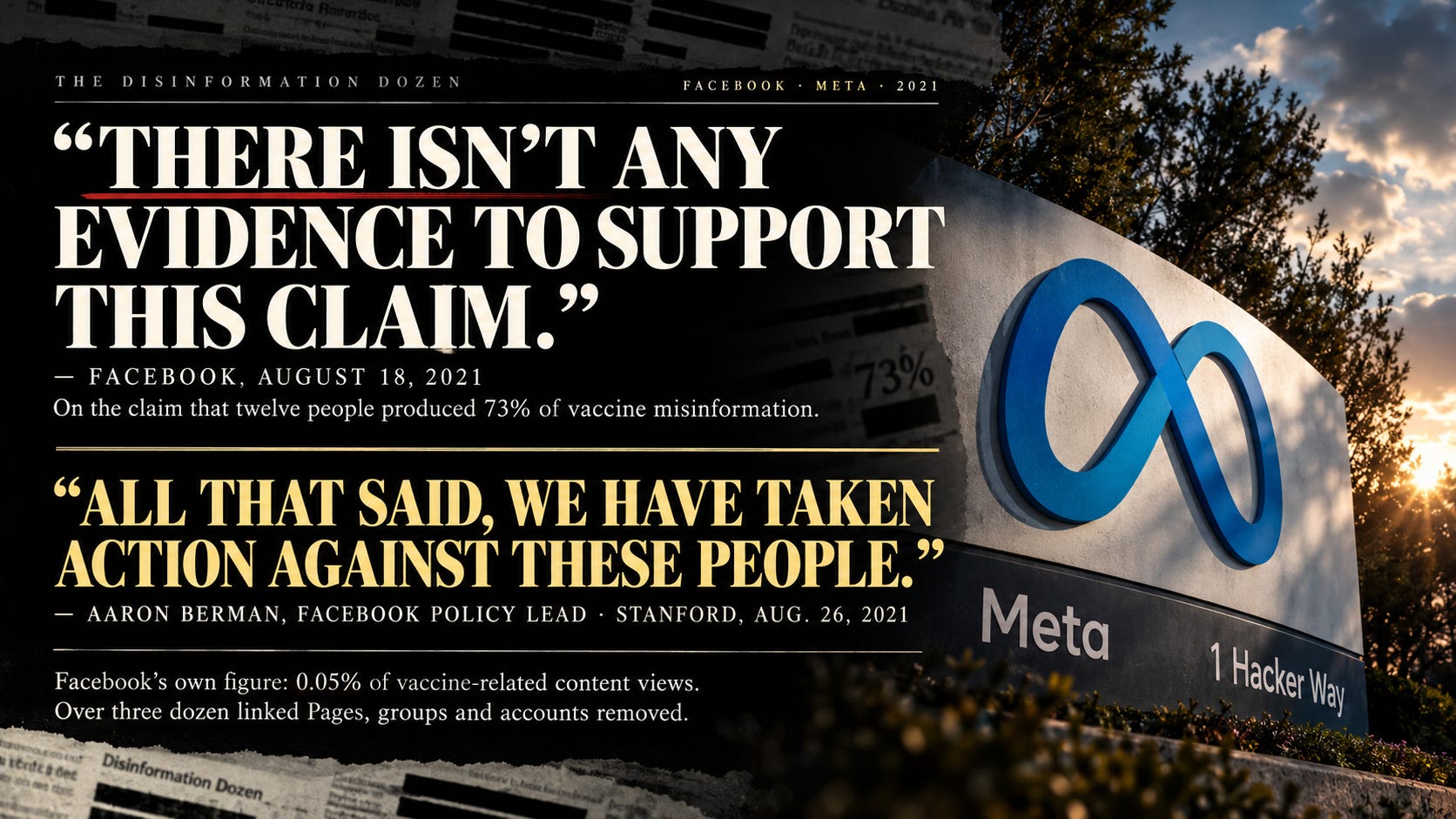
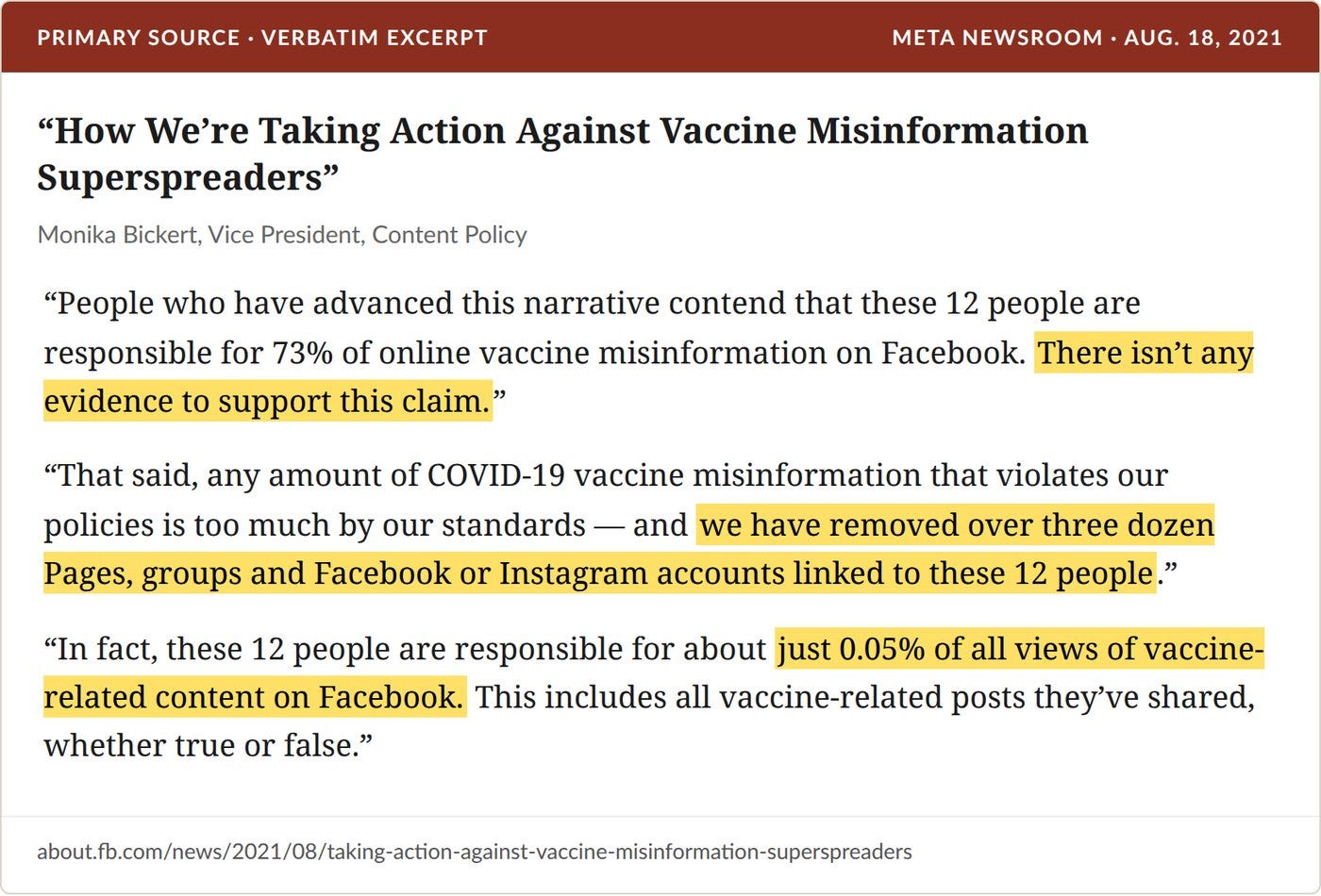
In that minute, he said Facebook had looked into the claim against us and wasn’t sure it held up. He said Facebook’s own measurement put the twelve at 0.05% of views of vaccine-related content, true or false. Then he said: “All that said, we have taken action against these people.”
Those three words, “all that said,” sum up what happened to us in 2021. The company knew the case against us was unsupported, said so publicly, and removed us anyway. Five years later, a Hollywood film and the people who built that case are telling the public Facebook should have done more.
Where and when he said it
The event was INFODEMIC: A Stanford Conference on Social Media and COVID-19 Misinformation, a virtual event sponsored by Stanford’s Ethics, Society, and Technology Hub and its Department of Emergency Medicine. Stanford posted the full recording on YouTube. The panel was “The Role of Social Media Companies,” with Aaron Berman of Facebook, Brian Clarke of Twitter and Anne Merritt, MD, of Google Search. Renée DiResta of the Stanford Internet Observatory moderated, according to the organizers’ published analysis of the conference.
Berman, according to his World Affairs Council biography, “leads a team managing misinformation policies at Facebook, with a focus on fact-checking policies.” The same biography says he previously worked at the Central Intelligence Agency, where he “wrote and oversaw intelligence analysis” on “influence operations, strategic communications, social movements, and terrorism.” The New York Post later reported that he spent 15 years at the agency and wrote for the President’s Daily Brief.
The full transcript
This is the complete exchange about the Disinformation Dozen, transcribed from the panel recording. Times refer to the panel’s audio file.
[27:53] Question to the panel: “Can any of you discuss the disinformation dozen as a case study of how your platform has or should respond to individuals responsible for significant disinformation?”
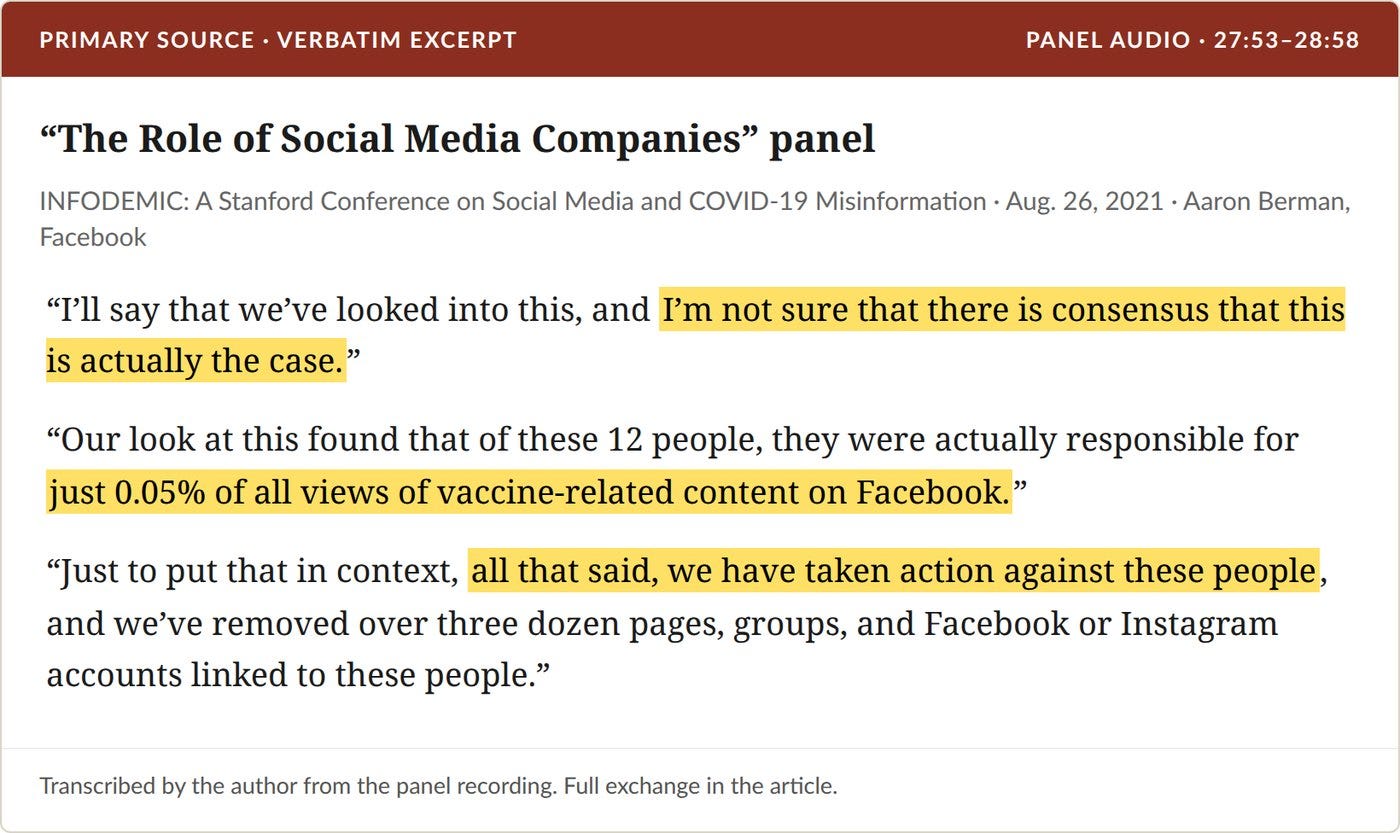
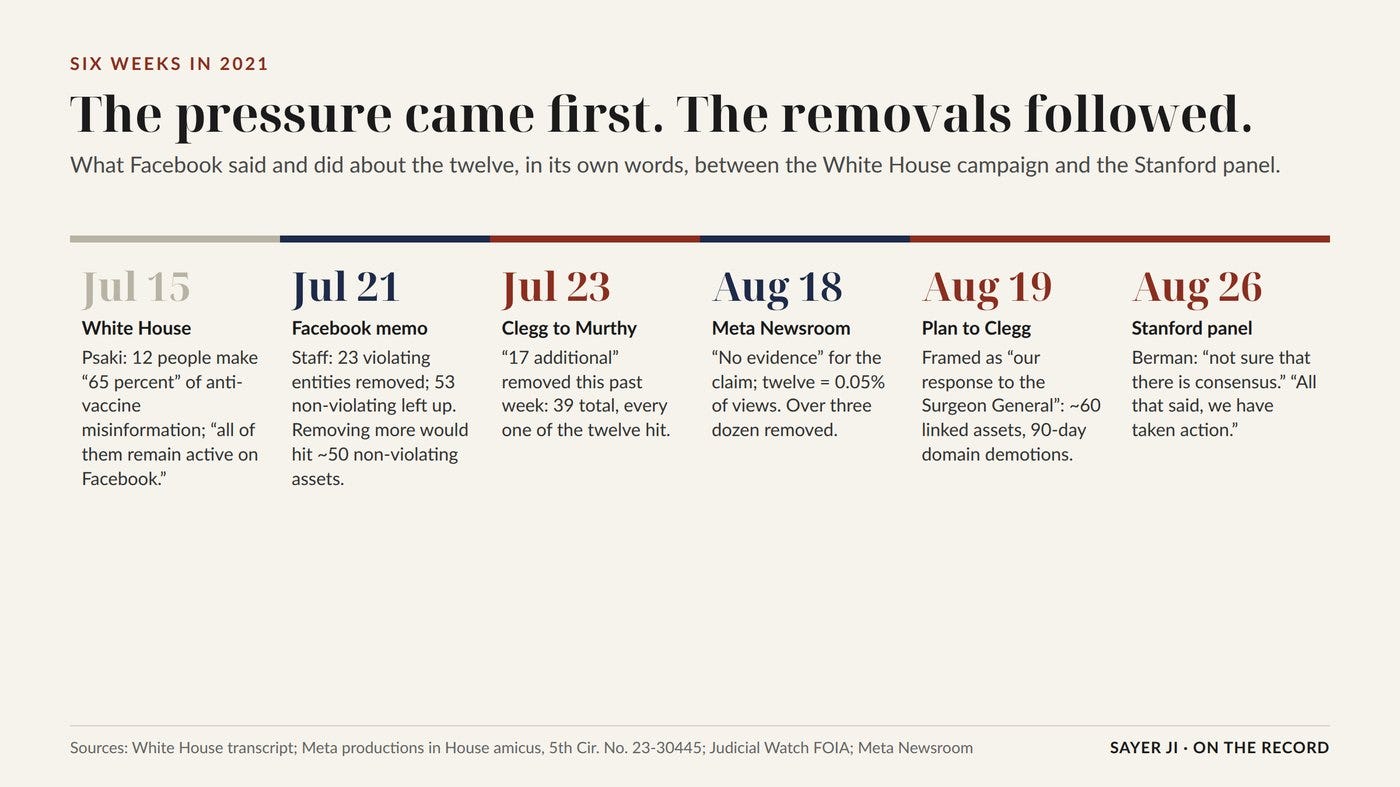
[28:04] Aaron Berman, Facebook: “So this is referring to a report that a certain 12 specific individuals are allegedly responsible for a large amount of misinformation about COVID-19. I’ll say that we’ve looked into this, and I’m not sure that there is consensus that this is actually the case. Our look at this found that of these 12 people, they were actually responsible for just 0.05% of all views of vaccine-related content on Facebook. So this includes vaccine-related posts they’ve shared, whether true or false, [and] links associated with those people as well. Just to put that in context.
“All that said, we have taken action against these people, and we’ve removed over three dozen pages, groups, and Facebook or Instagram accounts linked to these people. We’ve placed restrictions on other accounts related to them as well. And this is part of our strategy of ensuring that if people are posting misinformation that violates our policies, we remove it, and we remove those pages or accounts or groups that repeatedly post that content.” [28:58]
Twitter’s representative answered next. He said Twitter had taken “account level enforcement action on a number of the accounts identified,” and that “several of the tweets referenced predate our updated COVID-19 enforcement policy,” so Twitter didn’t act on them retroactively. Google’s representative said she wasn’t sure how Search had handled the case.
A few minutes earlier, the panel was asked, “How do you respond to the censorship narrative?” Berman answered first. Removal, he said, was for content health experts said was “false and leading to imminent physical harm.” For everything else, Facebook had “other approaches”:
“…where we can reduce the distribution of content that experts have told us lead to vaccine hesitancy, could lead to vaccine hesitancy, but is important for people to engage with, where we can work with our fact-checking partners to find content to reduce its distribution and add labels, but not remove it.”
Aaron Berman, Facebook, Stanford INFODEMIC panel, 25:57–26:31
In plain terms, Facebook also cut the reach of content that no expert had called false, on the grounds that it might make people hesitate.
HOW THIS WAS TRANSCRIBED
The exchange was transcribed from the panel audio using two automated speech-recognition passes and a separate audio review, then compared against Facebook’s published statements. One passage is hard to hear: “vaccine-related posts they’ve shared, whether true or false.” That reading matches the wording of Facebook’s August 18, 2021 statement: “This includes all vaccine-related posts they’ve shared, whether true or false, as well as URLs associated with these people.” The bracketed “[and]” is added for readability. Where one automated pass heard “3,000 pages,” the higher-accuracy pass and Facebook’s published statement both say “three dozen.” Facebook’s separate figure of 3,000 refers to accounts, Pages and groups removed platform-wide since the start of the pandemic.
What he conceded
Berman’s answer conceded three things.
The premise was unsupported. Facebook had looked into the claim and wasn’t sure it held. His company had put it more bluntly eight days earlier: “There isn’t any evidence to support this claim” (Meta).
The real number was tiny. The twelve accounted for 0.05% of all views of vaccine-related content, and that figure counted true posts as well as false ones.
The removals happened anyway. “All that said,” Facebook had removed over three dozen of our pages, groups and accounts, and restricted others.
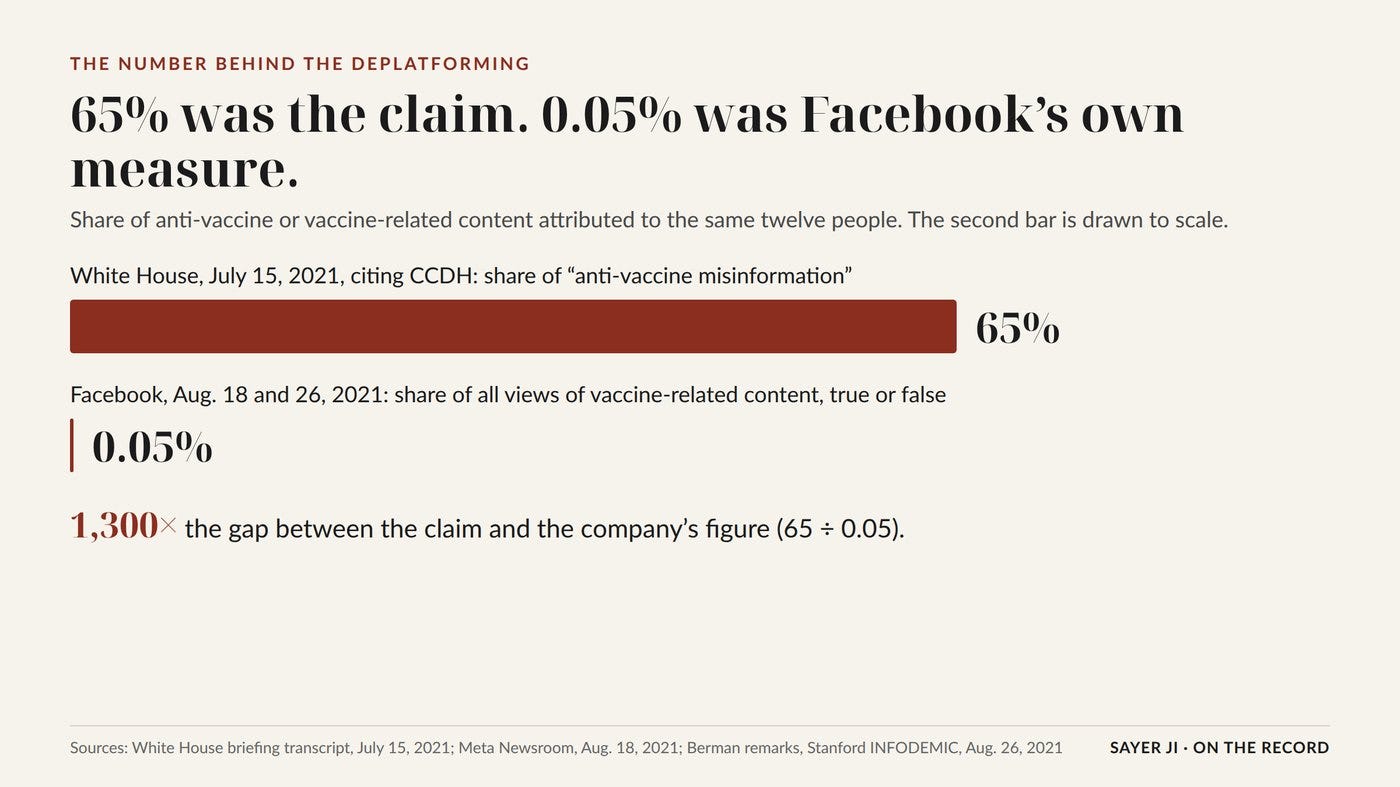
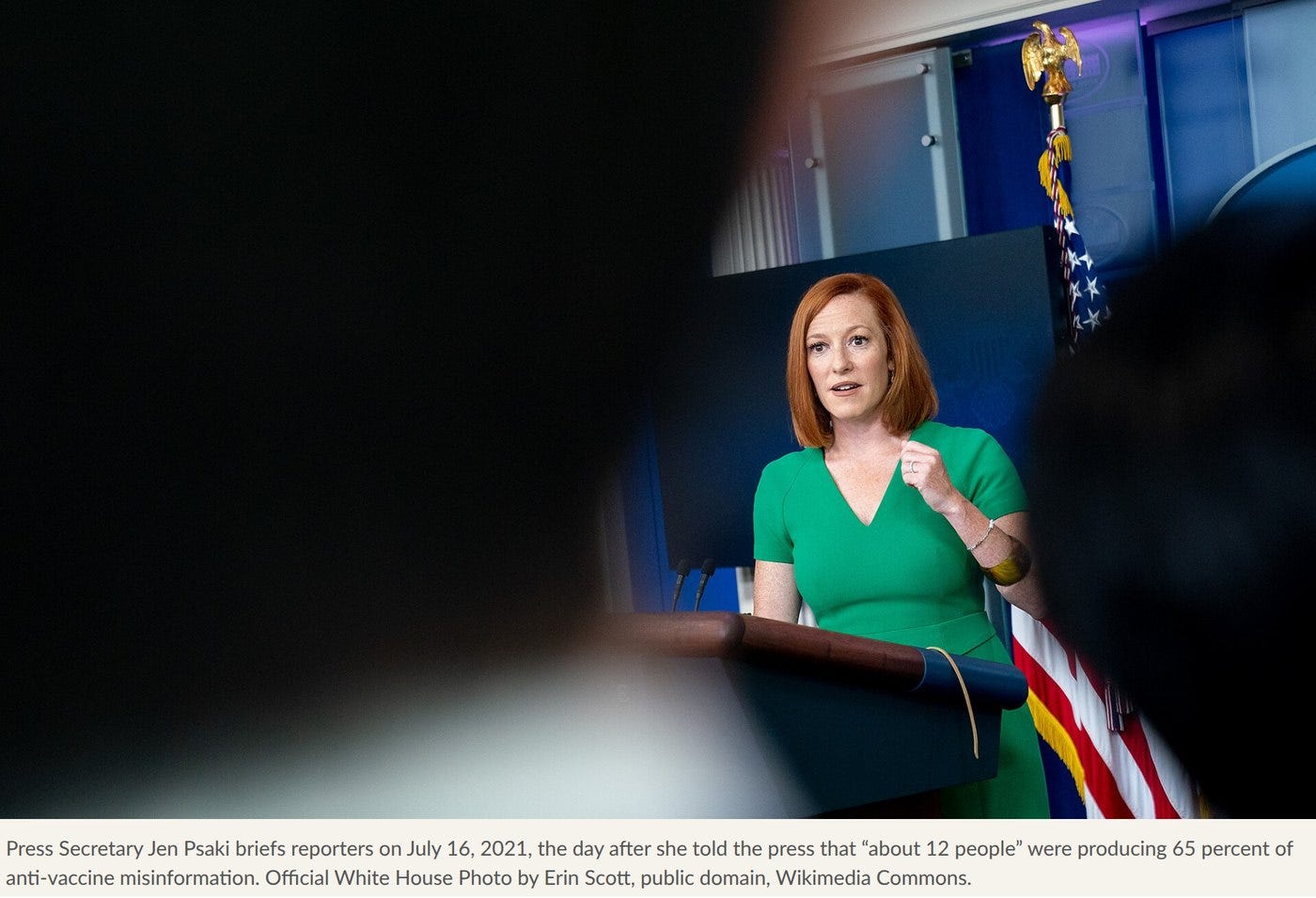
The claim Facebook was answering came from the White House podium. On July 15, 2021, Press Secretary Jen Psaki said: “there’s about 12 people who are producing 65 percent of anti-vaccine misinformation on social media platforms. All of them remain active on Facebook” (White House transcript). The figure came from CCDH’s report (CNN).
Sixty-five percent versus 0.05% is a 1,300-fold difference. The two numbers don’t measure exactly the same thing. CCDH’s figure covered content it classified as anti-vaccine in a small sample, while Facebook’s covered all views of vaccine-related content across the platform. That difference is the point: Facebook said CCDH’s sample of “483 pieces of content over six weeks from only 30 groups” was “in no way representative” of what people shared (Meta).
Subscribe to follow On the Record.
What Facebook knew before he spoke
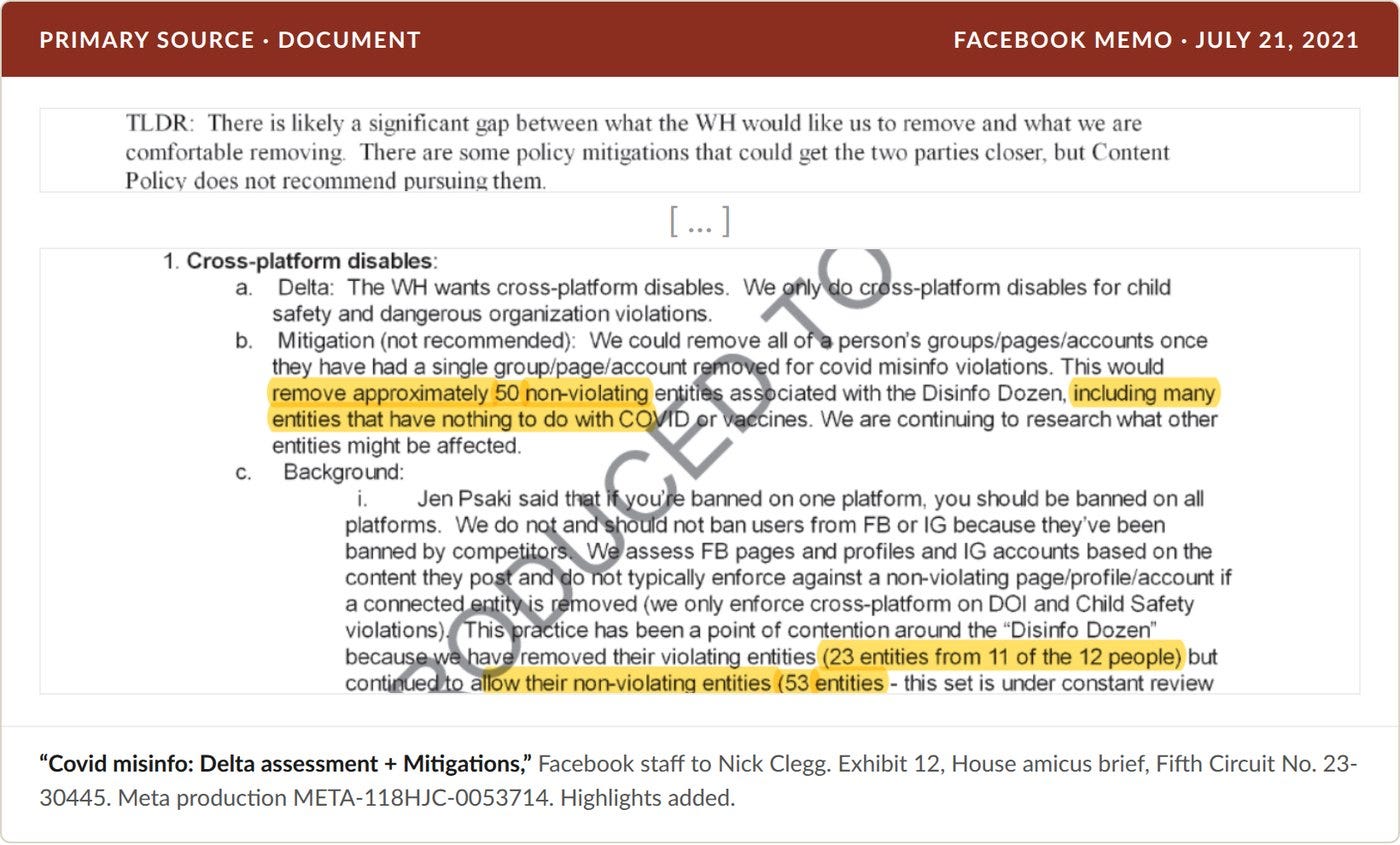
Berman’s answer wasn’t an improvised opinion. Five weeks earlier, his colleagues had put the same doubts in writing for Nick Clegg, then Facebook’s head of global affairs. Their July 21, 2021 memo, “Covid misinfo: Delta assessment + Mitigations,” was later filed as Exhibit 12 to a House Republican amicus brief in the Fifth Circuit (House amicus exhibits).
The memo opens with its conclusion: “There is likely a significant gap between what the WH would like us to remove and what we are comfortable removing.” On the twelve of us, it records that Facebook had already removed “23 entities from 11 of the 12 people” and “continued to allow their non-violating entities (53 entities).” The White House wanted cross-platform bans. Facebook’s staff warned that doing so “would remove approximately 50 non-violating entities associated with the Disinfo Dozen, including many entities that have nothing to do with COVID or vaccines.”
The same memo explains how the 65% figure could be reached at all: “To get to the claim that 65% of covid misinfo comes from the Disinfo Dozen, we assume the WH is complaining about non-violating content on FB.” In other words, the statistic only worked if it counted content that broke none of Facebook’s rules.
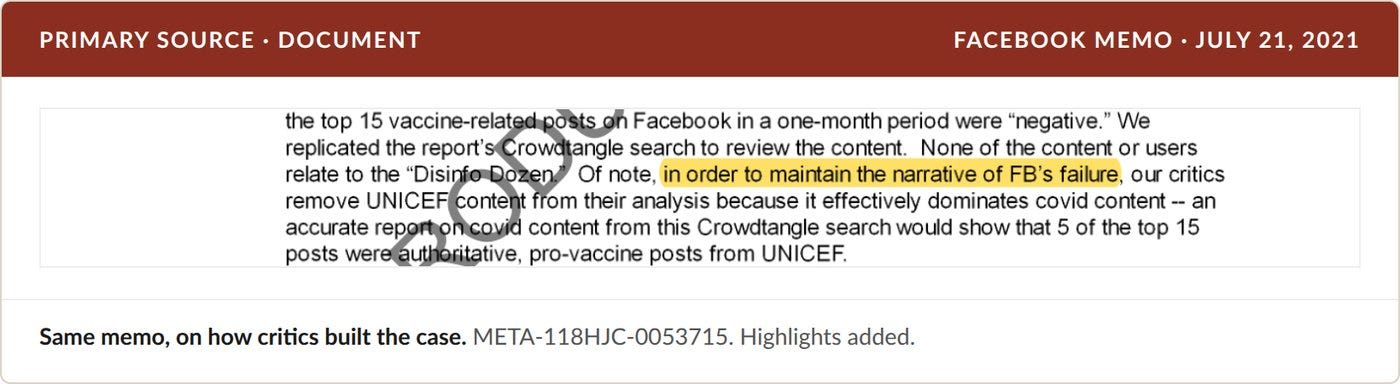
It also describes how critics trimmed data to build the case. When Facebook staff replicated one critical report, they found that “in order to maintain the narrative of FB’s failure, our critics remove UNICEF content from their analysis,” even though an accurate search “would show that 5 of the top 15 posts were authoritative, pro-vaccine posts from UNICEF” (META-118HJC-0053715).
And it confirms what Berman later described at Stanford, the suppression of true content. Under the heading “True information,” staff wrote that the Surgeon General “wants us to remove true information about side effects if the user does not provide complete information about whether the side effect is rare and treatable.” They added: “We currently label all of this content and demote some of it.”
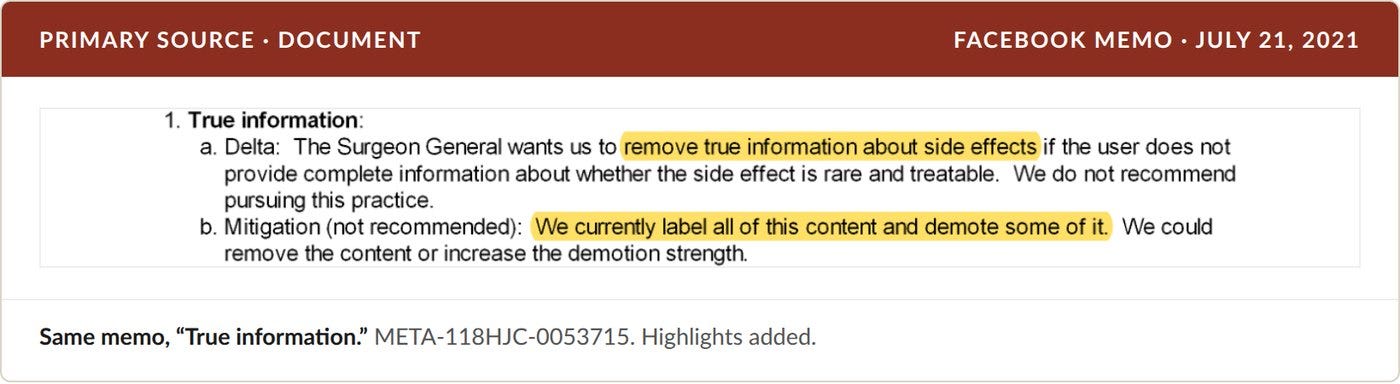
That evening Clegg forwarded the memo to Sheryl Sandberg. “What the WH appears to want us to remove ranges from humor to totally non violating chatter about vaccines,” he wrote. “I can’t see Mark in a million years being comfortable with removing that – and I wouldn’t recommend it” (META-118HJC-0053712).

Two days later, seventeen more
The public pressure peaked that week. On July 15, Psaki named the twelve as a group from the podium. The next day, according to the Fifth Circuit, the President said platforms were “killing people.”
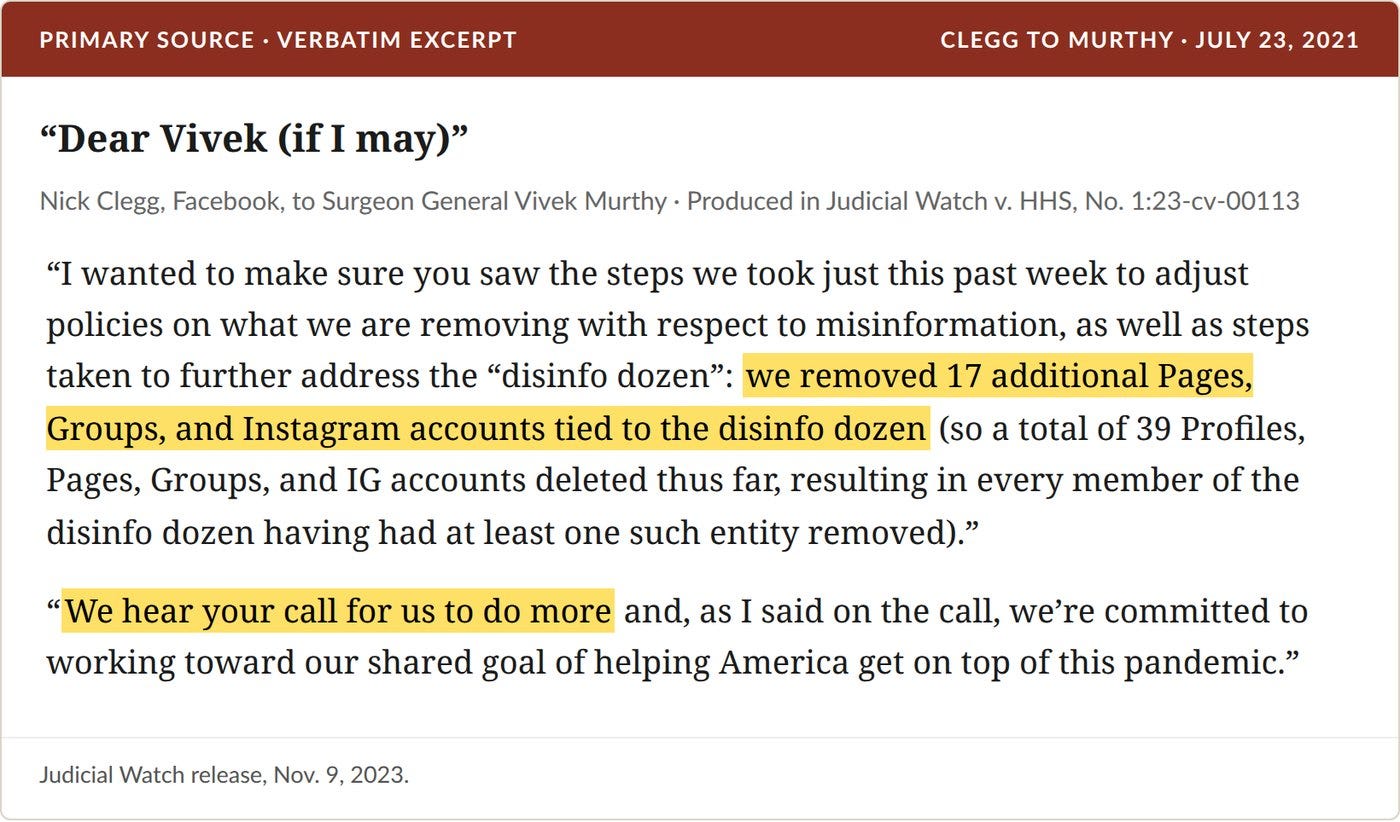
On July 23, two days after the memo, Clegg met Surgeon General Vivek Murthy. Afterward he emailed him. The email was obtained by Judicial Watch through a FOIA lawsuit against HHS (Judicial Watch):
“I wanted to make sure you saw the steps we took just this past week to adjust policies on what we are removing with respect to misinformation, as well as steps taken to further address the ‘disinfo dozen’: we removed 17 additional Pages, Groups, and Instagram accounts tied to the disinfo dozen (so a total of 39 Profiles, Pages, Groups, and IG accounts deleted thus far, resulting in every member of the disinfo dozen having had at least one such entity removed).”
Nick Clegg to Surgeon General Vivek Murthy, July 23, 2021
In the same email, Clegg wrote: “We hear your call for us to do more.” The removals were reported to the Surgeon General as progress against the list. They were done in the same week the President said platforms were killing people, and two days after Facebook’s own staff wrote that the White House wanted non-violating content taken down.
Then they built new penalties
On August 18, Facebook published its rebuttal of CCDH. The same post announced the removals and penalties: “we have removed over three dozen Pages, groups and Facebook or Instagram accounts linked to these 12 people,” imposed penalties on “nearly two dozen additional Pages, groups or accounts,” and “applied penalties to some of their website domains as well” (Meta).
The next day, Facebook’s teams sent Clegg an “Enforcement Update re COVID-19.” It opens: “This email provides a follow-up to our August 6th discussion regarding our response to the Surgeon General on COVID-19 misinformation.” Unless anyone objected by 9 a.m., they would “provide an update to the Surgeon General and start executing against these tomorrow.” Clegg replied: “Yep this looks good thx” (House amicus exhibits).
The plan had four parts. Facebook would stop recommending “approximately 60 linked assets related to the Disinfo Dozen.” It would raise the demotion of “Partly False” COVID content from 50% to 80%. Its own policy team had found that, for the most viral links to our websites, “85% of those ratings were either Partly False or Missing Context,” not “False.” Under Facebook’s normal rules, those ratings couldn’t trigger site-wide penalties. So the plan created a manual process to impose a “90-day domain demotion” on sites that met a threshold that was “still TBD.”
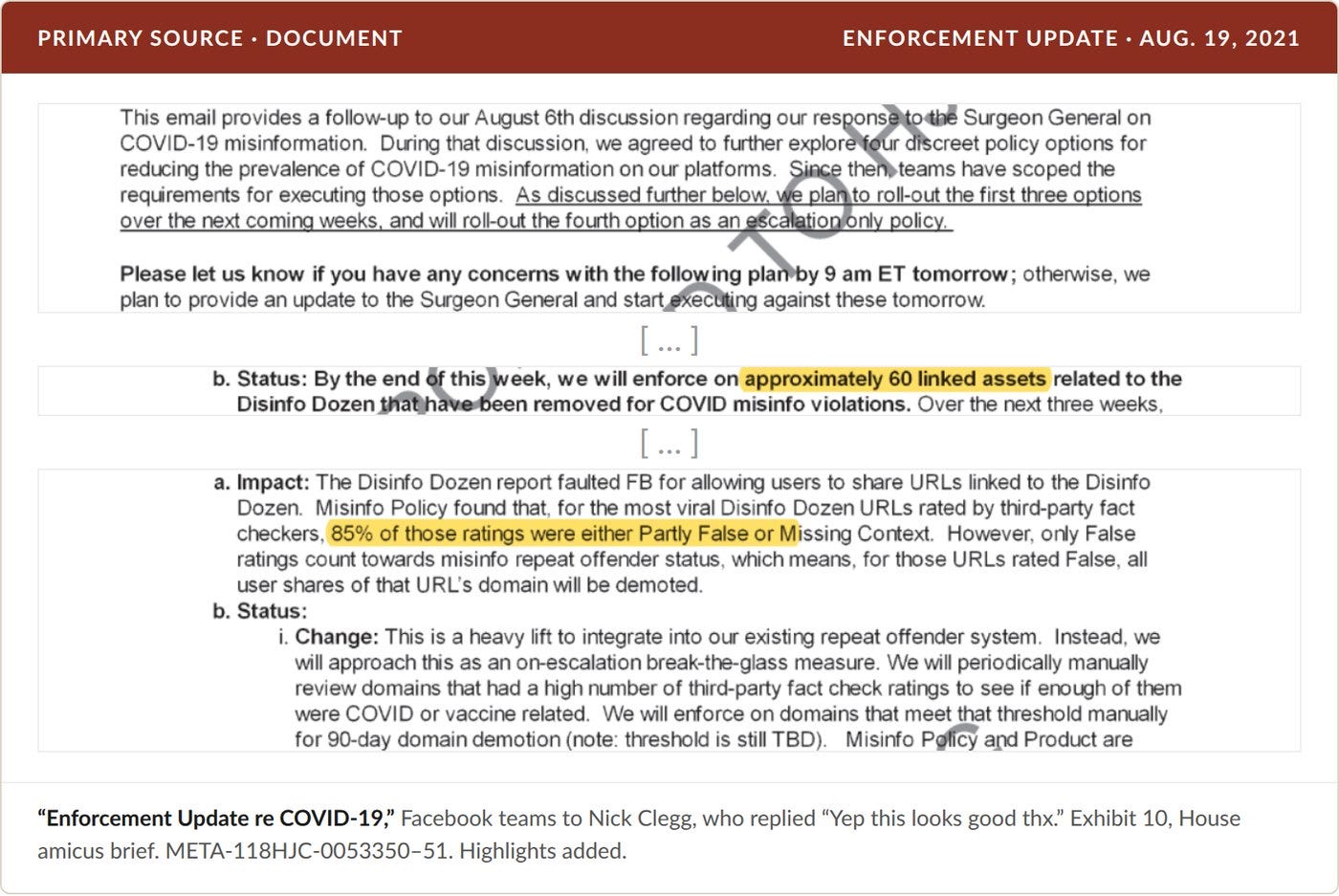
A domain demotion doesn’t only hit the site owner’s posts. It cuts the reach of every post that links to the site, whoever shares it. As I documented in my previous piece, internal Facebook messages from July 23, 2021, released by Rep. Jim Jordan, list GreenMedInfo.com under a 60% demotion. Facebook’s plan itself conceded that “many of our domain repeat offender demotions do not give notification.”
A week after that plan, Berman told the Stanford audience that Facebook acts when “people are posting misinformation that violates our policies.” The company’s own files show the policies themselves were being rewritten in response to the Surgeon General, so that ratings which weren’t “False” could still penalize entire websites.
Who was asking
The setting matters too. The panel’s moderator, Renée DiResta, led the Stanford Internet Observatory’s Virality Project, which tracked COVID-19 vaccine narratives across the major platforms throughout 2021 (Stanford Report). Internal Twitter emails published by Matt Taibbi in 2023 showed the project telling Twitter that “true stories that could fuel hesitancy” should count as standard vaccine misinformation (Twitter Files). The Stanford Internet Observatory has denied that it asked platforms to remove content about vaccine side effects (Public).
So the August 2021 conversation about whether Facebook had done enough to the twelve of us took place among a Stanford team that monitored vaccine narratives, a Facebook manager with a long career in intelligence analysis, and their counterparts from Twitter and Google. No one on the panel represented the people being removed.
How the history is being rewritten
Five years on, the record has been turned upside down. Aaron Sorkin’s The Social Reckoning tells audiences Facebook let vaccine conspiracy theories run wild. One review describes the film showing “Facebook pushing endless conspiracy theories about COVID and vaccines” (Vulture). As I wrote in “Why The Social Reckoning Failed at More Than the Box Office,” there is no White House pressure on Facebook anywhere in the film.
The “Facebook did too little” story didn’t start with Sorkin. In November 2021, three months after Berman’s remarks, CCDH chief executive Imran Ahmed told a House subcommittee that Facebook’s own internal research showed “CCDH’s findings were largely correct” (Nov. 17, 2021 testimony). The internal study that matches his description measured “vaccine hesitancy,” not falsehood, within one of 638 user segments, and it named no one (DocumentCloud).
Facebook’s public position in August 2021 was 0.05% and “no evidence.” Its own misinformation policy lead said there was no consensus. In the retelling, those statements disappear, and only the claim that Facebook failed to act survives.
The courts have weighed in on the pressure campaign. The Fifth Circuit found that Facebook “started removing information posted by the ‘disinfo dozen’… despite earlier representations that those users were not in violation of their policies,” and held that the White House, “acting in concert with the Surgeon General’s office,” likely coerced the platforms or significantly encouraged their decisions (Fifth Circuit). In 2024, Mark Zuckerberg wrote that “the government pressure was wrong” (AP).
THE FAIR-RECORD NOTE
The Supreme Court reversed the Fifth Circuit’s injunction in Murthy v. Missouri on standing grounds. It didn’t decide whether the government coerced anyone, and the majority said platforms also had “independent incentives” to moderate content (Murthy v. Missouri). Berman’s remarks reflect Facebook’s position as he presented it on a public panel. Nothing in the record cited here shows he personally decided any particular removal. The documents and his words stand as they are.
Why it matters now
This history isn’t only about the past. The “platforms did too little” story is now being used to argue for platform liability laws. Facebook’s own files show what platforms do when government says they are doing too little. They don’t sort true from false. They label, demote and remove whatever looks risky, including content their own staff call true.
The JAWBONE Act (S. 4749), from Senators Ted Cruz and Ron Wyden, would let Americans sue when federal officials pressure platforms to suppress their lawful speech (Congress.gov). It cleared the Senate Commerce Committee 18–10 on September 16, 2026, and has no floor date (Inside Radio).
What you can do
Ask your senators to cosponsor the JAWBONE Act (S. 4749) and press for a floor vote. Ask your representative to introduce a House companion.
Share the transcript. The words are Facebook’s own, spoken in public at Stanford. Put them next to anyone who claims Facebook did too little.
Tell your story if your speech was suppressed, or if you saw it happen from inside an agency, platform or contractor.
All three actions are at Restore the First.
They measured us at 0.05%. They said there was no evidence. All that said, they removed us anyway.
“All that said, we have taken action against these people.”
Aaron Berman, Facebook, Stanford INFODEMIC conference, August 26, 2021


Sources
INFODEMIC: A Stanford Conference on Social Media and COVID-19 Misinformation: https://med.stanford.edu/news/all-news/2021/09/infodemic-covid-19.html
YouTube:
organizers’ published analysis of the conference: https://pmc.ncbi.nlm.nih.gov/articles/PMC8849255/
World Affairs Council biography: https://www.world-affairs.org/people/aaron-berman/
New York Post: https://nypost.com/2022/12/22/facebook-twitter-stocked-with-ex-fbi-cia-officials/
Facebook’s August 18, 2021 statement: https://about.fb.com/news/2021/08/taking-action-against-vaccine-misinformation-superspreaders/
White House transcript: https://www.supremecourt.gov/opinions/URLs_Cited/OT2023/23-411/23-411-13.pdf
CNN: https://www.cnn.com/2021/07/16/tech/misinformation-covid-facebook-twitter-white-house/index.html
House amicus exhibits: https://www.nextgov.com/media/house-gop-amicus-biden-social-media.pdf
Fifth Circuit: https://www.ca5.uscourts.gov/opinions/pub/23/23-30445-CV0.pdf
Judicial Watch: https://www.judicialwatch.org/facebook-covid-censorship/
my previous piece: https://read.sayerji.com/p/why-the-social-reckoning-failed-at
Stanford Report: https://news.stanford.edu/stories/2022/02/curbing-spread-covid-19-vaccine-related-mis-disinformation
Twitter Files:

Public:

Vulture: https://www.vulture.com/article/review-the-social-reckoning-might-be-aaron-sorkin-overload.html
Nov. 17, 2021 testimony: https://docs.house.gov/meetings/VC/VC00/20211117/114254/HHRG-117-VC00-20211117-SD005.pdf
DocumentCloud: https://www.documentcloud.org/documents/21949716-tier2_c19_ir_undated
Murthy v. Missouri: https://www.supremecourt.gov/opinions/23pdf/23-411_3dq3.pdf
Congress.gov: https://www.congress.gov/bill/119th-congress/senate-bill/4749/text
Restore the First:
Images: Meta sign photo by Nokia621 (CC BY-SA 4.0); Stanford photo by Jawed (CC BY-SA 4.0); White House photo by Erin Scott (public domain), all via Wikimedia Commons. Document images from Meta productions filed with the House amicus brief, Fifth Circuit No. 23-30445; highlights added.