

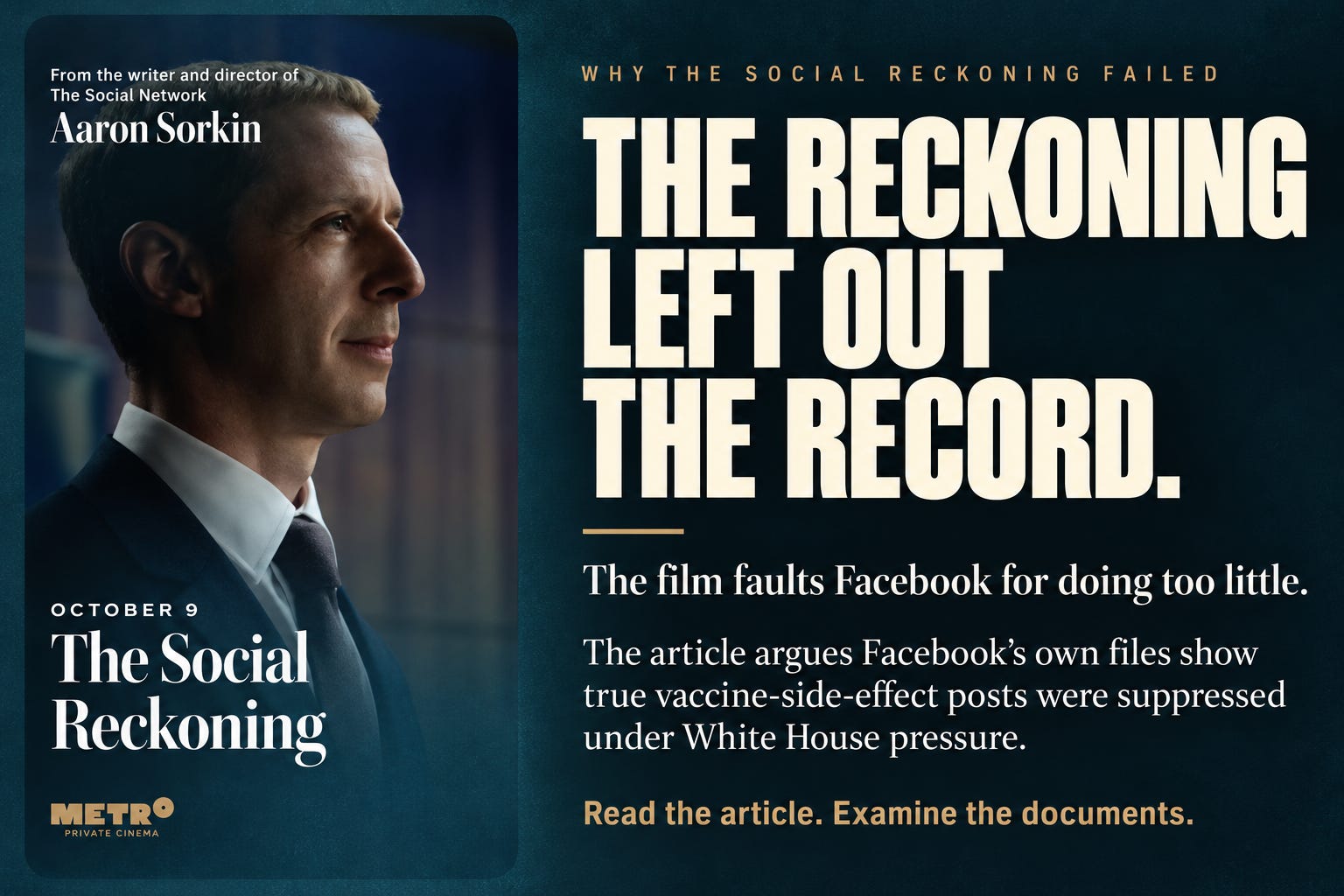
Sorkin’s film blames Facebook for not censoring enough. Facebook’s own files show it suppressed true vaccine-injury posts under White House pressure.
Disclosure: I am one of the twelve people the Center for Countering Digital Hate (CCDH) named in its 2021 “Disinformation Dozen” report, a plaintiff in Finn v. Global Engagement Center, and the founder of Restore the First, a free-speech coalition. I have a personal stake in this story. That is why everything below is tied to a document you can read yourself.
Aaron Sorkin’s The Social Reckoning opened to about $5.5 million (Yahoo/Deadline). For a film with a reported $30 to $42 million production budget (Deadline), that’s a flop. But the box office is the smaller failure. The bigger one is historical.
The film tells audiences that Facebook let vaccine “misinformation” run wild. One review describes it showing “Facebook pushing endless conspiracy theories about COVID and vaccines” (Vulture). Facebook’s own internal records, produced to Congress and cited in federal court, show something close to the opposite. In 2021, Facebook was labeling true posts about vaccine side effects and demoting some of them. The Surgeon General’s office wanted those posts removed. Facebook’s staff advised against it. Then, under sustained White House pressure, Facebook escalated anyway.
None of that is in the movie.
What Facebook wrote down
On July 21, 2021, Facebook staff sent Nick Clegg, then its head of global affairs, a memo titled “Covid misinfo: Delta assessment + Mitigations.” It laid out the gap, the “delta,” between what the White House and the Surgeon General wanted removed and what Facebook’s own rules allowed. It was later filed as Exhibit 12 to a House Republican brief in the Fifth Circuit, carrying Meta’s production number META-118HJC-0053715 (House amicus exhibits).

The first item on the list was headed “True information.”
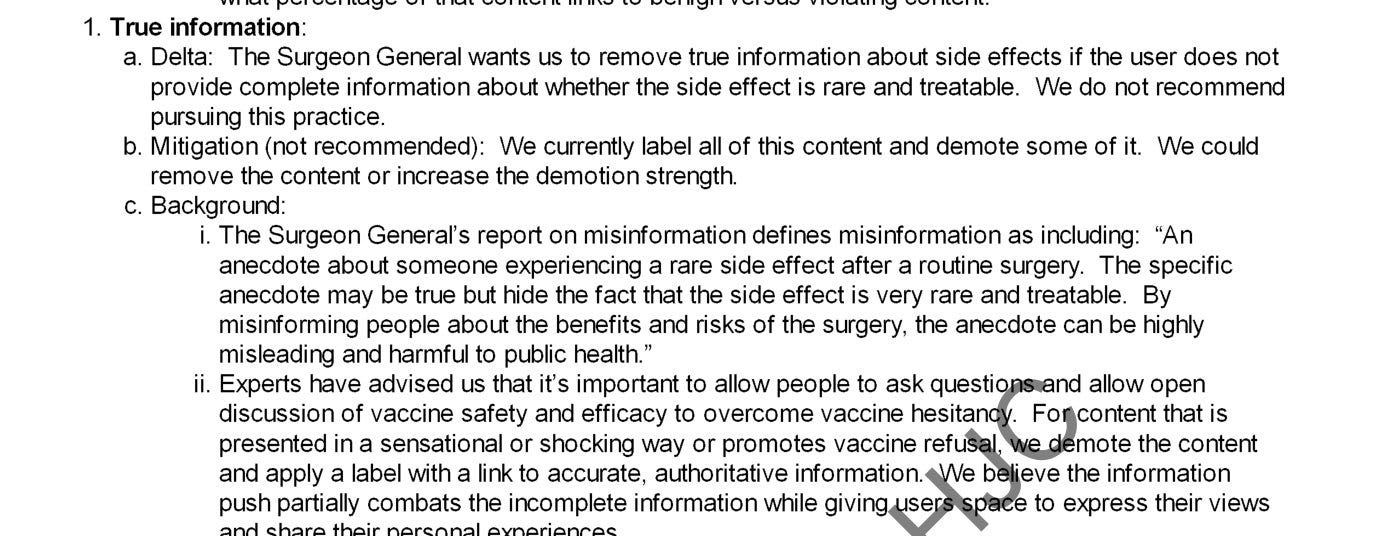
From the record (Meta production META-118HJC-0053715):
“Delta: The Surgeon General wants us to remove true information about side effects if the user does not provide complete information about whether the side effect is rare and treatable. We do not recommend pursuing this practice.”
“Mitigation (not recommended): We currently label all of this content and demote some of it. We could remove the content or increase the demotion strength.”
Read that second line again. We currently label all of this content and demote some of it.The content in question was true. Facebook was already suppressing it. The Surgeon General wanted more.
The memo also explains where the Surgeon General’s office got its rationale. His own misinformation advisory defined misinformation to include an anecdote that “may be true but hide the fact that the side effect is very rare and treatable.” Under that definition, a true account of a vaccine injury counts as misinformation if the person telling it fails to add the official caveat.
The White House wanted to go further still. Facebook staff concluded it wanted removed “any negative information on or opinions about the vaccine without concluding that the benefits of the vaccine outweigh that information or opinion,” as well as “humorous or satirical content that suggests the vaccine isn’t safe.” Facebook’s staff even flagged an ABC News report on side effects that its systems had rated “negative.” They wrote: “We don’t know whether the WH would propose that this reporting from network news should be removed for accurately reporting on side effects.”

That same day, Clegg forwarded the analysis to Sheryl Sandberg with his own summary.
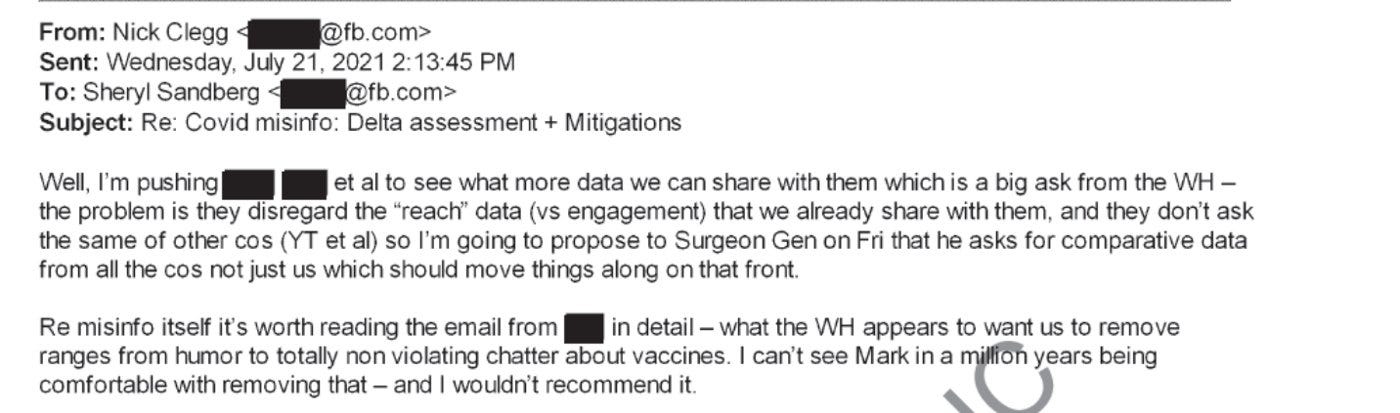
From the record (Clegg to Sandberg, July 21, 2021):
“Re misinfo itself it’s worth reading the email from [redacted] in detail – what the WH appears to want us to remove ranges from humor to totally non violating chatter about vaccines. I can’t see Mark in a million years being comfortable with removing that – and I wouldn’t recommend it.”
Clegg also told Sandberg he planned to propose to the Surgeon General, at a meeting that Friday, that he ask all the platforms for comparable data, “not just us.”
What Facebook said about the Disinformation Dozen
The same memo dealt with the twelve of us as a group, the “Disinfo Dozen.” By then, Facebook had already removed 23 rule-breaking pages and accounts belonging to 11 of the twelve, and it kept the rest up because they didn’t break its rules. The White House wanted more. It wanted Facebook to disable our accounts across all its platforms. Facebook reserved that penalty for “child safety and dangerous organization violations.” Its staff wrote that doing so “would remove approximately 50 non-violating assets associated with the Disinfo Dozen, including many entities that have nothing to do with COVID or vaccines.”
On CCDH’s headline claim, that twelve people produced 65% of anti-vaccine content, they wrote: “To get to the claim that 65% of COVID misinfo comes from the Disinfo Dozen, we assume the WH is complaining about non-violating content on FB.” They also noted that “91 entities are tied to the Disinfo Dozen (however, the majority of these entities do not share anti-vax content).”
And they described how critics built the case against Facebook in the first place.
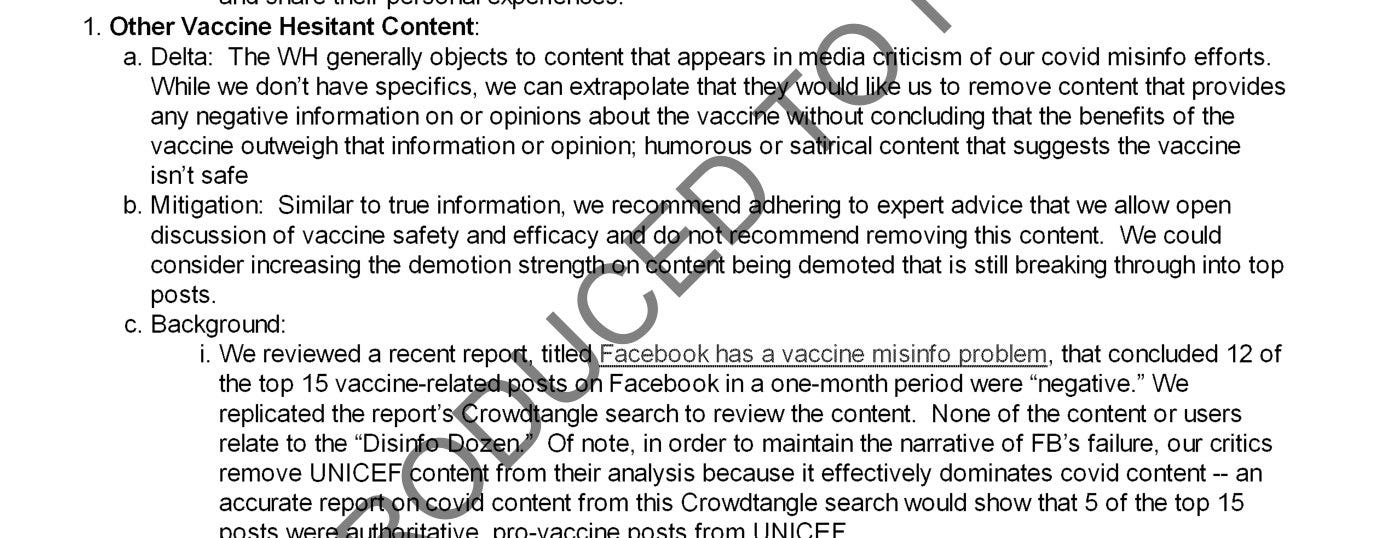
From the record:
“Of note, in order to maintain the narrative of FB’s failure, our critics remove UNICEF content from their analysis because it effectively dominates covid content -- an accurate report on covid content from this Crowdtangle search would show that 5 of the top 15 posts were authoritative, pro-vaccine posts from UNICEF.”
Facebook’s own staff, in 2021, described critics trimming data “to maintain the narrative of FB’s failure.” Five years later, that narrative is a Sony release.
Then Facebook gave in
The memo recommended against removing true content. Facebook didn’t hold that line.
The public pressure had already peaked. On July 15, 2021, the Surgeon General called misinformation “literally costing… lives.” The next day, the President said platforms were “killing people.” Days later, a White House official said the administration was “reviewing” the platforms’ legal liability (Fifth Circuit).
Facebook had business reasons to listen. On July 22, Clegg wrote internally: “Given the bigger fish we have to fry with the [Biden] Administration,” and asked for “creative thinking on how we can be responsive to their concerns.” The House Judiciary Committee identifies those fish as issues including “data flows” (House Judiciary report). On August 2, an internal email said leadership wanted “additional policy levers we can pull to be more aggressive against Covid and vaccine misinformation. This is stemming from the continued criticism of our approach from the US administration” (House Judiciary report).
On August 18, Facebook announced it had removed more than three dozen pages, groups and accounts linked to the twelve. In the same post, it said the twelve were responsible for “about just 0.05% of all views of vaccine-related content” on the platform, and called CCDH’s claim a “faulty narrative” (Meta).
The next day, Facebook’s internal teams sent Clegg the rest of the plan. The email opens: “This email provides a follow-up to our August 6th discussion regarding our response to the Surgeon General on COVID-19 misinformation.” Unless anyone objected by 9 a.m., the team would “provide an update to the Surgeon General and start executing against these tomorrow.” Clegg replied: “Yep this looks good thx.” (House amicus exhibits)
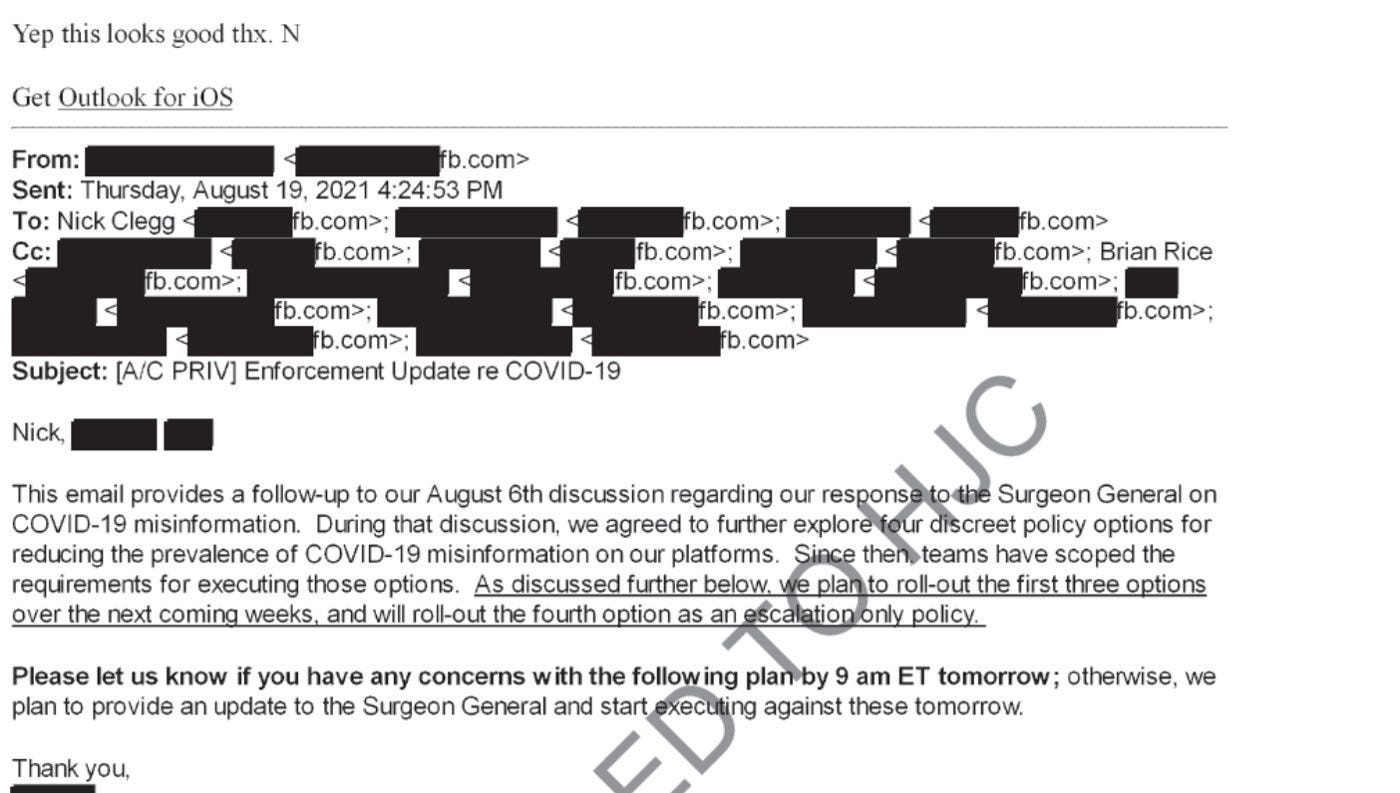
The plan went beyond the twelve people to our websites. Facebook’s own policy team had found that, for the most viral links to Disinformation Dozen sites, 85% of fact-checker ratings were “Partly False” or “Missing Context,” not “False.” Under Facebook’s rules, only “False” ratings could penalize an entire website. So the plan created a manual workaround: Facebook would review sites with many fact-check ratings and impose a “90-day domain demotion” on those that met a threshold that was “still TBD.”
From the record (Meta production META-118HJC-0053350–51):
“By the end of this week, we will enforce on approximately 60 linked assets related to the Disinfo Dozen that have been removed for COVID misinfo violations.”
“We currently demote content rated Partly False at 50%. We will increase that demotion level to 80% for COVID and vaccine misinfo.”
“We will enforce on domains that meet that threshold manually for 90-day domain demotion (note: threshold is still TBD).”
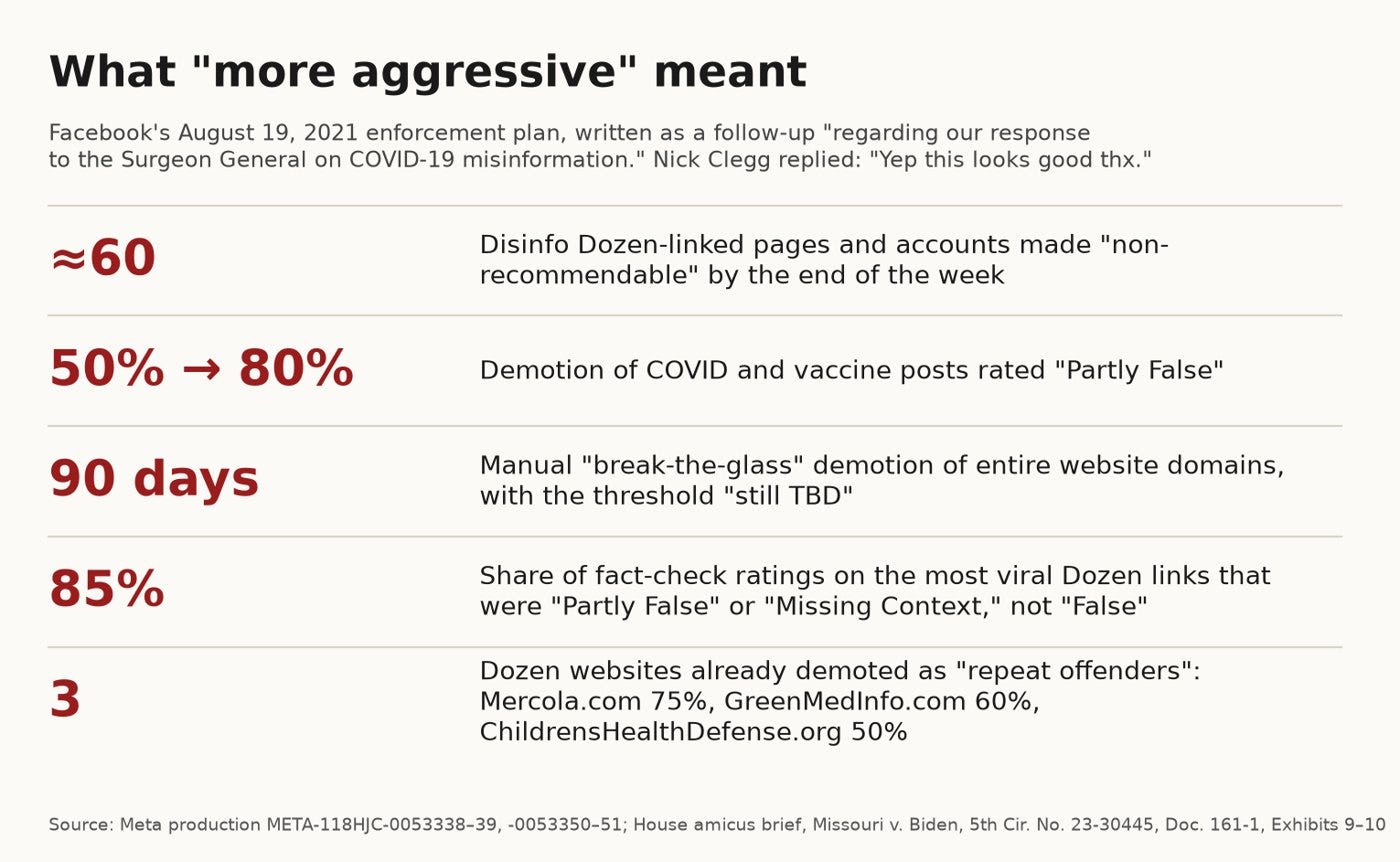
In plain terms, Facebook built a new penalty for websites whose content its own fact-checkers had not rated false, and filed it as a response to the Surgeon General.
Facebook’s August 6 options memo noted that “three Disinfo Dozen domains are already experiencing demotion” as repeat offenders (META-118HJC-0053339). Facebook knew exactly which three, and one of them was mine.
On July 23, 2021, the same day Clegg met the Surgeon General, Facebook staff were trading messages about “tracking the disinfo dozen’s off-platform domains on platform.” One message listed them:
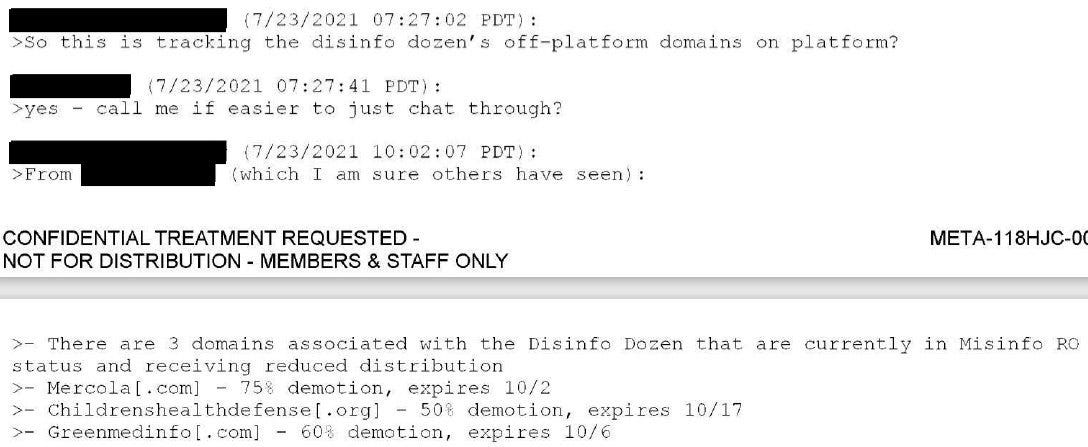
From the record (internal Facebook messages, July 23, 2021, released by Rep. Jim Jordan):
“There are 3 domains associated with the Disinfo Dozen that are currently in Misinfo RO status and receiving reduced distribution
Mercola[.com] - 75% demotion, expires 10/2
Childrenshealthdefense[.org] - 50% demotion, expires 10/17
Greenmedinfo[.com] - 60% demotion, expires 10/6”
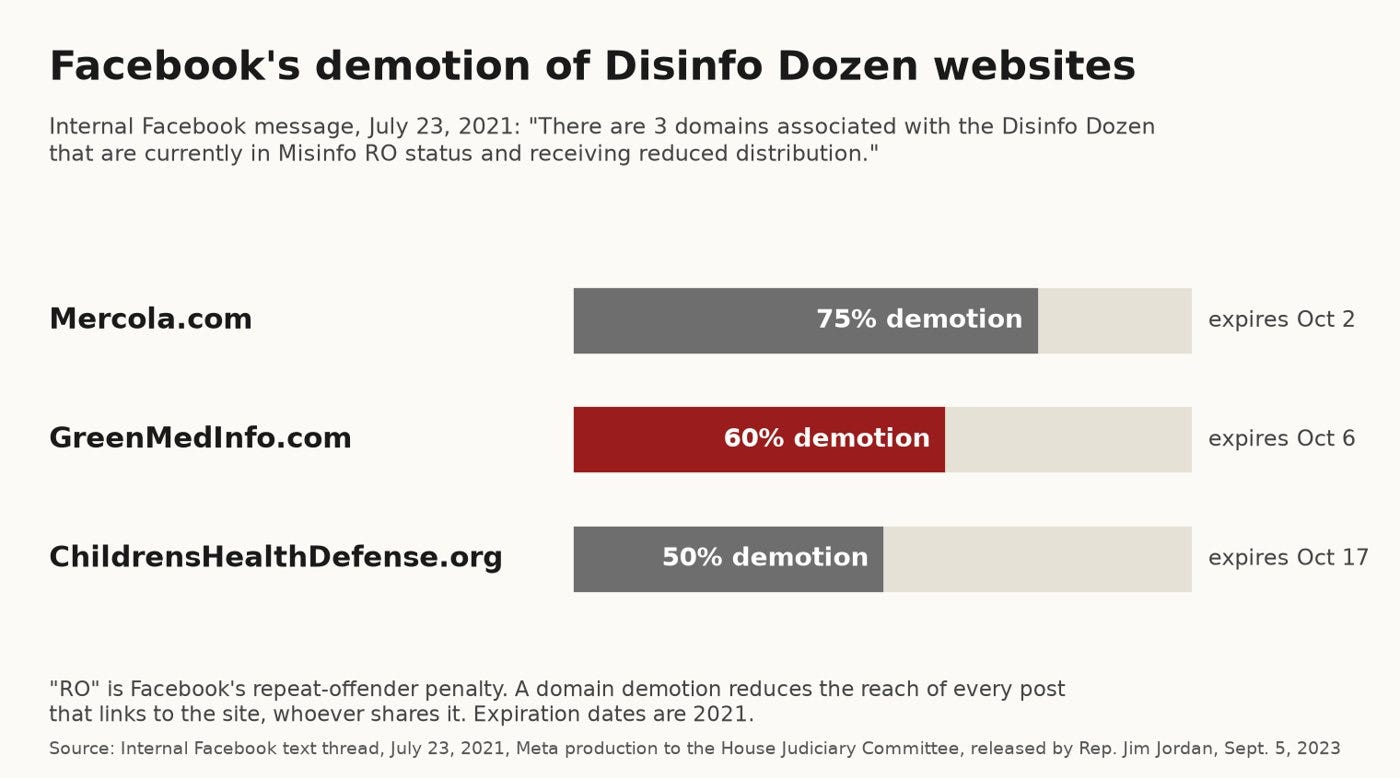
A domain demotion doesn’t just hit my own posts. It cuts the reach of every post that links to the site, whoever shares it (House amicus exhibits). For at least two and a half months of 2021, any Facebook user who shared a GreenMedInfo.com article was sharing it into a 60% headwind. Facebook’s own August plan conceded that “many of our domain repeat offender demotions do not give notification” (House amicus exhibits).
The Fifth Circuit later found that Facebook “started removing information posted by the ‘disinfo dozen’… despite earlier representations that those users were not in violation of their policies.” It held that the White House, “acting in concert with the Surgeon General’s office,” likely coerced the platforms or significantly encouraged their decisions (Fifth Circuit). In 2024, Mark Zuckerberg wrote that “the government pressure was wrong” (AP).
To be fair to the record: the Supreme Court reversed the injunction in Murthy v. Missouri on standing grounds, without ruling on whether the government coerced anyone. The majority said platforms also had “independent incentives” to moderate (Murthy v. Missouri). The documents above remain what they are.
The gap in the film
I saw The Social Reckoning. There is no White House pressure on Facebook in it. I also checked ten detailed reviews and recaps, including Wikipedia’s plot summary, The Verge’s fact-check and NPR’s discussion. None mentions the White House, the Surgeon General, “killing people,” or any government demand to remove content (The Verge; NPR). No screenplay has been published.
The structure explains part of the omission. The film runs from 2019 to early 2021 and climaxes on January 6 (Collider). To get there, it moves preparation of the first Facebook Files story to that day, although the series actually ran in September 2021 (The Verge). The campaign that pressed Facebook to suppress more ran from February to August 2021. Frances Haugen was still at Facebook gathering documents for most of it; she left in May.
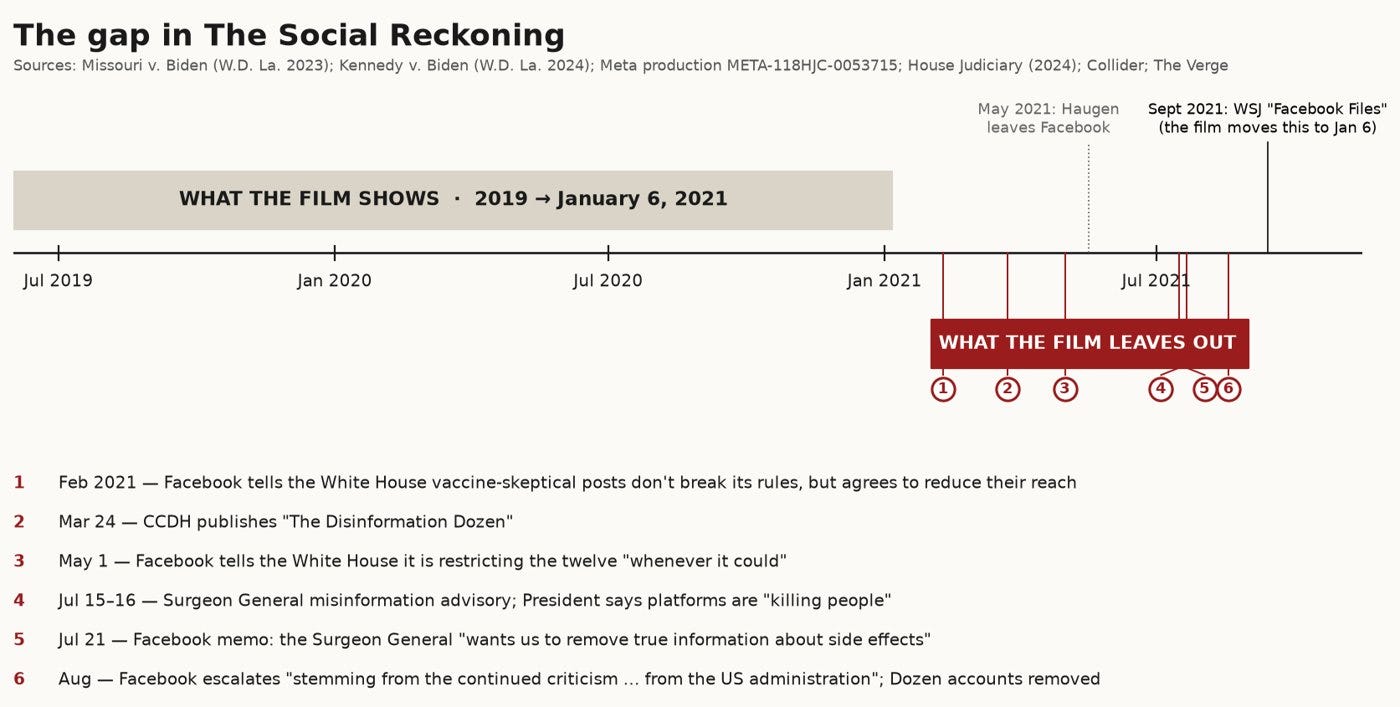
The only official the film shows interacting with Facebook over content is the unnamed sitting president on January 6, when staff urge Zuckerberg to block him (ABC Australia). Government pressure appears in the film only as something Facebook should have done more of.
The film also treats free speech as a pose. Zuckerberg says, “I’m a free speech absolutist. So except where there’s imminent harm—” and his adviser cuts him off: “You can’t say ‘absolutist’ and ‘except’ in the same sentence” (NPR). Fair enough. The same logic applies to a company that called itself a public square while labeling and demoting true posts at the government’s request.
The “proof” CCDH gave Congress
The film’s frame, that Facebook knew and did too little, didn’t start with Sorkin. In November 2021, CCDH’s chief executive, Imran Ahmed, told a House subcommittee that Haugen’s documents showed “on the exact same day that CCDH’s Disinformation Dozen report was released, Facebook had produced internal research showing that CCDH’s findings were largely correct” (Nov. 17, 2021 testimony). In December he told another committee that Facebook research “confirm[ed] that a tiny number of accounts were responsible for more than half of anti-vaccine content on the platform” (Dec. 9, 2021 testimony).
The Facebook study that matches his description is public, released with the Facebook Papers (DocumentCloud). It doesn’t say what he told Congress.
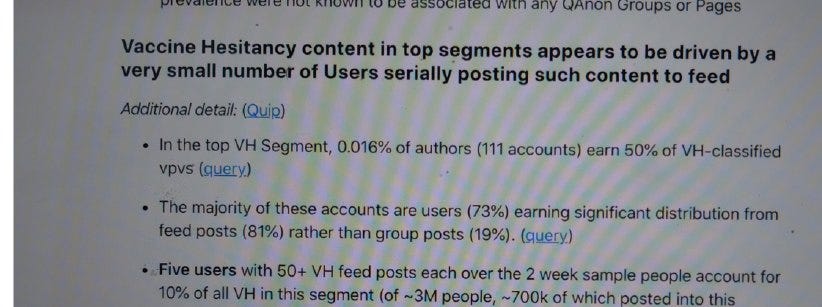
From the record (Facebook study, “COVID Vaccine Risks Appear To Be Concentrated Among A Few Subpopulation Segments”):
“In the top VH Segment, 0.016% of authors (111 accounts) earn 50% of VH-classified vpvs.”
The author’s note defines “VH” as “an early version of the ‘Vaccine Hesitancy’ classifier.”
The difference matters:
It measured hesitancy, not falsehood. Hesitancy includes people expressing concern. The study itself says some highly hesitant groups “may be motivated by perceived health risk or other factors.”
It covered one population segment, not the platform. The 111 accounts drew half the hesitancy-classified views in one of 638 user segments.
It named no one. Nothing in it ties those accounts to the twelve CCDH named.
It predates CCDH’s report. The Washington Post reported the same findings on March 14, 2021, ten days before CCDH published (Washington Post, cited by the Supreme Court).
The study also observed that, outside the few most hesitant segments, hesitant content “may often be remediated via comments and reactions.” Other users’ replies corrected it. That is an argument for counter-speech, and CCDH presented the study to Congress as proof that the platform should remove more.
Who shaped the story
No source shows CCDH, the Gates Foundation, or Pierre Omidyar’s Luminate putting money into this film. Sony and Columbia made it, and Alcon co-financed it (Deadline). The network didn’t need to finance the film. It supplied the story.
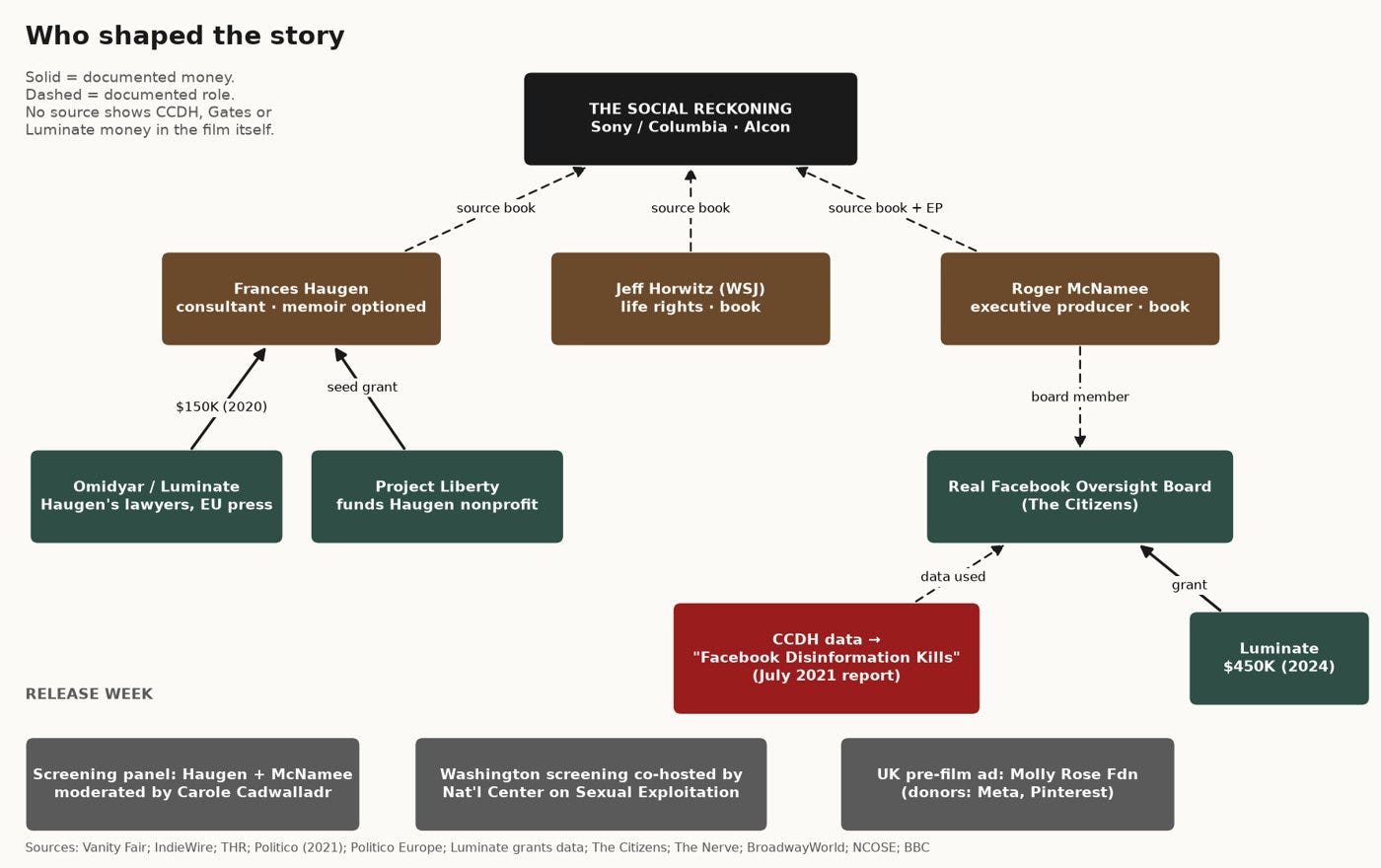
The film is built on its subjects’ own accounts. Sorkin optioned Haugen’s memoir and credits books by Haugen, Jeff Horwitz and Roger McNamee for changing his view of Facebook (THR via Escape Artists; IndieWire). Haugen served as a consultant (Business Insider).
McNamee is both executive producer and a principal source. Sorkin: “Of the people I spoke to a lot: There’s Frances, Jeff, and a man named Roger McNamee” (Vanity Fair).
McNamee’s board used CCDH’s data. He sits on the Real Facebook Oversight Board. Its July 2021 report, produced with SumOfUs “using data from Center for Countering Digital Hate,” ran under the banner “Facebook Disinformation Kills” and was paired with a body-bag protest at Facebook headquarters (The Citizens). Luminate gave the board’s parent organization $450,000 in 2024 to support it (Luminate grants data).
Haugen’s campaign had backers. Omidyar’s foundation gave $150,000 to her lawyers at Whistleblower Aid in 2020, and in 2021 Luminate ran her European press and government relations (Politico). Her nonprofit was seeded by Frank McCourt’s Project Liberty (Politico Europe).
The release events ran through the same circles. Carole Cadwalladr, founder of the group behind the Real Facebook Oversight Board, moderated a release-week screening panel with Haugen and McNamee (The Nerve).
And it isn’t only the left. A Washington special screening was co-hosted by the National Center on Sexual Exploitation (BroadwayWorld), a religious-conservative group campaigning to “Sunset Section 230,” the law that shields platforms from liability for what users post (NCOSE). In the UK, the Molly Rose Foundation ran an ad before screenings urging viewers to help “stop companies like Meta endangering young people” (Yahoo/PA). According to the BBC, its anonymous donors include Meta and Pinterest (BBC).
Real harms, the wrong lever
Sorkin has been clear about what he wants: “Until the owners of internet platforms are legally responsible the way the rest of us are, then there won’t be a change” (USA Today). The film lands in the middle of that fight in Congress.
The harms to kids are real, and parents are right to be angry about them. The question is what the remedy does to everyone else’s speech.
The leading vehicle is the Kids Online Safety Act (KOSA). The Senate Commerce Committee advanced it on August 5, 2026 (Senate Commerce). Its core is a “duty of care” that would make platforms liable for design features contributing to harms such as depression, anxiety and eating disorders (Tech Policy Press). Its sponsors say it regulates product design, not speech. The House stripped the duty of care from its own version, the KIDS Act, citing free-speech concerns (Tech Policy Press). Senators Blackburn and Blumenthal called the House bill “a pale imitation” and vowed to restore the duty of care (Blackburn). A separate Senate bill would repeal Section 230 outright (Congress.gov).
KOSA says nothing about vaccines. But the free-speech worry isn’t about the bill’s wording. It’s about how platforms behave when they’re exposed to liability. The Center for Democracy & Technology warns that, in practice, KOSA would require companies “to proactively reduce children’s exposure to content that can be deemed harmful” (Tech Policy Press). Who decides what is harmful? In 2021, the Surgeon General’s own advisory deemed a true anecdote harmful if it left out the official caveat.
That’s why 2021 matters here. The White House floated legal liability in July 2021, the same month Facebook’s staff wrote that true side-effect content was already labeled and demoted. A platform facing liability doesn’t sort true from false. It removes whatever looks risky. The film supplies the moral case for more liability by telling audiences that Facebook did too little. Facebook’s own records show what happened when the government decided it was doing too little.
There is a remedy aimed at the actual 2021 problem. The JAWBONE Act (S. 4749), from Senators Ted Cruz and Ron Wyden, would let Americans sue when federal officials pressure platforms to suppress their lawful speech, including attempted coercion (Congress.gov). The Senate Commerce Committee advanced it 18–10 on September 16, 2026 (Inside Radio). It has no floor date.
How the history was rewritten
Define. The Surgeon General’s advisory counts true anecdotes as misinformation.
Label. CCDH attributes 65% of anti-vaccine content to twelve people.
Pressure. The White House and the Surgeon General press Facebook publicly and privately, and float platform liability.
Comply. Facebook labels and demotes true content, then escalates against its own staff’s advice.
Recast. CCDH tells Congress Facebook’s own research proves Facebook did too little.
Canonize. A prestige film presents “Facebook did too little” as history.
Legislate. Liability laws would require at scale what was done informally in 2021.
At every step, the suppression itself becomes the evidence that there wasn’t enough of it.
The Social Reckoning failed at the box office. It also failed the record. The documents are public. Read them yourself.
What you can do
I founded Restore the First, a citizens’ coalition working for congressional action on government pressure that suppresses lawful speech, and for preserving the public record of what happened. If this story matters to you:
Ask your senators to cosponsor the JAWBONE Act (S. 4749) and press for a floor vote. Ask your representative to introduce a House companion.
Tell Congress to investigate the COVID-era censorship record and make sure it can’t be repeated.
Share your story if your speech was suppressed, or if you saw it happen from inside an agency, platform or contractor.
All three actions are at restorethe1st.com. Protecting kids online and protecting true speech are not opposites. A law that can’t tell them apart will fail at both.


Primary documents
Facebook memo, “Covid misinfo: Delta assessment + Mitigations,” July 21, 2021 (Exhibit 12, META-118HJC-0053715): House amicus exhibits
Facebook study, “COVID Vaccine Risks Appear To Be Concentrated Among A Few Subpopulation Segments”: DocumentCloud
Missouri v. Biden, Fifth Circuit, Sept. 8, 2023: opinion
Murthy v. Missouri, U.S. Supreme Court, June 26, 2024: opinion
Imran Ahmed testimony, Nov. 17, 2021: House; Dec. 9, 2021: House
Meta, “How We’re Taking Action Against Vaccine Misinformation Superspreaders,” Aug. 18, 2021: Meta
House Judiciary Committee, Biden White House censorship report, 2024: report