


Traditional midwives, one nurse midwife, and an Amish plaintiff went to Commonwealth Court on July 2, 2026 asking Pennsylvania to administer a 97-year-old certificate law it had let go dormant. Ten days later, Governor Josh Shapiro signed an omnibus fiscal-code bill that expressly repealed the statute they had gone to court to enforce. A Lancaster County lawmaker said afterward that he did not know he had voted for the repeal. The Attorney General then told the court that traditional midwives can practice without certificates. That is the legal posture that put an Elizabeth Catlin in a state uniform in Penn Yan, New York, in 2019.


Where I am writing from
My children were born by midwife. One at a birth center, and one at home. I ran the nutrition program at the Naples Birth Center in Naples, Florida during years when we watched hundreds of families make the same choice. I am not neutral about midwifery. I am also not sentimental about it. Everybody serious in this world knows that a planned home birth is a legitimate option for a healthy, well-selected woman with a trained midwife and a working transfer relationship to a hospital — and that a state ought to be building the training verifiable, the selection careful, and the transfer relationship reliable. Pennsylvania spent the summer of 2026 doing the opposite of all three, and it did it to the community for whom midwifery is not a lifestyle choice but a hundred-and-fifty-year birth tradition.
This piece is the third in a series. The first, COVID-Era Tyranny Returns to Pennsylvania — and It Falls Hardest on the Amish, walks through the 502-page Chapter 27 disease-rule rewrite the Department of Health filed in June — the same summer, the same administration — that gives the state warrantless-entry, church-school, family-funeral, and dairy-and-manure reach into the same Lancaster County community. The second, 9 Things Pennsylvanians Need to Know About the State’s New Disease Rules — Comment by September 21, is the plain-English comment guide, with the exact IRRC email address and the five categories that will matter most in the record. This third piece is about what happened, in the same summer, to the women who deliver the babies.
The 1929 law that was supposed to protect them
The Midwife Regulation Law of 1929, codified at 63 P.S. §§ 171–176, is the least fashionable statute the Pennsylvania General Assembly ever passed and one of the few that quietly worked for the Plain community. Section 1 (§ 171) opens: “It shall be unlawful for any person or persons … to practice midwifery … before receiving a certificate … authorizing such person or persons so to do ….” Section 2 (§ 172) directed the State Board of Medicine, upon the recommendation of the Secretary of Health, to issue certificates to midwives who satisfied the Board’s requirements, and vested the Board with rulemaking and limited authority to refuse or revoke a certificate. Section 3 (§ 173) fixed the application fee at ten dollars. Section 5 (§ 175) set a fine of not less than $10 and not more than $100 for practicing without either that certificate or another lawfully held Commonwealth license. Section 6 (§ 176) defines “midwife.”
In plain terms: the statute established a state certificate pathway for non-nurse midwives and directed the Commonwealth to issue certificates to applicants who satisfied the statutory and regulatory requirements. It was paternalistic. It was imperfect. It did one thing exactly right: it named non-nurse midwifery as a lawful profession and told the state to run a certificate regime for it.
The state stopped meaningfully administering it
Not officially. There is no press release, no rescission notice, no 20th-century repealing bill. What the traditional midwives now suing the Commonwealth allege is that applications went in, fees were paid, follow-ups were sent, and Harrisburg returned silence for decades.
In 2008, the Pennsylvania Commonwealth Court had to sort out what that meant when the State Board of Medicine had sanctioned Diane Goslin, a Lancaster County lay midwife who had delivered thousands of Amish babies, after charging her under the 1985 Medical Practice Act. Judge Rochelle S. Friedman, writing for the majority, reversed principally on due-process grounds — the Board had effectively sanctioned Goslin under a different statute than the one it had charged her under. Along the way, the court stated, on the record: “The 1929 Law regulates persons who are not registered nurses with nurse-midwife licenses but who attend women in childbirth gratuitously or for hire.” That is Goslin v. State Board of Medicine, Commonwealth Court of Pennsylvania (2008). It confirmed, from the appellate bench, that the 1929 law governed non-nurse midwives as a separate statutory regime, distinct from the nurse-midwife framework the Board is authorized to enforce. It did not hold that Pennsylvania was constitutionally obligated to operate the pathway. It did make the pathway’s existence and its distinctness judicially unambiguous. That distinctness is the thing Act 21 has now erased.
Meet Roberta Devers-Scott
Roberta Devers-Scott, of Mt. Laurel Midwifery, has caught more than 1,700 babies over thirty years across Lancaster, Berks, Chester, Montgomery, Cumberland, and York counties — the heart of Plain-community Pennsylvania. She is a Certified Professional Midwife, not a nurse. She began at Casa de Nacimiento, a free-standing birth center on the Texas–Mexico border, where she caught more than 300 babies before she was thirty.
Devers-Scott’s own history tells you why the certificate regime matters. In 1995, in New York State, she was arrested for practicing midwifery without a license — a charge to which she eventually pleaded, before moving to Vermont, organizing there for CPM licensure, and building a legal practice under Vermont law. She came back to Pennsylvania because Pennsylvania families needed a home-birth midwife and because the 1929 law, in theory, gave her a way to be one. She spent thirty years discovering that the 1929 pathway existed only on paper.
What happens when the pathway is closed
In 2019, in Penn Yan, New York, one hundred and eighty miles north of Lancaster, Elizabeth Catlin, a Certified Professional Midwife serving Mennonite families, was arrested at her home by two men in plain clothes who told her they wanted to question her “about you pretending to be a midwife.” She was taken to a state trooper barracks, chained by one wrist to a bench, fingerprinted, mugshot-photographed, and issued a state uniform. She had been a CPM since 2015. The prosecutor’s office told the local press she had been “posing as a midwife” and “exploiting pregnant women within the Mennonite community.”
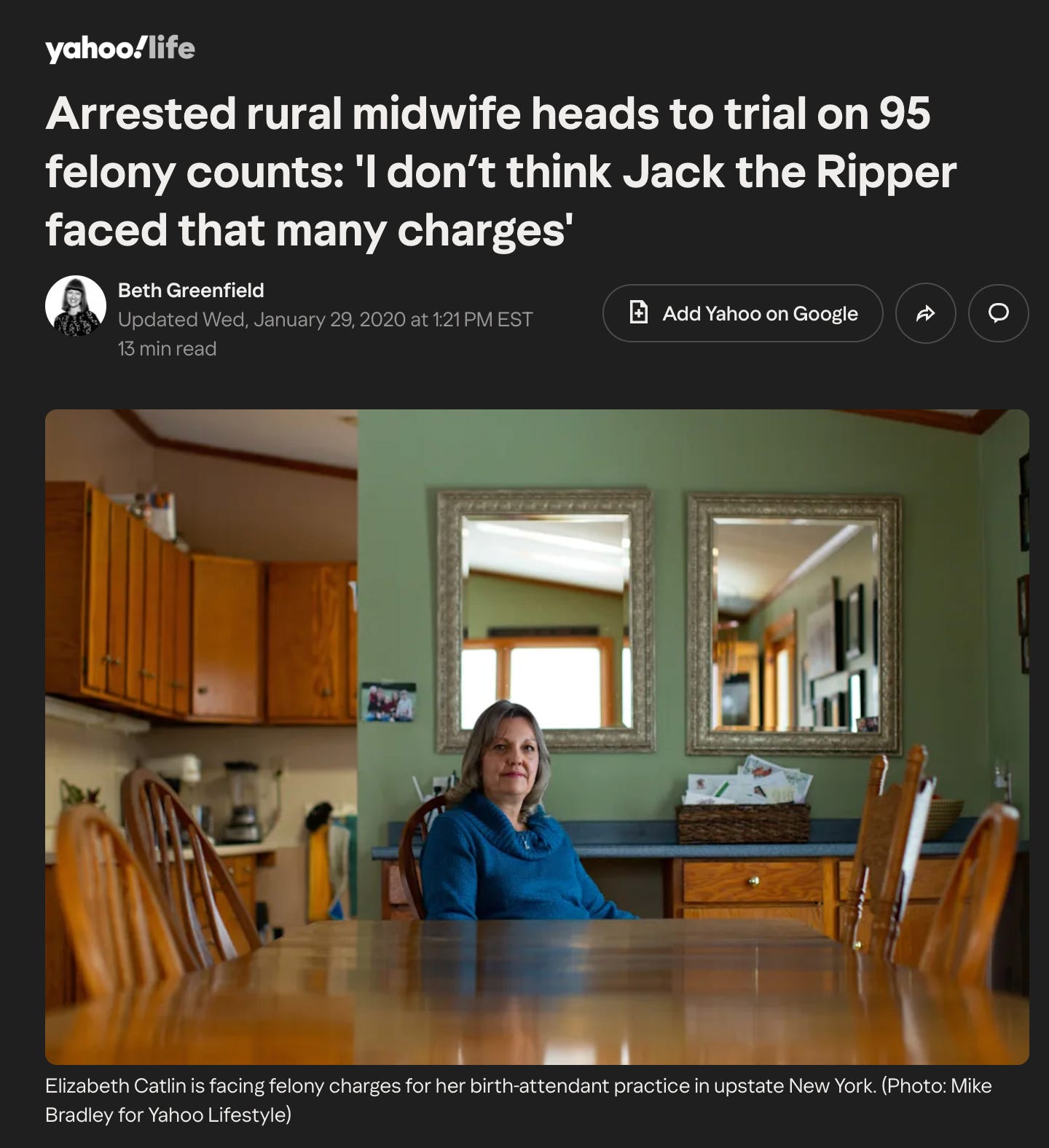
By December 2019, Catlin had been indicted on ninety-five felony counts, including criminally negligent homicide. Bail was raised, most of it in twelve hours, by the Amish and Mennonite communities she had served. She was, in Jennifer Block’s words for Longreads, “free to go after bail, but not free to be a midwife.” Certified nurse-midwives from Rochester filled the void — at fees reportedly at least double what Catlin had charged. Weeks later, New York State Police raided the home of a Mennonite CPM elsewhere in the state and served another CPM with a cease-and-desist.
That is what enforcement can look like, on the record, when the state’s legal posture is that lay midwives may simply “continue to practice … without certificates.” It is the posture Pennsylvania’s Attorney General took, in writing, on July 24, 2026.
The Pennsylvania sequence

Here are the four dates. Each is documented in the primary record.
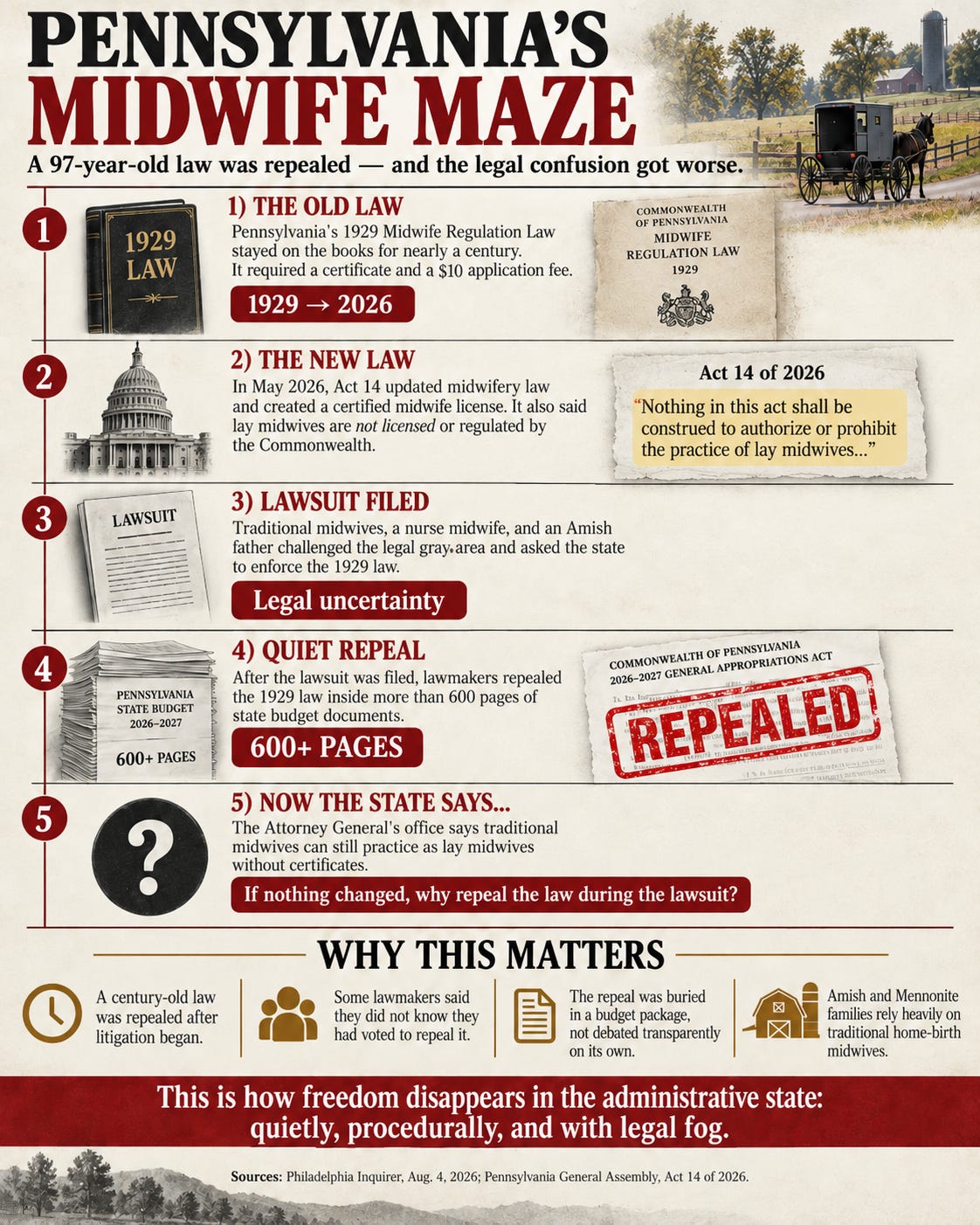
May 6, 2026. Governor Josh Shapiro signs Act 14 of 2026 (SB 507), creating a state Certified Midwife (CM) license under the State Board of Medicine.
July 2, 2026. Two anonymous traditional midwives, one nurse midwife, and one Amish plaintiff file in Commonwealth Court asking the court to hold that the 1929 Midwife Regulation Law remains valid and to compel the Commonwealth to administer it.
July 12, 2026. Ten days after the lawsuit is filed, Governor Shapiro signs Act 21 of 2026, the fiscal-code bill, which expressly repeals the 1929 Midwife Regulation Law effective immediately.
July 24, 2026. Attorney General Dave Sunday’s office files a response asserting that traditional midwives may “continue to practice as lay midwives without certificates” and calling the plaintiffs’ reading a “misreading and misunderstanding of the current law.”
August 2026. The plaintiffs amend their filing to challenge the repeal itself.
That is the extraordinary formulation. Not that the legislature acted eventually, not that it acted quietly, but that ten days after traditional midwives sued to force Pennsylvania to obey its own statute, the Governor signed an omnibus fiscal bill that expressly repealed the statute they had gone to court to enforce — forcing the plaintiffs to amend their case to challenge the repeal itself. That raises an obvious rule-of-law question.
Gillian McGoldrick’s August 4, 2026 Philadelphia Inquirer reporting documents each element: the repeal came after the lawsuit; it was buried in the budget package; Rep. Dave Zimmerman, the Republican whose 99th District contains some of the largest Amish settlements in Lancaster County, said on the record he did not know he had voted for the repeal; a source briefed on budget conversations attributed the request to the Shapiro administration; and the Attorney General’s July 24 filing took the “no certificate required” position. The documents do the work.
What Act 14 does and what Act 14 does not do
Act 14 does something real. It creates a state Certified Midwife license for someone with the same training as a Certified Nurse-Midwife but without the RN prerequisite. That is an expansion of state-licensed midwifery in Pennsylvania. Sen. Rosemary Brown, who authored SB 507, has said on the record that the law “was written to protect traditional midwives’ ability to practice.”
What Act 14 does not do is recreate the distinct traditional/lay-midwife certificate regime the 1929 Act established and the Commonwealth Court in Goslin confirmed governed non-nurse midwives. Act 14 routes all new midwifery licensure through the State Board of Medicine and does not, on its face, provide a certification path for the apprentice-trained non-nurse midwife the 1929 statute recognized. Act 21 then repealed the older pathway outright. Read the two together, in the order Pennsylvania passed them, and you have — in the same season, under the same administration — a licensure modernization that expands one framework and a fiscal-code cleanup that erases the other.
The safety literature, honestly
The comparative literature on planned home birth is contested, and honest sourcing requires acknowledging that. For carefully selected low-risk pregnancies attended by qualified midwives inside an integrated system with reliable hospital transfer, planned home birth can achieve good outcomes with fewer interventions. A 2024 U.S. study by Cheyney et al. published in PubMed found planned home birth comparable to birth-center birth among low-risk patients. A 2026 meta-analysis found fewer maternal complications while reporting a possible increase in peri- and neonatal mortality on low- or very-low-certainty evidence. The Cochrane randomized evidence remains profoundly insufficient.
That is the honest scientific frame — and it is precisely why training, careful selection, and reliable transfer are the load-bearing beams of a working home-birth system. It is precisely why a functional legal pathway matters. Legal ambiguity discourages timely consultation and transfer. Criminalization closes both. The Pennsylvania legislature has just made that argument harder to answer.
What the working system actually looks like
The evidence for the cooperative midwife–specialty-clinic ecosystem the Pennsylvania system currently sustains is on the record. The Clinic for Special Children in Strasburg, Pennsylvania — the Amish and Mennonite pediatric genetic clinic Dr. D. Holmes Morton founded in 1989 — has cared for more than two thousand patients from these communities and documented more than one hundred fifteen distinct recessive disorders, publishing in peer-reviewed journals.
The Clinic’s own 2018 case study, written by Kelly Cullen, records how nurse midwife Danielle Malik caught a below-normal pulse-oximetry reading within hours of delivering Josephine Sensenig, daughter of Mallory Sensenig of Denver, Pennsylvania. The baby was immediately seen by pediatric cardiologist Dr. Devyani Chowdhury of Cardiology Care for Children, admitted to the NICU at Heart of Lancaster for fluid in her lungs, and released two days later. She turned one on January 25, 2019.
That is what a working handoff between a trained midwife and a specialty clinic looks like inside a stable legal framework. Named practitioner. Named cardiologist. Named baby. Named hospital. On the record, in the Clinic’s own newsletter. It is the strongest available evidence in the United States that a Pennsylvania midwife serving Plain families in Lancaster County — with a working referral relationship to a specialty pediatric clinic when a baby is born with a genetic or cardiac condition that requires one — produces measurable, publishable, cooperative health outcomes. That is the ecosystem the Commonwealth is now making more difficult to sustain.
What Naples Birth Center taught me
I ran the nutrition program at the Naples Birth Center in the years my own children were being born by midwife. That center existed because the state of Florida had, over decades, built and maintained a legal pathway for it. What I watched, week after week, was families making an informed choice, cared for by midwives with legal standing under Florida law, in a facility with real medical equipment and a real transfer agreement to the local hospital, delivering babies whose outcomes were tracked and published. It was a working system.
Pennsylvania in the summer of 2026 has done the opposite: repealed the older pathway and left in its place a state license administered by the State Board of Medicine — and done this in the state that holds the country’s largest Amish population and whose traditional midwives have, for decades, been asking the Commonwealth to make the pathway meaningful. The repeal leaves Pennsylvania traditional midwives without the statutory certificate pathway that had distinguished their legal position — raising the kind of enforcement uncertainty illustrated, under a different state regime, by Elizabeth Catlin’s prosecution in New York. The plaintiffs’ Commonwealth Court case is now that pathway’s only remaining forum.
The wider pattern
This is not the only instrument the Commonwealth landed on the same community in the same summer. In June 2026, the Pennsylvania Department of Health filed Regulation 10-242 / IRRC #3490, a 502-page rewrite of the state’s disease-control rules under Chapter 27 of Title 28. The rewrite gives the Department powers a state court told it in 2021 it did not have, defines “school” for the first time to expressly include “any school operated by a bona fide church or other religious body,” expressly restricts funerals “with the body” to immediate relatives and pallbearers whenever the Department declares one of its own public-health emergencies, and reaches — for the first time — “food products made from animals” (milk, cheese, eggs, meat) on the standard of “suspected” contamination. The Department’s own filing documents, on page 122, that “vaccine-preventable diseases occur more often in Amish children than non-Amish children” and, on page 36, that “no special provisions have been developed” for the affected community. I walk through the rewrite section by section, with the page cites, in COVID-Era Tyranny Returns to Pennsylvania — and It Falls Hardest on the Amish.
The IRRC comment period closes September 21, 2026. The plain-English comment guide, with the exact IRRC email address and the five categories where a citizen comment carries the most legal weight in the record, is in 9 Things Pennsylvanians Need to Know About the State’s New Disease Rules — Comment by September 21. If you have not commented yet, that piece is what to read next.
Read the three pieces together and the pattern is what it is. The Department of Health filed the disease rewrite. The Department lost the mask-mandate case in 2021, took the hint, and is now — in the Department’s own words — rewriting its powers back into existence. The legislature repealed the midwifery certificate law. The Attorney General told the court the plaintiffs had it wrong. Each instrument, taken alone, is defensible as neutral. Sort them by the community they most heavily affect. Few communities sit as squarely at the intersection of these pressures as Pennsylvania’s Plain communities.
That is not a conspiracy claim. Nothing in the record establishes coordination. What is in the record is convergence: multiple state instruments, filed and enacted under the same administration in the same summer window, each of which lands on the same community that has the least representation in Harrisburg and, by three centuries of theological practice, will not run for planning commission, will not sign an NDA, will not sue for defamation, and will not vote in most municipal elections. Constitutional injury does not become socially insignificant merely because a law is facially neutral. Neutral rules can impose profoundly unequal burdens.
What can actually be done
The Commonwealth Court midwifery case is live. It is being coordinated through the National Alliance for Traditional Birth Rights (natbr.org/save-pa-midwifery). The plaintiffs’ amended challenge to the Act 21 repeal is pending. NATBR needs funding. Every legal-defense fund in the history of religious-liberty midwifery litigation has been paid for by the neighbors of the community under threat. The Amish are the community under threat here. The neighbors are the rest of us.
If you know a Pennsylvania state senator or representative, ask one question in writing: “Did you know that this year’s fiscal code repealed the 1929 Midwife Regulation Law, and if so, why?” Rep. Dave Zimmerman, whose 99th District is at the epicenter of this, has said on the record that he did not. He should not be the only one asked.
If you know a family, a bishop, or a market-stand vendor in Lancaster, Lebanon, Big Valley, or anywhere else in Plain Pennsylvania: print this piece and hand it over. The information will not reach them any other way. The Amish do not run press. They do not sit on Zoning Hearing Boards. They will not, by the Ordnung, walk into a state legislator’s office. Outsiders, in Plain terms, are the community’s hands and feet in the courtroom.
If you are a midwife, birth-center director, doula, or family-medicine physician who has ever transferred a mother from a home birth and been treated with respect at the receiving hospital, the plaintiffs need declarations from the profession. Contact NATBR at the link above. The Clinic for Special Children downstream has been the medical partner of Plain-community home birth for a generation, and every Pennsylvania OB who has ever taken a warm handoff from a lay midwife knows exactly how the system was actually working before the state stopped answering the 1929 applications.
And if you are a Pennsylvanian who has not yet filed a comment on Chapter 27, do that this week. Comment deadline: September 21, 2026. Email: RA-DHCHAPTR27PROPREG@pa.gov. Subject line: Regulation #10-242 / IRRC #3490. Paper: Independent Regulatory Review Commission, 555 Walnut Street, Suite 804, Harrisburg, PA 17101. Sign your name. Cite a page. The 9 Things guide tells you what to say.
The heart of it
My children are alive and healthy in part because the state I lived in kept its midwifery statute functional. Pennsylvania has just done, to the largest home-birth community in the United States, the opposite of what Florida did. It has erased the older statute. It has done so inside a fiscal-code bill. It has done so ten days after the community filed suit. It has done so at the request of an administration whose Department of Health, in the same window, is drafting a disease-control rewrite that reaches into the same community’s schools and funerals.
The Amish will not fight this. They will, in the community’s own words, take up their cross. Some families will move to Iowa or Tennessee or Wisconsin, as they have been doing already. Others will hold their births in the same upstairs bedrooms, with the same women, and simply hope the State Police do not appear.
They will not go to Harrisburg to defend those rooms. So the rest of us must.
Companion pieces (this three-part series so far):
COVID-Era Tyranny Returns to Pennsylvania — and It Falls Hardest on the Amish. The 502-page Chapter 27 disease-rule rewrite, section by section, with page citations to the Department’s own filing.
9 Things Pennsylvanians Need to Know About the State’s New Disease Rules — Comment by September 21. The plain-English comment guide.
This piece: The Pennsylvania Midwifery Repeal.
Support the legal defense: National Alliance for Traditional Birth Rights, natbr.org/save-pa-midwifery.
Sources for this piece: Pennsylvania Midwife Regulation Law of 1929 (Act 155 of 1929), 63 P.S. §§ 171–176 (palegis.us, 1929 Act 155 PDF); Act 14 of 2026 (Midwife Modernization Act, formerly SB 507, signed May 6, 2026 — palegis.us SB 507 page); Act 21 of 2026, signed July 12, 2026 (palegis.us, 2026 Act 21 PDF; Pennsylvania Bulletin vol. 56, no. 31); Goslin v. State Board of Medicine, Commonwealth Court of Pennsylvania (2008) (Justia); Gillian McGoldrick, “Why Pennsylvania quietly repealed its 1929 midwifery law — and is now getting sued for it,” Philadelphia Inquirer, August 4, 2026 (inquirer.com); Jennifer Block, “The Criminalization of the American Midwife,” Longreads, March 10, 2020 (longreads.com); Kelly Cullen, “Pulse Oximetry,” Clinic for Special Children, December 4, 2018 (clinicforspecialchildren.org); Cheyney et al., “Planned Home Births in the United States Have Outcomes Comparable to Planned Birth Center Births for Low-Risk Birthing Individuals,” PubMed (2024); Roberta Devers-Scott biographical detail: Mt. Laurel Midwifery (mtlaurelmidwifery.com).
Government is such a waste of time. They destroy everything that is good and decent. Everything.
I birthed both of my children at home with a midwife. It was a beautiful and life-changing experience. It was so positive, I said I wasn't interested in having more kids if I couldn't do it from home. My second child was an 11 pound, 9 ounce baby, a big boy. Delivery was comfortable, caring and actually pretty easy with my midwife's care. No episiotomy, no tearing. I never would have been allowed to deliver naturally in a hospital carrying a baby that large, it would have been a C-section all the way. So I also feel passionately about our ability to deliver babies with midwives — birth the way we want it. No vaccines, no antibiotics, no stress, no strangers making our decisions while we carry out one of the most important actions of our lives...bringing a new life into the world. Moving away from this freedom is a horrible direction.