


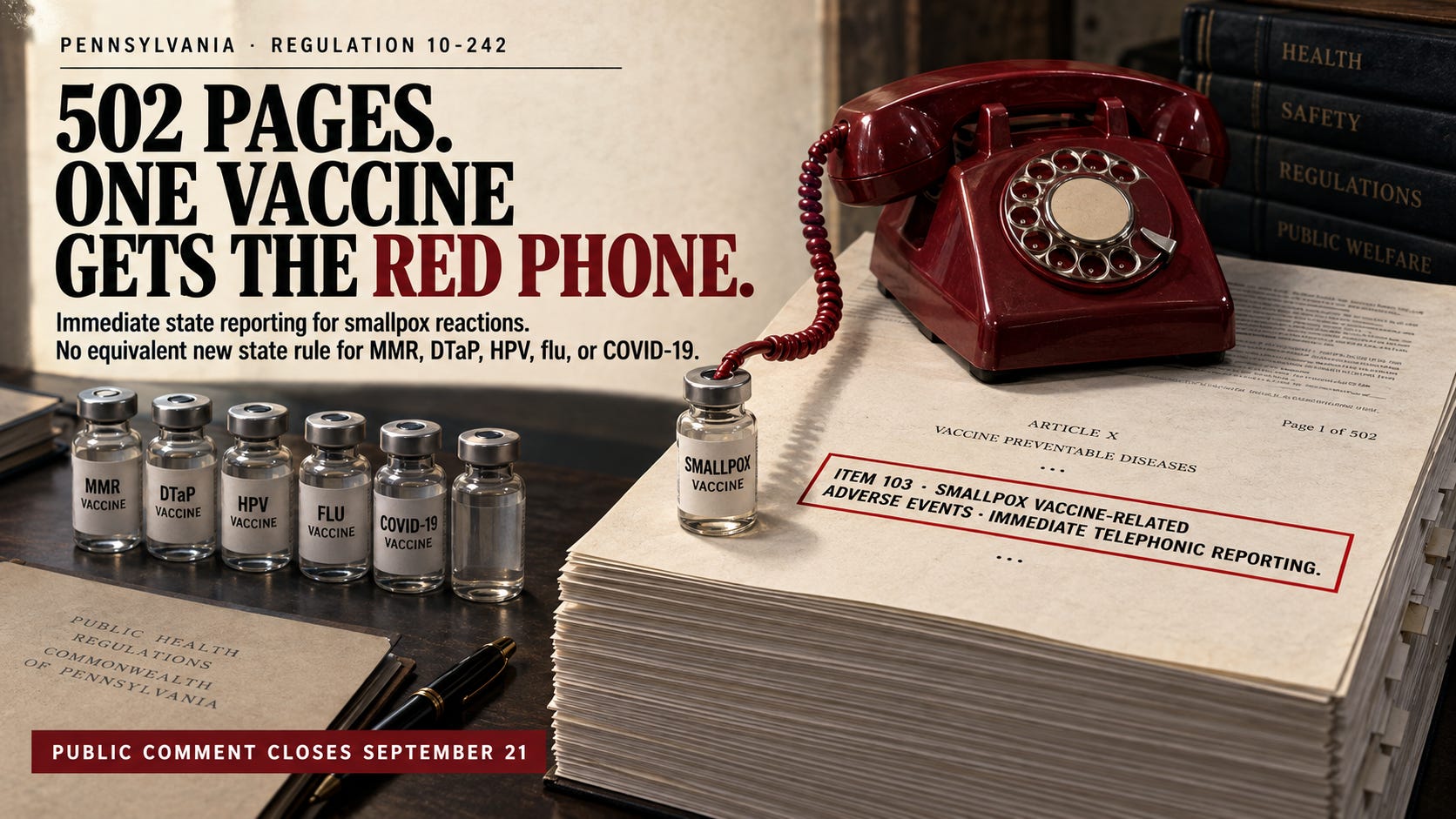
Regulation 10-242, buried on page 30 of a 502-page rewrite, adds state-level immediate telephonic reporting for smallpox vaccine reactions — and nothing analogous for MMR, DTaP, HPV, flu, COVID-19, or any other vaccine millions of Pennsylvanians actually receive. Public comment closes September 21.
⏰ Public comment closes Monday, September 21.
You have eight days to put an objection on the record. Every comment filed becomes part of the docket the Independent Regulatory Review Commission must consider before this regulation is finalized.
Email: RA-DHCHAPTR27PROPREG@pa.gov
Subject line: Public Comment — Regulation #10-242 / IRRC #3490
Or file directly with IRRC: irrc.state.pa.us/contact/comments.cfm
A ready-to-send comment is at the bottom of this piece. Adapt it, sign it, send it. Identical form letters are bundled into one file on the docket — a few sentences in your own words carry more weight.
On August 8, 2026, the Pennsylvania Department of Health published Regulation 10-242 in the Pennsylvania Bulletin — a 502-page rewrite of the state’s disease-control code, 28 Pa. Code Chapter 27. Public comment closes September 21.
The Tenth Thing Pennsylvanians Need to Know
This discovery is not an isolated provision. It is buried inside the same 502-page rewrite I examined in 9 Things Pennsylvanians Need to Know About the State’s New Disease Rules.
That investigation documented the broader architecture of Regulation 10-242: expanded disease-control powers, longer school exclusions, private interviews with students, increased access to medical records, removal of a religious-treatment accommodation, and a new definition of “public health emergency.”
Now there is a tenth problem: Pennsylvania is creating immediate state-level reporting for adverse reactions to the smallpox vaccine—a vaccine almost no Pennsylvanian receives—while adding no equivalent reporting requirement for MMR, DTaP, HPV, influenza, COVID-19, or any other routinely administered vaccine.
Read the foundational investigation, then examine the newly uncovered reporting asymmetry:
Read: 9 Things Pennsylvanians Need to Know →
Item 103 of the new reportable-conditions chart, verbatim:
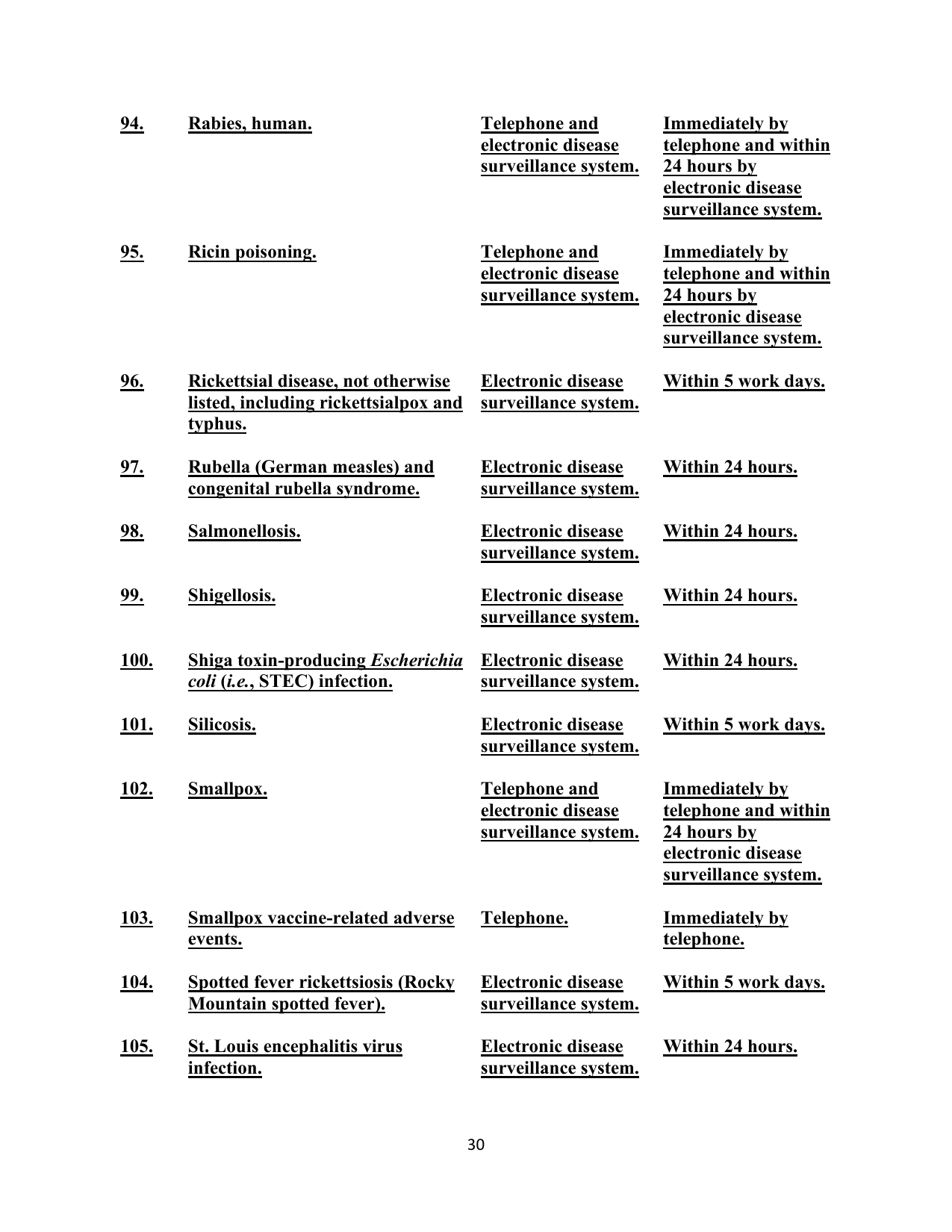
That is the entire item. The Pennsylvania Department of Health is proposing that healthcare providers must report smallpox vaccine adverse events to the state, immediately, by telephone.
The Department’s stated justification runs one paragraph, on page 119 of the preamble:
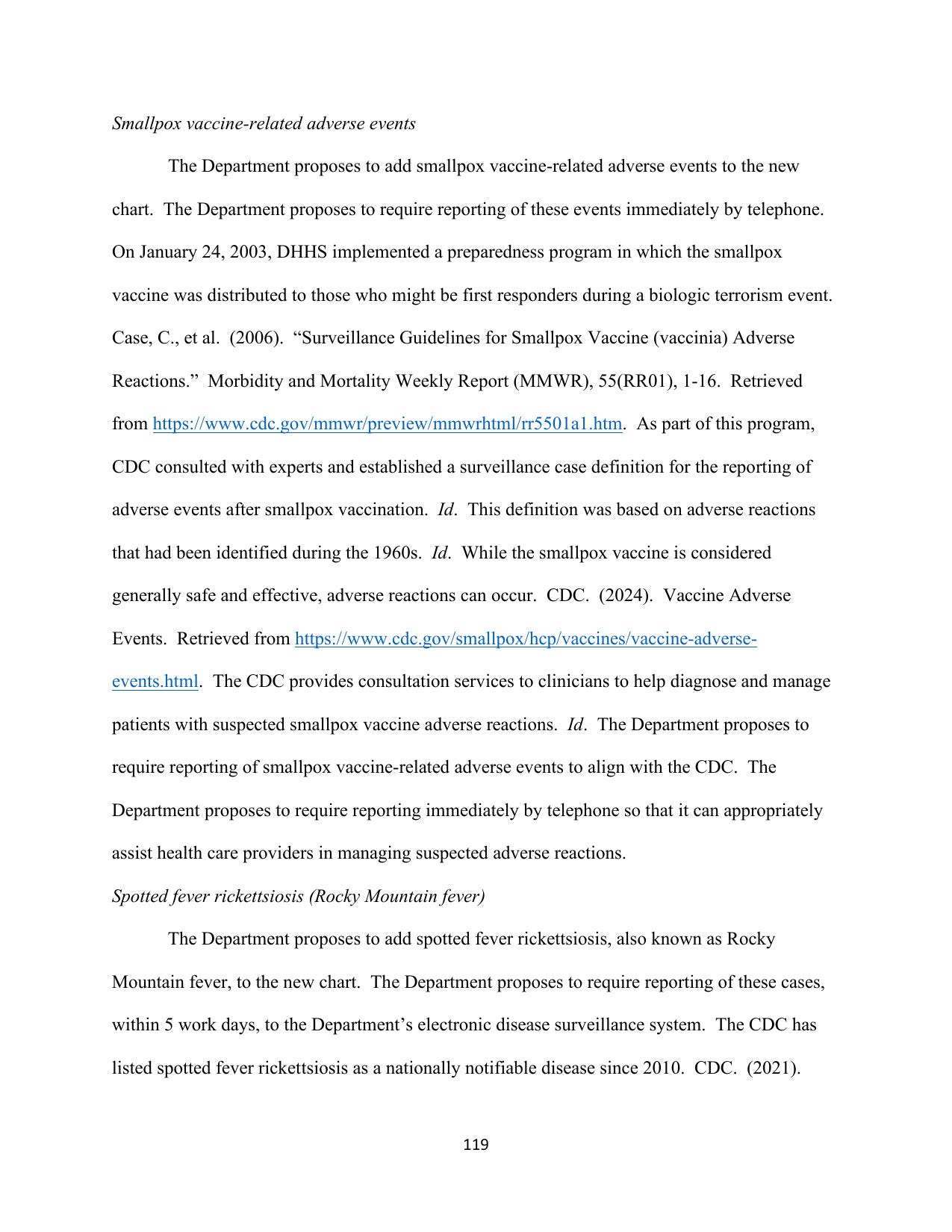
The rationale, distilled: in 2003 the federal government distributed smallpox vaccine to first responders anticipating a bioterrorism event, the CDC published a surveillance case definition in 2006, and PA now proposes to import that framework into state code “to align with the CDC.”
Two documents. From 2003 and 2006. As the reason a state agency is drafting immediate-telephonic adverse event reporting infrastructure — for a vaccine that essentially no Pennsylvanian currently receives.
What the same 502 pages do not add
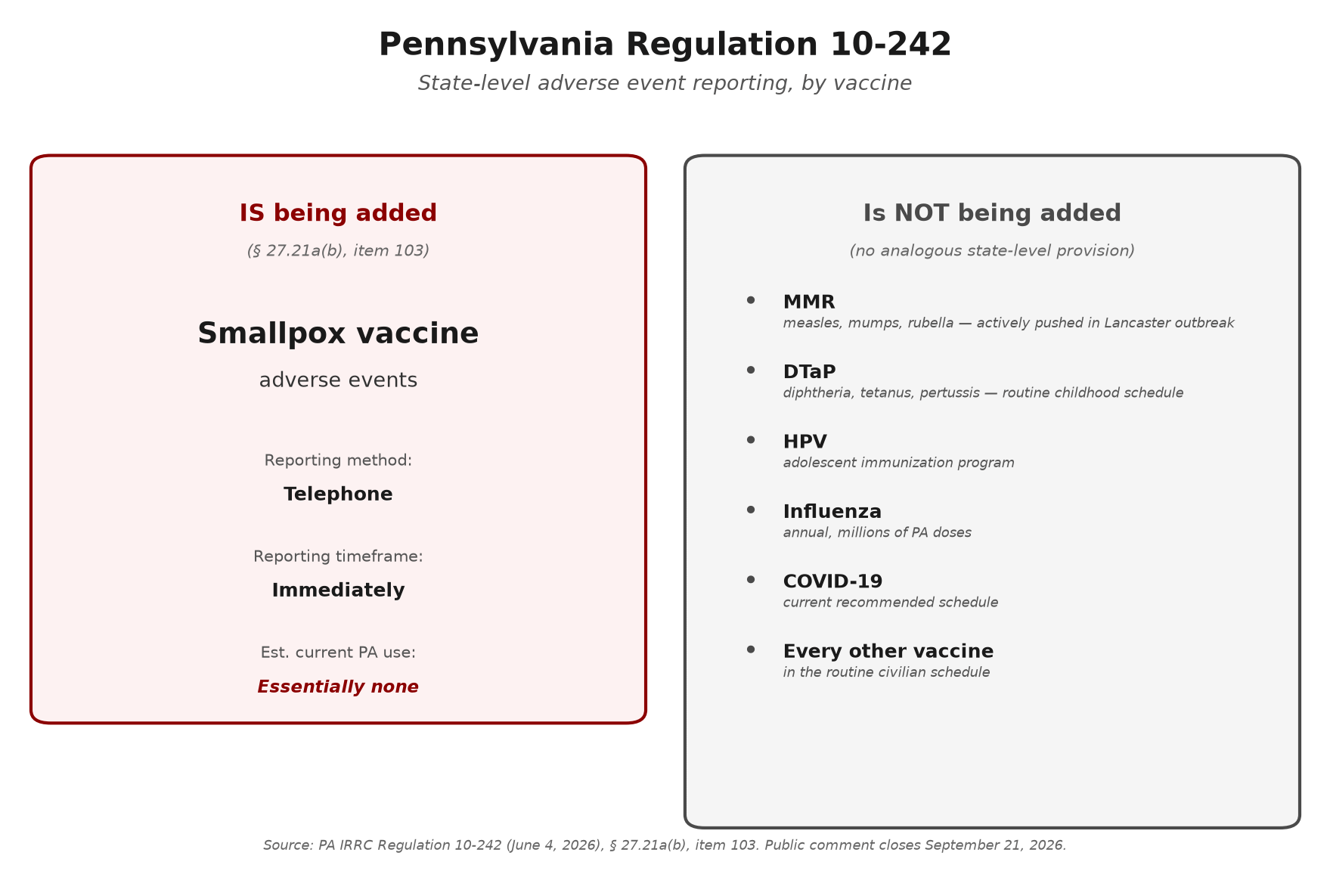
I searched the entire regulatory analysis form for every mention of “vaccine adverse event,” “VAERS,” “vaccine reaction,” or any analogous language.
There is one vaccine to which state-level adverse event reporting is being added.
The list of vaccines to which no analogous state-level reporting requirement is being added:
MMR — the vaccine currently being promoted across Pennsylvania during an active measles outbreak that has reached 676 cases in 37 counties as of September 11.
DTaP — routine childhood schedule.
HPV — adolescent immunization program.
Influenza — annual, millions of PA doses.
COVID-19 — currently on the recommended schedule.
Every other vaccine in the routine civilian schedule.
The federal VAERS system is the default answer for why state-level reporting isn’t needed for those vaccines. Which raises the obvious question: if VAERS is adequate for MMR, DTaP, HPV, flu, and COVID-19, why isn’t it adequate for smallpox? And if VAERS is not adequate for smallpox — which is what a state-level immediate telephonic reporting requirement necessarily implies — why is it adequate for the vaccines Pennsylvanians actually receive by the millions?
Either answer is a substantive problem. Only one of them can be true.
Why this asymmetry matters right now
The regulation is being proposed at a moment when the peer-reviewed record establishes three things about the measles-vaccination landscape in Pennsylvania that the state’s surveillance infrastructure is not currently equipped to track.
First: MMR-vaccinated people can transmit measles. Wright et al., “Do vaccinated cases transmit measles? A systematic review and meta-analysis,” published in Expert Review of Vaccines on August 14, 2026, documented 70 vaccinated transmitters across 33 outbreak investigations in 18 countries, 22 of whom had received two or more doses. The paper’s own operational conclusion, verbatim: transmissions from vaccinated cases “must be considered in public health investigations, as such transmissions can contribute to outbreaks.” I reported on this paper here.
Second: vaccine-strain measles RNA is shed after MMR, in patterns that routine clinical PCR cannot distinguish from wild-type virus. Vaccine-strain measles has been recovered from urine and respiratory specimens after MMR administration; a 2024 study by Watkins and colleagues found vaccine-strain RNA in 34.4% of post-first-dose respiratory specimens tested within 30 days of vaccination, with median detection at 11 days and detection up to 29 days post-vaccination. Standard clinical measles PCR does not distinguish vaccine from wild-type strain; only sequencing (genotyping) does, and most outbreak surveillance does not systematically genotype. I covered the boundaries of what PCR can and cannot establish in The Measles Certainty Gap.
Third: Pennsylvania is conducting simultaneous pyrethroid pesticide operations in the outbreak counties — the largest black-fly aerial larvicide program in the country combined with residential truck-fogging with synthetic pyrethroid adulticides. Pyrethroids are documented in peer-reviewed studies to cause respiratory symptoms and skin reactions, and their neurodevelopmental and immune effects in children are well documented. I reported on the pesticide operations here.
Put those three together and you have, right now, in Pennsylvania:
A population being actively encouraged to take MMR during a live outbreak.
A vaccine that sheds detectable measles RNA for weeks post-administration.
A meta-analysis co-authored by CDC’s own measles laboratory scientists documenting that vaccinated people can transmit measles.
Pesticide operations across the same counties producing respiratory and dermatological symptoms that create clinical noise in the outbreak setting.
A state surveillance apparatus that captures none of the adverse events from any of it — because the state is drafting the reporting mechanism only for a vaccine no one is getting.
The moment when adverse event reporting infrastructure would matter most is the moment the state has chosen to not build it.
What the DOH is telling itself
Read the preamble justification again. The Department writes that smallpox vaccine adverse event reporting is being added because “while the smallpox vaccine is considered generally safe and effective, adverse reactions can occur.” That is a general statement about vaccines. It applies to MMR. It applies to DTaP. It applies to every vaccine on the schedule.
The Department writes that CDC provides consultation services to clinicians “to help diagnose and manage patients with suspected smallpox vaccine adverse reactions.” CDC also provides adverse event consultation for every other vaccine, through VAERS and through VICP.
The Department writes that it proposes to require immediate telephonic reporting “so that it can appropriately assist health care providers in managing suspected adverse reactions.” That would be equally valuable — arguably far more valuable — for the vaccines currently being administered to Pennsylvanians in volume during an active outbreak.
The reasoning the DOH gives for building state-level reporting infrastructure for smallpox vaccine adverse events is reasoning that applies to every other vaccine. The Department applied it to one vaccine only.
The comment period
Regulation 10-242 is not yet law. It is a proposed rulemaking, published for public comment. The comment period closes September 21, 2026 — eight days from today.
Public comments filed during this window become part of the docket that the Independent Regulatory Review Commission considers before the regulation is finalized. Every filed comment increases the weight on the docket. As of last week, roughly 990 comments had been filed, most opposed.
The comment on the smallpox-only reporting asymmetry writes itself. Here is a version anyone can adapt:
To: RA-DHCHAPTR27PROPREG@pa.gov
Subject: Public Comment — Regulation #10-242 / IRRC #3490I am writing to comment on proposed rulemaking 10-242. I object to the addition of smallpox vaccine-related adverse events at § 27.21a(b), item 103 (page 30 of the Annex), while no analogous state-level adverse event reporting requirement is added for any other vaccine currently in widespread use in Pennsylvania.
The Department’s stated rationale — that adverse reactions can occur, that CDC provides clinician consultation, and that immediate reporting would help the Department assist providers in managing adverse reactions — applies with equal or greater force to MMR, DTaP, HPV, influenza, COVID-19, and every other vaccine currently on the routine civilian schedule.
Either federal VAERS is adequate for adverse event reporting, in which case there is no evident need for the smallpox-specific state-level requirement being proposed. Or federal VAERS is inadequate, in which case the same inadequacy applies to the vaccines millions of Pennsylvanians receive annually and the Department’s proposal is arbitrarily narrow.
I ask that the Independent Regulatory Review Commission require the Department to either (a) remove the smallpox-only adverse event reporting provision, (b) extend equivalent state-level adverse event reporting requirements to all vaccines currently on the recommended schedule, or (c) provide a written explanation for why smallpox specifically warrants state-level reporting infrastructure that no other vaccine requires — a justification that the current preamble does not supply.
[Your name and address]
Email that to RA-DHCHAPTR27PROPREG@pa.gov with “Regulation #10-242 / IRRC #3490” in the subject line before September 21. You can also file directly with the Independent Regulatory Review Commission at irrchelp@irrc.state.pa.us or through the IRRC website.
The full 502-page regulation is at the IRRC docket for regulation 10-242. The smallpox provision is Annex A, § 27.21a(b), item 103, on page 30. The preamble justification is on page 119.
Read them yourself. The asymmetry is on the page.
Sources: Pennsylvania Independent Regulatory Review Commission, Regulation 10-242 (published August 8, 2026); Wright et al., “Do vaccinated cases transmit measles? A systematic review and meta-analysis,” Expert Review of Vaccines, August 14, 2026; Watkins et al. 2024, on vaccine-strain measles RNA detection post-MMR; Pennsylvania Department of Health measles case tracker, September 11, 2026 update. Pennsylvania Is Quietly Building Adverse Event Reporting for the One Vaccine No One Gets
Regulation 10-242, buried on page 30 of a 502-page rewrite, adds state-level immediate telephonic reporting for smallpox vaccine reactions — and nothing analogous for MMR, DTaP, HPV, flu, COVID-19, or any other vaccine millions of Pennsylvanians actually receive. Public comment closes September 21.
Are they planning to blame something on smallpox? And then planning to find the traditional jab unsafe so they can swap in mRNA version? To manipulate the public to actually demand an mRNA smallpox vaccine? Somebody have another hypothetical here?
I still have no idea if out-of-staters can comment... but I did, just in case my comment counts.