


Universal postpartum home visits are voluntary. The immunization registry is not opt-out. A pending bill would eliminate religious school-vaccine exemptions. And Massachusetts has already linked home-visiting records with other state health data for evaluation.


Something significant is happening in Massachusetts.
And the most alarming version circulating online is not quite accurate.
Governor Maura Healey is not ordering government nurses into every home with a newborn. Massachusetts’ universal postpartum-home-visiting law expressly defines the service as voluntary, and allows a visit to occur at the family’s home or another mutually agreed location. I found no provision making vaccination a condition of participation, no provision penalizing parents who decline the visit, and no evidence that Welcome Family personnel are authorized to enter a home without consent. M.G.L. c.111 §248
That distinction matters.
Because once the exaggerations are removed, what Massachusetts is actually building still deserves close scrutiny.
On September 15, Governor Healey announced a proposal for an additional $2 million to expand the Department of Public Health’s Welcome Family program statewide. The program currently serves about 3,000 births per year; Massachusetts officials have described a statewide universe of roughly 68,000 births annually. Governor Healey announcement, Sept. 15, 2026
The timing also has an immediate maternal-health context that should not be omitted. The announcement came amid heightened Massachusetts attention to postpartum mental health. That humanitarian rationale and the privacy questions examined here can both be true. The question is not whether postpartum families deserve support. It is what data architecture accompanies a program as voluntary services become statewide infrastructure.
Then Healey described the program in her own words.
One day after the announcement, Governor Maura Healey appeared on GBH and said:
“Everybody in the state when you have a baby you’re going to have a home visit.”
She continued that the visit would provide “an opportunity for a health care provider to make an assessment” and determine whether additional support or resources were needed.
The distinction matters: Massachusetts’ official materials describe Welcome Family as voluntary. Healey’s remarks therefore do not establish compulsory home visits. But her description raises a more concrete question:
What exactly is being assessed, what is recorded, and what happens to that information afterward?
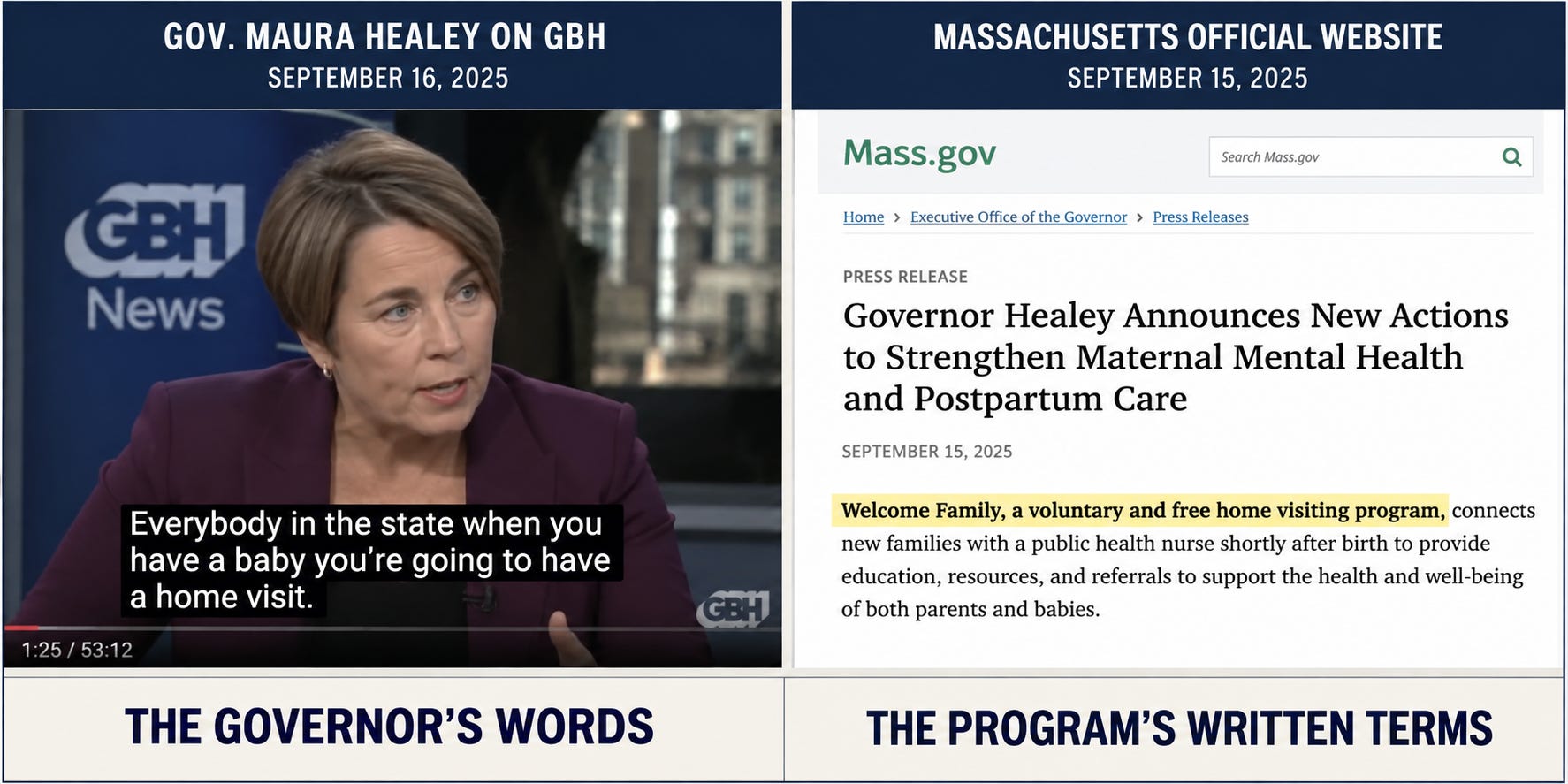
Welcome Family is not simply a baby-care tutorial. According to the family-facing state materials, the nurse performs a health check of parent and newborn, discusses feeding and nutrition, asks about emotional health and depression, considers home safety, connects families with resources, and follows up two to three weeks later. Welcome Family information for families
Massachusetts itself describes the program’s goal as serving as an:
“entry point into the system of care.”
Welcome Family information for providers
EXHIBIT 1 — UNIVERSAL DOES NOT MEAN MANDATORY
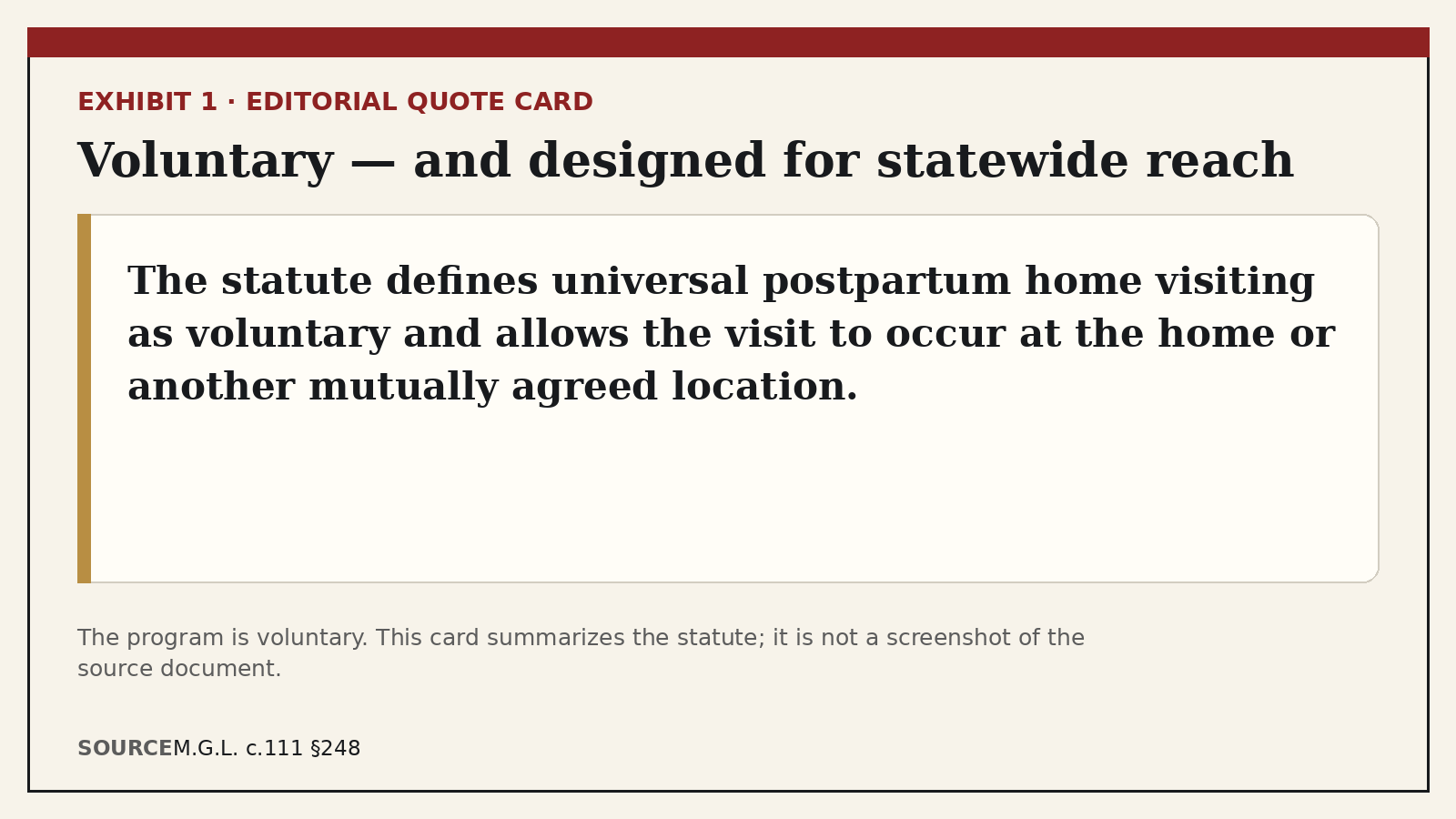
Editorial quote card based on M.G.L. c.111 §248; not a screenshot of the statute.
The statute defines universal postpartum home visiting as voluntary home- or community-based services. At least one visit is to take place at the patient’s home or another mutually agreed location within eight weeks after birth. DPH may administer the system directly or through contractors. M.G.L. c.111 §248
But the law also requires programs receiving state or federal funding to report information requested by DPH for monitoring, assessing effectiveness, quality improvement, and reducing disparities. The statute itself does not enumerate every individual data field that DPH may request.
The State’s Own Advisory Process Raised the Trust Question
In May, Massachusetts convened the Welcome Family Statewide Expansion Advisory Committee. Its remit includes workforce, outreach, community engagement, equitable access, and “data-driven quality monitoring.” Welcome Family Advisory Committee
In the May 11 minutes, under the heading “Fear related to the political landscape,” the committee’s follow-up questions included:
“How can the program help families overcome fear or hesitation about allowing state affiliated nurses into their homes?”
Welcome Family Advisory Committee minutes, May 11, 2026
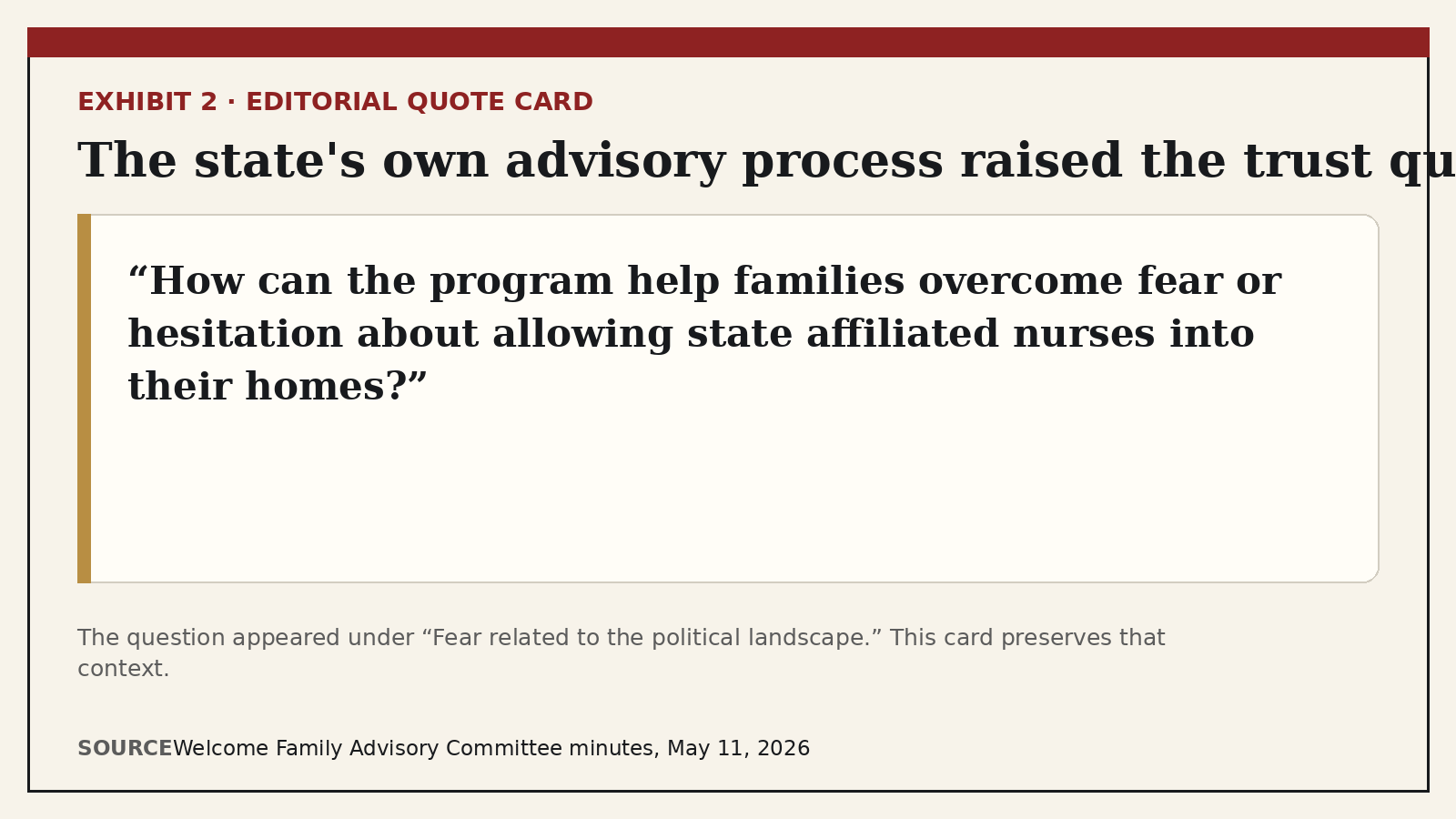
Editorial quote card. The source is the official May 11, 2026 advisory-committee minutes; the question appeared under “Fear related to the political landscape.”
That context matters. The minutes do not allege misconduct by Welcome Family, nor do they say families are being compelled to admit visitors. They show that the state’s own advisory process recognizes that government affiliation can affect whether families are willing to open their homes.
The same discussion contemplated Community Health Workers as a way to bridge trust gaps and reduce fear associated with state or local-government visits. Rather than treating that as evidence of wrongdoing, it is more accurate to treat it as evidence that trust and government affiliation are recognized implementation issues.
The committee materials also discuss broader reach, higher referral and utilization rates, community engagement, and system coordination. June 8 meeting · July 13 meeting
And the scope of assessment is expanding.
Moments later, Healey said Massachusetts would “expand the kinds of screenings” to account for mental-health issues and disorders beyond postpartum depression.
Her wording should not be read as a clinical protocol requiring every parent to be screened for every psychiatric disorder. But it makes the missing operational documents increasingly important: the actual assessment instrument, screening protocol, consent and privacy forms, data fields, and rules governing where the resulting information can go.
Those are the documents needed to determine where a voluntary postpartum support program ends—and a broader state health-data system begins.
Then There Is the Immunization Registry
Participation in Welcome Family is voluntary.
Reporting of administered immunizations to the Massachusetts Immunization Information System, or MIIS, is not optional for providers. Massachusetts law requires licensed health-care providers who administer vaccines to report them to MIIS. M.G.L. c.111 §24M
The state’s own public guidance says:
“There is no option to ‘opt-out’ of the MIIS.”
Residents may object to broader data sharing. If they do, the immunization record remains in MIIS, and DPH and the provider that administered the vaccine retain access. MIIS forms and objection guidance
The governing regulation goes further: a data-sharing objection “shall not limit the Department’s access to and use of immunization information.” 105 CMR 222.003
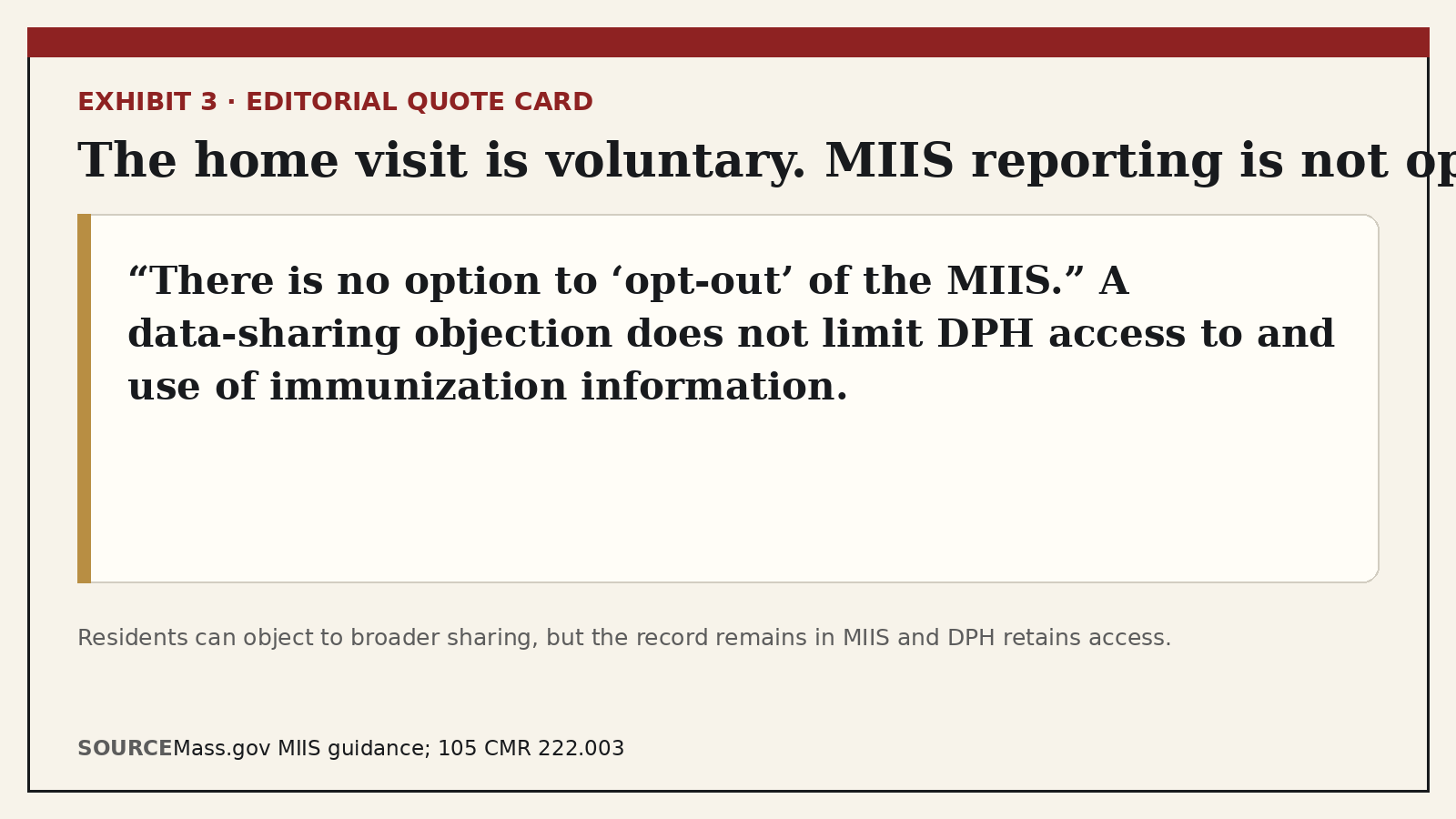
Editorial quote card based on Mass.gov MIIS guidance and 105 CMR 222.003.
The statute permits access by defined categories of recipients, including treating health-care providers; school nurses and registration officials who require proof of immunization for enrollment and disease control; local boards of health; WIC personnel; and staff of state agencies or programs whose duties include education and outreach related to improving immunization coverage among their clients. M.G.L. c.111 §24M
That does not establish that a Welcome Family clinician routinely has MIIS access. I have found no current document demonstrating that operational connection. That is one of the questions Massachusetts should answer.
The Data Have Already Been Linked — for Evaluation
This is an important finding, but it also needs careful interpretation.
Massachusetts has previously used linked home-visiting data in program evaluation. In federal maternal-and-child-health reporting, the state described evaluation work linking home-visiting program-management data with vital records, hospital utilization data, health-care claims, and Early Intervention information. Massachusetts Title V / HRSA reporting
Linking administrative datasets for public-health research is not unusual, and nothing identified here establishes that these historical linkages were improper. They may have been conducted under research agreements, privacy controls, de-identification, or other safeguards.
That is not the question.
The prospective question is: as Welcome Family moves toward statewide availability, what identifiable information is collected from participating families, what systems receive it, what secondary uses are permitted, and what data-sharing agreements govern those uses?
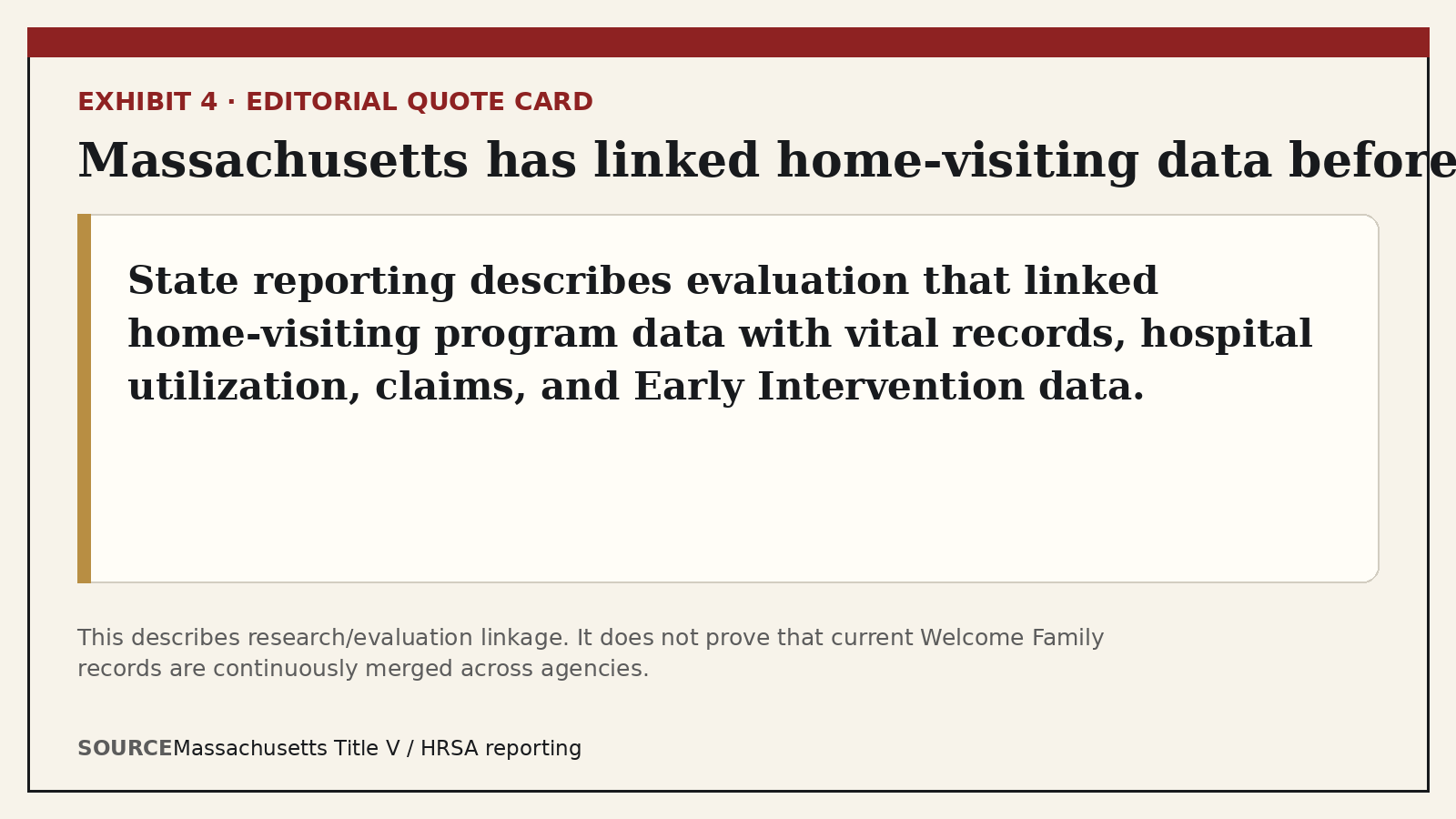
Editorial quote card summarizing Massachusetts Title V/HRSA reporting. Historical research linkage does not establish a current continuously merged cross-agency record.
There Is Another Legal Pathway: Mandatory Reporting
Massachusetts’ Welcome Family pages describe visits by experienced maternal-and-child-health nurses, while the statute more broadly authorizes a qualified health professional with maternal and pediatric health training. Welcome Family information for families · M.G.L. c.111 §248
Nurses are mandated reporters under Massachusetts law. If, while acting in a professional capacity, a mandated reporter has reasonable cause to believe a child is suffering qualifying abuse or neglect, a report to DCF can be required.
The current DCF Protective Intake Policy defines neglect to include failure to provide minimally adequate food, clothing, shelter, medical care, supervision, education, emotional stability and growth, or other essential care, while also stating that a neglect determination cannot result solely from inadequate economic resources or solely from a parent’s or caregiver’s disability. DCF Protective Intake Policy, revised Feb. 27, 2026
That creates a genuine but conditional pathway:
voluntary visit → professional observation or assessment → qualifying concern → mandated report → DCF screening or investigation.
But the evidentiary boundary is important. I found no Massachusetts policy stating that ordinary refusal of routine vaccination automatically constitutes neglect. I found no policy saying refusal of Welcome Family itself constitutes neglect, and no evidence that declining a visit automatically triggers a DCF referral.
Massachusetts case law also cautions against collapsing vaccination disputes into automatic findings about parental rights. In Care & Protection of Eve, 496 Mass. 42 (2025), the Supreme Judicial Court addressed residual parental religious rights in a vaccination dispute involving DCF custody. The decision is additional reason not to overstate what current child-welfare law authorizes.
At the Same Time, Massachusetts Is Moving on Vaccine Exemptions
House Bill H.2554, “An Act relative to routine childhood immunizations,” would eliminate Massachusetts’ religious vaccination exemption for children entering public, private, and charter K–12 schools and would expand school reporting to DPH.
As of September 20, 2026, H.2554 has not become law. The official legislative record shows that it was reported favorably and, on April 15, 2026, was referred to the House Committee on Ways and Means, where its status remains. Massachusetts General Court: H.2554
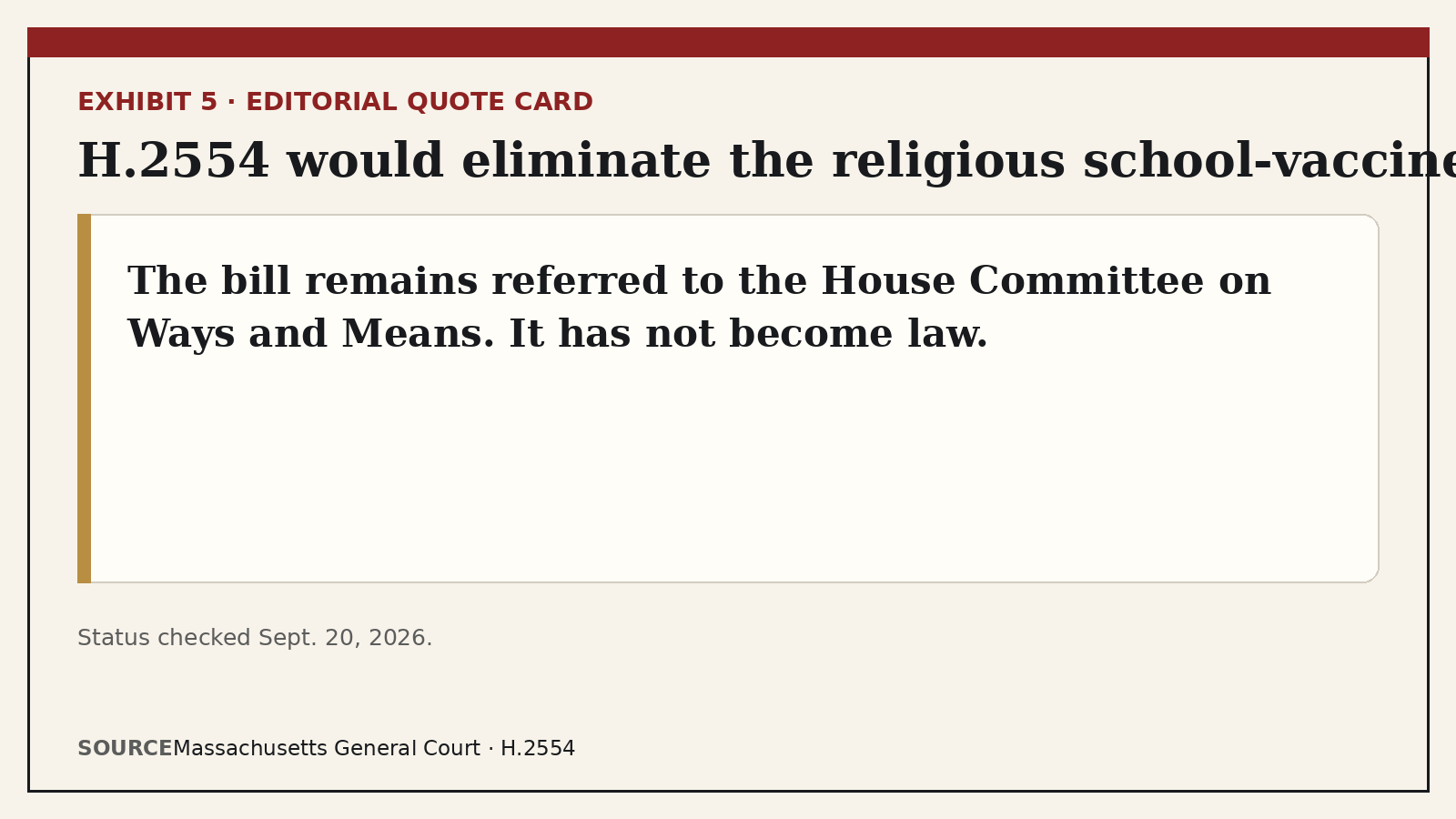
Editorial quote card. H.2554 is pending legislation, not enacted law, as of Sept. 20, 2026.
Existing Massachusetts law already limits the religious school-vaccine exemption during an emergency or epidemic declared by DPH. The statute says the exemption operates “in the absence of an emergency or epidemic of disease declared by the department of public health.” M.G.L. c.76 §15
Massachusetts Is Also Decoupling Vaccine Guidance From Washington
In January 2026, Massachusetts DPH directed clinicians to use the American Academy of Pediatrics schedule as the state’s primary pediatric vaccine reference. The same guidance also reminded clinicians of their reporting obligations, including documentation of administered immunizations in MIIS. Massachusetts DPH pediatric immunization guidance
That creates a clean, documented institutional connection: Massachusetts can set its own preferred pediatric vaccine guidance while administered immunizations continue to flow through the state reporting system.
Whatever one’s view of the policy merits, the relevant institutional picture now includes:
state vaccine guidance;
state immunization reporting;
state school-entry rules;
state home-visiting infrastructure;
state outbreak powers;
and a pending proposal to narrow exemption rights.
Those systems have different legal purposes. The investigation is about determining where they actually connect, not assuming that they do.
Why Pennsylvania Changed the Way I Look at This
For months I have been investigating Pennsylvania’s measles response, particularly in Lancaster and Lebanon Counties and the Plain/Amish communities affected by that response.
Pennsylvania’s current outbreak began in late April. By June 26, state health officials reported 72 cases in the Lancaster-Lebanon regional outbreak and expanding MMR outreach. Pennsylvania DOH, June 26, 2026
By September 18, Pennsylvania reported 767 cumulative cases across 38 counties and nearly 4,800 MMR vaccinations through 148 pop-up clinics. Pennsylvania DOH, Sept. 18, 2026
Pennsylvania also launched a public school-level immunization database during the outbreak, making local vaccine-coverage and exemption information more granular and visible. Pennsylvania school-level vaccination-rate tool
Separately, my reporting found that Pennsylvania’s public pesticide spray-notification record stopped adding entries after June 25 even as publicly documented mosquito-control applications continued later in the summer. That is a records-transparency question, not evidence that pesticide spraying caused the measles outbreak. The Spray Log Is Now 79 Days Behind Reality
The lesson is methodological: a temporal overlap is not causation; adjacent programs are not necessarily coordinated; and technical interoperability is not proof of abusive data sharing.
But when multiple state systems touching the same families are expanding at the same time, the appropriate journalistic response is to follow the records.
The Missing Documents
I was able to identify the law, the statewide expansion plan, the family-facing visit protocol, the MIIS architecture, the DCF pathway, the pending exemption bill, and historical cross-dataset linkage.
What I have not yet located publicly are the documents capable of answering the central question:
What happens to Welcome Family information after the visit ends?
Massachusetts should publish the current Welcome Family assessment instrument, intake and enrollment forms, consent and privacy forms, data dictionary, field definitions, retention rules, applicable data-use agreements, and the Public Consulting Group scope of work associated with the statewide expansion. The May 11 advisory minutes document DPH and PCG presenting together on the Welcome Family model. May 11 advisory minutes
We also need a definitive answer to whether Welcome Family clinicians can access MIIS and, if so, under what conditions.
Those records would allow the public to distinguish among three very different things:
a voluntary support service;
a statewide public-health data-collection system;
and an integrated surveillance or enforcement architecture.
The evidence currently establishes the first two.
It does not yet establish the third.
The Question Massachusetts Needs to Answer
Massachusetts can resolve this with primary documents.
Publish the forms. Publish the data dictionary. Publish the privacy and retention rules. Publish the relevant data-sharing agreements. Identify every database into which identifiable Welcome Family information is entered or matched. Explain whether vaccine status is collected, whether MIIS is queried, and how families are informed of secondary uses.
And there should be a clear commitment on the reporting side as well:
If those records show strict separation, narrow purpose limitations, no MIIS access, and strong privacy protections, that should be reported. If they show broader integration, the public deserves to know that too.
Because the documented question is not whether nurses are being forced into homes.
It is this:
Massachusetts is creating a public-health system capable of reaching families shortly after birth. Exactly what information follows a participating family into the state once the visit is over?
What this investigation does — and does not — establish
Established: Massachusetts has enacted a voluntary statewide postpartum-home-visiting framework; the Healey administration is proposing funding to expand Welcome Family statewide; providers must report administered immunizations to MIIS; DPH retains access to MIIS information even when an individual objects to broader sharing; Massachusetts has previously linked home-visiting data with other administrative datasets for evaluation; nurses are mandated reporters; and H.2554 would eliminate the K–12 religious vaccine exemption if enacted.
Not established: compulsory home entry; automatic DCF referrals for refusing Welcome Family; automatic child-neglect findings for vaccine refusal; routine Welcome Family access to MIIS; or a current unified database that automatically combines every Welcome Family assessment with immunization, welfare, and child-protection records.
Sources
1. M.G.L. c.111 §248 — universal postpartum home visiting.
2. Governor Healey, Sept. 15, 2026 — maternal mental health and postpartum care announcement.
3. Welcome Family information for families.
4. Welcome Family information for providers.
5. Welcome Family Advisory Committee minutes, May 11, 2026.
7. Massachusetts DPH: About MIIS.
8. 105 CMR 222 — MIIS regulation.
9. Massachusetts Title V / HRSA reporting on linked data.
10. Massachusetts DCF Protective Intake Policy, revised Feb. 27, 2026.
11. H.2554 — official Massachusetts General Court page.
12. M.G.L. c.76 §15 — school immunization law.
13. Massachusetts DPH pediatric immunization guidance, Jan. 2026.
14. Pennsylvania DOH measles response, June 26, 2026.
I saw a video recently of a recorded home visit (in NH, I think) to a new mom by a nurse. The mom was confused and didn’t want the nurses there. The main nurse was abrasive, superior and intimidating. When the mom said she didn’t want the service, the nurse responded, “so can I schedule your visit for (named a date)?” That happened repeatedly and was so bizarre. When the mom asked (repeatedly) if she HAD to comply, the nurse evaded the question every time. As a social worker for 30 years, I was disgusted. This is NOT right.
First they remove the extended family and call it cocooning, then the government comes in to take their place.