

Story at a glance
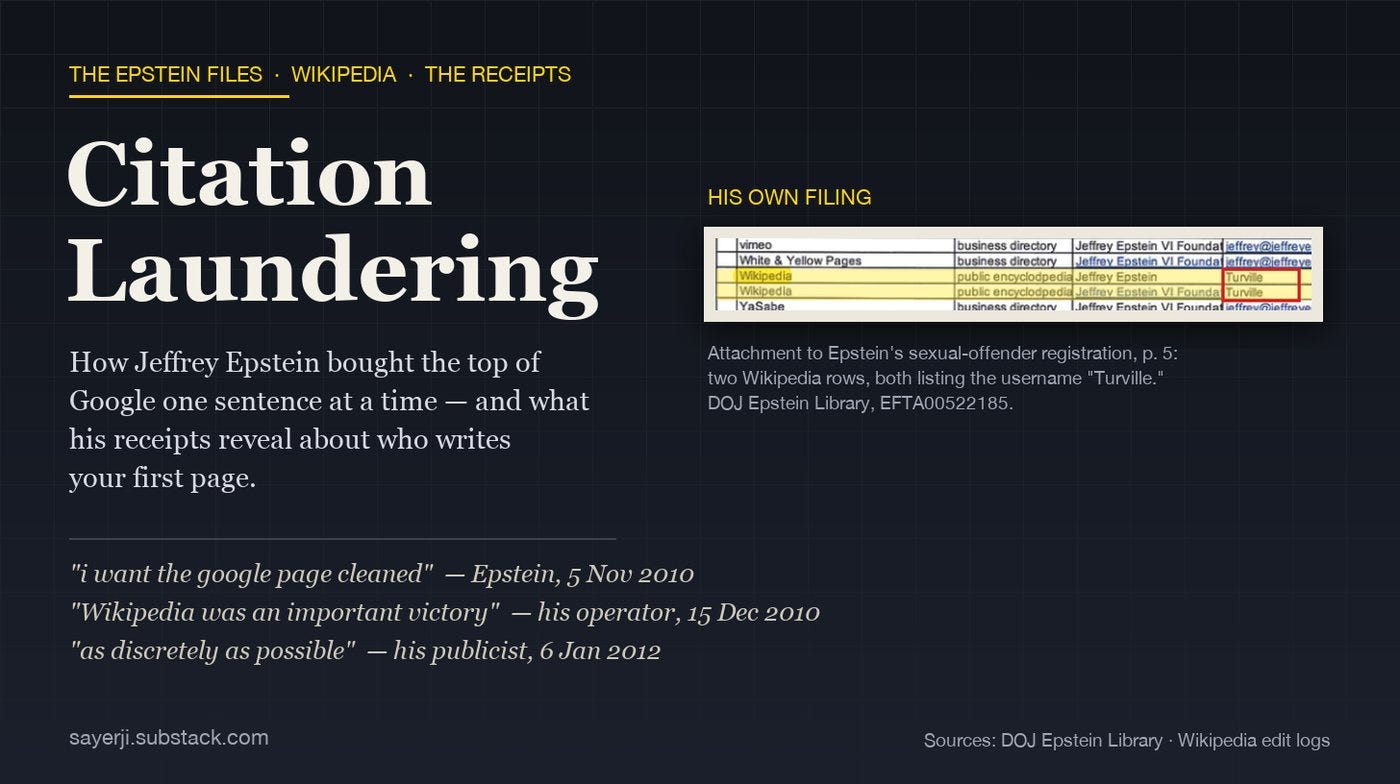
Between October 2010 and January 2015, Jeffrey Epstein paid four successive crews to rewrite his Wikipedia biography and bury what they could not remove. His own emails, released by the Department of Justice, record the method, the names, and the money.
His own sex-offender registration lists a Wikipedia account, “Turville,” for his biography and for his foundation’s article — and states that the accounts on the list were run by “internet reputation management service providers engaged by Mr. Epstein.”
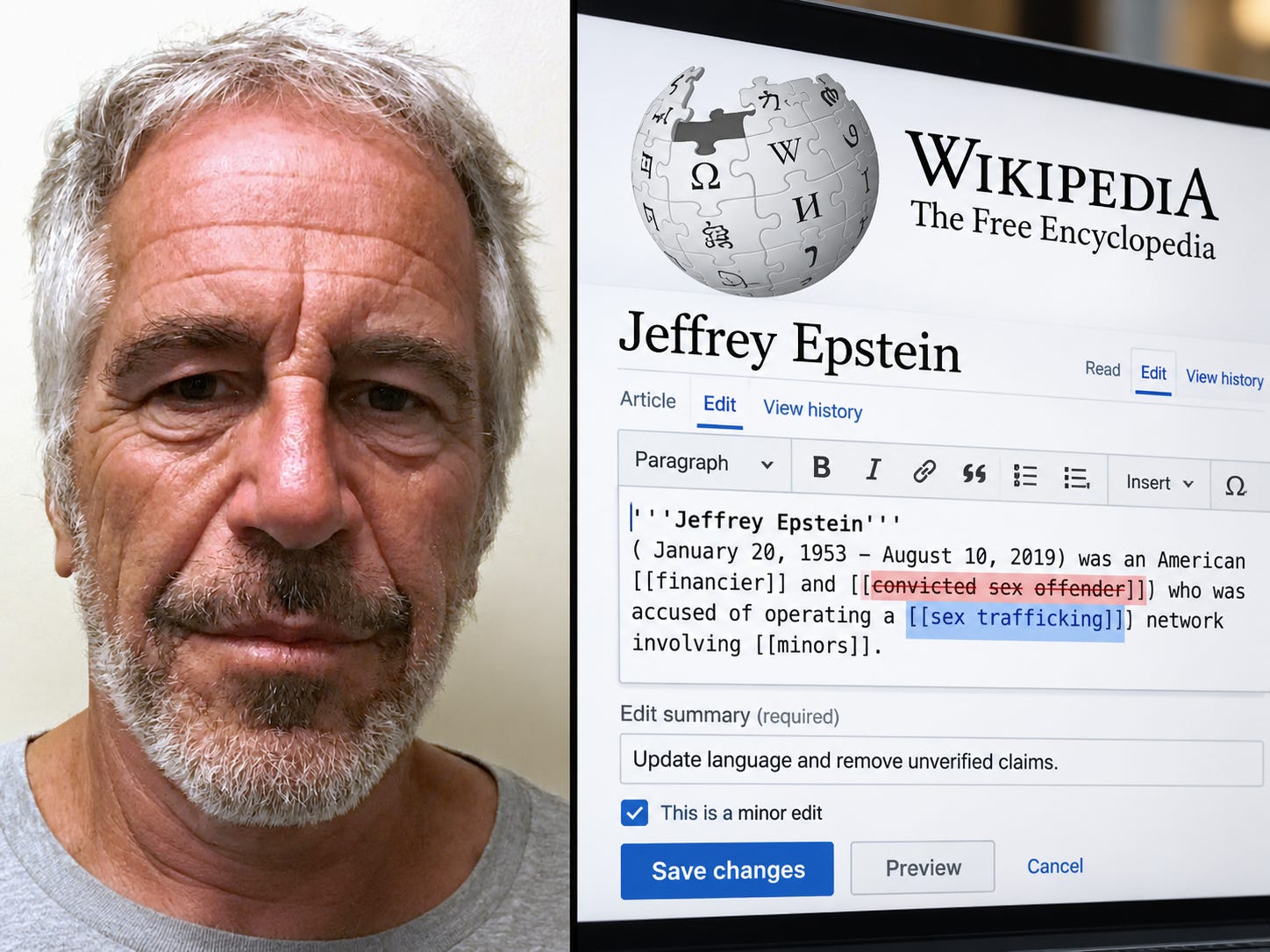
Wikipedia’s public logs show the same hands at the same minutes: a photo upload three minutes before “uploaded a new WIKI image… This should stick”; a sock-puppet’s edit fifteen minutes before “Updated your Wikipedia site… as discretely as possible.”
Reputation.com refused him “because of your background.” A cheaper firm took $2,449. An SEO contractor built “hundreds of links” and planned to make him a National Geographic contributor.
The laundering cycle: his publicist’s press releases were cited inside Wikipedia as sources until volunteer editors purged them in January 2015 as “self promotion.”
The raw material was science. Harvard’s own 2020 review found that his publicist asked the Program for Evolutionary Dynamics to put him on harvard.edu because “it would be very helpful in terms of Google results if his name were attached to a Harvard.edu url.” Harvard built the page.
The man who ran the 2010 operation came out of the organized-skeptic movement. The apparatus that polices “pseudoscience” on Wikipedia was, in this case, the detergent.
What stopped him was not a regulator or a newspaper. It was a dozen unpaid editors with the history tab open.
A note before we start
I have a Wikipedia page I did not write and cannot edit. I am on the Center for Countering Digital Hate’s list of twelve. McGill University’s Office for Science and Society — endowed by a $5.5 million gift — has published pieces about my work, the details of which you can read about in my recent piece Why Did McGill Target Me? I say this up front because this article is about how such pages get written, and you should weigh my stake in the answer.
So let me also say what this article is not. It is not a claim that Wikipedia is controlled by anyone. It is not a claim that its volunteers are paid, or that the people who have written about me were paid by pharmaceutical companies. Where money is documented, I show the document. Where it is not, I say so. The Epstein record below is drawn from the Justice Department’s Epstein Library and from Wikipedia’s own edit logs, which are public and permanent. Every quotation carries its document number. You can check all of it.
1. The last page of the registration
On the last page of Jeffrey Epstein’s sex-offender registration — after the Suburbans, the Escalade, the aircraft, and a column of some ninety websites — there are two lines for Wikipedia.
One is for his biography. One is for his foundation. The username on both is the same: Turville.
The form’s own notes explain what the list is. The accounts, it says, “were neither created nor used by Mr. Epstein” but “were created, administered, operated, and managed exclusively by independent third party internet reputation management service providers engaged by Mr. Epstein to provide content regarding Mr. Epstein and his business, scientific and philanthropic activities.” The copy in the Justice Department’s release lists a 2018 Suburban among his vehicles; by then, the notes add, use of the accounts “has been permanently discontinued.”
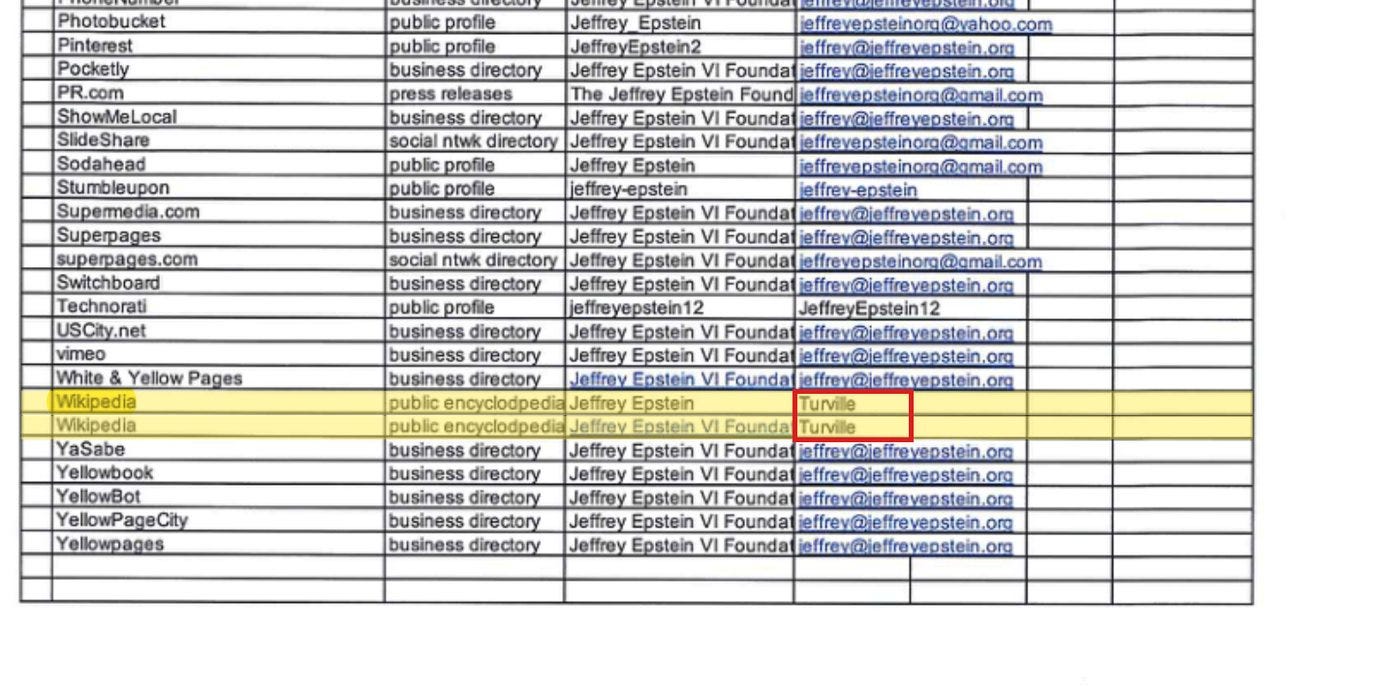
The law required him to disclose the identities used online on his behalf. He disclosed, in a government filing, that he had hired reputation-management providers — and that one of the accounts they ran was on Wikipedia.
I have spent the past year inside the Justice Department’s Epstein release for a book. The emails in it do something the registration cannot: they show who did the editing, what it cost, and how it worked. And Wikipedia’s own logs — public, timestamped, permanent — show the same hands at the same minutes.
Put the two records side by side and you get something rarer than a scandal. You get a manual.
This is not a story about one man’s vanity. It is a story about a market — the market for the first page of the internet — and about the only people who ever beat it.
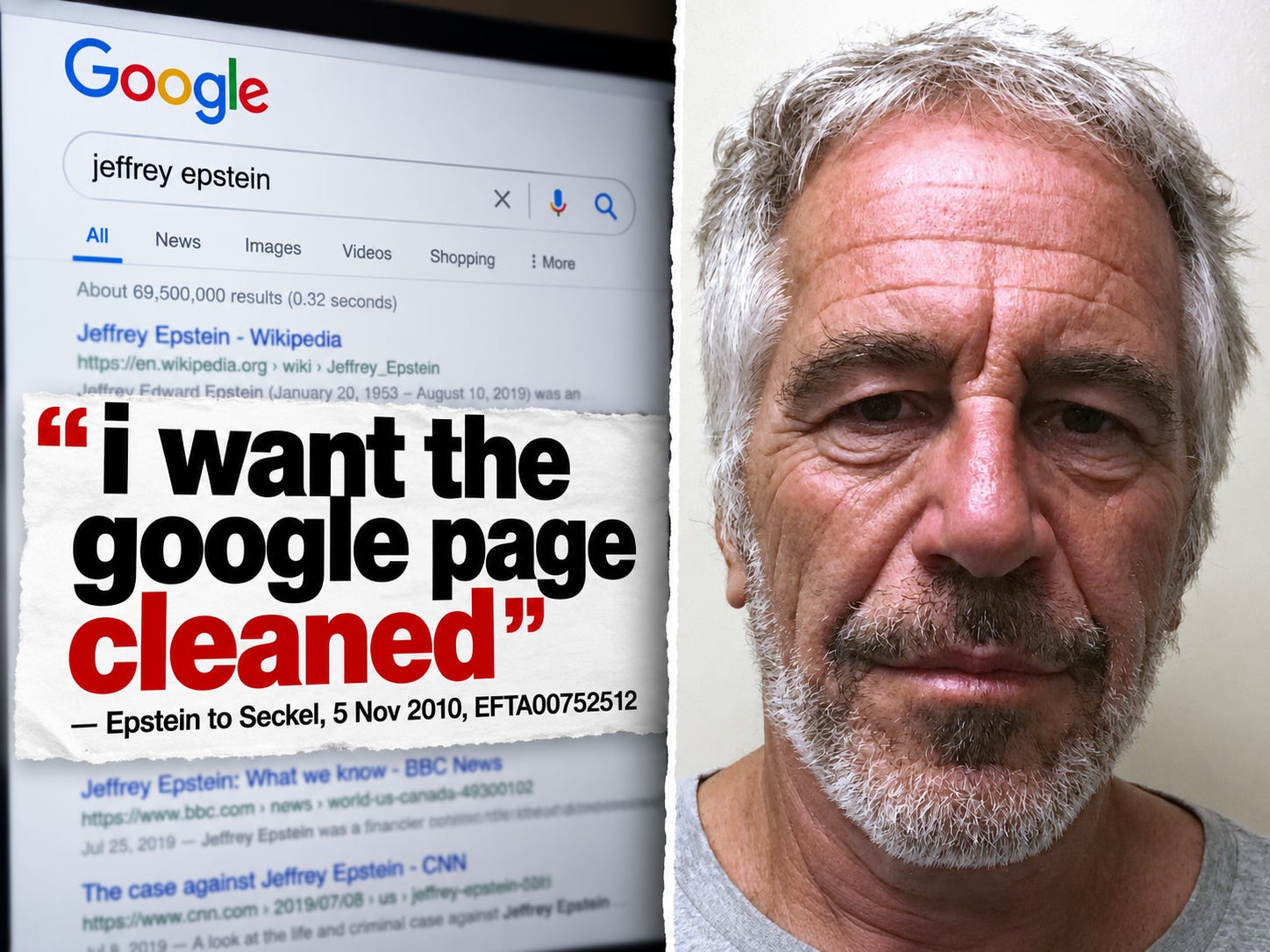
2. “I want the google page cleaned”
The first crew arrived in the autumn of 2010, a year after Epstein left the Palm Beach jail. It was led by Al Seckel — a perceptual scientist, a fixture of the Caltech lecture circuit, and the partner of Isabel Maxwell, Ghislaine’s older sister. Seckel brought a technician he called Mike, a man named Pablos who priced the job, and a content writer named Jessica. He also had, in his own words, “our philipine sites.”
On October 14, 2010, Seckel wrote to Epstein:
“Someone is fucking with your wikipedia. Everytime we hack it and remove or reword material, within a few hours, they put it back up.... They have many ‘watchers’ on your page, and are notified of any changes, and they are intent on putting the stuff back up.” — Al Seckel to Epstein, 14 Oct 2010, EFTA00754304
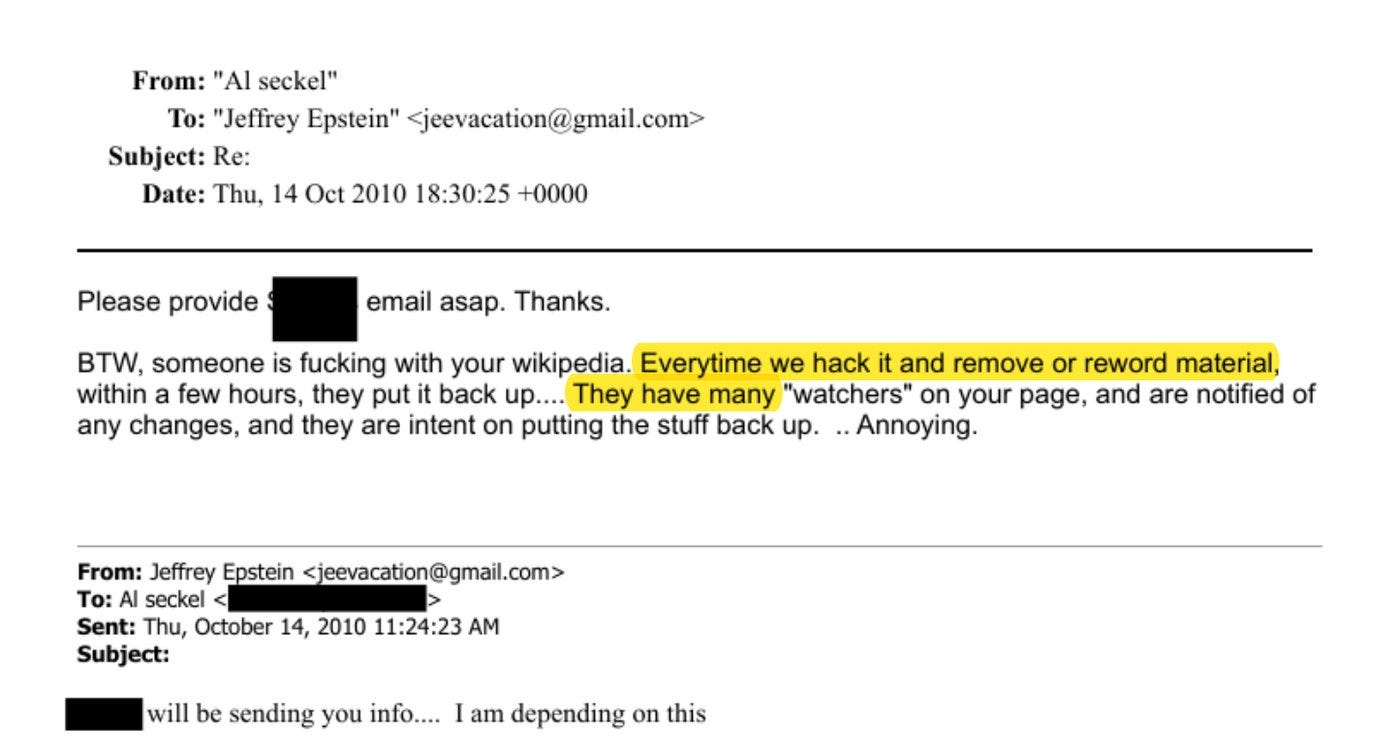
Wikipedia’s log for that day shows what “we” did. At 19:34 UTC a brand-new account, BrianL727, deleted 8,387 characters from the article — essentially the criminal record. Fifty minutes later another editor put it back. BrianL727 never edited again.
Two weeks later Seckel described the adjusted method:
“We are changing the wikipedia entry slowly and now it is having more of an effect… has to be done one sentence at a time.” — Seckel to Epstein, 28 Oct 2010, EFTA02415983
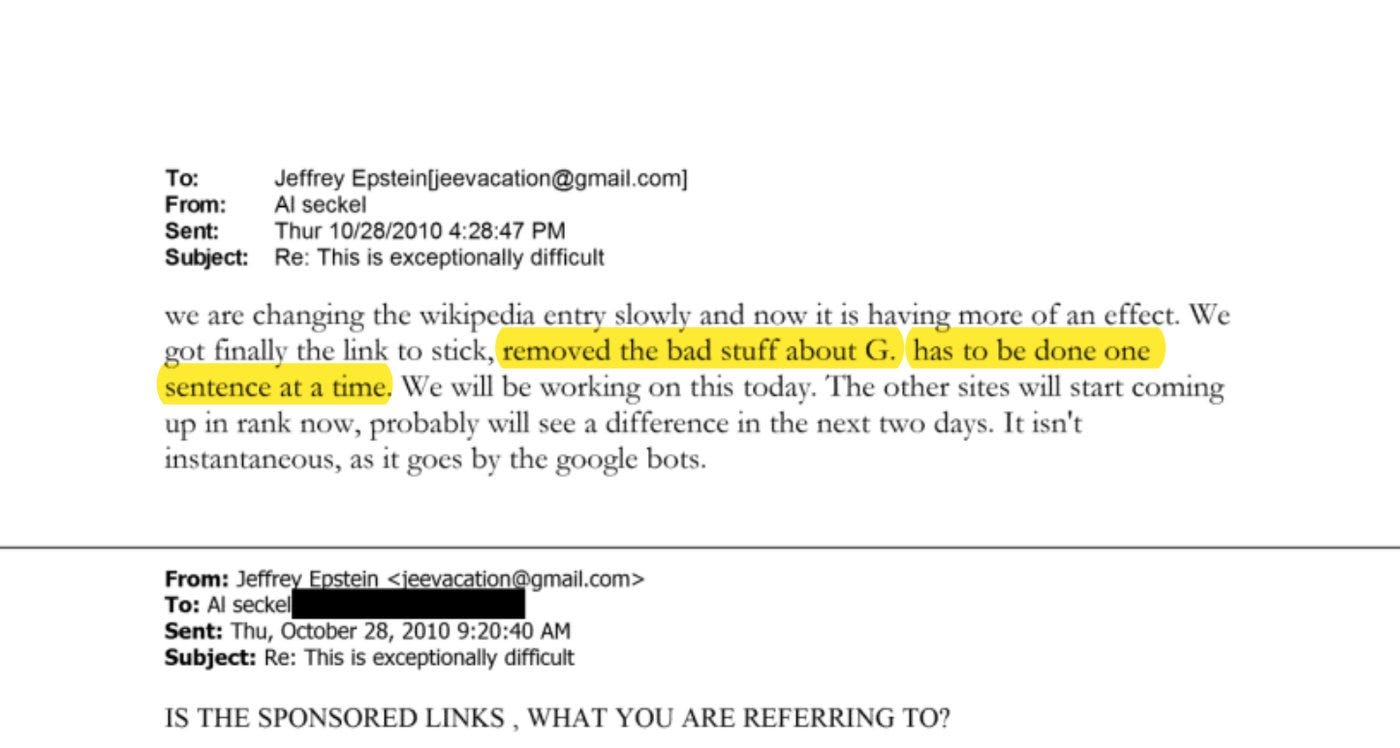
That, too, is in the log. From October 28 to November 26, 2010, a single IP address registered to Verizon Business made twenty-seven edits to the article: six successive cuts to the section on his solicitation conviction, cuts to the civil lawsuits, three edits to the external links — and then, on November 11 and 26, the additions: some thirteen thousand characters of new text under headings the editor spelled “Philanthrophic Work,” “The Epstein Foundation,” and “Promotion of Scientists.”
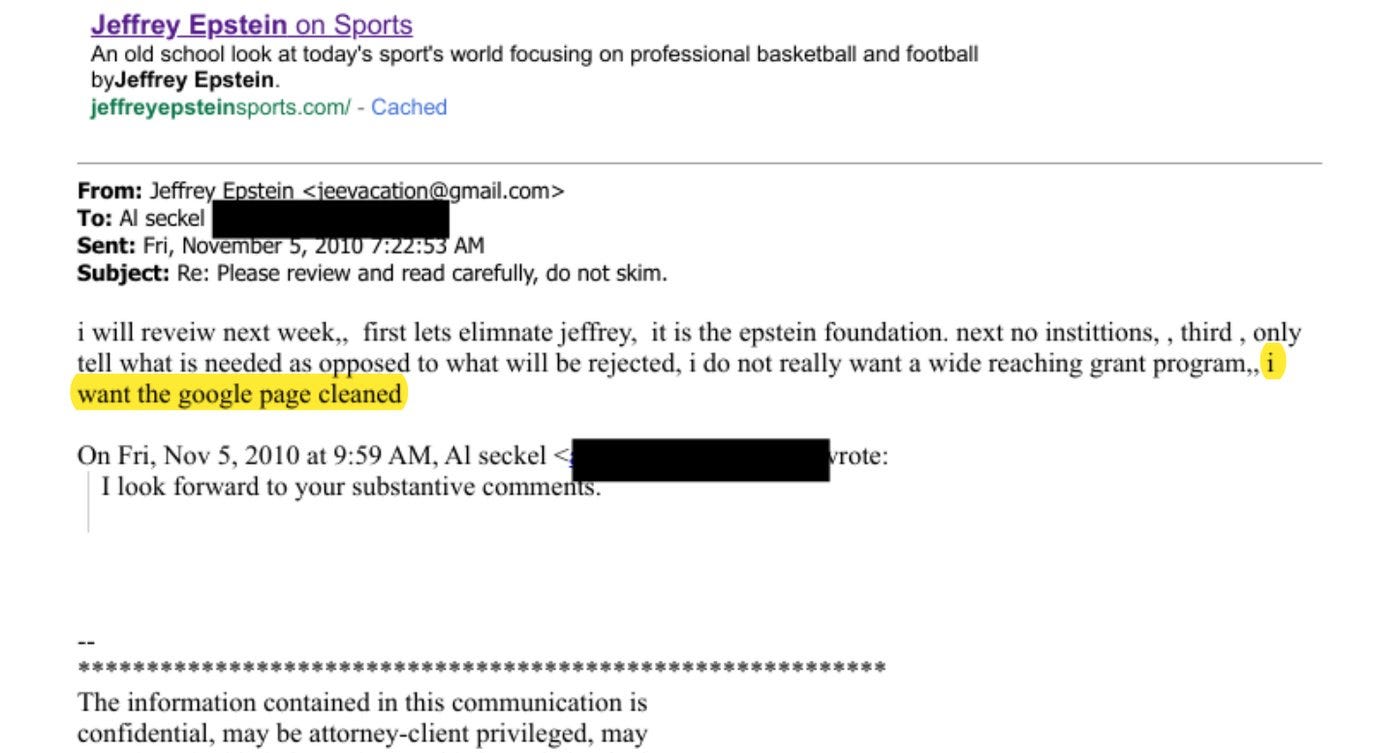
Epstein’s instruction, on November 5, was five words long:
“i want the google page cleaned” — Epstein to Seckel, 5 Nov 2010, EFTA00752512
On November 11, Seckel reported progress on the article’s sources: “Your wiki was primarily written by Conshita… She was the one who put most of the lurid and graphic details into your wiki entry. We removed them, and also, the collective links to all her articles at the Daily Beast at the bottom of wiki.” (EFTA02416976.) “Conshita” was Conchita Sarnoff, the Daily Beast reporter who had broken much of the Palm Beach story. The next morning Epstein wanted to be sure: “it is important, that I can be certain that the Wikipedia stuff has Conchita Sarnoffs input. how certain are we?” Seckel: “100%. It was her wording exactly and referenced to her.” (EFTA00777135, EFTA02416908.)
The same morning the Verizon IP added its philanthropy sections, a second new account, Wikilearner1980, uploaded a replacement photograph to Wikimedia Commons: JeffreyEpstein2010.jpg, “Source = Jeffrey Epstein, Author = M. Hawk.” Commons deleted it six weeks later as a copyright violation — the photo had been copied from jeffreyepstein.org, a site Seckel’s team ran.
On December 15, Seckel sent his results memo. It is the single most complete description of the method in the file, and it is worth reading slowly:
“Wikipedia was an important victory, as it will always be at the top of the search engine results. [N]ow the head lines do not mention convicted sex offender or pedophile. Instead, Philanthrophic work, Epstein Foundation, Promotion of Scientists. We have stopped the hacking on your wiki site, and that was a major effor[t]. Your wiki entry now is pretty tame, and bad stuff has been muted, bowlerized, and pused to the bottom. Careful editing and wording has muted the effect immensely. We hacked the site to replace the mug shot and caption, and now has an entirely different photo and caption. This was a big success.
We pushed the Edge all the way up to the front page, where it was previously buried on page 5 of google search. We have promoted the other jeffrey epsteins, and other pages are also filled with your material.” — Seckel to Epstein, 15 Dec 2010, EFTA00899885
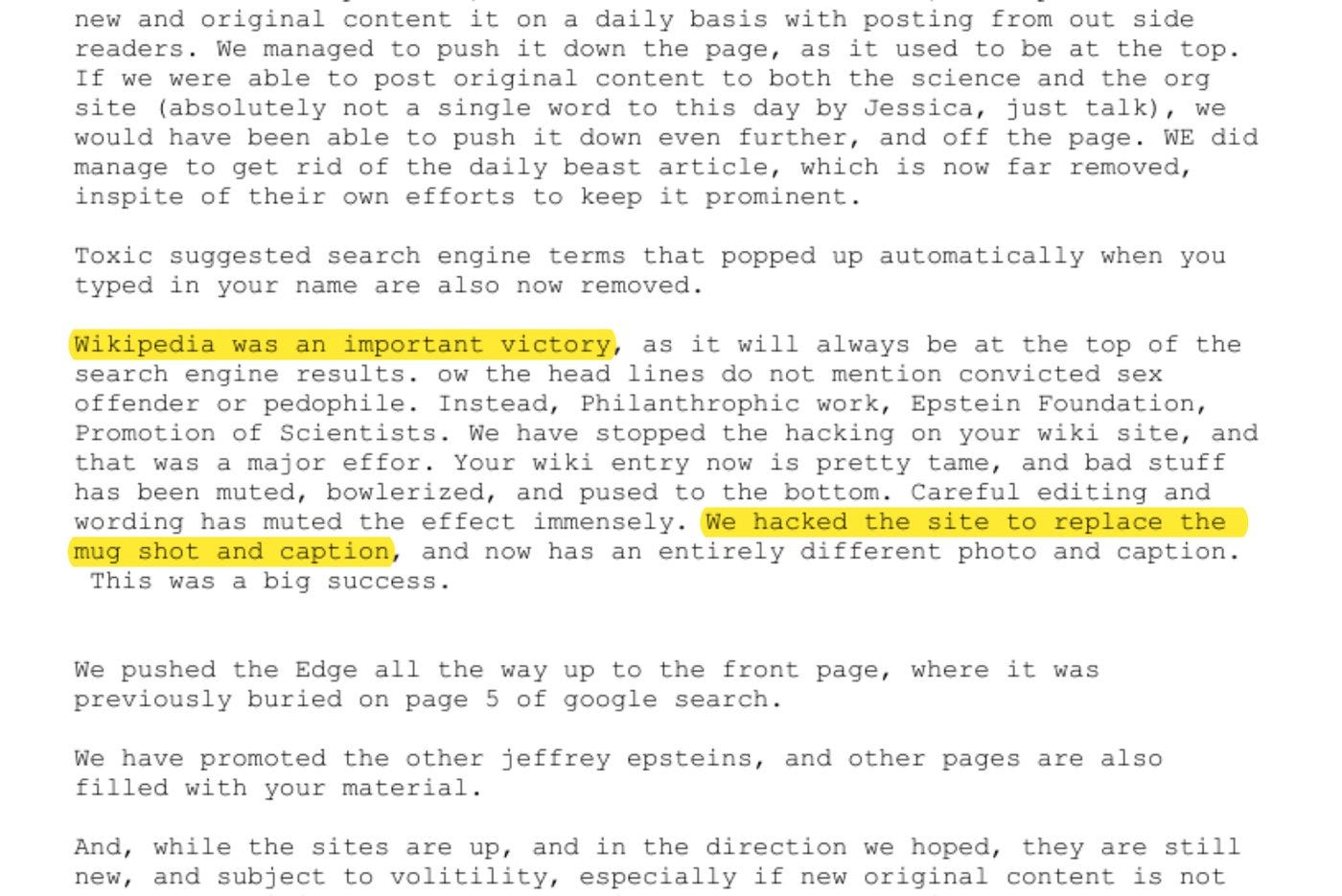
Note the last paragraph. “The Edge” is Edge.org, John Brockman’s salon of celebrity scientists, to which Epstein was a major donor. “The other jeffrey epsteins” are a hair-transplant surgeon in Miami, a neurosurgeon on Long Island, and a venture capitalist in Menlo Park, all of whom were promoted so that a reader searching the name would find them first. The strategy was not only to clean the page. It was to flood the zone.
The money. Epstein did not dispute the method. He disputed the bill:
“after sept when you told me you thought it would take approx twenty thousand to clean up… then another ten thsousand, and another ten thousand… then an emergency 2500 dollars to keep servers active… micahel… was sent forty thousand dollars directly to his bank.. I have yet to have a complete breakdown of payments. and the results, are what they are.” — Epstein to Seckel, 11 Dec 2010, EFTA01985744
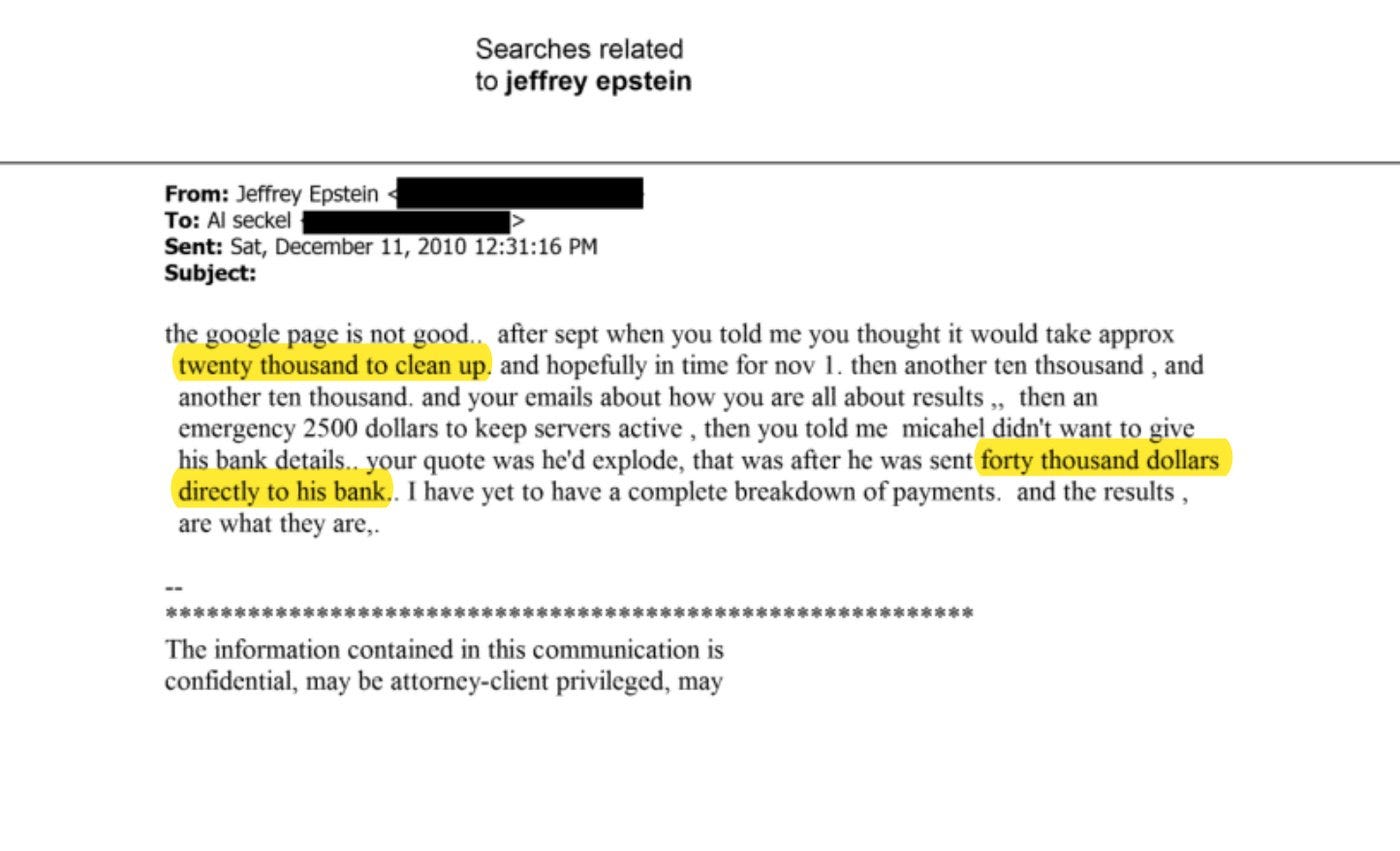
Seckel’s reply: “My initial estimate, given to me by Pablos, was 25… you have a dedicated group of people trying to undo and damage you… they can’t fux with your wiki page any more as we blocked that.” (EFTA01830122.) Epstein: “I was never told… that there was a 10k fee per month.”
“We blocked that” is a claim worth checking. Wikipedia’s protection log shows what actually happened: on November 26, 2010 — the day the Verizon IP added its last seven thousand characters — an administrator named Nakon semi-protected the article for “excessive violations of the biographies of living persons policy.” The protection locked out anonymous and brand-new accounts. The Verizon IP never edited again. Seckel was taking credit for the thing that had shut his own operation down.
By April 2011 the technician was writing to Epstein under his own name. “wiki not good news,” Mike Keesling reported. “they’ve got your wiki page under ‘lockdown’ essentially, any changes can only be approved by one editor and he’s not on your side… The only way to get good stuff added… is to have some positive things in the mainstream press that we can refer to with citations.” (EFTA01866228.)
Hold that sentence. It is the whole business model, and we will come back to it.
3. “As discretely as possible”
The second crew was in-house. In December 2011, Epstein’s publicist — Christina Galbraith, identified by name in the House Oversight Committee’s copies of these emails and by the New York Times in 2019 — sent him a strategy memo. Wikipedia, she wrote, “is a tough nut to crack… On the surface, Wiki is controlled by a morass of copyediting geeks who have nothing better to do than to discuss reference tags etc.” Her plan: a “copyright team dedicated to balancing the content on Wikipedia and gradually sectioning the bad stuff down to sub categories,” and a study of “how people like Prince Andrew managed to create an absolutely stellar profile.” (HOUSE_OVERSIGHT_025233.)
Two days before that memo, on December 14, a new Wikipedia account called Stgeorge12 made its first edits. It cut 2,568 characters from the “Life” section of the Epstein article, twice, with this edit summary:
“I have been asked by Jeffrey Epstein to describe his biography in a professional and accurate way, that does not involve any scandals or disreputable content. As a living person, this is his right.”
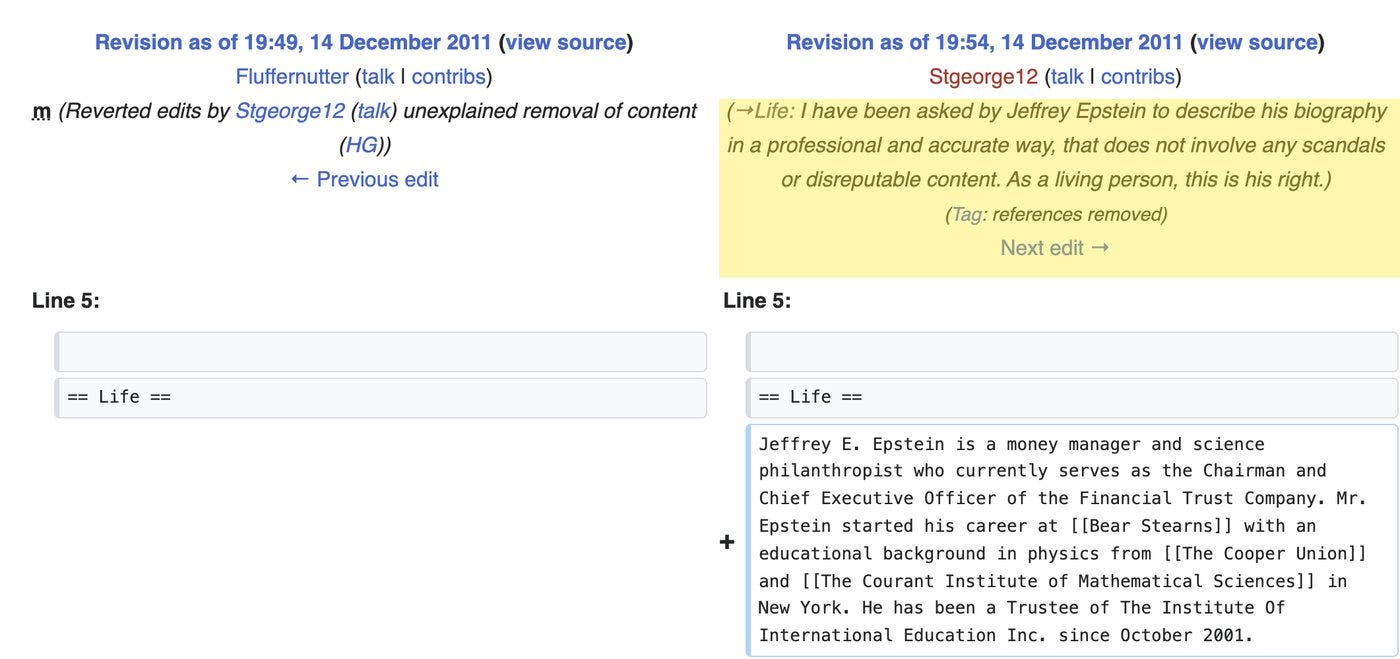
Wikipedia cannot prove who sits behind an account. It can record what the account did. Stgeorge12 made fourteen edits in its life. Four were to Jeffrey Epstein. One, on December 15, 2011, was to the article on Evan G. Galbraith, the late U.S. ambassador to France — Christina Galbraith’s father.
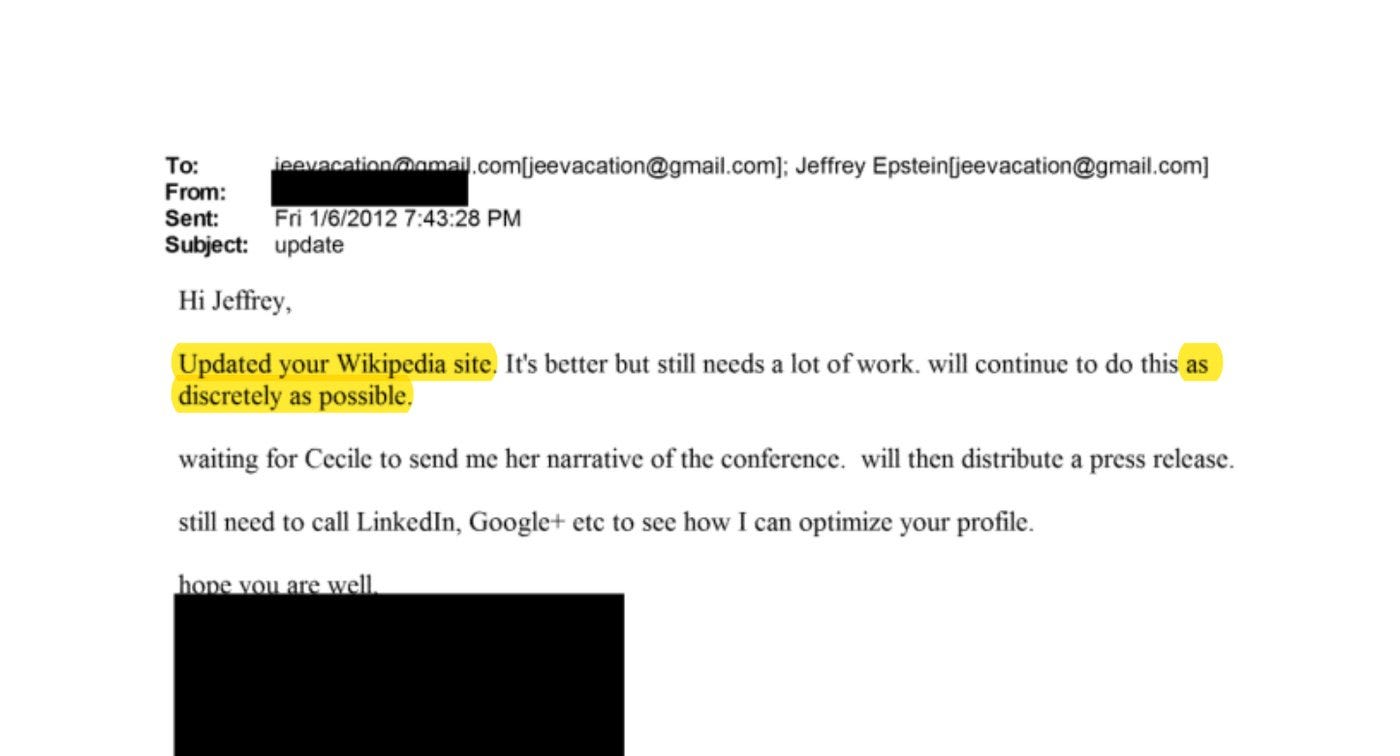
On January 6, 2012, at 19:28 UTC, a second new account, Ottotiv, consolidated a “science career” section into the article. At 19:43, Galbraith emailed Epstein:
“Updated your Wikipedia site. It’s better but still needs a lot of work. will continue to do this as discretely as possible. waiting for Cecile to send me her narrative of the conference. will then distribute a press release. still need to call LinkedIn, Google+ etc to see how I can optimize your profile.” — 6 Jan 2012, EFTA02019884
That evening Ottotiv removed the words “convicted sex offender” from the article’s first sentence, with the summary “unnecessary for the WP:LEAD.” A volunteer named Rklawton put them back: “it’s a major reason he’s notable, and Wikipedia takes a dim view of whitewashing articles.” The next night, January 7, 2012, Wikipedia’s CheckUser — the volunteer function that can see which accounts share a connection — blocked Stgeorge12 and Ottotiv at the same minute as sock puppets, and the article was protected again.
Galbraith’s next report to Epstein, a month later, complained that “the only thing that is worse is the added caption under your wikipedia photo” — a volunteer had labeled the mug shot — and recommended “a technical professional to get the bad stuff off of the first two pages.” (EFTA01841205.) Epstein’s reply: “get a full proposal from reputation, otherwise i will need to terminate this effort. it is not working.” (EFTA00928687.)
Then, on February 7, 2012, a sentence that should be framed:
“Reputation.com said they can’t represent you because of your background. BUT Integrity Defenders will. They are Yale vs. Harvard. Integrity is also less expensive by far.” — Galbraith to Epstein, 7 Feb 2012, EFTA00928748
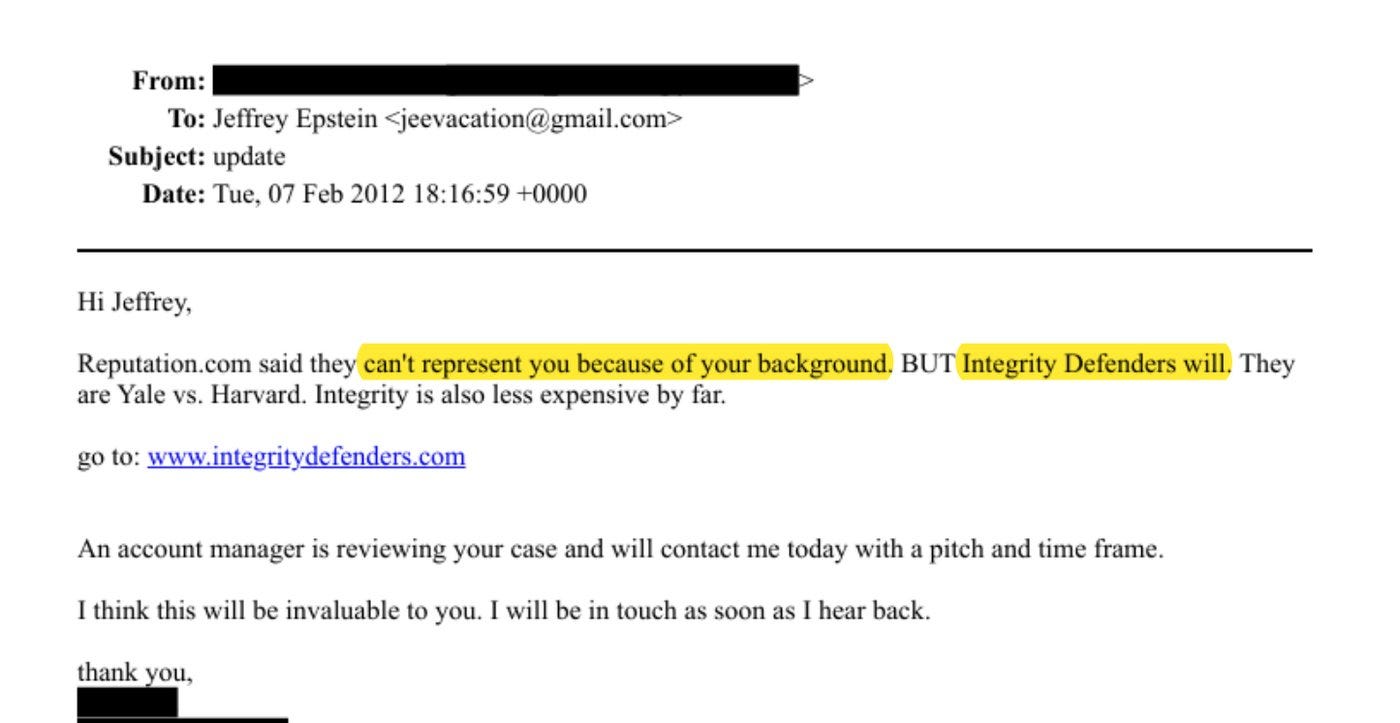
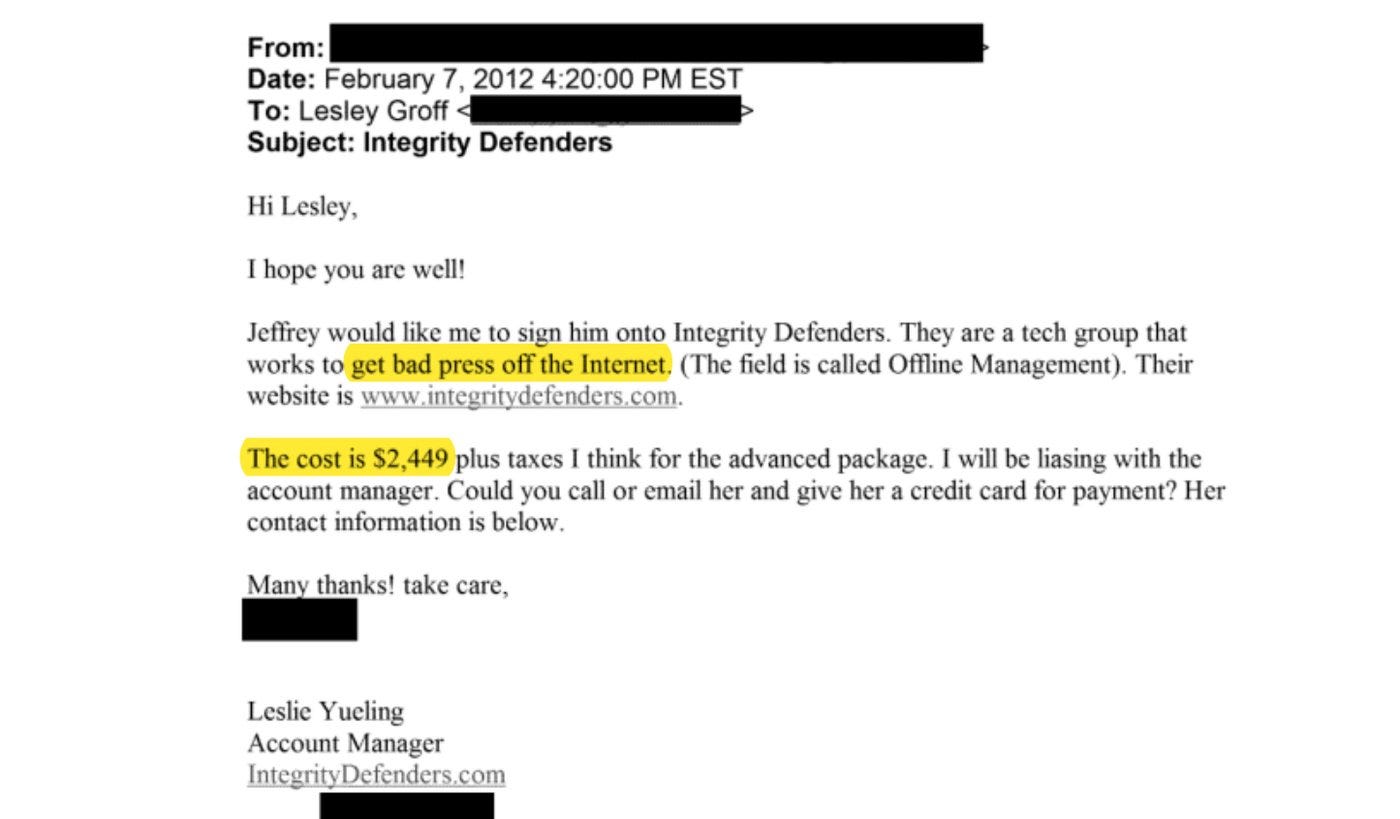
The same afternoon she asked Epstein’s assistant, Lesley Groff, to put $2,449 “plus taxes… for the advanced package” on a credit card. Integrity Defenders, she explained, “are a tech group that works to get bad press off the Internet. (The field is called Offline Management).” (EFTA02015224.) The firm’s own pitch, preserved in the House Oversight copies, described the method: “creating volumes of numerous sites, back linking and good content that will rank highly in results… We will recycle information found on his foundation website and also focus on other individuals with the same name in order to diffuse the monopoly of information there is about him… Please ask him or anyone else not to click on any of the negative links EVER again.”
On February 25, an account called Bdalessio — whose other edits were to the biographies of private-equity executives — deleted 9,534 characters from the Epstein article. A volunteer restored them in twenty-one minutes. Two days later Galbraith told Epstein: “Intergrity Defenders will be working on your Wikipedia site early this week.” (EFTA00719001.)
And on February 28, 2012, an account registered nine days earlier made its first edit to the article. Its name was Turvill.
4. Turvill
Turvill edited Wikipedia 144 times between February 2012 and January 2015. Forty of those edits were to Jeffrey Epstein’s biography. Fifty-three were to an article Turvill built from scratch: Jeffrey Epstein VI Foundation. The rest were talk-page arguments with the volunteers who kept reverting it, and three edits to an Argentine actress.
The pattern is visible in the first week. Turvill removed “money laundering” from the article’s opening sentence (”The references in the first paragraph do not refer to any of his scandals”), added paragraphs on Epstein’s funding of Harvard and Princeton programs, and reverted anyone who objected. Within three days the article was fully protected. Rklawton opened a thread on the talk page under the heading “User:Turvill”:
“a new account who hasn’t yet joined the talk page discussion has dedicated him or herself to whitewashing this article… I’m very concerned that there’s a ham-handed and unethical PR effort underway to clean up Epstein’s image… The whitewashing efforts including adding trivial details about scientific research that Epstein had funded — which is like boasting the Cali Cartel helped fund schools and hospitals.”
On March 4, 2012, a volunteer moved the mug shot out of the lead (”a mugshot is not suitable as a general illustration”). On March 5, another removed “money laundering” pending better sources. On March 29, a friend wrote to Epstein: “I see your wikipedia profile is changed. Hooray! Me is happy.” (EFTA01871060.) And on May 22, Galbraith sent her progress report:
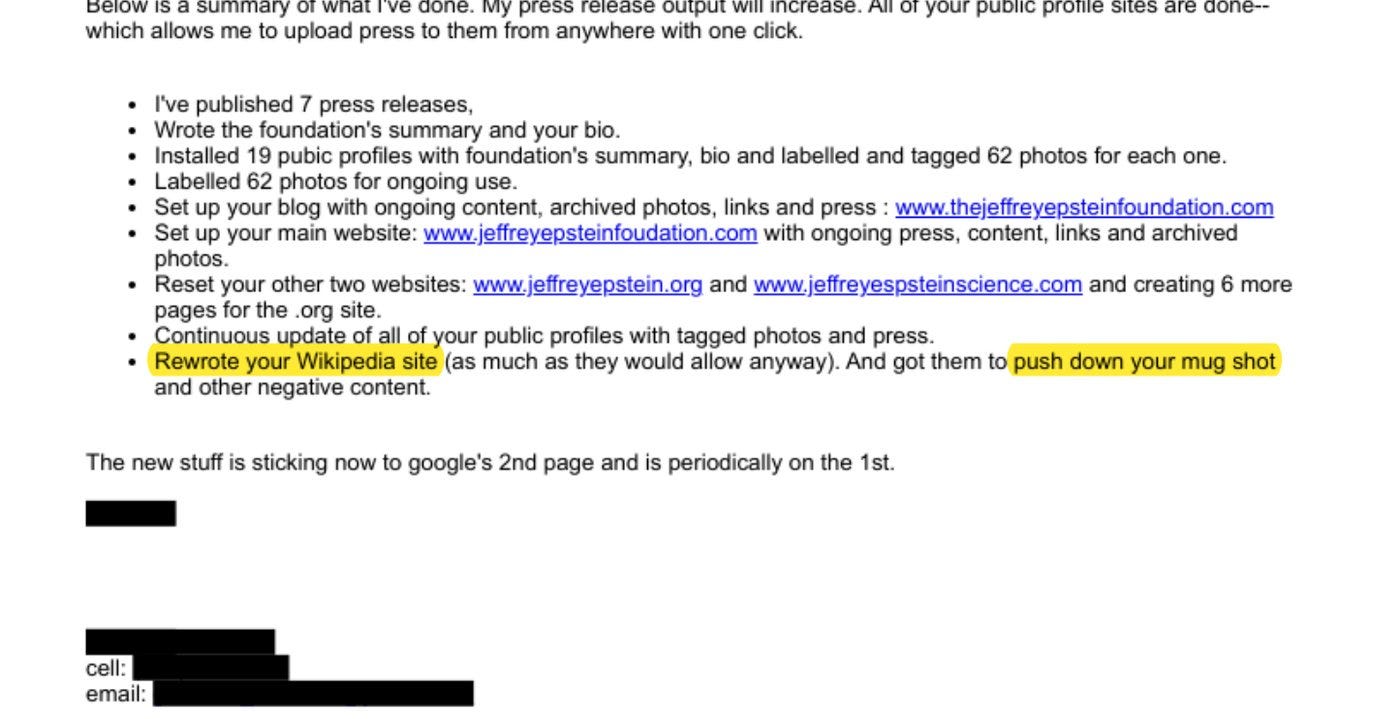
“I’ve published 7 press releases • Wrote the foundation’s summary and your bio • Installed 19 pubic [sic] profiles… labelled and tagged 62 photos • Set up your blog… • Set up your main website… • Rewrote your Wikipedia site (as much as they would allow anyway). And got them to push down your mug shot and other negative content.” — Galbraith to Epstein, 22 May 2012, EFTA00935164
In March 2013 she started the second article. “I’m working on the new Wikipedia page for the foundation,” she wrote on March 19. “If they accept it, Im expecting it to appear on google’s first page.” (EFTA02568040.) On March 22: “My first draft was accepted by them. I have to put in a list of press references to back it.” (EFTA01900167.) On March 26 at 17:01 UTC, Turvill expanded the draft Jeffrey Epstein VI Foundation to 13,684 characters; at 22:45 Galbraith emailed Epstein: “attached is the wikipedia article that is waiting final approval (process takes 5–7 days).” (EFTA01898396.) On April 4, Turvill asked at Wikipedia’s help desk how long the review would take. On July 25, Galbraith: “The new Wikipedia article was approved. Waiting for that to go live.” (EFTA02572018.) On July 27, a reviewer approved it. On August 14: “published and fortified the new Wikipedia article across the web.” (EFTA01760850.)
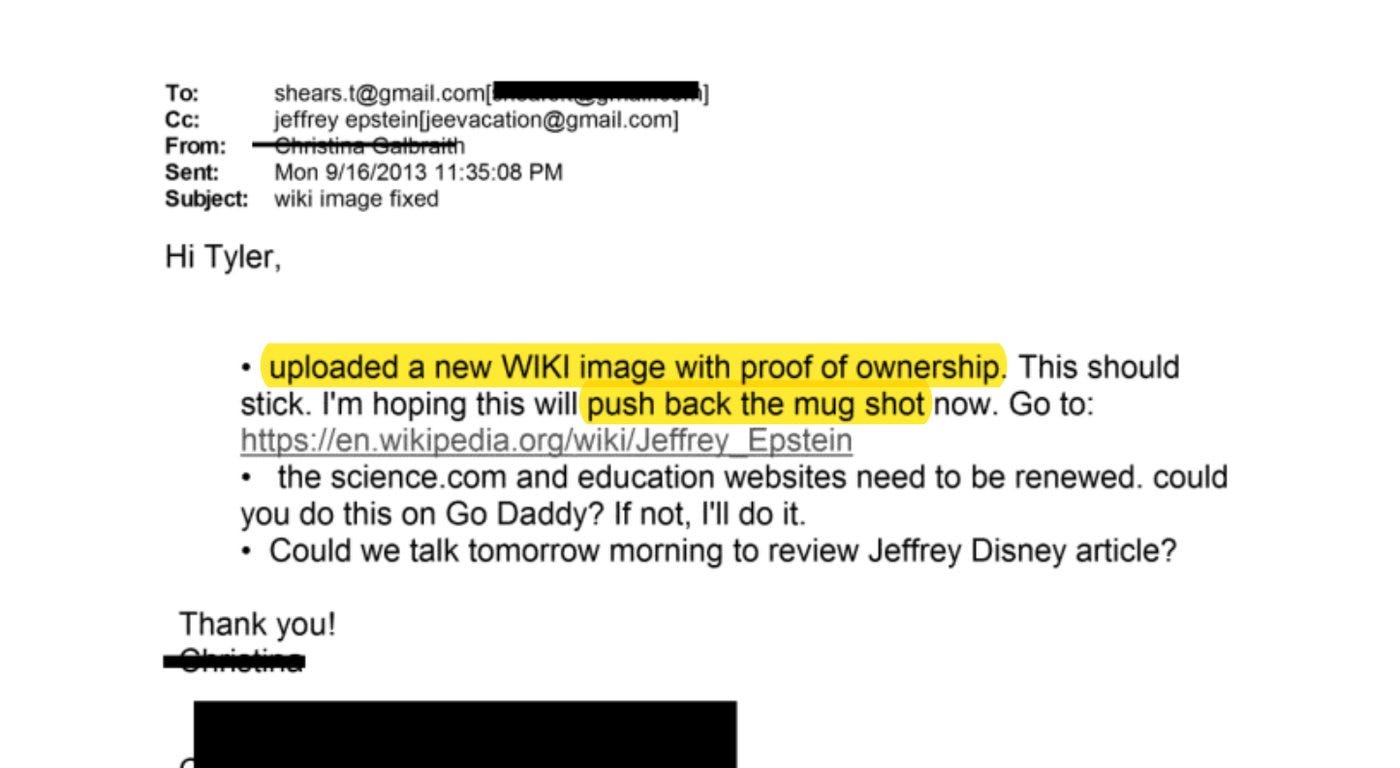
Then the photograph. On September 16, 2013, at 23:25 UTC, Turvill uploaded Jeffrey Epstein at Harvard University.jpg to Wikimedia Commons — “Source = Jeffrey Epstein VI Foundation, Author = Jeffrey Epstein.” At 23:32, Turvill placed it in the article’s infobox: “this is a free license creative common attribution image.” At 23:35, Galbraith emailed the SEO contractor, copying Epstein:
“uploaded a new WIKI image with proof of ownership. This should stick. I’m hoping this will push back the mug shot now.” — 16 Sep 2013, EFTA01959711
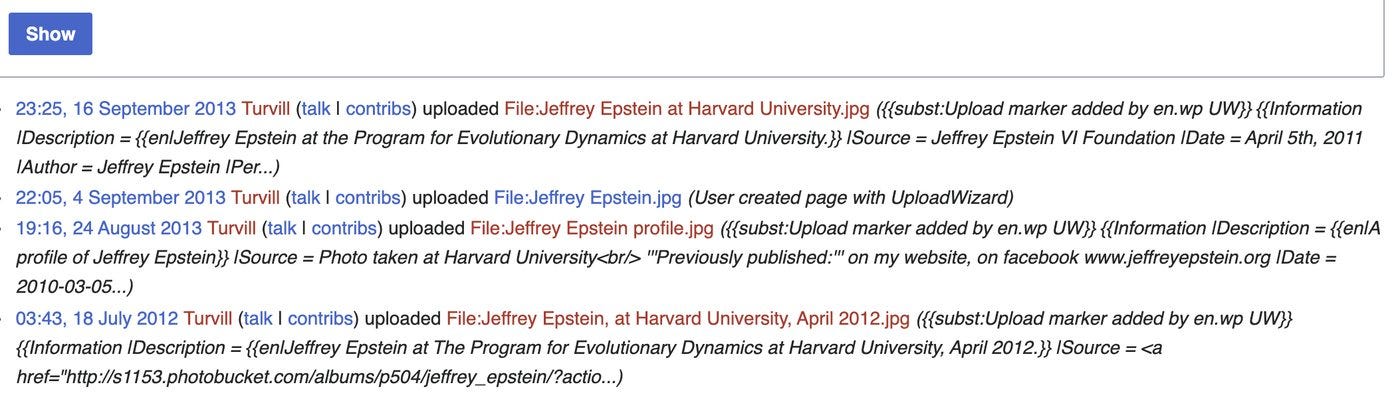
The next day Epstein’s accountant asked whether to wire her $2,000 for “Sept. 15th.” Epstein’s answer was three letters: “ysc.”
Wikipedia’s volunteers could not know any of this. What they could see was the pattern, and they named it in real time. Turvill was finally blocked on November 27, 2019 — the day after the New York Times reported that a Wikipedia username, “Turville,” appeared in Epstein’s registration papers — as a “spam / advertising-only account” engaged in undisclosed paid editing.

5. Citation laundering
Now go back to Mike Keesling’s sentence from April 2011. The only way to change the page, he told Epstein, “is to have some positive things in the mainstream press that we can refer to with citations.”
That is the mechanism. Wikipedia does not publish what is true; it publishes what can be cited. So the operation did not try to argue with the encyclopedia. It manufactured citations.
Galbraith wrote press releases — seven by May 2012, “a dozen or more” by the Times‘s later count — and distributed them through PR Newswire, which placed them on MarketWatch, TheStreet, and Yahoo Finance under headlines like “The Largest Private Funder of Melanoma Research Receives Vital Support from Activist Jeffrey Epstein.” (EFTA01768675.) She built nineteen “public profiles” and forty-three business-directory listings, the premium Yellow Pages entry “which gives a guarantee of a 1st page listing,” and a letter to EJewish Philanthropy describing a self-drafted biography. (EFTA00711844.) Those releases were then cited inside Wikipedia — in Epstein’s article and in the Foundation article — as the “press references” the reviewers required.
Ghislaine Maxwell’s own PR adviser explained why the encyclopedia was worth it, in an email she forwarded to Epstein in March 2011: “look at your Wikipedia page and have someone over there change it... if they cannot we can do it but this is important as anyone wanting to write will use this as a source.” (EFTA02008552.) Epstein’s reply to her: “you have hired morons again, you are making it worse rather than better.”
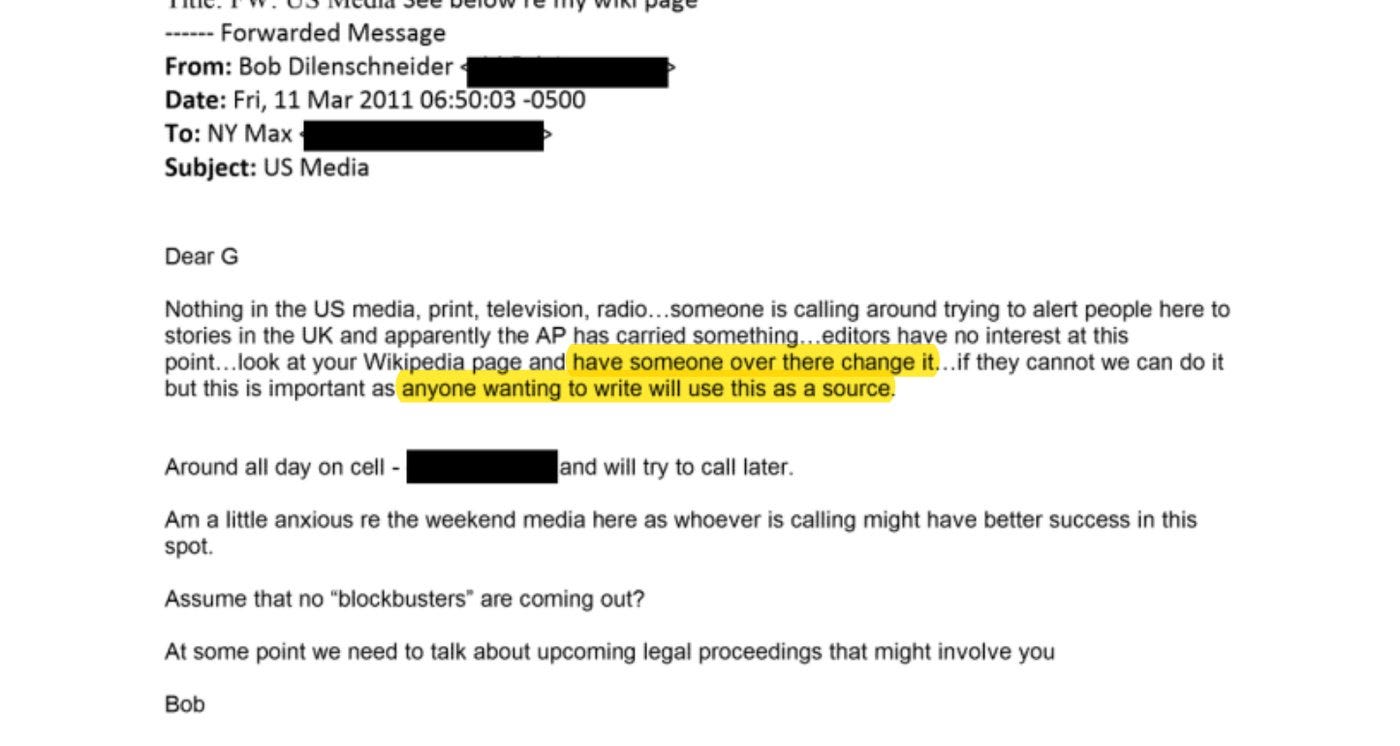
So the cycle runs: write the release; have the wire distribute it; cite the wire story in Wikipedia; let the next journalist read Wikipedia; cite the journalist. Dirty claims in, clean “facts” out. I call it citation laundering, and the term is not a metaphor. A self-authored claim enters the system as promotion and leaves it as the record.
Author’s analysis. This is the part of the story that generalizes. Epstein is unusual only in that his files were seized. The infrastructure he rented — wire services that will carry anything, directory farms, an encyclopedia that converts “published” into “verified,” a search engine that treats the encyclopedia as the authority — is available to anyone with $2,449 and a publicist. It is used, every day, by people whose files will never be seized.
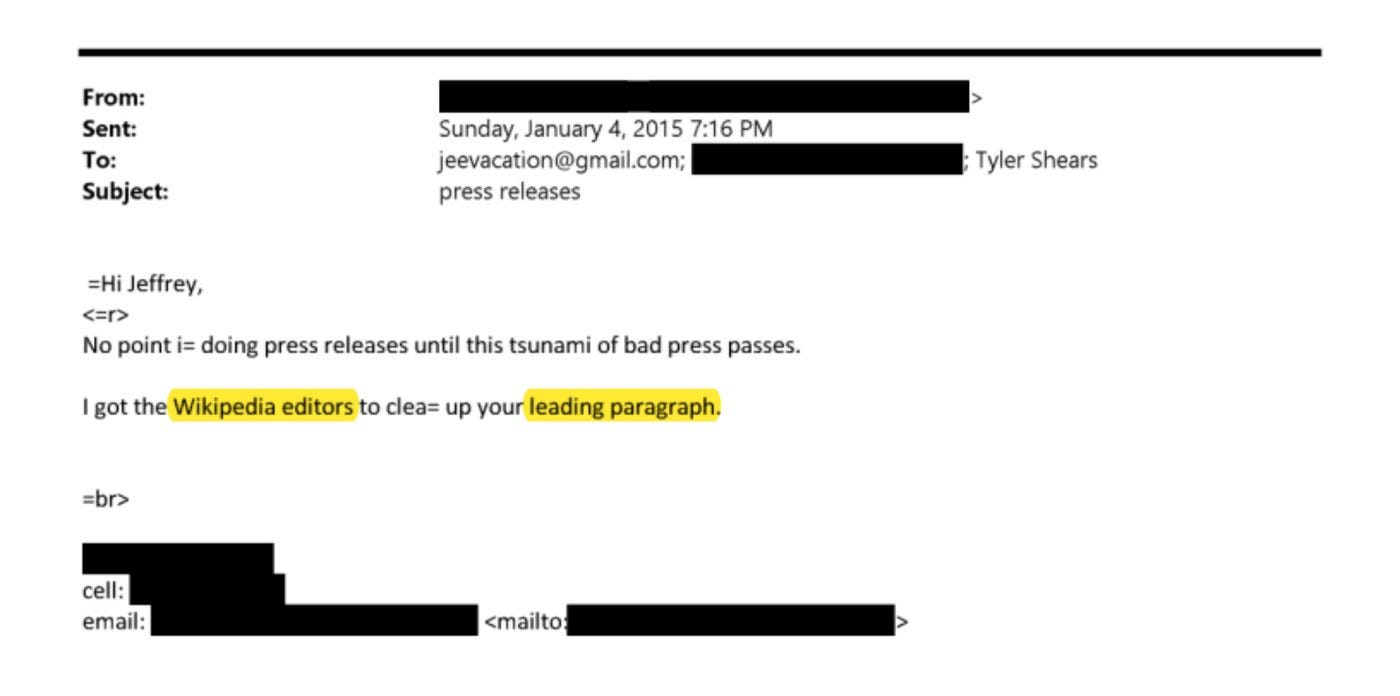
The cycle was broken in January 2015, after the Giuffre filing put Epstein back in the news. On January 4, Galbraith told him, “I got the Wikipedia editors to clean up your leading paragraph.” (EFTA02514346.) Wikipedia’s log shows the opposite. Over the following ten days two volunteers, J.K.Herms and John, went through the article’s sources one by one:
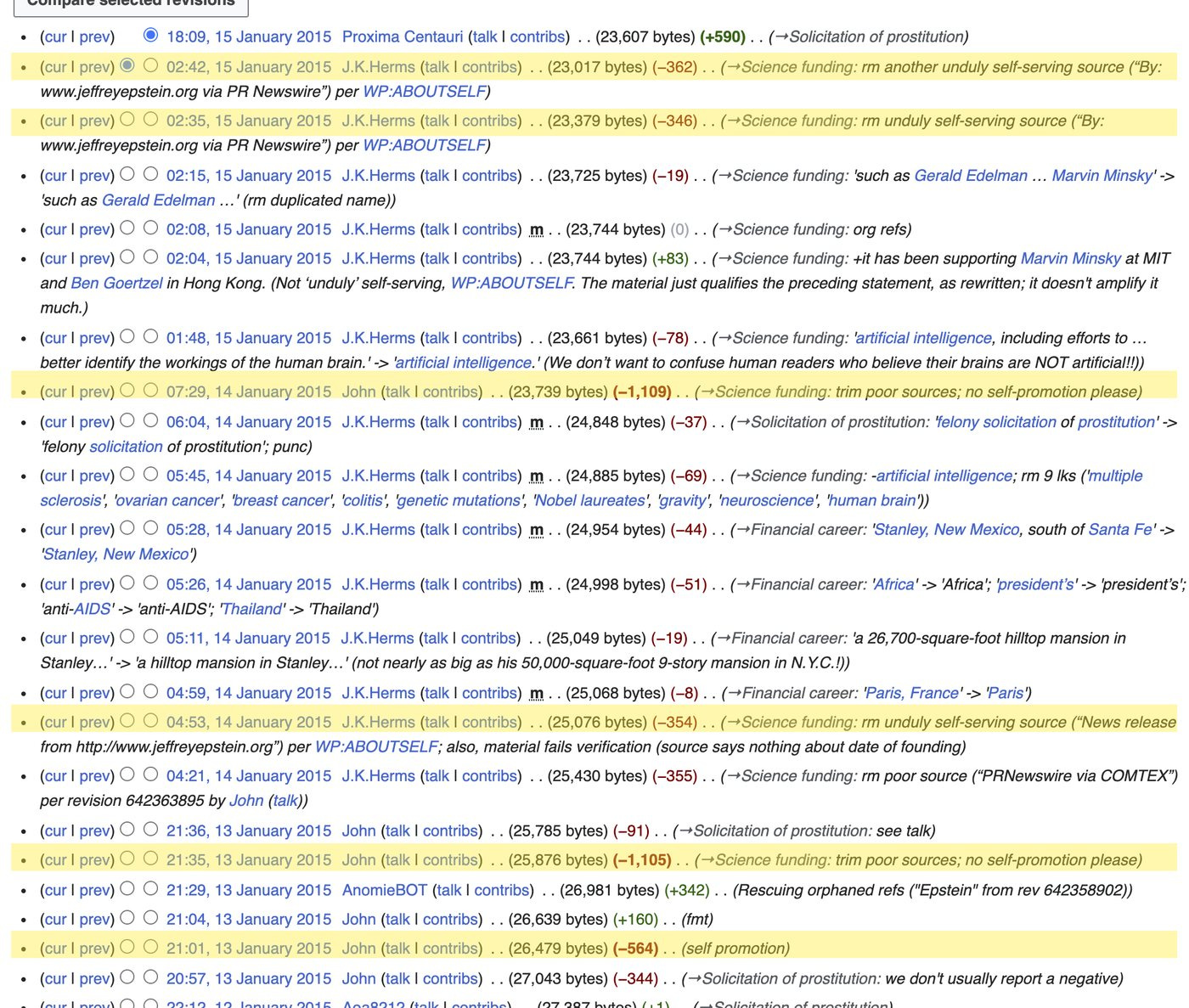
They removed the PR Newswire citations, the claims sourced to jeffreyepstein.org, and the self-drafted line that he was “a former member of the Trilateral Commission, the Council on Foreign Relations.” By February 1, 2015, the article’s first paragraph read: “an American financier… In 2008 Epstein was convicted of soliciting an underage girl for prostitution. He is a registered sex offender.”
Her claim and the outcome point in opposite directions. The volunteers had found the laundry and emptied it.
6. Science as detergent
What was the laundry washing with? Science.
Galbraith’s December 2011 memo was explicit about the function of scientists in the plan. Positive content, she advised, should be built to “algorithmically associate you to a larger pool of known scientists, further pushing up positive content” — her words, in the House Oversight copy. The goal, she wrote, was “to enhance anonymity and algorithmic associations at the same time.”
The SEO contractor hired in 2013, Tyler Shears, described the same idea from the technical side. “We are pushing up the highest authority domains available for ‘Jeffrey Epstein’,” he wrote in February 2014, promising “reinforcement we can provide from sites like Harvard, Nat Geo, and any other publications we have influence over.” He was arranging for Epstein to be “set as a contributing author” at National Geographic: “Your bio has been submitted and reviewed.” (EFTA00983500.) “Hundreds of links have been built to your primary sites,” he reported, and: “I know this is binary to you and you need it all gone.” (EFTA00706174, EFTA00983519.)
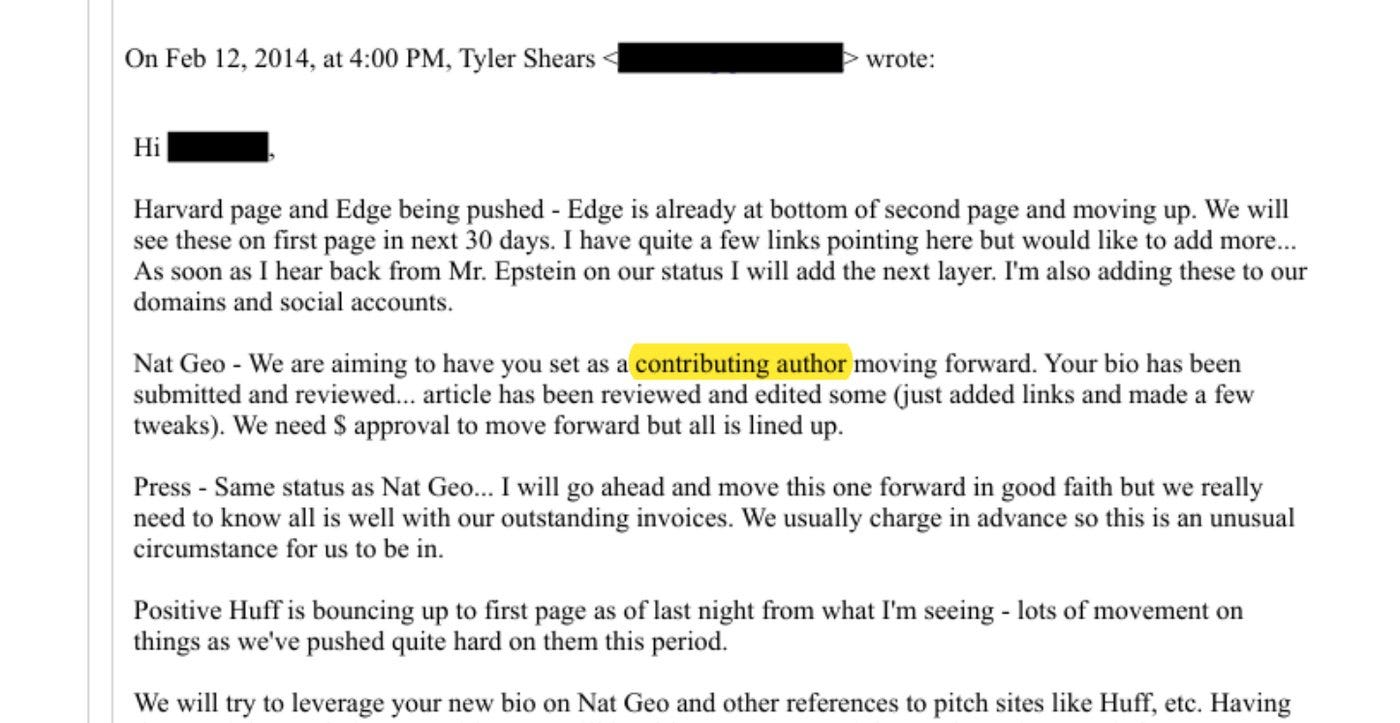
And Galbraith, the same week:
“Jeffrey’s Harvard page goes live this week. It should be a v. strong edu URL… Also the PED set up a page called ‘Friends’ which is where they’ll place jeffrey.” — 12 and 8 Feb 2014, EFTA00983500, EFTA00673091
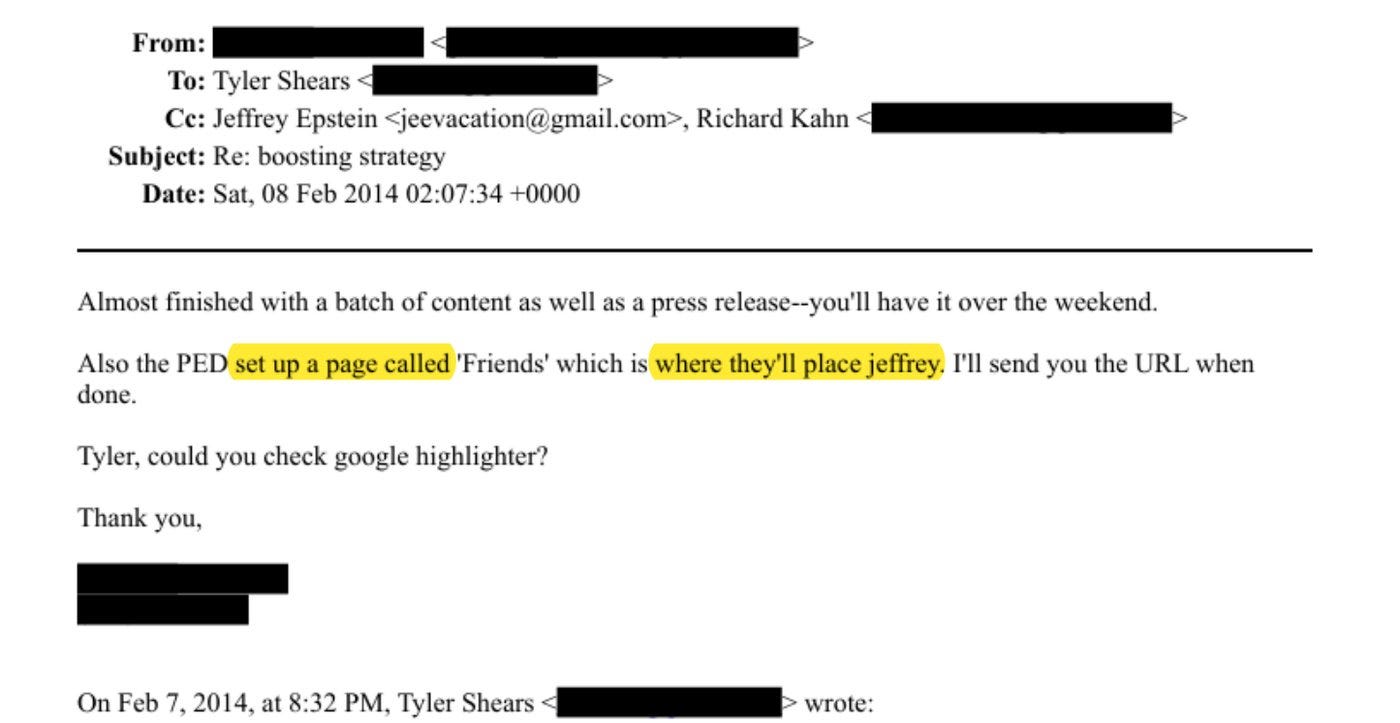
PED is Harvard’s Program for Evolutionary Dynamics, which Epstein had helped found in 2003 with a $6.5 million gift. Six years after this email, Harvard’s own review — the May 2020 report of its Office of the General Counsel — described what happened from the inside, and it is worth quoting at length because it is Harvard saying it:
“In mid-2013, Epstein’s publicist contacted Professor Nowak, announcing that she was ‘in charge of Jeffrey’s media/pr’… and was quite explicit about why and how she wanted to link Epstein’s name with Harvard… ‘Jeffrey is trying to boost his foundation’s websites and a link on Harvard’s network would be very helpful.’… In 2014… at the publicist’s request, PED added an entire page about Epstein to the website. The page included his photograph, a biography, and links to Epstein’s own websites. Epstein’s page was linked to the rest of the PED website by a tab labelled ‘Friends’ (Epstein was the only ‘Friend’ listed on the PED website). Nowak agreed to put the Epstein ‘Friends’ page on the website after Epstein’s publicist specifically requested that PED post information about Epstein on the harvard.edu domain because ‘it would be very helpful in terms of Google results if his name were attached to a Harvard.edu url.’”
The report adds that the Epstein foundation website linked from Harvard’s page “falsely stated (and continues to falsely state)” that his foundation “established the Program for Evolutionary Dynamics at Harvard University with a $35 million gift,” and that PED “maintained an office for Epstein’s use and granted him keycard and passcode access” — Office 610, which the program “referred to as ‘Jeffrey’s Office.’” Harvard also quotes a letter it received in March 2014 from an anti-trafficking group, which found it “unusual and disheartening… to read almost daily press releases distributed by a pedophile [who] feels entitled to identify himself as a ‘Harvard philanthropist.’” In March 2021 Harvard barred Professor Nowak from advising students for two years and shut the program down.
MIT’s parallel review, conducted by Goodwin Procter and published in January 2020, found that Epstein made ten donations to MIT totaling $850,000 between 2002 and 2017 — nine of them, totaling $750,000, after his 2008 conviction: $525,000 to the Media Lab and $225,000 to Professor Seth Lloyd. MIT’s senior administrators, the report says, accepted the money on a condition: that the donations “remain relatively small and unpublicized, so that they could not be used by Epstein to launder or ‘whitewash’ his reputation or to gain influence at MIT.” That is MIT’s own word for what the money was for. The Media Lab, Ronan Farrow reported in the New Yorker, referred to him internally as “Voldemort” and marked his gifts anonymous. Its director resigned.
Seckel’s 2010 memo had already told Epstein that “the Edge” — Brockman’s Edge Foundation, to which foundations associated with Epstein gave $638,000 of the roughly $857,000 in donations it received between 2001 and 2017, according to BuzzFeed News’s 2019 analysis of its filings, making him “by far its largest financial donor” — had been “pushed all the way up to the front page.” Seckel even proposed a way to recoup the web costs: “get Brockman to publish them in a book, get the advance.” (EFTA00751367.) The scientist interviews on jeffreyepsteinscience.com — the first of his three websites, which Seckel insisted “can’t appear to be ‘forced’… not standard ‘reputation management stuff’” — were the content that fed the algorithm. The Wayback Machine’s snapshot of 12 November 2010 — the week the philanthropy sections went into Wikipedia — shows a page titled “Testimonials From Leading Scientists About Jeffrey Epstein,” which opens: “Jeffrey Epstein’s generosity, encouragement and passion for the sciences have allowed many scientific projects to get off the ground.” The site’s roster of profiled scientists ran to two dozen names, among them Stephen Hawking, Murray Gell-Mann, Freeman Dyson, Frank Wilczek, Marvin Minsky, Lisa Randall, George Church, Martin Nowak, Robert Trivers, Lawrence Krauss, John Brockman — and Al Seckel. Whether any of them knew what the page was for is not something the record answers; the point is that it did not need them to.
Author’s analysis. None of these institutions is shown to have known what the pages were for; Harvard’s report says its leadership did not. That is the point. The laundering did not require their knowledge. It required their domain names. A Harvard URL, an MIT program, a seat at Brockman’s table — each was a source Wikipedia would accept and Google would rank. The science was real. Its function, in this operation, was detergent.
7. The skeptic in the laundry
There is one more thing to say about Al Seckel, because it bears on how the encyclopedia polices its pages.
Before he was Epstein’s reputation man, Seckel was a founder of the organized-skeptic movement in Southern California: in 1984 he co-founded and ran the Southern California Skeptics, the Los Angeles affiliate of the Committee for the Scientific Investigation of Claims of the Paranormal, with its lecture series at Caltech. He described it himself, in a 2012 email to Epstein about a critic: “a public group out of Caltech way back in the 80s that was skeptical of pseudoscience.” (EFTA00934456.) The credentials were thinner than the brand. He never graduated from Cornell and was never enrolled at Caltech, Mark Oppenheimer reported in Tablet in 2015; a skeptic author had written as early as 1992 that he “did not hold the academic credentials he claimed.” He had even litigated over Wikipedia before — a libel suit against a critic over edits to Seckel’s own page, settled in 2007. He died in France in 2015. But the brand was real, and it travelled.
Epstein’s most prominent public defender after his conviction was also a star of that movement. “As a scientist I always judge things on empirical evidence and he always has women ages 19 to 23 around him, but I’ve never seen anything else,” the physicist Lawrence Krauss told the Daily Beast in April 2011, “so as a scientist, my presumption is that whatever the problems were I would believe him over other people.” Krauss is a fellow of the Committee for Skeptical Inquiry; his Origins Project at Arizona State announced a postdoctoral prize “sponsored by the Epstein VI Foundation.” Epstein’s own mail shows him as a consumer of the skeptic canon — he forwarded Quackwatch and CSICOP links to friends between 2010 and 2016 — and, at the same time, as a man being pitched by the other side: in 2016 a correspondent sent him the Chopra circle’s plan to counter “militant atheism,” and Epstein proposed a conference of his own. He was shopping both shelves.
I want to be precise about what this does and does not show. It does not show that any skeptic organization edited Epstein’s page, took his money to do so, or knew what Seckel was doing. In the Justice Department’s files there is no correspondence between Epstein and Jimmy Wales, none with the organizers of “Guerrilla Skepticism on Wikipedia,” none with the physicians who run the best-known debunking sites. I searched for all of them. The nulls are real and I report them.
What the record shows is narrower and, I think, more important. The skeptic brand — rationality, evidence, the exposure of frauds — was an asset Epstein could rent. He rented it from Seckel. He bought association with it through Krauss and Edge. And Wikipedia, whose rules treat “pseudoscience” as a category to be policed, had no symmetric defense against the policeman’s own client.
