

McGill’s Office for Science and Society wrote the story the world tells about Sayer Ji. Here is the audit it never ran on itself.


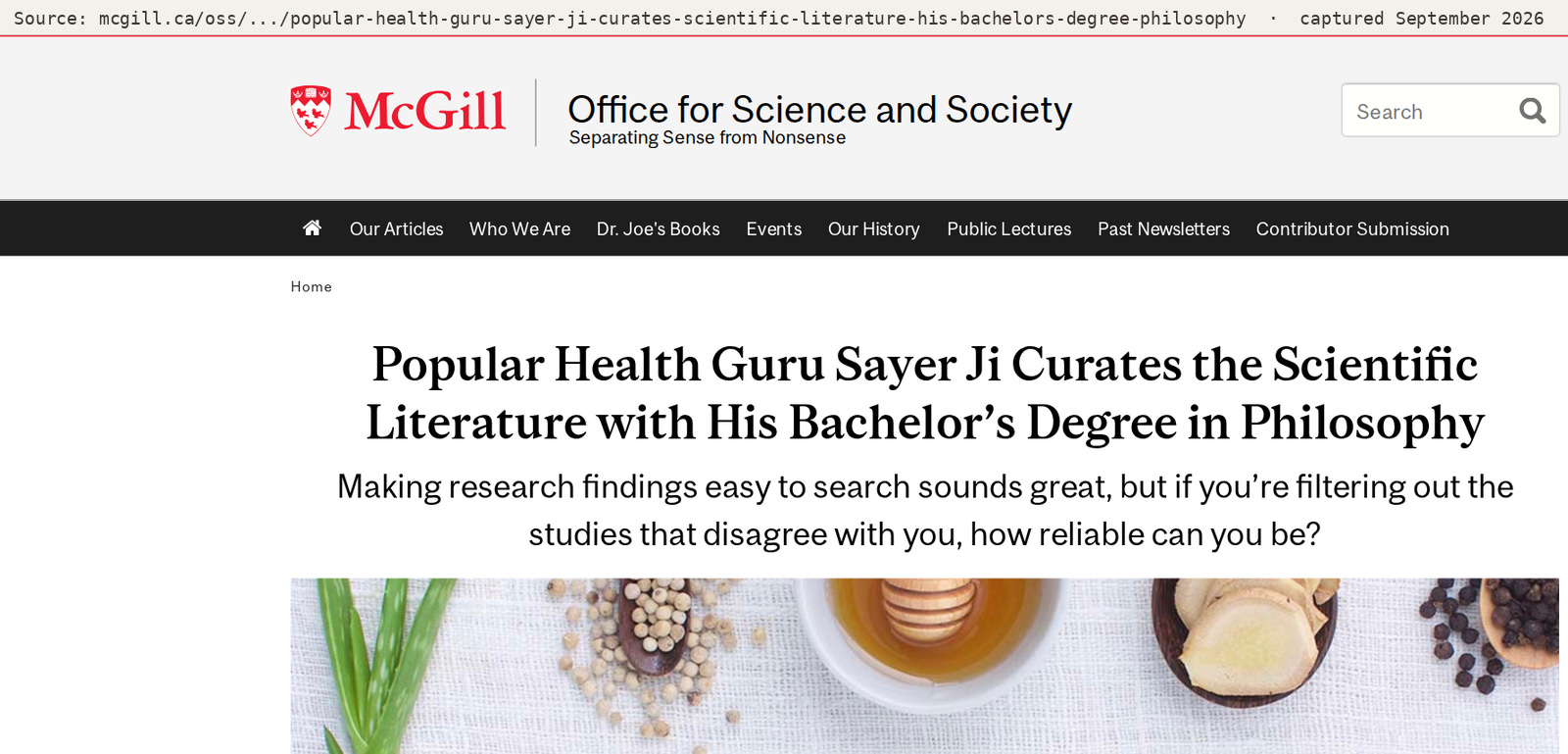
In July 2019, an office at McGill University published a profile of me under a headline that doubles as its entire argument: “Popular Health Guru Sayer Ji Curates the Scientific Literature with His Bachelor’s Degree in Philosophy.” Its author, a science communicator named Jonathan Jarry, compressed the thesis further still: “A guy who majored in philosophy simply is not up to the task.”
The task in question was reading the biomedical literature. The article conceded that GreenMedInfo’s database is what it claims to be: close to 100,000 research abstracts drawn directly from PubMed, the National Library of Medicine’s own index (now over 400,000). The author even wrote, “I wish I could endorse this fantastic tool.” He did not identify a single abstract we had misquoted, a single citation that did not exist, a single study mischaracterized. The argument was never that I had gotten the science wrong. The argument was that I was the wrong kind of person to be reading it.
I have had seven years to sit with that sentence, and I want to tell you what it finally produced in me. Not anger, though there was some. Not a hunger for vindication, though the record has since supplied more of it than I expected. What it produced, in the end, was curiosity. Because the sentence contains a question its author never thought to ask: who examines the examiners?
That happens to be a philosophy question. The discipline I trained in is not a warehouse of facts; it is a set of habits for interrogating authority, evidence, and the difference between an argument and the person making it. Judging a claim by the credentials of the claimant has a name in that discipline. It is called the ad hominem fallacy, and it is among the first things you unlearn.
So this piece is an exercise in the very activity I was declared unqualified to perform. I got curious about McGill. Three questions organized the inquiry:
Why did an institutional office at a major research university take a sustained adversarial interest in me?
How did two blog posts become the world’s memory of who I am, cited by Wikipedia, ingested by AI systems, and recited back to me by strangers and machines alike?
And what do we find when the same curiosity, held to the same evidentiary standard, is turned back on the institution?
The rules of this piece are stricter than the ones applied to me. Every factual claim links to a primary document or an on-record source. Every quotation is verbatim. Where the evidence is contested, I say contested. And where a claim would feel satisfying but the record does not support it, I name the claim and decline to make it. You will see me do this several times. That restraint is not a hedge. It is the method.
What the two posts actually said
The 2019 profile made three moves. First, the credential attack, which served as the entire thesis. Second, it reframed a disclosed editorial choice as a concealed one: GreenMedInfo curates studies on natural interventions as a deliberate counterweight to an industry-funded publication landscape, a methodology we state and defend in public. The profile presented the curation as deception and omitted the disclosure. Third, it editorialized about my faith, sneering at the idea that nature might be intelligible as a healing system, in an outlet published under the banner of institutional science.
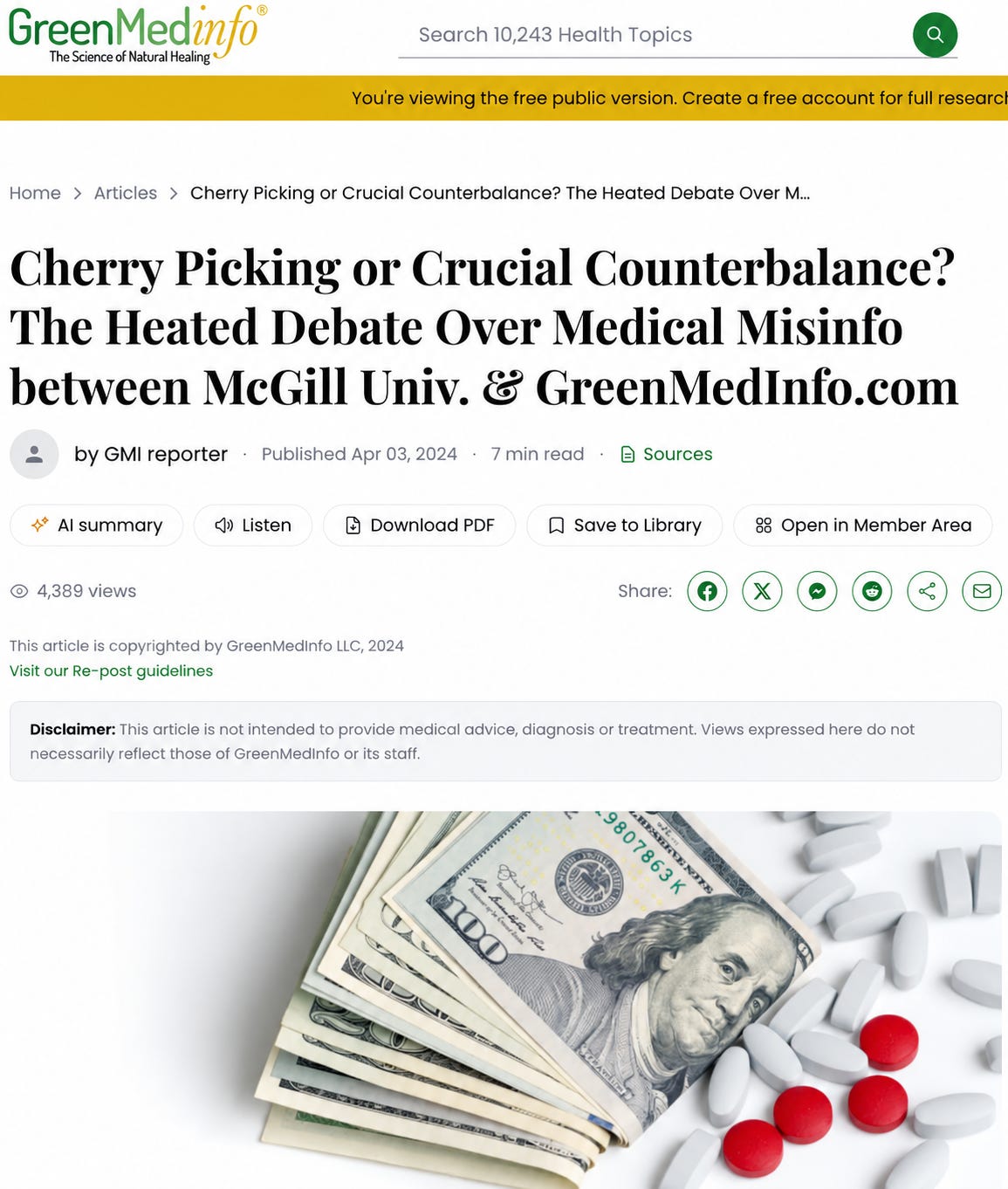
One more feature is worth noting for what came later. The 2019 piece preemptively dismissed any future claim of censorship as a “victim” card, a gambit, a pose. It said this two years before the deplatforming campaign it anticipated actually arrived.
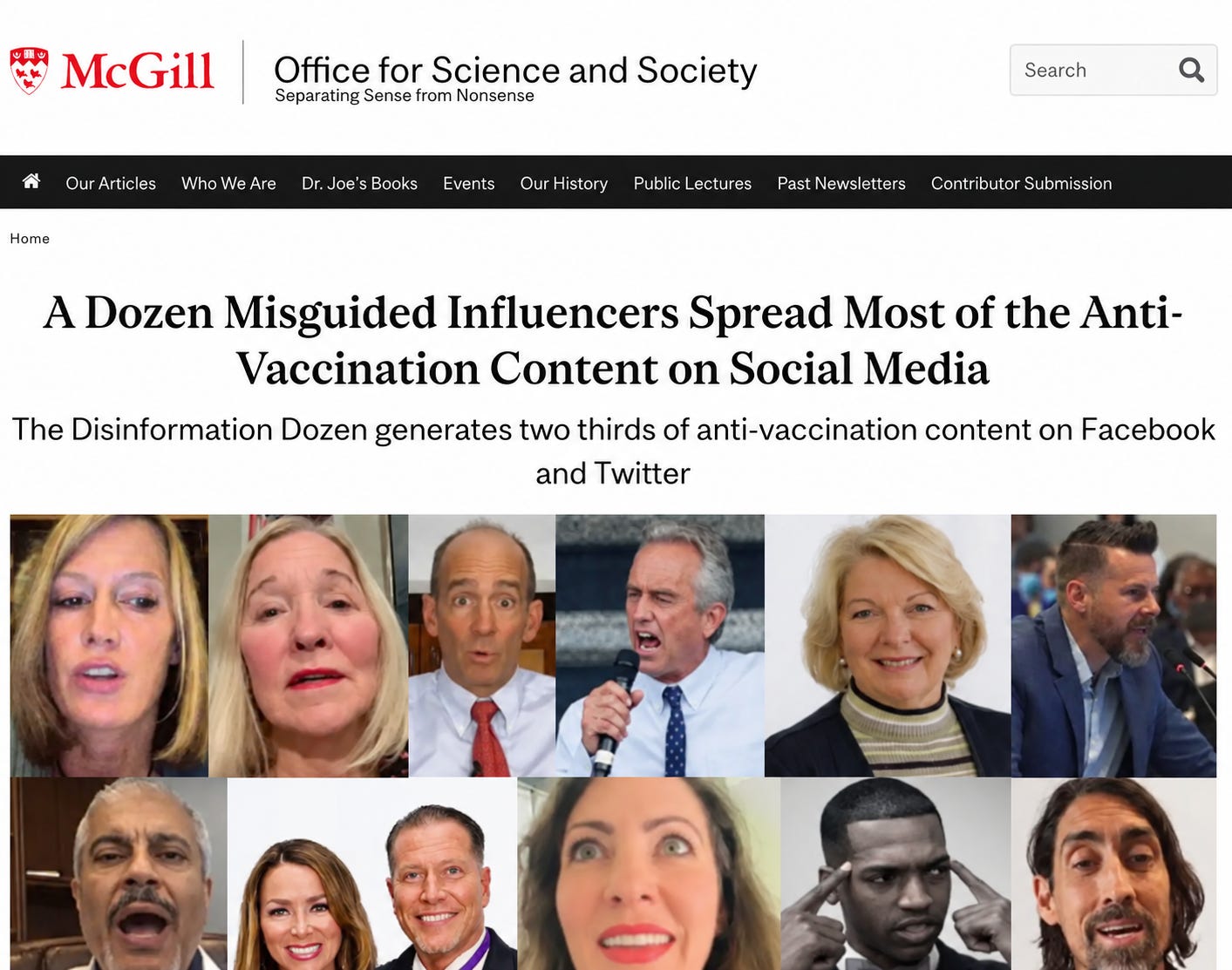
Then came March 31, 2021. In a piece amplifying the Center for Countering Digital Hate’s “Disinformation Dozen” report, Jarry told his readers that two-thirds of anti-vaccine content on Facebook and Twitter over a six-week window could be attributed to twelve individuals, of whom I was one. “Twelve. Let that sink in,” he wrote.
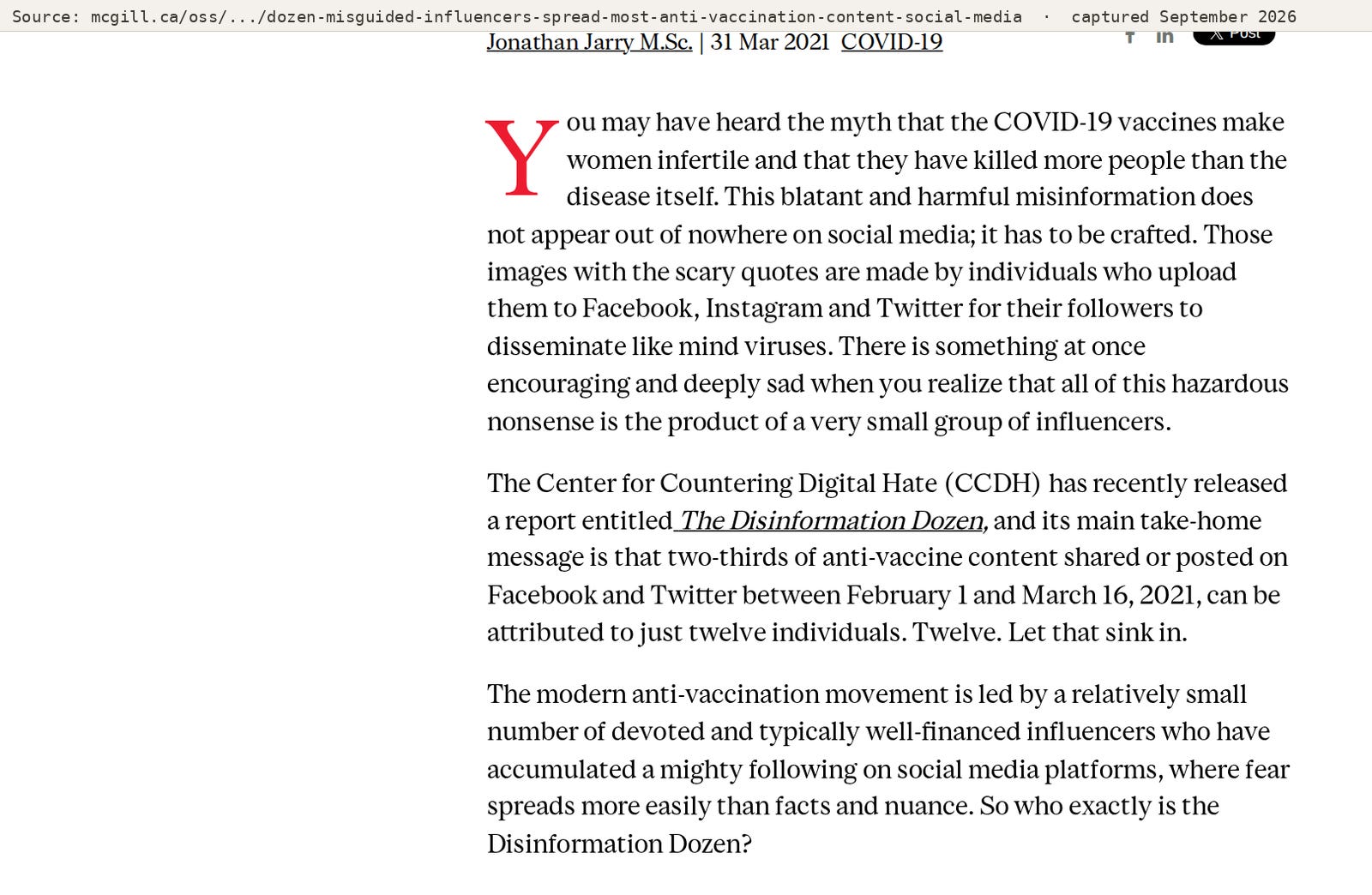
The March 31, 2021 OSS article: the two-thirds claim, and “Twelve. Let that sink in.” Captured September 2026.
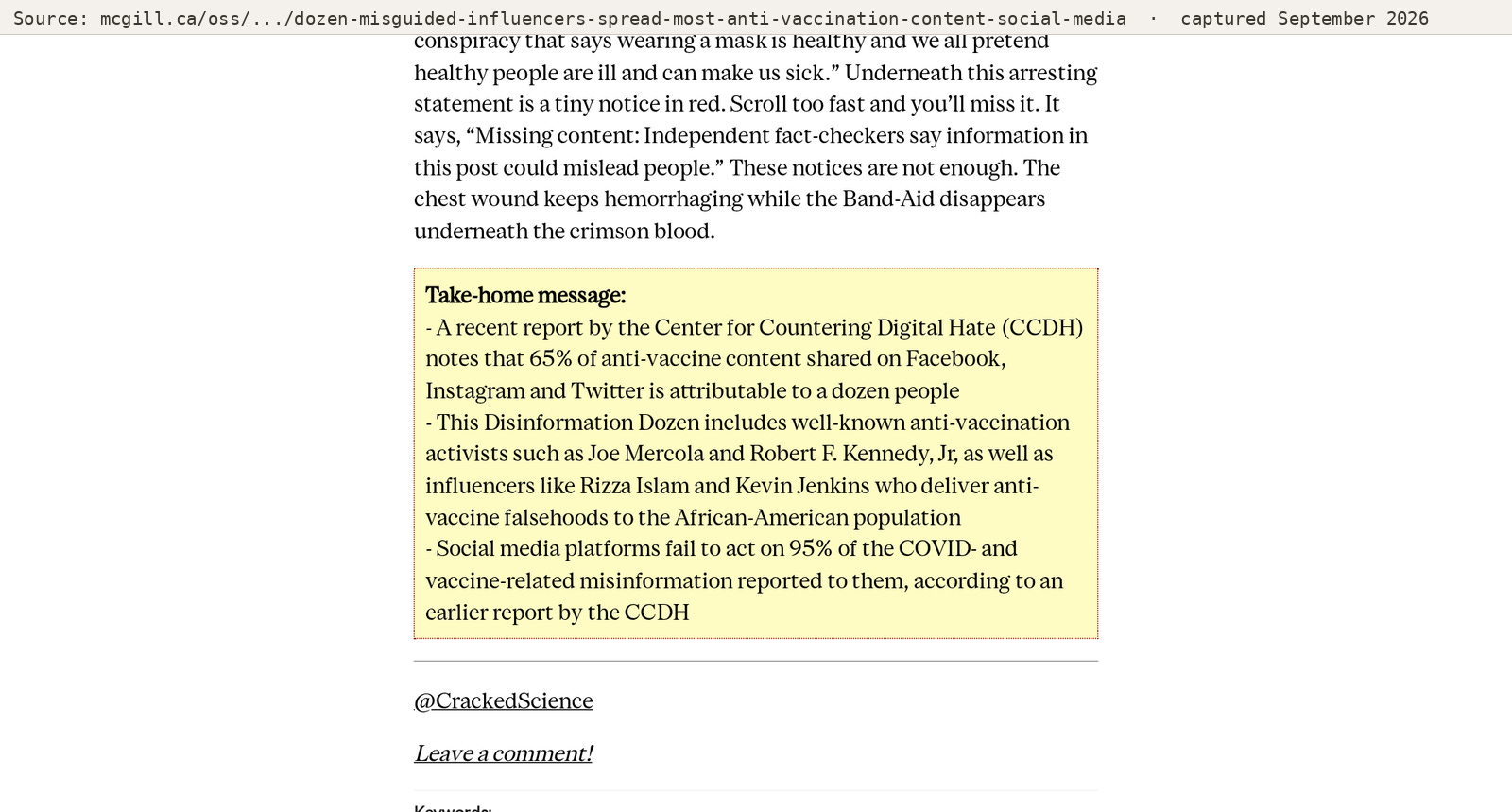
The end of the same article as it stands today: the take-home box still asserts the 65% figure, and no correction follows. Captured September 2026.
The article celebrated that I had been comprehensively removed from a major platform and argued that warning labels were insufficient: more removal was the remedy.
Five months later, the company that actually held the data responded. On August 18, 2021, Meta stated publicly that the twelve named individuals were “responsible for about just 0.05% of all views of vaccine-related content on Facebook,” that CCDH’s sample consisted of 483 posts drawn from only 30 groups over six weeks, that there was no justification for treating it as representative, and that the result was a “faulty narrative.”
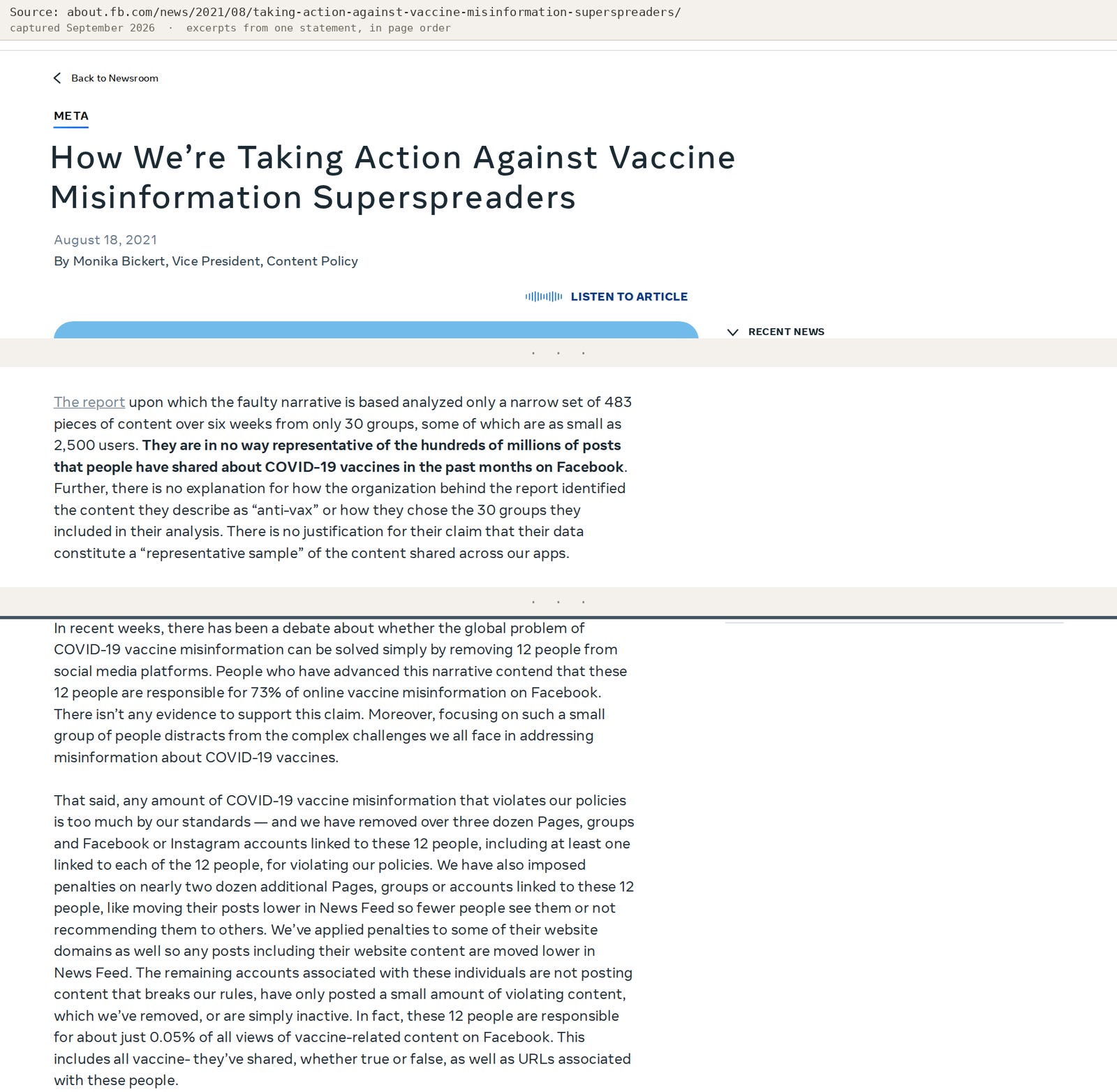
Two-thirds versus five hundredths of one percent. The claim and the correction differ by a factor of more than a thousand.
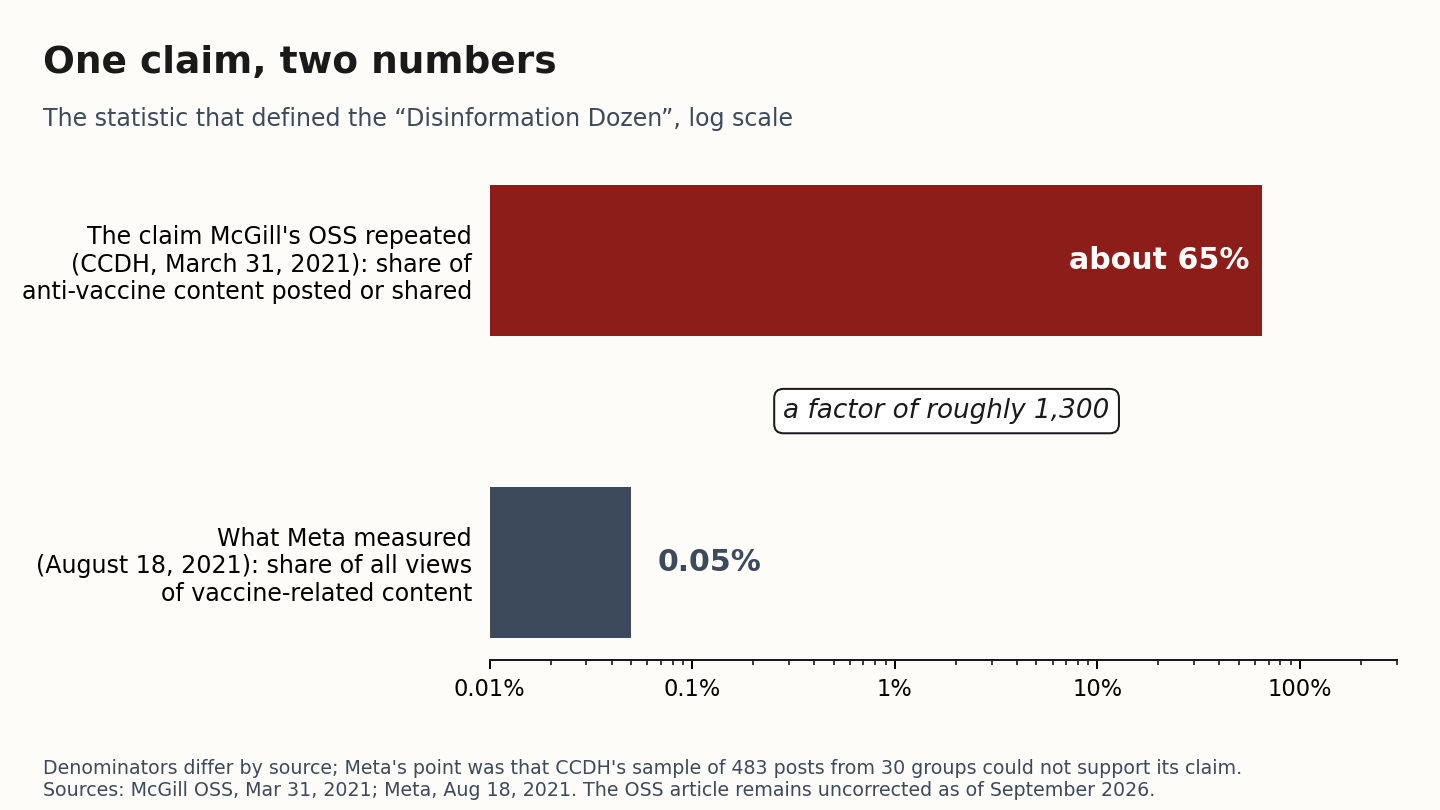
As of this month, September 2026, the OSS article carries no correction, no editor’s note, no update of any kind. Five and a half years. From an office whose brand promise is separating sense from nonsense.
How a blog post becomes the world’s memory of you
Here is the mechanism, and it deserves to be understood by anyone who may one day be its subject.
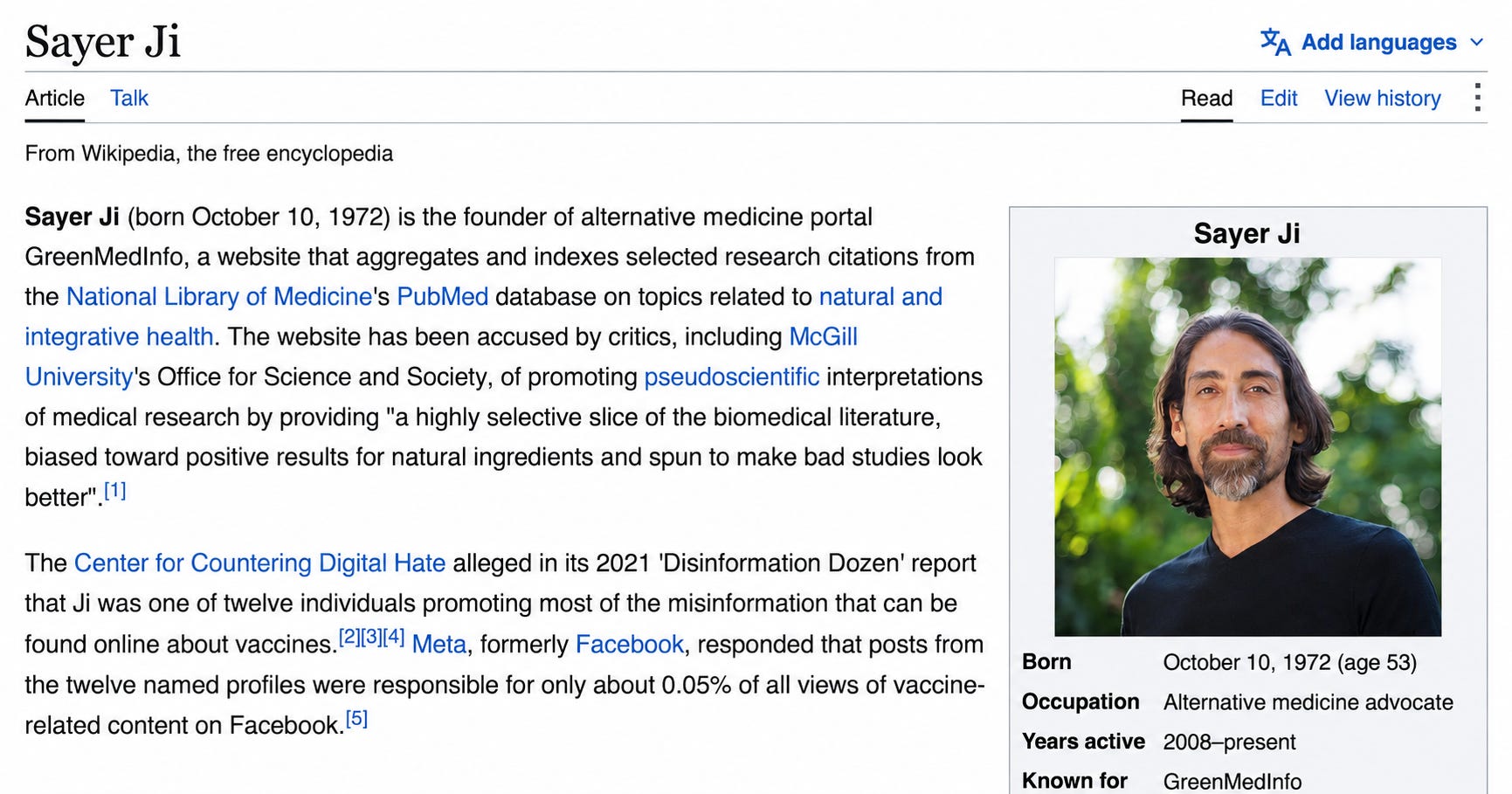
Wikipedia’s article about me relies on the McGill OSS pieces for at least four separate derogatory claims, including the direct quotation “Ji, who is anti-vaccination and anti-GMO, has no scientific training.” The article was created on May 20, 2021, four days before CCDH published its follow-up report, a timing pattern I documented in “They Came for My Name.”
And then come the machines. Large language models are trained on Wikipedia and treat it as a load-bearing source. When you ask an AI system who Sayer Ji is, you are, in many cases, reading Jonathan Jarry with the byline removed and the confidence doubled. A single uncorrected blog post, laundered once through an encyclopedia, becomes machine-readable consensus about a living person. It informs hiring decisions, deplatforming decisions, banking decisions, and the priors of every journalist who “does a quick search” before an interview.
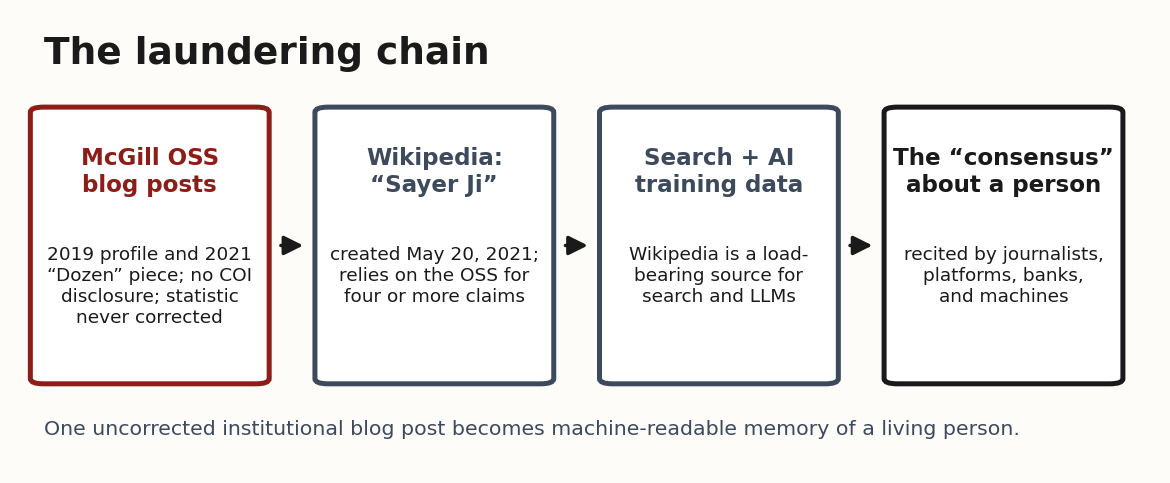
Let me be precise about what is documented here and what is not. The chain of citation and the dates are documented; you can verify every link yourself. Intent is an inference, and I am not asserting it. What requires no inference at all is the structural fact: our civilization’s memory of individuals now runs through a pipeline in which one institutional blog post, never corrected, can define a person to every machine on Earth.
Why me? What the record shows, and what it does not
The first honest answer is that it was not personal. It was declared strategy, and the declaration predates me.
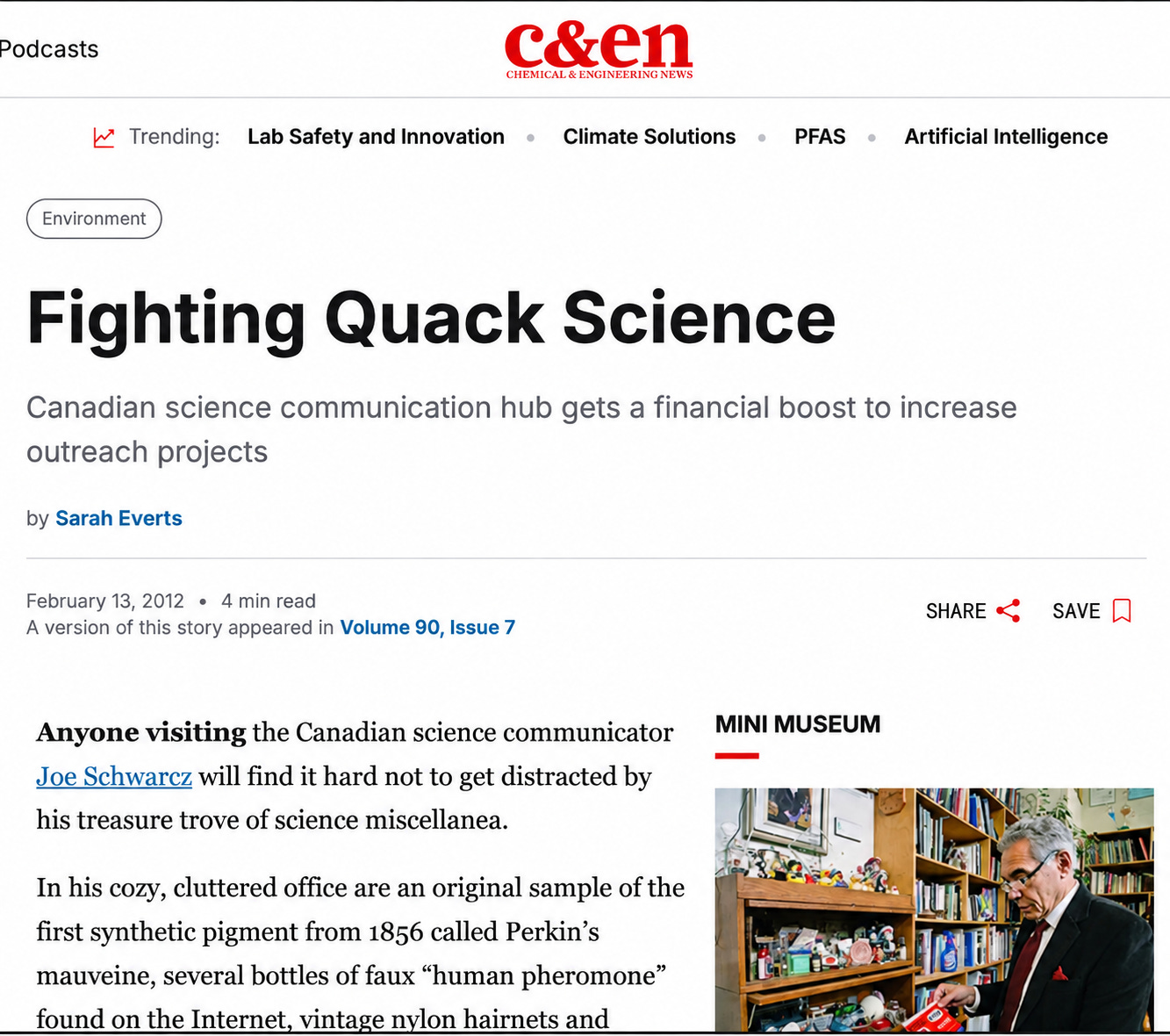
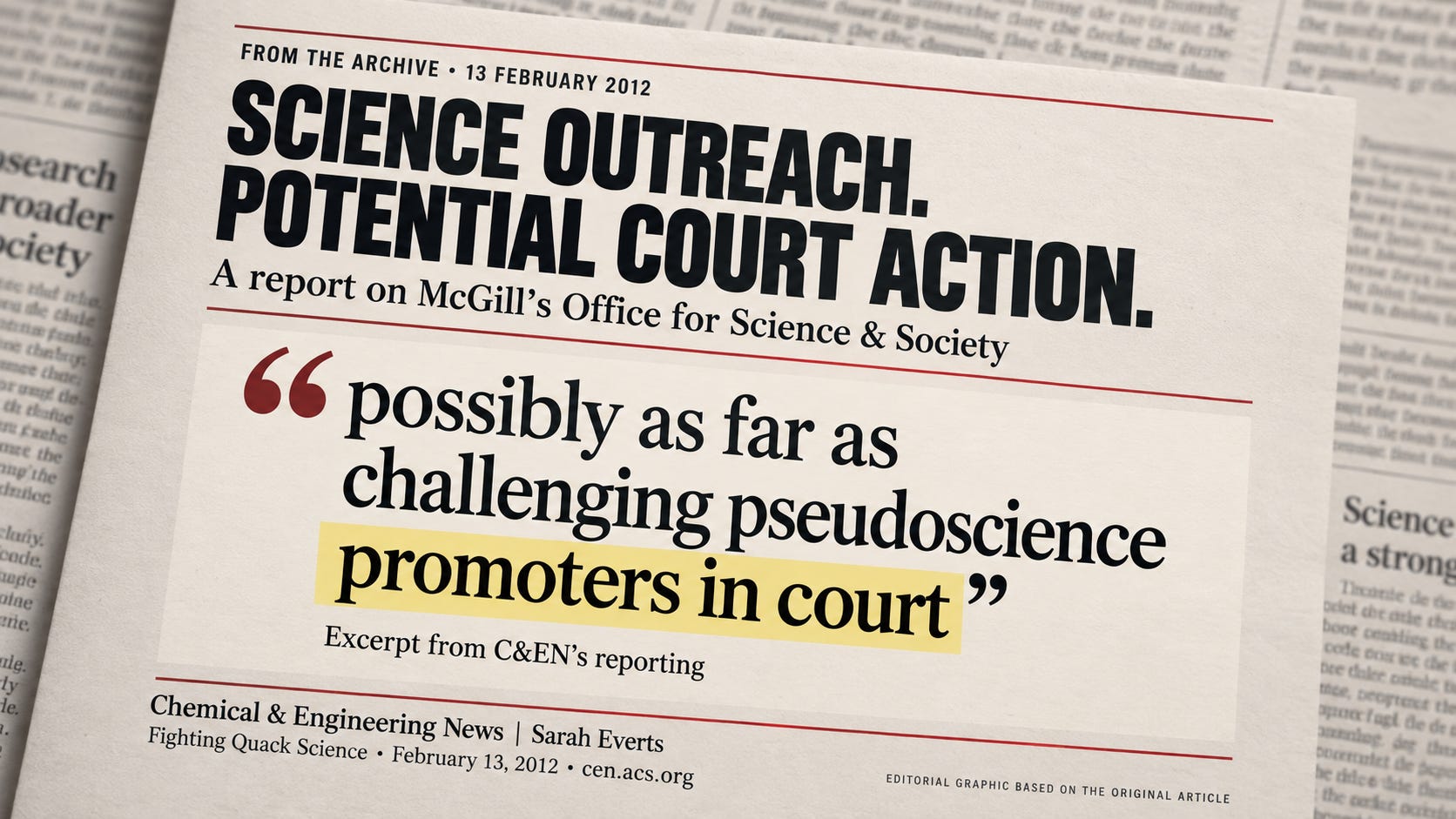
In 2012, after the OSS received a $5.5 million endowment from the Trottier family, its director Joe Schwarcz told Chemical & Engineering News that the office might expand its activities, possibly as far as challenging “pseudoscience promoters in court,” and identified the anti-vaccine movement as the most important issue the office was then tackling. Seven years before my name appeared in an OSS headline, the office had announced an adversarial mission and named its target category.
The output since then reads less like a science column than a production line of adversarial profiles: Joseph Mercola, analyzed with the help of more than 50 hours of leaked recordings; Christiane Northrup; Robert F. Kennedy, Jr.; the MAHA Report; Vinay Prasad and Casey Means; the documentary Died Suddenly. The roster tracks, name for name, the target list of CCDH and the organized skeptic movement.
The author’s network position is also on the record. Jarry was named a Fellow of the Committee for Skeptical Inquiry in 2021, speaks at its conferences, and serves as an expert resource for ScienceUpFirst, a vaccine-uptake campaign funded by the Public Health Agency of Canada’s Immunization Partnership Fund in April 2021. The same month his Disinformation Dozen piece was circulating, its author was an expert asset of a federally funded persuasion program.
Now the discipline. What the record establishes: a declared adversarial mission, a target roster mirroring a pressure group’s, an author embedded in a state-funded campaign, and a sequence of dates you can check. What the record does not establish: an instruction, a payment for a particular piece, a coordinated operation. Convergence is documented. Coordination is not asserted. I hold that line even though it forecloses the more satisfying story, because holding it is the difference between journalism and its imitation.
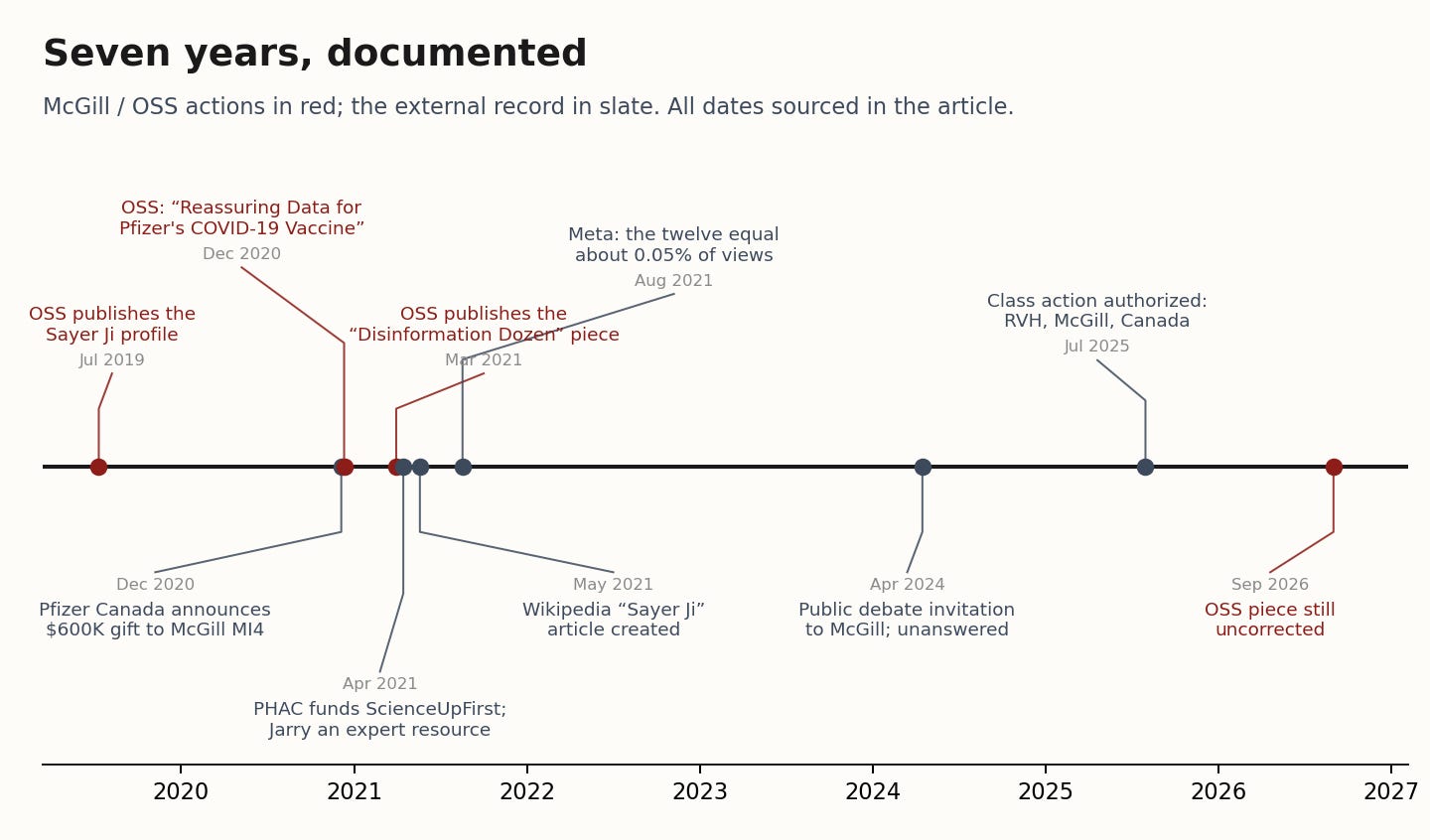
The auditor’s ledger
Which brings us to the institution itself. The OSS’s authority is entirely borrowed; the byline matters because the letterhead says McGill. So the letterhead is a fair subject. I put McGill through the same kind of audit its office performed on me, with one difference: every claim below is graded against primary sources, and the ones the evidence cannot carry are refused out loud.
What I found rearranged my understanding of the word “neutral.”
A defendant, right now, for experiments on its own patients
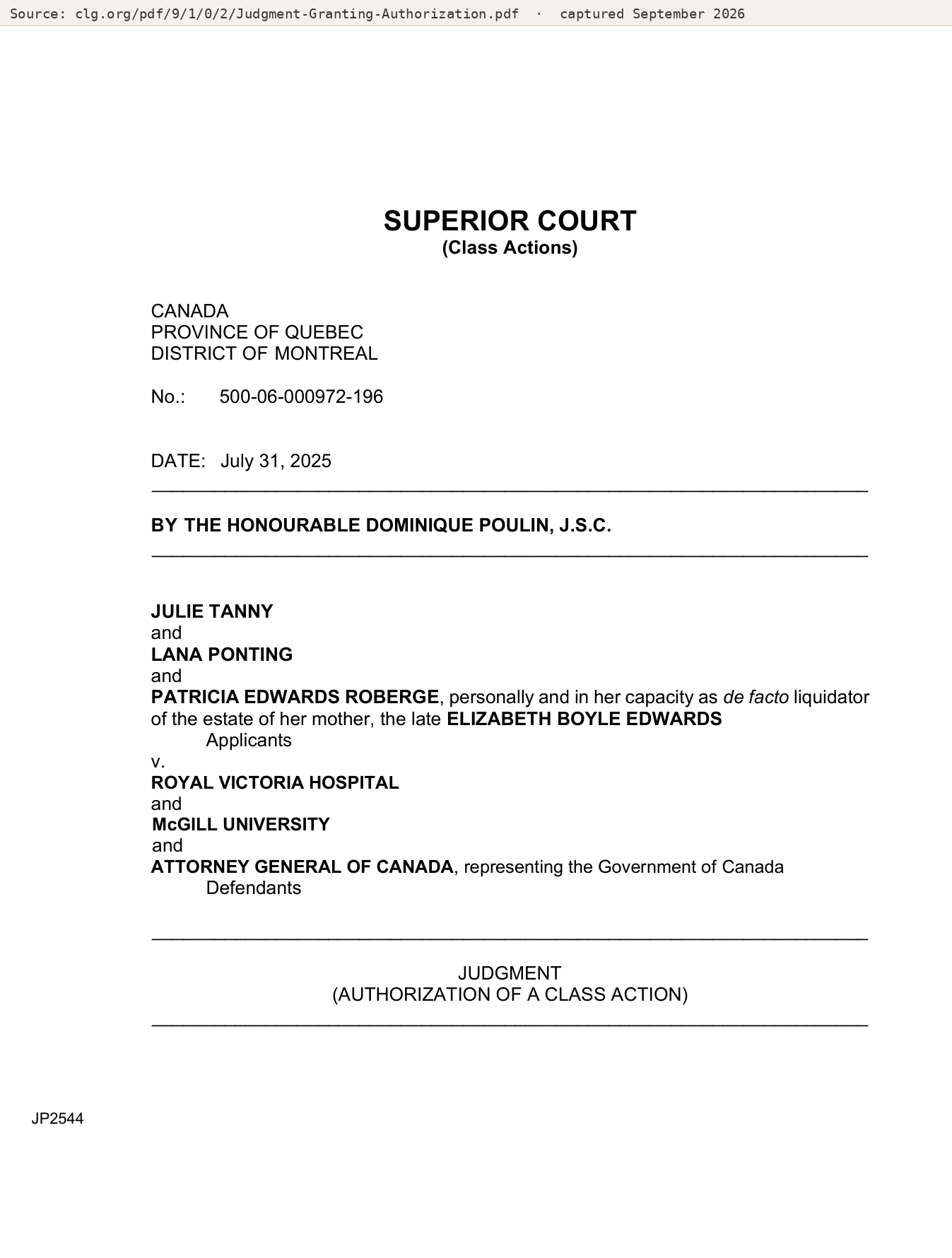
Quebec Superior Court, July 31, 2025: page one of the authorization judgment, court file 500-06-000972-196.
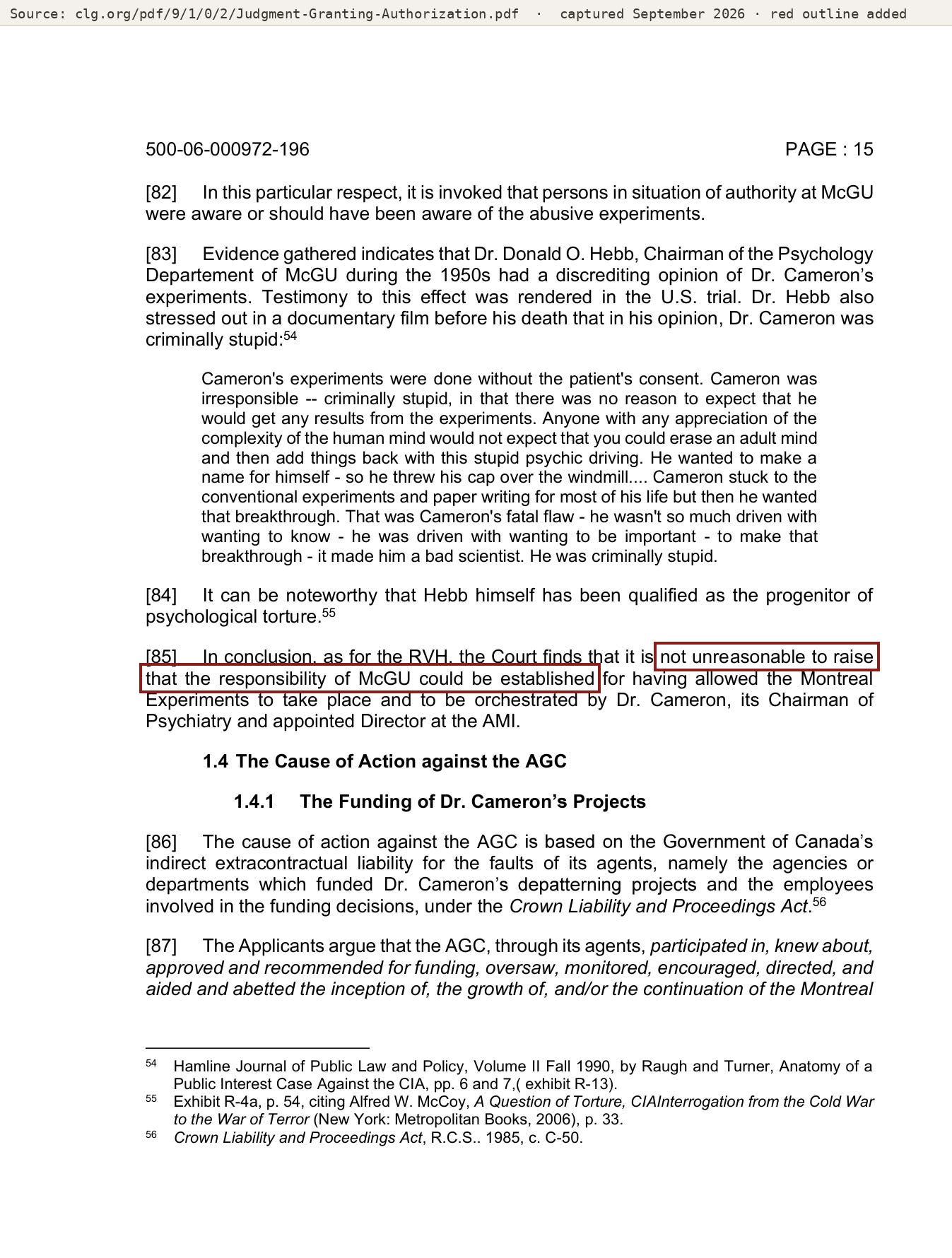
One page of the judgment, paragraphs 83 to 85: Hebb's testimony that the experiments "were done without the patient's consent," the "progenitor of psychological torture" line, and the finding on McGill's responsibility. Red outline added.
What was depatterning? Patients were immobilized and subjected to massive electroshock, sensory isolation, and heavy sedation until their minds were, in the program’s own aspiration, wiped; then came “psychic driving,” taped messages played thousands of times. People emerged unable to remember their native language, their spouses, their occupations. Canada’s own 1986 inquiry, the Cooper Report, conceded that the alleged techniques “were in fact used at the AMI” and described depatterning as an assault on the brain “not justifiable even by the standards of the time.”
The victims included children. Lana Ponting was 16, committed by a judge for being “disobedient,” and given LSD, barbiturates, nitrous oxide, and psychic driving. Lloyd Schrier was in utero while his mother was put through thirty days of induced sleep.
Who paid for this? The CIA contributed $69,000 through a front organization, MKULTRA Subproject 68. Canada’s Department of National Health and Welfare paid $495,494.41 across nine projects. The Defence Research Board funded related work. And McGill: the court records that McGill’s own Board of Directors appointed Cameron as the Allan’s director and chair of psychiatry, that McGill contributed salaries and the costs of operating the building, and that project workers’ “cheques were issued by McGill University.” The judgment states that McGill “is blamed for having blindfully tolerated experiments deemed abusive,” conducted against the standards of the time, while their effects were not hidden but openly published by Cameron himself. McGill’s own chair of psychology, Donald Hebb, called Cameron “criminally stupid” and said the experiments “were done without the patient’s consent.” The court found it “not unreasonable to raise” that McGill’s institutional responsibility could be established.
Hebb deserves his own sentence, because the thread does not end in Montreal. His sensory-deprivation research at McGill was funded by Canada’s Defence Research Board; the Cooper Report records that Cameron’s isolation work grew out of it; its findings fed the CIA’s 1963 KUBARK interrogation manual and, by a documented lineage, later detention practices. The authorizing judge noted that Hebb “has been qualified as the progenitor of psychological torture.”
One detail completes the picture. In 1945, Cameron was among three psychiatrists sent to Nuremberg to evaluate Rudolf Hess. He sat at the birthplace of modern research ethics, then returned to McGill and spent the next decade violating its every principle, on institutional payroll, in an institutional building, to institutional silence.
And the silence held. The 1986 report absolved Canada of legal and moral responsibility. In 1988 the CIA settled for $750,000 with no admission of liability. In 1992 Canada paid 77 surviving patients $100,000 each on humanitarian grounds, excluding the families of victims who had already died. In 2017 a settlement came with a confidentiality clause; the family’s lawyer said at least five such gagged settlements exist. In February 2025, Canada and the hospital moved to dismiss the class action on limitation grounds. McGill has never issued an acknowledgment or an apology; last September its own student newspaper wrote that the university “has failed to formally acknowledge its role.” As CBC’s long investigation put it, “no government has ever admitted liability, let alone apologized.” Hold the shape of that record in mind. It recurs in this story, and before the end I will give it its name.
The ground itself
There is a second live controversy on the same grounds, and I will state it exactly as far as the evidence goes and no further.
McGill’s Royal Victoria Hospital received Indigenous children from the residential school system that Canada’s Truth and Reconciliation Commission has called cultural genocide. McGill’s Allan Memorial ran non-consensual experiments in the same period. Whether Indigenous children were among the victims, and whether anyone lies buried on the grounds McGill is now redeveloping, remains under a contested investigation that McGill has repeatedly moved to curtail.

The documented pieces: Canada’s Independent Special Interlocutor for Missing Children reported that “Indigenous children were sent to the Royal Victoria Hospital,” some from residential schools and northern hostels, and that the Allan’s non-consensual experimentation “may have been done on Indigenous children.” Lana Ponting testified under oath that she saw Indigenous children at the Allan, including a girl named Morningstar subjected to the same drugging and electroshock, and that she saw people with shovels and flashlights by a cement wall at night. In 2023, three trained human-remains detection dogs alerted at that same wall; the handler said she was “confident that the odour of human remains is in this area.” In April 2025, the Mohawk Mothers alleged that bone fragments, two early-twentieth-century children’s shoes, radar anomalies, and a probe report had been withheld from them.
McGill’s position, which I preserve here because fairness demands it: “no human remains have been discovered,” and no patient has been identified as having disappeared. That may prove true. But here is what is also true, from the court record: McGill successfully fought applications by the Mohawk Mothers and the federal Special Interlocutor to access its patient archives, winning dismissal in December 2023 and defeating leave to appeal in March 2024. McGill and the provincial infrastructure agency disbanded the jointly appointed archaeological panel created by settlement, then prevailed against its reinstatement. The Mothers’ cultural monitors were removed from the site a week after excavation resumed.
I make no claim about what is in that ground. I observe who is fighting to keep the records closed, and I note that “trust us” is a strange posture for an institution simultaneously defending a class action over what happened on the same grounds.
Foundations
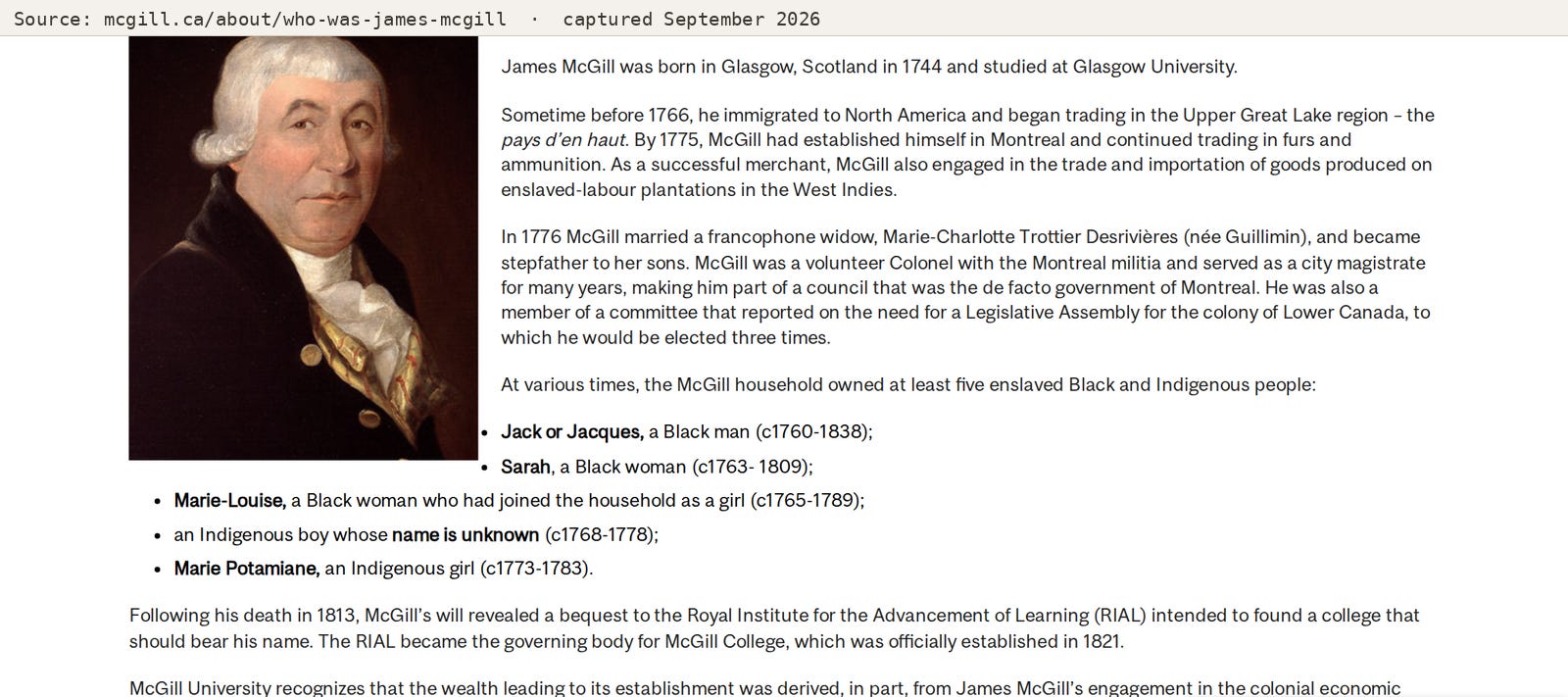
Some of this requires no investigation at all, because McGill now says it about itself. The university’s own page on its founder acknowledges that James McGill traded in goods produced on enslaved-labour plantations, that the wealth which established the college derived in part from the transatlantic slave trade, and that his household “owned at least five enslaved Black and Indigenous people.” McGill names them: Jack, also called Jacques; Sarah; Marie-Louise; an Indigenous boy whose name was never recorded, dead by about age ten; and Marie Potamiane, an Indigenous girl, dead by about age ten.
A century later, historians identify McGill as the center for the dissemination of eugenic ideas in Canada; a McGill alumnus introduced eugenics to the country in 1890, and the historian Sebastian Normandin finds no other Canadian institution where its promotion operated at comparable scale.
These are not my characterizations. The first set is McGill’s confession; the second is the standard historiography.
The money
McGill’s most recent reported year shows $749.2 million in research funding including its affiliated hospitals: $55.8 million directly from industry, and another $129.9 million from “not-for-profits and individuals,” the category where foundation money lives.
The named relationships come from McGill’s own press releases. Merck Canada: $4 million to the Faculty of Medicine in 2013, part of Merck’s $100 million Quebec pledge. Pfizer Canada: a $2 million professorship. Moderna: an mRNA program partnership in 2022, two funded lipid-nanoparticle projects in 2023, and a new RNA project in 2026. The Gates Foundation: roughly $12 million US by 2016, plus $1.5 million US in this cycle to make McGill the Canadian node of an RNA vaccine cooperative. The Sackler Foundation, of Purdue Pharma and OxyContin: $3,888,078 between 2014 and 2017.
One sequence of dates deserves exact statement. On December 4, 2020, Pfizer Canada announced a $600,000 gift to McGill’s infection-and-immunity initiative, creating “Pfizer Early Career Investigator Awards.” Six days later, on December 10, the OSS published “Reassuring Data for Pfizer’s COVID-19 Vaccine.”
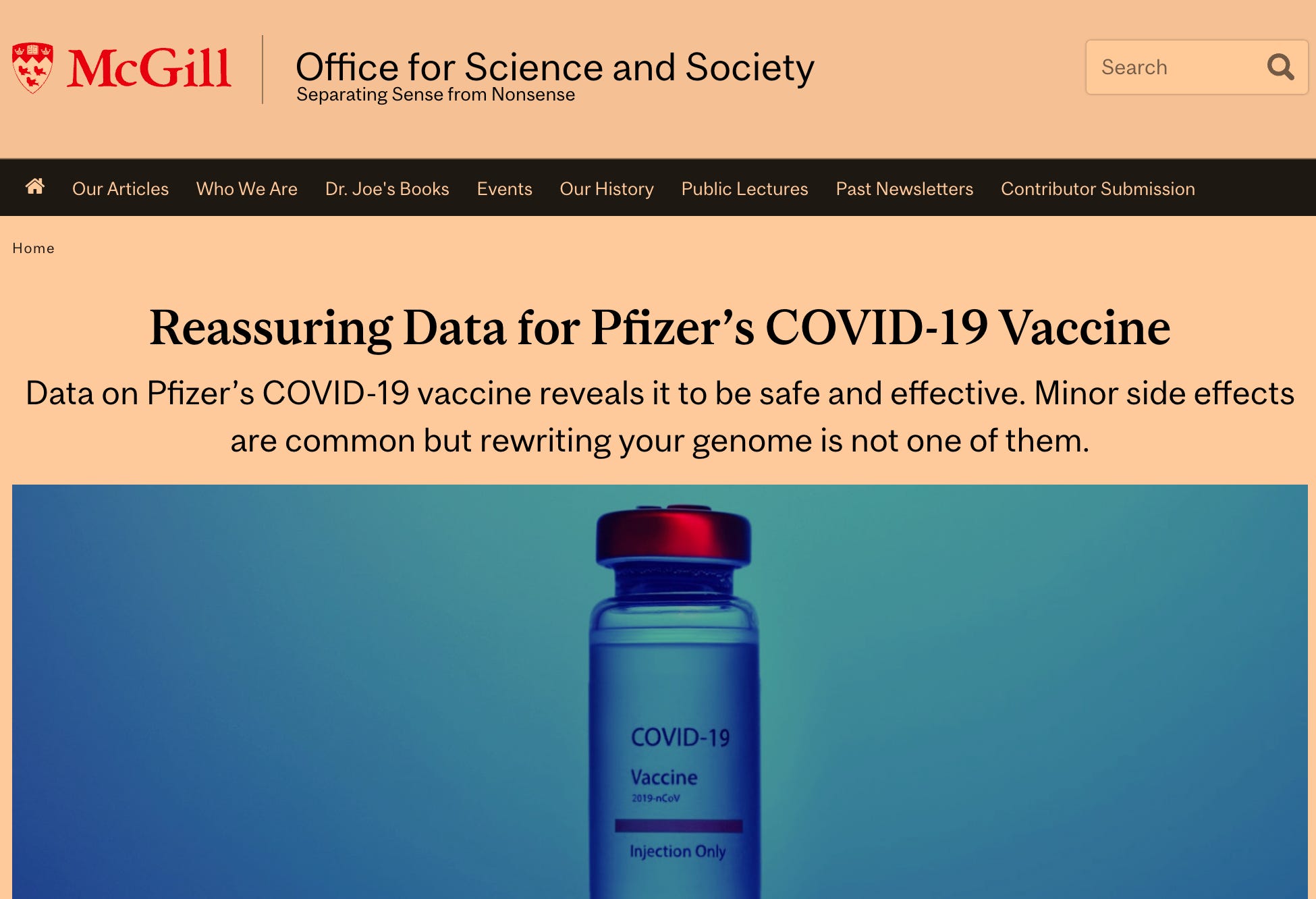
I am not claiming the gift purchased the article. No evidence supports that, and I will not publish what the evidence cannot carry. The documented claim is narrower, and I think sharper: an office trading on McGill’s name publishes verdicts on the products of companies whose money flows into McGill, and those articles carry no conflict-of-interest disclosure whatsoever. The standard the OSS applies to me, that undisclosed interest and undisclosed selection corrupt public science communication, is a perfectly good standard. It has simply never been applied at home.
The office that accepts nothing from vested interests
Today the OSS tells the public: “The OSS does not accept funding from any vested interest.”
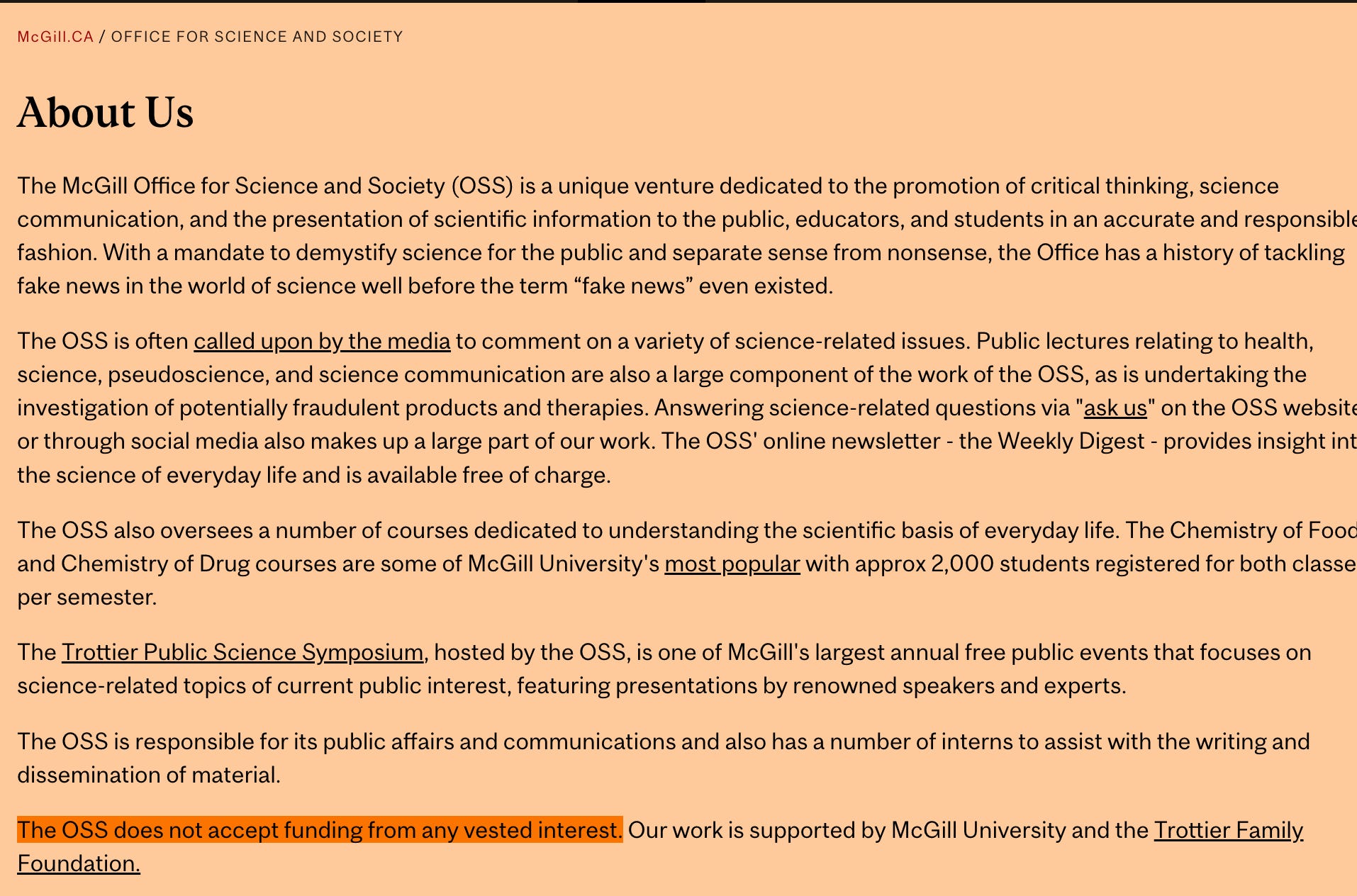
The Internet Archive remembers differently. From at least December 2003 through October 2007, the OSS homepage footer read:
“OSS receives support from McGill University, The Lorne Trottier Family Foundation, The Council for Biotechnology Information and private donors.”
By March 2008, the same footer read:
“OSS receives support from McGill University, The Lorne Trottier Family Foundation, and private donors.”
The captures are publicly checkable; the raw archived pages were retrieved and read for this piece.
The Council for Biotechnology Information was the agrichemical industry’s communications vehicle, whose members were BASF, Bayer, Dow AgroSciences, DuPont, Monsanto, and Syngenta, and whose founding membership in 1999 included Novartis and Aventis CropScience, pharmaceutical companies both. It spent more than $28 million on product-defense communications in its final five years before dissolving in 2019. The Environmental Working Group flagged the OSS’s CBI funding in 2008, after Schwarcz dismissed EWG’s pesticide guide as meaningless. By March 2008, the acknowledgment had vanished from the footer.
So the office’s present claim of purity is, for the years 2003 to 2007, contradicted by its own archived website: money from a Monsanto and Bayer PR consortium, acknowledged for four years, then scrubbed. How much money, who approved it, and who decided to remove the acknowledgment are open questions. Quebec’s access-to-information law reaches McGill, and I intend to ask.
And because the standard cuts in every direction, two exculpations the evidence requires. Lorne Trottier, the OSS’s principal benefactor, co-founded a computer-graphics company; his foundation’s roughly $180 million in giving has gone mostly to science education, health care, and climate, and the closest thing to a pharmaceutical connection on record is that his foundation and Pfizer Canada both appear on the donor rolls of the same community hospital. That is co-donorship, not a conflict, and I decline to publish it as one. Likewise, Joe Schwarcz holds a contributor profile at the American Council on Science and Health, whose leaked 2012 fundraising documents showed a donor base heavy with Coca-Cola, Monsanto, Syngenta, Bayer CropScience, Chevron, and Philip Morris International. The association is documented; whether Schwarcz has ever been paid by ACSH is not, and I make no such claim.
Notice what just happened. It took me two sentences to be fair to my critics. Neither of the pieces written about me contains their equivalent.
The refusals
Across this investigation I declined five claims that would have made better headlines. That McGill is “genocidal” as a settled matter of fact: the defensible statement is that McGill is implicated in Canada’s colonial medical system, with a contested unmarked-graves investigation on grounds it fought to excavate on its own terms. That pharmaceutical money dictated OSS content: unsupported; the documented claim is undisclosed institutional conflict. That Lorne Trottier is an industry conduit: unsupported. That Schwarcz is on ACSH’s payroll: unsupported. That the convergences among the OSS, CCDH, federal funding, and the platforms were coordinated: convergence is documented, coordination is not asserted.
Each refusal cost the piece a sharper headline. Each purchase was the same thing: the right to say that every claim remaining can survive hostile review. My critics have never made that trade. It shows.
What neutrality would actually require
The OSS’s entire product is the presumption of neutrality: a referee’s whistle, sense sorted from nonsense. But neutrality is not a location you occupy by announcing it. It is a practice, and the practice has tests.
Do you disclose your interests? My database’s selection principle is stated on its own site and defended in public. The OSS’s industry supporter lived in a footer until the footer was edited.
Do you correct the record? Five and a half years after Meta repudiated the statistic at the heart of the 2021 piece, the OSS has not.
Do you submit to examination? An invitation to public debate has stood open to McGill’s faculty and officers since April 2024, without response.
And here is the turn I want to make carefully, because it is the philosophical heart of the matter. The lesson of this audit is not that McGill’s history disqualifies McGill’s arguments. That would be the ad hominem fallacy with the names changed, and I refuse it for the same reason I refuse the rest. Whether a given vaccine is safe, whether turmeric modulates inflammation, whether any empirical claim is true: none of that is settled by anyone’s institutional record, theirs or mine. Arguments stand or fall on evidence.
What the history does settle is a narrower question: whether McGill may present itself as a party without interests. It may not. It is a defendant in a live class action over experiments its board enabled and its payroll sustained. It is a fundraiser whose donors include the companies its science office publicly evaluates. It is a litigant that fought to keep its own patient archives sealed. It is, in every documented sense, a player on the field, wearing a referee’s shirt.
The asymmetry, then, is the story. When I curate the literature with a disclosed method, it is called cherry-picking and my degree is offered as the explanation. When an institutional office runs an adversarial content operation with an undisclosed industry funder in its past, an uncorrected repudiated statistic in its present, and its parent university’s donor interests standing silently behind every verdict, it is called science communication, and its output becomes an encyclopedia’s source and a machine’s memory.
The correspondence: two correction requests, two answers
Everything above is the record as anyone could assemble it. What follows is the part only I could supply, and it functions as a controlled experiment, run over two years, on the question this piece keeps asking.
2024: the author
On August 2, 2024, I wrote to Jonathan Jarry directly about his March 2022 OSS video discussing me and the Dozen, linked Meta’s August 18, 2021 statement, and asked whether he planned any correction. He replied within days, twice, at length, and the replies deserve quoting, because they show the office’s method in the one situation its brand cannot survive: the data running the wrong way.
Meta’s measurement of its own platform was, he wrote, a case of “he said, she said.” It was “in Meta’s interest,” he suggested, to make the misinformation problem seem “more intractable than it is.” The advocacy group’s 483-post sample, by contrast, he defended as ordinary research method. The report might be flawed, “which, to be clear, I do not grant you,” but it would not matter if it were: “my critique would stand.” If I disputed the statistic, I should “contact them directly,” meaning CCDH, the group that made the claim; if CCDH ever retracted, he would “gladly write an article about it.” The office that published the number assigned the correction to someone else. And I was, he wrote, without identifying a single example anywhere in the exchange, “clearly producing and sharing a lot of misinformation.” His final email declared, “Misinformation is not a question of opinion,” proposed we agree to disagree, and closed the matter: “Our worldviews are just not compatible.” The disagreement was between two numbers, 65 and 0.05.
That same final email contained a concession, and it may be the most important fact in this piece. “In the interest of our viewers,” Jarry wrote, a pinned comment had been added to the video, “mentioning that Meta disputes the validity of the report” and linking Meta’s post. Note what this establishes: the office knows how to append a Meta note when the record requires one, and its own author judged that the record required one. He attached that note to a video he had just told me had 673 views. The next morning, and again on August 28, I asked the obvious question in writing: would the same note be added to the written article, the one that feeds Wikipedia and still carries the 65% claim in its own take-home box? I renewed the invitation to a public, evidence-based debate in the same letters. Those messages received no reply.
The comparison that makes this damning happened in the same weeks. Newsrooms with no stake in the argument handled the identical request in the ordinary way. The Independent added an update to its May 2021 coverage noting Meta’s objections; Forbes updated its December 2021 article to reference Meta’s statement; and in September 2024, the Guardian’s readers’ editor appended a footnote to its July 2021 story reflecting Meta’s challenge to the report. GreenMedInfo documented these at the time; that is my own site, and its sources are the editors’ written replies to me, so verify the notes on the outlets’ pages yourself, which is the point. None of those outlets conceded that CCDH was wrong about everything. Each simply told its readers that the platform holding the data disputed the number. That is the entire request. A university science office is the one party that declined it for its article.
2025: the director
Fourteen months later, the experiment ran in reverse. On October 6, 2025, the OSS’s director, Dr. Joe Schwarcz, emailed me about a post of mine which he read as alleging that his office receives funding from Pfizer or Merck. The allegation, he wrote, was “blatantly untrue. Please remove that allegation immediately.”
Thirty minutes later, I replied. I had reviewed the passage, corrected it that same morning to reflect the OSS’s stated funding sources, and said so. Whatever else is true in this story, that is what a correction request is supposed to produce: review, fix, confirm, move on.
The same reply renewed my own request, by then fourteen months old and formally lodged with McGill’s communications and ethics offices since August 5, 2024: would the OSS review or correct the March 31, 2021 article, given Meta’s statement? Two days later came the answer: “We stand by what was said in Jonathan Jarry’s article.” On October 8, I itemized the record formally, four publications, three questions: endorse or repudiate, review, retract or apologize. On October 10 the director replied that the office “will not make any changes other than possible additions based on what we find looking further into your online activities,” adding that “your educational background is not in line with the information you dispense.” On October 19, pressed once more, he made it, in his word, simple:
“We stand by everything we put out and will not make any changes barring some that we may make after looking further into your activities. Proceed as you wish.”
When I asked what that meant, the October 21 reply restated it: “We stand by everything on our website,” closing, “We continue to aim to separate facts from myths.”
Four observations, held to this piece’s standard. First, when Meta’s data was engaged at all, in 2024, the platform’s measurement of its own systems was dismissed as interested testimony while the advocacy group’s 30-group sample was defended as sound method; in 2025, the figure was not engaged at all. Second, the critique was declared standing “even if” the statistic beneath it failed. The article had called that statistic its “main take-home message.” A claim that survives the fall of its main take-home message by three orders of magnitude is a claim no correction can reach. Third, across both years the replies kept returning to the person rather than the claim: my good faith, my worldview, my education, my activities, my file. Fourth, and most telling: the office has already conceded the principle. A Meta note was added to a 673-view video “in the interest of our viewers.” The article Wikipedia cites has been denied the same note for the two years since, and counting.
Now set it all side by side. When the office asked me for a correction, it took me thirty minutes. When I asked the office, the author added a note to the low-reach version, declined to touch the high-reach one, and went quiet, in the same weeks that the Guardian, the Independent, and Forbes added theirs; the director then refused everything in writing and raised the prospect of additions after a further look into my activities. One of us corrects the record on request. It is not the office with “Separating Sense from Nonsense” under its letterhead.
The lawfare pattern
There is a name for the record I asked you to hold: lawfare. The term describes the use of legal and quasi-legal process as a weapon, where the objective is not a ruling on the merits but the process itself. The costs. The delay. The sealed record. The confidentiality clause. The threat of suit that arrives before any suit does. In lawfare, procedure is the punishment, and the merits are the one thing the machinery is built to avoid.
Consider the documented instances in this single story, each attributed exactly. In 2012, the OSS’s director mused publicly about using new funding to challenge “pseudoscience promoters” in court: a university science office contemplating litigation against critics as strategy. In 2017, Justice Canada attached a confidentiality clause to a survivor’s settlement; her lawyer said at least five such gagged settlements exist. In 2023 and 2024, McGill litigated its own patient archives closed, defeating access applications from the Mohawk Mothers and a federal Special Interlocutor. Through early 2025, McGill and the provincial infrastructure agency disbanded the jointly appointed archaeological panel and then prevailed against its reinstatement, up to a refusal of leave at the Supreme Court. And in February 2025, Canada and the hospital moved to dismiss the survivors’ class action not by arguing that no harm was done, but by arguing that the survivors sued too late.
My own coordinates sit inside the same grammar. I was removed from platforms on the strength of a statistic later repudiated by a factor of a thousand, by the very platform said to host the problem. And when six of us asked a federal court to examine the government’s role in coordinated viewpoint suppression, Finn v. Global Engagement Center was dismissed this past July on procedural grounds, without any court ever reaching the merits.
The discipline from earlier still governs: I am not alleging that these actors coordinated with one another, and the convergence rule holds here as everywhere in this piece. What I am naming is a shared grammar. Merits avoided. Records sealed. Time weaponized. The one venue our civilization built for testing evidence under oath, used mainly to prevent the test. And notice that the exceptions prove the point: the Montreal class action matters precisely because a court finally agreed to look, and the exhibits documenting McGill’s institutional role exist in public only because litigation pried them there.
This grammar is now being tracked systematically. Restore the First (www.restorethe1st.com), the coalition convened by the six Finn plaintiffs, has grown into a national coalition with international partners documenting lawfare against protected speech: who brings it, who funds it, what it costs, and who it silences. It includes a whistleblower function. If you have worked inside McGill, the OSS, or any institution described in this piece, and you know the answers to the questions below, the funding agreements with the Council for Biotechnology Information, the decision to scrub the footer, the disclosure files that were or were not kept, that channel exists for you.
Five questions for McGill
Curiosity, pursued honestly, ends in questions rather than verdicts. These are mine, addressed publicly to McGill University, its Provost, and its Office for Science and Society:
1. Will the OSS append a correction to its March 31, 2021 article, citing Meta’s August 18, 2021 statement that the twelve named individuals accounted for about 0.05% of vaccine-content views? If not, on what evidentiary basis does the two-thirds figure stand?
2. How much funding did the OSS receive from the Council for Biotechnology Information between 2003 and 2008, who approved the relationship, and who decided to remove the acknowledgment from the website?
3. Does McGill’s Regulation on Conflict of Interest apply to OSS publications, and were any disclosures filed for articles evaluating the products of McGill donors, including Pfizer and Moderna?
4. Will McGill open the Allan Memorial patient archives to qualified independent review, rather than litigating them closed, given the federal Special Interlocutor’s findings and the sworn testimony of surviving patients?
5. Will any McGill faculty member or officer accept the public debate invitation that has stood open since April 2024?
The class action now proceeds to the merits, with McGill’s board minutes, budget letters, and payroll cheques already in the court file. The access-to-information requests will follow this piece. Silence is also an answer, and it, too, will be reported.
Coda: the examined life
Jonathan Jarry was right about one thing. I did major in philosophy.
The founding scene of that discipline is a man walking around his city, asking its most credentialed institutions to examine what they claimed to know. The institutions did not respond with answers. They responded with a verdict on the man: wrong sort, corrupting influence, not up to the task. I claim nothing of his stature, and a blog post is not hemlock. But the shape of the exchange has not changed in twenty-four centuries, and neither has its lesson: the examined life must include the examiners, or the examination is theater.
For seven years, an institution that will not audit itself has supplied the world’s audit of me. I have now returned the courtesy, under rules it has never met: every claim sourced, every quotation verbatim, every overreach refused by name. The questions above are sincere, and they are open.
I majored in asking questions. These are mine.
Key documents
Quebec Superior Court, Judgment Granting Authorization, July 31, 2025 (the class action against the Royal Victoria Hospital, McGill, and Canada)
Cooper Report, Justice Canada, 1986
Meta, “How We’re Taking Action Against Vaccine Misinformation Superspreaders,” August 18, 2021
Office of the Independent Special Interlocutor, Interim Report, June 2023
Archived OSS homepage footers: Nov 2003, Oct 2005, Oct 2007, Mar 2008
McGill, “Who was James McGill?”
OSS, the 2019 profile and the 2021 Disinformation Dozen piece
Restore the First: lawfare tracking and whistleblower intake, www.restorethe1st.com
I never doubted you for a minute. I have a medical background. I do not trust a word that comes out of any university, anywhere, unless I go through the data myself and see if the data supports the alleged conclusions and buzz words, which often it doesnt. Possibly the number of people like myself that just use common sense is far larger than anyone realizes.
The problem with the entire covid story was multiple constant and shifting logical fallacy, multiple claims that just dont add up, none of it made any sense, obviously it was fake, obviously they were lying, its not my opinion, or my views on medicine, its simpler than that. So everyone with half a grain of common sense started asking questions. they are not anti vaxxers, they are simply using common sense. If those vaccinated people are vaccinated, why are they so frightened of anyone that isnt. for example. There is something wrong here with their story, we may not know what it is, but it doesnt make any sense, so therefore...there is something wrong with it. and I dont care if someone used a university letterhead to make it look official, what that translates to is misinformation, by definition.
further, a philosophy degree is whats missing in most of these scientific experts. Shills, take money, and they have a conflict of interest if they are accepting money, they never stopped for a second to think if there were ethical or moral implications or karmic implications, or if they did, they didnt care as long as they were getting paid to do it. It is a conflict of interest. some things are just facts....its not my opinion, its not misinformation, its always simpler than the official story. I doubt any of them have any consideration of ethics, for example, when people die as a result. It looks like an example of premeditated, intentional, repetitive action, that they knew would cause harm. The truth is generally simpler than any official story.
and that starts to shine a spotlight on psychological make up of some of these individuals, where someone just doesnt care what happens as a result of their actions, so they proceeded knowingly. in spite of knowing, in advance, it could cause harm or death, and then, did cause harm and death, and yet they continued. the average guy on the street had questions, but the experts never do. an expert is a conformist that follows rules long enough to get a piece of paper that said they did.
Sayer Ji, my heart goes out to you.. having to expend the considerable amount of time and energy required to expose this Big Pharma/Big Propaganda can of worms is an example of not only seizing the opportunity presented but also maintaining such a high level of integrity in that response..