

A House Judiciary report built on subpoenaed platform files documents a decade-long European campaign against lawful American speech — and the UK group that put twelve Americans on a digital hit list appears inside the official machinery.
View and share the X thread dedicated to this post.
Disclosure. I was named in CCDH’s 2021 “Disinformation Dozen” report and was a plaintiff in Finn v. Global Engagement Center (M.D. Fla.), in which CCDH and its CEO were defendants; the case was dismissed with prejudice in July 2026 on a pleading defect, without the court reaching the merits. I have a personal interest in this subject, and you should read what follows knowing that. Everything below comes from the congressional record, subpoenaed documents described in it, and identified public sources.
Article-at-a-glance
On February 3, 2026, the House Judiciary Committee published a staff report built on subpoenaed internal documents from ten technology companies — 302 exhibits, roughly 2,900 pages — documenting a decade-long European Commission campaign to shape what platforms allow Americans to say.
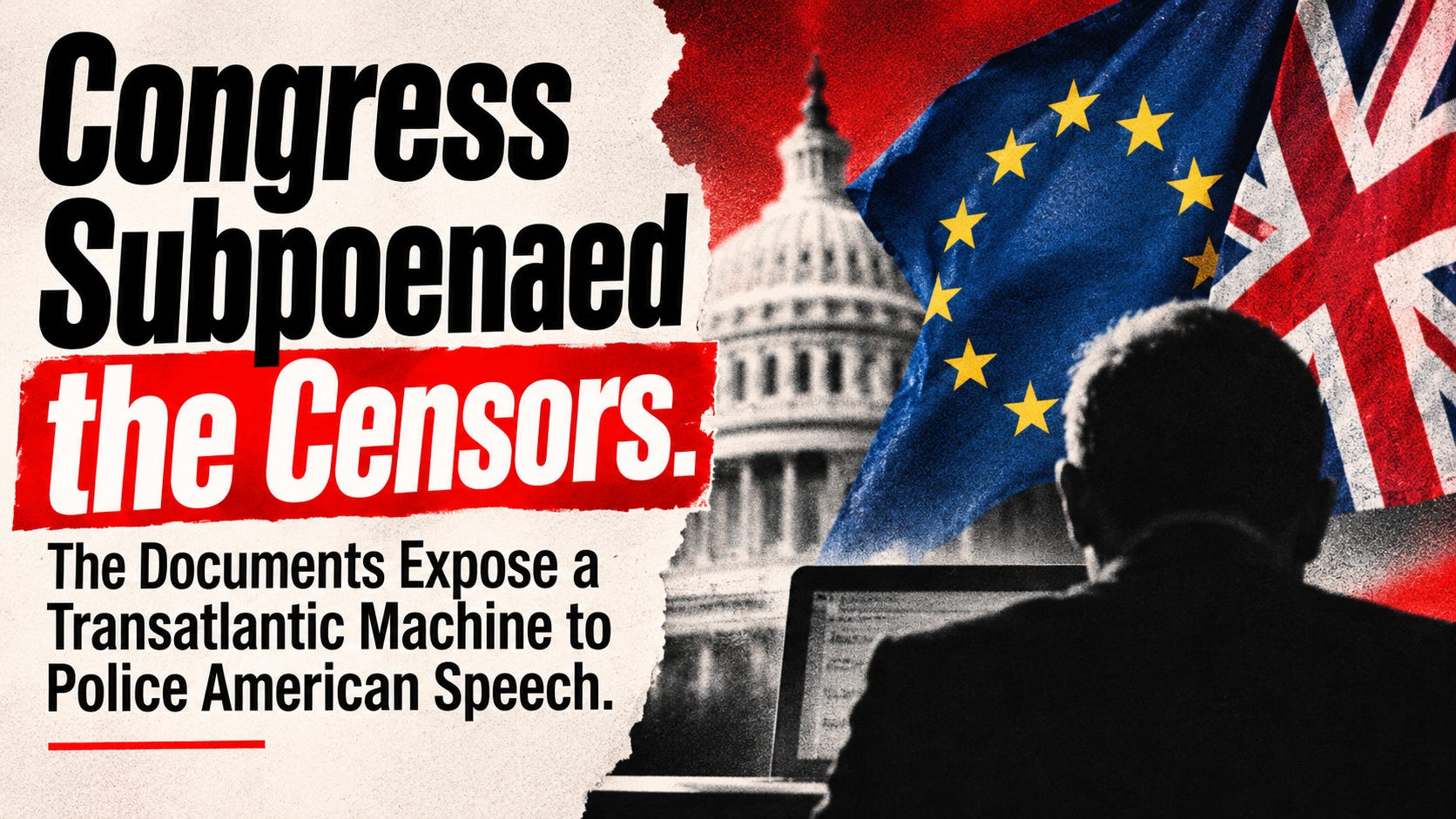
The Commission’s own “borderline content” handbook instructed platforms on moderating lawful speech — “populist rhetoric,” “political satire,” “meme subculture” — and carried policy recommendations from the Center for Countering Digital Hate, the UK group whose “Disinformation Dozen” list included my name.
CCDH refused to produce its communications voluntarily; Congress subpoenaed it in August 2023, and in November 2024 reminded it of “continuing” obligations while citing reports of a “Kill Musk’s Twitter” priority.
The report names the UK’s Online Safety Act as the most notable imitation of the EU model — British standards pressed into the moderation rules that govern American users.
The exhibits are public. Every claim here can be checked against them.
For a year I have been documenting, piece by piece, how speech rules written in London and Brussels end up governing what Americans can say — in their laws, and on their platforms. The response to reporting like this is always the same: there is no machine, only a mood — a coincidence of policy fashion on two continents.
On February 3, 2026, the House Judiciary Committee published an interim staff report titled The Foreign Censorship Threat, Part II. It is built on something no journalist has had: subpoenaed internal documents from ten technology companies — Apple, Amazon, Microsoft, Alphabet, Meta, X, TikTok, Reddit, Rumble, and OpenAI — plus productions from two advocacy organizations and Stanford University. Three hundred and two exhibits. Roughly 2,900 pages.
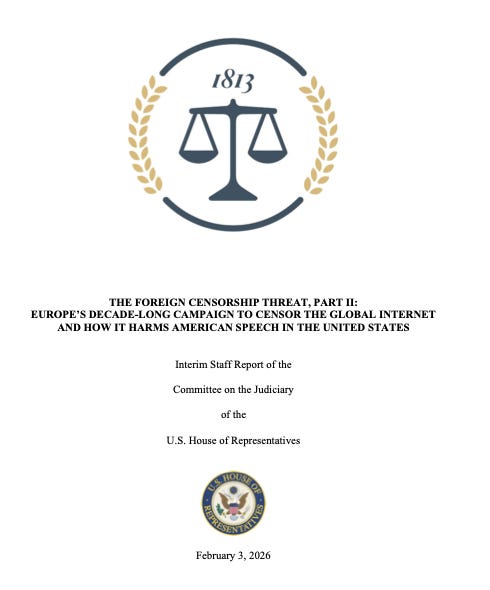
A note on the source. This is a majority-staff report, and its characterizations carry a partisan voice I will not borrow — you will find none of its adjectives here. What I am reporting is what the subpoenaed documents themselves show: the exhibits, the meeting readouts, the handbook, the emails. The record, not the rhetoric around it.
What the documents show

The report traces a decade of machinery.
In 2015, the European Commission founded the EU Internet Forum, a standing body where Commission officials, Europol, and the platforms meet to discuss what content should be moderated. In 2016 came a “Code of Conduct on Countering Illegal Hate Speech Online.” In 2018, a “Code of Practice on Disinformation.” Commission officials told platforms in private meetings — the readouts are exhibits — that these “voluntary” codes were intended to “fill [the] regulatory gap” until binding legislation arrived. How voluntary was it? A Google staff email in the exhibits, written as the Commission opened another subgroup: “I assume we want to join (we don’t really have a choice).” The same email explains that decisions are taken by “consensus” — “but consensus can be heavily pressed by the EC if they disagree with where it’s going.” That is a platform describing its own regulator, internally, with no expectation of being read. The binding legislation then arrived: the Digital Services Act, in force 2023, first fine issued against X — €120 million — in December 2025.
Between late 2022 and 2024, the report counts more than ninety meetings between platforms, civil-society organizations, and Commission regulators in the Disinformation Code’s task-force structure alone. The exhibits show what those rooms were for: in February 2021, Commission Vice President Věra Jourová pressed platforms over “toxic” vaccine-related content that remained online even after “trusted flaggers” — government-approved third parties empowered to make priority removal requests — had asked for it to come down. Not unlawful content. “Toxic,” in the regulator’s own word, by her own measure.
And then there is the handbook. By 2023, the EU Internet Forum had published a “Handbook of Borderline Content” — guidance for platforms on moderating speech that is explicitly lawful. The handbook’s own categories, reproduced in the report’s Exhibit 38:
“Populist rhetoric”
“Anti-government/anti-EU” content
“Anti-elite” content
“Political satire”
“Anti-refugee/immigrant sentiment”
“Meme subculture”
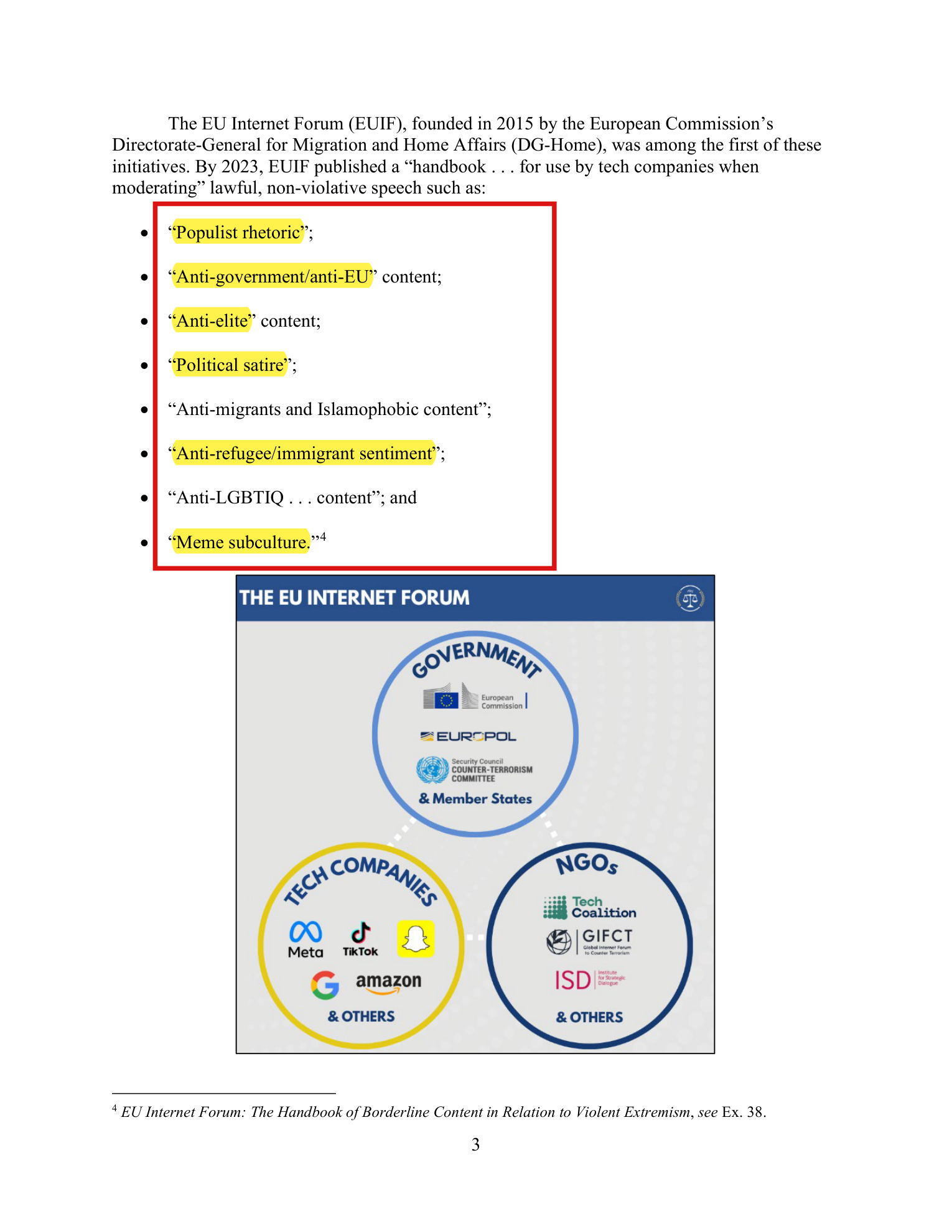
Page from the House Judiciary staff report (Feb 3, 2026): the EU Internet Forum’s own “borderline content” categories — lawful speech — with the EUIF structure chart beneath (Commission + Europol + platforms + NGOs including ISD). Source: judiciary.house.gov, Exhibit 38.
Read that list once more. None of it is incitement, none of it is fraud — it is satire, memes, and criticism of government, the core of what the First Amendment protects, listed for moderation in a handbook convened by a foreign executive for platforms that operate in the United States.
The organization all Americans should recognize
Inside that handbook, the report notes something further: it “contained platform ‘policy recommendations’ from the Center for Countering Digital Hate.”
I know that name, because it came after mine. In 2021, CCDH, a UK organization, produced the “Disinformation Dozen” — a list of twelve Americans the White House then invoked while pressing platforms to act. I was one of the twelve; the paper trail of that campaign is laid out document by document in the Targeting Tracker. My accounts and payment processors followed. The federal case that grew out of it was dismissed with prejudice in July 2026 on a pleading defect, without reaching the merits; I state that plainly, and you may weigh my reporting accordingly. You can also explore how the end of that case also became a flash point for a national coalition of grassroots organizations representing tens of millions of Americans who have had enough of censorship, laundered through NGOs, and originating on foreign soil.
So when a congressional report, built on subpoenaed documents, locates that same organization’s recommendations inside the European Commission’s own moderation handbook — the one that treats “populist rhetoric” and “political satire” as content requiring attention — the mood theory runs out. The same organization sits on both sides of the Atlantic, inside the official machinery, and the paperwork says so.
Who pays for that organization is its own documented story — the filings are assembled at Who Funds CCDH.

The congressional record does not stop there either, and none of what follows is my characterization:
In August 2023, the Judiciary Committee asked CCDH to produce its communications with the Executive Branch and the platforms. Its counsel declined voluntary compliance. The Committee issued a document subpoena on August 30, 2023.
In November 2024, the Committee wrote to CCDH again — the letter is public — reminding it that the subpoena is “continuing in nature,” and citing reporting that internal CCDH documents showed the organization had made “Kill[ing] Musk’s Twitter” a stated priority for 2024, and that its CEO had emailed a Twitter executive in 2020 to identify “groups/accounts/channels” for moderation. Those quoted phrases are from the Committee’s letter, citing the reporting it names.
And in June 2024, CCDH’s chief executive sat for a transcribed interview with the Committee — cited in the February 2026 report’s footnotes. That transcript, when released, belongs in the public record of this story.
The British chapter
The report devotes a section to what it calls the most notable foreign attempt to imitate the DSA: the United Kingdom’s Online Safety Act, passed in 2023, which positions Ofcom, the UK’s broadcast regulator, to shape how platforms “should deal with [so-called] disinformation and misinformation.” The Committee’s oversight had already shown British regulators pressing platforms to embed British standards on “hate” into their moderation policies — the policies that govern American users too.
This is the enforcement half of a pattern whose legislative half I documented separately: UK-drafted frameworks carried into American statute, instance by instance, in The London Template for American Law. Laws travel one way; moderation pressure travels the other. The documents now show both lanes of the same road.
The London Template for American Law

In September, I documented that the “Ban Superintelligence” bill Bernie Sanders brought forward in the United States Senate was drafted by a lobby shop in London. That was the fourth piece in a series. This is the one that steps back and names the machine.
The reward layer
One coda, because it completes the record. The organization whose recommendations sat in the Commission’s handbook, whose communications Congress subpoenaed, has not paid any reputational price. In 2025, the Miami-based Elevate Prize Foundation awarded its CEO a $300,000 prize. In November 2026, Elevate’s studio released a celebrity documentary built around him — Nevertheless: Democracy Defenders, executive-produced by Kerry Washington among others — in which the man whose organization supplied a deplatforming list is presented as the one being silenced. I did not construct that inversion. Elevate produced it, titled it, and published it on its own channel.
What this report changes
Before February 3, 2026, the claim that a foreign-anchored apparatus shapes lawful American speech rested on patient reconstruction from public filings — mine and others’. It now rests on subpoenaed internal documents, published by a committee of Congress, with exhibit numbers.
You do not have to take the committee’s adjectives — I haven’t. Take the exhibits: the handbook that lists “political satire” as borderline content, the ninety meetings, the subpoena one organization still sits under.
Americans who believe the First Amendment should not have a foreign exception have begun to organize at Restore the First, where the Foreign Censorship file tracks everything this report confirms. The record is public now. Check everything I have written against it. That is the point.
🧵View and share the X thread dedicated to this post.


Sayer, this is deeply concerning. Through these past 5 years, I’ve begun to suspect something more powerful than governments work behind the scene. A lot of what has gone down, wasn’t making sense. Doctor’s being silenced on the vaccine injuries they’re seeing in their practice. What is behind doctor’s silence? No independent active data collection on injuries caused by a technology never before tried. The push to indoctrinate the population that herd immunity was not possible without the vaccine. The massive censorship of dissenting voices, including the injured who were harmed and scared and desperately looking for help and answers. Something bigger is in control.
RESTRICTING free speech is an act of war