

Because he imagined he had done for politics what Koch had done for bacteriology.
In a conversation recorded by diplomat Walther Hewel on July 10, 1941, Hitler likened Jewish people to a bacillus and claimed their identification as his great discovery. The obscenity lay in what the analogy allowed him to do: describe the persecution of human beings as an act of healing. https://open.ifz-muenchen.de/server/api/core/bitstreams/09ccb554-d2dd-4173-95ca-8bc42b4474c9/content?utm_source=chatgpt.com
That history gives us reason to listen closely today whenever public debate turns from assessing a health risk to assigning collective blame. We should hear the difference when someone asks a question about vaccine safety or efficacy and is branded a danger for asking it, when the unvaccinated are spoken of as a threat by definition, or when an entire Amish community is reduced to a presumed vaccination status.
That history gives us a precise question to ask about biopolitics today. At what point does an account of how people become ill become a claim about who may govern them? A model of transmission can help explain how an infection moves through a population. It cannot decide what one person owes another, when the state may override a refusal, or who must answer for the harm an intervention causes. Those judgments belong to politics, however often officials deliver them in the vocabulary of medicine.
There is a prior question, too. What gets left out of the causal story once an illness has a name? In Pharmakeia, I return to the Greek pharmakon, a word that could mean both remedy and poison. Consider an experiment published in Scientific Reports. Researchers gave mice a liver-toxic dose of acetaminophen, isolated tiny vesicles called exosomes from their blood, and introduced those vesicles into healthy liver cells. The recipient cells showed signs of injury. In that experiment, the drug initiated the injury, and particles released by the animal’s own cells helped carry its effects further. Those are two distinct steps in a causal chain. Knowing what carried the injury would still leave open the question of what started it. Read Pharmakeia · Read the original study. https://read.sayerji.com/p/pharmakeia-the-oldest-word-for-poisoned
That distinction runs through my investigative series, Poisoned, Not Infected. What initiated the illness? What made this person vulnerable? What did they encounter in their air, water, workplace, or treatment? Which signals carried the injury through the body? Each question points toward a different opportunity for prevention. Each also changes whom we ask to account for what happened. Read the complete series. An Investigative Series https://read.sayerji.com/p/poisoned-not-infected-an-investigative
With COVID-19, measles, or the next public health emergency, identifying an infectious agent answers a biological question. It leaves the constitutional question open. A government that asks citizens to surrender a liberty owes them evidence for that particular measure, an account of its costs, and a public answer for when the power ends. The authority to name a disease is already considerable. By what right does it become the authority to decide what may be done to a person?
The deeper danger is that the global biosecurity state can become an alternative form of government without ever declaring itself one. An international body identifies a threat, private funders shape the response, and domestic officials decide which restrictions Americans must live under. Each can point to the others when a citizen asks who made the decision and who has the power to reverse it. The emergency may end while the machinery built to govern through it remains in place.

That is what I mean by veiled collectivism. It begins when officials treat a projected benefit to the population as sufficient authority to override the rights of the person before them. That premise is diametrically opposed to the constitutional rights of Americans. In a republic, the citizen is entitled to ask by what authority the government acts, to challenge its evidence, and to seek redress. The moment a citizen must prove that exercising a right is safe for everyone else, the burden has been reversed. It is the government that owes the citizen a justification for restricting it.
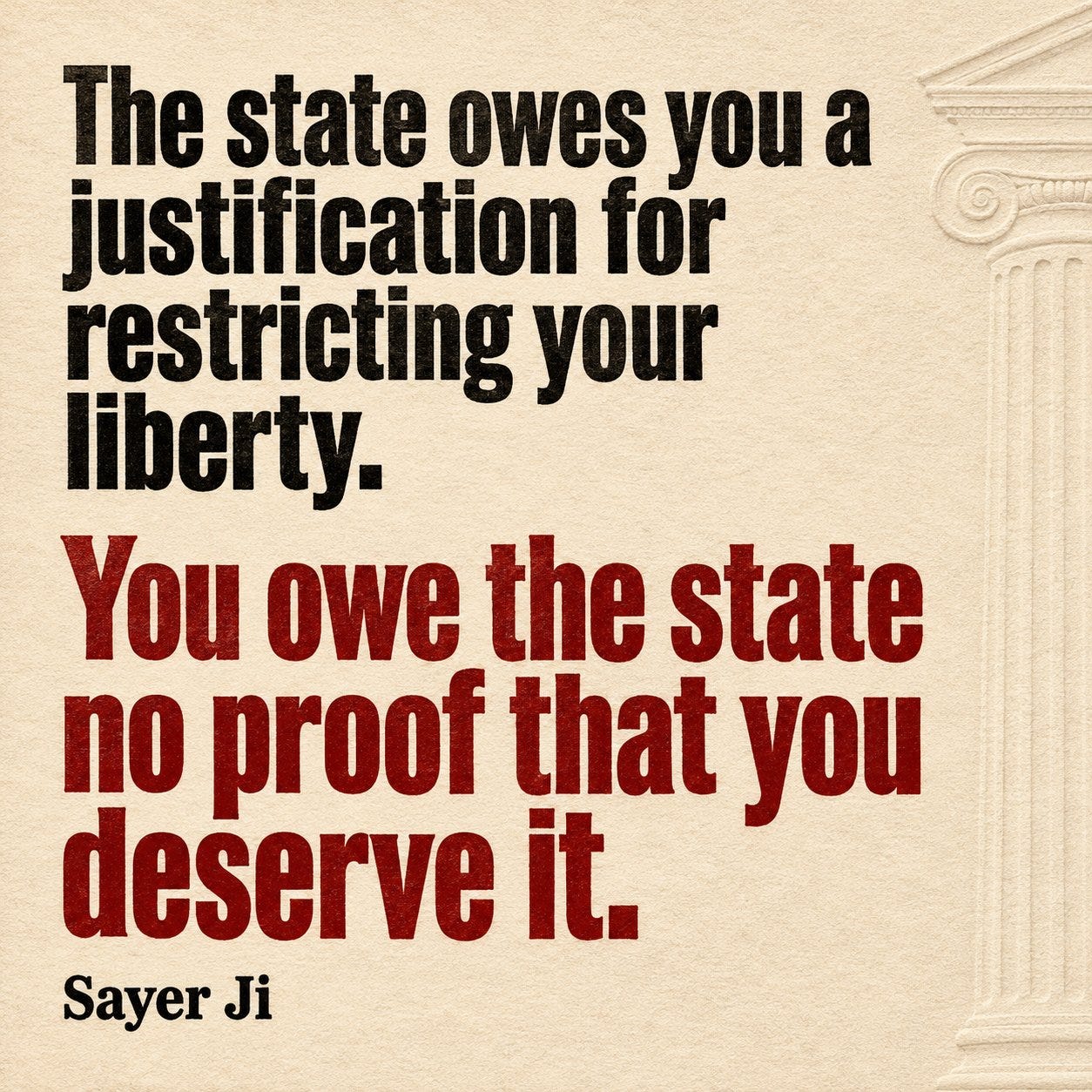
The state owes you a justification for restricting your liberty. You owe the state no proof that you deserve it.
The First Amendment protects your right to ask for the evidence, challenge the answer in public, and stand with others who do the same. Join us at
Read the full white paper, Endless Pandemics as a Failed Global Governance Model. https://read.sayerji.com/p/endless-pandemics-as-a-failed-global?utm_source=chatgpt.com

