


The debunk cited no sources. The National Academies' verdict was 'inadequate to accept or reject.' And the same viral sequence is back — in a product given billions of times.
View the X thread dedicated to this story.
A physician with a large following called Robert F. Kennedy Jr.’s position on polio vaccines and SV40 “weapons grade horse💩,” in response to the video clip aboe. The post traveled fast.


It carried no citations. Not one study, not one review, not one primary source. In a dispute ostensibly about scientific evidence, the side claiming to speak for science produced none.
And what did Kennedy actually say? Asked whether SV40-contaminated polio vaccine caused more deaths than polio itself, he said:
“I would say I don’t know because we don’t have the data on that.”
That is the sentence being called horse💩. Not an assertion. An admission of uncertainty — the thing a scientist is supposed to be able to say without professional consequence.
I responded to this “debunk” in detail on X here, but I think this top trending news story on X requires a deeper critique, given its viral amplification has nothing to do with science, and much to do with ignorance of both science and history.

So let us go to the record he was accused of ignoring.
What the record actually says
The National Academies of Sciences, Engineering and Medicine — not a fringe outlet — convened an Immunization Safety Review committee on this exact question in 2002. Their conclusion:
“The evidence is inadequate to accept or reject a causal relationship between SV40-containing polio vaccines and cancer.”
Inadequate to reject. That is the official finding of the most authoritative body that has examined it. Twenty-four years later it has not been superseded, because the study that would supersede it was never commissioned.
The same committee found the biological evidence strong that SV40 is a transforming virus, and moderate that SV40 exposure could lead to cancer in humans under natural conditions. Approximately 98 million Americans received polio vaccine during the 1955–1963 window when contamination occurred.
The subsequent large cohort studies in the United States and Denmark did not find elevated cancer incidence in the exposed birth cohorts. And much of the literature reporting SV40 sequences inside human tumors was later undermined when blinded multi-laboratory studies traced many of those positives to laboratory contamination — a point I will return to, because it turns out to be the most important thing in this entire story.
So the honest position is not “SV40 caused cancer.” The honest position is the one the National Academies reached and Kennedy repeated: we don’t know, and we didn’t find out.
Calling that horse💩 is not a scientific rebuttal. It’s a substitute for one, and in my opinion, a sign that the critic has very little ‘Science’ to stand on.
Three concessions
Here is the context the debunk omitted entirely. The polio program has already produced three harms that were denied at the time and conceded later. Not alleged by critics — conceded by the institutions themselves.
Cutter, 1955. Cutter Laboratories distributed inactivated polio vaccine that contained live poliovirus. Roughly 40,000 children were infected. About 200 were paralyzed. Ten died. The process was called foolproof until it wasn’t.
SV40, 1955–1963. Polio vaccines grown on rhesus monkey kidney cells carried simian virus 40. Bernice Eddy at NIH demonstrated that material from those cells produced tumors in hamsters — and was moved off the work and stripped of her laboratory for saying so. Sweet and Hilleman identified the virus in 1960. New lots were required to be SV40-free from 1961. Contaminated stock already manufactured was used for two more years rather than recalled.
Vaccine-derived poliovirus, ongoing. Jonas Salk testified in 1976 that the live oral vaccine had become the “principal if not sole cause” of American polio cases since 1961. He was dismissed as a rival with a grudge. He was correct. Today, vaccine-derived poliovirus paralyzes more children worldwide than the wild strain does.
Three failures. Three denials. Three eventual concessions.
This is not a program with a spotless record asking to be trusted on a fourth question. It is a program with a documented pattern asking that the fourth question not be asked at all.
Where the ten nanogram limit came from
To understand what follows, you have to understand a piece of regulatory history that almost nobody outside the field knows.
When vaccine manufacturers first considered growing product in immortalized cell lines, the appeal was obvious: transformed cells divide indefinitely and produce antigen without limit. The obstacle was equally obvious. Regulators worried about what they called an oncogenic factor — not that a vaccine would contain a tumor, but that residual DNA from a transformed cell substrate might carry something into a human genome.
That concern was never resolved by prohibition. It was resolved by a threshold. Residual DNA in the final product was capped, and the figure that emerged and has governed ever since is ten nanograms per dose.
That limit is the direct descendant of the oncogenic factor concern. It exists because regulators once took seriously the possibility that leftover manufacturing DNA could contribute to cancer. Hold that number. It is about to become the center of the story.
View my segment on SV-40 for Truth About Cancer below.
The same sequence, seventy years later
In 2023, Kevin McKernan reported sequencing residual DNA in Pfizer’s COVID-19 vaccine and finding, among the plasmid backbone fragments, an SV40 promoter-enhancer sequence.
Phillip Buckhaults, professor of cancer genomics and director of the Cancer Genetics Lab at the University of South Carolina, independently sequenced vials in his own laboratory and confirmed it. He testified to the South Carolina Senate that the product contained plasmid DNA, not just mRNA, and that he knew because he had sequenced it himself.
Then Health Canada confirmed it — and added a detail worth reading twice.
The agency stated that Pfizer had provided the full plasmid DNA sequence at the time of initial submission, but “did not specifically identify the SV40 sequence.” Health Canada said it expects sponsors to identify biologically functional DNA sequences such as an SV40 enhancer at submission. Confirmation only became possible afterMcKernan and Buckhaults published, at which point the agency could match the published SV40 sequence against what Pfizer had already filed.
Read that again slowly.
The regulator learned what was in the product from the product’s critics.
Pfizer’s own materials now concede the point, stating that non-infectious fractions of an SV40 sequence are present in the starting material. The MHRA has confirmed it. The FDA has responded to it. Nobody disputes presence anymore.
SV40 Contamination in Pfizer’s COVID-19 Vaccines: A Troubling Echo of the Polio Vaccine Scandal

A new study published in Science, Public Health Policy and the Law has revealed that Pfizer’s mRNA-based COVID-19 vaccines contain significant levels of residual DNA contamination, including sequences from the Simian Virus 40 (SV40) promoter/enhancer
What it is not
I am going to make the strongest argument against my own position now, because it is true and because you will hear it anyway.
The SV40 large T antigen is not present. Large T antigen is the transforming oncoprotein — it binds and disables p53 and retinoblastoma protein, and that is the mechanism by which SV40 immortalizes cells. It is not in the plasmid. It was not found by McKernan. It was not found by Buckhaults.
What is present is regulatory DNA: a promoter, the tandem 72 base-pair enhancer, an origin of replication. Standard vector engineering, used for decades, sitting in the backbone driving expression of a resistance marker.
Buckhaults — who found it, and who is a cancer genomicist by profession — has been explicit: the SV40 sequence in the vaccine is not the cancer-causing large T antigen, which would be a very significant risk. He describes what is actually there as posing a much smaller but non-zero future cancer risk, comparable to the other plasmid DNA present.
Anyone telling you “they put the cancer virus in the shots” is wrong, and gets dismantled on this point every time. Deservedly.
But look closely at what Buckhaults actually said. Not zero. Non-zero. And he said something else that almost nobody quoted:
The ten nanogram limit is not appropriate for LNP-encapsulated DNA.
That is the argument. Not the monkey virus. The threshold.
How much is actually in there?
Here the record becomes genuinely contested, and I am going to lay out both sides — because that is exactly what the debunk didn’t do.
Two research teams tested vials. They reached opposite conclusions. Understanding why is far more useful than picking a winner.
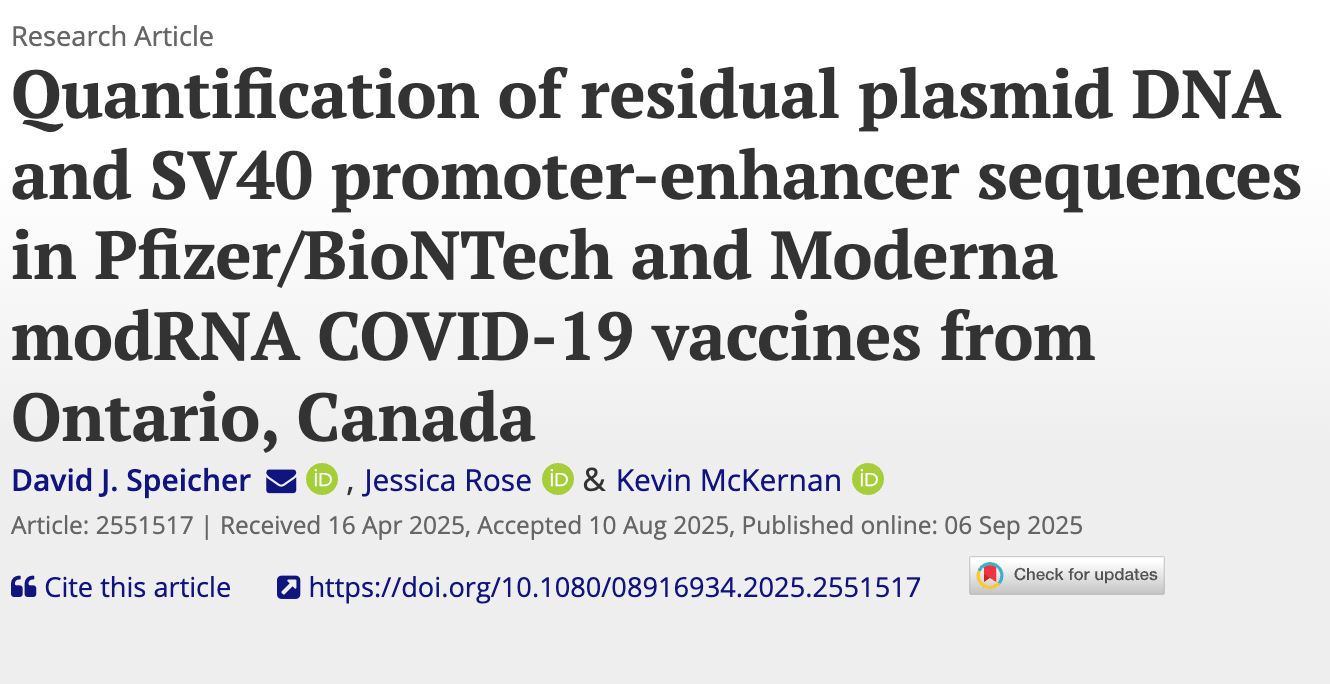
The first team — Speicher, Rose and McKernan, published in Autoimmunity (Taylor & Francis, PubMed-indexed, September 2025) — tested 32 vials drawn from 16 different lots, using two different measuring techniques.
The first technique, fluorometry, uses a dye that glows when it binds to DNA. Brighter glow, more DNA. It counts everything present, but it is not fussy about what kind of DNA it is counting.
By that method, the vials came in at 36 to 153 times over the legal limit for Pfizer, and 112 to 627 times over for Moderna.
The second technique, qPCR, works on an entirely different principle. It goes hunting for one specific stretch of DNA and copies it over and over until there is enough to count. Extremely precise about what it finds — and structurally blind to anything it was not told to look for.
By that method, every Moderna vial came in under the limit. Two of six Pfizer lots exceeded it for the SV40 element specifically, by roughly twofold.
The same team reported the SV40 promoter-enhancer sequence at 0.25 to 23.72 nanograms per dose, present only in Pfizer vials and never in Moderna’s. And they counted pieces: somewhere between 120 million and 160 billion fragments of plasmid DNA per dose, packaged inside lipid nanoparticles. Sequencing put the average fragment at 214 base pairs, with the longest running to roughly 3,500.
The second team — Achs and colleagues, published in npj Vaccines (Nature Portfolio, December 2025) — tested 15 batches using four separate methods and concluded the opposite. Every batch below the approved limit. The DNA broken into short pieces averaging around 150 base pairs. Between 83 and 98 percent of it traceable to the manufacturing template. Nothing alarming.
Now notice something that neither side of this fight likes to dwell on.
Speicher’s own two methods disagree with each other by a factor of hundreds.
Look again. Fluorometry says Moderna’s vials are 112 to 627 times over the limit. qPCR says every single Moderna vial is compliant. Same vials. Same laboratory. Same week.
Both numbers are printed in the same paper.
I am not raising this as a gotcha, and I am not raising it to undercut my own argument. I am raising it because it is the actual question, and almost nobody is asking it.
The question is not “is there too much DNA in these products.”
The question is: how would anyone know?
If two respected techniques, applied to the same vial by the same team in the same week, differ by two orders of magnitude, then the number printed on the certificate of analysis is not really a measurement. It is a choice of method. And whoever chooses the method chooses the answer.
That is a regulatory problem no matter which number turns out to be right.
And in 2026, someone worked out why the two methods disagree.
Conformation determines fate
Here is the finding I think matters most in this entire dispute, and it has been almost entirely ignored. It takes two minutes to understand, and it changes what every number above means.
Start with how the product is made. To manufacture mRNA at scale you need a DNA template — the plasmid. Think of it as a printing plate. An enzyme reads the plate and runs off millions of mRNA copies. When the run is finished the plate has to be destroyed, because it is not supposed to be in the final product. The tool for that job is DNase I, an enzyme that chews up DNA.
Now the complication. Transcription does not cleanly separate the copy from the plate. As the polymerase moves along, the freshly made RNA stays briefly paired with the DNA strand it was copied from. Those paired stretches are called RNA:DNA hybrids — one strand RNA, one strand DNA, wound together.
DNase I is built to cut double-stranded DNA. Against an RNA:DNA hybrid it is dramatically less efficient. This is not a fringe claim; the effect has been in the literature since the 1990s, and BioNTech’s own researchers acknowledged in 2024 that residual hybrids may be carried through purification alongside the mRNA.
So: wherever a fresh copy was still clinging to the plate, the solvent could not reach. Those fragments of plate survive.
Here is the part that matters. The DNA that ends up in the vial is therefore not a random sample of the plasmid. It is systematically enriched in precisely the regions that were shielded by hybrid formation — and the region being transcribed is the spike insert. That is where the polymerase runs. That is where the hybrids form. That is what survives.
Now look at how it is measured.
The release assay is qPCR, which amplifies one chosen stretch of DNA and counts it. Pfizer’s quantification assay targets the kanamycin resistance gene — which sits in the plasmid backbone, outside the transcribed region. No polymerase runs through it. No hybrids form there. It gets digested normally, and it comes back low.
The assay measures the part that was never protected, and infers the total from it.
Pfizer did disclose a second qPCR assay targeting the spike region to regulators — but used it only to confirm the insert was present, and reported no quantification from it.
McKernan, Rixey and Rose (follow her on X) put numbers on the gap this year: a greater than hundredfold discrepancy in quantitation between double-stranded DNA and RNA:DNA hybrids, and treatment with a more aggressive enzyme, DNase I-XT, producing 100 to 1000 fold higher degradation of spike DNA — concentrated exactly in the hybrid-forming regions, as the mechanism predicts.
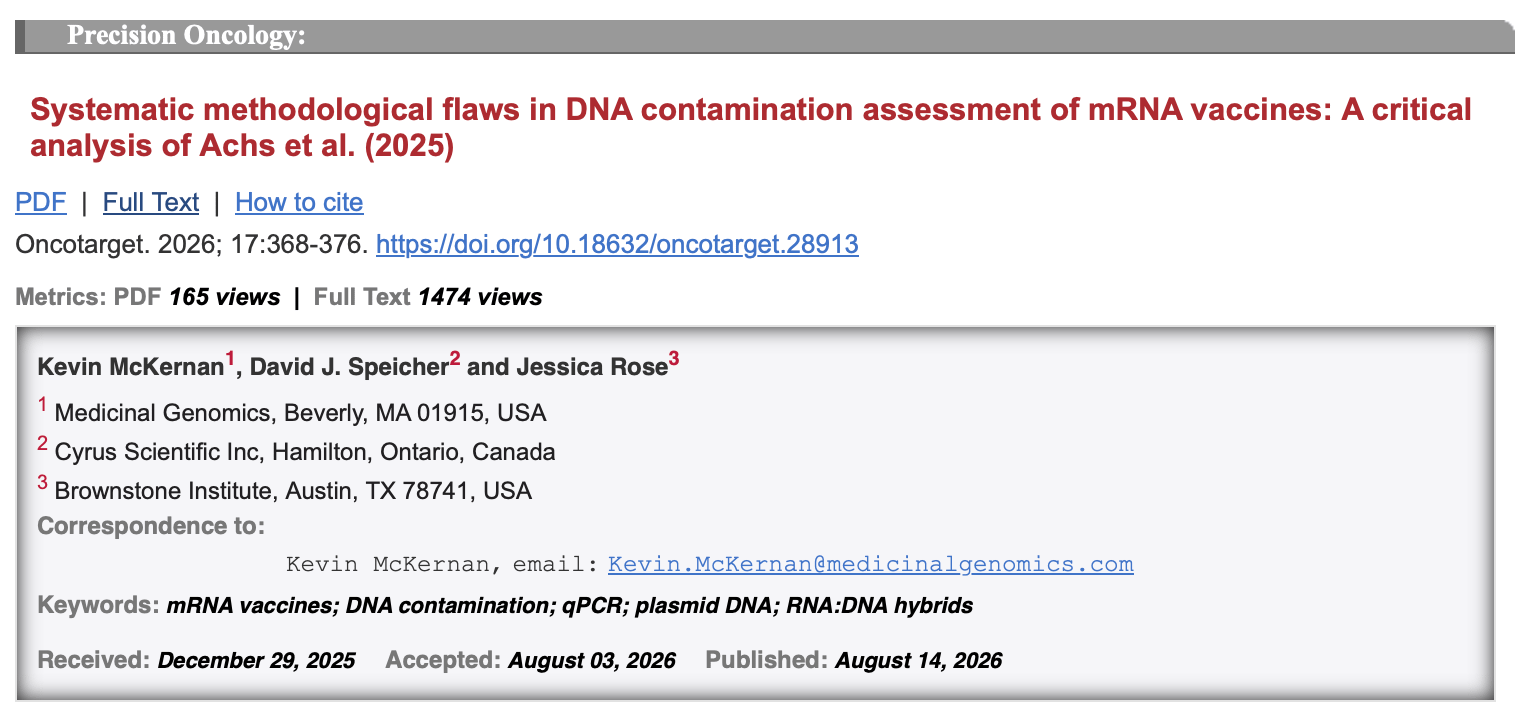
This is a conformational argument, and it is the right kind of argument. Same sequence, different physical state, different susceptibility to the enzyme, different fate in the body, different number on the certificate of analysis. It makes a specific prediction, and the prediction is testable by anyone with a sequencer.
And it arrives with a remedy: use DNase I-XT.
That is the part I want to underline. The fix is a different enzyme in a step that already exists. It is inexpensive. It has no effect on the product’s efficacy. It would reduce a contaminant that both sides of this dispute agree should not be there.
A manufacturer declining a cheap, effective, efficacy-neutral improvement to its own purification is telling you something. Either the contamination is trivial — in which case removing it costs nothing — or it is not.
The field keeps being fooled by its own reagents
Here is the thread that ties seventy years together, and it is the reason I don’t think this is a story about one company or one product.
In 1966, the geneticist Stanley Gartler compared seventeen human cell cultures obtained from laboratories around the world against a known HeLa strain. All seventeen were HeLa. In 1968 the American Type Culture Collection — the premier cell bank in the United States, established specifically to guarantee pedigreed authenticity — tested its own thirty-four human cell lines. Twenty-four were HeLa. In 1972, in a scientific exchange connected to Nixon’s War on Cancer, Soviet scientists supplied six tumor cultures from six patients in six different locations. All six were HeLa.
An enormous body of published research was invalidated. Walter Nelson-Rees, who documented the contamination, had his funding cut and was forced into early retirement at fifty-two. One supplier continued selling a contaminated line for thirteen years after being informed. Many discredited papers were never withdrawn.

Thirty years later, the literature reporting SV40 sequences inside human mesotheliomas, lymphomas, bone and brain tumors was substantially undermined when blinded multi-laboratory studies traced positives to laboratory plasmid contamination. SV40 regulatory sequences are ubiquitous in laboratory plasmids. The reagents were producing the finding.
Today, the fight over residual DNA in mRNA products is — at its core — another argument about contamination and artifact in quantification. Fluorometry versus qPCR. Intercalating dye cross-reactivity with RNA. Whether RNase A controls were run. Whether phenol-chloroform extraction stripped the low-molecular-weight fraction. Whether hybrid conformation defeated the assay.
Three times in sixty years, the field has been fooled by its own materials. Each time, the correction came from outside. Each time, the person who forced it paid for it.
That is not a conspiracy theory. It is a description of the publication record.
The proof of concept nobody cites
There is one more thing the debunkers left out, and it is the strangest omission of all, because it is not contested by anyone.
Between 1999 and 2002, gene therapy trials in Paris and London treated infants with X-linked severe combined immunodeficiency — children born with no functioning immune system. A retroviral vector delivered a corrective gene. The therapy worked. Children who would have died in isolation went home.
Then five of twenty developed T-cell leukemia. The cause was established with precision: the vector had integrated near the LMO2 proto-oncogene and activated it. Insertional mutagenesis. One child died.
Nobody disputes any of this. It is in Science and the New England Journal of Medicine. The field responded by redesigning vectors with self-inactivating long terminal repeats and chromatin insulators — an engineering response that is itself a formal admission that the mechanism is real, consequential, and required designing around.
So here is the question I would like someone to answer without calling it horse💩:
Insertional oncogenesis from introduced genetic material is established well enough to have forced the redesign of an entire vector class. On what basis were billions of plasmid DNA fragments per dose, lipid-nanoparticle encapsulated and delivered intramuscularly at population scale, judged to require no integration study at all?
The FDA’s answer, given to the Florida Surgeon General in December 2023, was that it is implausible on first principles that residual cytosolic fragments would reach the nucleus and integrate.
First principles, not data. The same epistemic move the debunkers are making, but one level up.
The asymmetry
One more case, and then the oldest question of all.
In 2020, the University of Queensland and CSL developed a COVID-19 vaccine candidate, v451, using a “molecular clamp” to stabilize the spike protein. The clamp contained an eighty-amino-acid fragment of the HIV gp41 protein.
In Phase 1, across 216 participants, recipients generated antibodies that produced false-positive HIV test results. There was no infection risk. There was no identified safety signal. The vaccine showed a robust immune response and a strong safety profile.

Australia cancelled a contract for 51 million doses and terminated the program.
Consider the asymmetry. An identified, non-health, diagnostic-interference problem in a candidate was sufficient to end a national program in weeks, at a cost of hundreds of millions of dollars, explicitly to protect public confidence.
An undisclosed viral regulatory element, in a deployed product, administered billions of times, with a quantification method its own critics and defenders cannot reconcile within two orders of magnitude, has produced no equivalent action in five years.
Something other than evidence is determining these outcomes.
The question that was declared dead four times
Which brings me to the oldest and most suppressed version of this story, and I want to be careful about how I raise it.
Between 1957 and 1960, experimental oral polio vaccine trials were conducted in the Belgian Congo on approximately one million people, including infants. Edward Hooper’s 1999 book The River argued that these trials, using locally prepared chimpanzee tissue cultures, were the origin of the HIV-1 pandemic.
I am not asserting that hypothesis is correct. Phylogenetic dating from multiple independent groups now places the most recent common ancestor of HIV-1 group M around 1908–1920, decades before the trials. Worobey and colleagues sequenced SIVcpz from wild chimpanzees in the relevant region in 2004 and found it phylogenetically distinct from HIV-1. That evidence is substantial and I am not going to pretend otherwise.
What I want to draw your attention to is not the hypothesis. It is the manner of its dying.
Hilary Koprowski sued Tom Curtis and Rolling Stone over the 1992 article that raised it.
In 1992 the Wistar Institute declared it could be stated “with almost complete certainty” that the Congo trials were not the origin, based on a British patient who died in 1959. That patient turned out not to have had AIDS; his sample had been mixed with another person’s.
A preserved CHAT sample tested negative — but it was not a batch used in Africa. No laboratory has ever reported testing a batch that was actually used there.
Science published “Disputed AIDS theory dies its final death” in 2001. Nature published “Origin of AIDS: contaminated polio vaccine theory refuted” in 2004 — three years after the final death.
W. D. Hamilton, the evolutionary biologist who proposed the Royal Society conference on the question and wrote Hooper’s foreword, died before it convened. The conference proceeded without him.
Wikipedia’s article on the hypothesis describes it as concerning rhesus macaque tissue cultures. The hypothesis concerns chimpanzee tissue cultures. Its first two footnotes are papers from 1958 and 1960 by the trial investigators, which mention neither the hypothesis nor the culture substrate.
A theory that requires four separate final refutations across twelve years was not refuted the first three times.
And the Wikipedia error is the exact same failure mode as the debunk that started this essay: a confident dismissal whose citations do not say what they are claimed to say. Sixty years apart, identical mechanism.
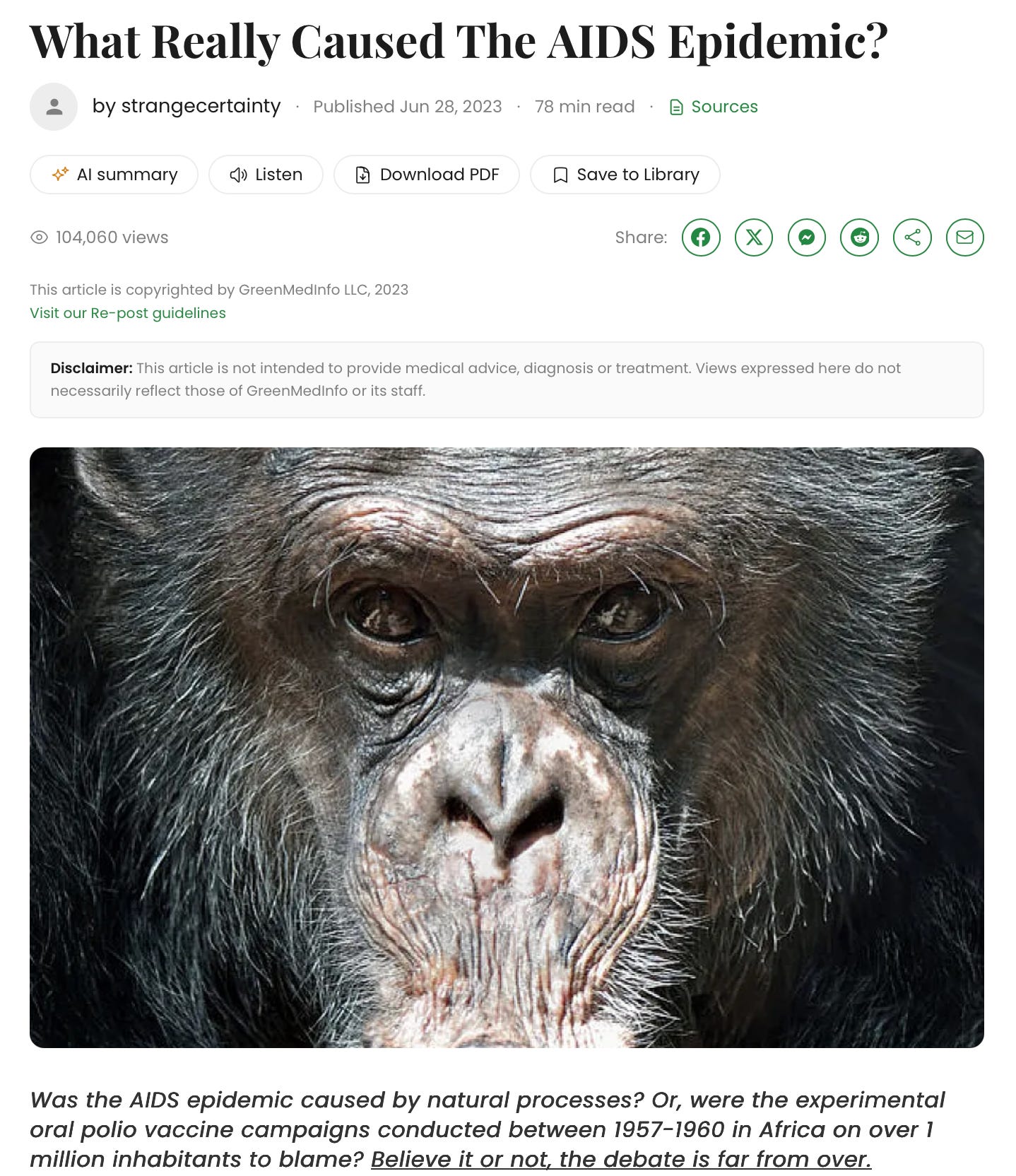
For readers who want to examine the epistemology of that episode directly rather than take my characterization of it, Robert Dildine’s case study A Strange Case of Certainty — which is explicitly about the manufacture of public certainty rather than about AIDS origins — is available here. Read it and judge for yourself. That is, after all, the entire point.
What would actually settle this
I am not asking anyone to accept a conclusion. I am asking for five specific things. None of them require believing I am right. All of them are cheap, and all of them would produce an answer.
1. Fix the speed limit.
The ten nanogram cap was written for bare DNA — DNA floating loose, which the body clears efficiently and which struggles to get inside a cell at all. The DNA in these products is not bare. It arrives packaged inside a lipid nanoparticle, a delivery vehicle engineered for the express purpose of getting its contents into cells. Some of it may be shielded from the digestion step by the hybrid problem described above.
That is a different physical object than the one the limit was written for. Buckhaults — who is not on my side of this argument — has said plainly that ten nanograms is not an appropriate limit for LNP-encapsulated DNA.
Rewrite the limit for what is actually in the vial. And measure it in number of DNA molecules per dose, not weight. Weight tells you how heavy the shipment is. Number tells you how many chances there are for something to go wrong.
2. Measure it more than one way, and show your work.
Right now a single test on a single stretch of DNA stands in for the whole. As shown above, that stretch is the one least likely to have survived.
Use several independent methods, publish the validation data, and let outside laboratories check the result. This is the one point on which both sides of this dispute already agree — the entire Speicher-versus-Achs disagreement is a disagreement about method, which is precisely why the methods should be public.
3. Take the SV40 sequence out.
This is the simplest ask in the list. That sequence is not doing therapeutic work. It is a leftover from vector engineering, sitting in the backbone helping switch on an antibiotic resistance gene the patient never needed.
Delete it. It costs almost nothing. It does not change how well the vaccine works. And it removes the single most contested element from the argument permanently.
4. Run the integration study.
The study asking whether any of this DNA ends up in human chromosomes was never done. The stated reason was that it seemed implausible on first principles.
First principles also did not anticipate that a gene therapy would cure twenty children of a fatal immune disorder and give five of them leukemia.
Do the experiment.
5. Compare the two products.
This is the cleanest test available and nobody has run it.
The SV40 element is in Pfizer’s plasmid. It is not in Moderna’s. If it matters, there should be a Pfizer-specific signal in cancer surveillance data. If there isn’t, that closes the question honestly and I will say so.
That is a real experiment with a real answer, and it can be run on data that already exists.
Point three is the one I would watch.
A manufacturer that declines a free, effortless, efficacy-neutral safety improvement is telling you something. Either the element is trivial — in which case removing it costs nothing and buys back enormous public trust — or it is not trivial, and someone has decided that saying so is more expensive than leaving it in.
There is no third explanation. That is why it is the ask I would press.
The Offense Was Accuracy
The National Academies said the evidence was inadequate to accept or reject. Twenty-four years later, it still is, because nobody generated the evidence that would have settled it.
Kennedy said he didn’t know because we don’t have the data. He was describing the situation accurately, and that is the whole offense.
Calling an unresolved question “weapons grade horse💩” without citing a single source is not a defense of science. It is the substitution of confidence for inquiry — and if the last seventy years teach anything, it is that this particular substitution has a body count.
Read the literature, debate the evidence, and ask the unanswered question. And remember to use www.GreenMedInfo.com as a resource for education and empowerment. Share it widely.
Share the X thread dedicated to this story:


Sources and further reading
Institute of Medicine, Immunization Safety Review: SV40 Contamination of Polio Vaccine and Cancer (2002) — NCBI Bookshelf
Speicher, Rose, McKernan, “Quantification of residual plasmid DNA and SV40 promoter-enhancer sequences in Pfizer/BioNTech and Moderna modRNA COVID-19 vaccines from Ontario, Canada,” Autoimmunity (2025) — PubMed
Achs et al., “Systematic analysis of COVID-19 mRNA vaccines using four orthogonal approaches demonstrates no excessive DNA impurities,” npj Vaccines (2025) — Nature
McKernan, Rixey, Rose, “RNA:DNA Hybrids Survive Digestion in mRNA Vaccine Manufacturing,” J Indep Med 2026;2(1)
FDA response to the Florida Surgeon General, December 2023 — FDA
Dildine, A Strange Case of Certainty — GreenMedInfo
SV40 research collation — GreenMedInfo
Sayer, I don't know how you do it. Just about every day you come up with a well-researched, well-reasoned science and/or research-based piece with profound implications. I remain in awe of your seemingly boundless energy, knowledge, insight, and wisdom. THANK YOU for providing this extremely important voice and perspective, over and over! (And for your intellectual support of RFKjr!)
Blessings to you and for all you are doing for all of us!
Improving sanitation and getting rid of toxic metals and pesticides made "polio" go away.