


In late 2015, at a US Army laboratory, monkeys vaccinated against Ebola were exposed to a lab-generated mist of the virus. The vaccinated animals developed lung damage the unvaccinated ones did not. Newly released Senate records show what happened inside Anthony Fauci’s institute when it learned it had helped pay for the experiment.


On March 9, 2016, Anthony Fauci sat in a secure room and joined a call with the White House, the CIA, the Defense Department, and health officials. The subject was an experiment at the Army’s high security lab at Fort Detrick, Maryland. Monkeys had been vaccinated against Ebola. Then they were exposed to a fine mist of the virus, generated in a lab to travel deep into the lungs.1
The results had set off an internal crisis. Almost all the exposed animals died, according to Fauci’s notes. But the vaccinated animals developed damage in their lungs that the two unvaccinated animals did not. That raised an alarming question. Had the vaccine made the lung disease worse?2

Then the story turned from an Army problem into a problem for Fauci’s own agency. Officials on the call asked who had paid for the experiment. The Defense Department answered that they had funded it together with Fauci’s institute, the National Institute of Allergy and Infectious Diseases, known as NIAID.
“No one followed up on that,” Fauci wrote the next morning, “but I almost fell off my chair.”3

The 26 page package released today by Senator Rand Paul, chairman of the Senate Homeland Security and Governmental Affairs Committee, shows what happened next. Fauci argued the experiment and its results should have been classified. NIAID officials talked about “damage control.” They paused related work. They told scientists not to discuss the matter outside a small group. They wrote an internal report that was not meant to leave the agency. And a senior scientist said he would move the rest of the conversation off email.4
That much has been widely reported. What follows has not. The same package contains a three month interagency record showing that NIAID sat in the room when the government agreed to take these findings to the FDA, asked for its own data to be included, briefed the manufacturers, and briefed the division running human vaccine trials in Liberia. All of it happened before Fauci called the disclosure a Pentagon blunder. And the internal report he commissioned to defend the classification argument is the document that destroys it.


The sequence, by date
2013. NIAID first takes part in vaccine related aerosol challenge work at the Army lab.
June 2015. A former NIAID employee, now at a military vaccine program, calls NIAID staff about “what appeared to be vaccine induced lung pathology” in an aerosol study of the Profectus vaccine.
Late November 2015. The military program partners on NIAID’s next open animal slot under Task Order 8. NIAID provides the funds.
December 4, 2015. At USAMRIID, every government agency in the room agrees the FDA must be told. The military asks to include NIAID’s own data.
January 8 and 20, 2016. Follow-up meetings, now including BARDA, then a joint review with the manufacturers Profectus and Crucell.
March 4, 2016. The 2015 results are shared verbally with NIAID’s clinical research division, which runs the human vaccine trials in Liberia.
March 7 to 9, 2016. Fauci learns of the result, calls the experiment stupid, and says it should have been classified.
March 10, 2016. “Damage control.” A stand down order. Discussion restricted to two scientists.
March 11 to 18, 2016. Fauci demands answers. The internal report confirms NIAID funding and says classification was never raised.
March 22, 2016. NIAID’s biodefense director calls classification “a red herring” and says he has no objection to public release.
What the documents do not show
The records do not show that an Ebola vaccine harmed anyone. They also do not show a virus made more dangerous. Nothing here was genetically altered. What the researchers changed was the delivery method: a mist of tiny particles piped into a head-only chamber, aimed at the deepest part of the lung. That is a biodefense exposure model, not an engineered transmissible pathogen, and the distinction matters. Overstating it is the fastest way to lose an argument that the documents otherwise win.
The study was also small. The animal counts in the records do not match each other. NIAID’s own scientists questioned whether the study could support any firm conclusion.
What the records do show is a breakdown in oversight. NIAID helped pay for and design risky research at an Army lab. Its director appears not to have known that until the Pentagon said so out loud in a White House level meeting. And secrecy became urgent only after a troubling result had already reached regulators, manufacturers, and the division running vaccine trials in West Africa.
How NIAID came to fund an experiment its director did not know about
The work came out of biodefense planning, not disease research. Federal planners had treated a deliberate release of Ebola or Marburg as a possible terrorist attack. That created a requirement for vaccines that could hold up against a deep lung exposure. Both the Defense Department and the health agencies carried that requirement.5
An internal NIAID report says the agency first got involved in this kind of work in 2013. In June 2015, a former NIAID employee then working for a military vaccine program called colleagues at NIAID about a study of a vaccine made by a company called Profectus. The concern, in the report’s words, was “what appeared to be vaccine induced lung pathology.” This was a different product from the Merck vaccine later tested in people in Liberia.6
What happened next explains how NIAID ended up paying. The military program did not commission a new study. It asked to partner on “NIAID’s next available animal queue slot,” scheduled for late November 2015, under a NIAID contract known as Task Order 8. Profectus declined to take part, so other vaccine platforms were used. The design was crafted with input from both sides. The study used a particular form of Ebola Zaire, a dose of 100 plaque forming units, and four vaccines in groups of four monkeys.7

The report’s answer to the money question is blunt: “For the 2015 aerosol study, NIAID provided funds.” On the earlier work it is more cautious, saying a 2013 interagency workplan “suggests that NIAID funded the aerosol studies” and that NIAID’s own front office should confirm. It names the responsible program officials as Nancy Sullivan for the Vaccine Research Center study and Paula Bryant for the Division of Microbiology and Infectious Diseases.8

The numbers do not line up
Fauci’s March 7 note says two control animals and 16 of 20 vaccinated animals died. His March 9 note says there were two controls and 22 vaccinated animals. The internal report describes four groups of four, which would be 16 vaccinated animals. The release does not explain the gap. The March 7 note also calls the virus “Zika” by mistake, and names the failed product as the VSV vaccine, though the report says that company declined to participate.9
One finding is consistent across every document. The vaccinated animals had serious lung damage that the small control group did not. Fauci described “necrosis, inflammation and fibrin in the lungs.” A Defense Department email called it “acute respiratory disease.” An NIAID email described “severe lung pathology when challenged by aerosol exposure.”10
The agencies knew enough to worry and not enough to know what it meant. Some officials feared the result could “derail filovirus vaccines permanently.” Peter Jahrling, then a senior NIAID scientist at the Integrated Research Facility at Fort Detrick, wrote that he had “serious concerns about the RIID experiment and its interpretation.”11
Everyone agreed to tell the FDA. Then Fauci blamed the Pentagon.
This is the part of the record that has gone unreported, and it sits on the same page as the funding line everyone has quoted.
On December 4, 2015, NIAID met a large Defense Department delegation at the Army lab. All the historical Ebola Zaire data was presented in order, along with the incomplete results from the new NIAID funded study. In the report’s words, “All government agencies in the room agreed that the FDA needed to be informed of these findings,” with the military vaccine program taking the lead. That program then asked to include NIAID’s own Task Order 8 data in the FDA package. It was agreed that every vaccine maker in the studies would be told their data was going to the FDA.12

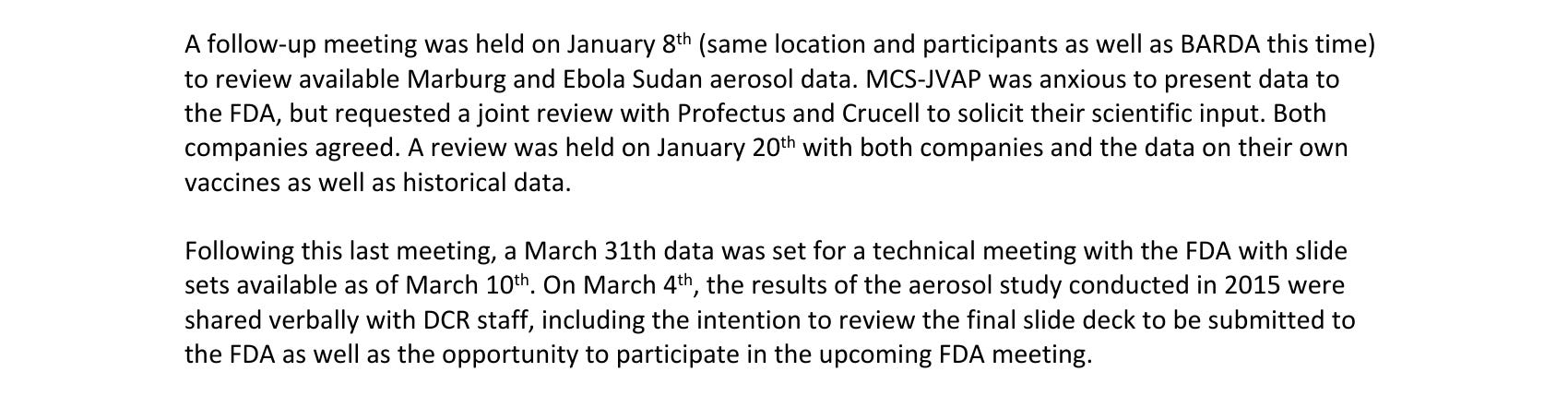
A follow-up meeting on January 8, 2016 added BARDA, the agency that buys countermeasures. On January 20, the government held a joint review with two manufacturers, Profectus and Crucell, and showed them the data on their own vaccines. A technical meeting with the FDA was set for March 31, with slides due March 10.13
Then comes the line that connects the animal room to the human trials. On March 4, the report says, the 2015 results “were shared verbally with DCR staff,” along with an invitation to review the FDA slide deck and attend the FDA meeting. DCR is NIAID’s Division of Clinical Research, the division running the Ebola vaccine trials in Liberia.14
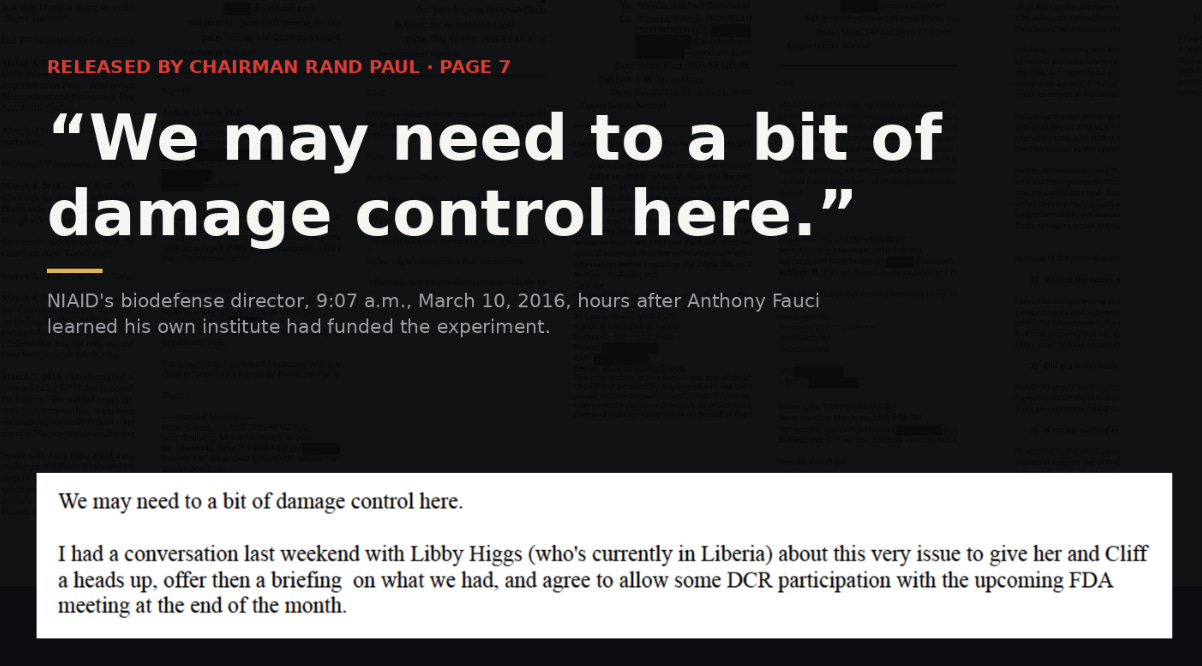
The same thread runs through the damage control email. Michael Kurilla opens it by saying he had spoken over the weekend with a colleague “who’s currently in Liberia” to give her and Cliff Lane a heads up and to offer a briefing.15
So by the time Fauci wrote that “the foolish DOD people” had sent the data to the FDA and the embassies, the FDA route had been jointly agreed for three months, the manufacturers had seen their own data, BARDA had been in the room, and NIAID’s clinical trials division had been briefed. None of that was a Pentagon indiscretion. NIAID was a party to all of it.
“What idiots those guys at USAMRIID are”
Fauci’s private notes captured his reaction:
“What idiots those guys at USAMRIID are. This should have been a classified experiment that never should have been done in the first place.”

He wrote that officials in Guinea, Liberia and Sierra Leone were “going batshit” because it looked like the United States was about to vaccinate people with a dangerous vaccine. He described the coming call with the National Security Council as a chance to “pick up the doo-doo” and explain why the experiment had nothing to do with natural Ebola.16
Two days later he blamed “the foolish DOD people” for sending the material to the FDA and the embassies. These experiments, he wrote, “should have been classified since they could indicate a vulnerability.” In an email to his deputy Cliff Lane, Fauci said he told the group the data should be classified, and that the National Security Council staff “blew them out of the water” and agreed with him.17
NIAID’s own report contradicted Fauci
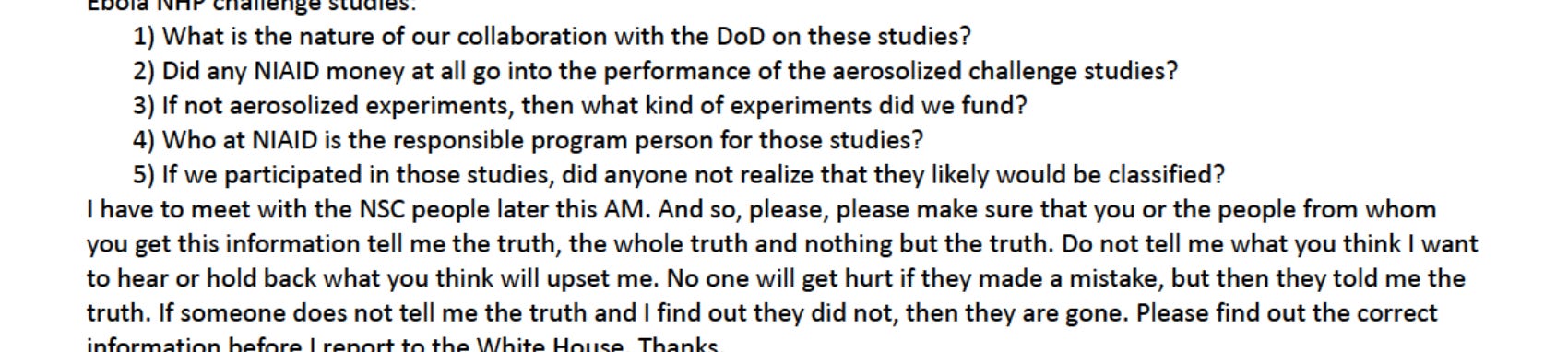
On March 11, before another meeting with the National Security Council, Fauci sent his biodefense director, Michael Kurilla, five numbered questions. He wanted to know the nature of NIAID’s work with the Defense Department, whether “any NIAID money at all” had paid for the aerosol challenges, which experiments the institute had funded, who was responsible, and whether anyone had realized the studies would likely be classified.
He asked for “the truth, the whole truth and nothing but the truth.” Anyone who held back, he wrote, would be “gone.”18
Kurilla’s answer took the classification argument apart. His report said that “at no time” during any of the relevant discussions was classification raised. Meetings were held outside secure facilities. No security clearances were requested. Current and historical aerosol data had already been shared with vaccine makers and in some cases published. And when NIAID and Defense Department staff designed the NIAID sponsored study together, “no mention was ever made of the need for classification status of the study results.”19

This is not simply Rand Paul against Anthony Fauci. Fauci’s position is contradicted inside the release by the report Fauci himself ordered.
One note on how the release has been described. Senator Paul’s announcement attributed the funding confirmation to Fauci’s diary. It does not come from the diary. It comes from Kurilla’s internal report, which is what makes it hard to wave away. The committee’s own fact sheet, page 1 of the package, gets this right and flags the damage control language, the stand down and the classification contradiction. Most of the coverage that followed did not.
“Damage control”
The most revealing material is not in the diary. It is in the emails around it.
At 9:07 a.m. on March 10, Kurilla forwarded a chain about the aerosol findings and wrote, “We may need to a bit of damage control here.” The missing word is in the original email. He said the Defense Department had finally acknowledged “a close held unreported finding” that NIAID had recently confirmed: vaccinated monkeys suffered severe lung damage after aerosol exposure. Some people at the Defense Department, he added, feared the result “may derail filovirus vaccines permanently.”20

About two hours later, Irene Glowinski, a senior NIAID official, asked what he meant:
“Can someone find out what Mike means by damage control...and who he expects will do it? All I see out of this whole chain is ‘Tony Fauci was on the line and not happy.’ Cliff will likely be blameless.”21

The Defense Department email underneath was just as blunt. Nicole Kilgore of the Joint Vaccine Acquisition Program wrote that a colleague identified only as “Sina” had “stirred the pot the whole way to the white house.” Her warning: “Tony Fauci was on the line and not happy.”22
That afternoon, Cliff Lane told two NIAID scientists to stop.
“I would not move forward on any experiments in this area until a bit of dust settles (if it does). One might consider this dual use research. Please do not get into discussions outside the two of you until we have a chance to talk.”23
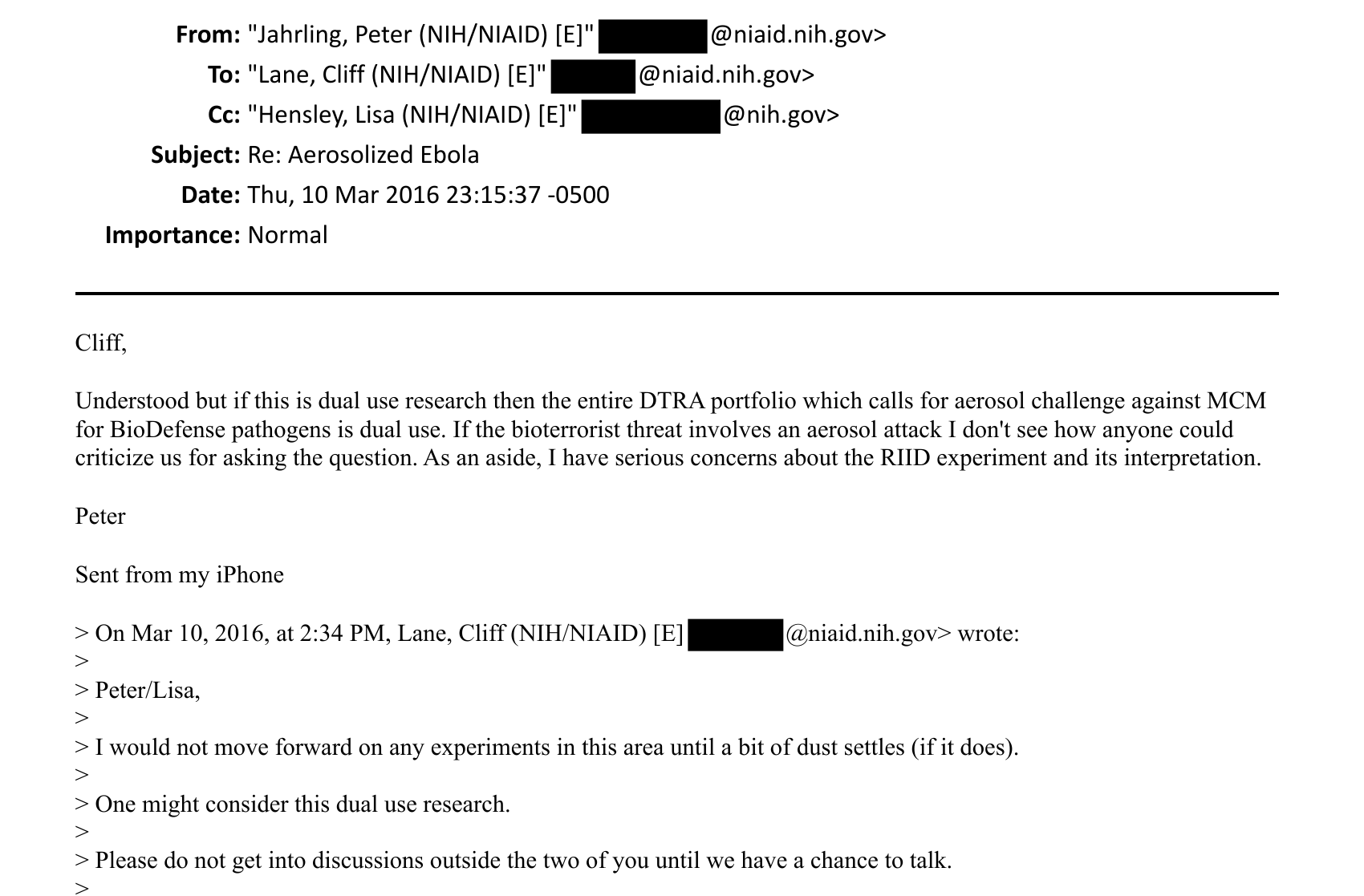
The order is unusually direct. Work stopped. The dual use problem was named. The conversation was limited to two people.
Kurilla’s March 18 report was then kept informal on purpose. “I did not organize this into a formal document for sharing outside of NIAID,” he told Fauci. “Messaging these results may require some attention.”24
Taken one at a time, each of these could be described as careful crisis management around uncertain data. Taken together, the sequence is harder to wave off: damage control, a stand down, restricted discussion, an informal internal report, and a decision to move part of the conversation off email.
“I will keep the rest off Email”
On March 14, Jahrling pushed for a better experiment. The Army result, he wrote, was a “piecemeal composite picture” that lacked proper controls. Someone needed to repeat it before drawing conclusions. Kurilla wanted to wait for the March 31 FDA meeting because of “the extreme anxiety all this seems to be creating.”25
Then Jahrling added three sentences that deserve their own inquiry:
“In the interim, however, we will continue to make plans to initiate the CoV study as soon as the lights turn green. I will keep the rest off Email, but if aerosol challenge studies are considered DURC then the entire MCM development paradigm is gutted.”26

“CoV” normally means coronavirus. “DURC” means dual use research of concern. “MCM” means medical countermeasure. But the email does not identify the study, the pathogen, the protocol, or whether it ever happened. It would be irresponsible to call it DEFUSE, the later EcoHealth Alliance proposal submitted to DARPA in 2018, or to suggest a link to the origin of SARS-CoV-2. The narrower question is the answerable one: what study was Jahrling preparing in March 2016, under what approval, and what happened when the lights turned green?
It is not speculative to ask whether his group could do coronavirus aerosol work. A 2015 paper with Jahrling and Lisa Hensley among its authors describes exposing four rhesus macaques to a small particle MERS coronavirus aerosol at NIAID’s Integrated Research Facility at Fort Detrick. That does not identify the study in the email. It shows the capability existed, and it points to a set of records worth requesting.27
“Keep the rest off Email” is evidence that someone chose to move a conversation out of email. By itself it is not evidence that records were destroyed, that a study went ahead, or that anyone broke a records rule. Those answers live in calendars, meeting notes, protocols and approvals, not in a 26 page release.
Whose problem was it?
Other emails show the agencies arguing over who owned the finding. Ed Nuzum of NIAID said aerosol challenge was “more of a DoD issue than a HHS issue” because the health agencies deal with natural disease. A military program manager, Christopher Dorsey, said he was hearing “rumblings” that the health side might drop its requirement for protection against aerosol exposure. Nuzum allowed that if the same damage appeared with large particle exposure, it would be “just as big a problem for HHS.”28
That debate runs into a wall inside the same release. Kurilla’s report states plainly: “Both DOD and HHS currently have requirements for vaccine efficacy with aerosol delivery.” The requirement was not the Pentagon’s alone. It was written into the health side too.29

What the record says in the agencies’ favor
A fair reading has to include this. Fauci’s scientific point was not invented. A cloud of engineered particles delivered straight to the alveoli is not the same as catching Ebola from another person. He made exactly that argument to Kurilla on March 12, saying a survivor re-exposed naturally would almost certainly not inhale a 2.5 micron aerosol reaching the deepest part of the lung. Kurilla agreed the natural outbreak setting was fundamentally different, while arguing that classifying the result “makes no sense.”30
The internal report goes further. It notes that the same vaccine candidates showed “clear, unambiguous protection without evidence of lung pathology” when the virus was delivered by injection rather than aerosol, and that “clinical experience with Ebola survivors would not suggest subsequent risk for lung pathology from large particle exposure.”31

By March 22, Kurilla called classification “a red herring” and said he had no problem with the aerosol data being shared publicly, as long as the agencies explained the difference between natural infection and an engineered aerosol. Lane told an interagency call that NIAID had no objection to its data becoming public once classification and proprietary questions were settled. The last email in the release shows a more open position than the one Fauci pressed right after the White House briefing.32

Later human evidence matters too, but it answers a different question. The PREVAIL I trial in Liberia tested Merck’s investigational rVSV vaccine and an adenovirus based candidate and reported no major safety concerns. The efficacy portion was never completed, because Ebola cases fell too far for it to be possible. So the trial could not test whether vaccination makes disease worse after infection. The Merck vaccine, later sold as Ervebo, was prequalified by the World Health Organization in November 2019. The 2016 animal finding should not be stretched into a claim that Ebola vaccines harmed people.33
The story that remains
Earlier coverage reported Fauci’s alarm, the “idiots” line, the NIAID funding, and the mention of a “CoV study.” The larger story sits in the correspondence around those headlines: the admission of damage control, the stand down and the gag on discussion, the classification argument his own director dismantled, and the three month interagency plan to brief the FDA that Fauci later described as a Pentagon blunder.
Fauci may well have been right that the animal model says little about what happens to a person exposed to Ebola naturally. The documents do not settle that. But his institute paid for and helped design the experiment he called stupid, and then argued for secrecy after the result had already reached regulators, manufacturers, and his own clinical trials division. His biodefense director put in writing that secrecy had never been part of the plan.
The documents to ask for
Every item below is named in the release and absent from it.
The full Task Order 8 protocol, group assignments, and individual animal pathology reports, including which vaccine platforms were used after Profectus declined.
The 2013 DOD Medical Research and Materiel Command Interagency Agreement workplan, which the report says “suggests” NIAID funded the earlier aerosol studies, plus the NIAID front office confirmation the report calls for.
The minutes, attendee list, and slide decks from the December 4, 2015 meeting at USAMRIID and the January 8 and January 20, 2016 follow-ups, including the manufacturer review with Profectus and Crucell.
The complete record of the March 31, 2016 FDA technical meeting, and the slide deck due March 10.
Any record of the March 4, 2016 verbal briefing to NIAID’s Division of Clinical Research, and any assessment made of its bearing on the Liberia trials.
Communications with U.S. embassies and West African health officials in Guinea, Liberia and Sierra Leone during March 2016.
The identity, protocol, approval status and disposition of the “CoV study” Jahrling planned to initiate, and whatever he moved off email.
Any documentation of the stand down Lane ordered on March 10, 2016, including when it was lifted.
Let the public see what the agencies knew, what they told one another, and what they chose not to put in an email.
Endnotes
All page numbers refer to the 26 page document package released by Senate Homeland Security and Governmental Affairs Committee Chairman Rand Paul on September 28, 2026 (PDF). Additional releases are posted at the committee chairman’s reading room. Page 1 of the package is the committee’s own fact sheet; the documents begin on page 2. Some copies circulating online omit that cover page and run to 25 pages. The internal report cited throughout is “Overview of the NIAID Filovirus Vaccine Program and Non-Human Primate Aerosol Challenge,” prepared by Michael Kurilla and sent to Fauci on March 18, 2016, at release pages 21 to 24.
Fauci notes, March 9, 2016: teleconference “in the SCIF with WH, CIA, NIA, DoD HHS” about the USAMRIID aerosol challenge. Release, page 4. The National Security Council role is established by the March 7 entry (”speak with the NSC from the SKIF tomorrow”) and by Fauci’s March 10 email describing “the NSC White House people.” Release, pages 2 and 5. ↩
Fauci notes, March 9, 2016: the two controls “did NOT have inflammation in the lung,” while “the vaccinated animals had necrosis, inflammation and fibrin in the lungs.” Release, page 4. ↩
Fauci to Cliff Lane, 6:13 a.m., March 10, 2016. Release, page 5. ↩
Release, pages 7, 14, 18 and 20. ↩
Internal report, background section, citing the 2006 Department of Homeland Security material threat determination for Ebola and Marburg and the 2013 PHEMCE product specific requirements, and answer to question one. Release, pages 21 and 23. ↩
Internal report, timeline section. Release, page 22. On the Merck candidate tested in humans, see NIAID’s summary of the PREVAIL trials. ↩
Internal report, timeline section. Release, page 22. ↩
Internal report, answers to questions two and four. Release, page 23. The 2013 point is hedged in the original: “NIAID OD should confirm, but the DOD Medical Research and Materiel Command Interagency Agreement (MRMC IAA) workplan from 2013 suggests that NIAID funded the aerosol studies.” ↩
Fauci notes, March 7 and March 9, 2016 (release, pages 2 and 4); internal report (release, page 22), which states that Profectus “declined to participate” and that other vaccine platforms were selected. ↩
Fauci notes, March 9, 2016 (release, page 4); Christopher Dorsey, Joint Vaccine Acquisition Program, March 7, 2016 (release, page 13); Michael Kurilla, March 10, 2016 (release, pages 7 and 8). ↩
Kurilla, March 10, 2016 (release, page 8); Peter Jahrling to Cliff Lane, 11:15 p.m., March 10, 2016 (release, page 14). ↩
Internal report, timeline section. Release, pages 22 and 23. ↩
Internal report, timeline section. Release, page 23. Crucell is the vaccine unit acquired by Johnson and Johnson. ↩
Internal report, timeline section. Release, page 23. On DCR’s role in Liberia, see NIAID’s PREVAIL summary. ↩
Kurilla, 9:07 a.m., March 10, 2016. Release, page 7. ↩
Fauci notes, March 7, 2016. Release, pages 2 and 3. ↩
Fauci notes, March 9, 2016 (release, page 4); Fauci to Lane, 3:19 a.m., March 10, 2016 (release, page 6). ↩
Fauci to Kurilla, “Call this morning,” 6:51 a.m., March 11, 2016. Release, page 15. ↩
Internal report, answer to question five. Release, page 24. ↩
Kurilla to Irene Glowinski and the NIAID distribution list, 9:07 a.m., March 10, 2016. Release, pages 7 and 8. ↩
Glowinski, 11:09 a.m., March 10, 2016. Release, page 7. ↩
Nicole Kilgore to Ed Nuzum, 10:41 p.m., March 9, 2016. Release, page 8. The email gives only the first name “Sina”; Kurilla’s message the next morning refers to “some (in DOD, such as Sina).” Neither document supplies a surname or title. ↩
Lane to Jahrling and Hensley, 2:34 p.m., March 10, 2016, quoted in Jahrling’s reply. Release, page 14. ↩
Kurilla to Fauci, 6:20 p.m., March 18, 2016. Release, page 20. ↩
Jahrling to Lane and Hensley, 5:22 p.m., March 14, 2016. Release, page 18. ↩
Same email. Release, page 18. On the DARPA proposal, see the publicly available DEFUSE documents, submitted in 2018 and unrelated to anything named in this release. ↩
Modeling [18F]-FDG lymphoid tissue kinetics to characterize nonhuman primate immune response to Middle East respiratory syndrome coronavirus aerosol challenge, EJNMMI Research, 2015. Four rhesus macaques, small particle aerosol of 0.5 to 3 microns, NIAID Integrated Research Facility at Fort Detrick. ↩
Ed Nuzum, 10:43 a.m., March 7, 2016 (release, page 12); Christopher Dorsey, 10:27 a.m., March 7, 2016 (release, pages 12 and 13). ↩
Internal report, answer to question one. Release, page 23. ↩
Fauci to Kurilla, 12:08 p.m., March 12, 2016, and Kurilla’s reply at 12:24 p.m. Release, page 16. ↩
Internal report, timeline section. Release, page 23. ↩
Kurilla to Lane and Fauci, 9:18 a.m., March 22, 2016, and Lane’s message at 8:26 a.m. Release, pages 25 and 26. ↩
Kennedy et al., “A Phase 2 Placebo-Controlled Trial of Two Vaccines to Prevent Ebola in Liberia,” New England Journal of Medicine, 2017; World Health Organization, November 12, 2019. ↩
Unfortunately, the reported results from studies may have been skewed by statistical analysis removing outliers, considering them to be errors, when indeed, they were valid data indicating serious adverse effects!
VAERD is the rare mechanism where a vaccine makes a later infection worse, and it is real for RSV (the old formalin vaccine) and dengue. That is what would make the Fort Detrick finding serious. Running the claim through openneedle.ai, the published Ebola record does not show it: nonhuman primate challenge studies report vaccinated animals protected with reduced viral load and no enhanced disease, and the one review that touches non-neutralizing antibodies treats them as a risk to watch, not a demonstrated effect. What the Senate package describes is an internal, unreplicated finding in a small arm, sitting against a published literature that says the opposite. That gap is the whole story, and it closes one way: the raw data or a replication.