


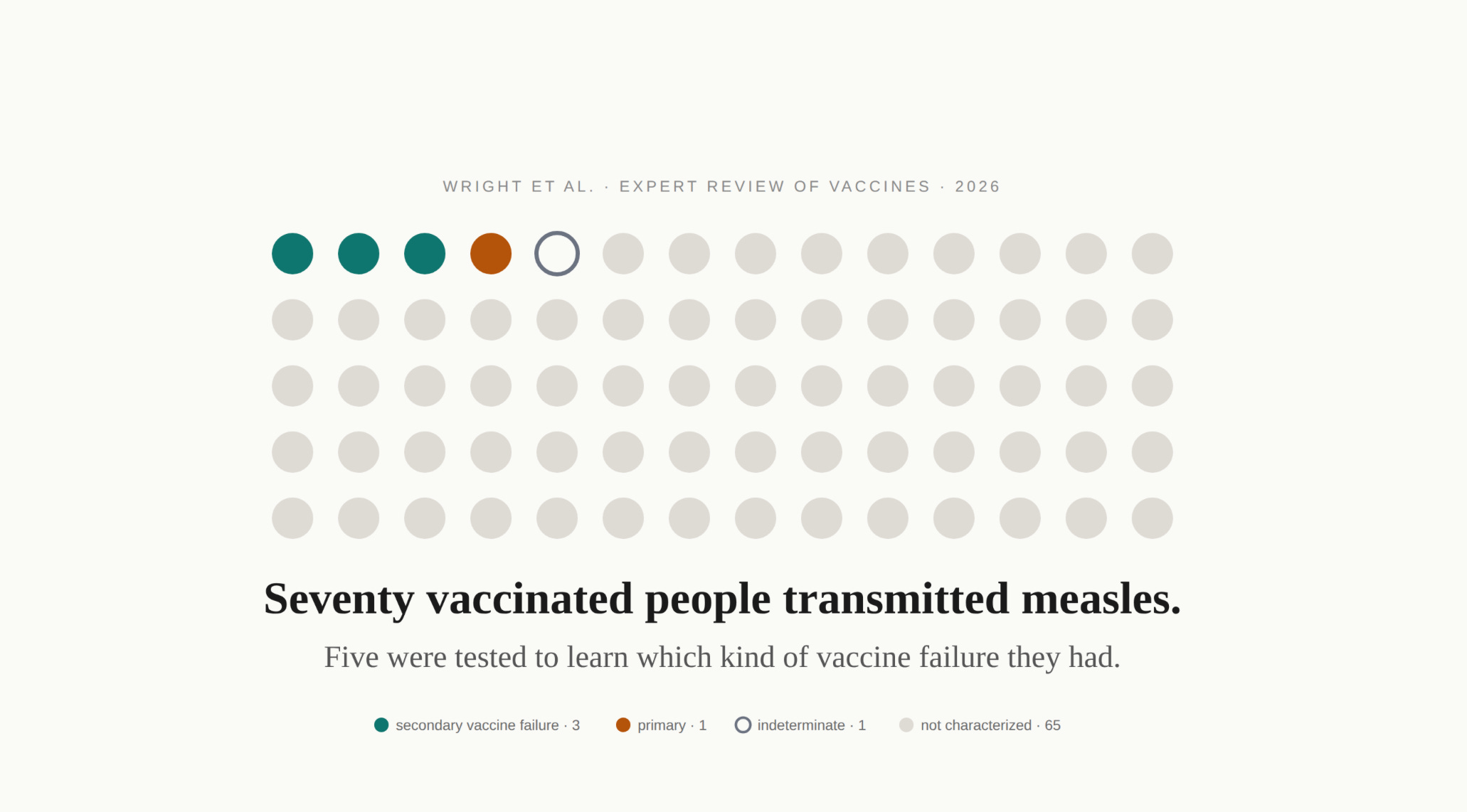
The study is Wright et al., Expert Review of Vaccines, August 2026: seventy vaccinated measles transmitters across 33 outbreaks in 18 countries. This is a reading of that paper against its own reference list, its own transmitter data, and its own lab work — including material that neither the paper's public coverage nor my earlier post engaged with.
EDITOR’S NOTE: Corrections to my earlier reporting on this paper are live on the original post, dated September 4, 2026. This piece takes up material from the same paper that neither my earlier post nor its public coverage engaged with.
The paper is Wright et al., Do vaccinated cases transmit measles? A systematic review and meta-analysis, in Expert Review of Vaccines, published online August 14, 2026. Preregistered, PRISMA-reported, led by Public Health Ontario and the University of Toronto. Fourteen authors, drawn from Public Health Ontario, the University of Toronto, the CDC’s Division of Viral Diseases at the National Center for Immunization and Respiratory Diseases, Johns Hopkins’ International Vaccine Access Center, Emory University School of Medicine, the Public Health Agency of Canada, RIVM in the Netherlands, PAHO, and the University of Newcastle in Australia.


Across 33 outbreak investigations in 18 countries, the authors identified seventy vaccinated people who transmitted measles to at least one other person. Those seventy produced 237 direct secondary cases, and — when the subsequent chains of transmission were followed — 812 total downstream cases attributed to a vaccinated index case. Median transmissions per vaccinated transmitter: two. Range: one to sixty-nine. Twenty-two of the seventy transmitters had received two or more doses of a measles-containing vaccine.
Every mainstream write-up of the paper reported those numbers. What none of them reported — and what my earlier post did not press hard enough on — is what the paper’s Discussion says, what the paper’s central interpretive premise rests on, and what its own transmitter lab data show. The rest of this piece is about those three things.
What the paper’s central premise rests on
The sentence in Wright et al.’s Discussion that carries its framing of relative outbreak drive is this:
“Because measles vaccine failure is rare [15], only a small proportion of exposed vaccinated people will develop measles (and even a smaller proportion would go on to transmit the virus), thus measles outbreaks are critically driven by unvaccinated cases, including in elimination settings.”— Wright et al., Discussion, paragraph 1
The sentence is deductive. It reasons from an external premise, cited as reference 15, to a conclusion. The authors do not claim the meta-analysis’s own dataset established that vaccine failure is rare; they claim the literature does, and cite it.
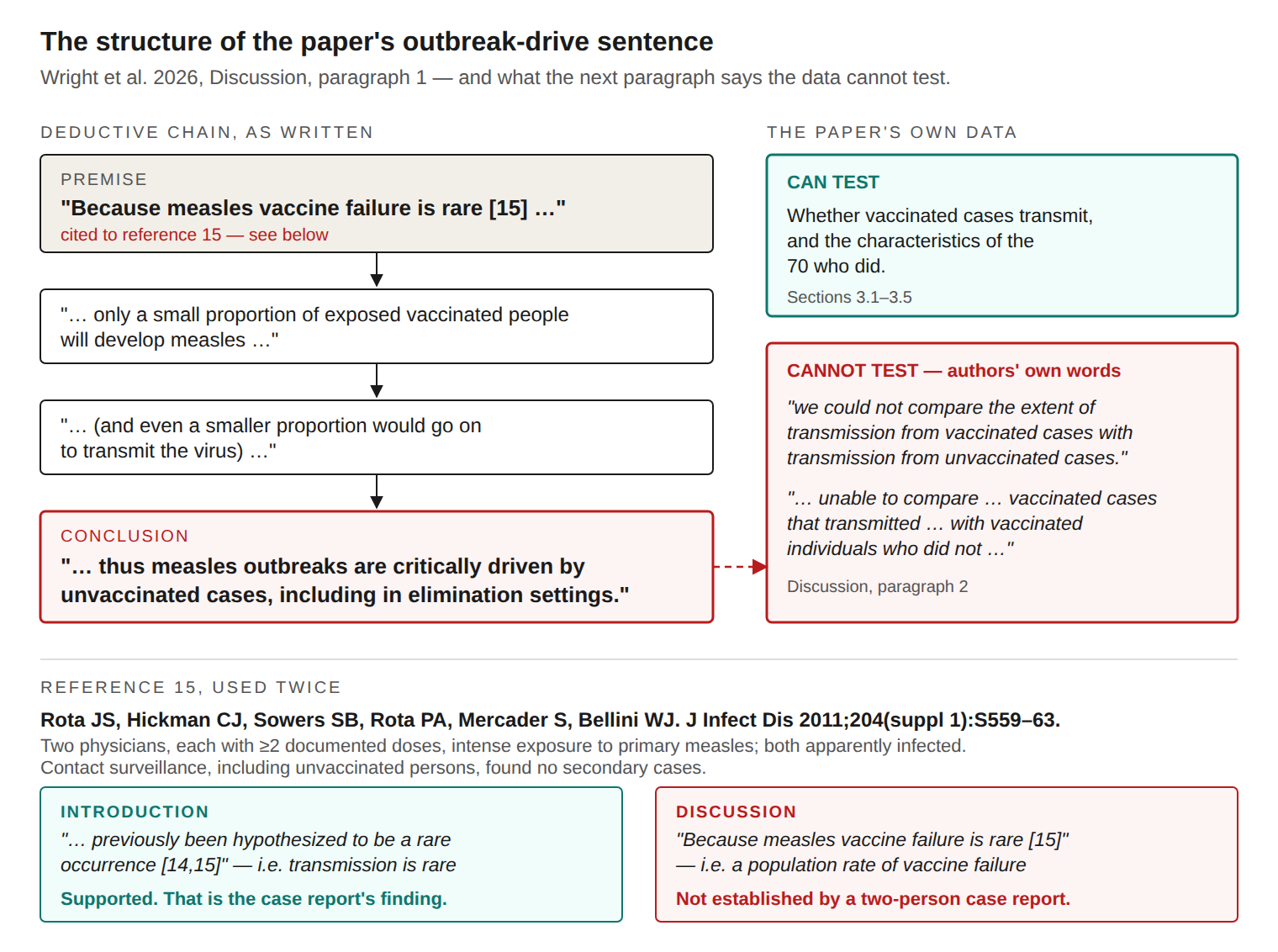
Turn to the reference list. Reference 15 is Rota JS, Hickman CJ, Sowers SB, Rota PA, Mercader S, Bellini WJ, “Two case studies of modified measles in vaccinated physicians exposed to primary measles cases: high risk of infection but low risk of transmission,” Journal of Infectious Diseases, 2011. It reports on two physicians, each with documented vaccination of two or more doses, who had intense, prolonged exposure to primary measles patients during 2009 outbreaks in Pennsylvania and Virginia. Both were apparently infected. Both continued seeing patients because neither thought they could have measles. Surveillance of their contacts, including unvaccinated persons, found no secondary cases.
That is a real and useful finding, and Wright et al. use it correctly once. In the Introduction, reference 15 supports the statement that transmission from vaccinated cases has previously been hypothesized to be rare — which is what the 2011 paper found: two infected physicians, no onward spread detected.
In the Discussion, the same reference is asked to do different work. “Vaccine failure is rare” is a population-level claim about how often measles vaccine fails to protect. A two-person case report cannot establish a population rate. The claim is well supported elsewhere in the literature; the authors could have cited any of a dozen vaccine-effectiveness studies. They cited the case report.
Nothing about this requires bad faith. It requires only that a reader look at what the citation is. The paper’s central deductive premise, in the sentence that carries its framing of outbreak drive, is cited to a source that supports a neighboring claim and not that one.
What the paper says it cannot do
In the next paragraph of the same Discussion section, the authors write:
“Since our study pre-selected vaccinated cases that transmitted measles, we could not compare the extent of transmission from vaccinated cases with transmission from unvaccinated cases. We were also unable to compare the characteristics of vaccinated cases that transmitted measles virus with vaccinated individuals who did not transmit their infection to others or were not infected.”— Wright et al., Discussion, paragraph 2
Read that carefully. The paper’s own methods do not permit comparison of vaccinated to unvaccinated transmission, or of vaccinated transmitters to vaccinated non-transmitters. Those comparisons are not in the paper. They could not have been done with this dataset.
The paper’s outbreak-drive framing — that outbreaks are “critically driven by unvaccinated cases” — is therefore not a claim the paper’s own data tested. It is a claim reasoned from an external premise, cited to the two-person case report above. The paper’s coverage in outlets like CIDRAP quotes only the operational conclusion — that transmissions from vaccinated cases “must be considered in public health investigations” — and does not carry the “critically driven” framing. That framing is in the paper’s Discussion and is the framing Dr. Vincent Iannelli quoted in his post; it is not the framing the mainstream infectious-disease press adopted.
What the paper’s lab section actually confirmed
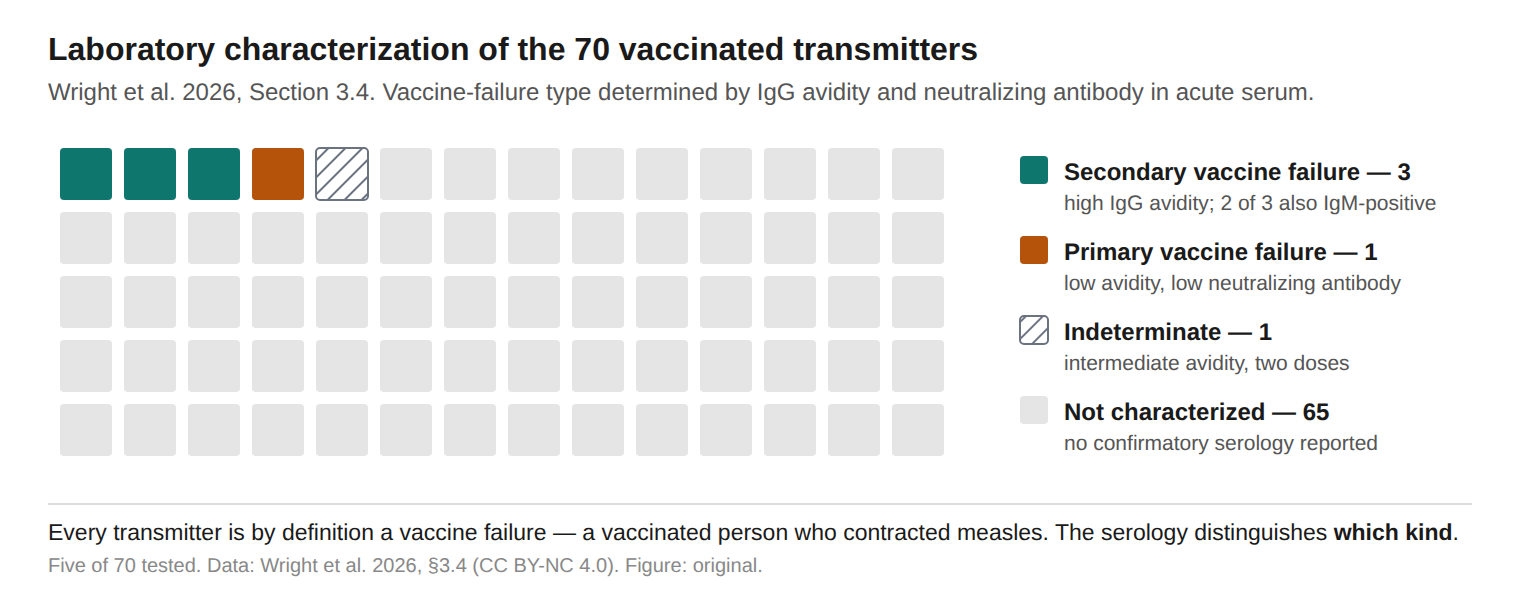
Section 3.4 reports the laboratory characterization of transmitters from the five studies where anyone ran the confirmatory serology. Verbatim:
“Five of the 30 studies described laboratory characteristics of transmitters. Of these, three transmitter cases that had previously received between one and three measles vaccine doses were determined to have experienced secondary vaccine failure based on their high IgG avidity. Two of the three were also anti-measles IgM antibody positive. One case that had received one vaccine dose was determined to have experienced primary vaccine failure, based on low IgG avidity and low levels of neutralizing antibodies in their acute serum specimen.”— Wright et al., Section 3.4
Two things this establishes.
Secondary vaccine failure was confirmed by lab work in specific transmitters. Three cases, with between one and three prior doses, transmitted measles after their vaccine-derived protection had waned. High IgG avidity is the serological signature of a mature, previously primed immune response — protection dropped below the threshold, but immune memory persisted. Not inferred; lab-tested.
Primary vaccine failure was confirmed in a specific transmitter. One case, one prior dose, transmitted measles because the vaccine had not produced protective immunity in the first place. Low IgG avidity, low neutralizing antibody, IgM positive on the acute specimen. The mechanism where the vaccine did not take, documented in a lab-characterized case.
The sample is small. Only five studies did serology at this level of specificity, and the paper flags this. But be precise about what the small sample means: every one of the seventy transmitters is, by definition, a vaccine failure — a vaccinated person who contracted measles. What the lab work distinguishes is which kind. The count of three secondary and one primary is the number of transmitters where anyone did the tests to tell the difference, not the number where failure occurred.
The presentation of vaccinated transmitters
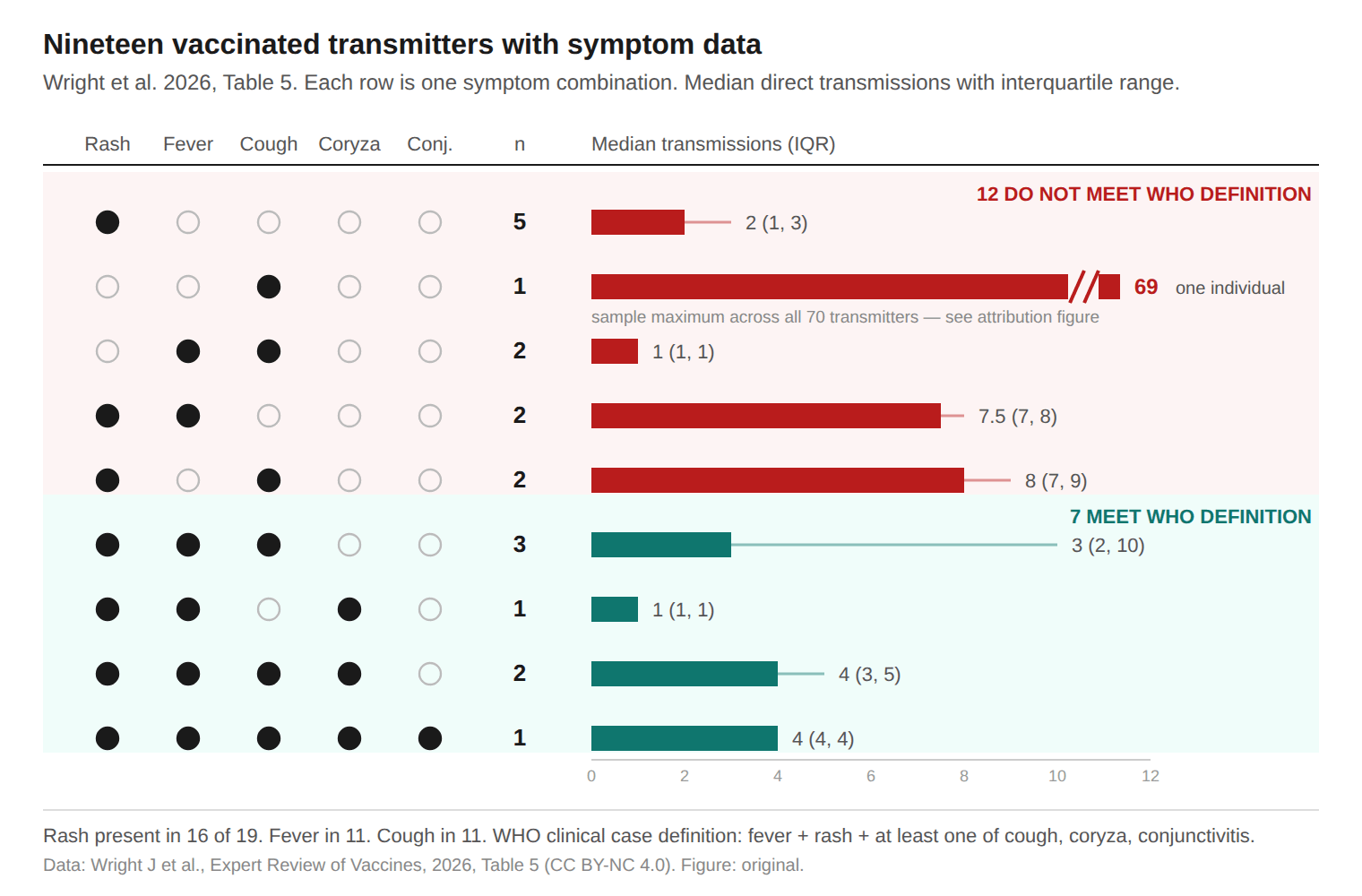
Section 3.3 documents the clinical presentation of the nineteen transmitters for whom detailed symptom information was available. Verbatim:
“Only 7 of 19 (36.8%) transmitters met the WHO measles clinical case definition of fever, rash and 1 of cough, coryza or conjunctivitis, while only 1 of 19 (5.3%) had all 5 classic measles symptoms.”— Wright et al., Section 3.3
Of these nineteen: sixteen had rash, eleven had fever, eleven had cough. Two-thirds did not meet the composite WHO case definition. One in nineteen fit the full classical presentation.
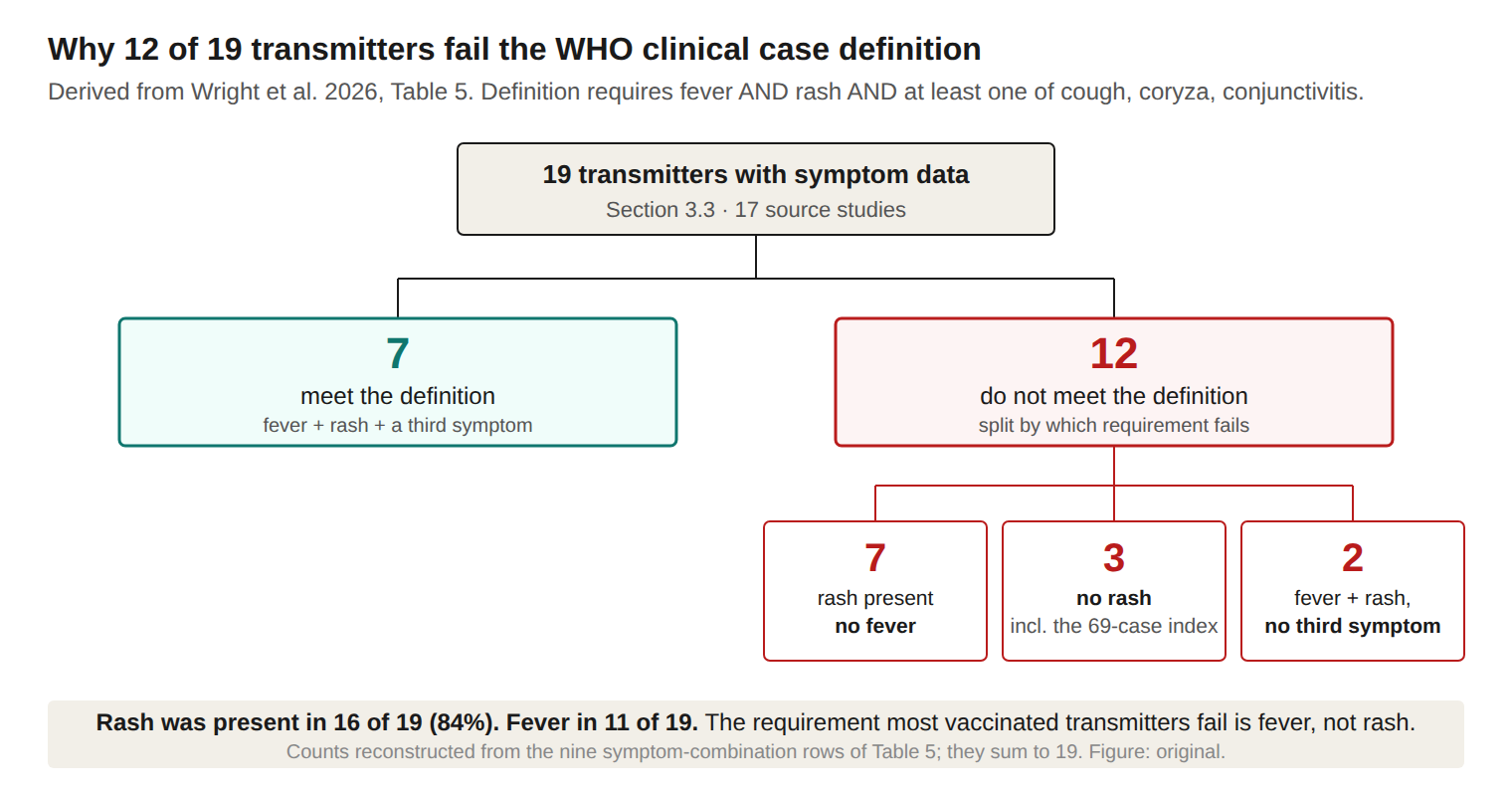
The distinction that matters: the composite case definition that triggers confirmatory testing in most surveillance systems requires fever plus rash plus at least one of cough, coryza, or conjunctivitis. Rash was present in sixteen of nineteen. Fever was present in eleven. Of the twelve who fail the definition, seven had a rash and no fever, three had no rash, and two had both fever and rash but none of the third-symptom set. The requirement most vaccinated transmitters fail is fever, not rash. A vaccinated patient presenting with rash and no fever, at low pretest probability in an elimination setting, is unlikely to be tested for measles.
The authors note this in the Discussion — “most cases included in our review experienced milder symptoms than the classical symptom combination” — and attribute it to the known immunology of breakthrough infection: lower viral load, shorter shedding, atypical presentation. Both readings are consistent. The narrower and defensible claim is that vaccinated transmitters, as a group, do not present in the pattern that triggers routine measles testing.
The 69-transmission case
Within the same nineteen-transmitter symptom breakdown sits one individual whose recorded symptom was cough alone, and who transmitted measles to sixty-nine others.
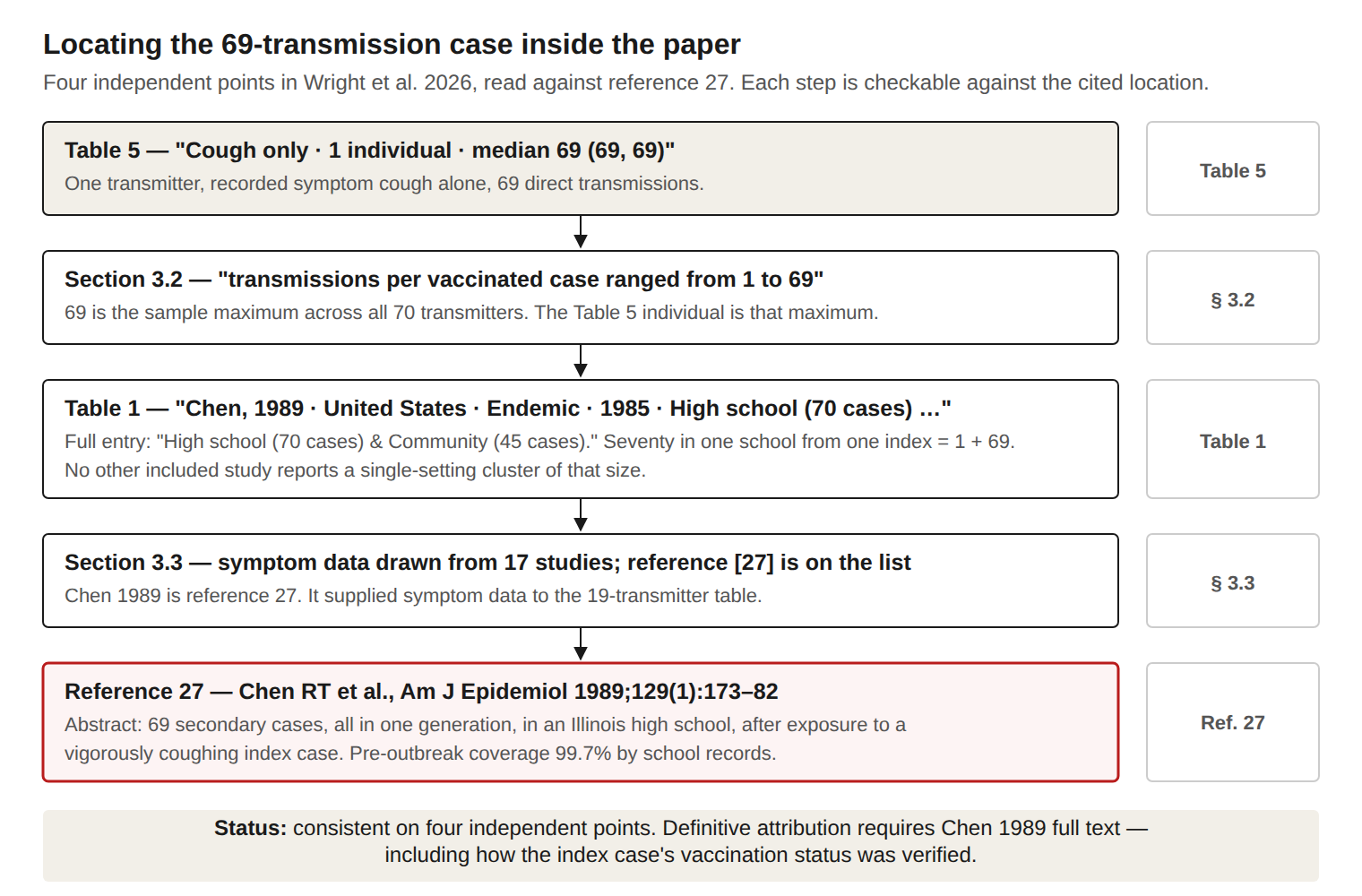
The paper’s Table 1 lists one included study as “Chen, 1989 — United States — Endemic — 1985 — High school (70 cases) & Community (45 cases).” Seventy cases in one school from a single index is one plus sixty-nine. That reference — reference 27 — is Chen RT, Goldbaum GM, Wassilak SGF, et al., “An explosive point-source measles outbreak in a highly vaccinated population: modes of transmission and risk factors for disease,” American Journal of Epidemiology, 1989. Chen is among the seventeen studies the paper lists as supplying symptom data. Chen’s own abstract describes 69 secondary cases, all in one generation, in an Illinois high school, after exposure to a vigorously coughing index case.
Four independent points match. Definitive attribution would require Chen’s full text, which would also settle how the index case’s vaccination status was verified — a live question, because Chen’s own finding was that the school’s vaccination records were unreliable.
If it is Chen 1989, three things follow. The outbreak occurred in 1985, in the endemic era, under a single-dose schedule that the field subsequently changed because of outbreaks in highly vaccinated populations like this one. “Cough only” describes the recorded symptom during the exposure window, and measles is most infectious in the prodrome, before rash, in vaccinated and unvaccinated people alike — so a coughing, pre-rash index case is ordinary measles caught at the moment of transmission, not necessarily atypical measles. And a vigorously coughing student in a crowded school is a high-contact, airborne-transmission setting, which is Chen’s own explanation for the size of the event.
That is a different kind of data point than a modern surveillance-detection story. It is a documented historical case of large-scale transmission from a vaccinated index in a school setting, published in a major epidemiology journal thirty-seven years ago — one of the empirical events that moved the U.S. schedule from one dose to two. Its inclusion in a 2026 meta-analysis, alongside more recent cases from the elimination era, is not evidence of a new surveillance failure. It is evidence that vaccinated transmission at scale has been in the peer-reviewed record for four decades.
What this does not establish
None of the above shows that vaccinated cases drive measles outbreaks in the current era. The honest version of the argument is the only version worth making.
The paper’s operational conclusion — that transmissions from vaccinated cases must be considered in public health investigations — is defensible and important. So is the broader public-health record: unvaccinated cases, at the population level, drive most measles transmission in modern settings. Two independent lines of evidence support that. Gastañaduy et al., in JAMA Pediatrics in 2020, reported per-case effective reproduction numbers of 0.76 for unvaccinated patients, 0.17 for one-dose recipients, and 0.27 for two-dose recipients, from 2,218 confirmed U.S. measles cases between 2001 and 2017. Two of that paper’s authors — Paul Gastañaduy and Paul Rota, both of CDC’s Division of Viral Diseases — are co-authors on Wright et al. 2026. Neither reading requires the other to be wrong. And measles has a basic reproduction number of twelve to eighteen; outbreak size has tracked coverage gaps for decades.
The narrower claim the record supports: the premise carrying the paper’s outbreak-drive framing is cited to a two-person case report that supports a neighboring claim and not that one; the paper’s own methods cannot compare vaccinated to unvaccinated transmission or transmitters to non-transmitters; and the paper’s lab section documents both primary and secondary vaccine failure in specific transmitters where anyone did the tests. Each of those is checkable against the paper’s own text. None of them require inference against the authors.
The distinction that matters for readers is this. The paper contains two claims about vaccinated transmission. One is the outbreak-drive framing, reasoned from a citation. The other is the operational conclusion — vaccinated cases must be considered in outbreak investigations — drawn from the paper’s data. Only the second is what the paper’s data support. The popular version of the public-health message, that vaccinated people don’t spread measles, is broader than either, and it is the version this paper does not defend.
Wright J, Crowcroft NS, Perry J, Poolsaar H, Gastañaduy PA, Durrheim DN, Moss WJ, Hahné S, Orenstein WA, Rota PA, Osman S, Pastor D, Severini A, Bolotin S. “Do vaccinated cases transmit measles? A systematic review and meta-analysis.” Expert Review of Vaccines. Published online August 14, 2026. Open access (CC BY-NC 4.0): tandfonline.com/doi/full/10.1080/14760584.2026.2708188
Rota JS, Hickman CJ, Sowers SB, Rota PA, Mercader S, Bellini WJ. “Two case studies of modified measles in vaccinated physicians exposed to primary measles cases: high risk of infection but low risk of transmission.” J Infect Dis. 2011;204(suppl 1):S559–S563. [Reference 15 in Wright et al.]
Chen RT, Goldbaum GM, Wassilak SGF, Markowitz LE, Orenstein WA. “An explosive point-source measles outbreak in a highly vaccinated population: modes of transmission and risk factors for disease.” Am J Epidemiol. 1989;129(1):173–182. [Reference 27 in Wright et al.]
Gastañaduy PA, Funk S, Lopman BA, Rota PA, Gambhir M, Grenfell B, Paul P. “Factors Associated With Measles Transmission in the United States During the Postelimination Era.” JAMA Pediatr. 2020;174(1):56–62.
An earlier post on the same paper appears here, with corrections dated September 4, 2026.
All figures are original, drawn from the tables and text of Wright et al. 2026 as labeled.
A reasonable analysis IMO.
People coming to this Substack may just take away one headline message.. the first standout sentence in your heading, namely: "Vaccinated people can spread measles".
Unfortunately, from years of personal on-line experience, I know that message will be interpreted by most readers as saying two things...
1. It is common (or at least not uncommon) for vaccinated people to spread measles, and
2. Measles may be acquired from vaccinated people shedding vaccine-strain measles.
Both of those conclusions are of course incorrect.
...Perhaps your heading could have been worded differently?
I have known this for decades. Just by observation of the number of soldiers (THAT ARE VACCINATED) that contracted measles especially in countries with a high measles endemic rate.