

Read and share the X thread dedicated to this announcement.
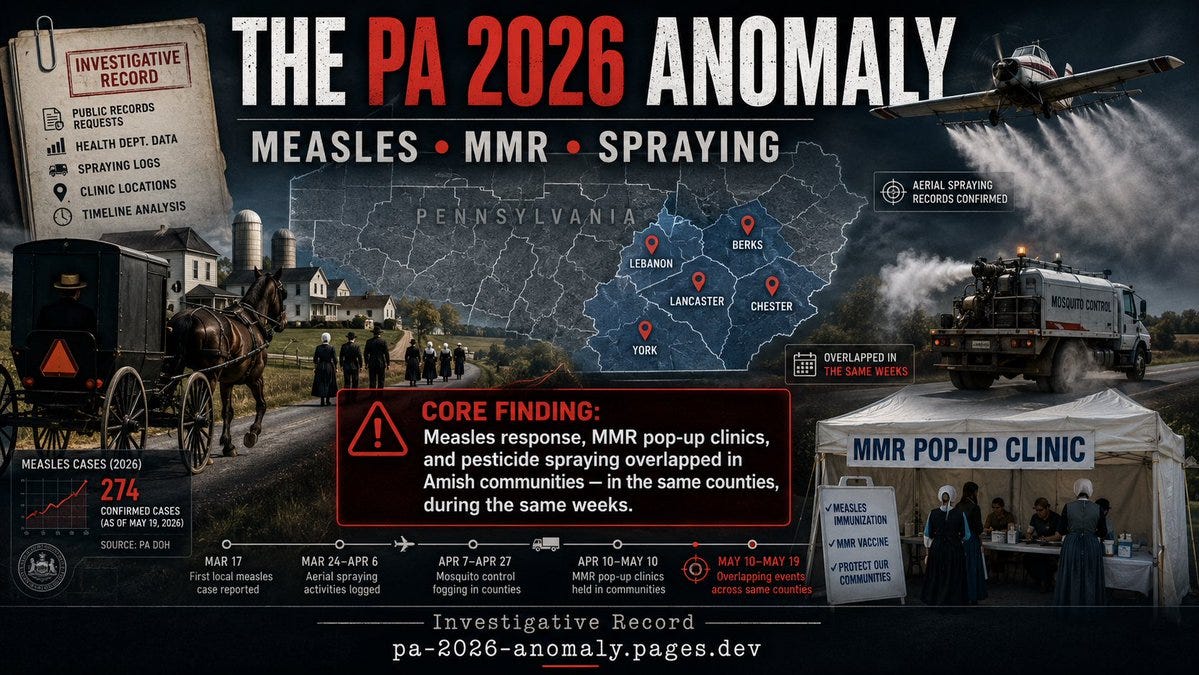
For the past week I’ve been documenting three concurrent Pennsylvania operations — the 2026 measles outbreak response, an MMR pop-up vaccination campaign targeting Amish communities, and a residential pyrethroid pesticide fogging program running in the same counties. What the state has not published is where. The 2026 file DEP does post shows a single Lancaster–Lebanon truck application, in Lebanon County, roughly forty kilometers from the Amish settlement. Whether that is the whole record is the question the filings exist to answer. Today, two accountability tools go live at once. Neither will let the state stay silent.
The Public Dashboard
Every event dated. Every claim source-cited. Every dispute filable. A live investigative record of the three concurrent 2026 Pennsylvania operations in one navigable place.

The Records Requests
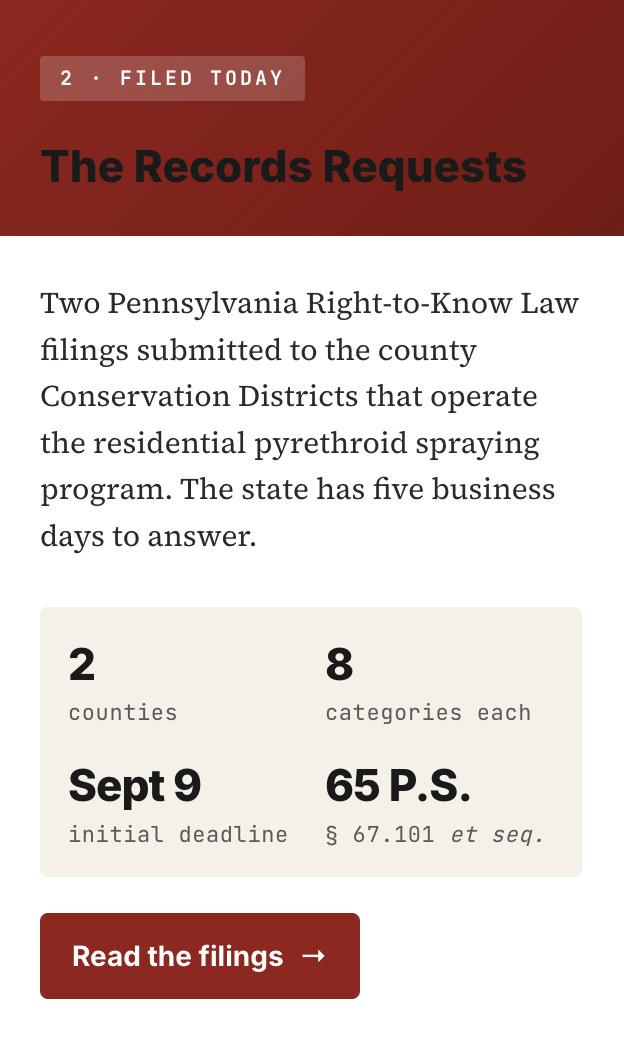
Two Pennsylvania Right-to-Know Law filings submitted to the county Conservation Districts that operate the residential pyrethroid spraying program. The state has five business days to answer.
Read the Sept 2, 2026 filings:
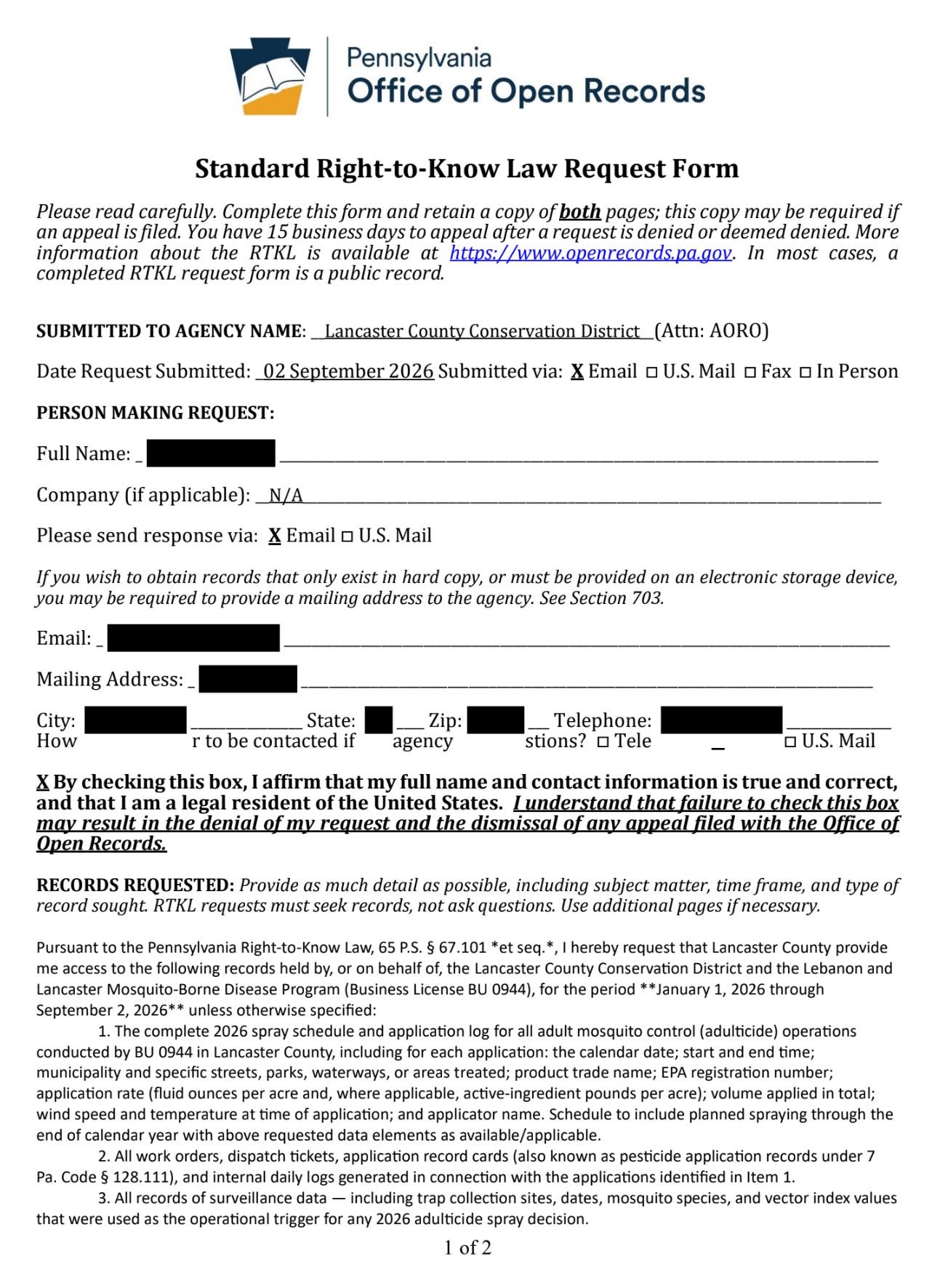
These are not competing announcements. They are two halves of the same accountability architecture. The dashboard makes the investigation navigable, source-cited, and disputable. The Right-to-Know filings force the state to produce records it is legally required to keep. Every path from here — full disclosure, partial disclosure, extension, denial, silence — becomes part of the record.
The state cannot both refuse to answer and remain unaccountable. The Right-to-Know Law was written to make that impossible.
Why both matter — and why now
The exclusive investigation published last week documented three concurrent operations happening in the same Pennsylvania counties in the same weeks. The Open Letter to President Trump filed this morning asks the federal government to demand the records that would settle the extent of the collision. The two moves today — the dashboard going public and the county-level records requests going in — are what an investigation looks like when it moves from writing to enforcement.
The dashboard’s job is to keep the record. The Right-to-Know filings’ job is to force the record to grow. Together they turn a Substack investigation into a live, adversarial-grade civic action that anyone — journalist, lawyer, elected official, concerned neighbor — can verify, dispute, or extend.
The clock
THE PROCEDURAL CLOCK
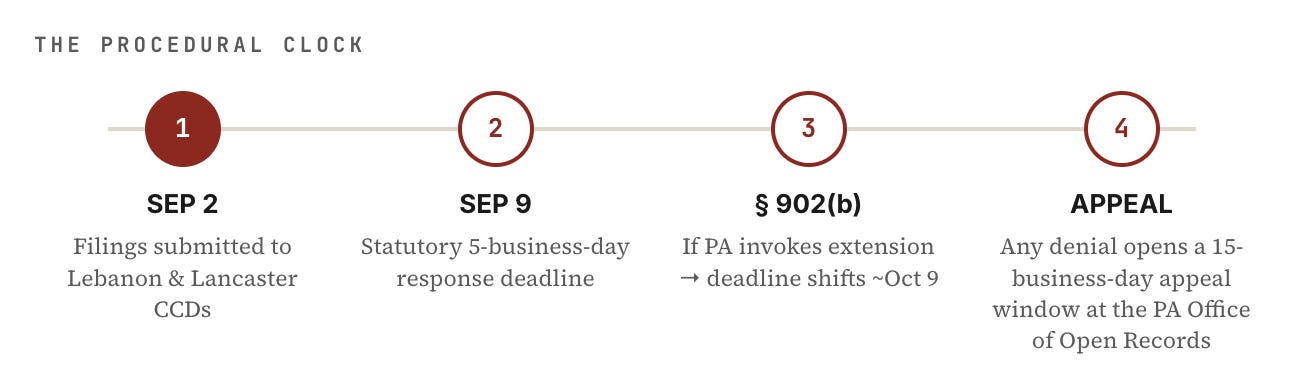
Any denial opens a 15-business-day appeal window at the PA Office of Open Records
What full disclosure would show
If Pennsylvania answers the Right-to-Know filings in full, four things enter the public record for the first time: every 2026 spray event dated and located; notification protocols for Plain communities on paper; communications between the districts and community liaisons readable; and every complaint record counted. Each of those categories currently lives only in state files.
What silence would show
If Pennsylvania invokes the 30-day extension, denies, or produces fragments, the state’s response itself becomes citable. Every denial triggers a 15-business-day appeal at the Office of Open Records. A § 902(b) extension is lawful and common, and invoking one proves nothing on its own — but it is a dated, written, signed act, and it puts the agency on the record as to why. A non-response is a deemed denial under § 901, which opens the same appeal. Whatever the districts choose, they choose it in writing.
How you can help right now
This is a citizen-led investigation, catalyzed to protect the Amish and every community living downwind of a spray program the state has not fully disclosed. A Pennsylvania citizen filed today’s records requests. A journalist filed the Open Letter. A public dashboard puts every event on the record. None of it is institutional. All of it is public. Every reader has something to do:
Open the dashboard — spend five minutes, dispute anything you disagree with, forward it to a journalist you trust.
Contact your Pennsylvania state representative — ask them to demand a full response to the Right-to-Know filings by September 10.
Read the exclusive investigation — the reporting the records requests are built on.
Read the Open Letter to the President — the federal-facing appeal filed this morning.
If you live in Lancaster, Lebanon, or a neighboring county — document what you see and DM me.
The record will grow either way.
The dashboard is live. The clock is running. The Amish don’t speak up for themselves online. We can.
Open the Dashboard →Read the Investigation


As a resident in PA and Lancaster County, I will help make the Amish aware. Their farms landlocked the dairy farm I live on. You're right, they don't generally defend themselves or fight back, but the Mennonite do. Maybe we could get their help to help their Amish neighbors