

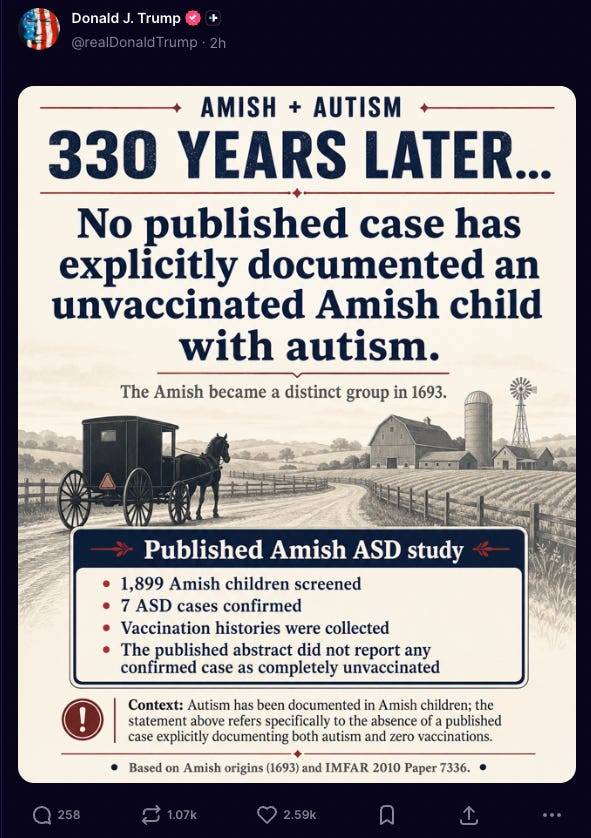
Direct link, for the record: truthsocial.com/@realDonaldTrump/posts/117190855202153056. Posted 12:35 AM Eastern.
Today, the President of the United States posted this to Truth Social. It’s rhetorically imperfect — the “330 years” is wrong. But it points toward two documented observations worth investigating: Amish communities have unusually low vaccination uptake, and the limited research conducted in this population has reported substantially lower estimated autism prevalence than contemporary U.S. estimates.


The “330 years” claim is easy to correct and worth correcting up front, because his amplifiers won’t. Amish life in North America begins in the 1730s — meaning it’s closer to 290 years, not 330. And the framing itself doesn’t work: autism wasn’t a diagnostic category until Kanner in 1943, and modern ASD criteria (DSM-IV-TR — the very framework used in the study this graphic points at) date to 2000. You cannot meaningfully compare “autism rates” across three centuries when the diagnosis itself is 80 years old.
The headline sentence — “no published case has explicitly documented an unvaccinated Amish child with autism” — is also, on its face, a rhetorical move. It’s technically true. It’s an argument from absence. It’s not a positive finding, and it should not be treated as one.
Get those two corrections out of the way, and something remarkable is left standing. The study the graphic points at is real. What it actually collected, and what it never published, is what the fact-checks left out. That study, and what happened to it, is the subject of this piece.

Vaccination histories were collected in 2008–2009. The stratified results were never published. What happened next?
The study
The conference abstract is “Prevalence Rates of Autism Spectrum Disorders Among the Old Order Amish.”.” It was presented as Paper 7336 at the International Meeting for Autism Research (IMFAR) on May 22, 2010, by a joint team from the University of Miami’s Hussman Institute for Human Genomics and Vanderbilt University’s Center for Human Genetics Research. The authors are Jennifer L. Robinson, Laura Nations, Nadi Suslowitz, Michael L. Cuccaro, Jonathan Haines, and Margaret Pericak-Vance — a research group of significant standing. Pericak-Vance received the American Society of Human Genetics Lifetime Achievement Award in 2024 and is an elected member of the National Academy of Medicine.
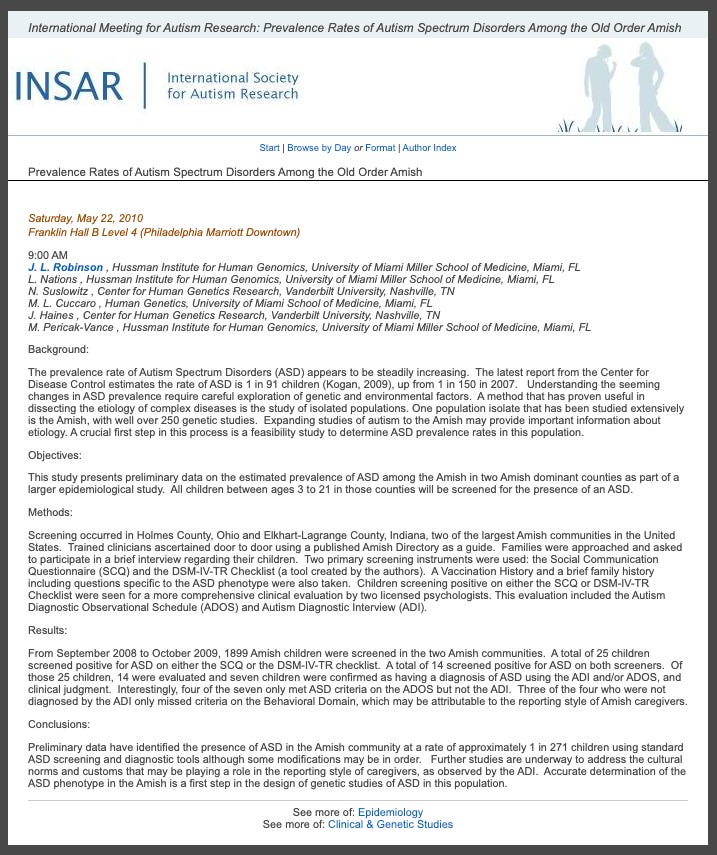
Here is what they did, in the abstract’s own words:
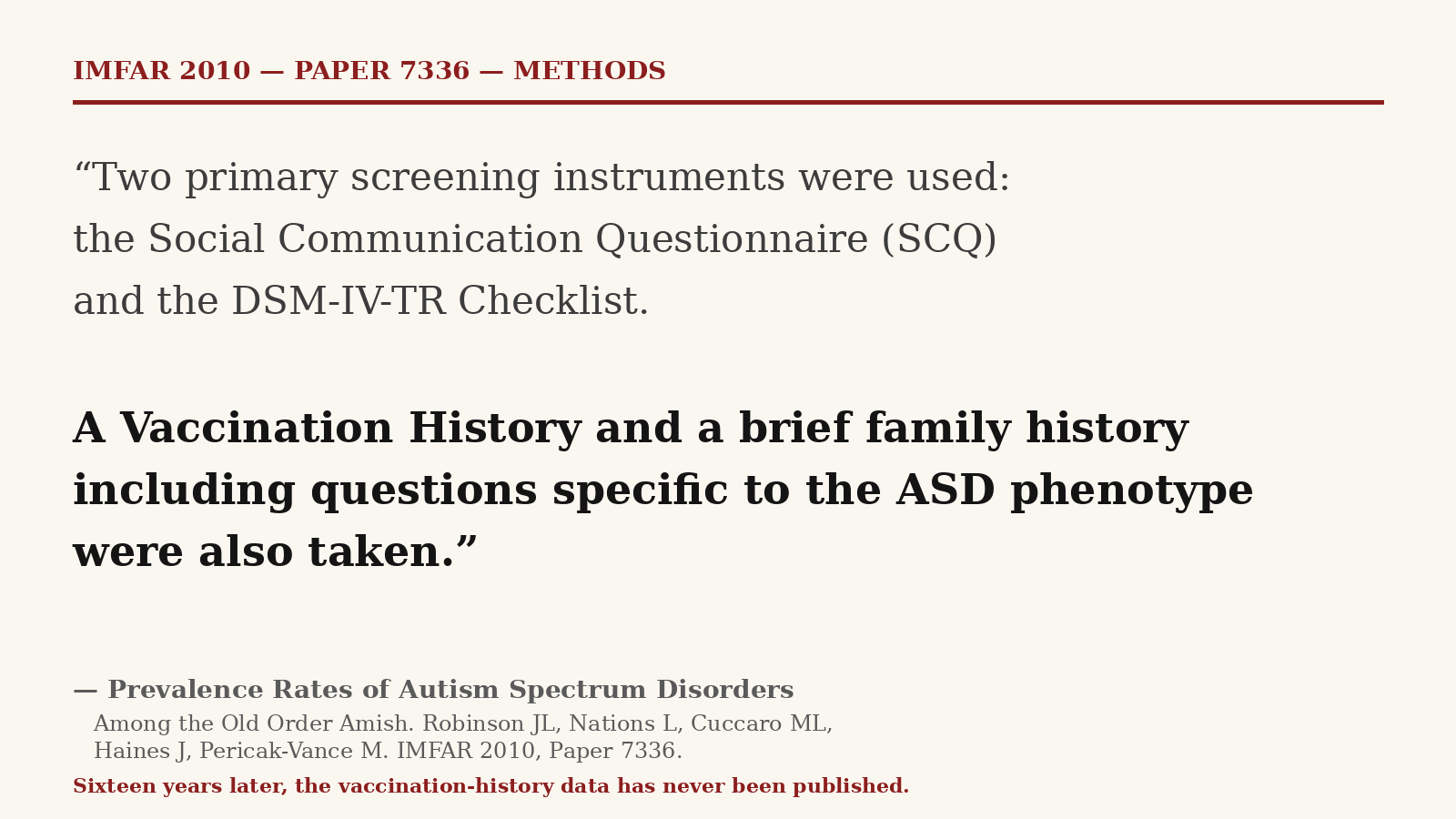
“Screening occurred in Holmes County, Ohio and Elkhart-Lagrange County, Indiana, two of the largest Amish communities in the United States. Trained clinicians ascertained door to door using a published Amish Directory as a guide. Families were approached and asked to participate in a brief interview regarding their children. Two primary screening instruments were used: the Social Communication Questionnaire (SCQ) and the DSM-IV-TR Checklist (a tool created by the authors). A Vaccination History and a brief family history including questions specific to the ASD phenotype were also taken. Children screening positive on either the SCQ or DSM-IV-TR Checklist were seen for a more comprehensive clinical evaluation by two licensed psychologists. This evaluation included the Autism Diagnostic Observational Schedule (ADOS) and Autism Diagnostic Interview (ADI).” (IMFAR Paper 7336)
Read that paragraph again. Slowly. Then read the bold sentence.
Between September 2008 and October 2009, the team went door-to-door across two of the largest Amish communities in the United States, screened 1,899 Amish children, confirmed 7 cases of Autism Spectrum Disorder by ADI/ADOS clinical evaluation, and — as a matter of published methodological record — included vaccination history as part of its data collection during the 1,899-child screening.
The authors reported a preliminary estimated prevalence of approximately 1 in 271, substantially below the 1-in-91 national estimate they cited at the time—although the two estimates were generated using different methodologies and should not be treated as a direct apples-to-apples comparison.
In the same abstract, the authors stated:
“Further studies are underway to address the cultural norms and customs that may be playing a role in the reporting style of caregivers, as observed by the ADI. Accurate determination of the ASD phenotype in the Amish is a first step in the design of genetic studies of ASD in this population.” (IMFAR Paper 7336)
That was sixteen years ago.
What never happened
I asked a research team to trace what became of that promised follow-up. We queried PubMed directly. We queried NIH RePORTER for the underlying grant record. We searched Google Scholar, personal LinkedIn pages, faculty rosters at the University of Miami’s Hussman Institute for Human Genomics, Case Western Reserve, Duke’s Center for Autism and Brain Development, and every institution the six authors have passed through since 2010. Here is what we found:
No peer-reviewed journal paper on Amish autism prevalence has ever been published by this team. Sixteen years later, the conference abstract remains the only written product of the 1,899-child screening.
The vaccination-history data collected during the 1,899-child screening have never appeared in a published stratified analysis — not in any peer-reviewed paper, letter, editorial, book chapter, or preprint traceable to the six co-authors.
The “further studies underway” never surfaced. PubMed queries for
Amish AND autism AND Pericak-Vance,Amish AND autism AND Cuccaro,Amish AND autism AND Haines, andAmish AND autism AND Robinson JLeach return zero results.The team pivoted. Pericak-Vance and Cuccaro’s post-2010 Amish work — 52 papers between them, verified live in PubMed — is exclusively on Alzheimer’s disease, age-related macular degeneration, Parkinson’s disease, aging biology, and cardiovascular genetics in the same Ohio/Indiana Amish population. Not one autism paper.
No dedicated NIH grant for Amish autism epidemiology or genetics was ever awarded to Pericak-Vance, Cuccaro, or Haines. NIH RePORTER confirms this. The 2008–2009 screening was piggy-backed on general autism-genetics grants (P01 NS026630 and R01 MH080647) whose public abstracts don’t even mention the Amish, with private philanthropic backing from the John P. Hussman Foundation. When those grants ended, no follow-on was awarded, and no follow-on was requested.
No public statement from any of the six authors has explained why a full journal publication of the Amish autism prevalence work never materialized, what became of the vaccination histories, or what the “further studies underway” produced. I searched for interviews, letters to the editor, op-eds, and public engagement with the finding. There is nothing.
STAT News confirmed the state of the field on October 2, 2025, in an op-ed by Braxton Mitchell of the University of Maryland Amish Research Clinic: “The only thing we know for certain is that the true prevalence of autism among the Amish remains unknown.” (STAT News) The Philadelphia Inquirer on September 23, 2025 quoted Mitchell adding that his own six-month literature search had located “only one study that performed a systematic assessment of autism in the Amish” (Inquirer) — the same 2010 IMFAR abstract we are discussing.
Sixteen years. One dataset. 1,899 children. 7 confirmed cases of autism. Vaccination histories were collected as part of the screening protocol. And nothing — not one stratified analysis — has ever been published.
That is the actual factual situation. It has nothing to do with whether vaccines cause autism. It is a claim about data. The data was collected. The data was not published. That much is not in dispute.
The fact-check that debunks itself
Now here is what makes the situation genuinely remarkable.
Since 2023, when the “Amish don’t get autism” claim resurfaced in political discourse, essentially every major fact-checker in the English-speaking world has published a rebuttal. They cite the same study we’ve just been discussing. They correctly note that Amish children do develop autism — the seven clinically confirmed ASD cases establish that point. They generally frame the claim as either “false” or “misleading.”
And, without exception, every single one of them omits the sentence in the abstract’s Methods section that documents the vaccination-history collection.
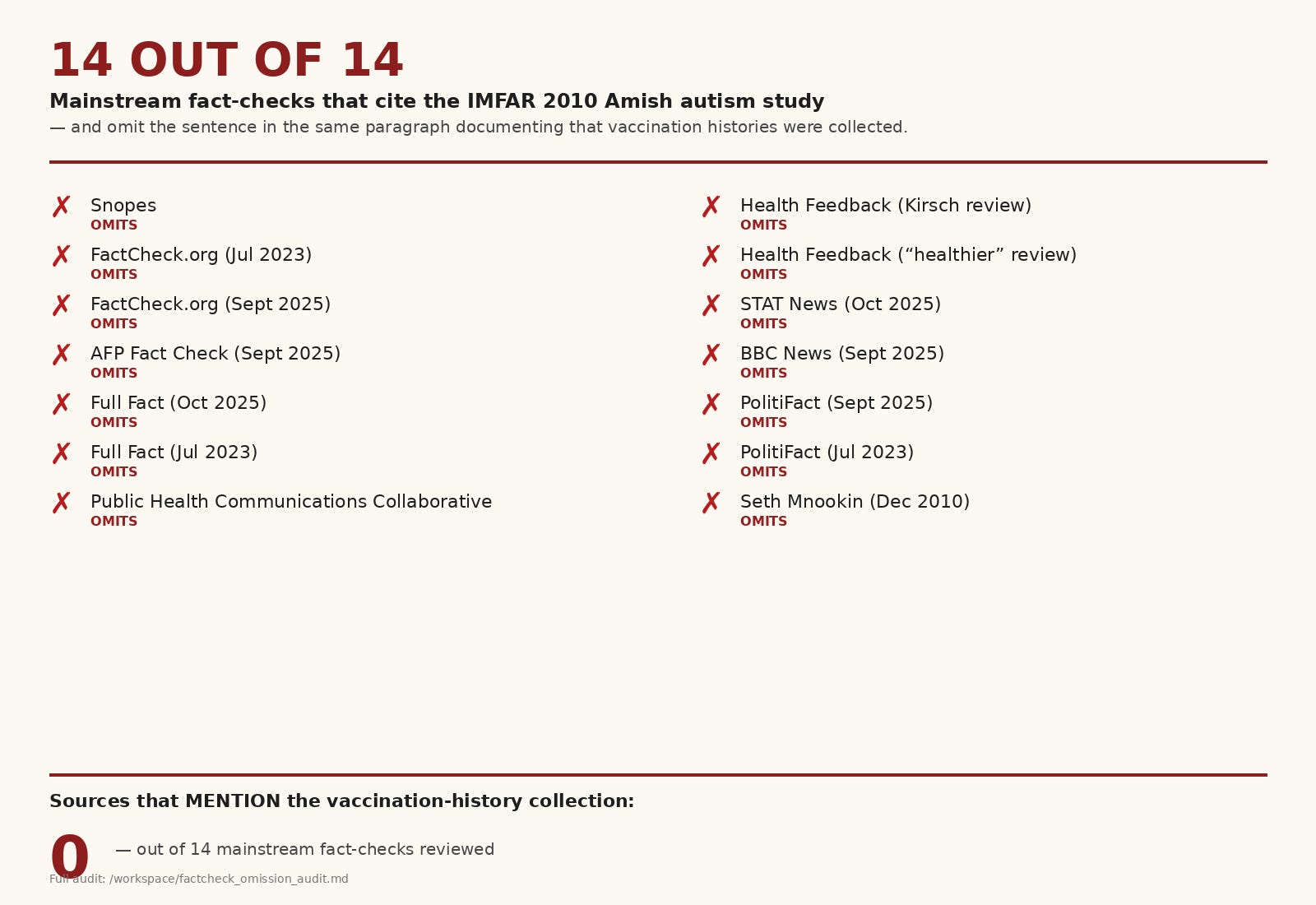
We audited fourteen mainstream fact-checks and explainers, all of them citing the 1-in-271 prevalence figure from IMFAR Paper 7336 to rebut the Amish/vaccine argument. The count:
Number that quote or mention the sentence “A Vaccination History and a brief family history including questions specific to the ASD phenotype were also taken”: zero.
Number that mention that the vaccination data was collected but not published in stratified form: zero.
Number that ask what happened to that data: zero.
The list, with verbatim quotes and per-source verdicts, is preserved in our full audit file. It includes:
Snopes, which cites the study by name and the 1-in-271 figure — and describes vaccine-data collection only in the context of a different unrelated 2011 survey.
FactCheck.org, July 2023, which quotes the study’s Conclusions section verbatim while omitting the Methods sentence one paragraph above.
FactCheck.org, September 2025, same omission.
AFP Fact Check, September 2025, which describes the door-to-door screening methodology in detail but leaves out the vaccination-history collection.
Full Fact, October 2025 and July 2023, both of which cite the study without mentioning the collected vaccination data.
BBC News, September 2025, same omission.
PolitiFact, September 2025 and July 2023, same omission.
Public Health Communications Collaborative, which reproduces the collective talking points without ever citing the study by name.
Health Feedback’s Kirsch review achieves a particularly striking irony: it writes, verbatim, “any attempt to link vaccines to the presence or absence of a given health condition among the Amish should at least take into consideration their vaccination status. This is something that neither Kirsch nor those who propagated his claim did.” — while itself omitting the fact that Paper 7336 collected exactly that data.
STAT News, October 2025, which mentions the vaccine question in passing but does not tell readers that Paper 7336 had actually collected the histories.
Fourteen fact-checkers. Zero mentions. The omission is uniform. It cannot be explained by editorial preference, publication length, or space constraints. Each of these outlets had room for detailed methodological discussion, multiple expert quotes, and lengthy caveats about caregiver reporting styles. What none of them had room for was one sentence — the one sentence in the whole abstract that would allow a reader to draw the obvious question:
If the researchers had the vaccination status of the 7 confirmed autism cases on file since 2009, where is it?
The absence of that question, across fourteen independent fact-checks, is not itself a smoking gun about vaccines. It is a smoking gun about the fact-check ecosystem. Ask yourself: what mechanism produces that kind of uniform blind spot?
The pattern
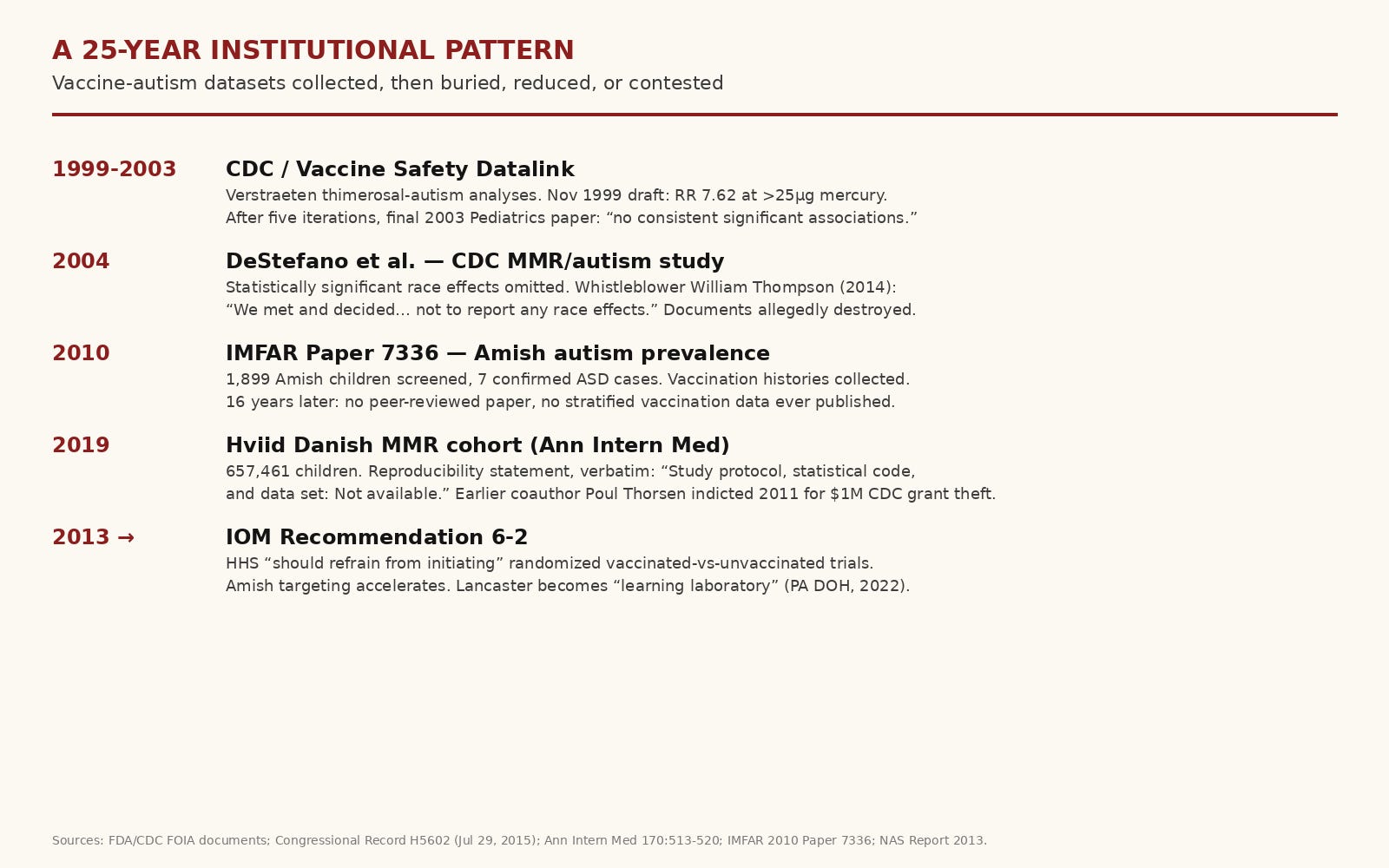
It would be one thing if IMFAR Paper 7336 were an isolated case. It isn’t. The pattern of vaccine-autism data being collected, held internally, then either not published, published in altered form, or contested by co-authors, is documented and named in the peer-reviewed and Congressional record.
Verstraeten and the Vaccine Safety Datalink (1999–2003)
Between November 1999 and November 2003, epidemiologist Thomas Verstraeten at the CDC’s National Immunization Program produced at least five distinct iterations of the same Vaccine Safety Datalink analysis on thimerosal exposure and autism. The earliest — dubbed “Generation Zero” by internal correspondence — was never formally reported. Only through FOIA-released tables preserved by SafeMinds do we know what the November 1999 draft showed: an autism relative risk of 7.62 at greater than 25 micrograms of ethylmercury exposure at one month of age; 11.35 in the December 1999 iteration.
By the time the analysis was published in Pediatrics in November 2003, the finding had transformed into: “No consistent significant associations were found.” (PubMed 14595043) The published paper still shows a tics relative risk of 1.89 (95% CI 1.05–3.38) at HMO A — a finding difficult to reconcile with the “no consistent associations” summary.
The Simpsonwood transcript — the record of a June 7–8, 2000 CDC-hosted closed meeting where the interim results were discussed with vaccine manufacturers present — surfaced publicly only through FOIA release years later. The Institute of Medicine’s own 2005 report on VSD access confirmed: “there is currently no way for an independent external researcher…to use the VSD.”
William Thompson and DeStefano 2004 (revealed 2014)
CDC senior scientist William Thompson issued a public statement through attorney Morgan Verkamp on August 27, 2014, that Rep. Bill Posey later read into the Congressional Record on July 29, 2015 (Vol. 161, No. 121, page H5602):
“I regret that my coauthors and I omitted statistically significant information in our 2004 article… All the authors and I met and decided sometime between August and September 2002 not to report any race effects for the paper… coauthors scheduled a meeting to destroy documents related to the study. The remaining four coauthors all met and brought a big garbage can into the meeting room and reviewed and went through all the hard copy documents we had thought we should discard and put them in a huge garbage can.” (Congressional Record H5602)
The CDC’s own archived study description confirms one component of the omission verbatim: “Hence CDC study did not present data by race on black, white, or other race children from the whole study sample.” Approximately 40 percent of the original sample was excluded from the published paper via a birth-certificate restriction imposed after the initial analysis.
The Danish MMR studies (2002, 2003, 2019)
Poul Thorsen — a coauthor on the influential 2002 Madsen NEJM MMR-autism paper and the 2003 Madsen Pediatrics thimerosal paper, both foundational to the “no association” consensus — was indicted by the U.S. Department of Justice on April 13, 2011 for allegedly stealing over $1 million in CDC autism-research grant money. He was extradited to the United States in 2026 to face trial.
Anders Hviid’s 2019 Annals of Internal Medicine cohort of 657,461 Danish children — currently the most-cited “MMR does not cause autism” reference in existence — carries a reproducibility statement that reads, verbatim: “Study protocol, statistical code, and data set: Not available.” The Institute of Medicine’s 2004 committee on vaccine safety noted its own limitation: “The committee does not perform primary or secondary analyses of unpublished data.”
The pattern named
These are not isolated errors. They are a class of institutional behavior. Vaccine-autism data is repeatedly collected on very large samples by researchers with legitimate credentials, and then either not stratified in the ways the source data would allow, or contested internally by co-authors, or made structurally unavailable to independent replication.
The IMFAR 2010 Amish study is a member of that class. It does not stand alone; it fits a documented, 25-year pattern.
That does not prove vaccines cause autism. It proves that when the data that would help answer the question has been collected, it has repeatedly not been made available in the form necessary to answer it.
The IOM said it out loud
In 2013, the Institute of Medicine — commissioned by the U.S. Department of Health and Human Services to produce The Childhood Immunization Schedule and Safety: Stakeholder Concerns, Scientific Evidence, and Future Studies — issued Recommendation 6-2. It reads, verbatim:
“The Department of Health and Human Services should refrain from initiating randomized controlled trials of the childhood immunization schedule that compare safety outcomes in fully vaccinated children with those in unvaccinated children or those vaccinated by use of an alternative schedule.” (National Academies of Sciences, Engineering, and Medicine, 2013)
The committee’s stated ethical reasoning:
“Any child, even the child of a parent who staunchly rejects vaccination, who is randomized to a no-vaccination arm is essentially consigned to an elevated risk of severe illness and even possible death.”
And here is the sentence that makes this piece necessary. The committee explicitly considered — and rejected — using naturally occurring unvaccinated populations, including “certain religious communities,” as a study control:
“Some people have suggested comparing vaccinated children with children in ‘naturally occurring’ populations of unimmunized individuals, such as certain religious communities. With less than 1 percent of the American population refusing all immunizations, however, it would be very difficult to recruit enough willing unvaccinated participants, the committee concluded.” (National Academies News, January 16, 2013)
Read that sentence twice. It is the single most important sentence in the modern vaccine-safety debate, and almost no one reads it out loud.
The committee is saying:
A randomized vaccinated-vs-unvaccinated study is unethical, because it exposes children in the unvaccinated arm to risk.
A naturally occurring unvaccinated population — like the Amish — is too small to produce statistical power.
Therefore, the study should not be done.
The committee is not blaming a shortage of researchers, or funding, or interest. They are blaming a shortage of unvaccinated children.
And what has happened since 2013? The American Academy of Pediatrics has, in 2016 and again in July 2025, formally called on all fifty states to eliminate all nonmedical (religious and philosophical) exemptions from school vaccination requirements. Six states have complied: California (2015), Vermont (2015), Maine (2019), New York (2019), Connecticut (2021), plus Washington’s MMR-specific elimination in 2019. Bills are currently active in Massachusetts and Pennsylvania. The American Medical Association has adopted the identical policy position.
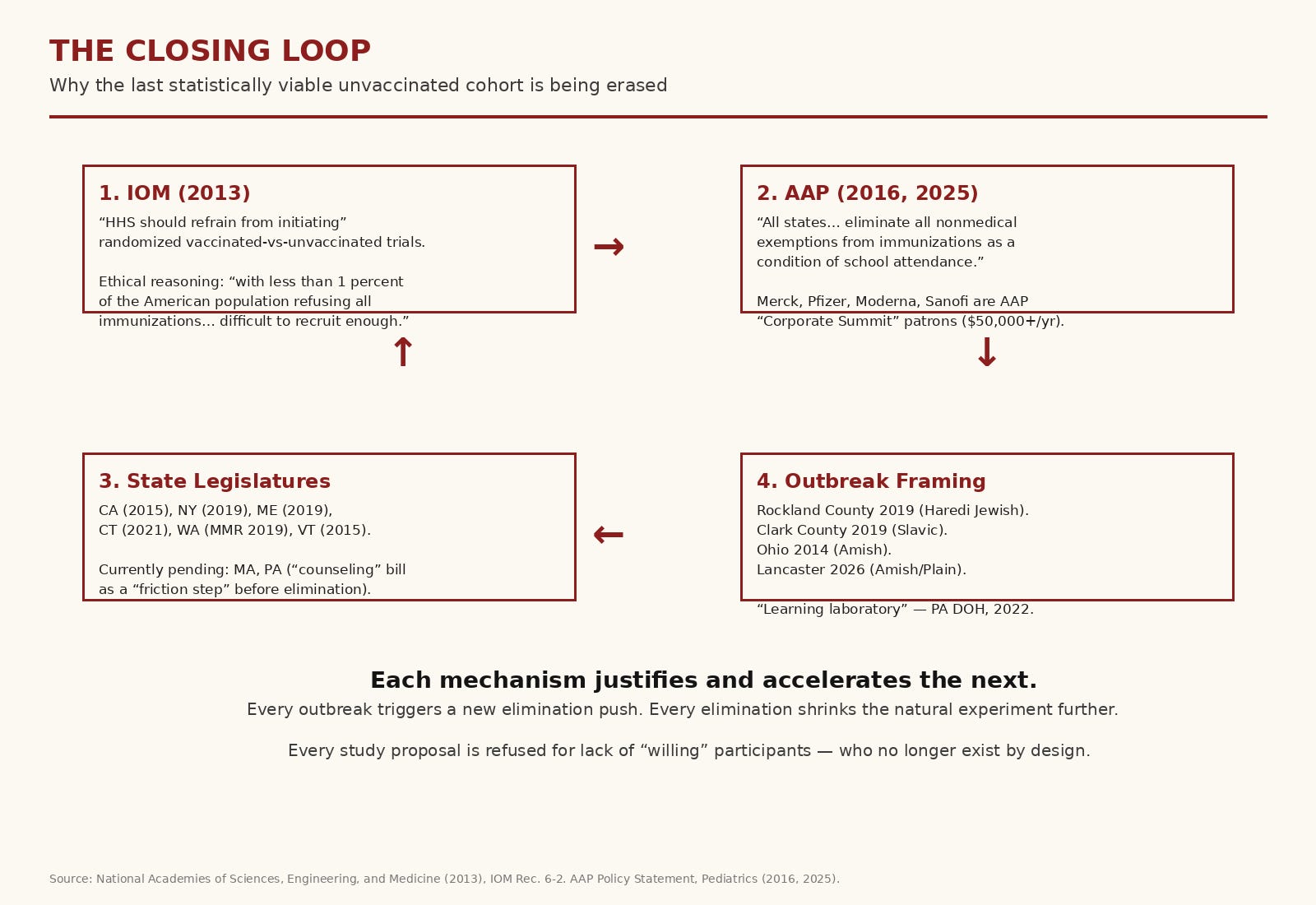
Each mechanism justifies and accelerates the next. Every outbreak triggers a new elimination push. Every elimination shrinks the “naturally occurring” unvaccinated population further. Every study proposal is refused for lack of “willing” participants — who no longer exist by design.
The Amish, whose vaccination rates in Lancaster County are estimated by the Pennsylvania Department of Health at around 25 percent, are — along with a handful of other Plain and Old Order communities — one of the last statistically viable natural experiments left. The IMFAR 2010 team explicitly reported collecting vaccination histories during its 1,899-child screening. What the abstract never disclosed was the resulting vaccination-status distribution—or the vaccination status of the confirmed ASD cases. Sixteen years later, the analysis has not been done. The pattern says it will not be done. And the AAP, the AMA, and six state legislatures are working to ensure the next generation of researchers won’t even have the population to try.
Why now
That framing is what makes Trump’s post — however clumsy, however factually imperfect — genuinely important. Whatever else you think of the man, he pointed at the study. And when the fact-check machine responded within hours, it responded exactly as the pattern predicts: cite the study, quote the prevalence figure, correct one factual error, and completely omit the buried sentence that opens the actual question.
Your job as a reader, and mine as a writer, is not to defend the graphic. It has errors. The “330 years” claim is wrong. The headline’s argument-from-absence is a rhetorical trick. Both of those criticisms are valid.
But those criticisms are also the entire fact-check ecosystem’s only line of attack — because the underlying situation the graphic points at is, once you look, indefensible on the merits.
The situation is this:
The only systematic screening identified in the published literature explicitly included vaccination history in its data collection while screening 1,899 Amish children.
The team that conducted the study never published the vaccination-stratified analysis.
In sixteen years, no follow-up study has been done.
The institution that oversees vaccine-safety consensus has formally advised HHS not to do such a study.
The professional societies that represent American pediatrics have advocated for state laws that would eliminate the population necessary to run such a study.
The state where the current measles outbreak is being framed as an “Amish problem” describes its own outreach as targeting a “learning laboratory” (Pennsylvania Department of Health, AIM case study, 2025).
The Lancaster squeeze
If you’ve followed my recent reporting, you know what’s happening on the ground in Pennsylvania right now.
Since April 2026, the Pennsylvania Department of Health has run over 91 pop-up MMR clinics in Amish-heavy areas of the state, administering more than 4,100 MMR doses and briefing 1,000+ providers. The state’s Bureau of Immunizations director, Tom McCleaf, presented the operational playbook to a national audience of state immunization managers on April 15, 2025 — before the current outbreak — in a slide deck titled “Responding to Measles Outbreaks in High Priority Populations.” The Plain community section, verbatim from McCleaf’s own slides, includes:
Horse and buggy clinics
Mud sales — “Have materials available; items they can take with them, such as coloring books and handouts”
Amish school visits
In-home immunization services via Lancaster EMS
“Starting in 2025, PA DOH will be holding vaccine clinics in the Lancaster area”
Under “Persuasion doctrine,” the same deck instructs staff to “focus on staying healthy and fit, preventing diseases, with vaccines as just an aspect of that” and warns that “making noteworthy impacts will take time, perhaps even over generations.” (AIM slide deck)
The AIM Pennsylvania case study describes the state’s own framing more directly: “The Pennsylvania Department of Health (PDH) utilized Lancaster County as a learning laboratory for immunization improvement activities.” Named partners include the Lancaster County Immunization Coalition, the Health Improvement in Plain Population (HIPP) Task Force, “Lancaster EMS to provide in-home immunizations,” and “the local FQHCs to provide in-home horse and buggy immunization services.” (AIM case study)
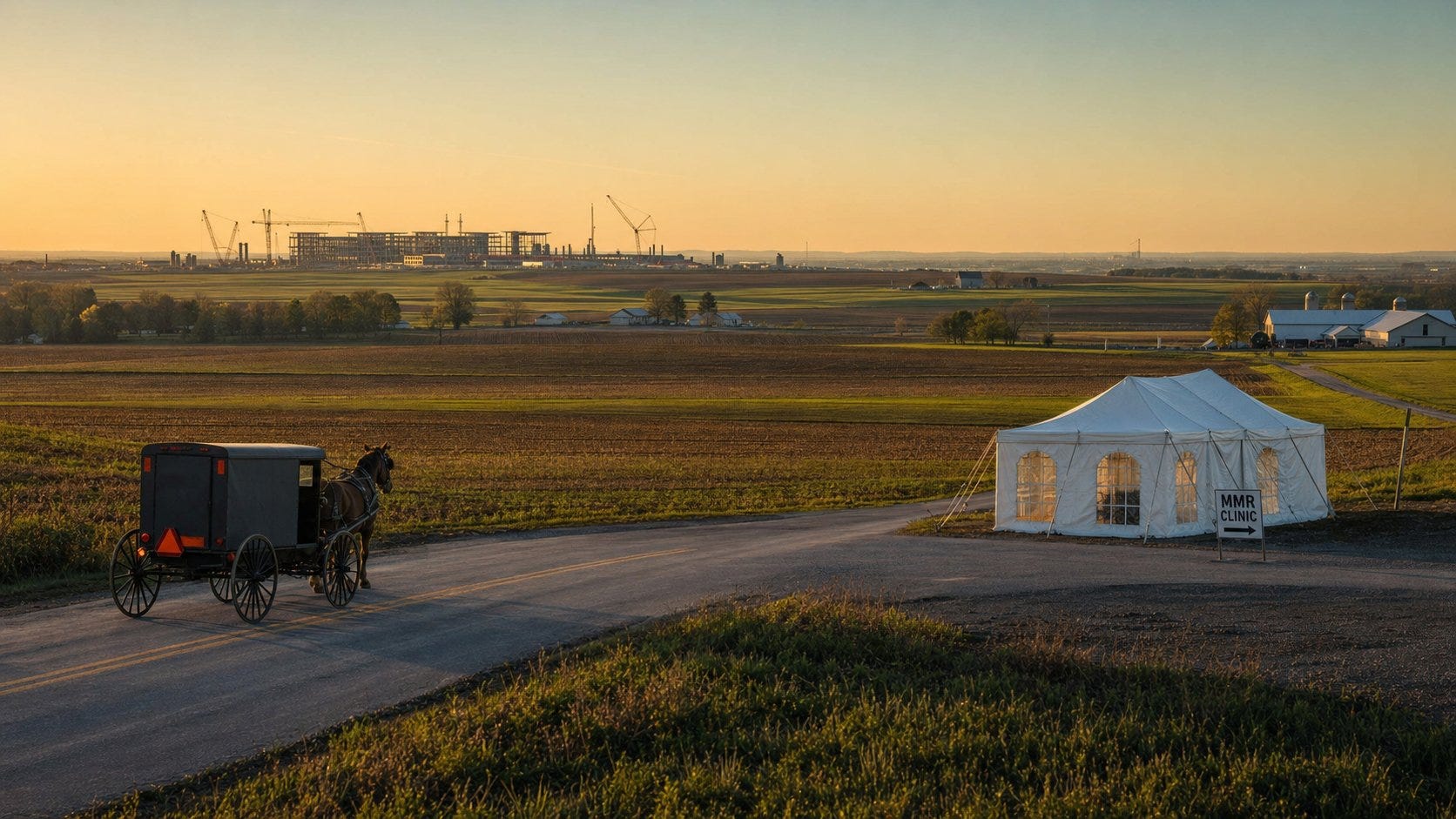
The current outbreak framing is now explicitly directed at this population. City & State PA (August 27, 2026): “Those cases are ‘predominantly within the plain community,’ Franklin said, using a term for the traditional Christian groups, such as Amish and Mennonites.” (City & State PA) CNN’s August 28, 2026 dispatch was more explicit: “Pennsylvania’s Amish country.” The New York Times headline for the August 25 death announcement: “Two People in Amish Region Are Said to Die From Measles.”
The Lancaster County Coroner told LancasterOnline his office “had handled no measles deaths.” The state’s own official definition of a “measles-associated death” concedes that the disease “may not be assessed by the medical certifier or coroner to be the immediate cause of death.” That contested factual foundation is the political basis for the current escalation.
Zoom out


@elyseyoung23, quoting my earlier post on X, put the point better than most professional health journalists have managed:
“The Amish may get measles. But zoom out. They’ve also been reported to have strikingly lower rates of asthma/allergies and several major chronic diseases, while limited autism research has reported a far lower prevalence than contemporary U.S. estimates. Maybe instead of pointing at the Amish only when measles appears, we should be asking what their overall health can teach us. The goal should be healthy children, not one disease metric.”
She’s right. And the pattern of published research on Amish population health, taken seriously, is remarkable:
Williamson et al., Pediatrics 2017 (PubMed 28768853): the risk ratio for vaccine-preventable disease hospitalization among Amish children vs. non-Plain children was 2.67 (95% CI 1.87–3.82). Amish acute-disease risk is higher on this narrow measure. That is the finding this study exists to make.
The same dataset’s chronic-disease outcomes — the ones the Amish natural experiment would actually illuminate — remain systematically unpublished. Wisconsin Amish, per a 2018 study (PubMed 29802980), have “a lower prevalence of allergic disease compared to Old Order Mennonite.” Notably, Old Order Mennonites vaccinate at somewhat higher rates than Old Order Amish. That comparison is the natural experiment sitting on the table — and no one is running it in public.
The University of Maryland’s ongoing Amish wellness study has preliminarily reported lower rates of type 2 diabetes and hypertension. Science Feedback, in the very piece that “debunks” the vax-Amish claim, is forced to concede that “at least according to preliminary studies,” Amish rates of autism occurrence are “lower” than the general population.
The Amish are, by every indication we have, one of the healthiest populations in North America across nearly every chronic-disease axis — with the acknowledged exception of ‘vaccine-preventable’ acute infection. They are also one of the least vaccinated, least glyphosate-exposed, least ultrasound-exposed, least Tylenol-in-pregnancy-exposed, most breastfed, most whole-food-fed, and most physically active populations in the country. Any one of those variables — or their interaction — could contribute to what’s observed. The Amish are the natural experiment where you could actually begin to disentangle them.
And that is exactly why they are being erased.
The Amish are not being targeted because they are sick. They are being targeted because they are the last population large enough, coherent enough, and demographically stable enough — the Old Order Amish population in the U.S. has doubled in the last 25 years — to actually run the study the IOM banned in 2013 and the AAP is legislating out of existence one state at a time.
Who benefits
Every mechanism in the closing loop is either directly funded by, or directly staffed by, or operates as a proxy for, the vaccine manufacturers whose revenue depends on its outcome. I have documented this in detail in The Pharma Playbook research memo; the short version:
Merck, Pfizer, Moderna, and Sanofi are American Academy of Pediatrics “Corporate Summit” patrons at $50,000+ per year. Undark’s September 2025 investigation confirmed that “at least nine of the 16 members of the committee responsible for those and other immunization recommendations have received payments, research funding, or perks in the form of meals, travel, or lodging from vaccine manufacturers.” The AAP’s July 2025 policy statement re-affirming its call to eliminate all nonmedical exemptions was produced by that committee.
Merck’s 2025 10-K explicitly names the ACIP schedule reduction as a material risk factor. (Merck 2025 10-K) MMR-II — the vaccine at the center of the Lancaster outbreak response — is Merck’s own single-vaccine revenue line most exposed to both (a) the Trump EO 14420 breakup order splitting MMR into three monovalents, which Merck disclosed “could take more than 10 years” to implement, and (b) vaccine hesitancy. Every MMR dose administered in Lancaster this summer is Merck revenue.
The peer-reviewed academic record on pharma’s role in state vaccine mandate legislation is definitive. Mello, Abiola, and Colgrove (2012) in the American Journal of Public Health: “Merck promoted school-entry mandate legislation by serving as an information resource, lobbying legislators, drafting legislation, mobilizing female legislators and physician organizations.” Colgrove et al. (2010) in the New England Journal of Medicine confirmed the same. Lee Fang’s April 2023 investigative reporting documented Pfizer’s covert financing of third-party groups that lobbied for COVID vaccine mandates in exactly the same architecture.
PhRMA spent a record $38 million on federal lobbying in 2025 (OpenSecrets), the highest annual total in its history.
That is the machinery that keeps the closing loop closed.
What a real study would look like
The constructive close matters, because the whole point of this piece is that a study can still be done.
Whether the underlying vaccination-history data from the 2008–2009 screening still exist is not apparent from the public record. The IMFAR abstract establishes that vaccination histories were collected, but neither the raw data nor a vaccination-stratified analysis appears to have been published. The obvious question for the authors and institutions is therefore straightforward: Do those data still exist, and if so, what do they show?
Beyond that: what needs to happen is a properly designed prospective, pre-registered, multi-factor Amish and Mennonite health study. Not a single-variable vaccine study. A study that includes vaccination status, pesticide exposure, glyphosate, Tylenol in pregnancy, ultrasound frequency, breastfeeding duration, dietary composition, endogamy, EMF exposure, screen time, and healthcare access. That is the study the IOM refused to run in 2013 and the study the population still exists to allow. It should be pre-registered on a public registry. Its analysis plan should be locked before recruitment begins. Its data should be deposited in a public repository at the study’s conclusion, regardless of the direction of the findings.
That study is not anti-vaccine. It is science. It is the actual mechanism by which the question the president gestured at, however clumsily, would be answered — one way or the other.
The current institutional environment makes that study impossible not because the data would be hard to collect, but because the population necessary to collect it is being legislated, mandated, socially pressured, and messaged out of existence in real time. Lancaster is not an outlier. Lancaster is a test bed. Rockland County, New York (2019) was a test bed. Clark County, Washington (2019) was a test bed. Each one produced an elimination bill in its state. Each elimination bill shrinks the natural experiment further. Each shrinking of the experiment provides more justification for the next round of elimination bills. That is the closing loop.
What to do
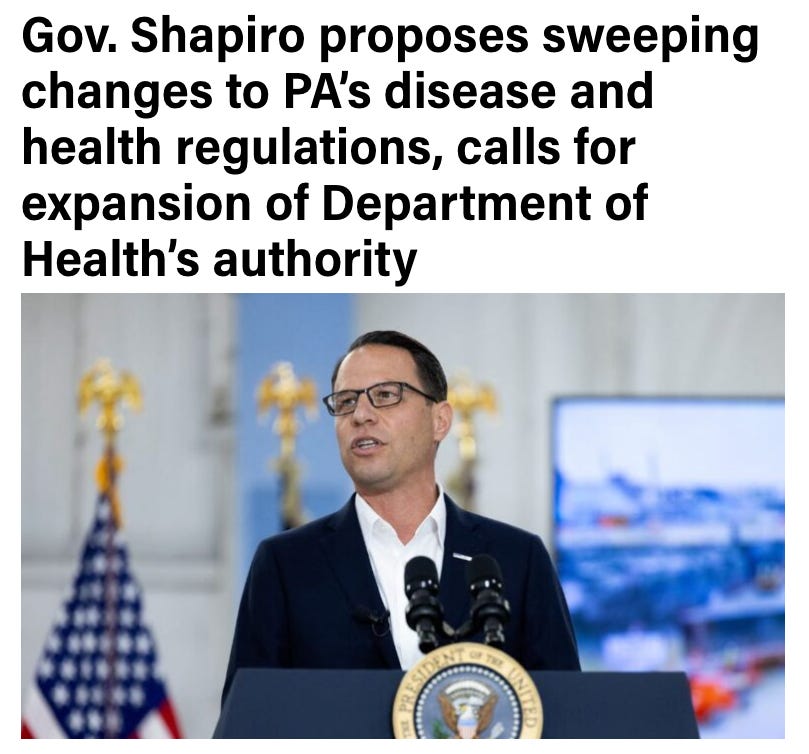
If you are a reader in Pennsylvania: the state’s proposed 500-page expansion of Department of Health authority under the August 2026 disease-control regulation has a public comment window open through September 21, 2026. The HIPP Task Force, whose organizational documents remain outside the public record, is subject to Pennsylvania Right-to-Know Law (65 P.S. § 67.101 et seq.). Both are levers.
If you are a researcher or a journalist: the six IMFAR 2010 authors are reachable. Their faculty pages, LinkedIn profiles, and institutional emails are all public. Ask them where the vaccination histories are. Ask them why the follow-up never appeared. Ask them what the “further studies underway” produced. Ask the University of Miami’s Hussman Institute for Human Genomics whether it retains the primary research files from grants P01 NS026630 and R01 MH080647. Ask NIH RePORTER why no dedicated Amish-autism grant was ever awarded.
If you are a reader anywhere: the Miller v. McDonald religious-exemption case is currently on remand at the Second Circuit after a December 8, 2025 Supreme Court order to reconsider. CIDRAP’s own analysis notes: “a ruling in the plaintiffs’ favor could essentially require religious exemptions across the country.” (CIDRAP) Whatever else you do or don’t do, follow that case. It is the fulcrum on which the closing loop either holds or breaks.
Coda
The president’s post was rhetorically imperfect. It contained factual errors I have corrected in this piece. But the study it pointed at is real, its unpublished vaccination-history data is real, the sixteen-year silence is real, the fact-check ecosystem’s uniform omission is real, the institutional pattern of buried vaccine-autism datasets is real, the IOM’s explicit prohibition is real, the AAP’s exemption-elimination campaign is real, the pharma financing of that campaign is real, and the Lancaster “learning laboratory” is real.
None of that requires you to believe vaccines cause autism. It requires you to believe what the primary sources themselves say — and to notice what they don’t say. It requires you to hold the empty space in the record open long enough for someone competent, credible, and independent to fill it.
That is what “further studies are underway” was supposed to mean in 2010.
Sixteen years on, someone still needs to do them.
Share the X thread dedicated to this article:
Further reading from this project:
The Amish Are Being Targeted — the Pennsylvania Department of Health’s own playbook
First Came the Measles Deaths, Then Came the Coroner’s Denial — the disputed Lancaster mortality claims
For 290 or 330 years or, pick any number you want, the Amish have avoided toxins that capitalism has warmly embraced and actually promoted, and then gone to great lengths to hide the truth of the damages they actually caused. Vaccines are comprised of toxins. Everyone knows that. By the fact that the Amish have chosen to live a less toxic life speaks volumes. Sorry to see them so persecuted for choosing the pursuit of that lifestyle.
Governments worship money ... promoting Industries that are killing people and the environment.. Americans have gone from # 1 in World health to 47th place in 75 years. Americans spend more money on medical drugs and treatments than any other country in the world; yet mental and physical illness are rampant. Multi-millions have died with the CV-19 vax rollout... and this Big Pharma-connected Governor Shapiro in Pennsylvania is going after the Amish for two deaths in Pennsylvania??? In the olden days, this governor would have been horsewhipped or worse for what he is doing to innocent people depriving them of their constitutional rights.