
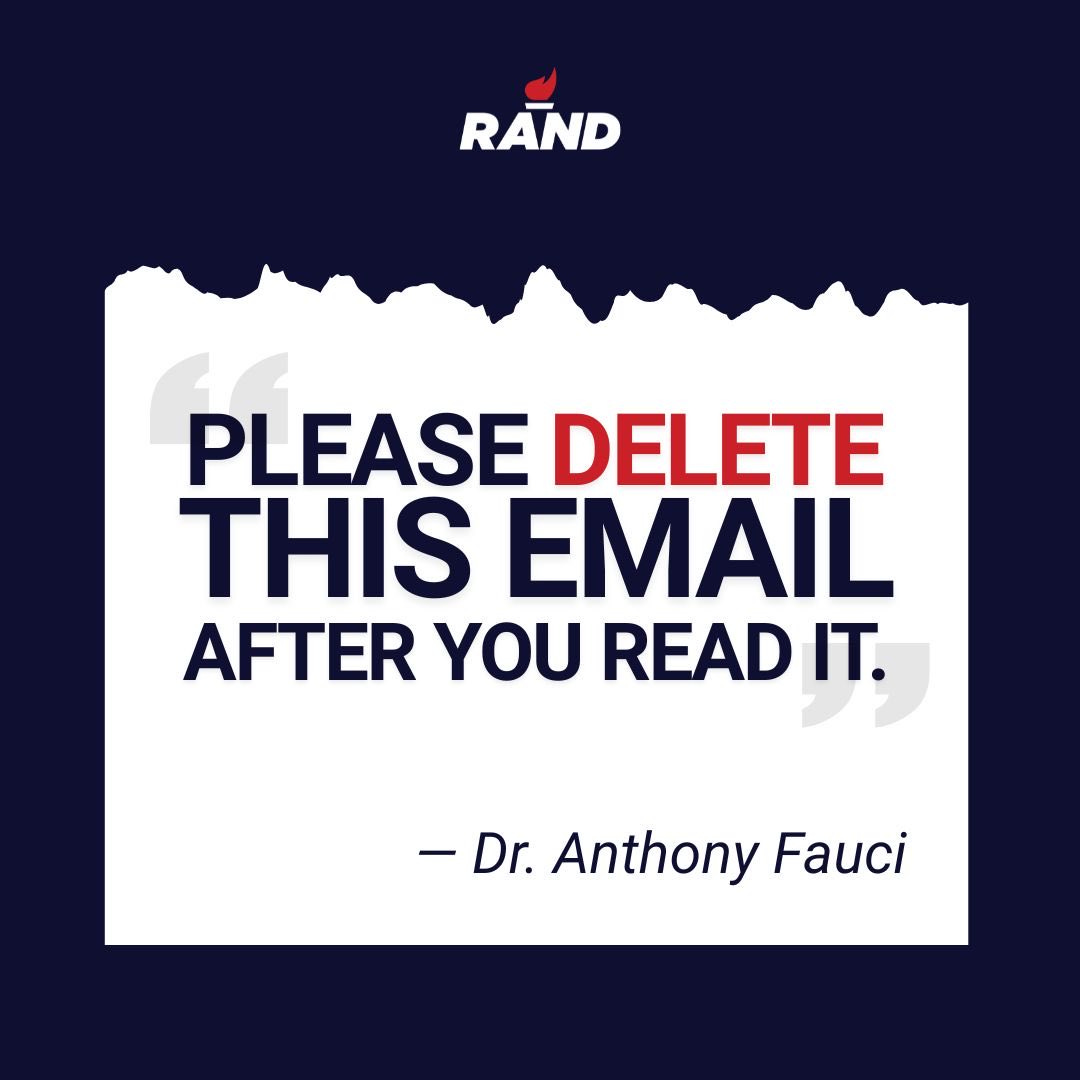
Anthony Fauci invoked the Fifth Amendment more than a hundred times yesterday. The twelve Americans branded the “Disinformation Dozen” (and tens of millions of censored and defamed citizens) never got a hearing at all.
Yesterday Anthony Fauci sat before the United States Senate and invoked the Fifth Amendment more than a hundred times.
While Fauci’s non-testimony generated immense outrage, and rightfully so, what we all witnessed was actually due process in action. With counsel at his side, the presumption of innocence, and the right not to incriminate himself protecting him, Fauci was afforded what all Americans should have access to. It is, in the narrow sense, exactly how a republic is supposed to treat a man under investigation.
Uniquely, Fauci also had a presidential pardon in his pocket, issued in advance, for crimes never named. It remains to be seen if his allegedly auto-penned impunity holds.
So ask the obvious question.
Where was any of that for the twelve Americans branded the “Disinformation Dozen”? And what about the countless other Americans who suffered censorship and related injury for their lawful, constitutionally protected speech?
No hearing. No evidence entered. No cross-examination. No appeal. No finding of fact by anyone accountable to anyone. And for us, the “disinformation dozen,” a report from a London-based NGO, a number attached to our names, and a coordinated campaign to strip us of platforms, reach, income, and the most basic medical right there is — the right to know what is being put into your body, and to say no.
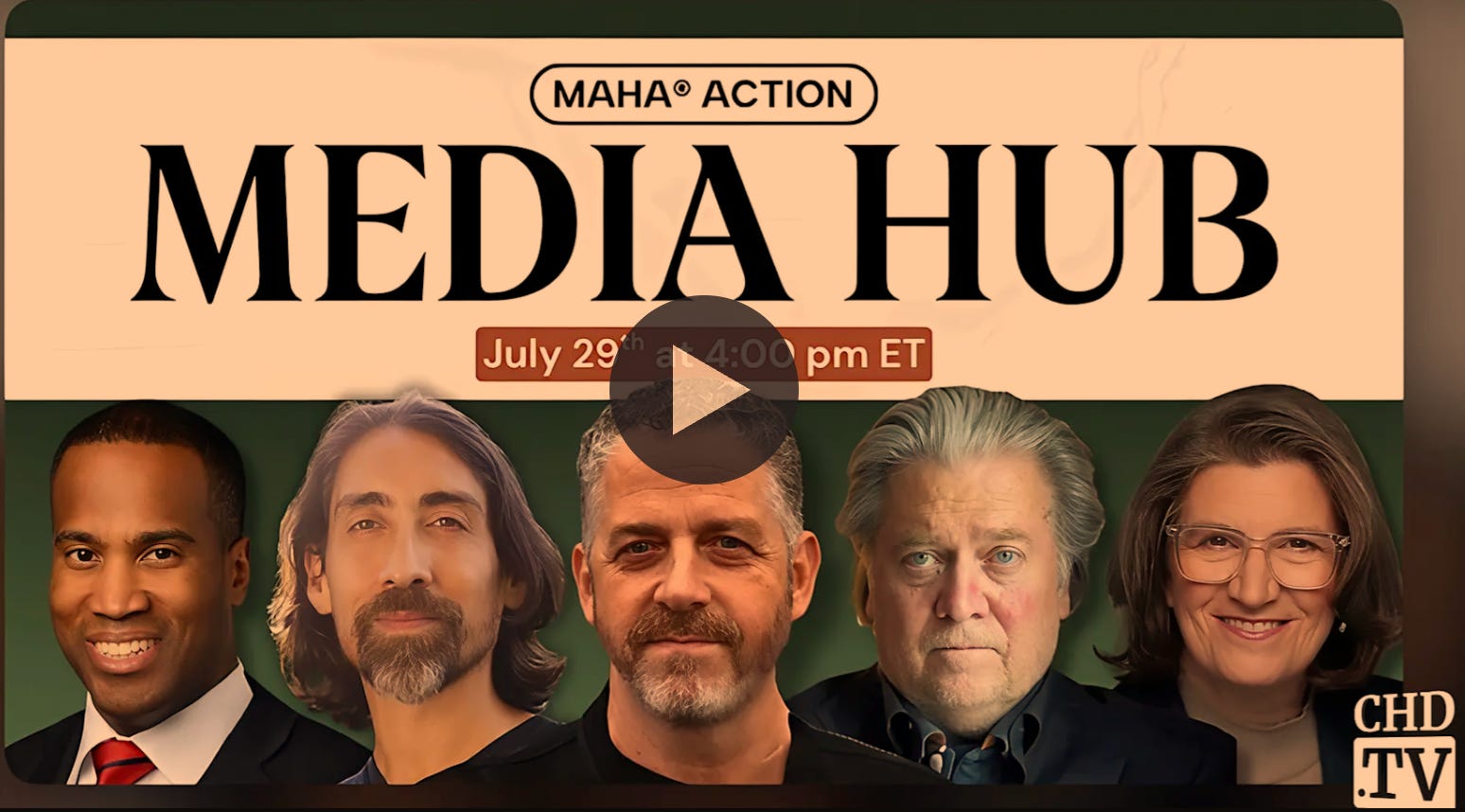
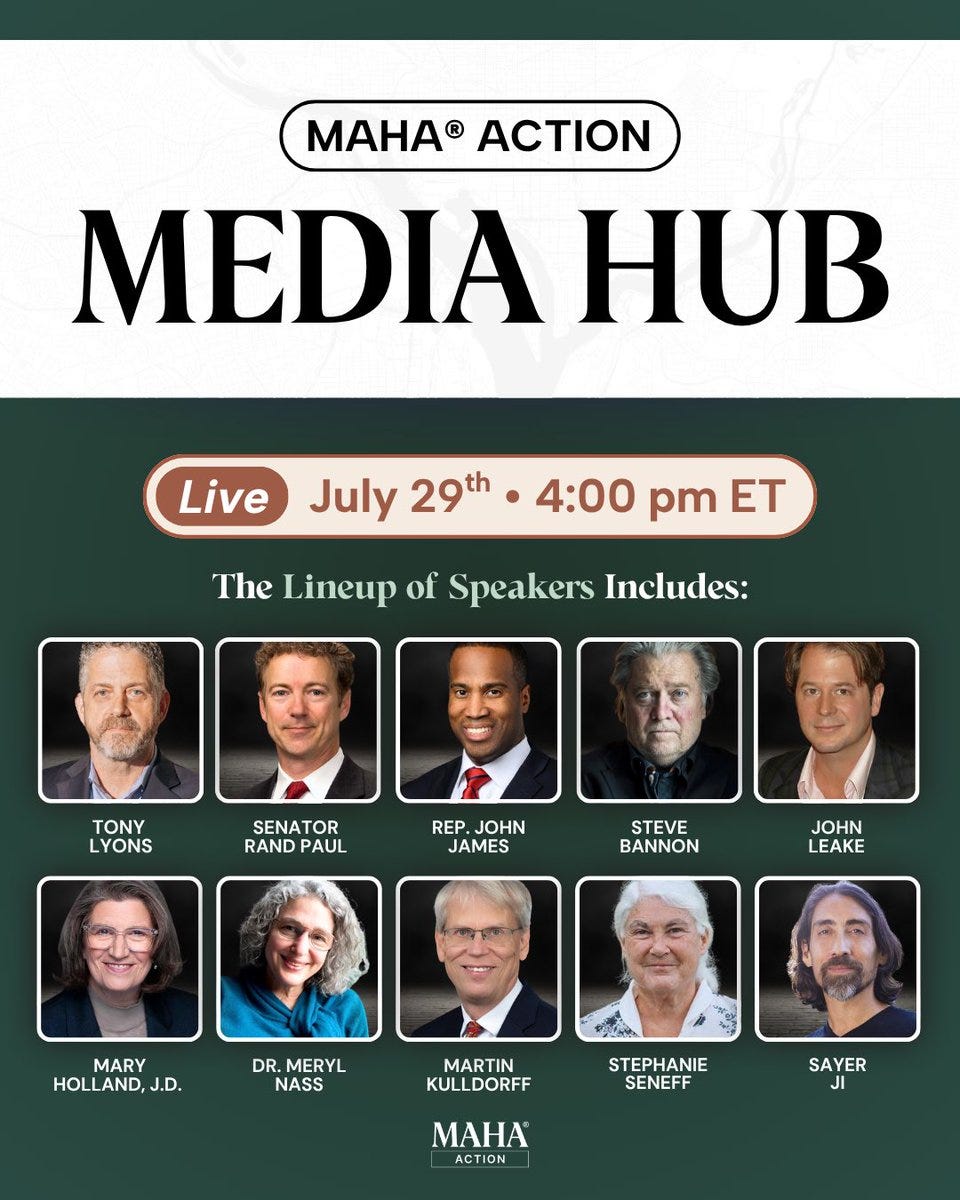
Last night I joined the MAHA Media Hub to lay out how that machinery actually worked. I was speaking from London — a few miles from where the campaign against us was built.
Two records, one man
The reason yesterday mattered has nothing to do with theater. It has to do with paper.
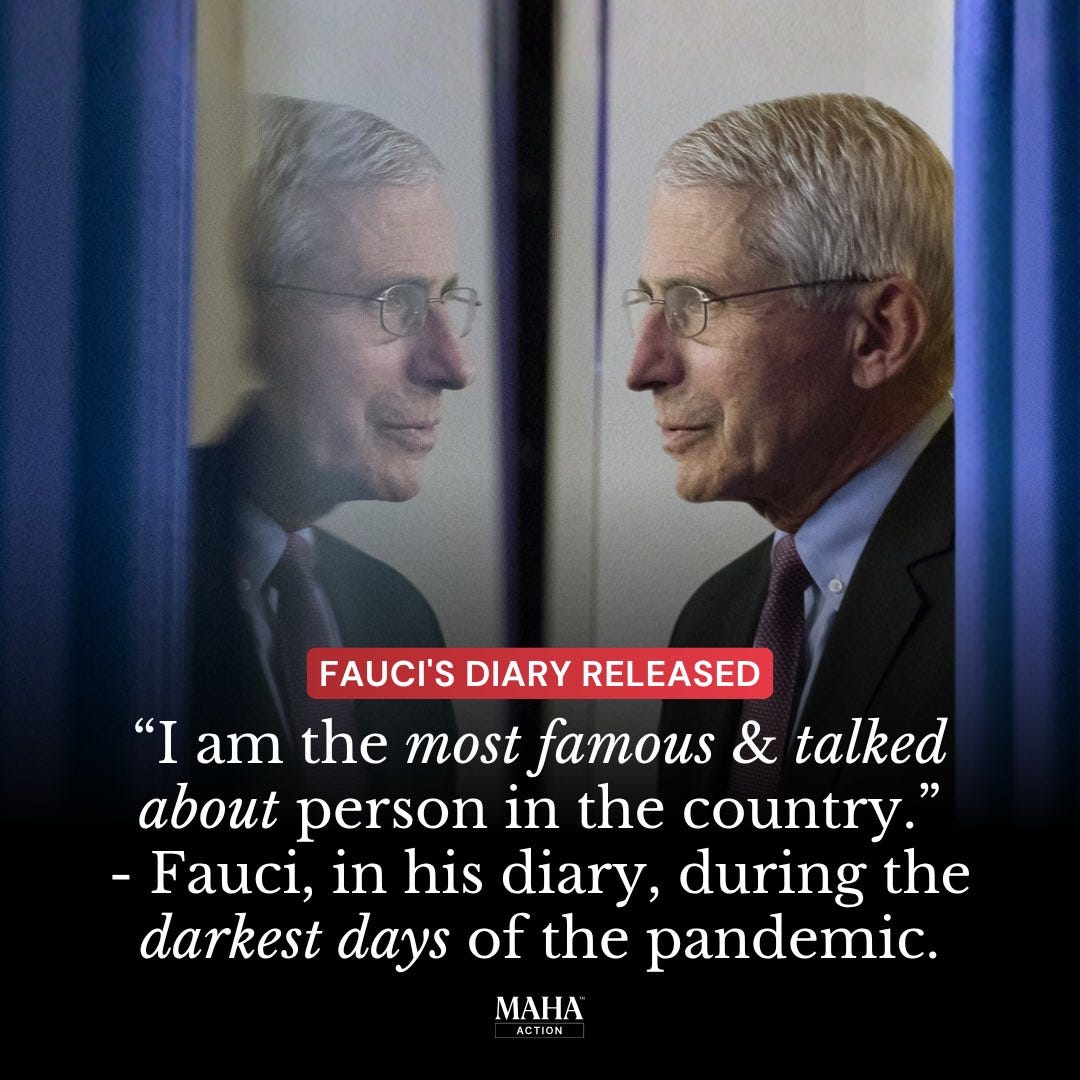
Last weekend Senator Rand Paul released more than a thousand pages of Fauci’s private journals, covering December 2019 through the end of 2022 (NPR). For the first time, the public version of the pandemic can be laid directly against the private one, in his own hand, contemporaneously written, never intended for our eyes.
On January 26, 2020 — weeks before the World Health Organization would use the word pandemic — he wrote that the earliest infections were not connected to the Wuhan market, and concluded that the market “was not the source, it was the amplifier” (UPI).
Hold that date in your mind. Then remember what the following two years were like for anyone who said the same thing out loud.
They were not corrected, nor debated. They were labeled.
A list is not a finding
On March 24, 2021, the Center for Countering Digital Hate — a British organization, operating on American speech — published a forty-page report titled The Disinformation Dozen. It named twelve people. I was one of them.
The report’s central claim was that 65 percent of anti-vaccine content on Facebook and Twitter was attributable to those twelve individuals (CCDH).
Understand what that document was and was not. It was not a charge. There was no charging authority. It was not a finding, because no adjudicative body made it. It was not tested, because there was no forum in which to test it. It was a press release that functioned as an indictment, and it was treated as one within twenty-four hours: CCDH’s own chief executive later testified to Congress that this committee “asked Mark Zuckerberg about the report in a hearing on March 25th” — the day after publication (House Energy and Commerce testimony).
By July, the number was coming out of the White House podium. “There’s about 12 people who are producing 65 percent of anti-vaccine misinformation on social media platforms,” the press secretary said, adding that the administration had “recommended/proposed” that Facebook build “a robust enforcement strategy” (CNN). The President of the United States, asked whether social media was “killing people,” clarified that he meant us specifically: “these 12 people are out there giving misinformation” (BBC).
Twelve private citizens, named from a podium, by a president, as the cause of American deaths. No hearing, and no right of reply.
Consider what my own site actually was at the moment it was designated a threat. GreenMedInfo indexes the peer-reviewed biomedical literature — tens of thousands of study abstracts across thousands of health topics, the overwhelming majority of it concerning the therapeutic properties of foods, plants, and nutrients. Vaccines are one subject among thousands. For that, we were classified alongside political extremists.
Nobody ever had to prove that a single claim on the site was false. That was the elegance of it. The list did the work that evidence would otherwise have had to do.
The number the platform itself rejected
Here is the part that should end the discussion and never does.
The company whose data was supposedly being described said the claim was unsupported. In August 2021, Facebook’s vice president of content policy responded directly to the report and to the White House pressure built on it: “There isn’t any evidence to support this claim.” She noted that the study behind what she called a “faulty narrative” had examined “only a narrow set of 483 pieces of content over six weeks from only 30 groups, some of which are as small as 2,500 users,” and that those groups were “in no way representative of the hundreds of millions of posts that people have shared about COVID-19 vaccines” (CNN).
Four hundred and eighty-three pieces of content. Thirty groups. That was the evidentiary base for a designation that ended careers.
And the figure did not die when the platform disowned it. Four months after that rebuttal, in December 2021, CCDH’s chief executive was still presenting the 65 percent claim in written testimony to a subcommittee of the United States Congress (House Energy and Commerce).
That is the tell. A statistic that cannot survive contact with the underlying data, but which continues to be recited to legislatures on both sides of the Atlantic, is not functioning as evidence. It is functioning as scripture.
Censorship, laundered
Here is the mechanism, stated plainly, because naming it is precisely how we prevent it from happening again.
A government constitutionally forbidden from silencing its citizens does not need to silence them itself. It needs an intermediary. Funding, framing, and pressure flow outward to civil-society organizations, to favored academics, to media partners. Those actors generate the designation. Private platforms — which the First Amendment does not bind — act on it. And when the citizen objects, every node in the chain points at another. The NGO says it only published research. The platform says it enforced its own policy. The government says it never gave an order. A chain of plausible deniability, carefully crafted to violate our constitutional protections and human rights in service of industries and agendas that are coercive, extractive, and sometimes deadly.
This is not an inference I am drawing. It is the design, described in the government’s own documents.
A congressional investigation into the Election Integrity Partnership — a consortium led by Stanford’s Internet Observatory, created in the summer of 2020, in the words of one founding partner, “at the request” of the Cybersecurity and Infrastructure Security Agency — found that the partnership existed precisely to fill what its own postmortem called a “critical gap”: no federal agency had authority over domestic speech, so a non-governmental entity would handle it. The committee’s conclusion was blunt: the arrangement “provided a way for the federal government to launder its censorship activities in hopes of bypassing both the First Amendment and public scrutiny” (House Judiciary interim staff report).
The word is theirs, not mine.
What the workflow looked like
Nobody had to pass a censorship law. They built a help desk.
Flagged American speech moved through Jira tickets — the ordinary project-management software a software company uses to track bug reports. External stakeholders, including federal agencies, submitted reports. Analysts then searched other platforms for similar content. The compiled links went to the platforms with specific recommendations: reduce a post’s “discoverability,” suspend “an account’s ability to continue tweeting for 12 hours,” monitor whether tagged accounts reshared a particular user (House Judiciary).
Before that there was switchboarding — the federal practice of forwarding content-removal requests to platforms. The agency characterized its role as passive intermediation. Its own emails, obtained under subpoena, show officials weighing in on whether flagged posts constituted misinformation, and following up when platforms did not act. And every one of those emails carried a disclaimer promising no retaliation from that agency — while noting that the material “may also be shared with law enforcement or intelligence agencies,” about whose retaliation it promised nothing at all (House Judiciary).
And then there is the fact that should be the center of every conversation about this and almost never is: true speech was an explicit target.
The Virality Project, the same Stanford center’s COVID-era operation, advised the platform that “true stories that could fuel hesitancy” — the report’s examples included a school closing after reports of post-vaccine illness — should be treated as standard vaccine misinformation. Researchers flagged “true content which might promote vaccine hesitancy,” including foreign governments suspending particular vaccines over side effects, and treated objections to vaccine passports as a “misinformation” event because concerns about them “have driven a larger anti-vaccination narrative about the loss of rights and freedoms” (Reason).
Vivek Murthy, the US Surgeon General, at the time, pushed platforms like Facebook to censor true vaccine injury reports while reinforcing the narrative that truth-tellers were actually ‘killing people with misinformation.’ [Dive deeper into this sad chapter in the history here.]
Read that again. Not false speech. True speech, suppressed because of the reaction it might produce.

The congressional review of the election-era tickets found the same pattern: the government and universities pressured platforms to censor “true information, jokes and satire, and political opinions,” and did so asymmetrically, in a direction that consistently favored one side (House Judiciary).
The standard was never truth. The standard was compliance.
The twelve were never the target
We were the pilot program.
The method is legible once you see it run: select a small group whose name can be made to sound disreputable, supply a number, let officials and platforms do the enforcement, and observe whether anyone objects. Nobody objected. So it scaled.
It scaled into election-speech ticketing systems, into university “misinformation” centers on federal money, into trust-and-safety pipelines processing ordinary Americans by the million. Mothers describing an injury to their own child. Physicians citing their own patient data. Nurses. Pastors. Pharmacists. People on no list anywhere, who were throttled, delisted, demonetized, delicensed, or simply made unfindable — and who in most cases never received notice, never saw evidence, and had no appeal.
That is the part that lands hardest when you sit with it. Most Americans who were censored do not know they were censored. Reach suppression is invisible by construction. That was not a side effect. It was the feature.
What was actually taken
Deplatforming is usually discussed as a speech injury. It is that. But it is also something more serious and less understood.
Medical ethics rests on informed consent. Consent is not a signature; it is a state of knowledge. It requires access to the risks, the benefits, the alternatives, and the uncertainties — including the inconvenient ones, the disputed ones, the ones that cost somebody money. Remove that access and consent becomes a formality performed on a person deprived of the only thing that would make it meaningful.
This is not a fringe standard. It is the first principle of the Nuremberg Code, written after the world saw what medicine does when it stops asking.
What the apparatus took was not merely our accounts. It was the public’s capacity to decide.
And it worked because the culture had already been trained to treat medical authority as a source of truth rather than a producer of evidence. That is not evidence-based medicine. It is eminence-based medicine — a priesthood, operating on engineered trust, whose central claim was never a study but a person. “I am the science” is not a scientific statement. It is a theological one.
Real science welcomes dissent. Only a religion needs heretics.
No court ever said it was illegal
This is where most accounts of the censorship years quietly mislead people, so let me be precise, including where precision cuts against me.
In Murthy v. Missouri, the Supreme Court reversed 6–3 — on standing. The plaintiffs, the majority held, had not shown injury traceable to a government defendant and redressable by the injunction they sought, and so the Court never reached the constitutional question at all (Supreme Court opinion). The machinery was not ruled lawful. It was ruled unexamined.
Then, in March of this year, the Justice Department settled the case by consent decree. Its terms bar the Surgeon General, the CDC, and CISA from threatening social media companies with adverse legal, regulatory, or economic action unless they suppress protected speech, and from unilaterally directing or vetoing content-moderation decisions (The Federalist).
That is real, and it is worth saying so. It is also narrow. The obligations run to the named plaintiffs and the two plaintiff states rather than to the public at large, they bind three agencies out of many, and they expire in ten years (The Federalist).
A decade-long promise from three agencies, enforceable by a handful of people, is not the same thing as a settled constitutional rule. The architecture — the grants, the university centers, the ticketing systems, the foreign proxies, the entire habit of routing state preference through private hands — was never dismantled. It was defunded in places, renamed in others, and left standing.
This is why the “trusted twelve” are fighting back as plaintiffs, with our lawyer and his team, Jeff Childers, in a federal civil rights lawsuit filed in the Middle District of FL. Learn more and support this historic effort below.
What accountability would actually require
Yesterdays’s testimony was necessary and yet insufficient. One man declining to answer questions does not dismantle an apparatus built to prevent questions from being asked.
Three things would:
Disclosure. Every channel between a government office and a platform’s moderation function, and every dollar that moved from a public agency to a private censorship contractor, made public and searchable.
Prohibition with teeth. A statutory bar on laundering censorship through nonprofits, universities, and foreign organizations, with a private right of action — because a rule nobody can sue over is a press release.
Restitution. For the delicensed physician, the demonetized writer, the small business erased from search. If we can compute damages for a trademark, we can compute them for a livelihood destroyed by a designation nobody had to prove.
Why it backfired
They meant to make examples of us. That was the function of publishing twelve names rather than twelve arguments: not to refute, but to demonstrate. The medieval version was a scaffold in a public square, and the purpose was never the condemned. The purpose was everyone watching.
It failed. And that’s the silver lining here.
The man they spent a decade defaming is now the Secretary of Health and Human Services. The book they refused to review, refused to advertise, and buried at the back of the store sold more than a million copies. The journals they never expected anyone to read are public. And the movement they intended to decapitate is larger by orders of magnitude than anything those of us in the trenches twenty years ago could have built on our own.
Roughly a hundred times more people are awake to this now than when there were only a handful of us. Censorship did that. Every act of suppression is an advertisement for the thing suppressed, because ordinary people are not stupid and they know what it means when they are told not to look.
So I come at this from the position of victory, and I mean it.
The work from here is not vengeance. It is reconstruction — of institutions that can be trusted because they can be checked, and of health itself, which is rebuilt the way it was lost: in small daily decisions about what we eat, what we absorb, what we permit, and what we refuse. Clean food. Clean water. Clean soil. Clean air. Consent restored as a precondition rather than a courtesy.
They put twelve names on a list to make an example of us.
Let the list be the example instead. They gave us a list. We built a movement.
Watch the full 87-minute broadcast, the 29th MAHA Media Hub, hosted by Tony Lyons of MAHA Action: watch the full episode. Also featured: Mary Holland, reporting from inside the hearing room; Dr. Martin Kulldorff; Dr. Stephanie Seneff; Dr. Meryl Nass; Steve Bannon; John Leake; and Rep. John James.