


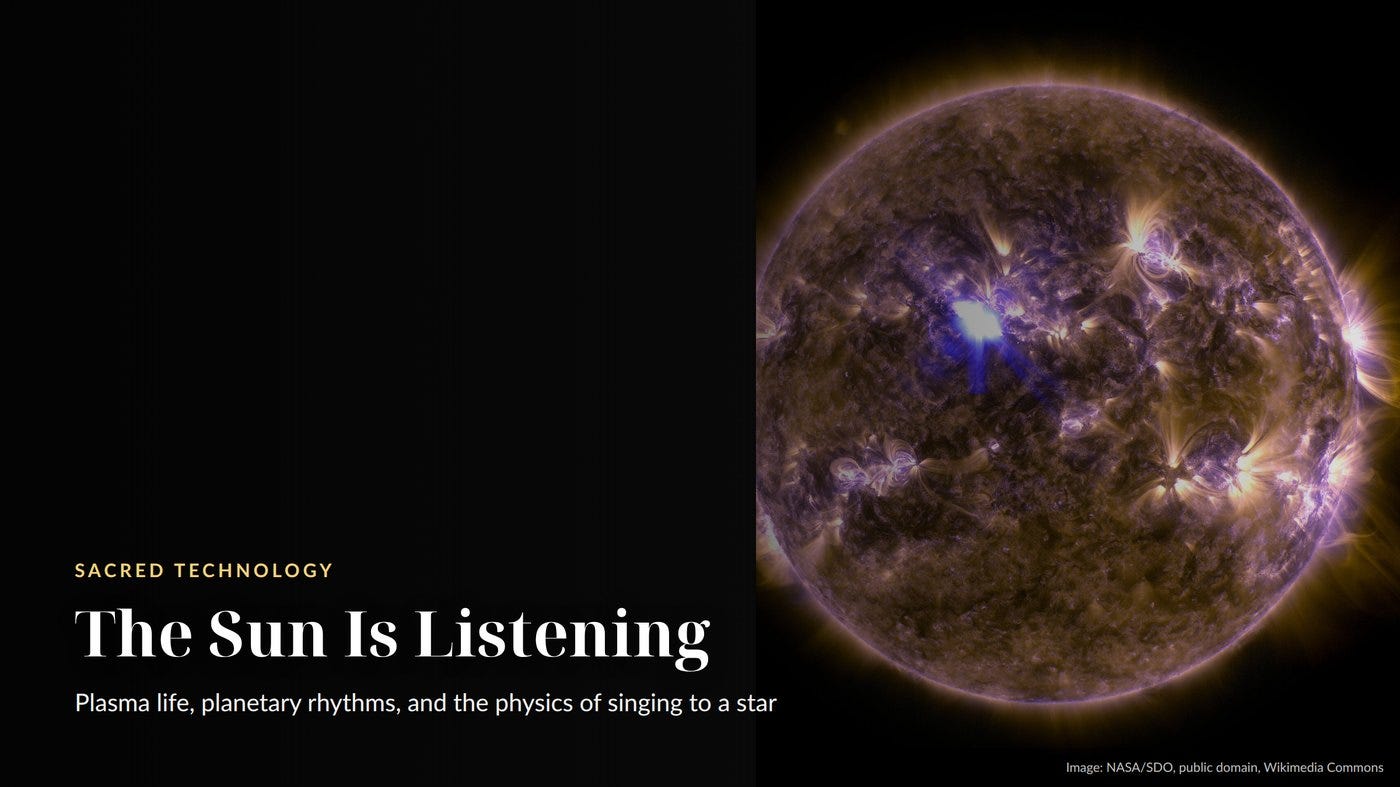
Plasma life, planetary rhythms, and the physics of a singing to a star
🧵Read and share the X thread dedicated to this article.
Quick Summary
The Sun sings. Stanford helioseismologists track about 10 million resonant tones ringing through the solar body.
Plasma behaves like life. It was named after blood. David Bohm called it “almost like a living thing.” Laboratory and simulation studies have produced plasma structures that grow, divide, carry memory and signal one another.
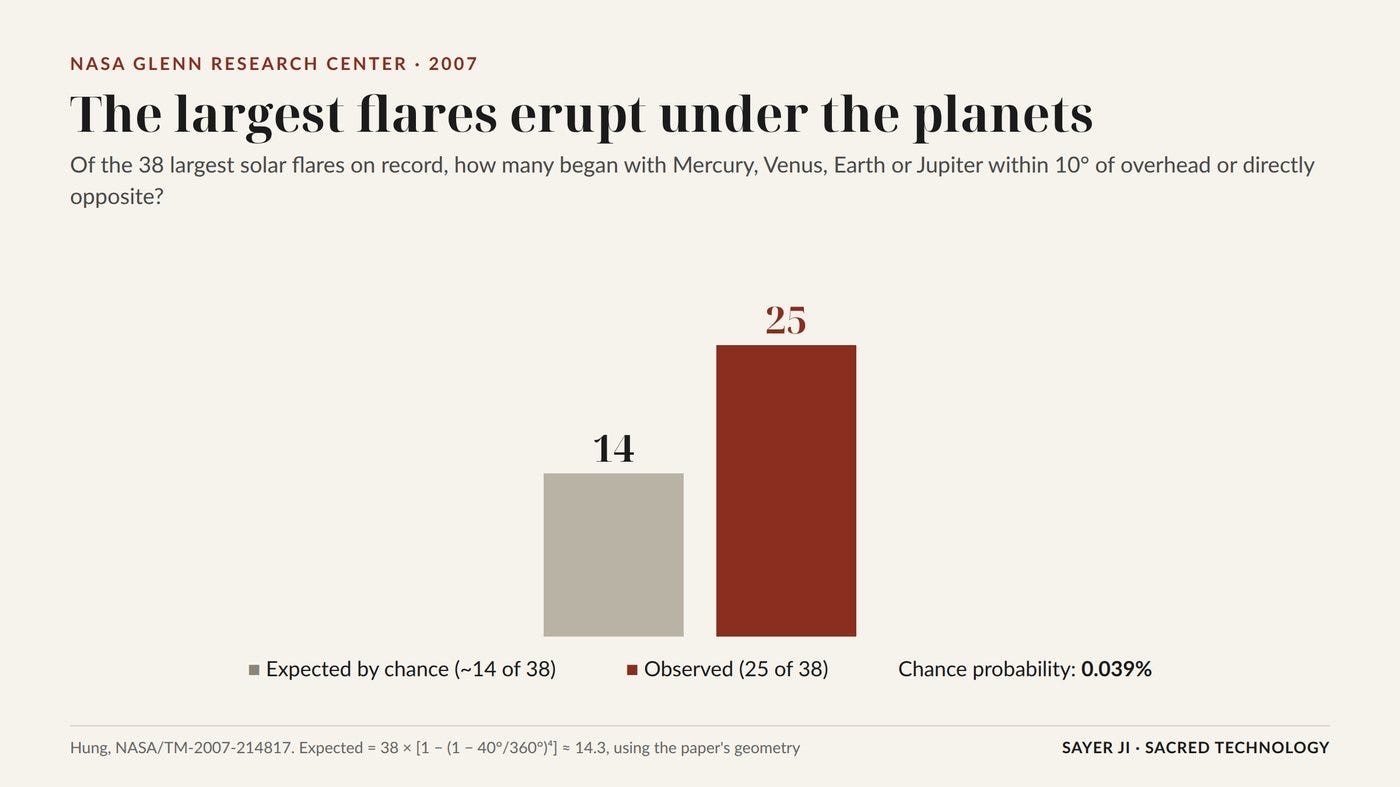
The Sun responds to small signals. A NASA report found that 25 of the 38 largest solar flares began under planetary alignments, with a 0.039% probability of chance. German physicists have modeled how planetary tides too weak to stir the solar interior can still set the Sun’s cycle.
The Sun shapes the human nervous system. From Chizhevsky’s study of 2,400 years of history to a 2018 heart-rhythm study in Scientific Reports, solar activity tracks human physiology and mass behavior.
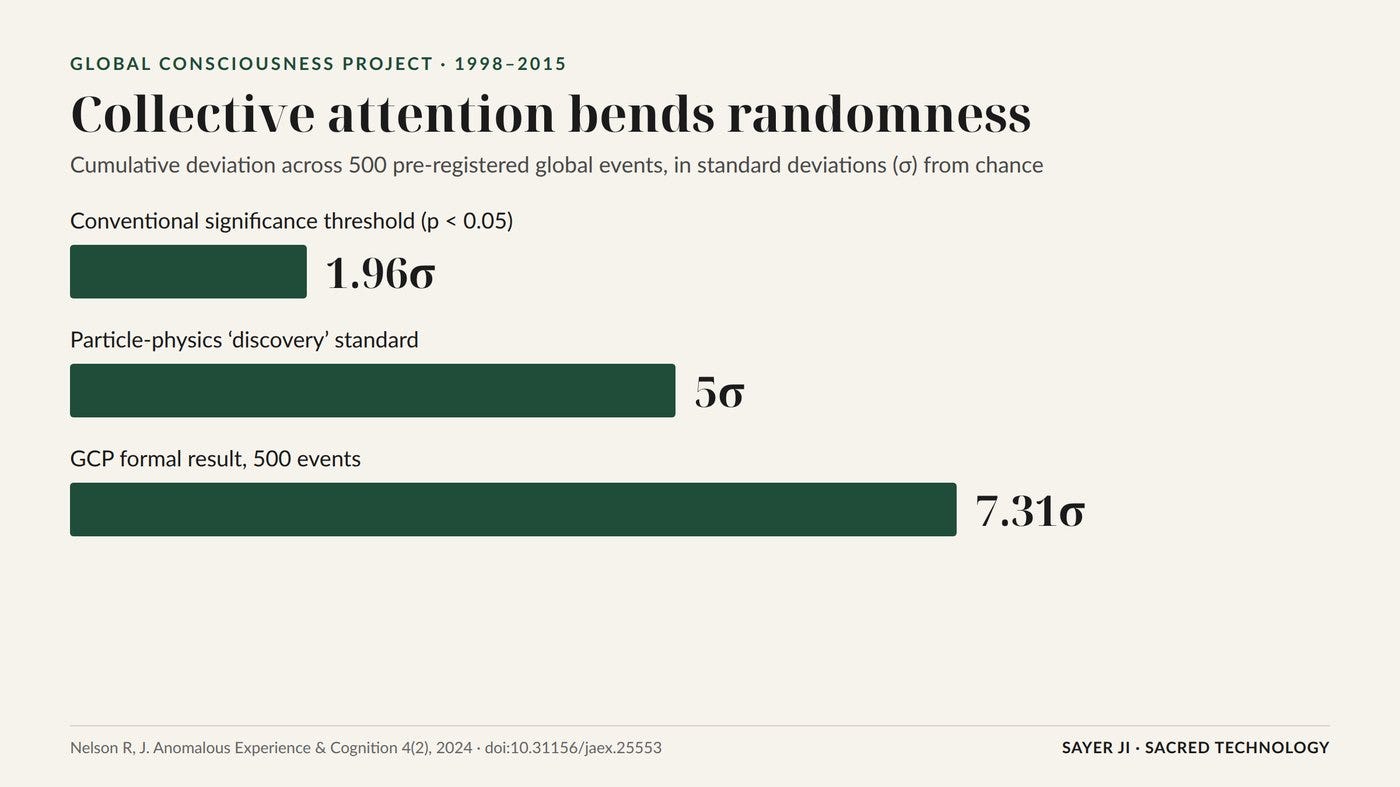
Collective attention moves matter. The Global Consciousness Project’s 500 pre-registered tests produced a cumulative 7.31-sigma deviation in physical random number generators.
That leaves one link untested. Can coherent human feeling reach back to the Sun? That’s the question behind Dan Winter’s “children singing” story and Buryl Payne’s 1980s meditation experiment, and modern data could now answer it.
The Sun Has a Voice
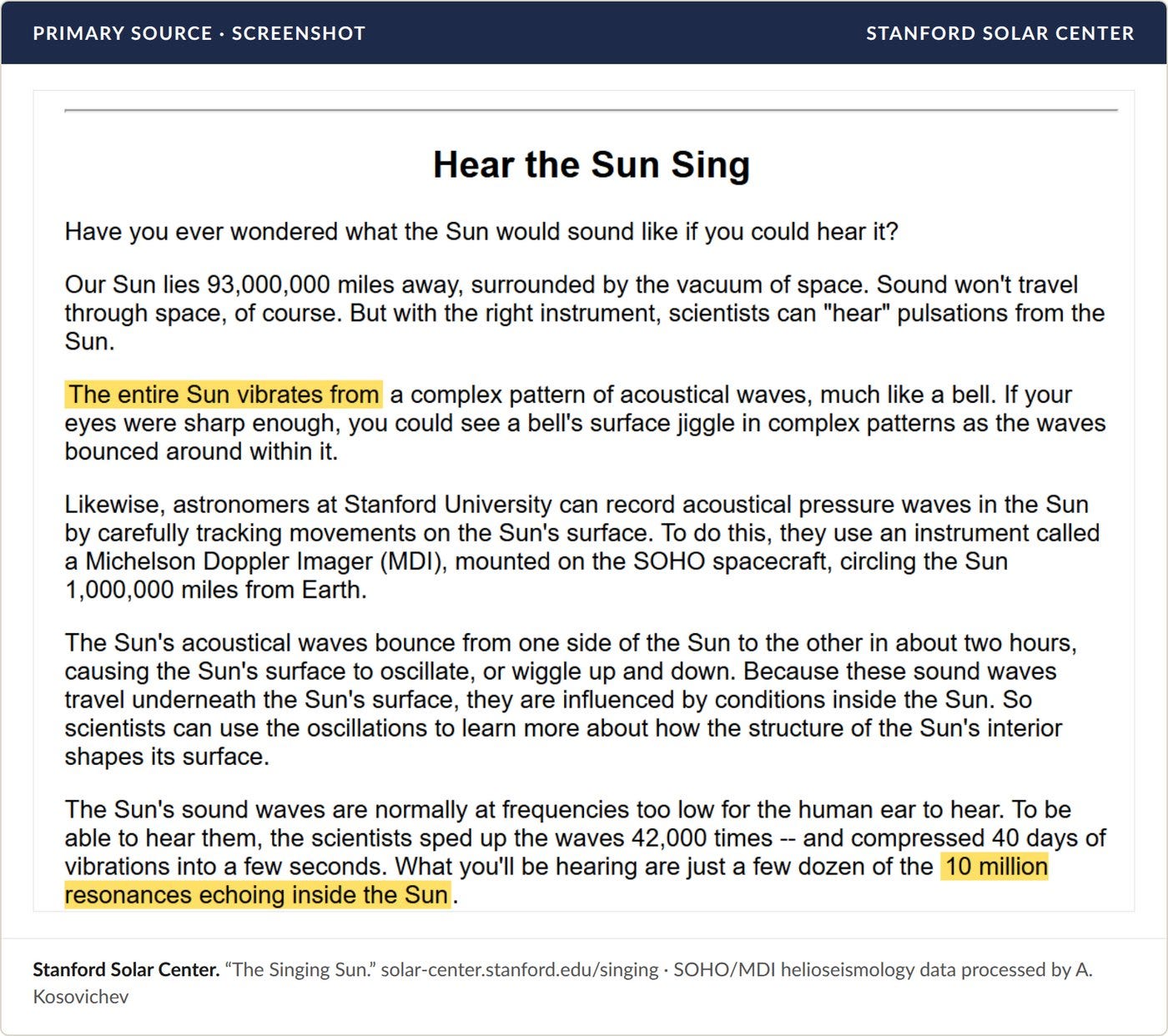
A million miles from Earth, the SOHO spacecraft watches the surface of the Sun rise and fall. When Stanford scientists speed those vibrations up 42,000 times, the Sun becomes audible.
“The entire Sun vibrates from a complex pattern of acoustical waves, much like a bell,” the Stanford Solar Center explains. What we hear in their recordings “are just a few dozen of the 10 million resonances echoing inside the Sun.” Their teaching guide says it more simply: “The Sun is like a huge musical instrument. It rings like a bell, and vibrates like an organ pipe. Just like a piano has 88 keys or musical notes the Sun has 10 million keys or notes” (Stanford, Solar Music).
Hold that image: a star with ten million keys.
Now hold another. For more than a decade, the researcher Dan Winter has closed his lectures with what he calls his “climax slide.” He says that when more than a million children sang the same song at the same time, the Sun’s flares calmed. “They relax. They get towards stillness. They get centripetal” (Dan Winter, 2026). “And the Sun goes ah” (Winter and Elena Danaan, 2023).
Most people laugh at that. I want to follow the physics one link at a time and see how much of the chain between a child’s voice and a star’s voice has already been forged in published science.
The answer is: more than almost anyone realizes.
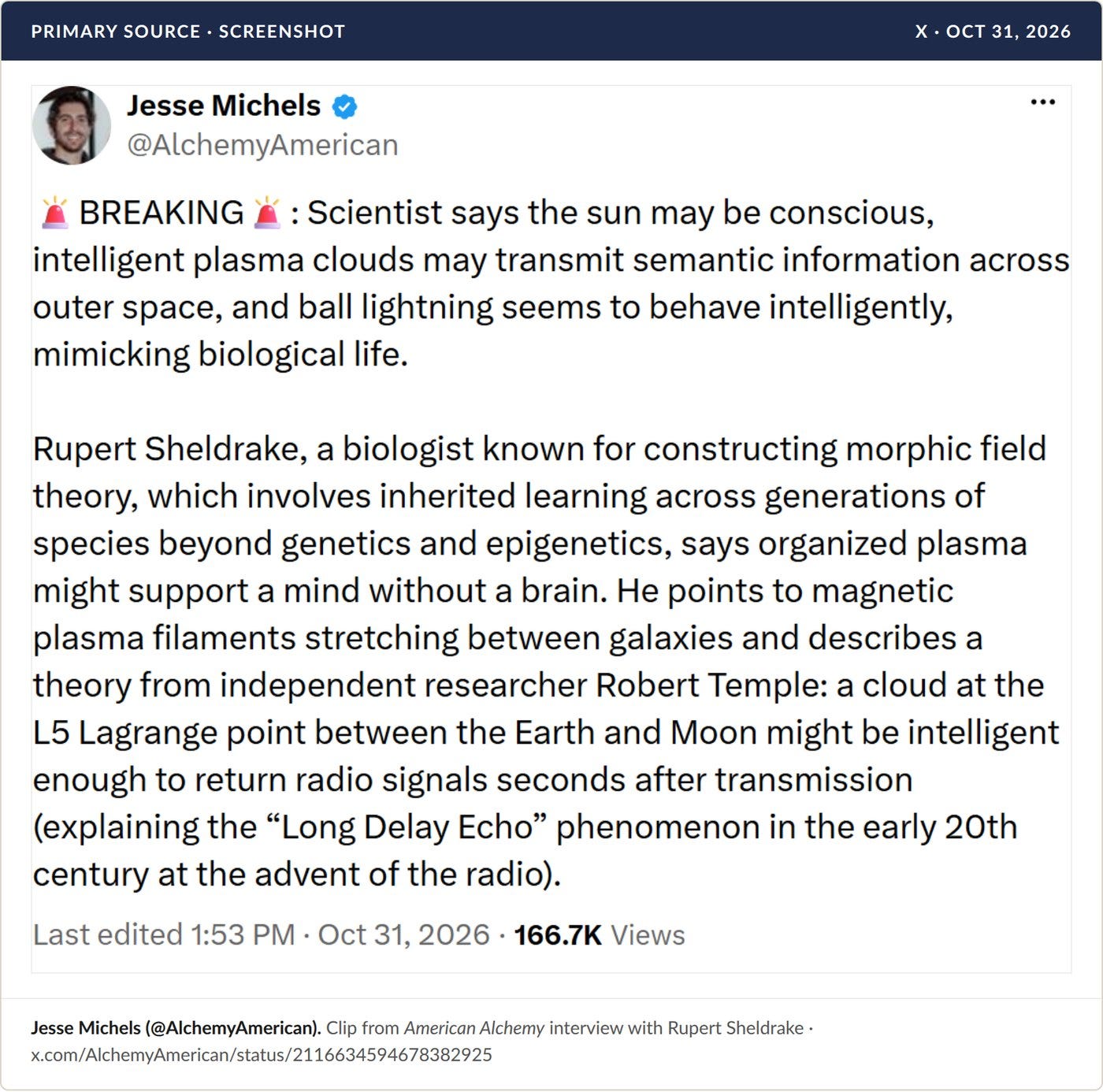
The question is in the air again. On October 31, Jesse Michels posted a clip of Rupert Sheldrake saying “the sun may be conscious,” and that “organized plasma might support a mind without a brain.” The post passed 166,000 views within a day (Jesse Michels on X; full interview, 1:54:13).
I. Plasma Was Named After Blood
Begin with the substance the Sun is made of.
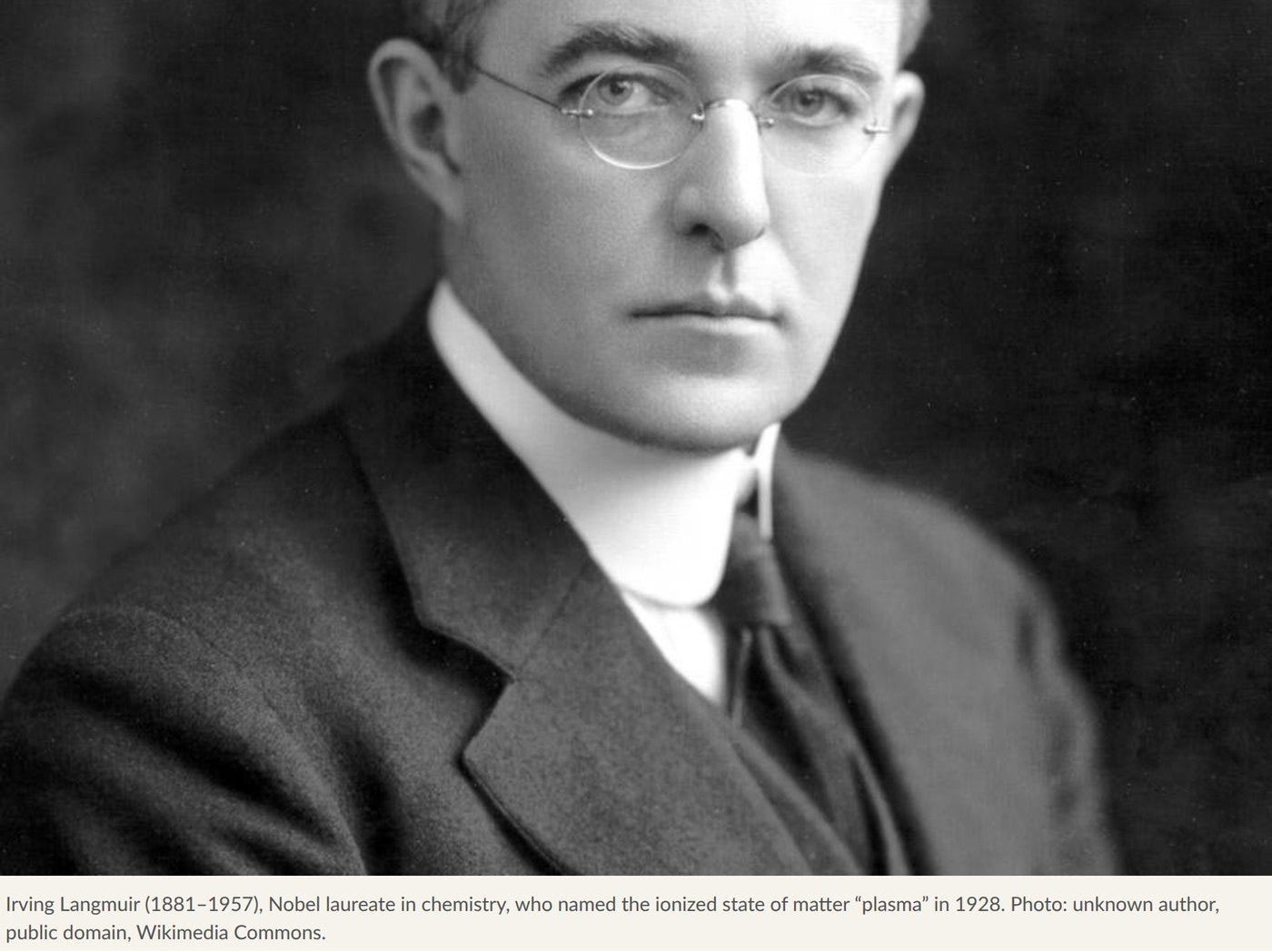
In 1928 the Nobel chemist Irving Langmuir needed a word for the glowing, self-organizing state of ionized gas he was studying at General Electric. His colleague Harold Mott-Smith later recalled that Langmuir was struck by the analogy with “the way blood plasma carries around red and white corpuscles and germs,” and proposed the name plasma (Plasma Sources Science and Technology, 2009; ITER).
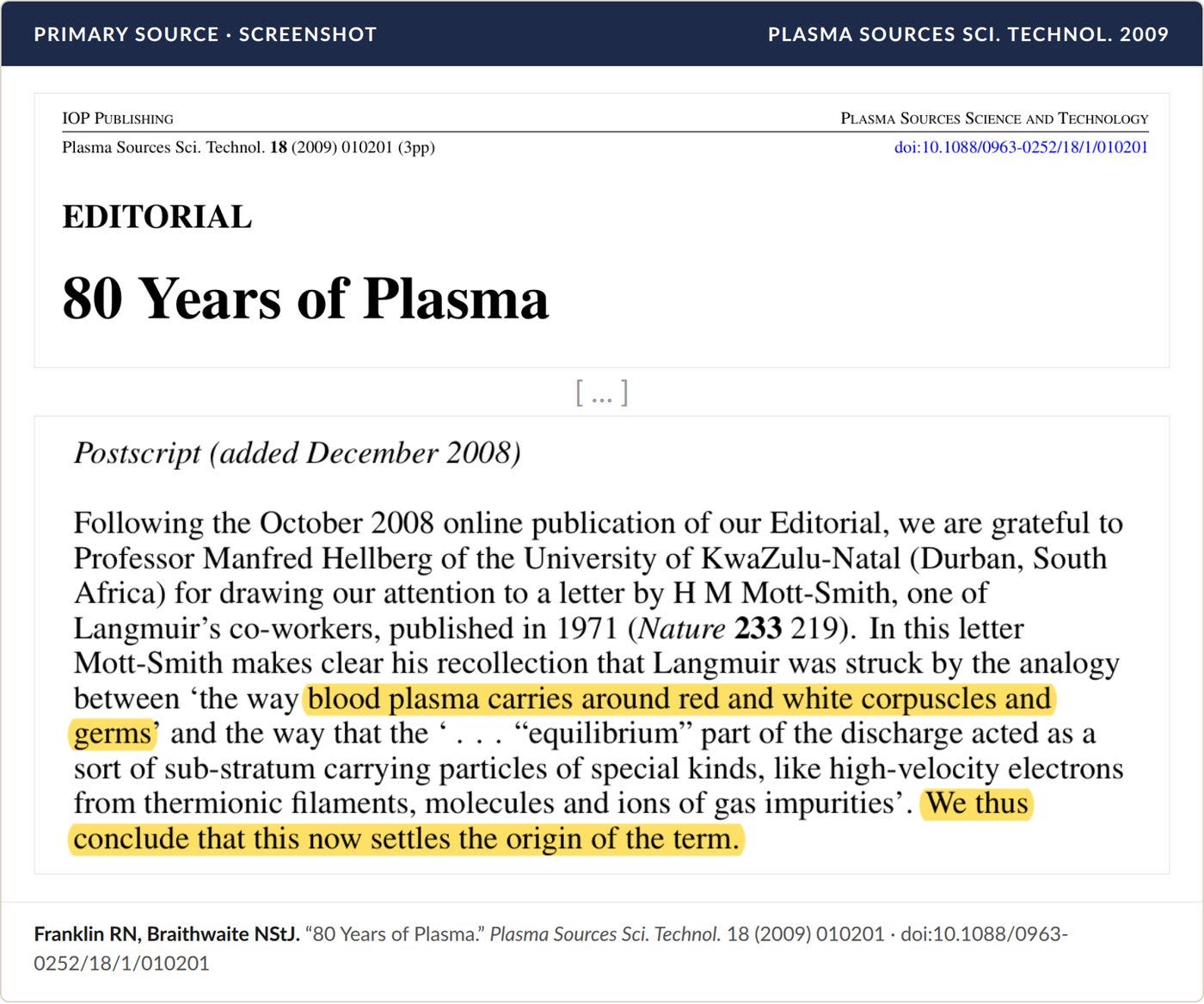
So the fourth state of matter was named, from the start, after the fluid of life.
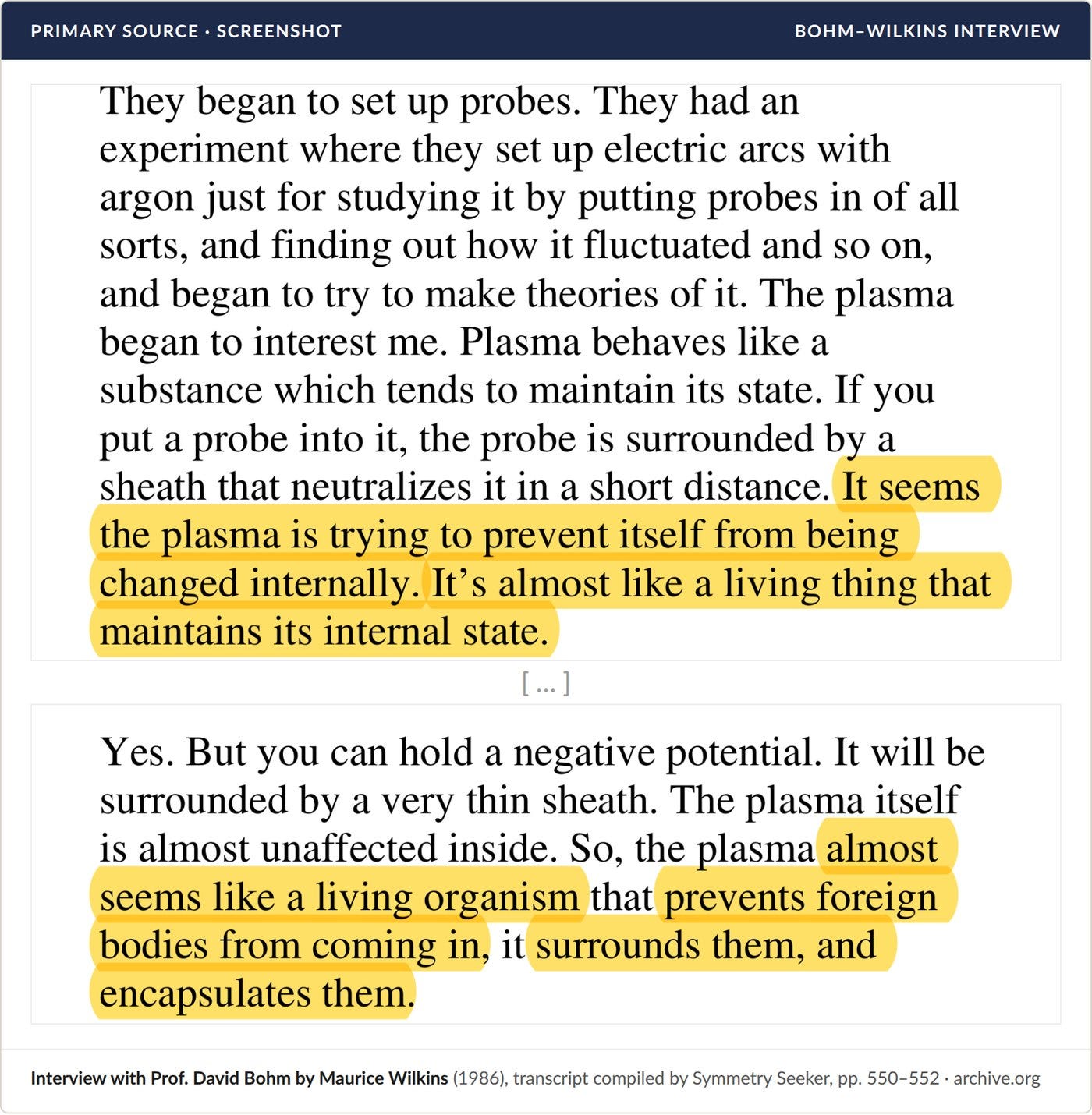
Two decades later, David Bohm, one of the great physicists of the 20th century, did his foundational work on plasma at Berkeley. In an interview with Nobel laureate Maurice Wilkins, Bohm described what he saw: “It seems the plasma is trying to prevent itself from being changed internally. It’s almost like a living thing that maintains its internal state... the plasma almost seems like a living organism that prevents foreign bodies from coming in, it surrounds them, and encapsulates them” (Bohm–Wilkins interview).
Translation
Plasma holds its own internal state steady, which biologists call homeostasis. It walls off intruders, which immunologists call encapsulation. It moves as one coherent body. These are the defining behaviors of a living system.
In 2003, physicists Erzilia Lozneanu and Mircea Sanduloviciu of Alexandru Ioan Cuza University in Romania published “Minimal-cell system created in laboratory by self-organization” in Chaos, Solitons & Fractals (DOI 10.1016/S0960-0779(02)00662-8). According to New Scientist‘s report on the work, a spark fired into argon plasma produced glowing spheres wrapped in a two-layer electrical membrane. The spheres pulsed in a rhythmic “inhalation,” grew by drawing in neutral atoms, split in two, and signaled each other by emitting electromagnetic energy (summary of the New Scientist report).
In 2007, a team led by V.N. Tsytovich of the Russian Academy of Sciences, working with the Max Planck Institute for Extraterrestrial Physics, published a simulation study in the New Journal of Physics. They found that dusty plasmas “may naturally self-organize themselves into stable interacting helical structures that exhibit features normally attributed to organic living matter,” including “bifurcations that serve as ‘memory marks’, self-duplication, metabolic rates.” The authors concluded that these structures “exhibit all the necessary properties to qualify them as candidates for inorganic living matter” (Tsytovich et al., New J. Phys. 2007).
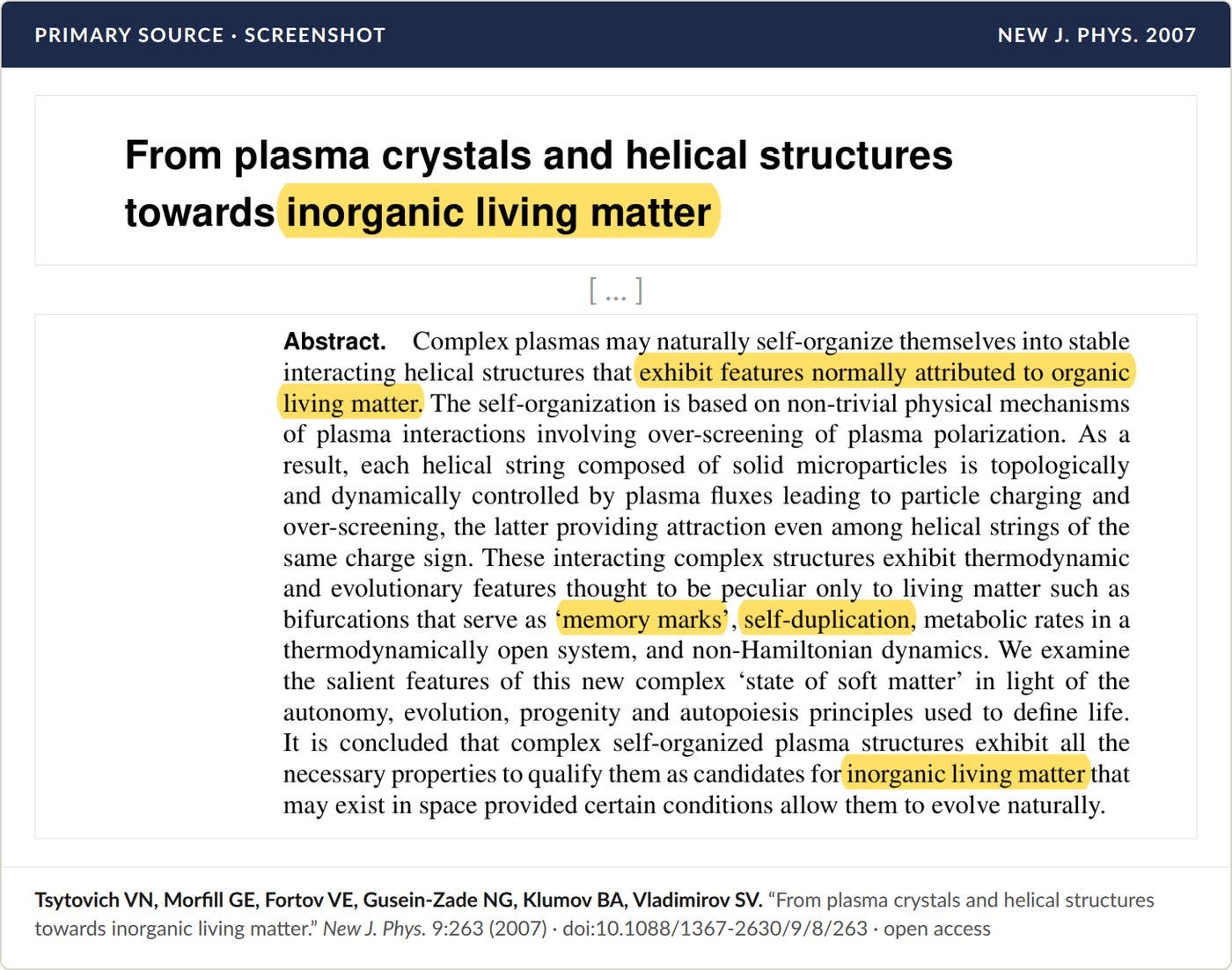
Helices. Memory. Self-replication. Metabolism. In plasma.
This is the base on which Robert Temple builds A New Science of Heaven (2022). His argument is that the 99% of the visible universe made of plasma is not inert: “in certain circumstances, plasma exhibits sentience” (Robert Temple). Asked directly whether the Sun is conscious, Temple doesn’t hedge: “the sun is an absolutely gigantic plasma entity it is alive it is intelligent it is conscious and it’s got its eye on us” (Temple, Theosophical Society lecture).
II. A Star With a Nervous System
If plasma behaves like life, how does the Sun behave? Like a brain.
In 1991 Edward Lu and Russell Hamilton proposed in The Astrophysical Journal that the Sun’s coronal magnetic field “is in a self-organized critical state,” and that “solar flares are avalanches of many small reconnection events.” This explains why flare sizes follow a single power law over more than five orders of magnitude (Lu & Hamilton, ApJ 1991). It became the standard model of flare statistics.
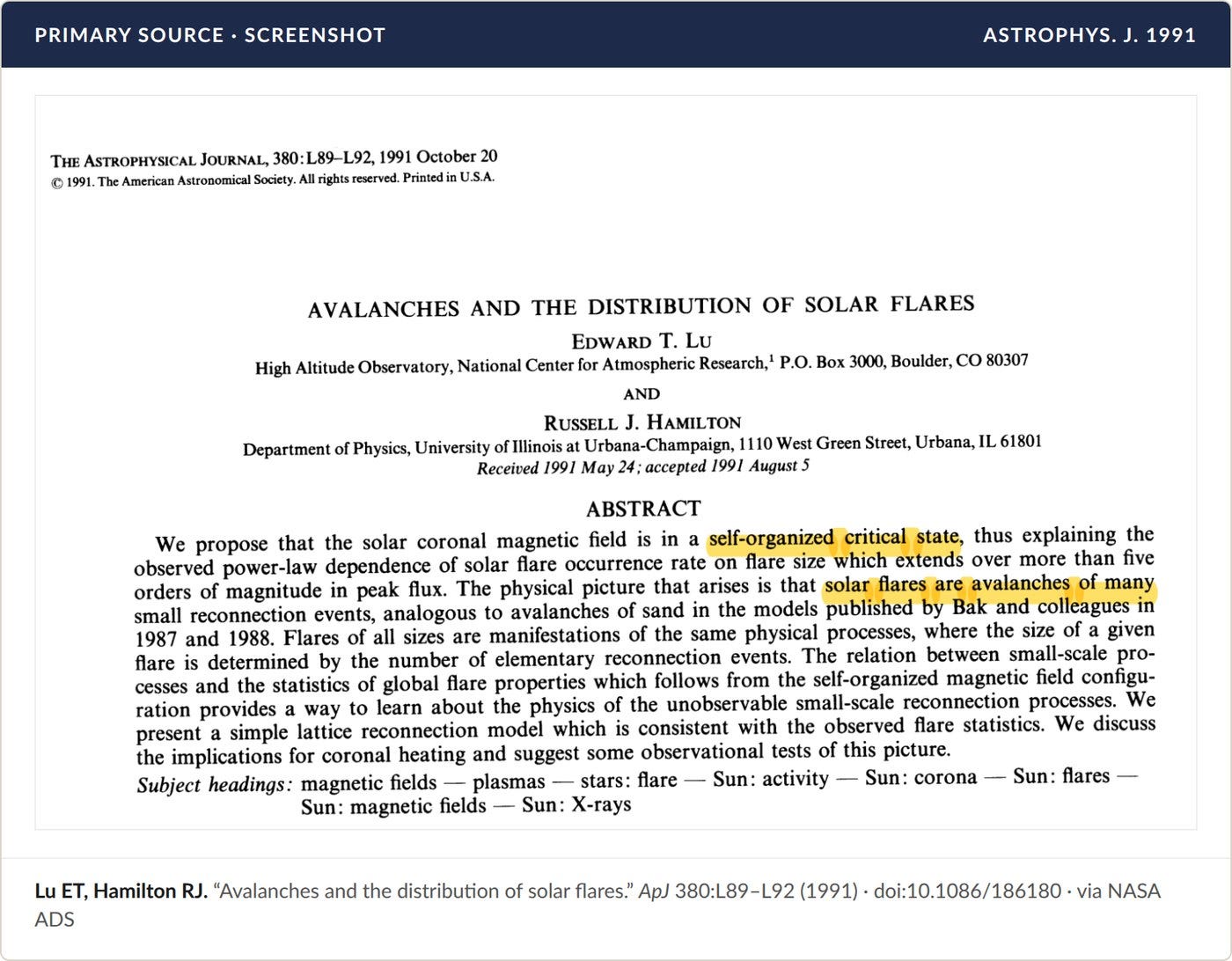
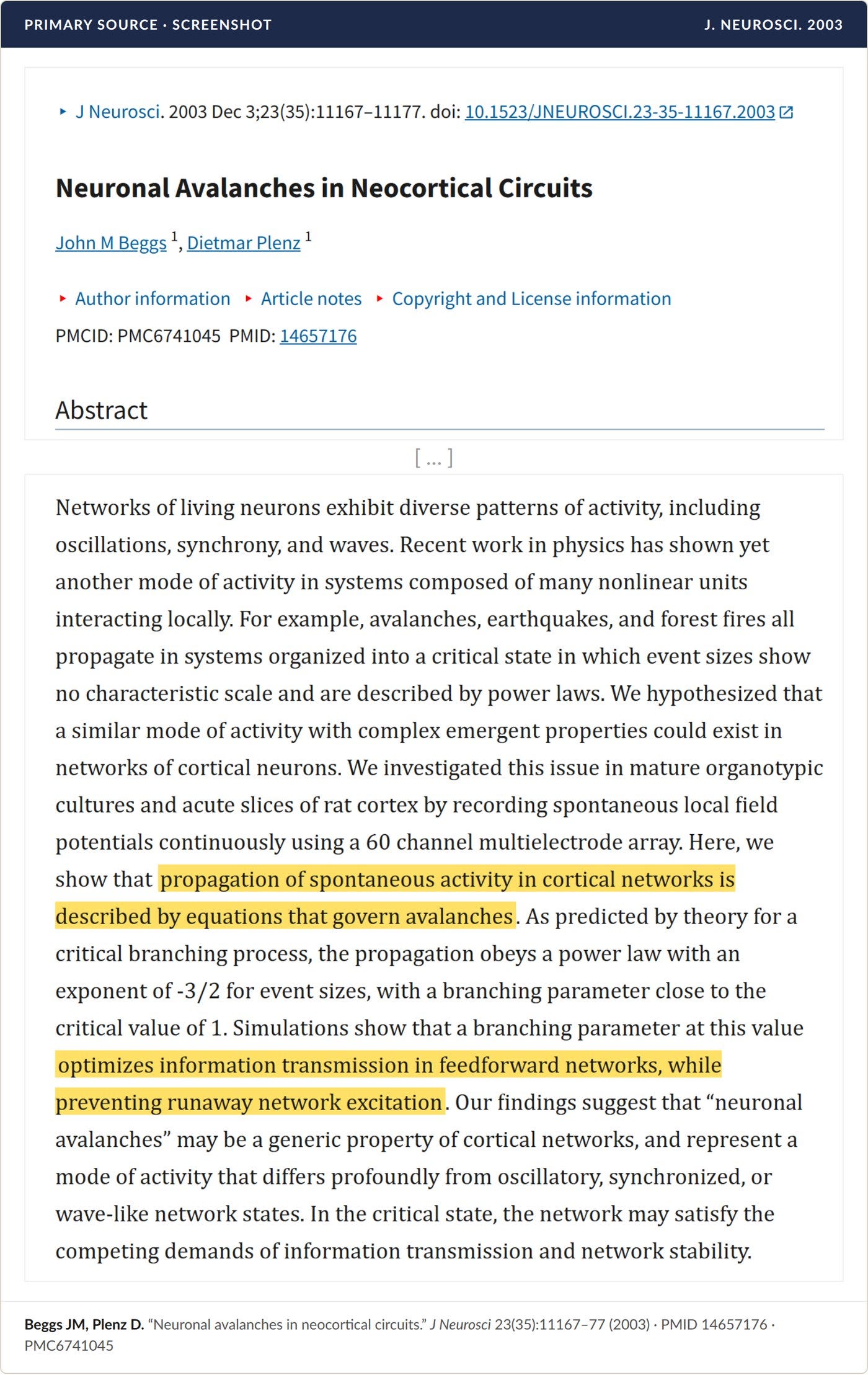
Twelve years later, John Beggs and Dietmar Plenz at the U.S. National Institute of Mental Health recorded living cortical tissue and found the same mathematics. They showed that “propagation of spontaneous activity in cortical networks is described by equations that govern avalanches,” and that this critical state “optimizes information transmission... while preventing runaway network excitation” (Beggs & Plenz, J. Neurosci. 2003). The paper launched what is now called the critical brain hypothesis.
Translation
The solar corona and the human cortex are organized on the same principle. Both sit at the edge between order and chaos and release energy in avalanches of every size. Neuroscientists think this is the state in which a system processes information best.
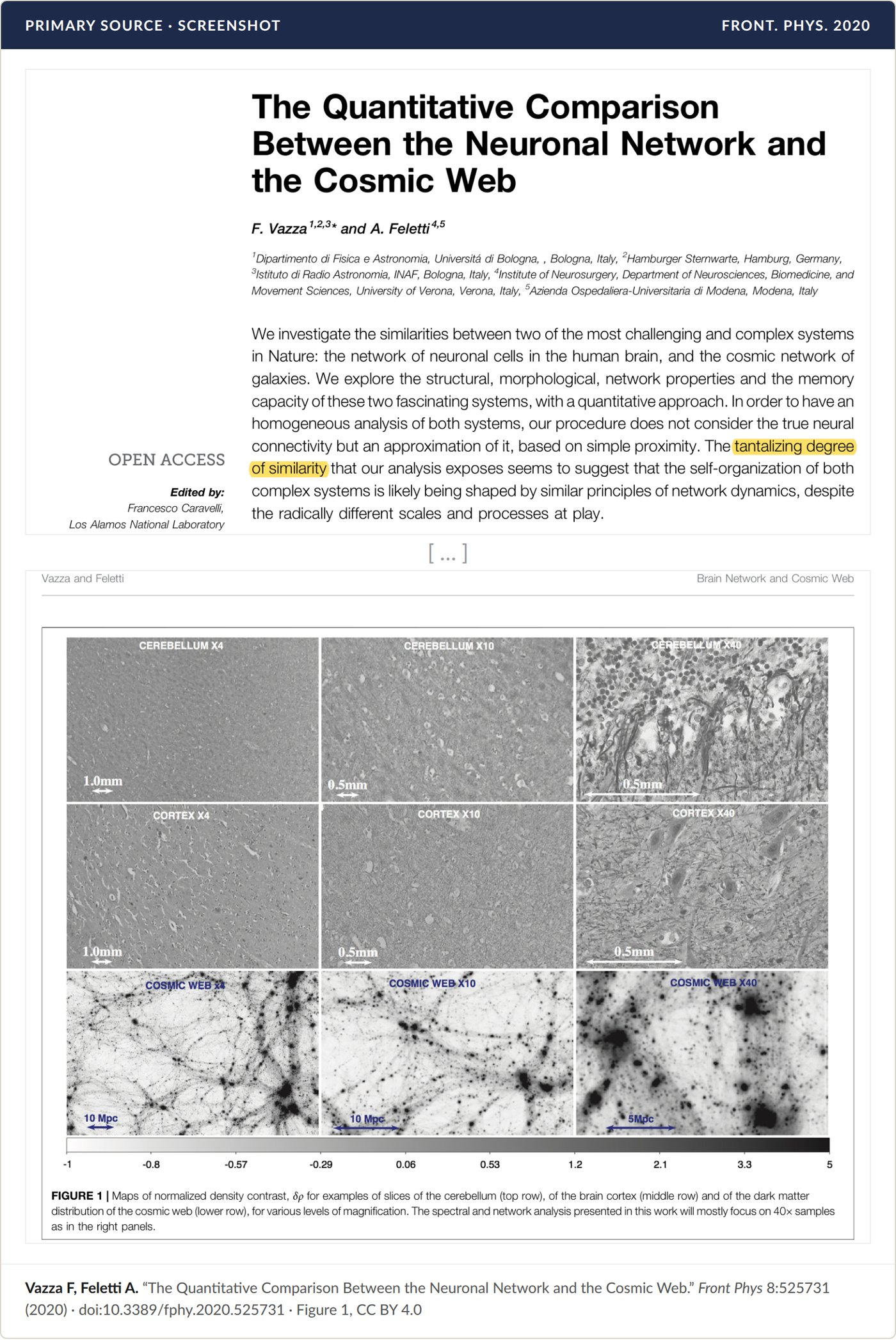
The parallel goes further. In 2020, an astrophysicist at the University of Bologna and a neurosurgeon at the University of Verona compared the cosmic web of galaxies with the neuronal network of the human cerebellum. They found “a tantalizing degree of similarity” in structure and connectivity across a difference in scale of 27 orders of magnitude (Vazza & Feletti, Frontiers in Physics 2020; Phys.org).
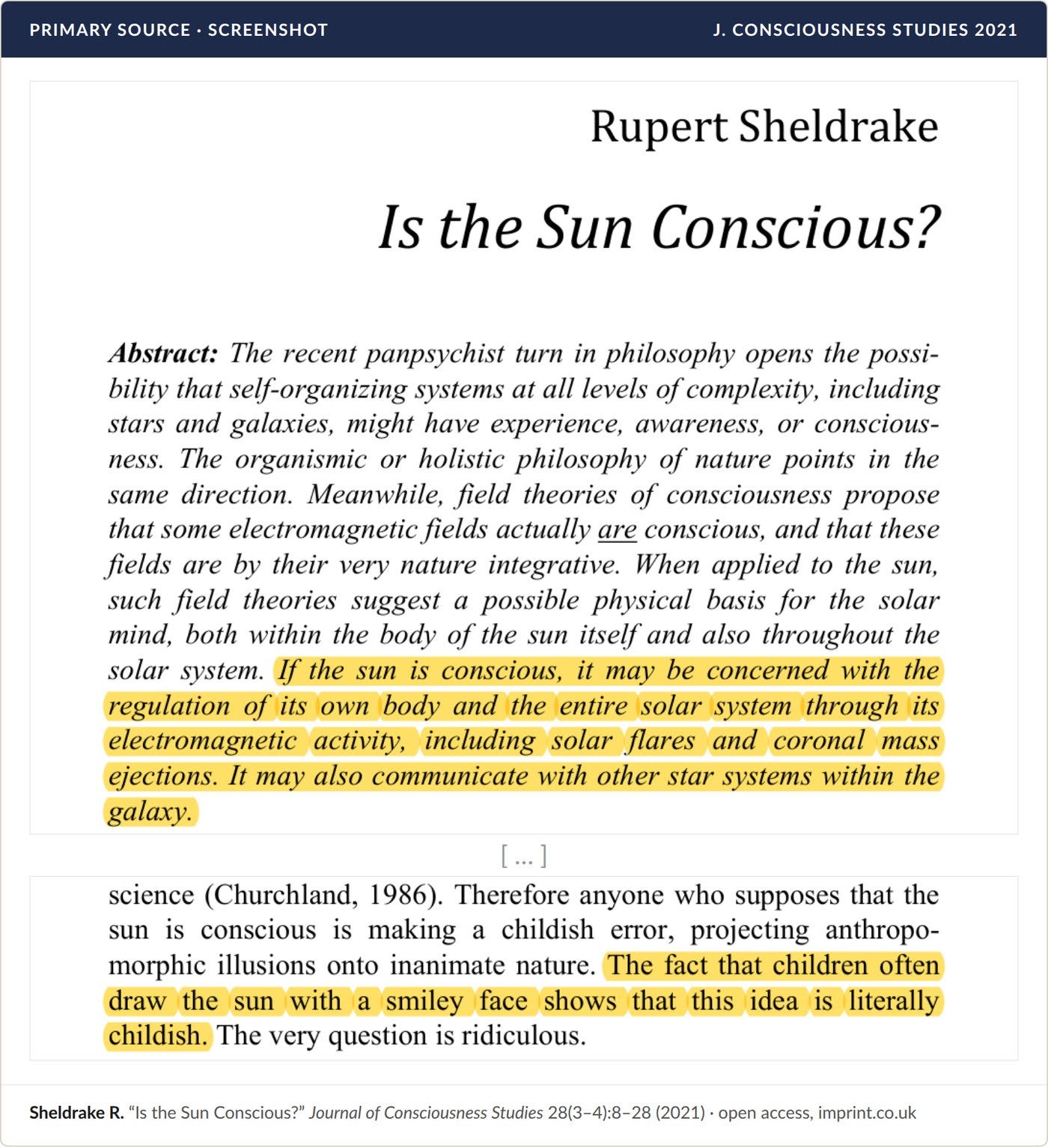
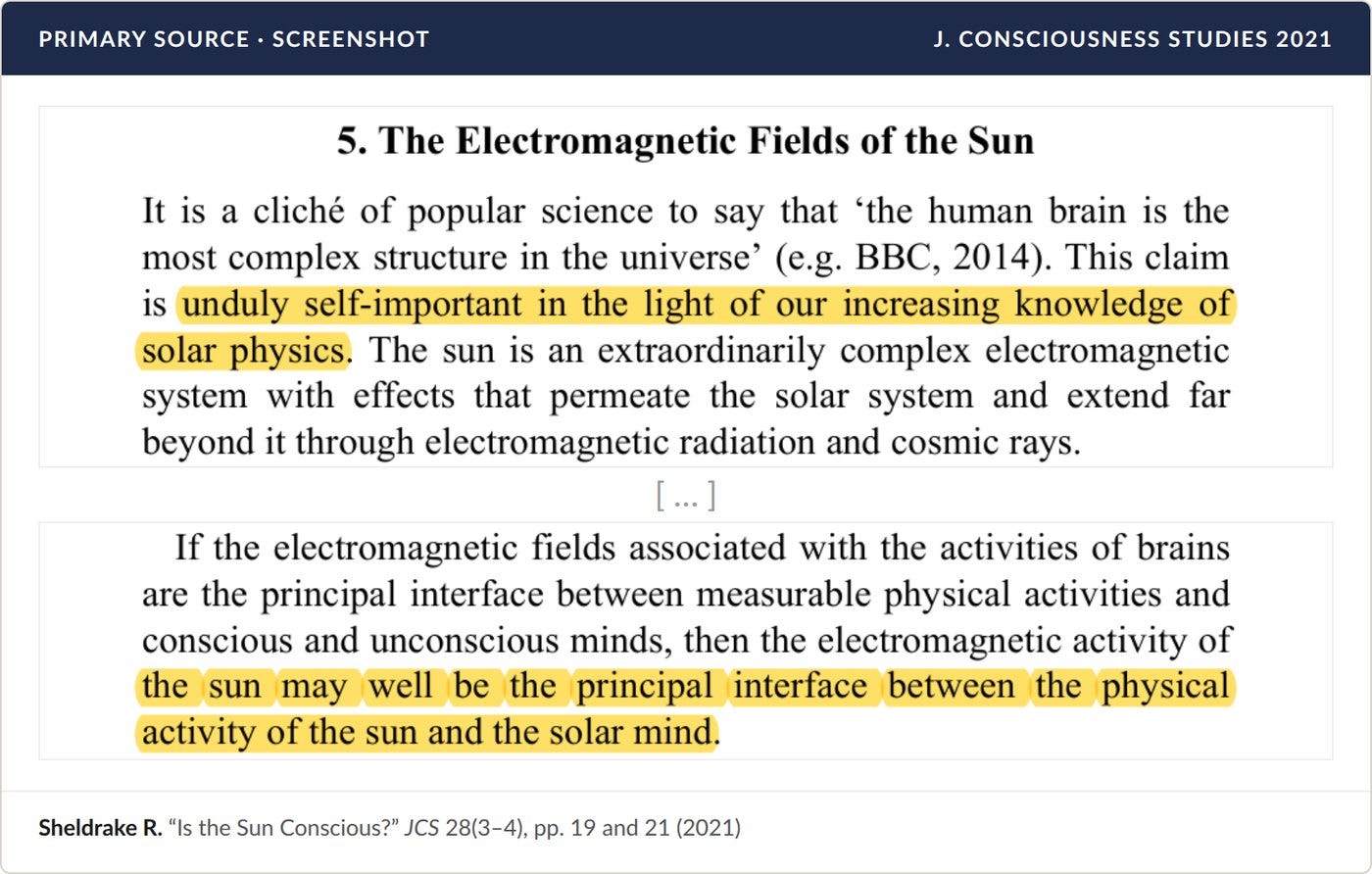
Rupert Sheldrake takes the next step in his peer-reviewed paper “Is the Sun Conscious?” in the Journal of Consciousness Studies. If the mind is tied to the brain’s electromagnetic field, as several current field theories propose, then “the electromagnetic activity of the sun may well be the principal interface between the physical activity of the sun and the solar mind.” He calls the cliché that the brain is the most complex structure in the universe “unduly self-important in the light of our increasing knowledge of solar physics” (Sheldrake, JCS 2021).
III. The Sun Responds to Small Signals
This is the turning point of the argument, and it’s where my astrology-as-resonance essay finds its physical footing.
A system at the critical point is, by definition, extremely sensitive. A single grain of sand can set off an avalanche. So the question is not whether the Sun has enough energy to be moved by something small. It’s whether anything small and rhythmic has been shown to move it.
It has: the planets.
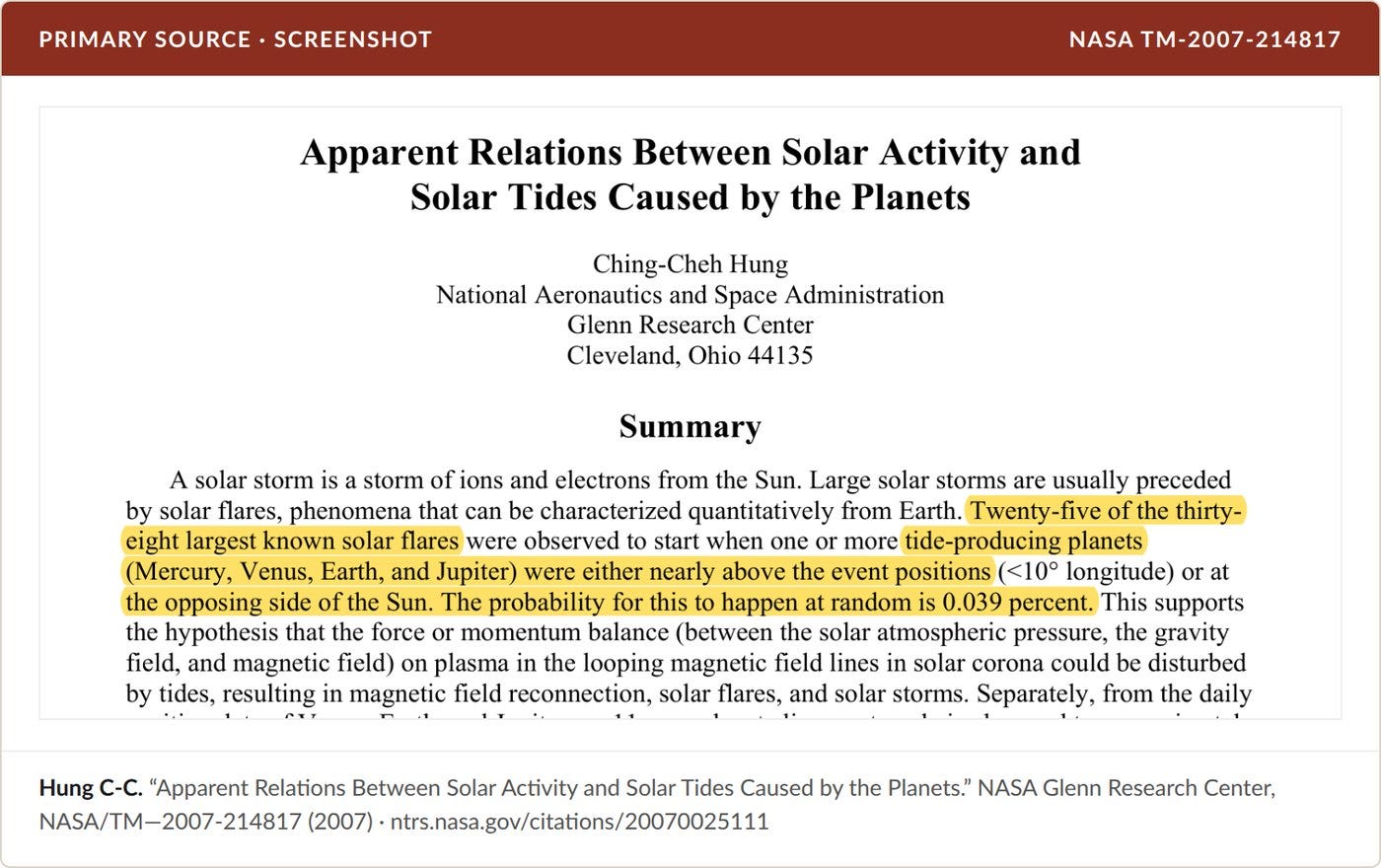
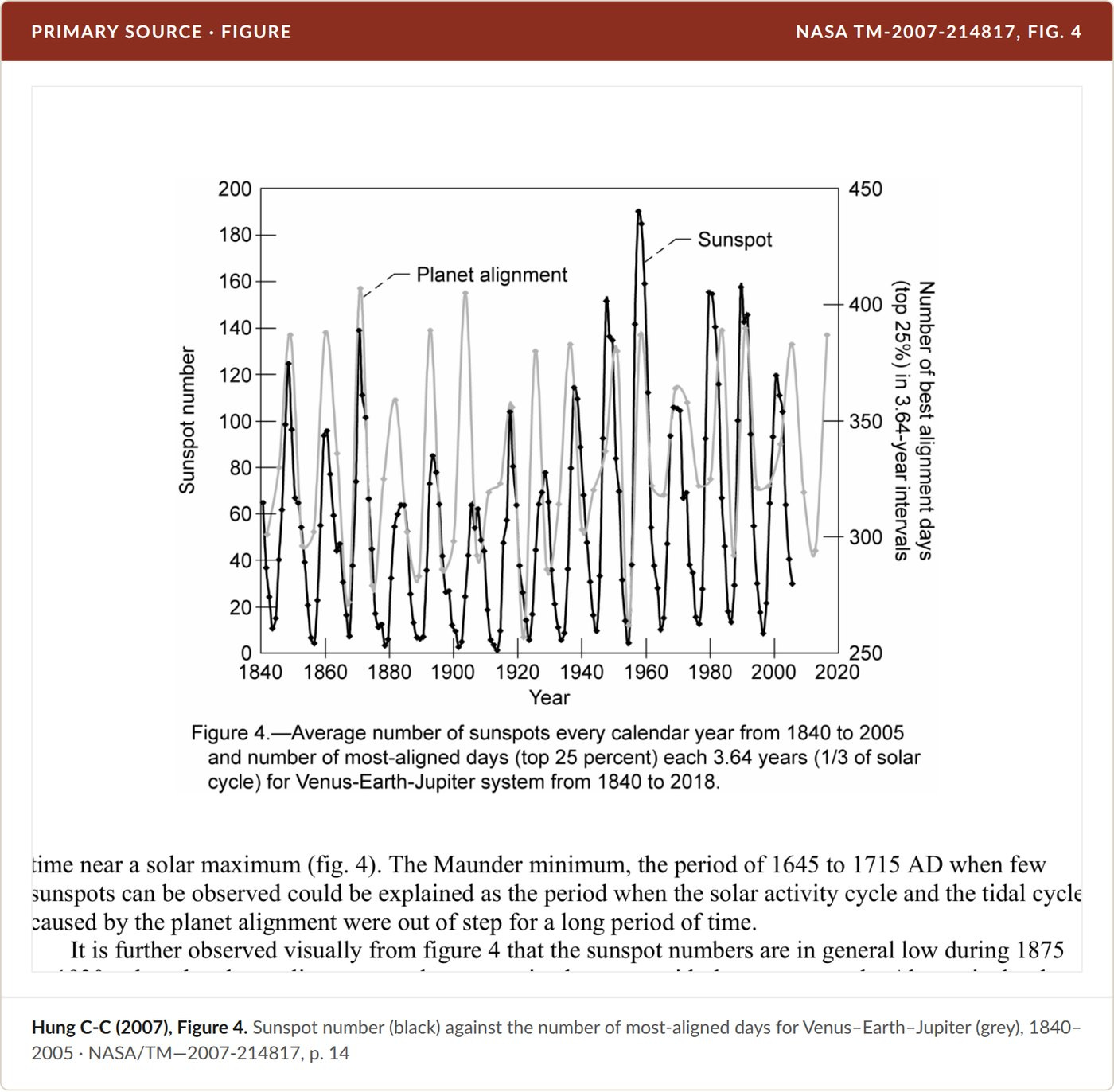
NASA, 2007. Ching-Cheh Hung of NASA’s Glenn Research Center analyzed the largest flares on record. He found that “twenty-five of the thirty-eight largest known solar flares were observed to start when one or more tide-producing planets (Mercury, Venus, Earth, and Jupiter) were either nearly above the event positions (<10° longitude) or at the opposing side of the Sun,” and estimated “the probability for this to happen at random is 0.039 percent.” He also found an 11-year alignment cycle of Venus, Earth and Jupiter that “approximately match[es] the sunspot cycle” (Hung, NASA/TM-2007-214817).
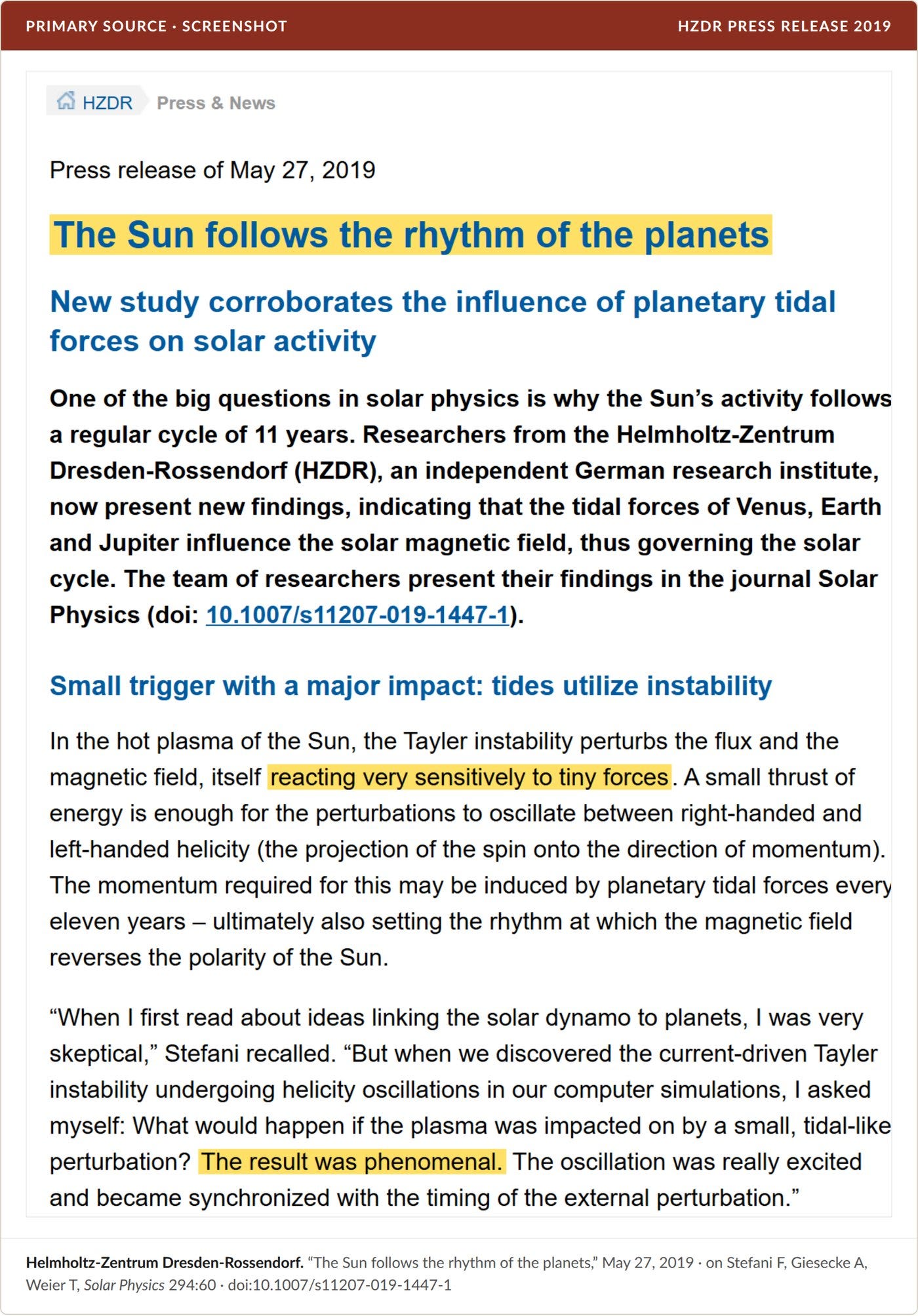
Helmholtz-Zentrum Dresden-Rossendorf, 2016–2019. Frank Stefani’s group at one of Germany’s national research centers then proposed a mechanism. Their release states plainly that the planets’ tidal effect “is too weak to significantly perturb the flow in the solar interior.” Yet in the Sun’s plasma, a current-driven effect called the Tayler instability “reacts very sensitively to tiny forces.” When Stefani applied a small tide-like push to the simulation, “the result was phenomenal. The oscillation was really excited and became synchronized with the timing of the external perturbation.” Comparing a thousand years of solar observations with planetary positions, Stefani reported “an astonishingly high level of concordance” over 90 cycles (HZDR, “The Sun follows the rhythm of the planets”; Stefani et al., Solar Physics 2019).
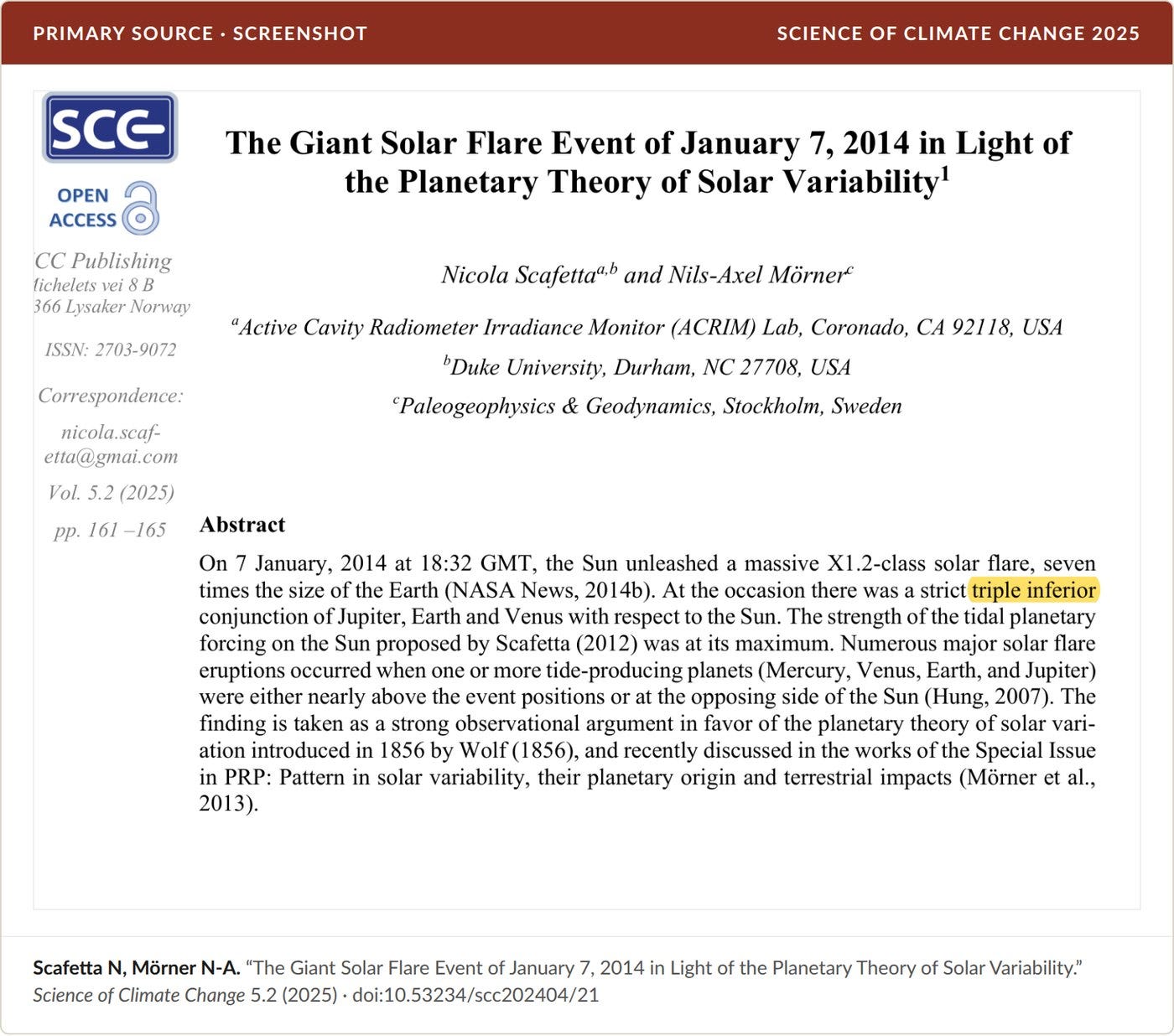
Independent researchers report more cases. The giant X-class flare of January 7, 2014 erupted during a rare triple alignment of Venus, Earth and Jupiter (Scafetta & Mörner). A 2022 review gathers decades of these findings under the “planetary theory of solar activity” (Scafetta & Bianchini 2022).
Translation
The planets’ pull on the Sun is tiny, yet the Sun’s 11-year heartbeat appears to keep time with it. This is entrainment: a weak rhythmic signal, delivered at the right frequency to a system poised at criticality, can take over the timing of the whole. Pendulum clocks on a shared wall fall into step this way, and so does a clapping crowd.
This is the hinge of the argument. Mainstream solar physics has modeled a mechanism by which a minuscule, coherent, periodic input reorganizes the behavior of a star. The Sun isn’t deaf to small signals. It’s tuned to them.
IV. The Sun Writes on the Human Heart
The influence running from the Sun to us is the best-documented link in the chain.
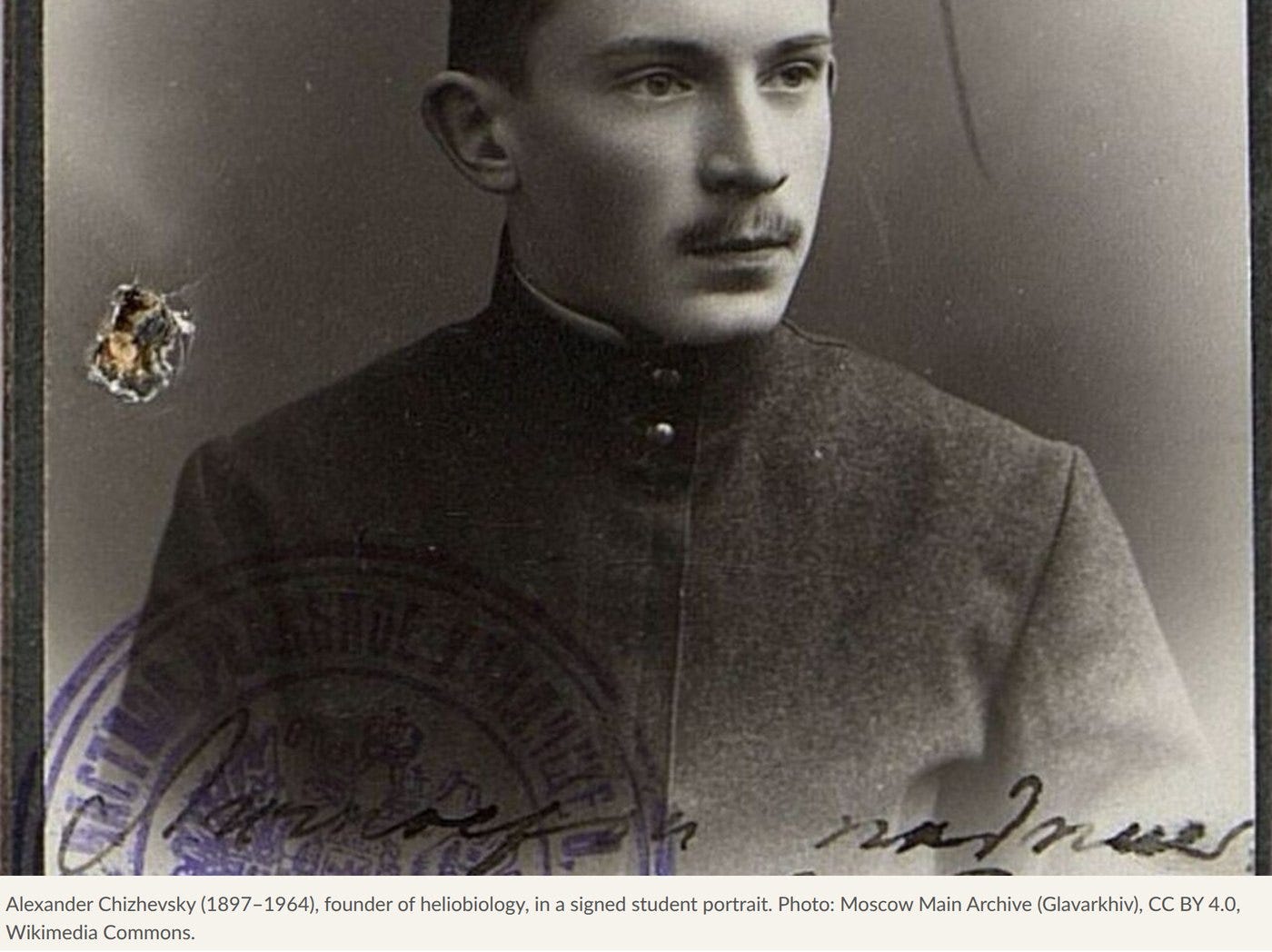
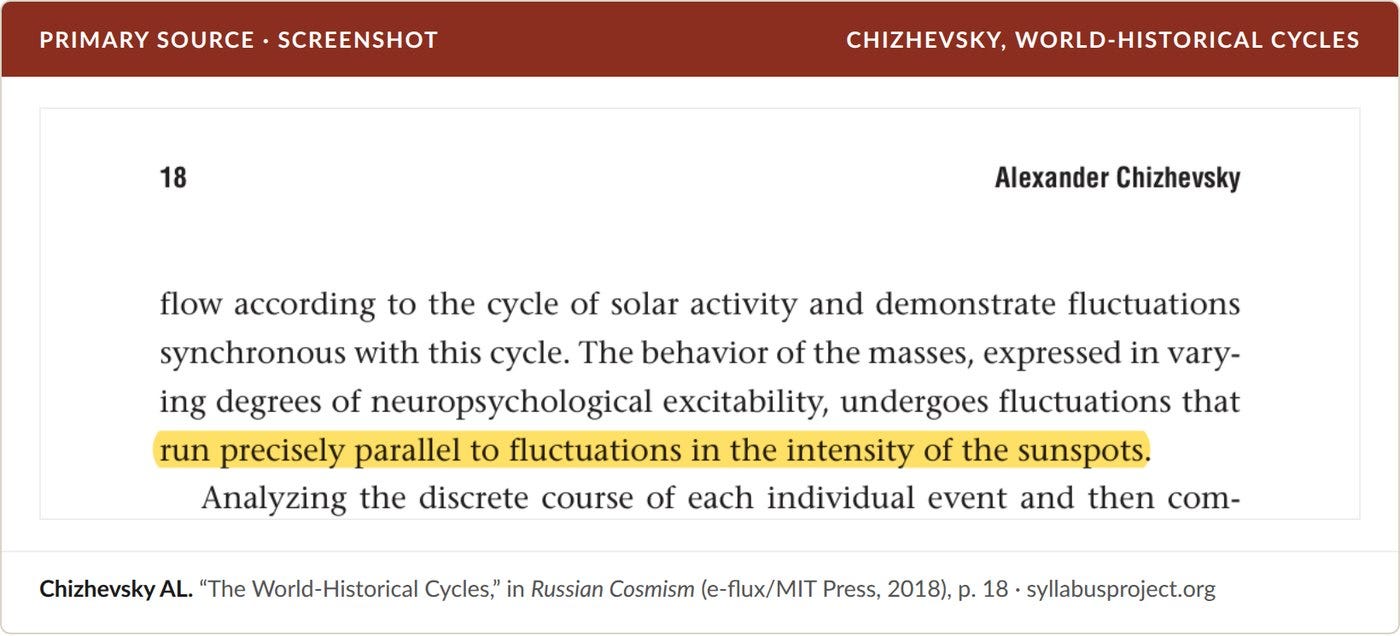
In the 1920s the young Russian scientist Alexander Chizhevsky compared sunspot records with riots, revolutions and wars in 72 countries from 500 BCE to 1922. He concluded that mass behavior “undergoes fluctuations that run precisely parallel to fluctuations in the intensity of the sunspots” (Chizhevsky, The World-Historical Cycles). He founded heliobiology and was later imprisoned in the Soviet camps (Esker Foundation). Later researchers backed him up, among them Göttingen psychologist Suitbert Ertel, who in 1996 reported a “substantial” relationship between solar activity and revolutionary unrest from 1700 to 1985 (summary of the literature).
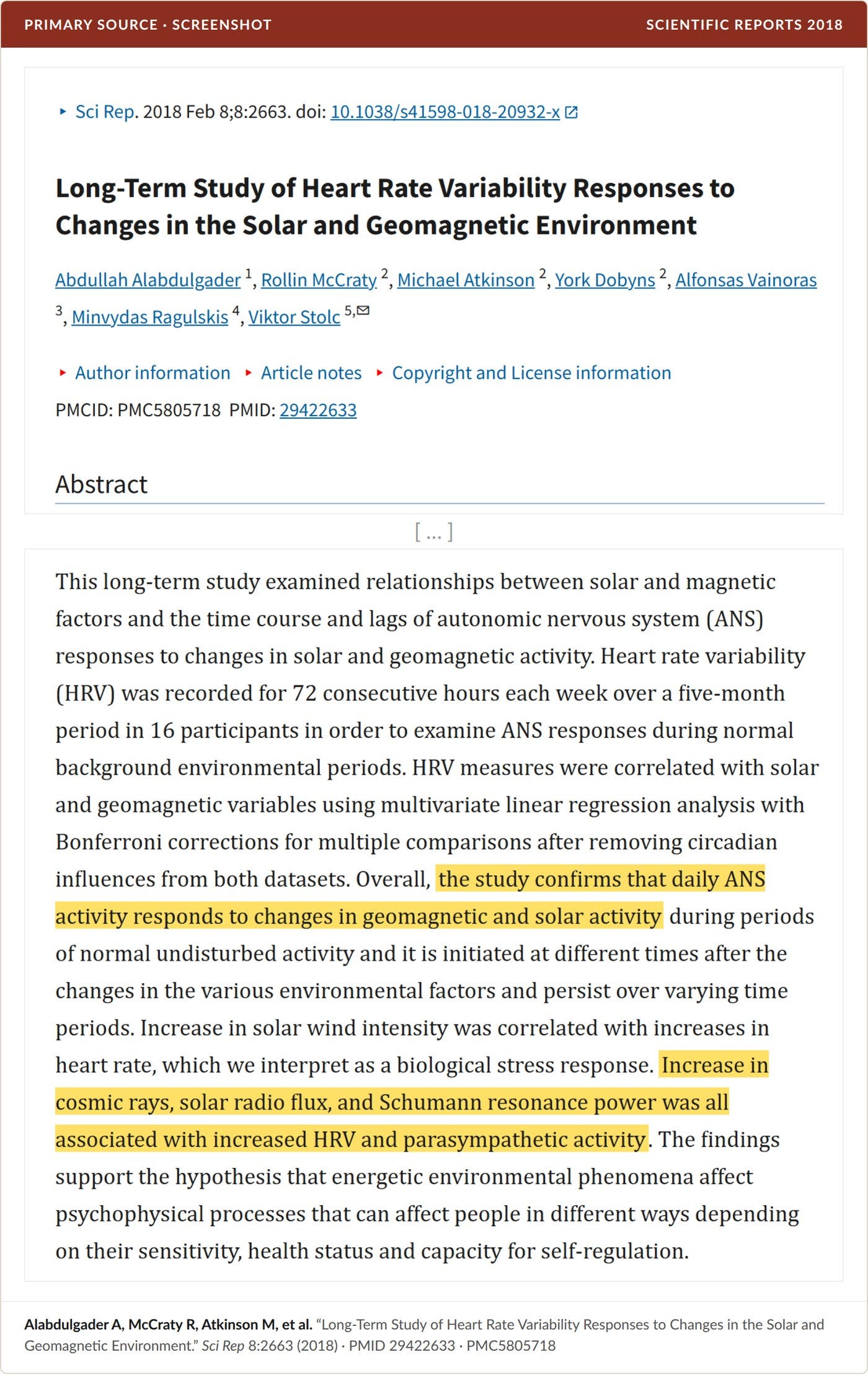
Today the same signal shows up in the heart. In a five-month study in Scientific Reports, cardiologist Abdullah Alabdulgader and HeartMath Institute researchers recorded heart rate variability (HRV) for 72 consecutive hours each week in 16 participants. They concluded that “the study confirms that daily ANS activity responds to changes in geomagnetic and solar activity” (Alabdulgader et al., Sci Rep 2018). A 2021 study across five countries found human heart rhythms synchronizing with the Earth’s time-varying magnetic field (Timofejeva et al. 2021).
The technical record
Design: 16 participants; HRV recorded 72 consecutive hours a week for five months; multivariate regression with Bonferroni correction after removing circadian effects. Solar wind intensity correlated with higher heart rate. Cosmic rays, solar radio flux and Schumann resonance power were associated with increased HRV and parasympathetic activity (PMC5805718).
Translation
The Sun is already inside us. Its weather passes through the magnetosphere and the ionosphere and reaches the pacemaker cells of the human heart. We are part of one resonant circuit.
V. Collective Attention Moves Matter
If the Sun can be entrained by tiny rhythms, and human hearts are entrained by the Sun, the remaining question is whether human consciousness gives off a signal coherent enough to travel the other way.
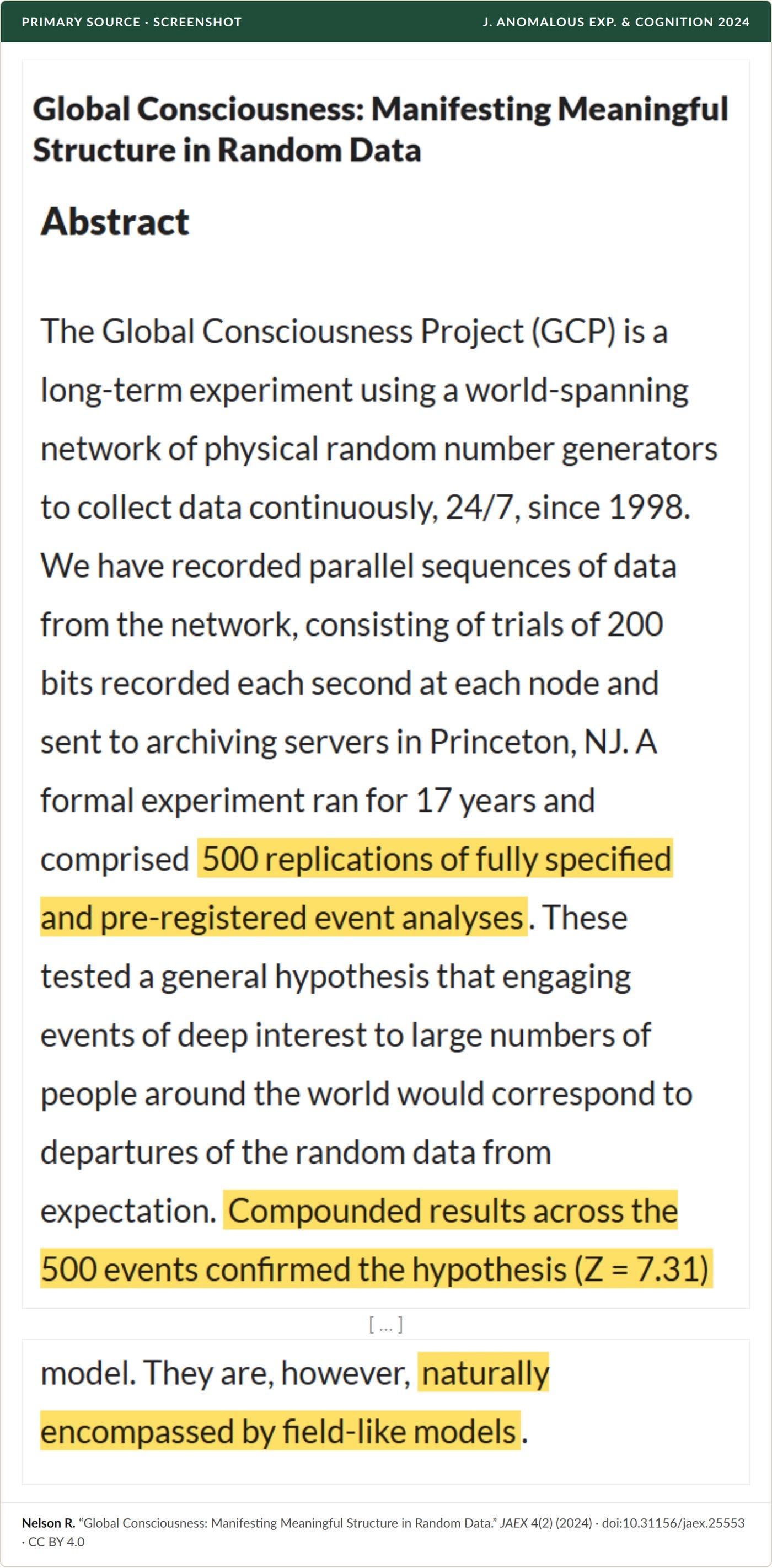
The largest experiment on that question ran for 17 years out of Princeton. The Global Consciousness Project, led by Roger Nelson, placed physical random number generators around the world. Before each major global event (New Year’s, disasters, mass meditations, funerals, moments of shared compassion), the team pre-registered the time window and statistical test. The formal experiment “comprised 500 replications of fully specified and pre-registered event analyses,” and the “compounded results across the 500 events confirmed the hypothesis (Z = 7.31).” Nelson reports that the structure in the data “cannot be explained by an experimenter effect or goal orientation model” and is “naturally encompassed by field-like models” (Nelson, JAEX 2024).
Translation
When millions of people focus on the same thing at the same time, physical systems built to be perfectly random stop being perfectly random. Collective attention leaves a measurable mark on matter.
Those devices run on electrons, the same charged particles that, gathered in plasma, make up the Sun.
VI. The One Experiment That Tried to Close the Loop
That brings us back to the children.
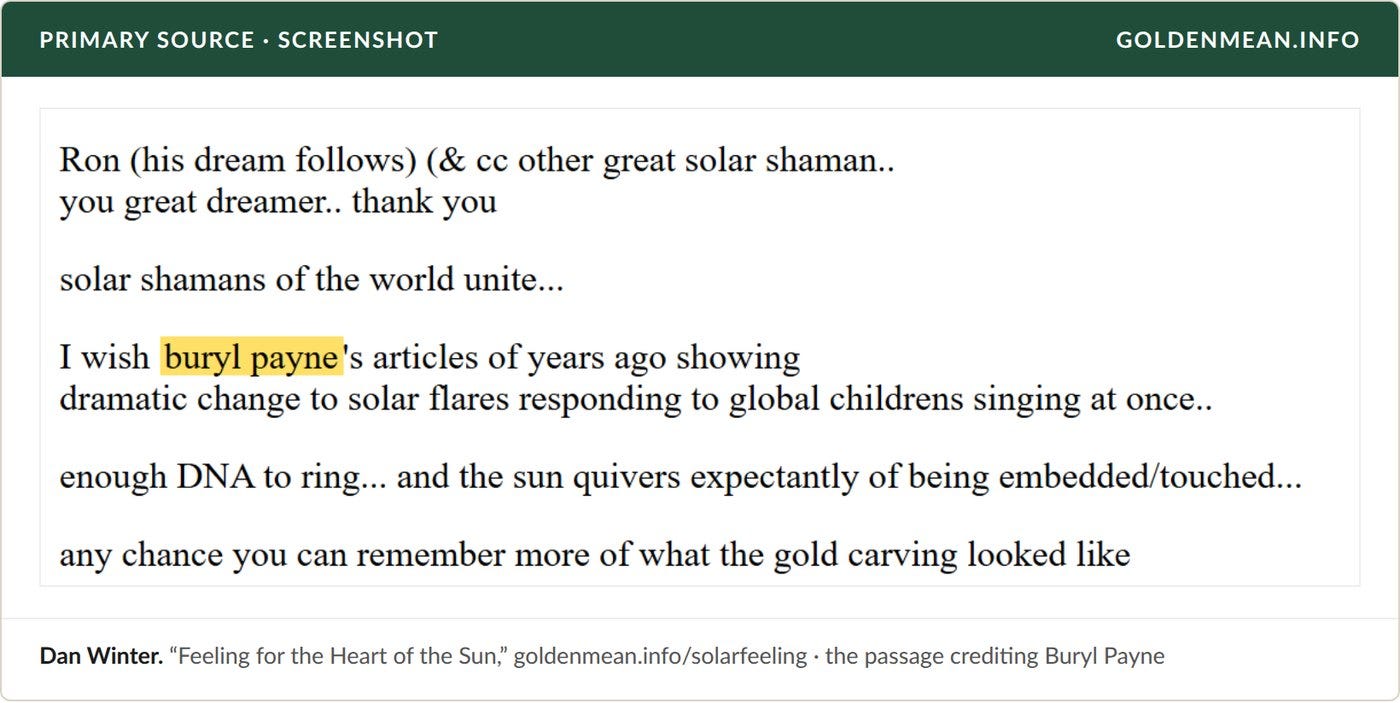
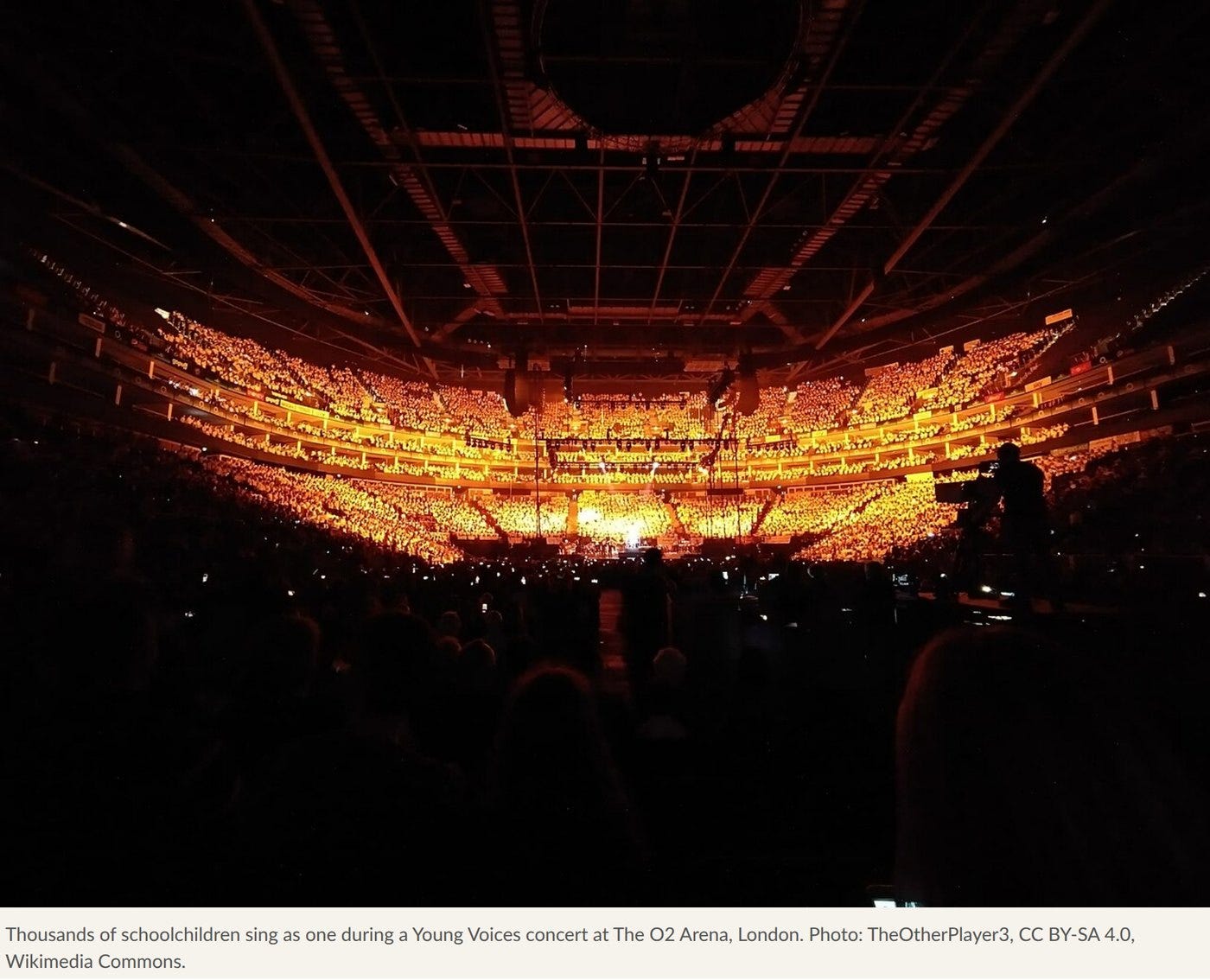
Dan Winter has told the story for years: “11 different times when a million more than a million children sang the same song we measure dramatic effect on the solar flare numbers the solar flares get peaceful” (Winter, Innervibe Show, 2013). His explanation comes from his work on implosion and heart coherence: coherent human emotion produces an inward-spiraling, centripetal field, and “the sun is needing requiring that centripetal effect.” In his essay Feeling for the Heart of the Sun he names his source: “buryl payne’s articles of years ago showing dramatic change to solar flares responding to global childrens singing at once” (Winter, goldenmean.info).
Buryl Payne, a physicist and psychologist, ran the experiment underneath the legend. Through his Academy for Peace Research he launched the Global Meditation Project: “People were invited to meditate at six dates each year (the Solstices, Equinoxes, etc.)” over three and a half years, ending in June 1988. His conclusion: “On the average the effects of several million people meditating appears to have resulted in a decrease in solar activity of 30% for a period of 7 to 10 days following the meditations.” He even proposed a mechanism: “Perhaps when enough people meditate they quiet down Earth’s field by some unknown resonance mechanism. The Earth in turn could be in resonance with the Sun and hence a quiet Earth could result in a quieter Sun” (Payne, Journal of Borderland Science, 1989). His interim report, “The Power of Thought to Influence the Sun,” appeared through the National Council for Geocosmic Research in 1986 (Payne bibliography).
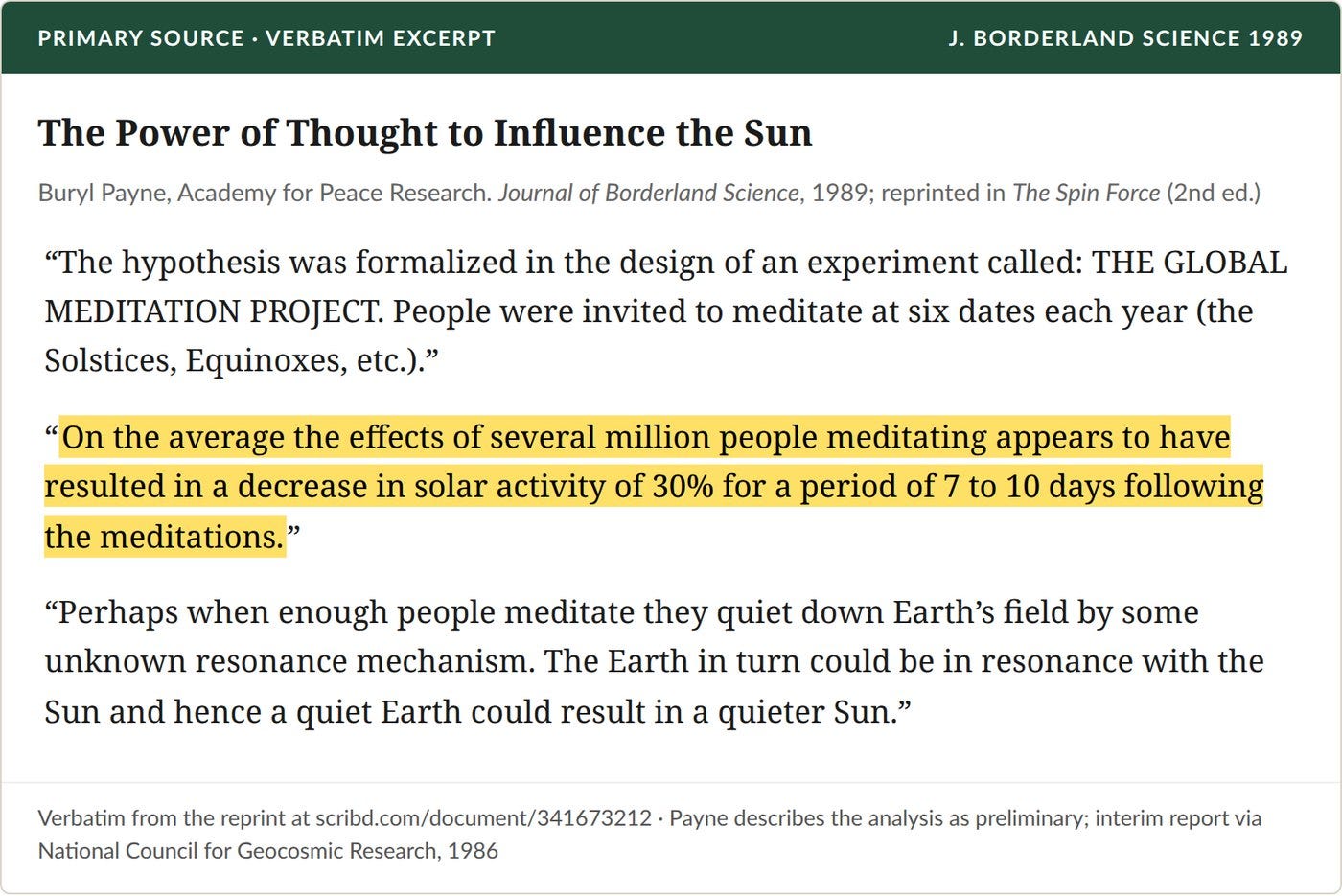
So the original experiment involved meditators, not children, and Payne called his analysis preliminary. “Children singing” is the form the story took as Winter retold it. The real history is stronger than the legend: millions of people, fixed dates set by the solar calendar, a consistent reported effect, and a proposed resonance mechanism. And for nearly 40 years, no one has tried to replicate it.
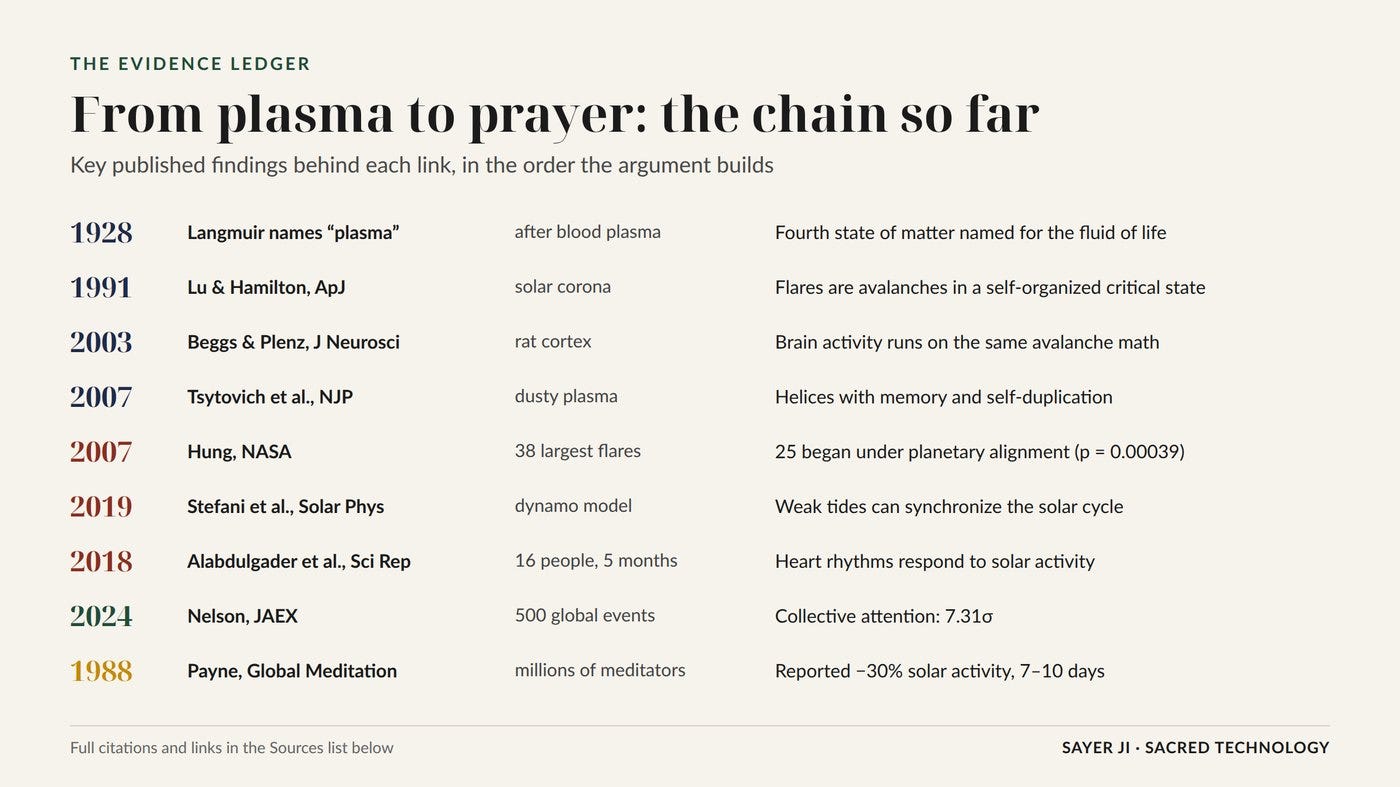
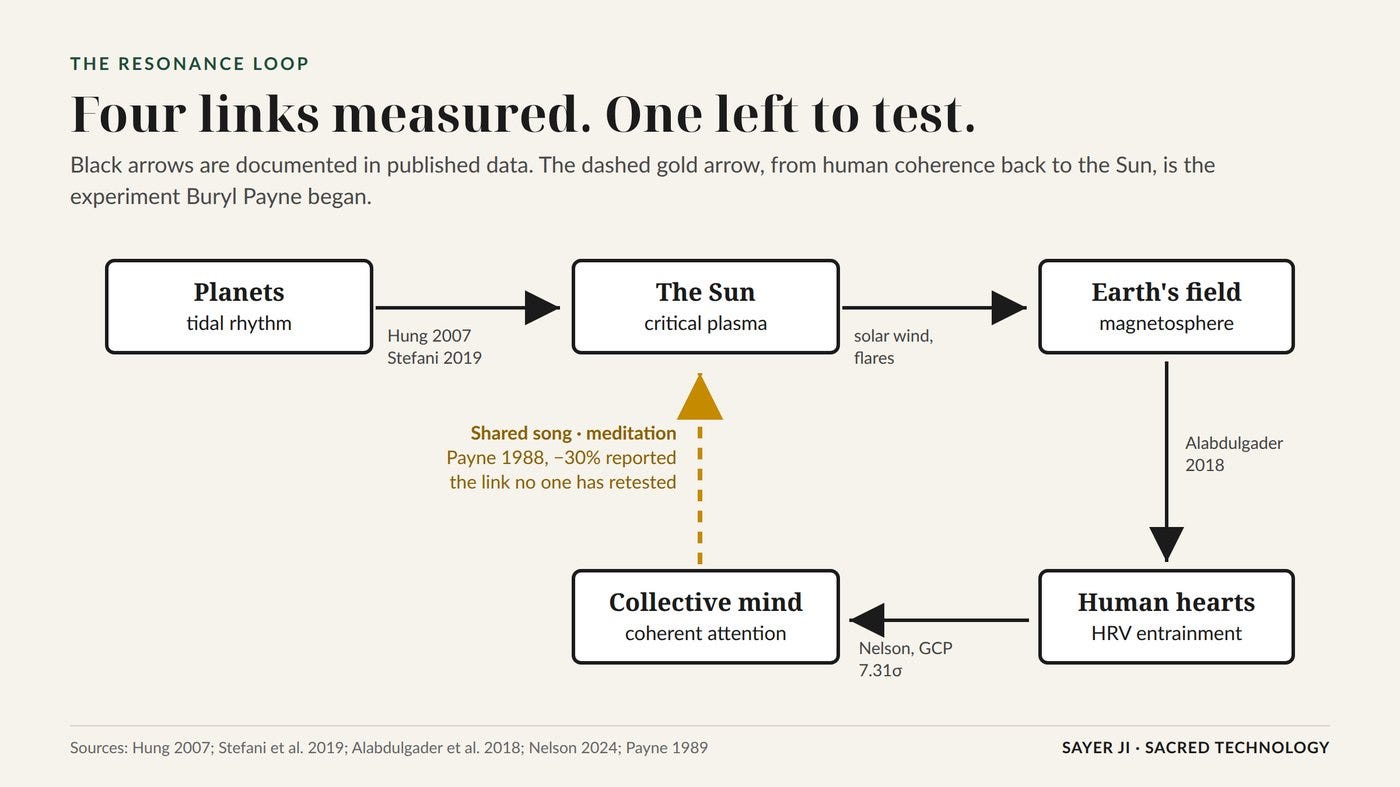
Every other link in the chain has now been measured. Payne’s experiment is the only one that tries to connect them all, and it’s the one science has left alone. His result is no longer a stray anomaly. It’s the obvious next test.
VII. The Oldest Sacred Technology
Every civilization that left records sang to the Sun.
The Gayatri mantra, chanted at dawn for millennia, addresses the Sun directly: “We meditate on the adorable glory of the radiant sun; may he inspire our intelligence.” Sheldrake quotes it, and notes that “in almost all other societies and civilizations, including medieval Europe, the sun and other heavenly bodies were thought to be alive and intelligent” (Sheldrake 2021). For Plato, the stars were “visible gods.” The hymns to the Aten, the Hopi sun-watchers, the Sun Dance and Inti Raymi were not superstitions waiting to be corrected. They were protocols: synchronized, rhythmic, emotionally coherent group practices timed to the solar calendar, on the same solstices and equinoxes Payne chose.
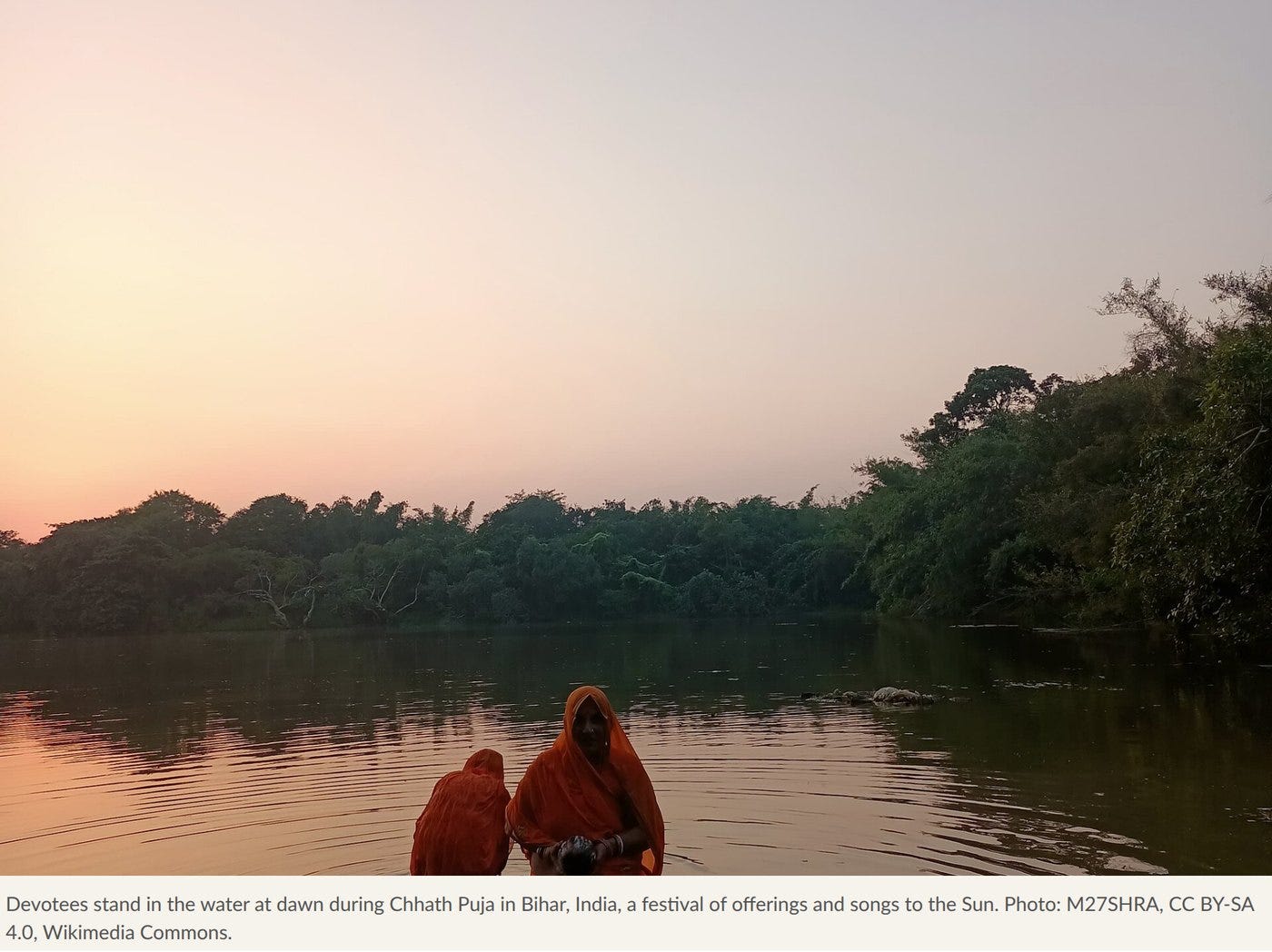
Temple says the Sun “sends inspiration to those who are receptive to it” (Temple Q&A). The Gayatri asks the Sun to “inspire our intelligence.” These are two descriptions of the same relationship, three thousand years apart.
That’s what I mean by Sacred Technology. It isn’t a gadget. It’s a practice that turns a crowd of separate nervous systems into one coherent oscillator, and directs it toward a star that we now know rings with ten million tones, sits at the edge of criticality, and keeps time with signals far weaker than itself.
A choir is an entrainment device. So is a chant. So is a million children singing the same song at the same moment.
VIII. The Experiment We Owe the Sun
We don’t need anyone’s permission. NOAA publishes the data: GOES X-ray flux at one-minute resolution, full flare catalogs, daily sunspot numbers, solar wind, and geomagnetic indices.
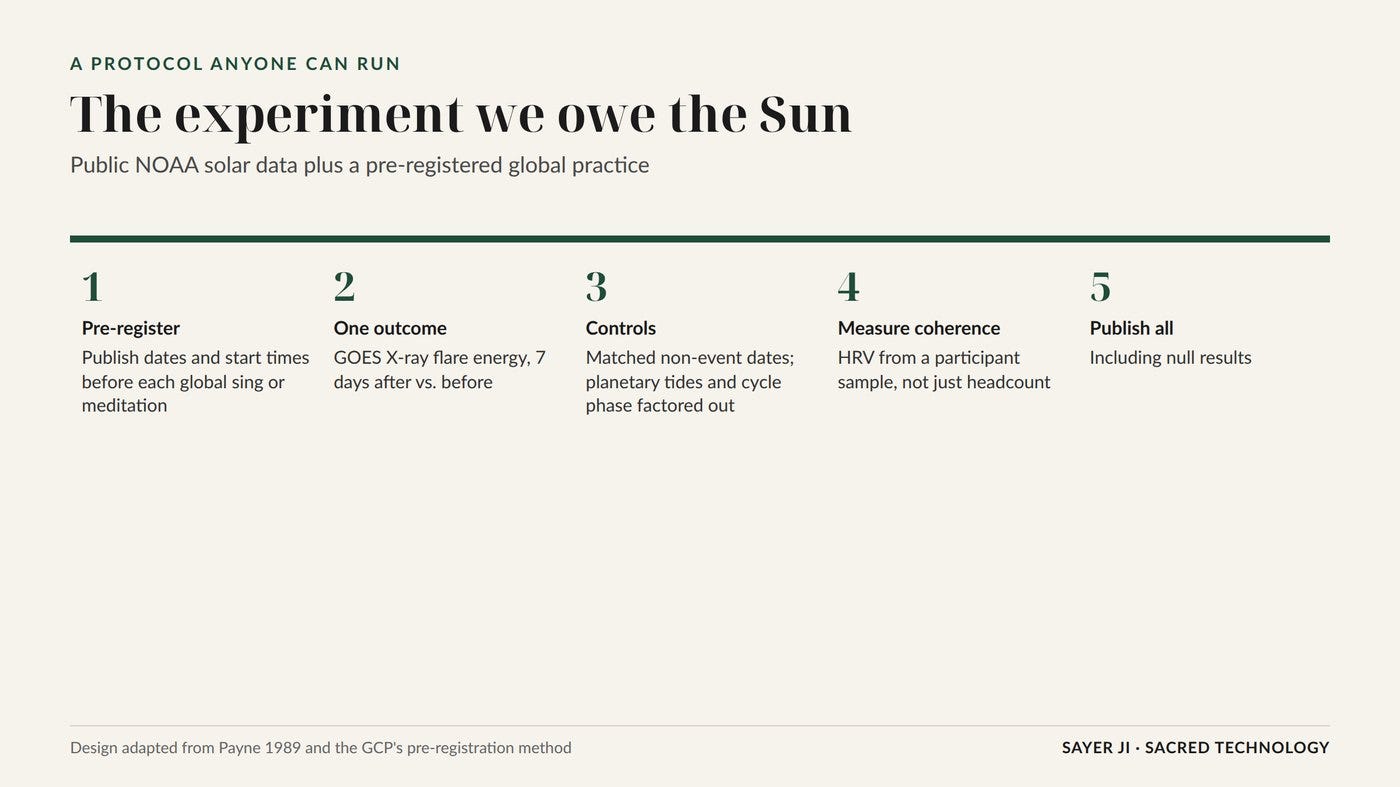
Pre-register the dates. Choose four to six global synchronized events a year (solstices, equinoxes and large existing mass sings) and publish start times in advance.
Fix one outcome. For example, total GOES X-ray flare energy in the 7 days after each event versus the 7 days before, matching Payne’s window.
Build controls. Compare against matched non-event dates in the same solar rotation and cycle phase, with planetary tidal configuration factored out, so Hung’s and Stefani’s effect is separated from ours.
Measure coherence, not headcount. Collect HRV from a sample of participants.
Publish everything, including null results.
If coherent human feeling reaches the Sun, a protocol like this would show it within a few cycles. If it doesn’t, we will have tested the oldest religious claim on Earth with the best instruments ever built, and that is its own kind of reverence.
The technical record
Strength of each link: the Hung figure comes from a NASA Technical Memorandum, not a refereed journal. Stefani’s mechanism is a dynamo model, and the planetary theory of solar activity is still debated among solar physicists. The Tsytovich structures come from a computer simulation. The Lozneanu details come from New Scientist‘s report on the paper. Payne’s study used meditators, not children; he described it as preliminary; and the surviving reprint does not describe controls. The Global Consciousness Project’s interpretation is disputed, but every proposed explanation, including experimenter psi, still implies an effect of mind on matter.
Children draw the Sun with a face. Sheldrake opens his paper by noting that this reflex is what makes the very idea seem “literally childish.”
Maybe the children are simply the first to notice what our instruments are only now starting to confirm: the Sun is a voice, a rhythm and, quite possibly, a listener.
So let’s sing, and this time let’s measure.
“We meditate on the adorable glory of the radiant sun; may he inspire our intelligence.”
The Gayatri mantra, trans. S. Radhakrishnan
🧵Read and share the X thread dedicated to this article.


Related in this series: Reimagining Astrology as Cosmic Resonance and Astrology as the Language of the Cosmos.
Sources
Stanford Solar Center: https://solar-center.stanford.edu/singing/
Stanford, Solar Music: https://solar-center.stanford.edu/singing/Sol_Music.pdf
Dan Winter, 2026:
Winter and Elena Danaan, 2023:
Jesse Michels on X:

full interview, 1:54:13:
Plasma Sources Science and Technology, 2009: https://home.sandiego.edu/~severn/psst9_1_010201ej_80yrs.pdf
Bohm–Wilkins interview: https://ia802903.us.archive.org/10/items/interviews_with_prof_david_bohm_-_maurice_wilkins_-_symmetry_seeker/Interview%20with%20Prof.%20David%20Bohm.pdf
DOI 10.1016/S0960-0779(02)00662-8: https://ouci.dntb.gov.ua/en/works/4vXQVqw9/
summary of the New Scientist report: https://www.unexplained-mysteries.com/column.php?id=111062
Tsytovich et al., New J. Phys. 2007: https://iopscience.iop.org/article/10.1088/1367-2630/9/8/263
Robert Temple: https://www.robert-temple.com/books2.html
Temple, Theosophical Society lecture:
Lu & Hamilton, ApJ 1991: https://ntrs.nasa.gov/citations/19910072271
Beggs & Plenz, J. Neurosci. 2003: https://pmc.ncbi.nlm.nih.gov/articles/PMC6741045/
Vazza & Feletti, Frontiers in Physics 2020: https://www.frontiersin.org/journals/physics/articles/10.3389/fphy.2020.525731/full
Phys.org: https://phys.org/news/2020-11-human-brain-resemble-universe.html
Sheldrake, JCS 2021: https://www.imprint.co.uk/wp-content/uploads/2021/04/Sheldrake_Open_Access.pdf
astrology-as-resonance essay: https://read.sayerji.com/p/reimagining-astrology-as-cosmic-resonance
Hung, NASA/TM-2007-214817: https://ntrs.nasa.gov/citations/20070025111
HZDR, “The Sun follows the rhythm of the planets”: https://www.hzdr.de/db/Cms?pOid=58444&pNid=99
Stefani et al., Solar Physics 2019: https://scispace.com/journals/solar-physics-5fs4m0v0/2019
Scafetta & Mörner: https://www.iris.unina.it/retrieve/5528c21b-bc7c-412a-b027-3c05c6b1121f/Scafetta-Morner-Giant-Flare.pdf
Scafetta & Bianchini 2022: https://ar5iv.labs.arxiv.org/html/2208.09293
Chizhevsky, The World-Historical Cycles: https://syllabusproject.org/wp-content/uploads/2023/06/the-world-historical-cycles-alexander-chizhevsky-.pdf
Esker Foundation: https://eskerfoundation.com/exhibition/anton-vidokle/
summary of the literature: https://en.wikipedia.org/wiki/Alexander_Chizhevsky
Alabdulgader et al., Sci Rep 2018: https://pmc.ncbi.nlm.nih.gov/articles/PMC5805718/
Timofejeva et al. 2021: https://www.heartmath.org/research/research-library/coherence/global-study-of-human-heart-rhythm-synchronization/
Nelson, JAEX 2024: https://journals.lub.lu.se/jaex/article/view/25553
Winter, Innervibe Show, 2013:
Winter, goldenmean.info: https://www.goldenmean.info/solarfeeling/index.html
Payne, Journal of Borderland Science, 1989: https://www.scribd.com/document/341673212/docslide-us-the-spin-force-a-collection-of-articles-experiments-2nd-edition-pdf
Payne bibliography: https://michael-chen-mg2n.squarespace.com/news/tag/sun
Temple Q&A:
Astrology as the Language of the Cosmos: https://read.sayerji.com/p/astrology-as-the-language-of-the
Images: NASA/SDO (public domain); Irving Langmuir portrait (public domain); Alexander Chizhevsky, Moscow Main Archive (CC BY 4.0); Young Voices at The O2, TheOtherPlayer3 (CC BY-SA 4.0); Chhath Puja, M27SHRA (CC BY-SA 4.0), all via Wikimedia Commons. Study screenshots are from the cited primary sources.
I used to have my biology students read Sheldrake's essay on the Sun's consciousness. Textbook biology can be soooo boring. 🌞
The strongest move in this piece is the honesty about which link is missing. Every other connection has been measured, and Payne's experiment is the one nobody has replicated in nearly forty years. That is the rare kind of argument that tells you exactly what would prove it wrong.
From my cosmopsychist framework, there is a layer underneath the chain that makes it more coherent rather than less. If consciousness is fundamental, then the Sun does not need to be granted sentence as an exception. It is a localized expression of the same field, organized at a scale and in a medium we do not share. Plasma behaving like life is not a curiosity in that framework. It is what you would expect when the same organizing principle expresses itself through different substrates.
Which reframes the entrainment question. Stefani's finding that a tide too weak to stir the interior can still synchronize a system poised at criticality is the physics of participation. A small coherent signal does not overpower the system. It harmonizes with it. That is not domination. It is resonance, and it is the mechanism your framework keeps pointing to.
The detail I will be sitting with is the naming. Plasma, named after blood, by a chemist struck by the analogy. Sometimes the language arrives before the understanding does.
One question: if the experiment were run and produced a null result, would that end the inquiry for you, or would it only rule out one version of it?