


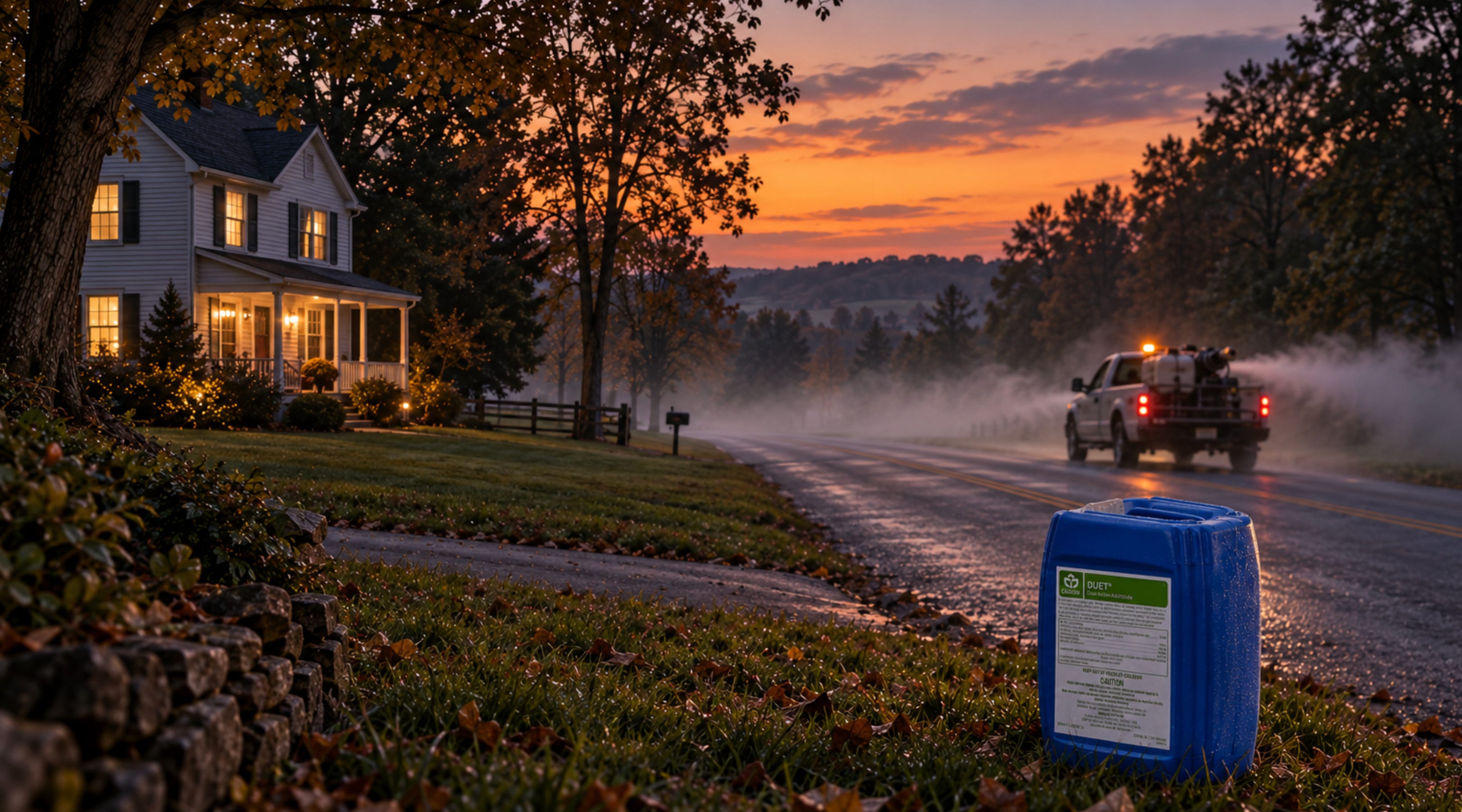
Since I began reporting on the residential pyrethroid fogging operations running adjacent to and within Pennsylvania’s Amish counties, I have received reports from residents of getting sick who suspect having been exposed to spraying operations. In the same weeks, the state’s public spray-notifications file has gone silent — 79 days without a single entry, in a season it had been updating every 2.6 days. The pattern is concerning. Every fact in this piece is one click from the state’s own documents.


Since I began reporting on the pesticide operations running adjacent to and within Pennsylvania’s Amish counties — beginning with the September 2 investigation “EXCLUSIVE: They Are Spraying Neurotoxins Over the Outbreak Amish Counties in PA” and the same-day announcement “Two things went live today. Both give the state a deadline.” — residents in the sprayed geography have contacted me reporting illness following exposure to the sprays. I am collecting these accounts and will report their specifics only after each is verified and each reporter has chosen a publication-consent option. What I can say now, without breaching any of those confidences: the reports exist, they are concerning, and they describe a pattern that a functioning public-health agency would already be tracking in a public log.
I am collecting these accounts. I am asking, formally, whether the state has any equivalent record of resident complaints from these same townships and dates — and, if it does, why it has not published them. That is a legitimate question. Resident-symptom reports after a documented residential application of a neuroactive pesticide are the kind of thing a public-health agency should be tracking, in a public log, in the ordinary course of business. If Pennsylvania is tracking them, the public should see them. If it is not, someone should have to explain why not.
I do not need to prove causation before saying that. A pattern of resident illness reports concurrent with residential applications of a synthetic pyrethroid formulation is, on its face, a fact pattern that warrants public disclosure of both the spray records and the complaint records. That is the entire proposition of this piece.
The public record, as it stands tonight
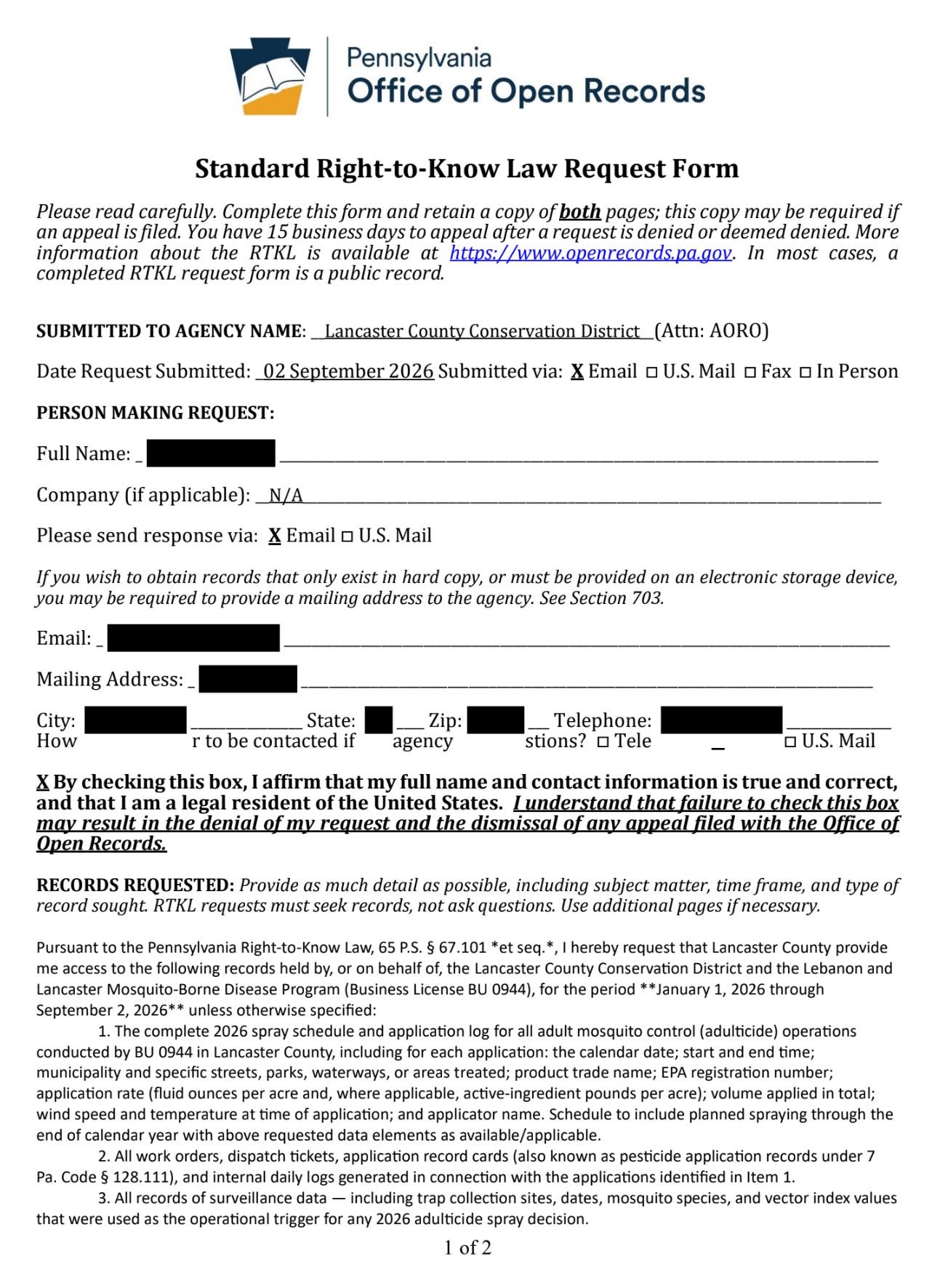
On September 2, 2026, I published an open letter to the President asking the federal government to obtain from Pennsylvania the full 2026 township-level record of the residential pyrethroid fogging program running in the same weeks and geography as the state’s Amish-focused MMR campaign. That letter was addressed to the President, to Secretary Kennedy, to Administrator Zeldin at the EPA, to the CDC Director, and to the Civil Rights Division at DOJ. On the same day, two Right-to-Know Law requests were filed with the county entities that hold the operational records: Lebanon County Conservation District and Lancaster County Conservation District. The statutory response deadline was September 10.
Eleven days later, this is what the state’s own file shows.
Two things went live today. Both give the state a deadline.

Read and share the X thread dedicated to this announcement.
The 79-day gap
The Pennsylvania Department of Environmental Protection 2026 Spray Notifications file is the public-facing record of the state’s spray operations. I re-pulled it tonight, September 13. Here is what it shows.
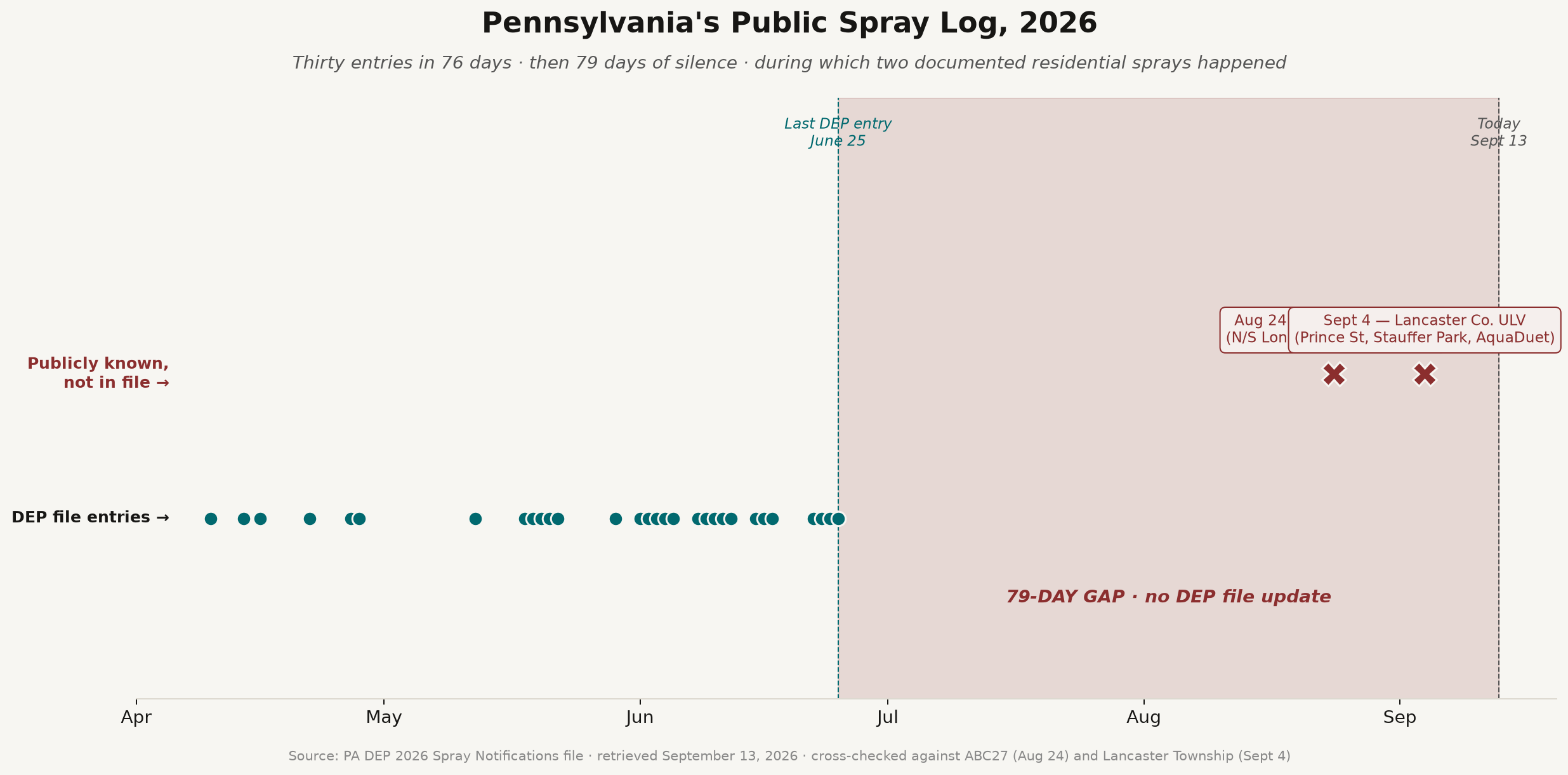
Thirty spray-events are listed for the 2026 season. The first entry is dated April 10, 2026. The last entry is dated June 25, 2026.
During the active portion of the 2026 season — April 10 to June 25 — the file was updated on average every 2.6 days. The longest gap between consecutive entries during that period was 14 days.
From June 25 to tonight, September 13, is 79 days without a new entry. That is 5.6 times longer than any prior in-season gap in the 2026 record. It is not a seasonal wind-down. The spray season is not over. Truck-fogging is happening in the state right now, and the state’s public file has not reflected any of it since late June.
The events the file does not show
At least two publicly documented residential ULV events have occurred in Lancaster or Lebanon counties during the 79-day silent window. Both were reported by mainstream news outlets. Neither is in the state’s public file.
August 24, 2026 — Lebanon County. ABC27 reported that the Lancaster/Lebanon Mosquito-Borne Disease Program conducted a truck-mounted ULV spray in North Londonderry Township and South Londonderry Township beginning around sunset Monday, in response to West Nile virus surveillance. The event was coordinated out of the Lebanon County Conservation District (BU 13818). AquaDuet — a synthetic pyrethroid formulation containing prallethrin, sumithrin, and piperonyl butoxide — was applied at approximately 1 fluid ounce per acre. The PA DEP 2026 file does not list this event.
September 4, 2026 — Lancaster County. Lancaster Township’s own website announced that “Prince Street, St. Mary’s Cemetery, Stauffer Park, and N. Plum Street will be sprayed for adult mosquitoes beginning around sunset (7:35 pm) on September 4th.” The event was conducted by BU 9444, operating out of the same Lancaster/Lebanon program, with the same AquaDuet formulation at approximately 1 fluid ounce per acre. Manheim Township, East Hempfield Township, and portions of Lancaster City were also covered. The PA DEP 2026 file does not list this event either.
Why these events belong in the file
A skeptical reader will ask a fair question: maybe the state’s file is only for aerial larvicide events over regional watersheds, and truck-mounted residential ULV events belong in some separate document. That question has a definitive answer from the file itself.
There is a truck-mounted ULV mosquito event listed in the file: Philadelphia City, June 8, 2026, product “Duet,” BU 4357, applied at 1.25 oz/acre. The rain date is June 9. The pest is listed as “Mosquito,” not “Black fly.” This entry proves the file structurally accepts truck-mounted residential ULV mosquito events. They are not filtered out by category. When Philadelphia sprays, it goes in the file. When Lancaster and Lebanon spray, it does not.
What ten days of silence from the county conservation districts means
The two RTKL requests filed September 2 had a statutory response deadline of September 10. As of tonight, September 13, I have received no public indication that either Lebanon County Conservation District or Lancaster County Conservation District has responded, granted, denied, or invoked the 30-day extension provision. Under Pennsylvania’s Right-to-Know Law (65 P.S. § 67.902), an agency’s failure to respond within five business days constitutes a deemed denial, from which the requester has 15 business days to appeal to the Pennsylvania Office of Open Records.
That appeal window is now open. It closes on October 1.
The fact pattern, stated plainly
The Pennsylvania Department of Environmental Protection’s public spray-notifications file has not been updated in 79 days. In the 79 days it has been silent, at least two residential pyrethroid ULV events have been publicly documented in Lancaster and Lebanon counties by mainstream news outlets and by the townships themselves. The file structurally accepts entries of exactly this type — a Philadelphia truck-spray event from June 8 is in the file — and yet the Lancaster and Lebanon events are not there. Residents in the sprayed geography have contacted me reporting symptoms consistent with acute exposure to the chemical class being applied. Two Right-to-Know Law requests for the underlying operational records were filed September 2 and have received no public response as of the September 10 statutory deadline.
I do not claim I have proven a causal chain from spray to illness. I claim, on the record, that the fact pattern above is one that warrants the state opening its books. That is what a functioning public-records system exists for. And in this case, so far, it is not functioning.
What the state can do this week to settle it
There are five documents the state of Pennsylvania could publish today that would end the ambiguity in this piece:
The full 2026 residential ULV spray log — every date, every township, every product, every application rate, every applicator ID, every complaint received. Not the aerial larvicide file. The residential ULV file that ought to exist but has not been produced.
The Lancaster/Lebanon Mosquito-Borne Disease Program’s 2026 complaint intake record — every phone call, email, or in-person report from residents concerning spray-related symptoms, adverse effects, or damage to property, animals, or plants, with the state’s response to each.
The vector-surveillance data that triggered each 2026 residential ULV event — the mosquito trap counts, the West Nile positivity data, and the specific threshold values the state applied to authorize each spray in each township.
The Sept 10 responses to the two Right-to-Know Law requests — either as public production or as formal notification of extension or denial, so that the record reflects a decision rather than silence.
A public statement from the PA DEP Bureau of Labs Vector Management program explaining why the DEP file has gone 79 days without a new entry during active spraying season, and when it will next be updated.
Producing all five would take a functioning bureau one afternoon. Producing none of them is a choice.
The three questions Pennsylvania should be made to answer this week
Why is the state’s public spray-notifications file 79 days out of date? The prior in-season update cadence was every 2.6 days. Nothing in the state’s spray schedule or public statements has explained the change.
Why do at least two publicly documented residential ULV events in Lancaster and Lebanon counties — August 24, 2026 and September 4, 2026 — not appear in the file? The file structurally supports truck-mounted mosquito events, as the June 8 Philadelphia entry demonstrates.
Is the state tracking, in any public or non-public record, resident reports of illness following the August 24 and September 4 residential ULV events — and if so, will those records be produced under the Right-to-Know Law requests filed September 2?
If you were exposed and got sick
If you live in Lancaster, Lebanon, Berks, Chester, York, or Dauphin County and became ill after a spray event this summer or fall, I want to hear from you. I am building a documented record of resident reports. Please reach out with:
The date and approximate time of the spray
Your township or nearest municipality
The symptoms you or anyone in your household experienced, and when they began
Whether anyone else in your household was affected (including children, elderly relatives, pets, or livestock)
Whether you sought medical care and, if so, what the provider said
Whether you have submitted a complaint to any state, county, or municipal authority — and if so, what response you received
I will not publish your name or identifying information without your explicit permission. Your details will be kept confidential and shared only with medical or legal advisors with your consent. What I need is the record. Email us at
Author’s note: The two RTKL requests referenced above were filed September 2. The September 2 open letter to the President is available at An Open Letter to President Trump: The Missing Spray Log. If either conservation district responds to the RTKL requests, I will publish the responses in a follow-up. If neither does, I will publish the deemed-denial appeal to the Pennsylvania Office of Open Records before the October 1 window closes.
Sources cited in this piece
PA DEP 2026 Spray Notifications file — retrieved September 13, 2026. Most recent entry dated June 25-26, 2026. Thirty 2026-season entries total. Mean gap between consecutive entries during the April 10 – June 25 active period: 2.6 days. Longest in-season gap prior to the current silence: 14 days.
Sayer Ji, “EXCLUSIVE: They Are Spraying Neurotoxins Over the Outbreak Amish Counties in PA”, Substack, September 2, 2026.
Sayer Ji, “Two things went live today. Both give the state a deadline.”, Substack, September 2, 2026.
Sayer Ji, “An Open Letter to President Trump: The Missing Spray Log”, Substack, September 2, 2026.
I didn’t realize any county in the US was still doing this. The government did it in government installations when I was stationed years ago. It’s recognized them that it was dangerous, same with crop dusting, which does continue.
Good job, Sayer! God bless freedom lovers everywhere!