


In 2023, the Nobel Prize in Physiology or Medicine went to the discovery of how to keep synthetic messenger RNA from setting off the body’s immune alarms. The molecule that made it possible is called pseudouridine. Pseudo, from the Greek, means false. Three years later, the people who defend that technology still call its critics pseudoscientists. They have the right word. They have it pointed at the wrong people.


“Pseudoscience” may be the most effective word in modern medicine, and it rarely gets used to describe a method. It works as a verdict. Once someone is called a pseudoscientist, the conversation is over. Nobody has to look at their evidence or answer their questions, and they get pushed out of polite company and often off the platforms where the conversation is happening.
Usually the label goes to people who doubt the pharmaceutical model: those who ask whether a synthetic molecule the body has never encountered belongs in it, or whether a technology was tested before it was deployed. The people who make the products, the agencies that approve them and the fact-checkers who defend them are assumed to be the scientists.
This article turns that assumption around. If pseudoscience means anything precise, it means claiming the authority of science without accepting its discipline. Under that definition, the clearest current case is not the person asking questions about mRNA injections. It is the enterprise that told the public in 2021 that the product would stay where it was put, do only what it was designed to do (“safe and effective”), and leave nothing behind, and then kept its authority when each of those claims ran into the evidence.
My test case is synthetic, nucleoside-modified mRNA. Commercially, it is the most celebrated biotechnology platform of the century. By the standards of the philosophy of science, it is one of the most revealing examples of confidence running ahead of evidence.
What Pseudoscience Actually Means
The modern demarcation problem, meaning how to tell science from non-science, starts with Karl Popper. In the Stanford Encyclopedia of Philosophy’s summary, Popper held that “a theory is scientific only if it is refutable by a conceivable event,” and that a theory “modified solely to accommodate such observations” or “consistent with all possible observations” is unscientific.
Imre Lakatos refined the idea. He argued that scientific programs protect a “hard core” of assumptions with auxiliary hypotheses. A program is healthy while those adjustments keep producing new, testable knowledge. In this summary of Lakatos’s methodology, once a program “only makes ad hoc changes to protect itself, it begins to degenerate.”
Taken together, these give five practical warning signs of pseudoscience:
Unconditional assurances. Claims stated with more certainty than the evidence allows.
Ad hoc rescue. When a prediction fails, the claim is reworded instead of withdrawn.
Moving endpoints. The definition of success shifts to fit whatever the data show.
Category manipulation. Terms are redefined so a product escapes the scrutiny its real nature would trigger.
Immunity from disconfirmation. Anomalies are treated as threats to manage, not signals to investigate, and the people who report them are discredited instead of answered.
Notice that none of these tests asks how sophisticated the tools are. A lab full of sequencers and bioreactors can produce pseudoscience as easily as a tent revival can. The question is whether claims are exposed to refutation and whether refutation is respected.
First Principles: The Xenobiotic Problem
Before looking at mRNA specifically, it helps to state something that pharmacology itself accepts but rarely says out loud.
A xenobiotic, from the Greek xenos (foreign) and bios (life), is “a chemical substance found within an organism that is not naturally produced or expected to be present within the organism,” according to the standard reference definition. The same entry lists drugs among the main classes of xenobiotics, next to carcinogens, pesticides, food additives and environmental pollutants. The Quebec government’s official terminology database lists “médicaments,” or medicines, in the same family as pesticides and toxins.
This is not a fringe position. It is the textbook framework. A synthetic pharmaceutical is a foreign molecule by definition. The body’s main machinery for handling one, the hepatic cytochrome P450 system and the conjugation pathways that follow it, is called xenobiotic metabolism for a reason. The body does not use these drugs as building blocks. It identifies them as foreign, transforms them and removes them.
The supply chain makes the point concrete. A 2026 report in The Hill on drug-supply vulnerabilities cited an estimate that 99 percent of pharmaceutical feedstocks and reagents are derived from petrochemicals, and the American Gas Association’s pharmaceutical report repeats the same figure. Modern drugs come largely out of the refinery’s chemical pathways, not the living world.
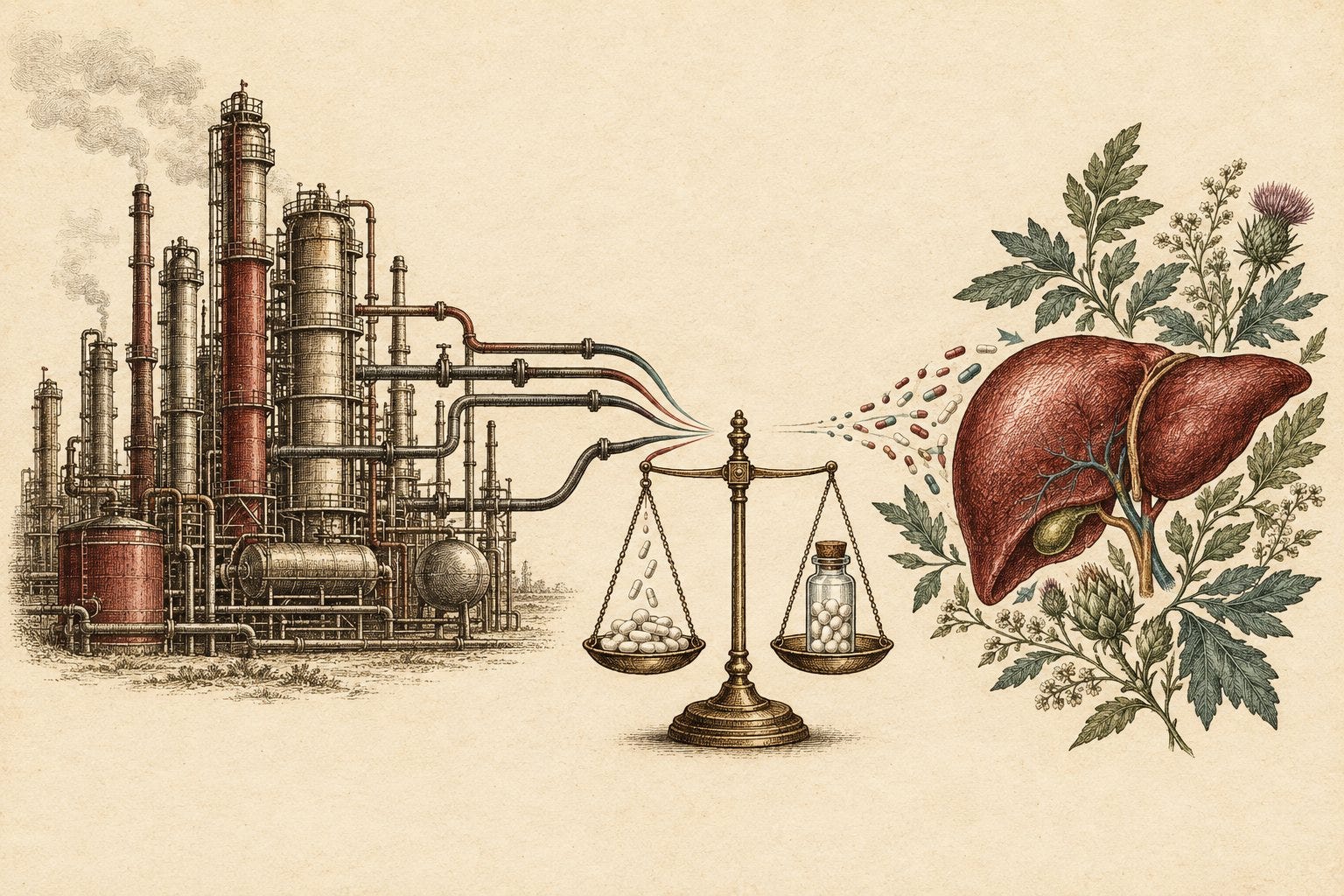
That reverses the burden of proof. A substance with no co-evolutionary history with human physiology does not get compatibility by default. It has to earn it, and the evidence should match the scale of the intervention. A tradition that skips that step, treats novelty as innovation and calls doubt ignorance, has given up the precautionary logic that science is supposed to have.
Synthetic mRNA is the most extreme example of the xenobiotic problem so far, because it was engineered to keep the body from recognizing it as foreign.
A Foreign Molecule Disguised as Self
Natural messenger RNA is one of the most short-lived and tightly regulated molecules in the cell. It carries a temporary copy of a gene’s instructions to the ribosome and is then quickly broken down. Its brevity is a safety feature.
When researchers first tried to use lab-made mRNA as a drug, the body did what it is designed to do: it recognized the molecule as foreign and mounted an inflammatory response. The breakthrough that won the 2023 Nobel Prize in Physiology or Medicine was the discovery that replacing natural uridine with modified bases let the synthetic mRNA “evade innate immune recognition and improve protein expression.” The Nobel Committee’s own technical summary explains that incorporating pseudouridine and related modifications “abrogated activation of inflammatory responses,” and that later work with N1-methylpseudouridine “further improved the mRNA platform both in terms of reducing recognition of innate immune receptors and increasing protein expression.”
Put plainly, the prize went to the discovery of how to get a foreign genetic molecule past the body’s system for detecting foreign genetic molecules.
The name says it too. Pseudo means false. Pseudouridine is, literally, “false uridine.” The working ingredient of the platform is a nucleotide built to look natural to the immune system while behaving differently from what the body would make itself.
The delivery system is just as synthetic. The manufacturer’s composition table for BNT162b2, released by the UK regulator under freedom of information, lists two proprietary “functional lipids,” ALC-0315 (an ionizable aminolipid) and ALC-0159 (a polyethylene glycol, or PEG, lipid), each made to “in-house specification” and not to a pharmacopeial standard. These are not dietary fats. They are engineered amphiphiles designed to carry a payload across cell membranes that would otherwise keep it out.
Technical note: what is in the vial. Each 30 µg BNT162b2 dose contains about 0.43 mg ALC-0315, 0.05 mg ALC-0159, 0.09 mg DSPC and 0.2 mg cholesterol, plus sucrose and buffer salts (UK MHRA FOI release). The RNA payload uses N1-methylpseudouridine in place of every uridine, the modification the Nobel Committee credits with reducing innate immune recognition and increasing ribosome occupancy.
The Category Maneuver: Gene Therapy by Another Name
The fourth warning sign is changing the category to avoid scrutiny. With mRNA, the change was a single word: vaccine.
The FDA’s own guidance says what these products are. In its documents on human gene therapy, the agency writes that it “generally considers human gene therapy products to include all products that mediate their effects by transcription or translation of transferred genetic material,” and it lists “in vitro transcribed ribonucleic acid (RNA)” as an example (FDA, Human Gene Therapy for Rare Diseases; see also FDA, Human Gene Therapy Products Incorporating Human Genome Editing). The same guidance defines human gene therapy as seeking “to modify or manipulate the expression of a gene.”
Synthetic mRNA products work in exactly that way. They deliver transferred genetic material, in vitro transcribed RNA, which human ribosomes translate into a protein the person’s own genome does not encode. By the regulator’s own wording, this is the mechanism of gene therapy.
The objection is that mRNA “does not change your DNA.” But the FDA’s definition does not require changing DNA. Gene therapy also covers products that act through translation of transferred genetic material, and “altering gene function” includes taking over the machinery of gene expression to make a foreign protein in human tissue. The DNA-editing question is a distraction. The relevant fact is that the product is a genetic instruction the body did not write, run on the body’s own equipment.
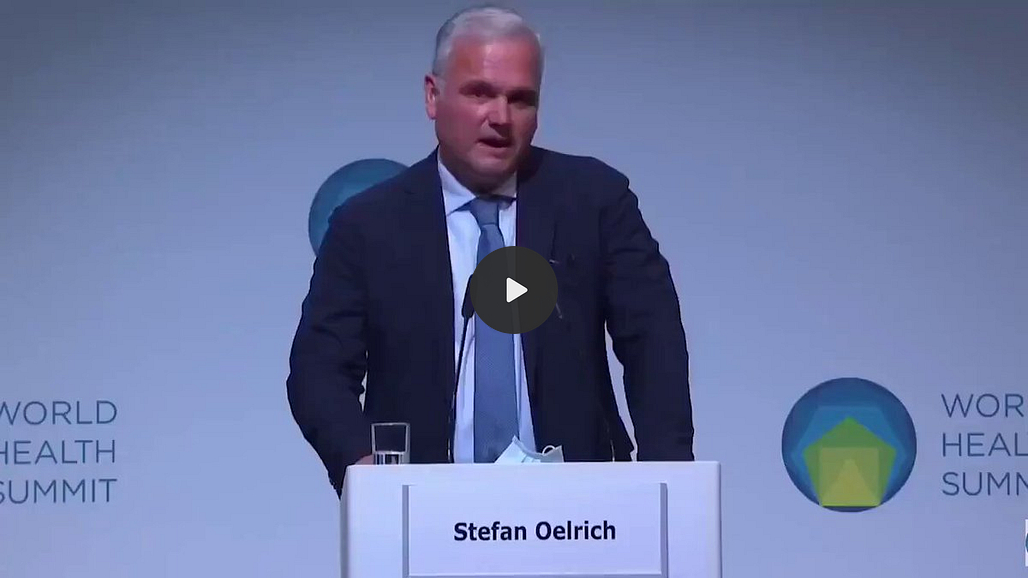
Industry has said as much. At the 2021 World Health Summit, Bayer pharmaceuticals chief Stefan Oelrich said, “Ultimately the mRNA vaccines are an example for that cell and gene therapy,” and added that two years earlier a public survey on accepting gene or cell therapy would likely have produced “a 95% refusal rate” (Reuters). Reuters argued that he was describing public acceptance of biotech innovation, not formally classifying the shots. Even on Reuters’ reading, a leading pharmaceutical executive presented mRNA as evidence that the public had come to accept a category it would previously have refused. That is a statement about how the product was labeled, not about its underlying biology.
Calling a gene-expression product a “vaccine” brought it under a regulatory and cultural framework of routine, universal and often mandated use, with liability protections, school schedules and decades of public trust, and kept it out of the framework built for genetic interventions: long-term follow-up and caution about integration, persistence and off-target effects. That is not a scientific distinction. It is a branding decision with regulatory consequences.
Test One: The Assurances That Did Not Hold
Popper’s standard is simple: make claims that could be proven wrong, and accept it when they are.
In 2021, U.S. public-health authorities made clear, falsifiable claims. The CDC’s archived “Myths & Facts” page told the public that the genetic material “never enters the nucleus of your cells,” and that after the immune response the body “gets rid of all the vaccine ingredients just as it would get rid of any information that cells no longer need” (CDC archive). An archived version of the CDC’s “Understanding mRNA COVID-19 Vaccines” page said the vaccines “are given in the upper arm muscle” and that “the cell breaks down and gets rid of the mRNA soon after it is finished using the instructions” (CDC Stacks).
Each of those claims could be tested, and each was tested.
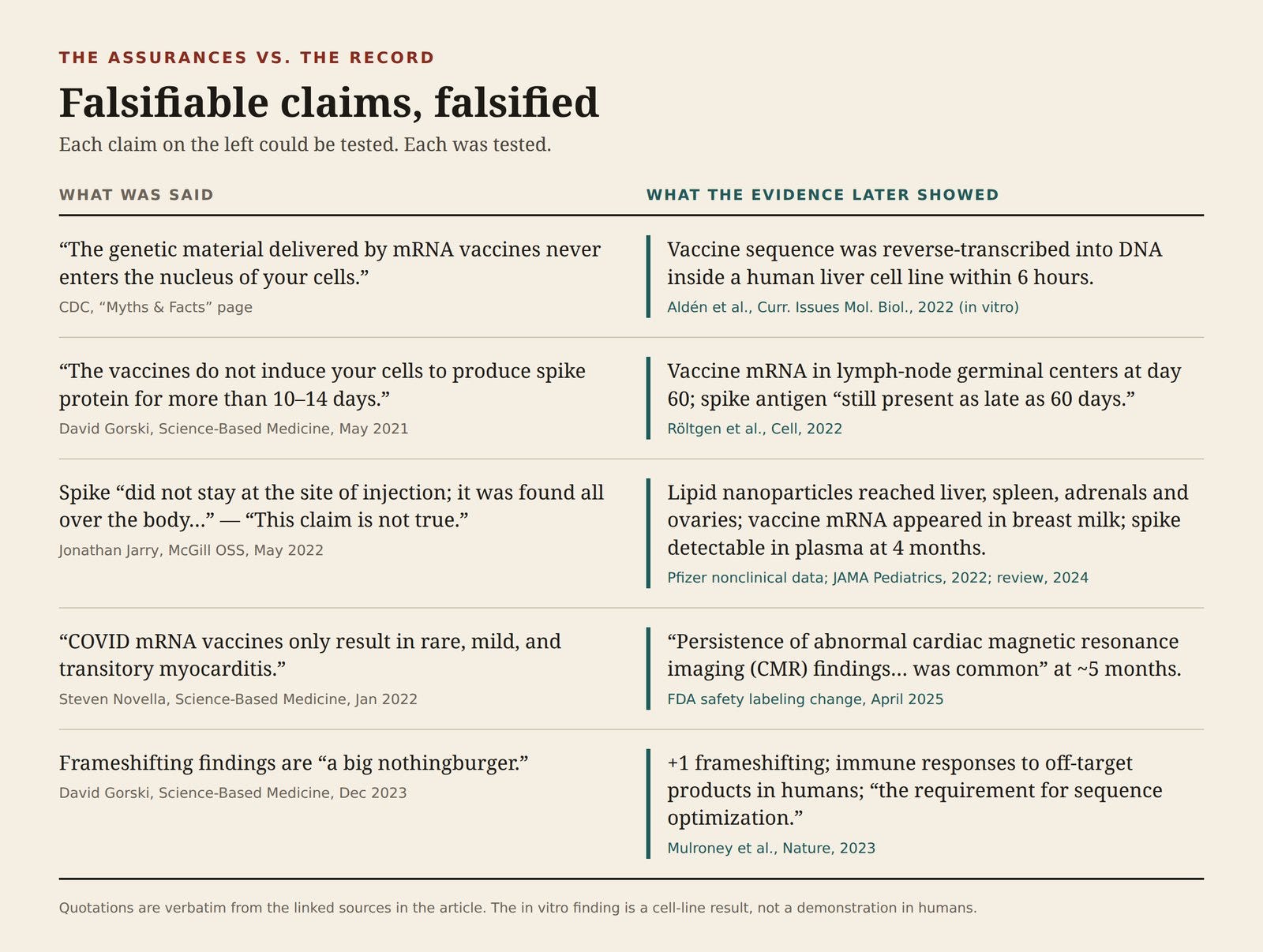
On “soon” and “gets rid of”: In a 2022 paper in Cell, Röltgen and colleagues biopsied lymph nodes of vaccinated people and “detected vaccine mRNA collected in the GCs [germinal centers] of LNs on day 7, 16, and 37 post vaccination, with lower but still appreciable specific signal at day 60,” with spike antigen “still present as late as 60 days post-2nd dose” (Röltgen et al., Cell). Castruita and colleagues found full or partial vaccine mRNA sequences circulating in plasma up to 28 days after vaccination. A Clinical Infectious Diseases literature summary called that persistence “surprising” because “it has generally been assumed” the mRNA would be “rapidly degraded.”
The word assumed matters. The public was given a certainty, while the literature later admitted it had been an assumption.
On “upper arm”: Pfizer’s own nonclinical pharmacokinetic package found that lipid nanoparticles reaching the bloodstream distribute to the liver. In a radiolabeled-lipid study, outside the injection site, recovery was highest in the liver (up to 18 percent of the dose), with measurable amounts in spleen, adrenal glands and ovaries (translated Japanese regulatory biodistribution summary). In humans, a 2022 study in JAMA Pediatrics detected trace vaccine mRNA in breast milk up to 45 hours after vaccination, concentrated in extracellular vesicles. The authors wrote that their data showed “the biodistribution of COVID-19 vaccine mRNA to mammary cells and the potential ability of tissue EVs to package the vaccine mRNA that can be transported to distal sites” (Hanna et al., JAMA Pediatrics). A 2024 review of RNA vaccine biodistribution collected human studies detecting the encoded spike antigen in plasma, lymph nodes and skin, including one cohort in which spike “declined significantly at 4 months after the double vaccination but was still detectable.”
On “never enters the nucleus”: In a 2022 in vitro study, Aldén and colleagues exposed a human liver cell line to BNT162b2 and reported “increased nucleus distribution of LINE-1,” an endogenous reverse transcriptase, and that the vaccine sequence was “reverse transcribed intracellularly into DNA in as fast as 6 h” (Aldén et al., Current Issues in Molecular Biology). This was a cancer-derived cell line in a dish, not a living person, and the finding has been disputed. That is exactly the point. A falsifiable question was raised by a peer-reviewed signal, and the right response was to replicate it in human tissue, not to keep repeating “never.”
Technical note: persistence by design. The persistence is not mysterious. N1-methylpseudouridine was chosen to increase translation and reduce immune clearance (Nobel Committee), and lipid encapsulation slows degradation. The Clinical Infectious Diseases summary notes that the investigators attributed plasma persistence to “slow release of its encapsulating lipid nanoparticles from the site of injection and slowing of mRNA degradation by the lipid encapsulation” (CID). The engineering goal, a molecule more durable and less visible than natural mRNA, contradicted the public assurance that it would behave like natural mRNA.
In a functioning science, a falsified claim is withdrawn and the people who said it apologize. Here the claims were quietly archived, and those who had questioned them kept the label.
Test Two: Does the Cell Read the Code as Written?
The whole logic of mRNA as medicine depends on one premise: the ribosome will read the synthetic instructions faithfully and produce exactly the intended protein, and nothing else.
In December 2023, a team at the University of Cambridge tested that premise and published the result in Nature. Mulroney and colleagues found that “incorporation of N1-methylpseudouridine into mRNA results in +1 ribosomal frameshifting in vitro and that cellular immunity in mice and humans to +1 frameshifted products from BNT162b2 vaccine mRNA translation occurs after vaccination” (Mulroney et al., Nature).
A frameshift means the ribosome slips one letter along the code and reads a different sequence of three-letter “words,” producing a protein that was never designed. The authors linked this to “N1-methylpseudouridine-induced ribosome stalling,” which is the same modification that made the platform workable.
The paper is careful. It notes that “there are no adverse outcomes reported from mistranslation of mRNA-based SARS-CoV-2 vaccines in humans,” and it shows that redesigning the “slippery sequences” can reduce the problem. But look at what that means for scientific order. A basic question about translational fidelity, whether the product makes only what it says, was answered in a peer-reviewed study after the product had been given to very large numbers of people. The authors themselves concluded that their findings “demonstrate the requirement for sequence optimization.”
A requirement identified after mass deployment is not a minor footnote. It shows that the basic claim that synthetic mRNA reliably makes only the intended protein had been assumed, not demonstrated.
Test Three: Is It Only What the Label Says?
A pharmaceutical product is supposed to contain what is declared and nothing else. Synthetic mRNA is made by transcribing RNA from a bacterial DNA plasmid template, which then has to be removed.
A 2025 study in Autoimmunity measured DNA in 32 vials representing 16 lots of Pfizer-BioNTech and Moderna COVID-19 products from Ontario, Canada. By fluorometry, total DNA in all vials exceeded the FDA and WHO residual-DNA limit by “36-153-fold for Pfizer and 112-627-fold for Moderna,” after correcting for nonspecific binding to the modRNA. The researchers also detected the SV40 promoter-enhancer-ori sequence only in Pfizer vials and estimated “1.23 × 10^8 to 1.60 × 10^11 plasmid DNA fragments per dose encapsulated in lipid nanoparticles” (Speicher et al., Autoimmunity).
The authors describe their sample as “a limited number” of vials, and by the targeted qPCR method most lots were within limits. The importance of the finding is not that it settles the question. It shows the question was open. DNA fragments packaged in the same lipid nanoparticles built to get into cells are a different exposure from loose DNA in an injectable, and residual-DNA limits developed for older biologics were never designed for transfection-grade delivery systems.
Test Four: Did the Immune System Do What Was Predicted?
The immunological model behind repeated boosting was simple: more doses, more protection. In 2023, Irrgang and colleagues reported in Science Immunology that three doses of mRNA vaccine produced “a class switch toward noninflammatory, spike-specific IgG4 antibodies,” a shift not seen after an adenoviral vector vaccine (Science Immunology commentary).
IgG4 is the antibody subclass usually associated with tolerance after long-term antigen exposure, the profile seen in beekeepers and allergen immunotherapy. The accompanying commentary noted that pure IgG4 “might be less effective than IgG1 or IgG3 antibodies in facilitating opsonization by phagocytes, complement fixation, and NK cell–dependent elimination of infected cells,” and that the switch tends to happen “when individuals are exposed for an extended period of time to a protein or glycoprotein antigen.”
Whatever the long-term clinical meaning turns out to be, this was not part of the original model. It emerged later and was absorbed into the narrative instead of prompting a reassessment of a repeated-dosing strategy that was already under way.
Test Five: Moving Endpoints
Lakatos’s degenerating program shows itself in how it handles failure. Watch the endpoints.
Transmission. Public policy, including mandates, passports and workplace requirements, rested on the idea that vaccination protects others. Yet when a member of the European Parliament asked whether the product had been tested for stopping transmission before it went to market, Pfizer executive Janine Small answered: “No. We had to really move at the speed of science” (FactCheck.org). FactCheck.org’s defense was that “the clinical trials did not assess if the vaccine could reduce transmission,” and that the FDA’s emergency authorization had stated there was no “evidence that the vaccine prevents transmission.” That defense is itself the indictment. A policy premise that was never tested was enforced as settled science, and when the gap became public, the people who had pointed it out were told it was old news.
Safety. Myocarditis signals were first described as rare and mild. In April 2025, the FDA required new label language stating that after the 2023–2024 formula, “the highest estimated incidence was in males 16 through 25 years of age (approximately 38 cases per million doses),” and that “at a median follow-up of approximately 5 months post-vaccination, persistence of abnormal cardiac magnetic resonance imaging (CMR) findings that are a marker for myocardial injury was common” (FDA safety labeling change letter).
Population. A product once recommended for nearly everyone six months and older is now approved, in its 2026–2027 formula, for people 65 and older or those 6 months through 64 years “with at least one underlying condition that puts them at high risk” (FDA, Spikevax).
Effectiveness. In August 2025, HHS began winding down mRNA vaccine development under BARDA and terminated 22 investments. Secretary Robert F. Kennedy Jr. said “the data show these vaccines fail to protect effectively against upper respiratory infections like COVID and flu” (HHS).
Each change is presented as “following the science.” But a theory that accommodates every outcome, from preventing infection to preventing severe disease, from everyone to the high-risk only, from rare and mild to persistent cardiac findings being common, while keeping its core claim of “safe and effective,” is what Popper described: compatible with all observations and therefore unfalsifiable as practiced.
The platform keeps growing anyway. The FDA now lists an approved mRNA influenza vaccine, Moderna’s MFLUSIVA, for adults 50 and older (FDA). The hard core is protected while its anomalies pile up at the edges.
The Inversion
Set the five warning signs beside the record.
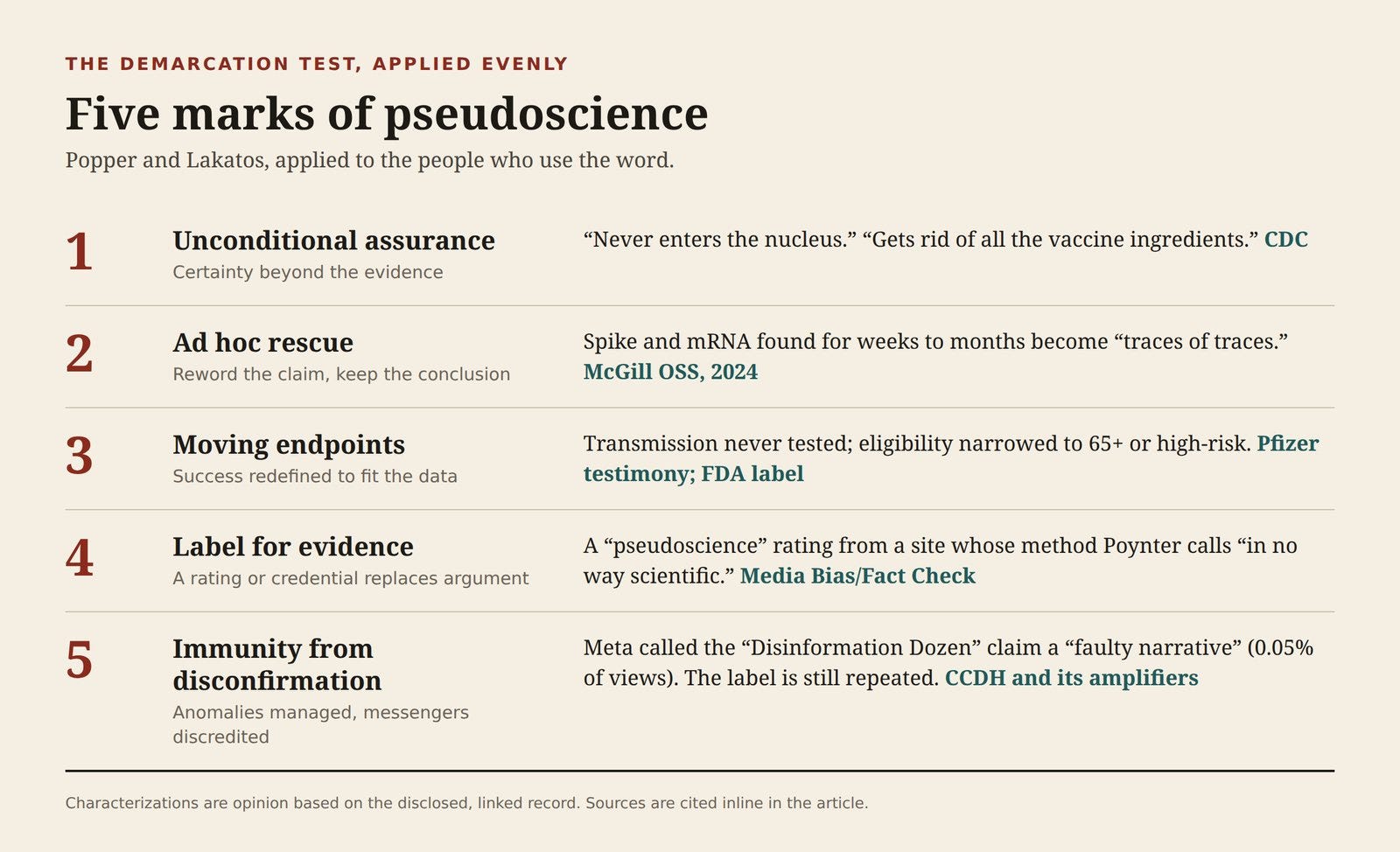
Unconditional assurances. Critics are accused of overstating risk. Yet the official claims were that mRNA “never enters the nucleus” and that the body “gets rid of all the vaccine ingredients” (CDC). Persistence data later contradicted them (CID).
Ad hoc rescue. Persistence was reframed as expected. Frameshifting was handled with “sequence optimization” after deployment (Nature).
Moving endpoints. Transmission was never tested (FactCheck.org), and eligibility has been narrowed (FDA).
Category manipulation. The FDA defines gene therapy as products acting through “translation of transferred genetic material,” including in vitro transcribed RNA (FDA).
Immunity from disconfirmation. The people who asked about persistence, biodistribution, DNA residuals and myocarditis were labeled. The claims they questioned were quietly revised.
The label was applied to the people who turned out to be asking the right questions, and withheld from the institutions whose claims failed.
The Label Is Not an Argument
I have been called a pseudoscientist by a university science office, a ratings website, an online encyclopedia and a physicians’ blog. Every one of those labels has an author, a date and a source. So does every claim in the figure above. Two of the writers quoted there, David Gorski and Jonathan Jarry, wrote articles that are now used to label my work this way.

That is why I built SayerJi.com. Its criticism page links every critical article written about me, 23 so far, by outlet and date, beside what has changed since. Its corrections log records my own errors with the date and the reason, and never edits silently. Its McGill record sets one article’s claims beside the sources it cited. Nothing is hidden. Read both sides.
Then there is defamation. Opinion is protected, and it should be. Anyone may call my work pseudoscience, and as a public figure I accept that the legal bar for challenging speech about me is deliberately high. But high is not infinite. But the Supreme Court has held that there is no separate privilege for opinion. Saying “in my opinion Jones is a liar” still implies facts that can be proved false (Milkovich v. Lorain Journal Co.). As the Reporters Committee for Freedom of the Press summarizes it, “if there are no facts given to support the opinion, or these facts are false, the ‘opinion’ statements will not be protected.” A list that ranks a man among “scam artists” and cites his “ties to QAnon” without one supporting fact (Medika Life) is not science communication. It is a factual assertion awaiting its evidence.
My standard is the one I ask of my critics: cite it, or correct it. Report any error of mine with a primary source, and it will be fixed and logged in public. I extend the same invitation to every institution on that page.
What This Argument Does Not Claim
A thesis this serious has to be precise about its limits, because overstating it would repeat the error it is criticizing.
It does not claim that every finding above has been shown to cause clinical harm in humans. Several, including frameshifting, IgG4 switching and DNA residuals, are open questions. The Mulroney team reported no known adverse outcomes from mistranslation, and the Aldén result came from a cell line.
It does not claim that synthetic mRNA rewrites the human genome. It claims, in the FDA’s own terms, that the product works by manipulating gene expression with transferred genetic material, and that this is the defining mechanism of gene therapy.
It does not claim that every xenobiotic is harmful at every dose or in every context. It claims that foreignness is the starting fact of pharmacology, and that a foreign substance has to prove biological compatibility. The body does not owe it an assumption of safety.
The charge is about method, not malice. Pseudoscience is not defined by bad intentions or bad equipment. It is defined by claims that will not submit to refutation. On that standard, the case against the mRNA enterprise does not depend on proving harm. It depends on showing that confident claims were made before the evidence existed and kept after the evidence contradicted them. The record shows that.
Restoring the Biological Standard
Real biology starts from humility. The human body is the product of billions of years of co-evolution with food, microbes, light and the molecules of the living world. Its recognition systems, including innate immunity, xenobiotic metabolism and RNA surveillance, are not obstacles to engineer around. They represent the accumulated intelligence of life about what belongs inside it.
The mRNA platform’s central achievement was to switch off part of that intelligence by building a false uridine that the body’s sentinels would not flag, wrapping it in synthetic lipids designed to get past membranes, and calling the result a vaccine so it would be received as routine. Then, when the molecule persisted, spread, frameshifted and prompted label changes, the people who noticed were the ones called unscientific.
Science that means the word would reverse the order. Foreign substances would carry the burden of proof. Falsified assurances would be retracted publicly. Category labels would follow mechanism, not marketing. The word “pseudoscience” would go back to describing a method, and when used that way, it applies to the institutions that used it most.