


The headlines brought back the Black Death, vaccine stocks jumped and the outbreak had already been rehearsed, all before anyone confirmed a single case of plague in Siberia


A 28-year-old laboratory technician at the Irkutsk Anti-Plague Research Institute died on October 2 after an illness Russian authorities described as pneumonia of unknown origin. The public record reviewed for this article does not establish that plague caused her death or that a laboratory accident occurred. (Reuters) Her death deserves a serious investigation, and her family deserves answers.
What happened next deserves an investigation too. Within days, readers were told that a “14th-century plague” was spreading across Russia. Shares in companies with no plague vaccine rose by double digits. Commentators reached for COVID. And almost nobody mentioned that the vaccines, the response playbooks and even a cross-border “imported plague” drill involving the director of the same Irkutsk institute were already in place before the worker fell ill.
None of that proves the event was planned, and this article does not claim it was. It shows something more ordinary, and in some ways more troubling: a fear narrative and a countermeasure economy were fully built and waiting - the exact pattern the exploration of the Epstein files has shown in regard to COVID-19 pandemic preparations. They can be set in motion by an unresolved death long before the evidence arrives, and sometimes whether it arrives or not.
What the evidence says right now
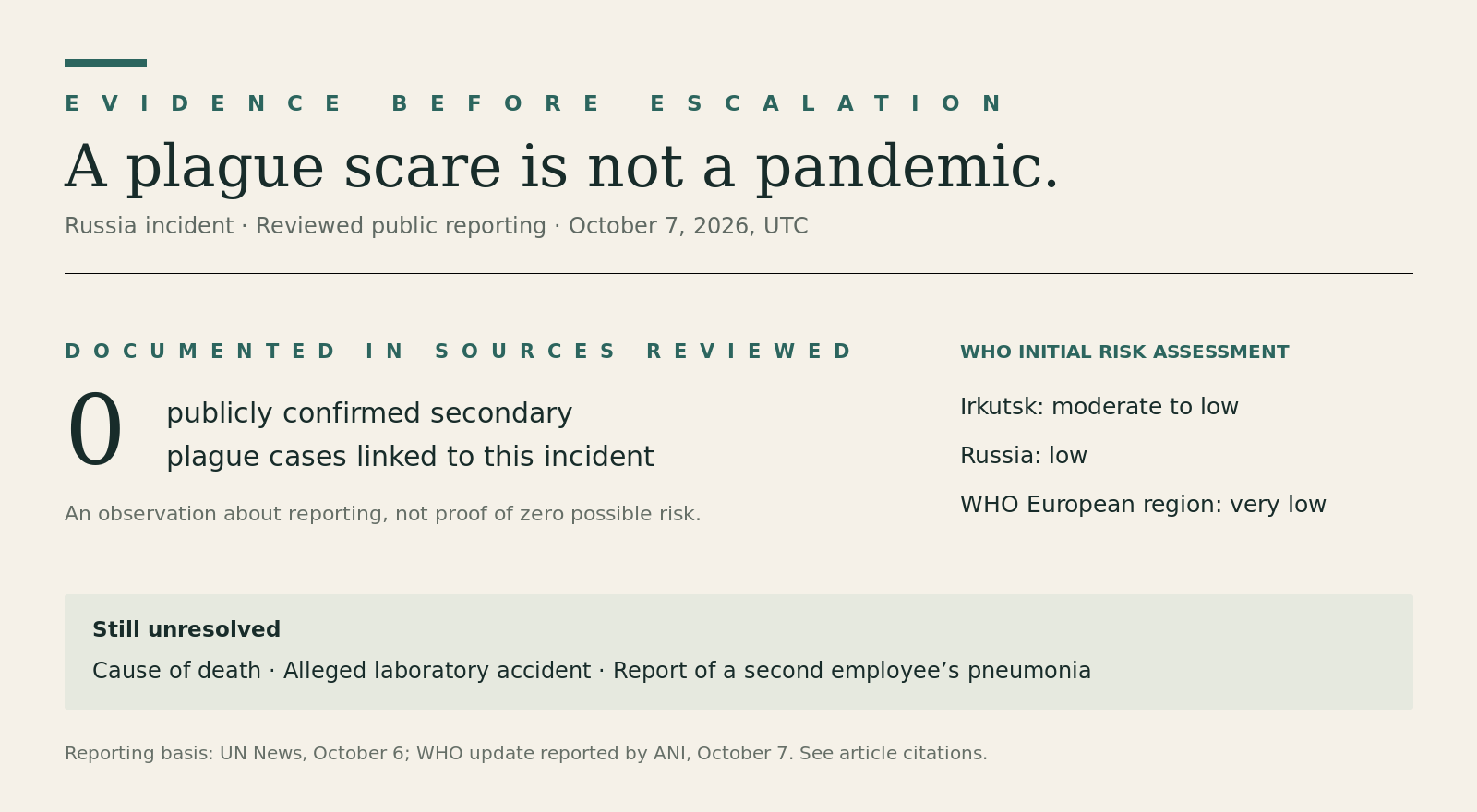
The most important fact is also the easiest to lose beneath the headlines: the sources reviewed document no publicly confirmed secondary plague cases linked to this incident. (UN News; WHO update reported by ANI)
WHO’s initial assessment places the risk at moderate to low for Irkutsk, low for Russia, and very low for its European region, and the agency says the assessment can change as information arrives. (UN News) The CDC’s statement, reported by Axios, says there is “no indication of a broader threat to the United States.” (Axios)
In an update reported October 7, WHO Director-General Tedros Adhanom Ghebreyesus said Russian authorities had reported no recent registered plague cases in Irkutsk oblast, no high-threat pathogens among identified contacts, and completion of medical observation for all identified contacts. (ANI) Those are Russian claims relayed through WHO, not an independently published diagnostic dossier. WHO is still asking what caused the pneumonia, what prompted the precautions, and whether a reported second employee with pneumonia is linked. (ANI)
The story that she broke a test tube containing plague bacteria remains unconfirmed and has been denied by Russia’s health watchdog. (Reuters) Russia’s denials should not be taken on faith either. But an institution’s name is not a diagnosis, a quarantine order is not a positive test, and a frightening possibility is not an observed chain of transmission.
The Black Death came back in the headlines, not the lab results
The gap between the evidence and the coverage was wide from the start.
On October 5, while authorities were still describing the case as pneumonia of unknown cause, the Express reported that “the so-called ‘black death plague’ begins to take hold across Russia” under the headline “Russian hospitals on lockdown as ‘14th-century plague outbreak’ sparks panic.” (Express) The next day’s follow-up read: “Russia ‘on lockdown’ as horror ‘14th-century plague spreads’.” (Express) Neither the takeover nor the spread had been demonstrated.
The pattern was not confined to one tabloid:
“Has hit Russia”: One London outlet described the 14th-century pandemic that killed up to 60% of Europe’s population and announced that it “has hit Russia.” (London Loves Business)
Cover-up as a question mark: “‘Black Death Cover-up?’ Scientist Dies in Siberia as Russia’s Secrecy Fuels Claims of a Mystery Plague Case.” (IBTimes)
Hiding as a question mark: “Is Russia Hiding a Pneumonic Plague Outbreak? Concerns Escalate as Lab Worker Dies.” (Men’s Journal)
Geopolitical amplification: “Is Russia’s plague scare Putin’s Chernobyl crisis?” (Newsweek)
Fear as the headline, reassurance in the body: Vox ran its piece as the real reason the case should scare you, while saying inside that a global outbreak was not likely. (Vox)
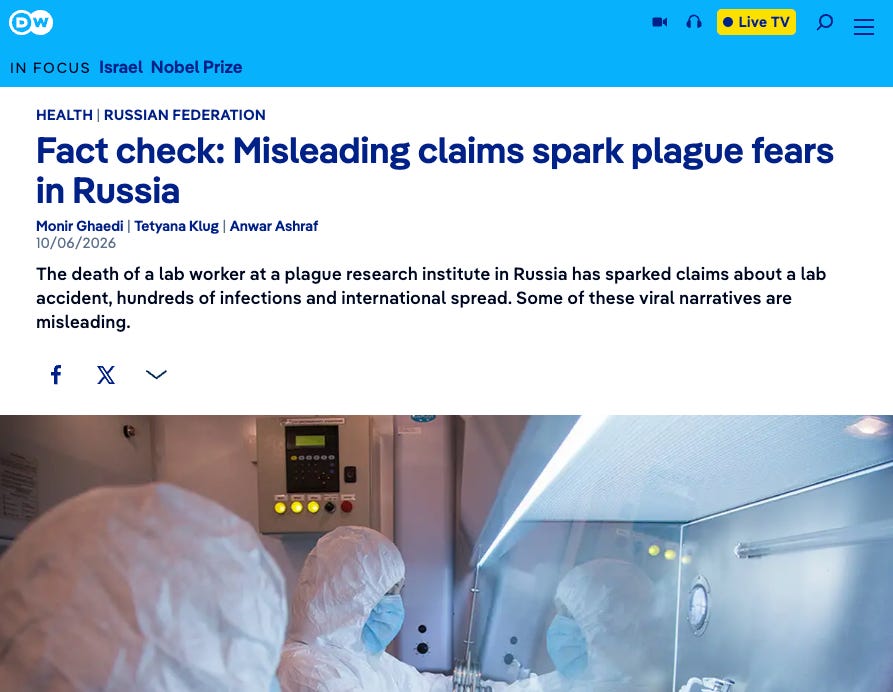
Social media went further. DW’s fact-checkers found that a post claiming the worker broke a flask and infected “several hundred people” drew more than 320,000 views, and rated it unproven. A video billed as plague spreading across Russia, with more than 1.7 million Instagram views, was old footage from Kabardino-Balkaria, about 6,000 kilometers away. (DW Fact Check)
Mainstream coverage repeated an outdated statistic as well. A CNBC article stated that treated pneumonic plague is fatal in about half of cases. (CNBC) A 2020 systematic review that specifically examined that figure estimated a pooled death rate of 17% among treated patients, with a 95% confidence interval of 8% to 31%. (Salam and colleagues) The authors noted sparse data and possible reporting bias, so this is not a reason to treat plague lightly. (Review limitations) It is a reason not to trust a frightening number simply because it has been repeated many times.
Repetition did much of the work. Many stories drew on the same Russian statements, the same WHO briefing and the same local-media rumor. Ten outlets repeating one unverified claim do not make ten confirmations. (Reuters; AP)
The tone at the top added to it. President Trump said of plague: “somehow those microbes have gotten stronger and smarter. They’re like an army.” (The Hill) The experts quoted in the same article said something very different. Former WHO emergencies chief Mike Ryan said pneumonic plague “is not particularly easily transmissible,” and Peter Hotez said, “We don’t even know for sure that it’s plague.” (The Hill)
Experts calling for calm were available all along. The headlines simply weren’t written around them.
Fear moved markets before facts did

Fear has a price, and on Monday, October 5, it was paid in the stock market.
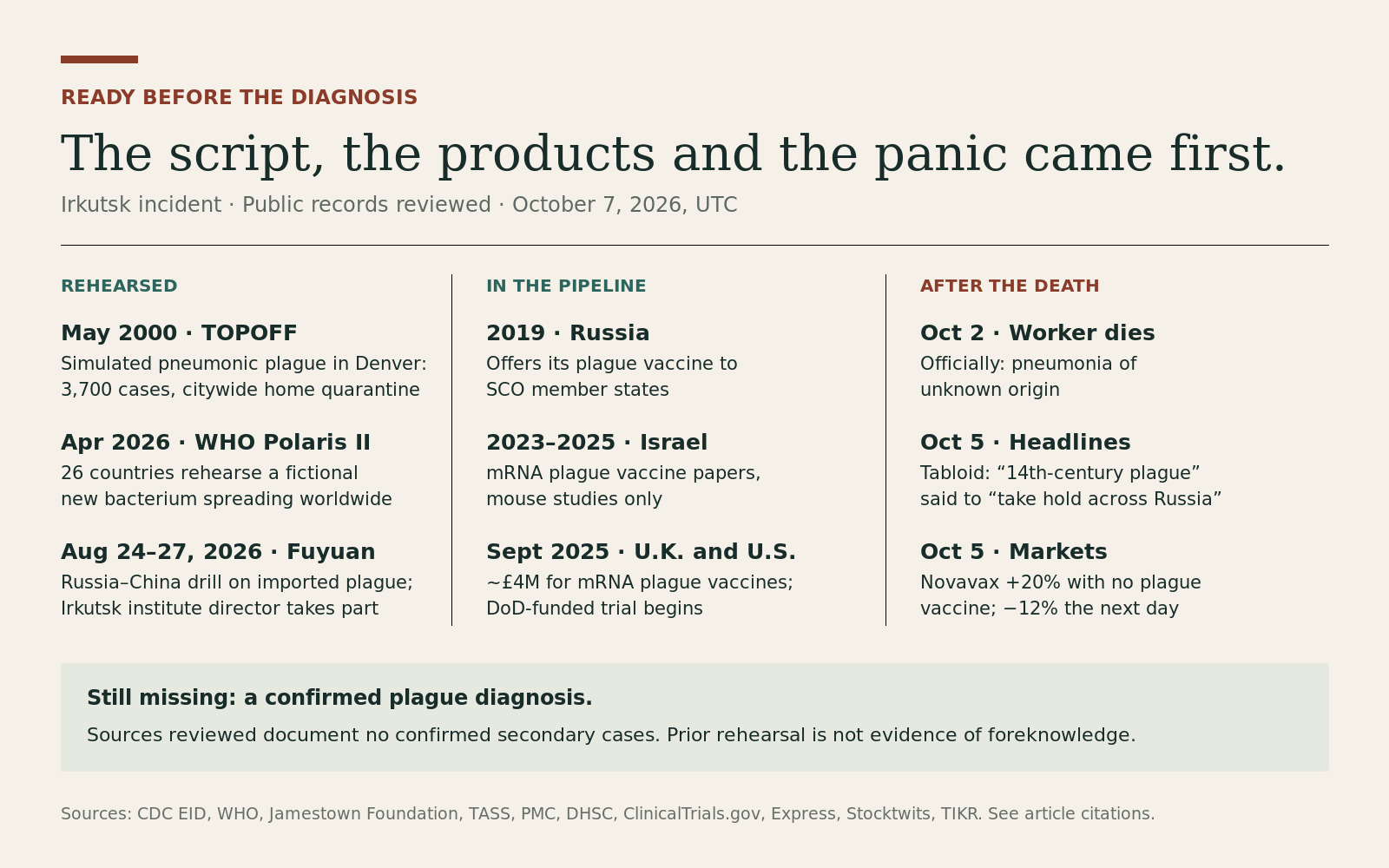
Stocktwits reported that Novavax rose 20%, Emergent BioSolutions 14%, Arcturus 13% and Moderna 7% after the death, along with protective-equipment makers Lakeland Industries (15%) and Alpha Pro Tech (13%). It noted that “no plague case has been confirmed, and no government orders have been announced,” and that the commercial vaccines of Novavax, Arcturus and Moderna do not target plague. (Stocktwits) Its own headline described retail traders eyeing “contract awards.” (Stocktwits)
The next day, after WHO said testing of contacts had found no plague, Novavax fell 12% and gave back most of the gain. One market analysis described the move bluntly: “The company has no plague vaccine at all,” and “Monday’s spike was a scare trade.” (TIKR)
This is not evidence that any company or official orchestrated the coverage. It does show how quickly fear turns into money. Investors bet that an unconfirmed foreign case would produce emergency procurement, and they did it before a diagnosis existed. When a scare trade is that predictable, the people who would benefit from escalation are exactly the people whose claims need the most scrutiny.
The vaccines were already in the pipeline
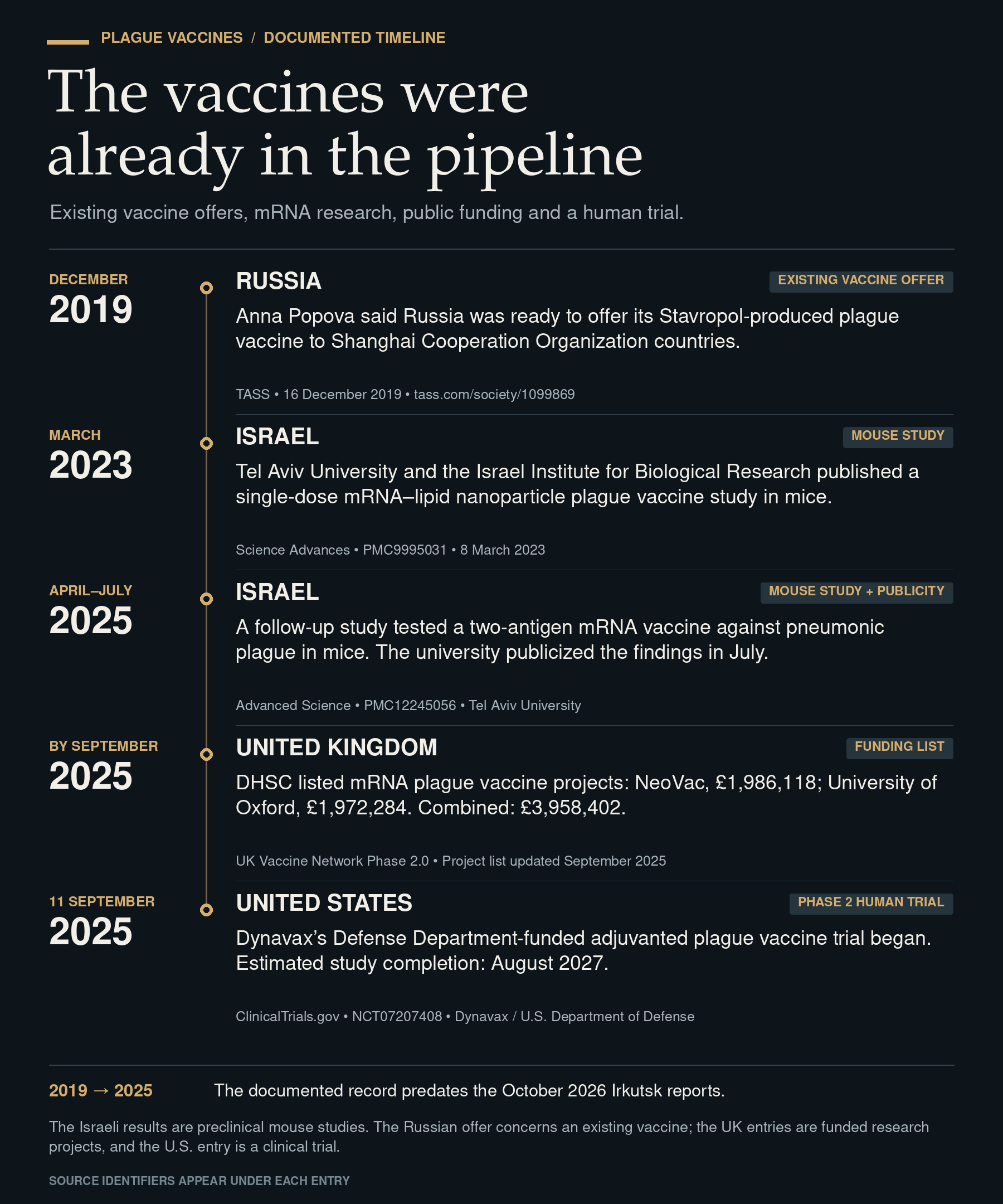
A second fact went almost unmentioned in the coverage: new plague vaccines were already being developed, funded and promoted well before the Irkutsk worker became ill.
• December 2019, Russia: Rospotrebnadzor chief Anna Popova said Russia was ready to offer its plague vaccine, made by the agency’s Stavropol Anti-Plague Institute, to Shanghai Cooperation Organization countries.[tass]
• March 2023, Israel: Tel Aviv University and the Israel Institute for Biological Research published a single-dose mRNA–lipid nanoparticle plague vaccine study in mice. (2023 paper)
• April–July 2025, Israel: A follow-up paper tested a two-antigen mRNA vaccine against pneumonic plague in mice; the university’s release followed in July. (2025 paper; Tel Aviv University)
• September 2025, United Kingdom: A UK government project list allocated £1,986,118 to NeoVac and £1,972,284 to the University of Oxford for mRNA plague vaccines. (DHSC project list)
• September 2025, United States: A Defense Department-funded trial of Dynavax’s adjuvanted plague vaccine started on September 11, 2025, with completion estimated in August 2027. (ClinicalTrials.gov)
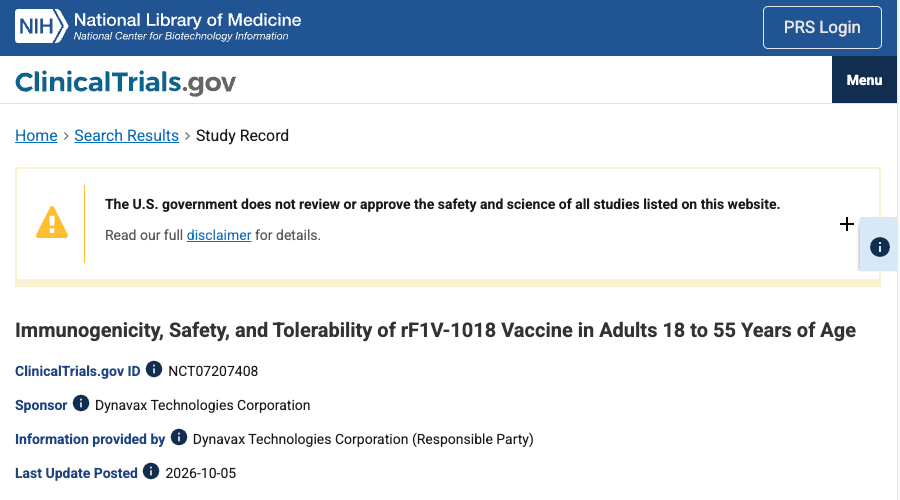
The Israeli program shows how platform money becomes plague money. Its papers acknowledge the EU’s EXPERT project, grant 825828, which ran from September 2019 to February 2025 with about €14.93 million in EU funding. Its stated goal was “an off-the-shelf mRNA-delivering nanomedicine platform,” with a planned human proof of concept in cancer patients. (CORDIS) CORDIS lists the 2023 plague paper among the project’s outputs. (CORDIS results) That is a documented link between broad platform funding and plague research. It does not mean the whole €14.93 million paid for a plague vaccine, and the 2025 paper’s funding acknowledgements do not name the Gates Foundation. (2025 paper)
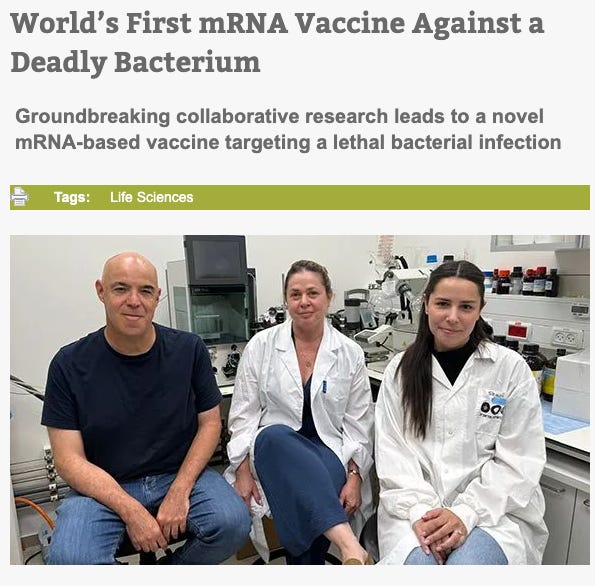
The stated motive is biodefense. “If one of our enemies tries to use it against us, we want to be prepared with a vaccine,” a lead researcher said in the university’s release. (Tel Aviv University)
The publicity also ran ahead of the data. The university promoted the work as a vaccine against a deadly, antibiotic-resistant bacterium, but the 2025 paper does not report a test against antibiotic-resistant plague. (Tel Aviv University; 2025 paper) Three doses produced complete survival in the tested mouse groups. With fewer doses the results varied widely: a single dose protected between 12.5% and 50% of mice, depending on the strain. The authors caution that mouse results may not translate to humans. (2025 paper)
The products in this pipeline need a market, and plague is rare. Conventional efficacy trials are hard to run because outbreaks are small and unpredictable, and deliberately infecting people with plague is unethical. (npj Vaccines review) Every frightening headline therefore does work the trials cannot do. It turns a preclinical mouse result into something that sounds like a remedy the public needs.
Timing matters. These programs predate the Russian event by months or years, which is evidence that the countermeasures were not invented in response to it. It is not evidence that anyone foresaw or caused the worker’s death. What it does show is that by the time the headlines arrived, there was already a product pipeline ready to benefit from them, and the coverage almost never said so.
The outbreak had already been rehearsed

The third missing factor is the long record of simulations. They are the script many officials and reporters read from when a real event arrives.
The plague template: TOPOFF, 2000. In May 2000, U.S. local, state and federal officials and three Denver hospitals took part in Operation Topoff. They simulated a covert aerosol release of plague bacteria at a performing-arts center, followed by pneumonic plague spreading from person to person. (CDC Emerging Infectious Diseases) By the end of day three, the simulated toll had reached 3,700 cases and 950 deaths, including at least 780 secondary cases. An executive order quarantined everyone in metropolitan Denver in their homes, and the governor’s committee chose broad antibiotic prophylaxis. (CDC Emerging Infectious Diseases)
Compare the real U.S. record. CDC reports an average of seven human plague cases a year in recent decades, mostly in the rural West. (CDC surveillance) Its report on a confirmed fatal pneumonic plague case in Arizona in July 2025 found 46 potentially exposed people. All received preventive antibiotics, and none became ill. (CDC MMWR) The scenario modelled thousands of secondary cases; the real case produced none among its identified contacts. That doesn’t prove untreated contacts faced no risk. It does show that the rehearsal and the observed outcome bear little resemblance.
A fictional bacterium: Polaris II, April 2026. Five months before the Irkutsk worker was hospitalized, WHO ran Exercise Polaris II, a two-day simulation “based around an outbreak of a fictional new bacterium spreading across the world.” It involved 26 countries and territories, 600 health emergency experts and more than 25 partners. (WHO) WHO says the April 2025 exercise centered on a fictional virus. (WHO) WHO’s public summary does not describe the bacterium as plague.
Imported plague at the border: Fuyuan, August 2026. The closest rehearsal is also the most striking. According to the Jamestown Foundation, Russia and China held a large cross-border exercise in Fuyuan, Heilongjiang, from August 24 to 27, 2026. More than 300 Chinese personnel, including the PLA Northern Theater Command Disease Control Center, rehearsed an unknown tick-borne “Disease X” and imported plague. Sergey Balakhonov, director of the Irkutsk Anti-Plague Institute, took part in person. (Jamestown Foundation) Jamestown describes this as the second stage of joint infectious-threat exercises, after an earlier stage in Khabarovsk. (Jamestown Foundation) Charter 97 also reported that Balakhonov gave a presentation and that the program included practicing a response to a plague outbreak. (Charter 97)
About five weeks later, an employee of his institute was hospitalized with severe pneumonia. (DW Fact Check)
The wider pattern. Readers who remember the last six years will recognize the sequence. On October 18, 2019, the Johns Hopkins Center for Health Security, the World Economic Forum and the Gates Foundation hosted Event 201, a high-level pandemic exercise. (Johns Hopkins) Its fictional coronavirus pandemic killed 65 million people in 18 months, roughly two months before the first reported COVID-19 cases. (Baltimore Sun; Johns Hopkins Hub) In March 2021, NTI and the Munich Security Conference simulated an engineered monkeypox outbreak producing more than 3 billion cases and 270 million deaths. (NTI) A real, multi-country mpox outbreak followed in 2022. NTI noted that the scenario’s start date “roughly coincides” with the outbreak, called the overlap “purely a coincidence,” and said the real outbreak did not resemble the engineered scenario. (NTI)
Rehearsal is not proof, but it is not irrelevant
Fairness requires saying plainly what this record does not show. Preparedness exercises are common. Many scenarios never come true, and a scenario that resembles a later event is not, on its own, evidence of foreknowledge. I have seen no document showing that anyone anticipated this worker’s illness, and the public record reviewed here does not even establish that she had plague.
Coincidences can also be manufactured from ordinary bureaucracy. WHO updated its plague fact sheet on September 29, the day the worker was reportedly hospitalized. DW found that the update belonged to a scheduled publication cycle on cholera, meningitis and plague, with no evidence linking the two events. (DW Fact Check; WHO)
But dismissing the simulations entirely misses what they actually do. They are where the response is decided in advance. TOPOFF rehearsed a citywide home quarantine of roughly two million people and mass prophylaxis. (CDC Emerging Infectious Diseases) The exercises set the casualty numbers people remember, the measures officials reach for and the institutions that expect a seat at the table. When a real but ambiguous event happens, it gets fitted to the scenario that has already been practiced.
That helps explain how the Irkutsk story jumped so quickly from an unexplained death to “lockdown,” “Black Death” and “Chernobyl.” It also explains why traders bought vaccine stocks before a diagnosis. Everyone already knew the script.
The legitimate questions are about influence, not occult foresight. Who designs these scenarios? Who funds them? Which countermeasures do they assume? And how often do the same institutions that run them also stand to gain from the responses they rehearse? Those questions can be answered with records, not speculation.
Plague is real, and so is proportion
None of this means plague is imaginary. Pneumonic plague is a serious infection, and prompt diagnosis and appropriate antibiotics matter. (WHO fact sheet) CDC guidance describes person-to-person transmission mostly among caregivers and household members after close, sustained contact, and says asymptomatic transmission has not been documented. (CDC guidelines)
Plague can still cause substantial outbreaks. Madagascar’s 2017 outbreak involved 2,348 suspected, probable and confirmed cases and 202 deaths, yet WHO assessed regional and global risk as low and reported no cases linked to international travel. (WHO outbreak report) Local danger and global danger are different claims, and the public deserves to hear which one is being made.
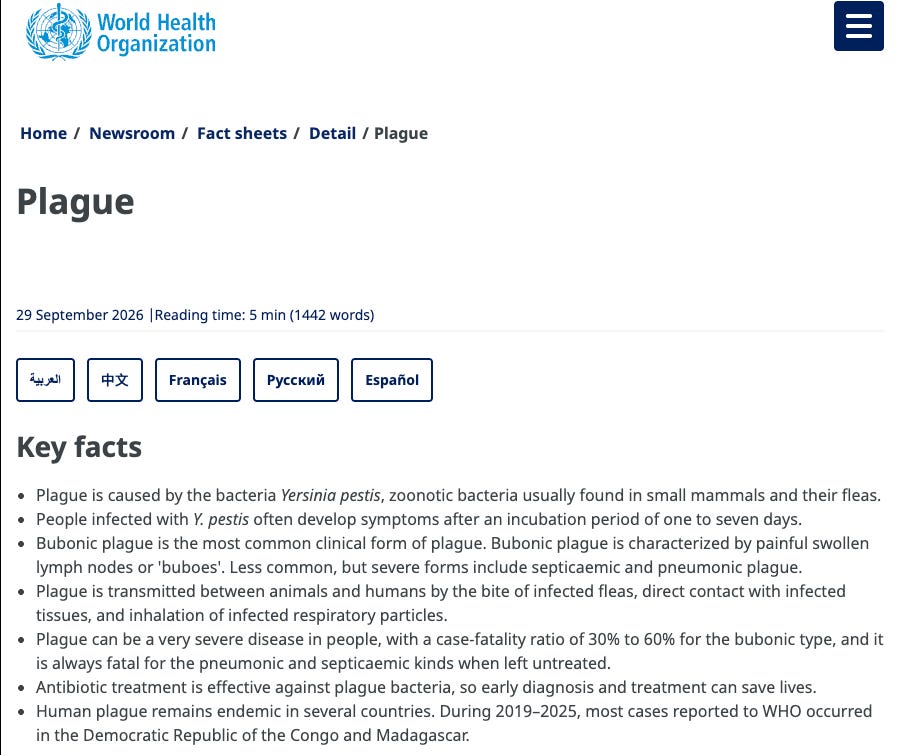
The disease also has a natural ecology. WHO lists environmental management, animal surveillance and reducing exposure as parts of prevention. (WHO fact sheet) A serious investigation should look at exposure, housing, occupational conditions, underlying health and timely access to care, not just at which new countermeasure could be bought.
The COVID-era accountability question is legitimate
In my white paper, “Endless Pandemics as a Failed Global Governance Model,” I argued for a health framework governed by evidence, proportionality, transparency and limits on emergency power. One recommendation was straightforward: “Threshold criteria should be specified in advance and published, not determined retroactively.” (Endless Pandemics)
The Irkutsk episode shows why. The scenarios are written in advance and the countermeasures are funded in advance. Only the thresholds for escalation, the evidence that should be required before a lockdown, a procurement order or an emergency declaration, are routinely left vague.
The record behind this concern is concrete. Amnesty International reported in 2021 that governments used the pandemic as a pretext to muzzle critical voices and silence or imprison journalists and health professionals. (Amnesty International) In March 2022, a Brooklyn company pleaded guilty to price gouging KN95 masks at a markup of more than 400%. (U.S. Department of Justice) In May 2025, the EU General Court annulled the European Commission’s refusal to release text messages between Ursula von der Leyen and Pfizer CEO Albert Bourla. That was a transparency ruling, not a finding of corruption. (EU General Court)
These are different kinds of failure with different legal status. Together they establish why accountability cannot wait until after the public has been frightened into accepting a response.
Demand the records, not a blank check
De-escalation should not mean accepting Russia’s denials on faith. Nor should it mean accepting an alarming interpretation because a tabloid, a trader, a Western official or a biosecurity advocate repeats it.
The most useful disclosures would be:
Diagnostic evidence: What testing was performed on the deceased worker, when, and with what results?
Contact outcomes: How many people were followed, for how long, and with what testing and treatment?
The second pneumonia report: Is it accurate, what caused it, and is it epidemiologically linked?
Occupational evidence: Is there a documented laboratory incident, or only an allegation?
Exercise records: What scenarios, assumed countermeasures and after-action findings came out of the August Fuyuan exercise and WHO’s Polaris II, and did the Irkutsk institute run any plague drills in the weeks before the illness?
Countermeasure interests: Which governments, funders and companies hold contracts, options or development programs for plague vaccines and therapeutics, and what procurement decisions, if any, have been discussed since October 2?
The basis for restrictions: What prompted each measure, who was affected, and what criteria determine its end?
These are requests for evidence, not claims that the answers are already known. They are far more informative than a contest over who can imagine the most frightening scenario.
If a confirmed diagnosis and documented linked infections emerge, the assessment should change. For now, the reviewed record supports a narrower conclusion: an unexplained death, an ongoing demand for transparency, no publicly confirmed secondary plague cases, and low to very low risk assessments beyond the immediate area. (Reuters; UN News)
The headlines, the vaccines and the simulations were all ready before the diagnosis. The public is entitled to ask why the evidence is always the last thing to arrive. It owes no one panic.
Publication note: This article is an evidence-based snapshot, not a claim of mathematically zero risk or a substitute for medical care. People with a relevant exposure and acute illness should seek prompt professional assessment; early treatment matters in suspected plague. (WHO clinical guidance)
It feels more people are aware than before 'C*vid'. Whether enough people will awaken for a collective consciousness shift, there is more is be revealed? Fear is the motivating factor, evidenced by the insatiability of a 'forever war'. Each day, more of the vehicles of fear perpetuation (ie education, medicine, financial, war, media, etc) are being exposed more loudly. People have choice to release their former beliefs, for truths to be revealed. Fear is the emotion that drives. Awareness is the state of recognition.
On our national broadcast-news website today:
'Hundreds of millions of deaths in the Middle Ages, and today about 1,000 infections per year: here’s what you need to know about the plague'
https://www.vrt.be/vrtnws/nl/2026/10/06/de-pest-risico-wat-is-het/
and
on the same web page today:
'How dangerous is the plague? “The deadliest infectious disease to have struck the world in the last few thousand years”
https://www.vrt.be/vrtnws/nl/kijk/2026/10/06/terzake-pest/
Also many warnings about mosquito diseases and our wastewaters full of Covid.
Anyone interested in a vacation in our country, Belgium?