


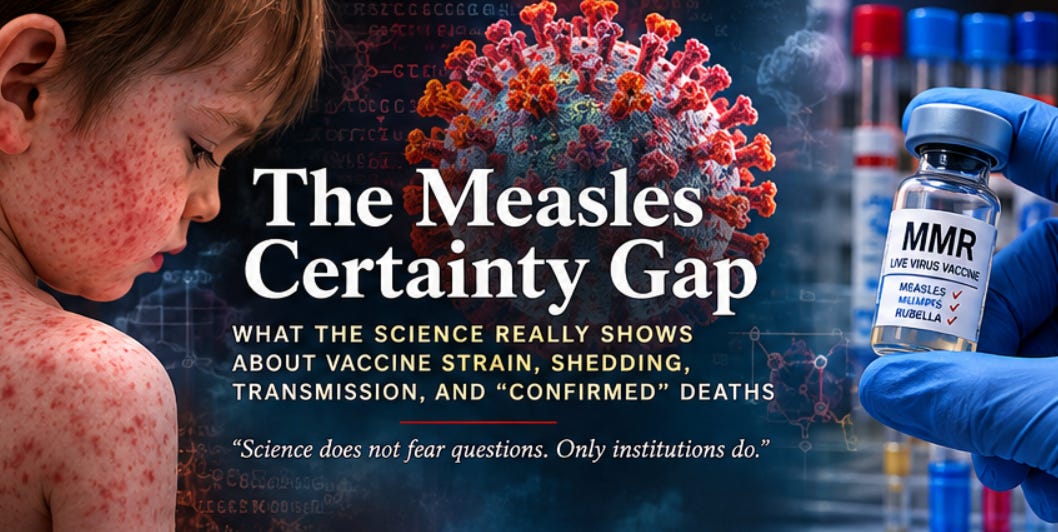
The scientific question is no longer whether measles vaccine material can be shed from a recently vaccinated person. It can. Vaccine-strain measles RNA has repeatedly been recovered from urine and respiratory secretions; in a published case, vaccine-type measles virus was actually isolated from a child’s throat. Yet that fact is routinely blurred with a very different proposition: whether shed vaccine virus has been proven to transmit person-to-person.
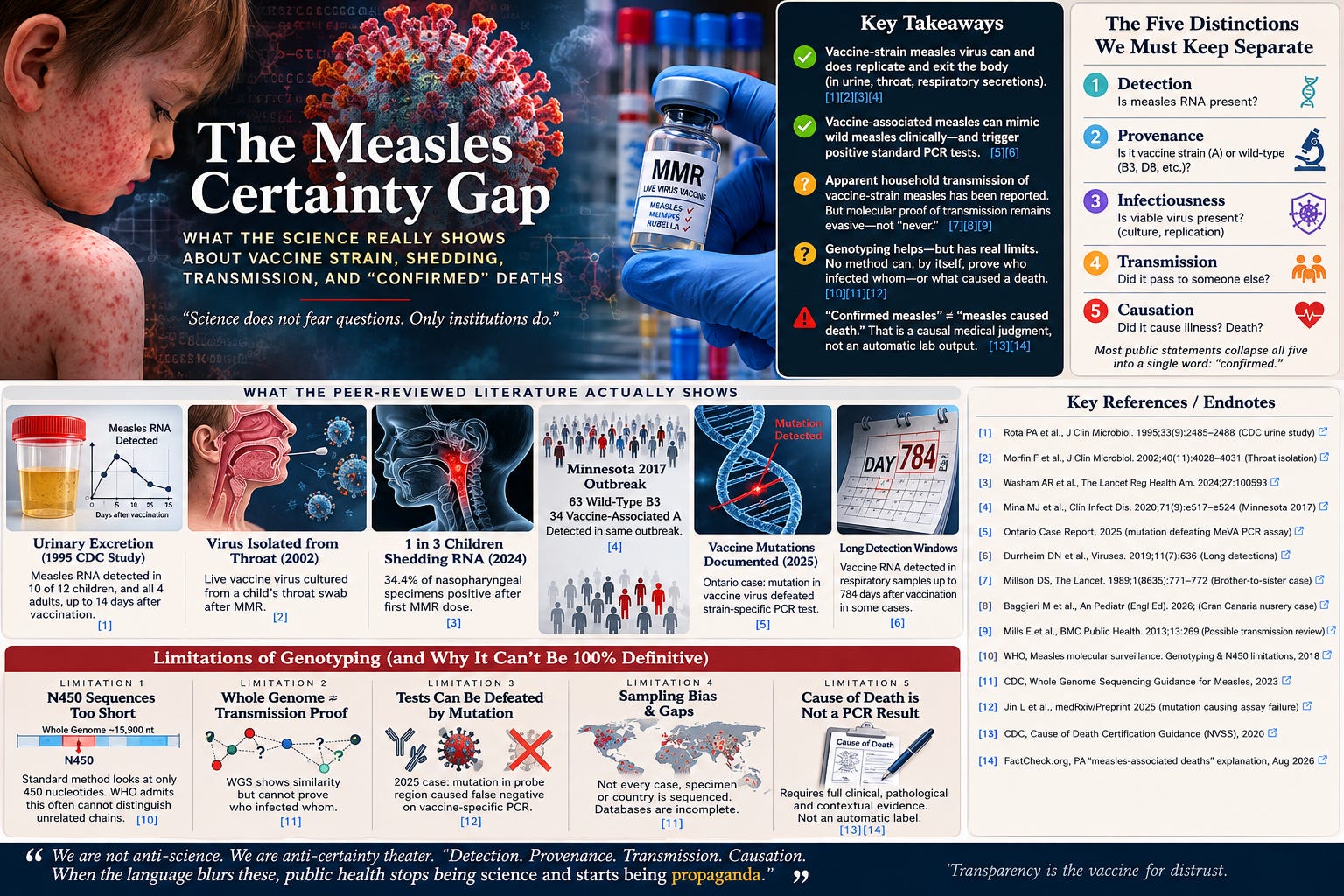
This investigation argues for maximum evidentiary precision. Detection, provenance, infectiousness, transmission and causation are separate questions. Conflating them produces certainty the underlying methods do not necessarily supply.
Earlier investigation: Wild-Type or Vaccine Strain? Investigating the Measles Question
1. The part that should no longer be controversial: vaccine-strain shedding is documented
The measles component of MMR is a live attenuated virus. It must replicate sufficiently in the recipient to generate an immune response. That does not make it equivalent to wild-type measles, but neither is it biologically inert.
In 1995, CDC investigators prospectively collected daily urine specimens after measles immunization. Measles-virus RNA was detected in 10 of 12 vaccinated children during the two-week sampling period, appearing as early as one day and as late as 14 days after vaccination. It was also detected in urine from all four young adults studied between one and 13 days after vaccination. The authors explicitly wrote that the method would facilitate further study of measles-virus “shedding and transmission.” [1]
PCR detection alone does not establish that the detected material is infectious. That distinction matters. But in 2002, Morfin and colleagues reported something stronger: measles virus was isolated from a throat swab from a child who developed fever after MMR, and genetic characterization identified it as vaccine type. The investigators concluded that injection of the attenuated strain can result in respiratory excretion of vaccine virus. [2]
In 2010, Croatian investigators independently detected the Schwarz vaccine strain in both pharyngeal secretions and urine from a child who developed a vaccine-associated febrile rash illness after MMR. [3]
THE LANGUAGE SHOULD BE PRECISE
Molecular shedding: established. Respiratory excretion of culture-isolated vaccine virus: documented in at least one published case. Person-to-person secondary transmission: reported as possible, but not molecularly proven.
2. A 2024 study found vaccine RNA in 34.4% of selected post-dose-one respiratory specimens
Washam and colleagues examined 127 nasopharyngeal specimens from children who underwent respiratory testing within 30 days of MMR vaccination. Among 96 specimens obtained after the first MMR dose, 33 — 34.4% — were positive for vaccine RNA. Median detection was 11 days after vaccination, and vaccine RNA was detected up to 29 days after MMR. The study described the amount detected as low, reflected by comparatively high cycle-threshold values. [4]
That result should not be generalized to mean one-third of every vaccinated child sheds detectable vaccine virus: this was a selected clinical cohort undergoing respiratory testing. But it establishes something important for surveillance: vaccine-derived measles RNA in the nasopharynx after MMR is not merely a theoretical diagnostic possibility.
CDC’s own 2024 MMWR makes the same problem explicit. In a review of commercial syndromic PCR panels, 17 of 1,548 panels detected measles. Among the 14 patients for whom vaccination and case-investigation data were available, all had received MMR, most within three weeks, and the positive results were attributed to detection of vaccine virus rather than wild-type measles. CDC warned that post-vaccination detection can trigger unnecessary public-health responses unless vaccination history and confirmatory strain testing are considered. [5]
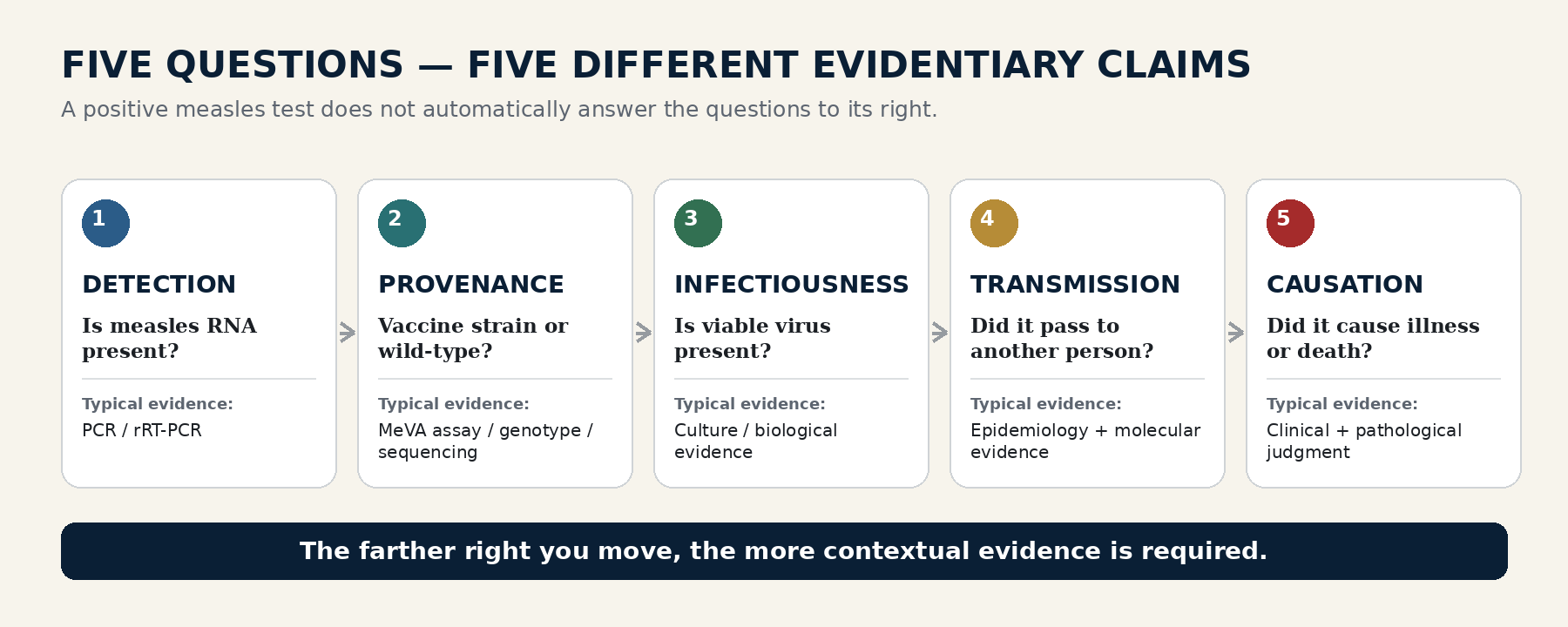
3. Minnesota showed how easily vaccine-associated illness and wild measles can collide in the same outbreak
The 2017 Minnesota outbreak is one of the clearest real-world demonstrations of why strain resolution matters. During the response, more than 51,000 MMR doses above expected were administered. The state laboratory tested 944 suspected patients; 113 were measles RT-PCR-positive. Genotyping succeeded in identifying 63 genotype-B3 wild-type cases and 34 genotype-A vaccine-associated rash illnesses. [6]
The vaccine-associated patients were not simply asymptomatic laboratory curiosities: 94% had fever, 41% cough, 47% coryza and 24% conjunctivitis; 74% had at least one of the classic “3 Cs.” Clinical presentation alone did not reliably separate the groups. The investigators emphasized that routine measles testing cannot by itself distinguish vaccine-associated rash illness from wild-type measles and that genotyping is needed. [6]
Okinawa provided a similar natural experiment during its 2018 outbreak. Investigators documented 99 laboratory-confirmed wild measles cases and 14 vaccine-associated measles cases. Among the vaccine-associated cases, 92.9% of throat-swab specimens were RT-qPCR positive, compared with 25% of urine specimens and 7.7% of whole-blood specimens. [7]
The inference is not that vaccination caused those outbreaks. It did not: outbreak molecular epidemiology documented wild virus. The point is narrower and stronger: when mass vaccination occurs during an outbreak, vaccine-associated illness and vaccine-strain PCR positivity can exist alongside genuine wild-type transmission, creating a classification problem unless provenance is resolved.
4. Some vaccine-strain RNA detections have appeared far beyond the expected window
A 2019 Australian series reported measles vaccine-virus RNA in respiratory specimens from 11 children more than 100 days after their most recent measles-containing vaccination, with intervals ranging from 101 to 784 days. The investigators used multiple molecular targets and sequencing for confirmation in several specimens and called for additional work to determine whether persistent RNA represented viable virus and whether transmission to contacts could occur. [8]
This finding must be described with discipline: a positive specimen at day 784 does not demonstrate continuous shedding for 784 days, nor does RNA prove viable virus. It does, however, challenge simplistic assumptions about how long vaccine-derived measles RNA may remain detectable in unusual cases.
5. Vaccine-associated measles disease is rare — but real
A 2021 comprehensive literature review identified 66 laboratory-confirmed cases of vaccine-associated measles in vaccine recipients published at that time. Most were mild and self-limited. Three severe cases involving serious complications or death occurred in profoundly immunocompromised patients. [9]
That evidence supports two conclusions at once: clinically significant vaccine-associated measles is rare, and the attenuated virus remains biologically capable of producing genuine disease under particular host conditions. “Attenuated” is not synonymous with “inert.”
6. Has vaccine-strain measles ever transmitted from one person to another?
This is where the record becomes more nuanced than either side’s slogan.
In 1989, The Lancet published a letter explicitly titled “Brother-to-sister transmission of measles after measles, mumps, and rubella immunisation.” The report described an apparent temporal household sequence following MMR vaccination. [10] Later reviews continue to recognize it as a possible transmission report — while emphasizing its decisive limitation: the suspected secondary case was clinically diagnosed and was not microbiologically proven to be vaccine strain. [11] [9]
A 2016 systematic review examined 773 publications looking specifically for genotypic confirmation of vaccine virus transmitted from a recently vaccinated person to a susceptible close contact. It found no such confirmed transmission event among the published material reviewed. [12]
Then came a provocative 2026 report from Gran Canaria. Two children attending the same nursery developed laboratory-confirmed genotype-A vaccine-associated measles after each had recently received MMR. Investigators traced 107 close contacts and found no further cases. Because both children had independently been vaccinated, the authors judged coincidental vaccine reactions more likely than transmission — yet their published conclusion states that the possibility of transmission could not be entirely dismissed. [13]
THE MOST DEFENSIBLE FORMULATION
Respiratory excretion of vaccine measles virus is documented. Possible person-to-person transmission has been reported. Definitive molecular proof of a secondary vaccine-strain infection acquired from a recently vaccinated contact remains absent.
7. Genotyping helps — but “genotyped” does not mean omniscient
Current vaccine strains are genotype A, while contemporary wild measles is dominated by genotypes such as B3 and D8. That makes genotype analysis extremely useful for distinguishing a recent vaccine reaction from wild-type infection. CDC also uses a vaccine-strain-specific real-time RT-PCR assay, MeVA, for rapid identification of vaccine reactions. [15]
But several distinct limitations matter.
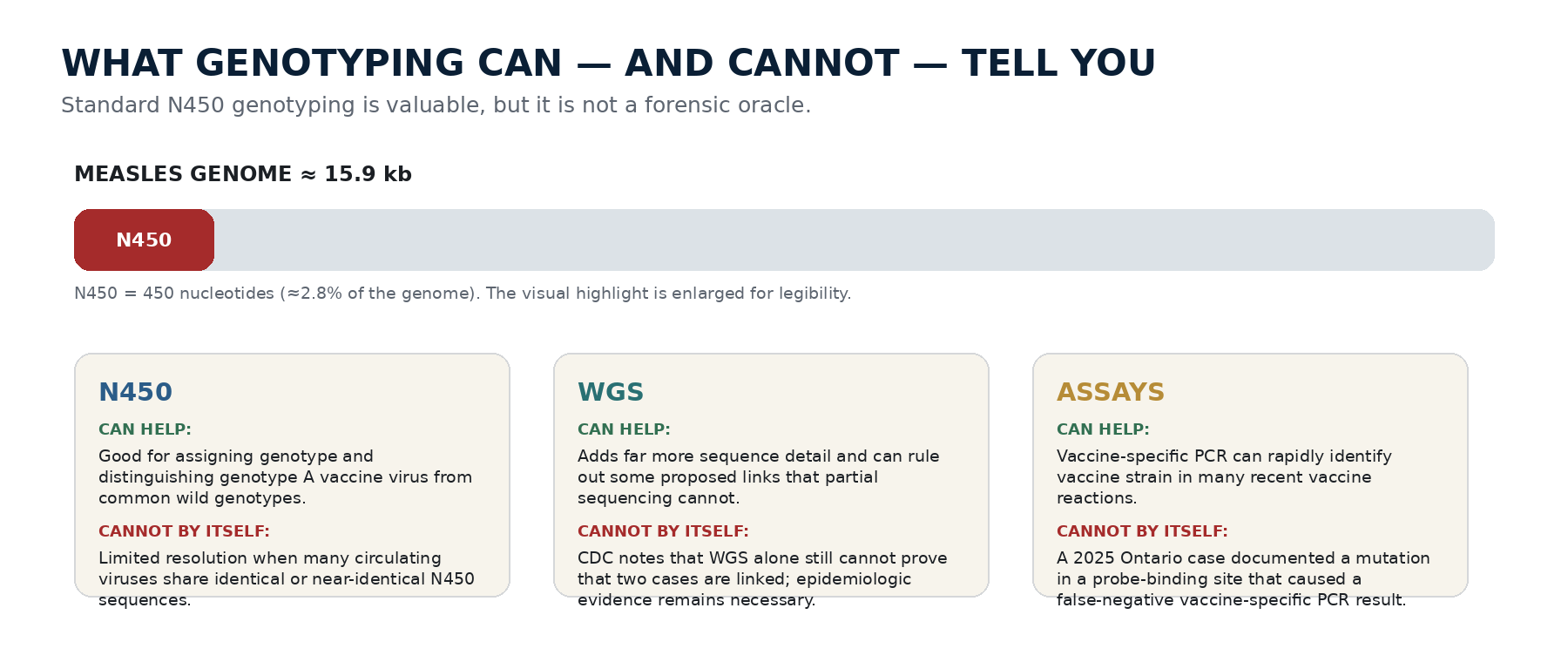
First: standard N450 sequencing examines only a small portion of the genome.
The standard WHO genotyping window analyzes 450 nucleotides from the measles nucleoprotein gene. WHO guidance acknowledges that N450 sequences can remain stable for long periods and that identical N450 sequences may occur in viruses from distinct transmission chains; additional epidemiologic context is often required. [16]
Second: whole-genome sequencing improves resolution, but still does not prove who infected whom.
CDC’s own WGS fact sheet states the limitation with unusual clarity: whole-genome sequencing can provide enough resolution to rule out some proposed relationships, but WGS alone cannot prove that two cases are linked. Epidemiologic evidence is still required. [17]
Third: strain-specific assays can fail.
In Ontario in 2025, a recently vaccinated child with a rash illness tested positive on a general measles PCR but negative on the vaccine-specific MeVA assay. Sequencing subsequently established genotype-A vaccine virus and identified mutations that apparently arose within the recipient, including a mutation in the assay’s probe-binding site that explained the false-negative vaccine-specific result. [14]
Fourth: not every case is sequenced.
Surveillance systems operate on samples and case definitions, not perfect genomic coverage of every person in every chain. That does not invalidate outbreak conclusions; it simply means an outbreak-level inference and an individual-level molecular determination are not the same thing. CDC’s surveillance manual itself requires special attention to recent MMR vaccination because vaccine reactions can satisfy clinical criteria and vaccine strain must be distinguished from wild type in the relevant window. [18]
8. An important counterweight: extensive sequencing can strongly establish that an outbreak is wild-type
Precision cuts both ways. The existence of vaccine-strain shedding does not justify treating every measles outbreak as suspect or vaccine-derived.
During the large 2025 U.S. outbreak, CDC reported that among 251 cases with specimens available for molecular sequencing through April 17, all were wild-type: 225 genotype D8 and 26 genotype B3. In the Texas–New Mexico–Kansas outbreak specifically, all 208 genotyped specimens were D8; 196 shared an identical N450 sequence and 12 differed by one nucleotide. [21]
That is substantial evidence of genuine wild-type transmission. It should be acknowledged plainly. The advocacy case here is not “all measles is vaccine strain.” It is that recent vaccination creates a known diagnostic confounder, and individual cases should be resolved with the highest feasible level of strain-specific evidence when the distinction matters.
9. The largest category error comes after the lab result: “measles detected” is not identical to “measles caused the death”
Laboratory methods answer laboratory questions. PCR can establish that a targeted measles RNA sequence is present. Genotype analysis can help identify provenance. Culture can support viability. Sequencing plus epidemiology can strengthen or weaken a transmission hypothesis.
None of those methods, by itself, determines the cause of an individual death.
CDC’s death-certification guidance separates the immediate cause, the sequence of conditions leading to death, the underlying cause that initiated the sequence, and other significant contributing conditions. It explicitly describes cause-of-death certification as the certifier’s best medical opinion and allows conditions to be recorded as probable even when they have not been definitively established. [19]
This does not mean infectious-disease deaths are unknowable. A measles-caused death can be established to very high medical confidence when clinical history, timing, laboratory evidence, pathology and recognized complications converge and reasonable competing explanations are excluded. It means something more modest — and more important:
No single PCR result, genotype call or sequence can, by itself, prove that measles caused an individual death.
Absolute 100.000% certainty is not the ordinary standard of empirical medicine. Cause-of-death attribution is an inference from converging evidence. Public communication should therefore distinguish among measles detected, measles infection, measles contributed to death, and death caused by measles rather than treating them as interchangeable phrases.
10. Koch’s postulates do not rescue us from this problem
It is tempting to argue that unless Koch’s classical postulates are fulfilled, a measles death can never be established. That argument is historically and scientifically vulnerable.
Koch’s framework was developed in the bacteriological era to establish causal relationships between microorganisms and diseases at the level of disease etiology; it was not designed as a forensic checklist for assigning the cause of an individual person’s death. Virologist Thomas Rivers was already explaining the limits of rigidly applying Koch’s postulates to viral disease in 1937. [20]
The stronger standard is modern causal reasoning: Does the total clinical, pathological, molecular and epidemiological evidence form a coherent causal chain, and have meaningful alternative explanations been considered?
11. What genuine transparency would look like
When an individual measles case becomes the basis for quarantine, emergency orders, political accusations or a public declaration that a person died because of measles, the evidentiary standard should rise with the consequence.
✓ Specimen type and collection date
✓ Relevant PCR result and, where appropriate, Ct/context
✓ Recent measles-containing vaccination history
✓ Whether vaccine-specific testing was performed
✓ N450 genotype and, where material, extended/WGS findings
✓ Whether viable virus was isolated or only RNA detected
✓ Epidemiologic link and competing sources of exposure
✓ Clinical syndrome and major competing diagnoses
✓ For deaths: immediate, underlying and contributing causes
✓ Relevant autopsy/pathology findings when available
12. The real scientific position is more interesting than the slogan
The published record already establishes that live attenuated measles vaccine virus replicates in recipients; vaccine-strain RNA can leave the body in urine and respiratory secretions; a culture-confirmed vaccine-type virus has been isolated from the throat; vaccine-associated rash illness can resemble wild measles and trigger standard PCR tests; unusually late RNA detections have been published; clinically significant vaccine-associated measles, though rare, is documented; and at least one historical report and one recent cluster have raised the possibility of person-to-person transmission without providing definitive molecular proof. [1] [2] [4] [8] [9] [10] [13]
At the same time, systematic review and modern contact investigations have not produced a genotype-confirmed secondary transmission event from a vaccine recipient, while extensive outbreak sequencing has repeatedly demonstrated genuine wild-type transmission. [12] [21]
That tension is not a reason to retreat into certainty. It is the reason to demand better resolution.
The question is not whether measles exists, nor whether wild-type measles can cause serious disease. Both are established.
The question is whether institutions will consistently distinguish detection from provenance, provenance from infectiousness, infectiousness from transmission, and transmission from causation before turning a laboratory signal into a categorical public claim.
Precision is not obstruction. It is the price of scientific credibility.
Endnotes & source links
Every numbered citation in the article is hyperlinked directly to its source. The full references are repeated here for independent confirmation.
CDC/NCHS. “Instructions for Completing the Cause-of-Death Section of the Death Certificate.”
Rivers TM. “Viruses and Koch’s Postulates.” Journal of Bacteriology. 1937;33(1):1–12.
Methodological note: This article is intentionally written as an argument for maximal diagnostic and causal transparency. It does not claim that MMR vaccination has been shown to drive community measles outbreaks, nor that vaccine-strain person-to-person transmission has been molecularly confirmed. It distinguishes what is documented, what is plausible, what is reported, and what remains unproven.
Alt headline:
Infection disease contagion: Unproven / Disproved
Article walks through it.
"The measles component of MMR is a live attenuated virus"
I hought viruses/virions were considered not to be alive, not a living thing.