


The Story of a 2006 Mayo Clinic Report That Should Have Changed Everything
🧵View the X thread on this article here.
Twenty years ago, Mayo Clinic published a report that should have changed how we treat leukemia forever.
It didn’t.
Not because the patients didn’t improve.
Not because the doctors who saw it were fringe.
Not because the follow-up trial failed.
It didn’t because the thing that helped them was a green tea extract, and nobody stood to profit from carrying it to the finish line.
I’ve spent two decades tracking studies like this one: findings that make it into the peer-reviewed record and then quietly disappear from medical practice. Across more than 100,000 studies indexed on GreenMedInfo, this is one of the clearest examples I know.
What the study actually showed
Chronic lymphocytic leukemia, or CLL, is the most common adult leukemia in the Western world. For most patients diagnosed early, the standard of care is a phrase that patients come to dread: watch and wait. There is no treatment offered. You come back every few months, and your doctors measure how fast the disease is advancing until it is bad enough to justify chemotherapy.
In 2004, a Mayo Clinic team that included hematologists Tait Shanafelt and Neil Kay reported that a green tea compound called epigallocatechin-3-gallate (EGCG) killed leukemic cells from CLL patients in the lab. The paper in Blood found that EGCG significantly increased leukemic cell death in 8 of 10 patient samples.
Then something happened that rarely happens in medicine. Patients read the research and acted on it.
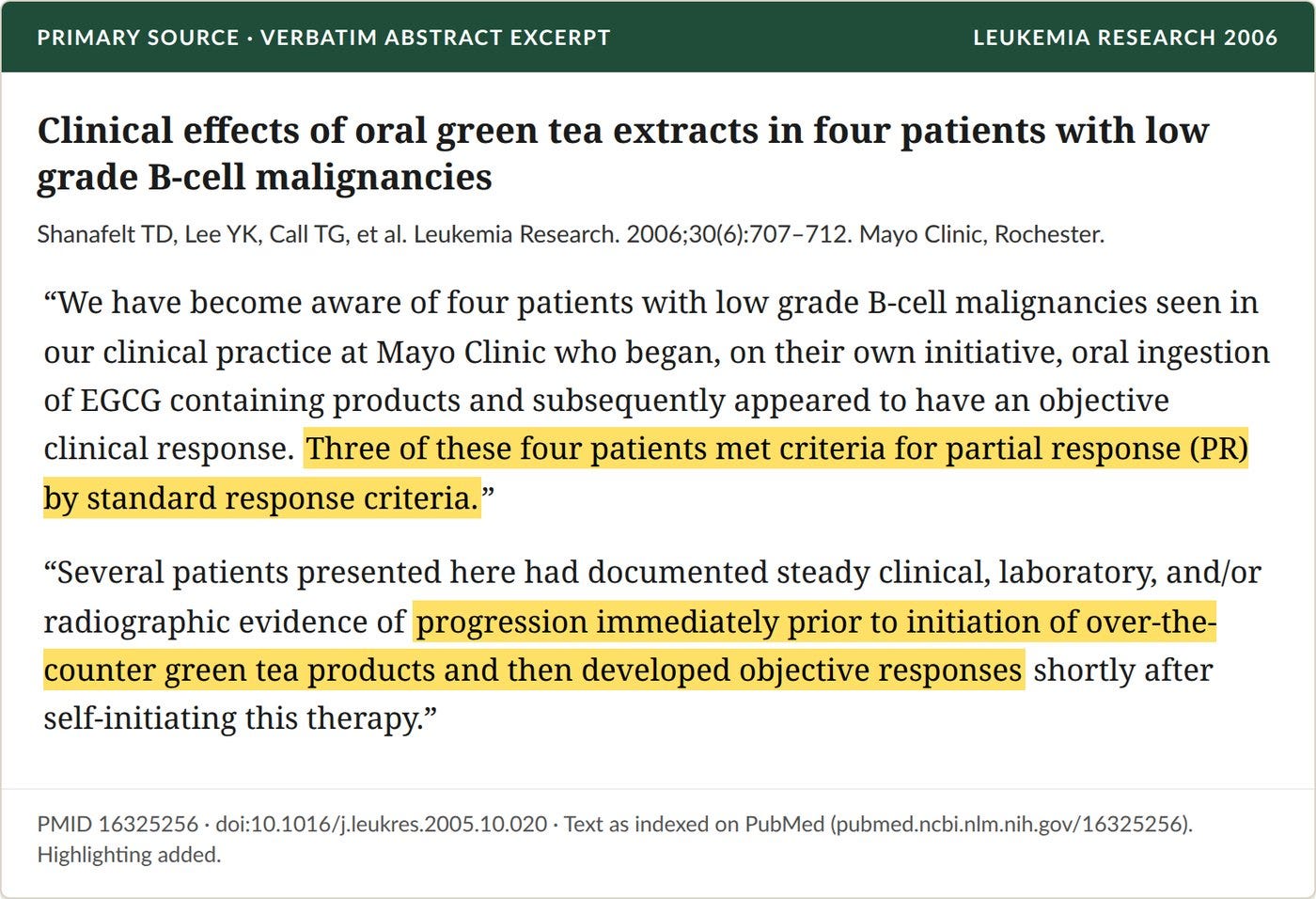
In 2006, the Mayo team published a report in Leukemia Research on four of their own patients with low-grade B-cell cancers who had started taking over-the-counter green tea extracts on their own. Three of the four met standard criteria for a partial response.
The detail that matters most is this: several of these patients had documented, steady progression immediately before they started the green tea extract, and then developed objective responses shortly afterward.
Read that again. The disease was getting worse. They added green tea extract. The disease reversed.
To its credit, Mayo did what science is supposed to do next. It opened a trial.
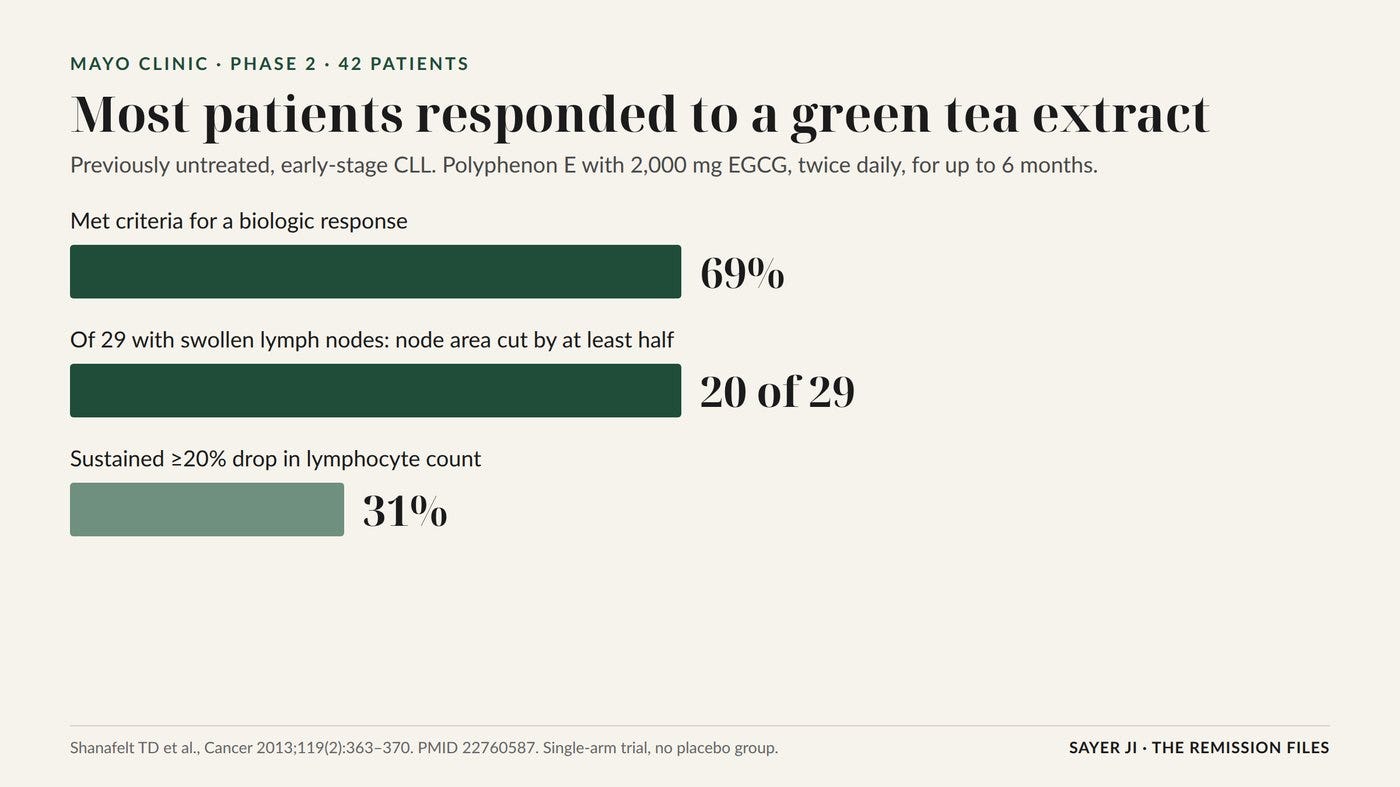
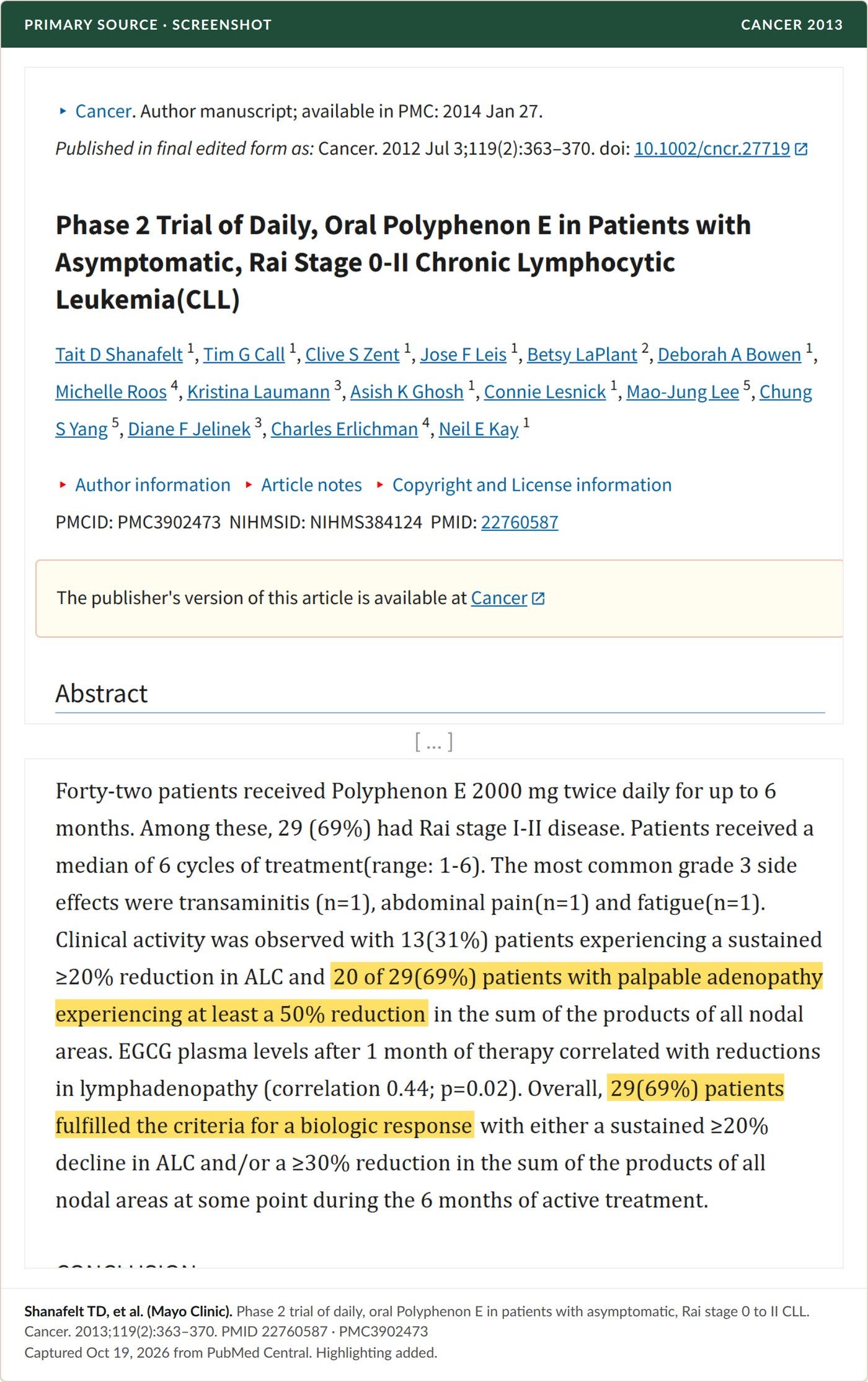
The phase 2 results, published in Cancer in 2013, followed 42 previously untreated, early-stage CLL patients who took Polyphenon E, a standardized decaffeinated green tea extract, at 2,000 mg of EGCG twice daily for up to six months:
69% of patients met the criteria for a biologic response.
20 of 29 patients with swollen lymph nodes saw their total node area shrink by at least half.
31% had a sustained drop of 20% or more in their lymphocyte count.
The more EGCG in a patient’s blood after one month, the more their lymph nodes shrank.
The authors’ own conclusion: “Durable declines in ALC and/or lymphadenopathy were observed in the majority of patients.”
Subscribe to follow The Remission Files. Part of this series is published each week.
The patient whose marrow came back clean
While Mayo was running its trial, one patient was running his own.
In September 1991, a 28-year-old man was diagnosed with CLL. He had a massively enlarged spleen, which surgeons removed, and he was put on watch and wait. He has since told his story publicly as Glenn Sabin, in his book n of 1. His case was written up in the peer-reviewed journal Cureus in 2015 by five physicians, including integrative oncologist Keith Block and physician-scientist Vikas Sukhatme.
I know Glenn, and he’s a great guy. He’s has been tirelessly dedicating his life to educating people on integrative alternatives for a long time. You can visit his website here.
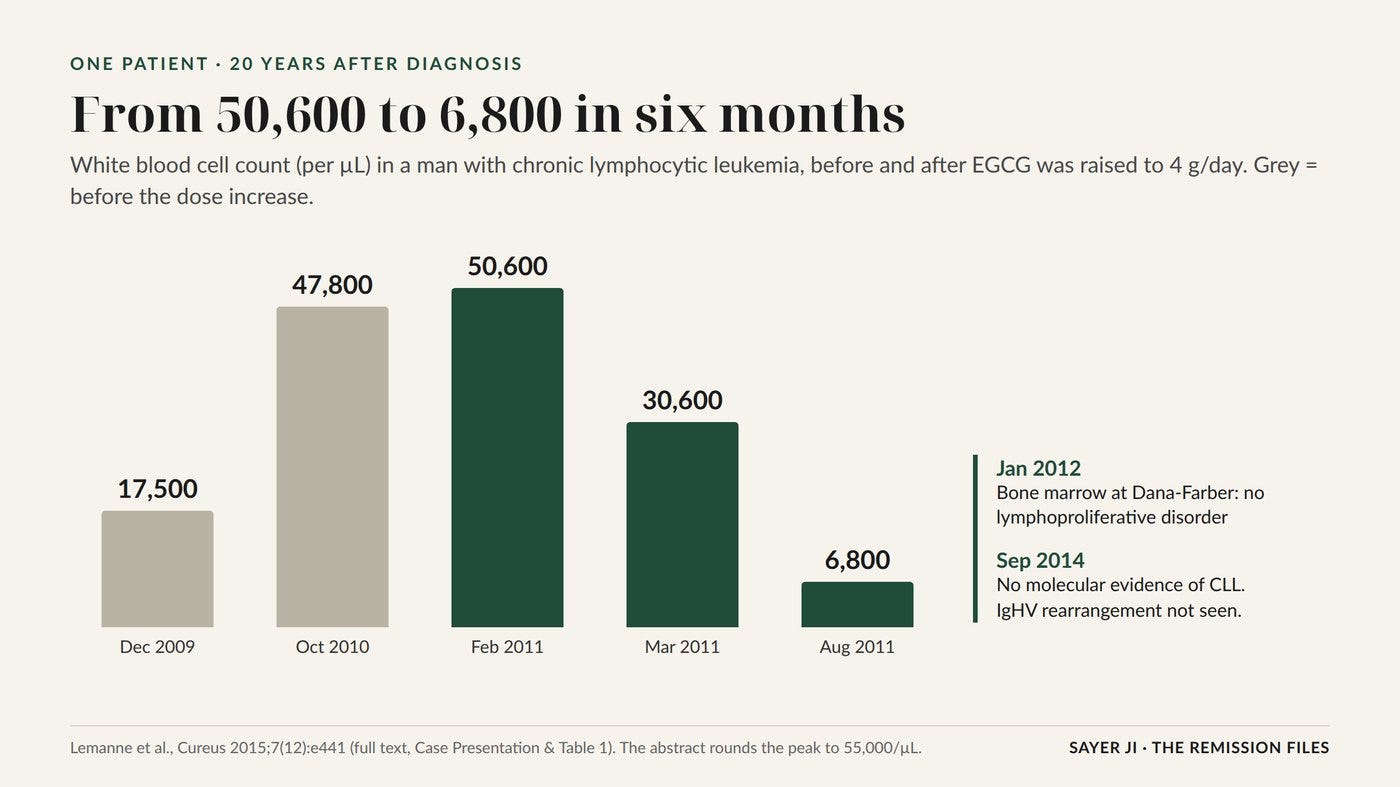
Over the next two decades, his bone marrow biopsies showed the leukemia steadily advancing. He declined chemotherapy and built a regimen of his own: a near-vegetarian diet, daily exercise, and supplements. Then, in late 2009, the disease accelerated. Here is what the case report records, step by step:
December 2009: white blood cell count 17,500/µL
October 2010: 47,800/µL, on a formula supplying about 1,200 mg of EGCG a day
December 2010: EGCG increased to 4 g daily, the dose used in the Mayo trial
February 2011: peak of 50,600/µL
March 2011: 30,600/µL
August 2011: 6,800/µL
January 2012: bone marrow at Dana-Farber Cancer Institute shows no evidence of a lymphoproliferative disorder
September 2014: a second marrow study: “IgHV rearrangement not seen; no clonal B cell population”
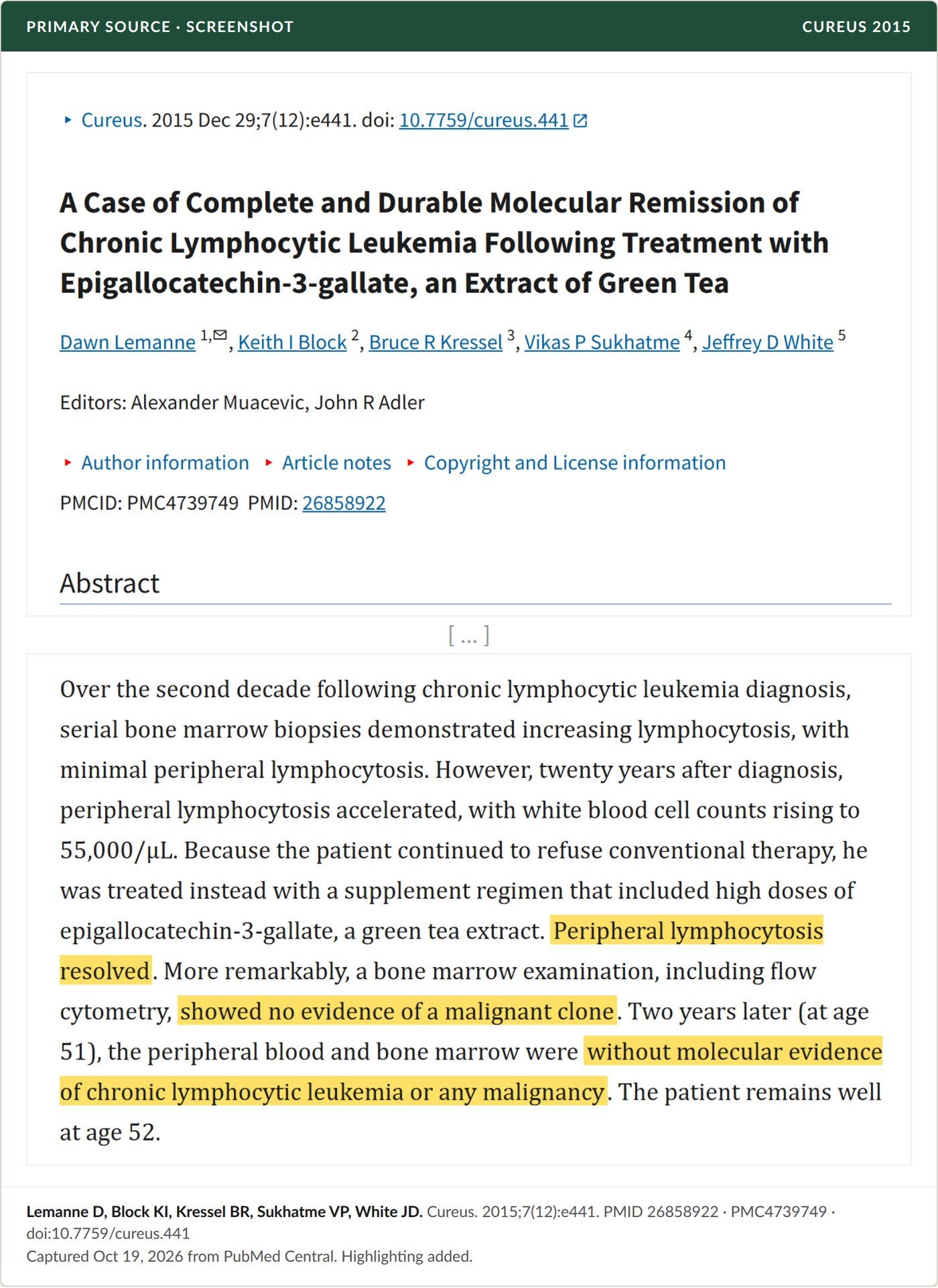
The authors wrote that the remission was “related in time to supplemental curcumin, fish oil, vitamin D, Scutellaria baicalensis, and perhaps most importantly, epigallocatechin-3-gallate.” Their conclusion was unusually direct for a medical journal: green tea extract “may offer a safe, inexpensive, and effective treatment for some patients, and … it should be vigorously investigated.“
The technical record
Was this just spontaneous remission? The authors addressed this directly. Clinical remission of CLL without conventional therapy occurs at roughly 1% of cases per year, and most such remissions are incomplete: in a review of 21 cases they cite, only 33% regressed to a molecularly normal state. The longer the time since diagnosis, the less likely a complete molecular remission becomes. This one came 20 years in.
Why this case can’t be attributed to EGCG alone. The patient also took curcumin (4 g/day), high-dose fish oil, vitamin D3, Scutellaria and probiotics. The timing points to EGCG: the turnaround began about two months after the dose was raised to 4 g. But one patient on several agents cannot isolate a single cause.
Disclosure. Dr. Dawn Lemanne, the lead author, helped the patient prepare his memoir without compensation. Dr. Sukhatme disclosed a Pfizer grant and advisory fees unrelated to this case.
Sources: Lemanne et al., Cureus 2015;7(12):e441. Note: the abstract rounds the peak white count to 55,000/µL; the case presentation and Table 1 report 50,600/µL, the figure used here.
The detail most people miss
Neither Mayo’s patients nor this one gave up anything to try green tea extract.
Early-stage CLL has no standard treatment to abandon. Watch and wait is the treatment. Every patient in the Mayo trial was previously untreated and was simply being monitored. The extract wasn’t an alternative to chemotherapy. It was something to do during the years when medicine offers nothing at all.
That reframes the whole question. The issue isn’t whether a green tea extract can replace a drug. It’s whether patients should spend years watching their disease progress while a well-tolerated option, already shown to shrink lymph nodes in most patients in a Mayo Clinic trial, goes unmentioned.
Why you’ve never heard of this
Imagine a drug company had produced these results: a well-tolerated oral agent, a dose-response relationship, lymph node shrinkage in 69% of patients, and a documented complete molecular remission. The phase 3 trial would have been funded within the year, followed by press releases and a launch campaign.
Instead, as far as I can find, the only green tea trial for CLL ever registered on ClinicalTrials.gov is the original Mayo phase 1/2 study, opened in 2005. No phase 3 followed.
This isn’t primarily a conspiracy. It’s an incentive structure. Phase 3 trials cost tens of millions of dollars, and no one recovers that investment on a compound found in a beverage people have drunk for thousands of years.
The irony is that the same extract did become a drug. In 2006, the year Mayo published its four cases, the FDA approved Veregen (sinecatechins), a green tea catechin ointment, for genital warts. A patentable topical product had a commercial path. The oral form for leukemia did not.
Reading the biology carefully
The Mayo laboratory work explains why this response is plausible rather than miraculous. The 2004 Blood study found that CLL cells make their own survival signal: they secrete VEGF and carry receptors for it, essentially feeding themselves the signal that keeps them from dying. EGCG partially blocked those receptors, lowered the cells’ anti-death proteins (Bcl-2, XIAP and Mcl-1), and the leukemic cells went into programmed cell death.
That points to a different model of what this cancer is. CLL cells aren’t indestructible. They are cells that have stopped dying on schedule, and they are kept alive by a signal they produce themselves. Interrupt the signal, and the cells resume the death they were always programmed for.
The dose-response finding fits this. In the Mayo trial, patients with higher EGCG blood levels had more lymph node shrinkage. Real pharmacology usually behaves this way. Placebo responses and chance findings usually don’t.
Safety: read this before you act on anything above
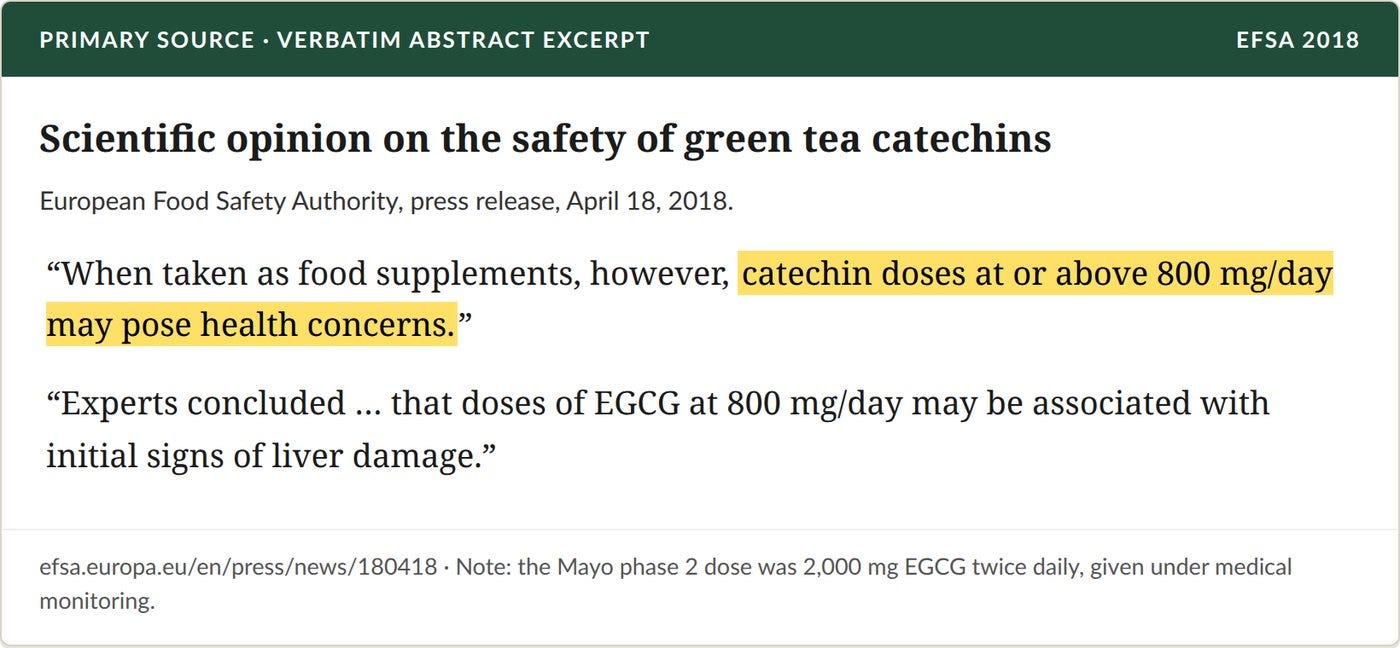
The doses in these studies were not cups of tea. The Mayo trial gave 2,000 mg of EGCG twice daily under medical monitoring, and one patient developed grade 3 elevation of liver enzymes. The European Food Safety Authority concluded in 2018 that EGCG at or above 800 mg/day from supplements “may be associated with initial signs of liver damage,” while green tea as a beverage is generally safe.
Anyone considering concentrated green tea extract during CLL monitoring should do so with their hematologist, with liver tests on a schedule. That is exactly how Mayo did it.
The broader evidence
This case doesn’t stand alone. The body’s capacity to reverse cancer is better documented than most patients are told.
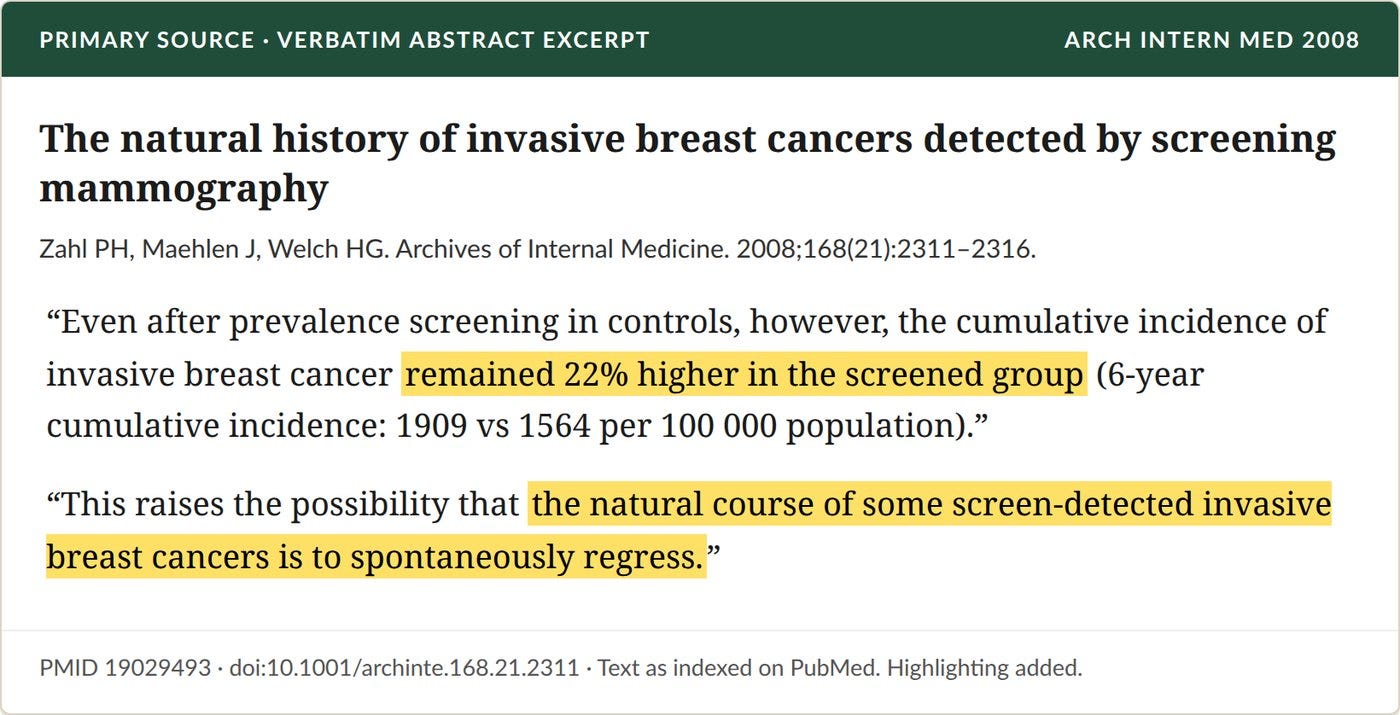
A 2008 study in the Archives of Internal Medicine compared Norwegian women screened every two years with an age-matched group screened once at the end of six years. If every screen-detected cancer persisted, the two groups should have ended up with the same number of cancers. They didn’t: the screened group had 22% more invasive breast cancers. The authors concluded that “the natural course of some screen-detected invasive breast cancers is to spontaneously regress.”
I’ve written about this capacity for years on GreenMedInfo, in When Cancer Spontaneously Disappears, Yes, Breast Cancer Can and Often Does Spontaneously Regress, and The Case of the Incredible Disappearing Cancer Patients. A 2023 review in the Journal of Translational Medicine collected 16 case reports of cancer remission after a viral infection or vaccination, and the authors pointed to immune activation, which links to the old observation that fever helps the body fight disease.
The green tea story adds something these reports usually lack: a specific compound, a plausible mechanism, a dose-response relationship, and a Mayo Clinic trial.
The question we should be asking
I’m not arguing that anyone should abandon their hematologist. Glenn Sabin’s case is one patient, and he took more than one supplement.
I’m arguing that the “wait” in watch and wait doesn’t have to mean doing nothing. A compound with lab evidence, a dose-response relationship, a phase 2 trial in which most patients responded, and a documented complete molecular remission deserves a phase 3 trial. Patients deserve to hear about it from their doctors rather than discover it on their own, the way Mayo’s first four patients did.
When patients get ahead of their physicians, it’s usually because the physicians stopped reading.
For more of the evidence on food compounds that target the cells driving cancer, see 25 Cancer Stem Cell Killing Foods. Next week, Part 2 of The Remission Files covers the vitamin C trials that Mayo Clinic ran in the wrong form.
One extract. One dose increase. One bone marrow that came back clean.
“Natura sanat, medicus curat.” Nature heals; the physician treats.
Latin medical maxim
If you enjoyed this article, and are interested in natural and integrative alternatives, visit the world’s largest open source database: www.GreenMedInfo.com and consider becoming a member to support our ever-expanding project to index and freely disseminate the Science of Natural Healing.
This article is for educational purposes and is not medical advice. Discuss any change to your care with a qualified clinician.


Sources
The paper in Blood: https://pubmed.ncbi.nlm.nih.gov/14996703/
a report in Leukemia Research: https://pubmed.ncbi.nlm.nih.gov/16325256/
phase 2 results, published in Cancer in 2013: https://pmc.ncbi.nlm.nih.gov/articles/PMC3902473/
the peer-reviewed journal Cureus in 2015: https://pmc.ncbi.nlm.nih.gov/articles/PMC4739749/
the only green tea trial for CLL ever registered on ClinicalTrials.gov: https://clinicaltrials.gov/study/NCT00262743
Veregen (sinecatechins), a green tea catechin ointment: https://www.accessdata.fda.gov/drugsatfda_docs/label/2018/021902s033lbl.pdf
The European Food Safety Authority concluded in 2018: https://www.efsa.europa.eu/en/press/news/180418
2008 study in the Archives of Internal Medicine: https://pubmed.ncbi.nlm.nih.gov/19029493/
When Cancer Spontaneously Disappears: https://greenmedinfo.com/content/when-cancer-spontaneously-disappears
Yes, Breast Cancer Can and Often Does Spontaneously Regress: https://greenmedinfo.com/content/yes-breast-cancer-can-and-often-does-spontaneously-regress-confirmed-case-reports1
The Case of the Incredible Disappearing Cancer Patients: https://greenmedinfo.com/content/case-incredible-disappearing-cancer-patients
2023 review in the Journal of Translational Medicine: https://greenmedinfo.com/article/spontaneous-cancer-remission-after-covid-19
fever helps the body fight disease: https://greenmedinfo.com/content/hotter-bodies-better-fighting-disease
25 Cancer Stem Cell Killing Foods: https://read.sayerji.com/p/25-cancer-stem-cell-killing-foods