

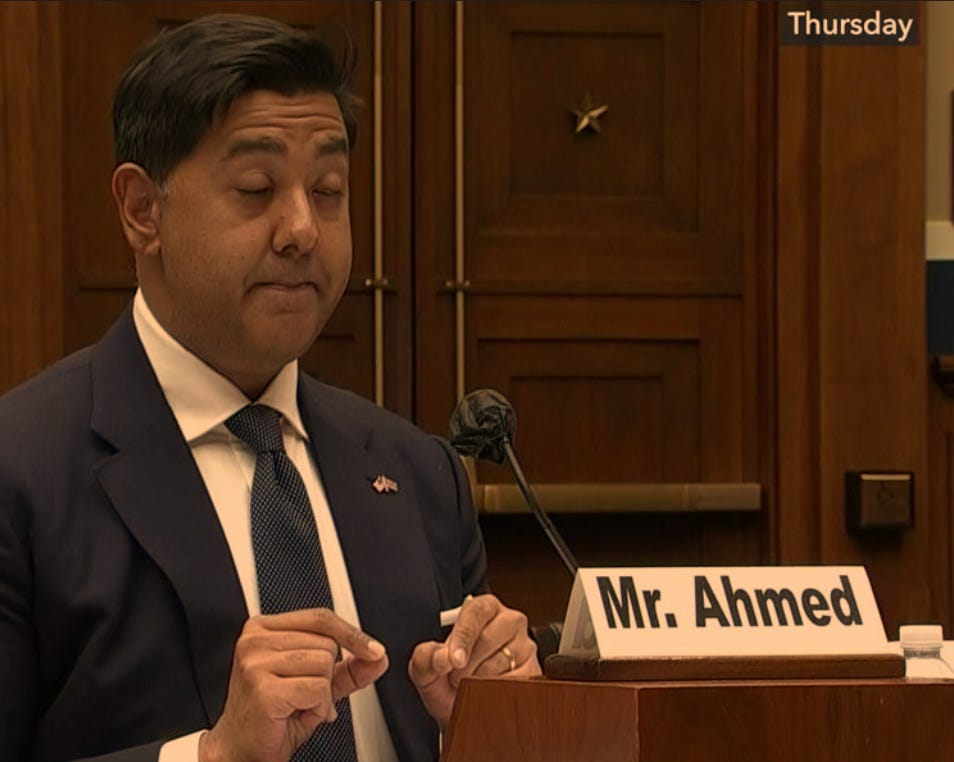
A three-page filing, a Second Circuit ruling, and a federal case that may end without any judge ever reaching the merits — and why that should concern every American, including the twelve of us his organization targeted.
Three Pages on a Judge’s Desk
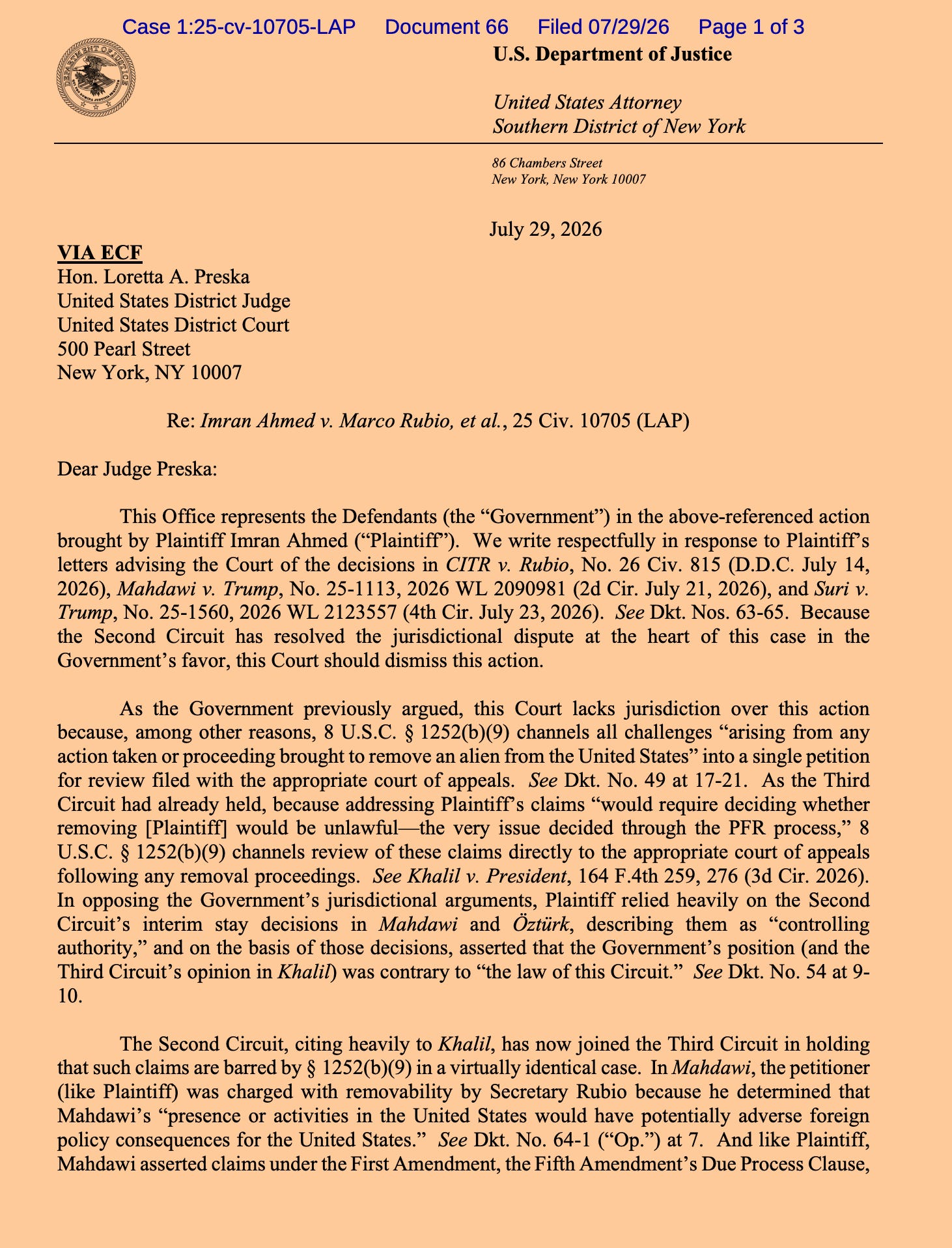
On July 29, the U.S. Attorney’s Office for the Southern District of New York delivered three pages to Judge Loretta Preska. [Dkt. 66 ]. No new evidence. No new argument, really. Just a citation — and a conclusion: “Because the Second Circuit has resolved the jurisdictional dispute at the heart of this case in the Government’s favor, this Court should dismiss this action.”
The case is Imran Ahmed v. Marco Rubio, 25 Civ. 10705. The plaintiff is the CEO of the Center for Countering Digital Hate — the organization that in 2021 branded twelve of us the “Disinformation Dozen” and built the template for the deplatforming campaigns that followed. I have written about his deportation case twice before. I am also a plaintiff in Finn v. Global Engagement Center, the federal case challenging the censorship architecture his organization helped operate.
So let me state my position at the outset, because precision is the discipline this moment demands.
Nothing in what follows vindicates Imran Ahmed. And nothing in what follows vindicates the government. No court has ruled on either. That — as you will see — is the entire problem.
What Happened in December
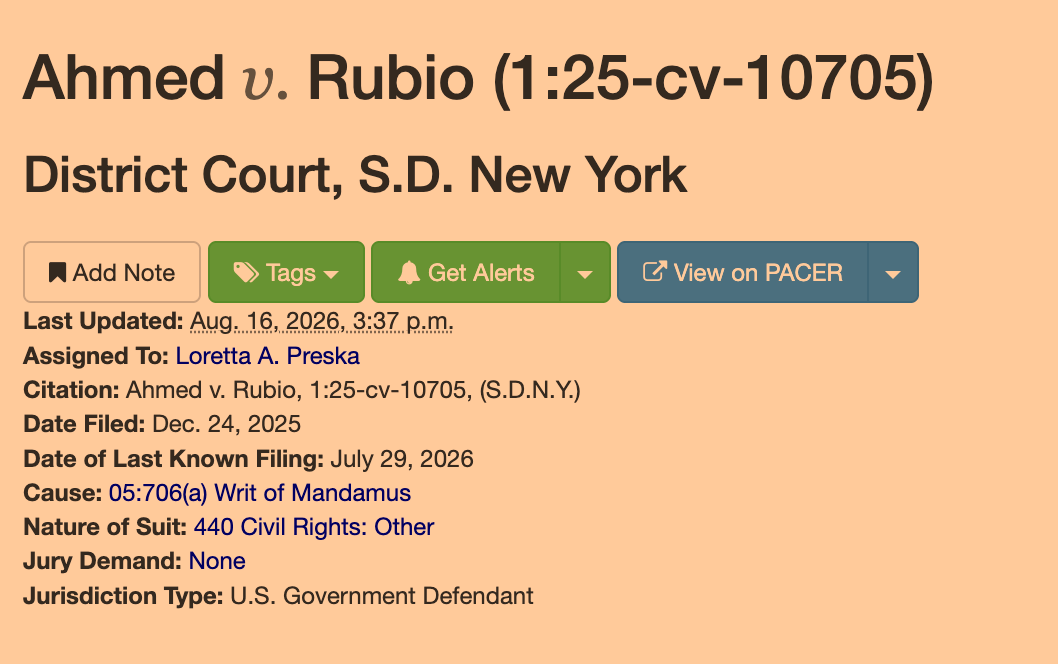
On December 23, 2025, the State Department designated five European nationals over their “anti-disinformation” work and moved to detain and deport the only one on American soil: Imran Ahmed. Secretary Rubio’s stated basis, announced publicly, was that these were “weaponized NGOs” that had run “organized efforts to coerce American platforms to censor, demonetize, and suppress American viewpoints” — the same architecture I have spent years documenting from primary records.
Ahmed sued in Manhattan federal court within days and won a restraining order blocking his detention. He calls the government’s action punishment for advocacy. The government calls it a response to coercion of American platforms. For nearly eight months, no court has resolved which.
After July, none may.
BREAKING: U.S. Bars and Removes UK ‘Digital Hate’ Leader Imran Ahmed Over Foreign Censorship of American Speech

Disclosure: I am Sayer Ji, a named plaintiff in Finn v. Global Engagement Center, Case No. 3:25-cv-00543-WWB-MCR, currently pending in the United States District Court for the MiddleDistrict of Florida. This reporting describes facts central to that litigation, and I have a financialinterest in its outcome.
Wrong Courthouse: The Statute Doing the Work
Here is what most coverage of this case has missed. The government’s defense has never been “we didn’t punish him.” It has been: wrong building.
A federal statute — 8 U.S.C. § 1252(b)(9), the immigration code’s so-called “zipper clause” — funnels every legal question “arising from” an effort to remove a noncitizen into one channel: immigration judge, then the Board of Immigration Appeals, and only at the very end, review by a federal appeals court. If the statute applies, ordinary federal district courts — the courts where Ahmed sued — have no power to hear the case at all. Not to dismiss his claims as wrong. To refuse to hear them.
Ahmed’s answer rested on one load-bearing wall: early rulings from the Second Circuit in the Columbia student-deportation cases — Mahdawi, Öztürk — signaling that the courthouse stays open for people challenging speech-based removal. His lawyers called those rulings “controlling authority.”
July 21: The Wall Comes Down
On July 21, the Second Circuit issued its final decision in Mahdawi v. Trump — and held the opposite. First Amendment retaliation claims attacking a Rubio removability determination are channeled out of district court entirely; the “plain meaning” of the statute reaches “the Secretary of State’s removability determination” itself, not merely commenced proceedings. And the court held that its earlier stay rulings — the ones Ahmed built on — were preliminary calls that bind no one.
Same circuit. Same species of Rubio determination. Nearly identical claims. The Second Circuit thereby joined the Third Circuit’s January decision in Mahmoud Khalil’s case [Khalil v. President, 164 F.4th 259]. Two days later the Fourth Circuit went the other way in [Suri v. Trump], with Judge Wilkinson’s dissent naming the conflict outright — a clean 2–1 circuit split, now pointed at the Supreme Court.
The Letter, and Ahmed’s Last Card
The July 29 letter walks Mahdawi into Judge Preska’s chambers and dismantles Ahmed’s two remaining distinctions point by point. He argues no removal proceedings have been commenced against him — the government answers that Mahdawi covers the determination itself. He argues he sued under the Administrative Procedure Act rather than habeas — the government answers that this makes channeling cleaner, not harder, and notes he “mounted no independent challenge to his prospective detention.”
His one live card is the argument the Supreme Court left open in Jennings v. Rodriguez: a channeling statute cannot be read to foreclose all review — and with no removal case even filed against him, Ahmed literally has no channel available. It is his best argument. It is also an argument the Mahdawi panel already considered and distinguished. Long odds, in this circuit, at this hour.
My Assessment
My read, stated plainly so you can hold me to it: roughly an 80% likelihood this case is dismissed, most probably this fall. The restraining order protecting Ahmed from detention dissolves with it. His appeal would go to the very court that just decided Mahdawi — call that 90% against him. The real action then moves to the Supreme Court, where a cert grant on the circuit split is more likely than not, with a decision possibly by June 2027.
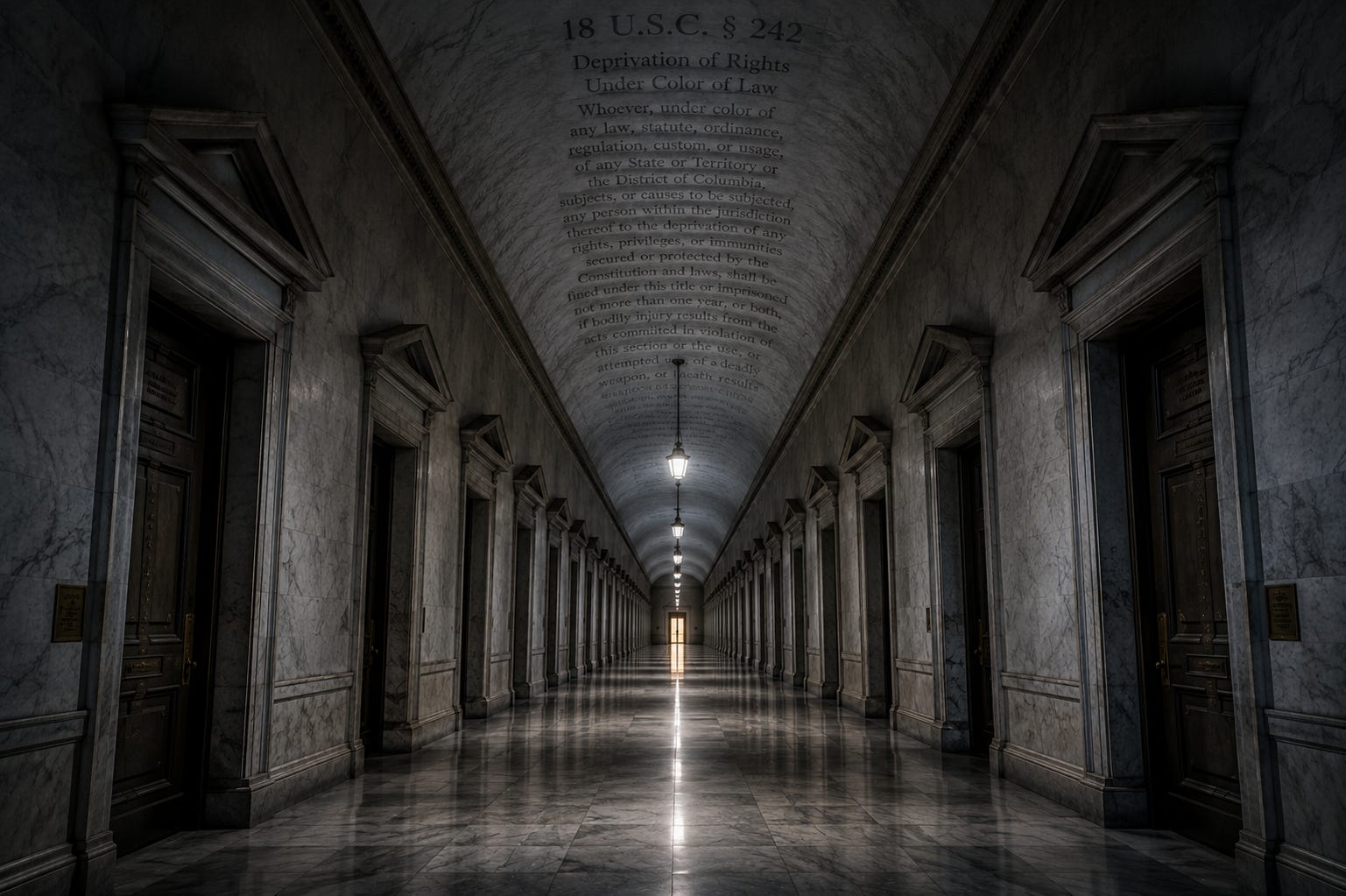
And here is the paradox nobody says out loud. Under this doctrine, the only way Ahmed ever gets a judge to rule on his First Amendment theory is if the government actually moves to deport him. Peace means no forum. The punishment is the ticket to court. Until the government acts, he remains at liberty but unshielded — unable to leave the country without forfeiting his return, unable to force a ruling, dangling on a timeline the government alone controls.
What This Does Not Mean
Now the part I ask my own readers to sit with, because the discipline here is the credibility of everything else we do.
A jurisdictional dismissal is not a verdict. If Judge Preska dismisses, no court will have found that Ahmed’s organization did what Secretary Rubio said it did — and no court will have found that it didn’t. Rubio’s findings remain exactly what they have been since December: official, public, consequential, and untested by any judge. The documented record on CCDH’s operations — the record I have published, sourced, and stress-tested — stands on its own evidence. This development adds nothing to it and subtracts nothing from it.
Anyone on my side of this fight tempted to celebrate a man losing on a technicality should think harder about what is actually being built.
The Loaded Weapon
Because notice where the machinery that shut Ahmed’s courthouse door was forged: in the pro-Palestinian student deportation cases — Khalil, Mahdawi, Öztürk. Jurisdiction-stripping does not check your politics before it strips. A removal designation that no court can review is a loaded weapon left on the table for every future administration. Today it points at a censor. Tomorrow it can point at anyone — including people like me, who have already learned what it feels like when the state’s machinery turns toward your speech.
This is why I have insisted, from the beginning, that our fight is not a grievance but a structural claim on the American inheritance. The Missouri v. Biden Consent Decree resolved the government’s direct pressure on platforms. Executive Order 14,149 disavowed it. But the indirect architecture — the NGO intermediary pipeline that laundered state preferences into private enforcement — was never adjudicated anywhere. It is being litigated today in exactly one case: Finn v. Global Engagement Center. Not because we sought the fight, but because someone had to close the gap, in a courtroom, on the record, under rules that bind both sides.
That is the difference between accountability and power. Accountability survives review. Power avoids it.
What to Watch
Judge Preska’s ruling, likely within one to three months — I will update this piece the day it lands. The researchers’ coalition case in D.C., where the organizational challenge to the underlying policy has already won preliminary relief and remains the one open judicial lane. And the Supreme Court’s docket, where the Khalil/Mahdawi/Suri split is now ripening toward a decision that will determine whether any of these cases — his or, in principle, anyone’s — ever gets a merits hearing at all.
The Measure of a Free Country
The measure of a free country was never whether it protects the speech of people we admire. It is whether the machinery of the state must answer to a judge before it moves against anyone — the censor and the censored alike. That is the inheritance. It does not defend itself. It is defended by people willing to insist on it even when the person standing in the closing doorway is the one who helped build the door.
We will keep insisting.


Support the legal fight to dismantle the censorship-industrial complex: Legal defense fund: LINK
Sayer the 2nd Circuit Court of Appeals is perhaps the most corrupt in the nation imo. I know, my case seeking "emergency relief" for being fired for declining the Covid shot was stalled in that court for 2 years...
Imran Ahmed harmed us all, I am personally offended by his behavior & the legal shennanigans. I too was censored for stating the obvious about covid although on a much lesser scale. This foreigner tried to deprive me of my 1st Amendment rights.