

What a viral vitamin C skin cancer trial reveals about medicine’s 40-year blind spot
A topical vitamin C solution that cleared 86% of basal cell carcinomas is trending as a curiosity. It is something far more important: the third independent line of evidence that vitamin C’s anticancer power was never really in question. What was in question was whether enough of it ever reached the tumor.
The trial everyone is talking about
In 2022, Briant Burke and Jon-Eric Bailie published a randomized trial in Biomedicine & Pharmacotherapy comparing a strikingly simple formula, 30% ascorbic acid dissolved in 95% DMSO, against imiquimod, a standard prescription cream for low-risk basal cell carcinoma (PubMed). Twenty-five patients with 29 biopsy-confirmed lesions were randomized. After eight weeks, a follow-up punch biopsy found complete resolution in 13 of 15 vitamin C–treated lesions (86.7%) versus 8 of 14 imiquimod lesions (57.1%).
Imiquimod caught up partially when given four extra weeks (78.6% at 12 weeks), which is why the authors describe vitamin C as superior at 8 weeks and non-inferior at 12 (full text). But the tolerability gap never closed. Pain occurred in 8% of vitamin C patients versus 40% on imiquimod; skin erosion in 16% versus 81%. Thirty months later, no vitamin C patient had scarring or hypopigmentation, while 70% of the imiquimod group still carried pale patches.
The authors conclude that concentrated ascorbic acid in DMSO “is a well tolerated, inexpensive, easy to use topical preparation that warrants larger clinical trials as a suitable first line treatment for BCC.”
Technical callout: study limits
15 vs 14 lesions; low-risk nodular and superficial BCC only. Participants were blinded; the paper does not state that pathologists were. Allocation was by numbered token (odd/even). Recurrence over 30 months was 0 vs 1, not statistically significant. The authors did not study mechanism and attribute DMSO’s role mainly to skin penetration.
Why the solvent isn’t the story
Much of the online excitement has centered on DMSO. But the authors note that earlier work with ascorbic acid alone also cleared BCC. Holló and colleagues used a 33% aqueous paste on seven lesions, only far more slowly, averaging 22 weeks under 12-hour daily occlusion (full text). DMSO compressed that timeline to eight weeks by getting the vitamin C where it needed to go.
That is the clue. The variable that matters is how much vitamin C reaches the tumor.
The 2005 discovery that changed the question
At the National Institutes of Health, Mark Levine’s group showed that vitamin C at millimolar concentrations kills cancer cells while leaving normal cells untouched. Normal cells were unaffected by 20 mM ascorbate, whereas five cancer lines had EC50 values below 4 mM (Chen et al., PNAS 2005). The killing depended entirely on hydrogen peroxide generated in the fluid around cells: vitamin C acting as a “pro-drug” for a targeted oxidative strike. Follow-up work confirmed that pharmacologic doses produce this hydrogen peroxide selectively in tumor fluid but not in blood, and that daily treatment slowed the growth of ovarian, pancreatic and glioblastoma tumors in mice (Chen et al., PNAS 2008).
In other words, the vitamin that protects healthy cells as an antioxidant becomes a selective weapon against cancer cells once its concentration crosses a threshold.
How medicine tested the wrong drug
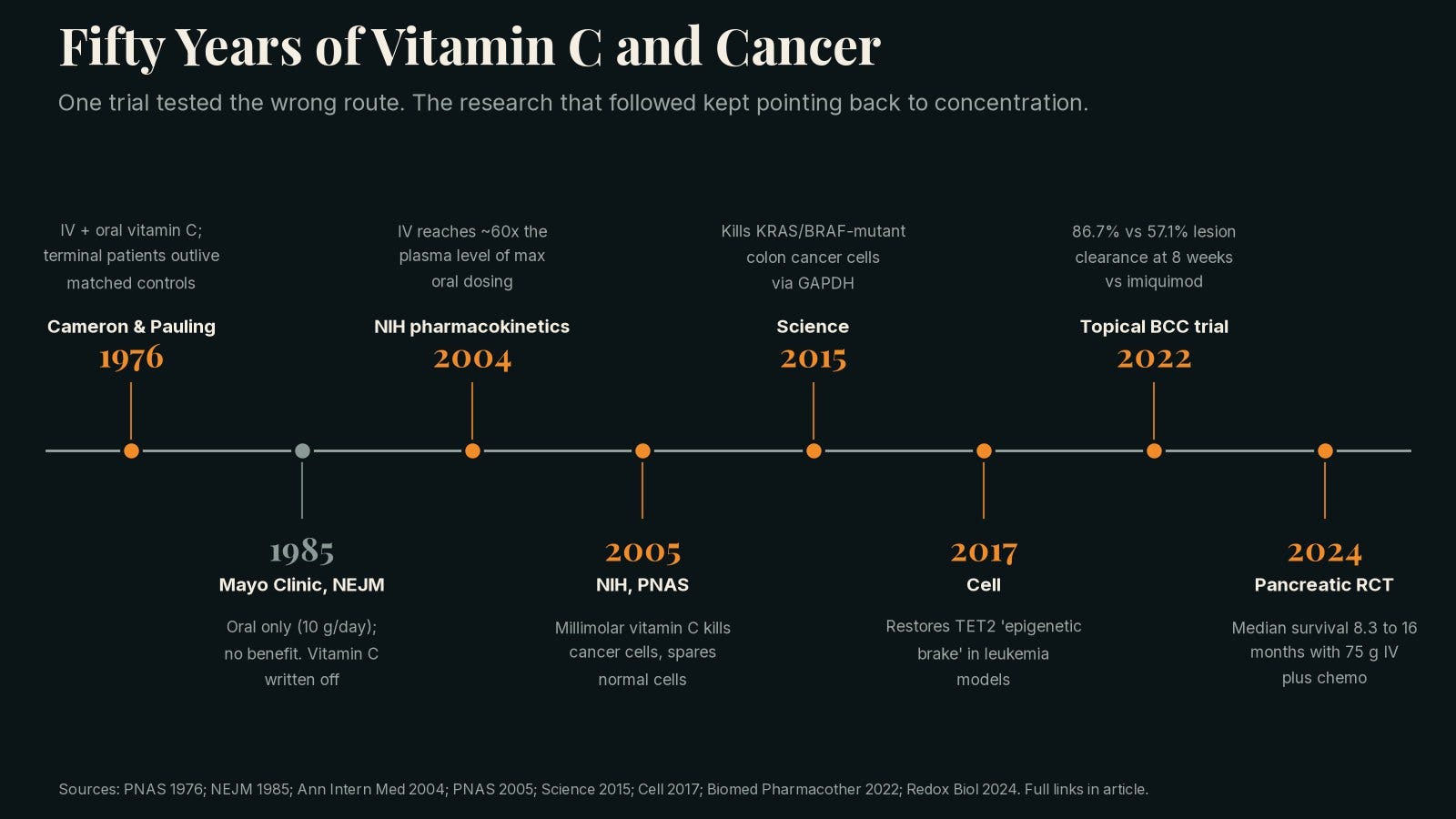
In 1976, Ewan Cameron and two-time Nobel laureate Linus Pauling reported that 100 terminal cancer patients given supplemental ascorbate lived markedly longer than 1,000 matched controls (Cameron & Pauling, PNAS 1976). Their patients received vitamin C intravenously for about 10 days, then orally (NCI PDQ).
The Mayo Clinic responded with randomized, double-blind trials. In 1985, 100 patients with advanced colorectal cancer took 10 g of vitamin C daily, by mouth only, and fared no better than placebo. The authors concluded vitamin C “is not effective against advanced malignant disease” (NEJM 1985).
Nineteen years later, the NIH ran the pharmacokinetic study that should have come first. Even the maximum tolerated oral regimen, 3 g every four hours, was predicted to peak around 220 µmol/L in plasma. A 50 g intravenous dose was predicted to reach about 13,350 µmol/L (Padayatty et al., Annals of Internal Medicine 2004). The gut simply will not let enough in.
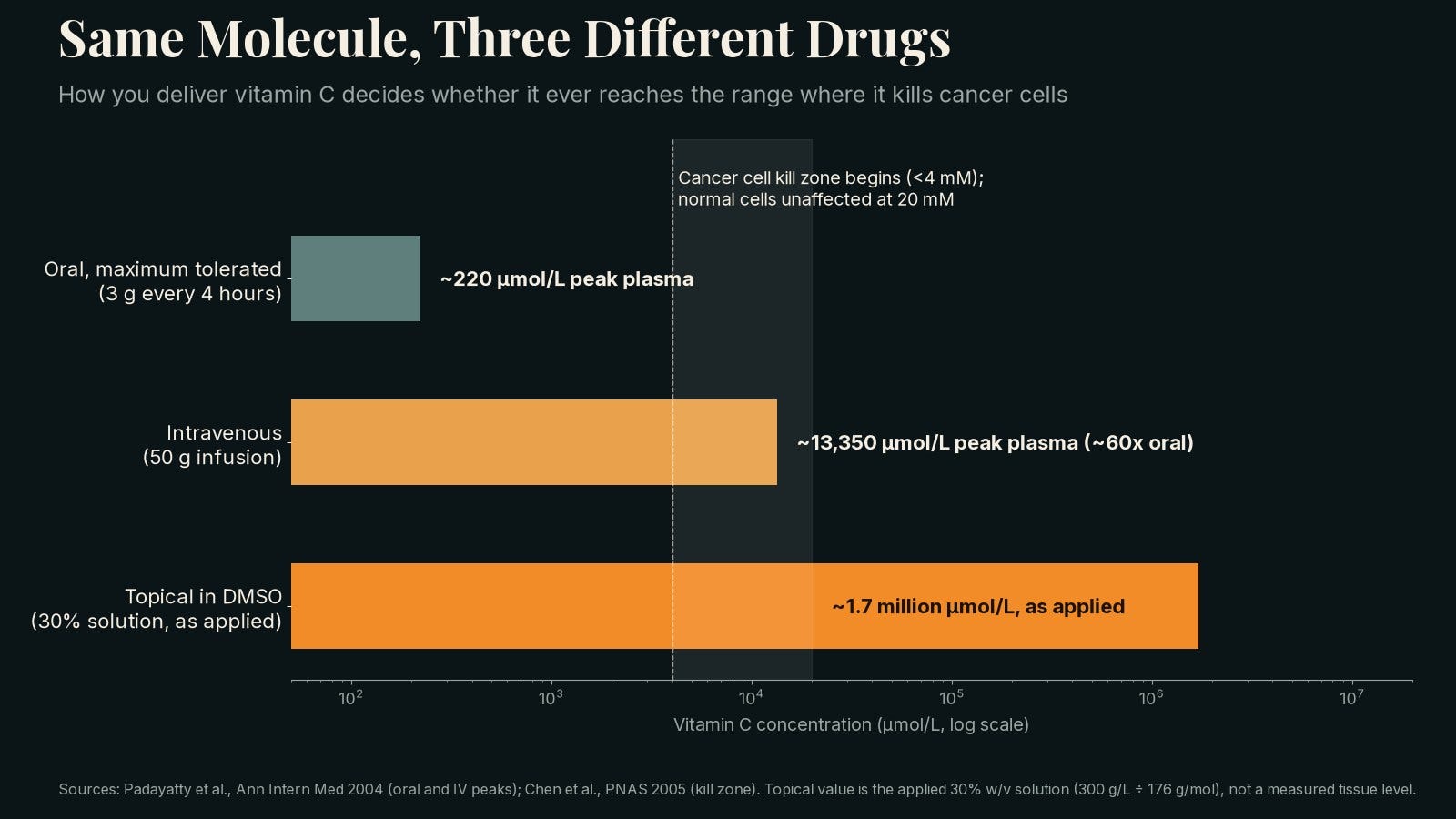
The Mayo trials did not disprove vitamin C. They showed that oral vitamin C cannot reach the anticancer threshold, a finding consistent with everything since. The NIH’s own fact sheet now notes that the discrepancy “may be due to the route of administration” (NIH Office of Dietary Supplements).
When the right dose was finally tested
In a 2024 randomized phase II trial in stage IV pancreatic cancer, adding 75 g of IV vitamin C three times weekly to gemcitabine and nab-paclitaxel raised median overall survival from 8.3 to 16 months (HR 0.46) and progression-free survival from 3.9 to 6.2 months, “without detriment to quality of life or added toxicity” (Bodeker et al., Redox Biology 2024). The University of Iowa team stopped the trial early because the benefit was so clear (University of Iowa).
In ovarian cancer, IV ascorbate combined with carboplatin and paclitaxel reduced tumor weight by 94% in mice and, in a pilot patient trial, decreased low-grade chemotherapy toxicities across nearly every category measured (Ma et al., Science Translational Medicine 2014). A recent meta-analysis found IV vitamin C associated with a 1.83-fold longer median overall survival in adults with malignant tumors, rated moderate certainty (International Journal for Vitamin and Nutrition Research).
Not one mechanism, but many
Metabolic sabotage. KRAS- and BRAF-mutant colorectal cancer cells take up oxidized vitamin C through their overexpressed sugar transporter, deplete glutathione, and suffer inactivation of the glycolytic enzyme GAPDH, an “energetic crisis and cell death not seen in KRAS and BRAF wild-type cells” (Yun et al., Science 2015).
Epigenetic repair. Vitamin C mimicked restoration of the TET2 tumor-suppressor enzyme in leukemia models and suppressed leukemia progression in patient-derived xenografts (Cimmino et al., Cell 2017).
Immune activation. High-dose vitamin C delayed tumor growth in a T cell–dependent manner and cooperated with checkpoint immunotherapy in mice (Magrì et al., Science Translational Medicine 2020).
The KRAS finding has already echoed in people. The 442-patient phase III VITALITY trial did not meet its overall endpoint in metastatic colorectal cancer, but in the prespecified RAS-mutant subgroup, adding IV vitamin C extended progression-free survival from 7.8 to 9.2 months (HR 0.67) (Wang et al., Clinical Cancer Research 2022).
The deficiency hiding in plain sight
There is a second, quieter reason vitamin C is essential in cancer. Humans cannot make it. Our GULO gene, the final enzyme in vitamin C synthesis that most mammals still use, became a broken pseudogene in our primate ancestors roughly 61 million years ago (Genetics of Vitamin C Loss in Vertebrates).
Cancer burns through what we do take in. In one study, 30% of hospice residents with advanced cancer were severely deficient, and low vitamin C tracked with high inflammation and shorter survival; another series found severe deficiency in 50% of terminal patients (High-Dose Vitamin C in Advanced-Stage Cancer Patients). Patients with hematologic and other cancers “are often markedly vitamin C-deficient” (Vitamin C in Stem Cell Reprogramming and Cancer). Cameron and Pauling made the same point in 1976: cancer patients are “significantly depleted of ascorbic acid,” indicating “a substantially increased requirement” (PNAS 1976).
Two faces of one molecule
As an essential nutrient, it is the cofactor that keeps collagen, immune cells and TET epigenetic enzymes working, and many cancer patients are running low.
As a pharmacological agent, at concentrations only IV or direct topical delivery can achieve, it becomes a selective pro-oxidant that exploits the very features (iron overload, sugar addiction, weak peroxide defenses) that make cancer cells cancer.
This is a theme I return to often: our nutrients are not single-purpose chemicals but context-dependent information. Vitamin C even helps regenerate UV-degraded steroid hormones before they break down into potentially carcinogenic byproducts (“The Surprising Role of Vitamin C in Hormone Regeneration”). And in a 2025 animal study, vitamin C plus grape seed extract outperformed doxorubicin in shrinking solid tumors (“The $5 Cancer Treatment That Embarrassed Modern Medicine”).
What the evidence does and doesn’t say
The BCC trial is small and needs the larger trials its authors call for. A 2026 dermatology systematic review classes it as early evidence (PMC).
Not every IV trial has been positive: adding IV vitamin C to docetaxel did not improve outcomes in metastatic castration-resistant prostate cancer, and the FDA has not approved high-dose vitamin C as a cancer treatment (NCI PDQ).
Oral vitamin C, however valuable nutritionally, should not be expected to reproduce pharmacological effects.
The real lesson
The story trending today is not that a cure was hidden. It is that a cheap, off-patent and remarkably safe molecule was written off for a generation on the strength of trials that delivered it by a route that could never reach the anticancer threshold. Every time researchers have closed that concentration gap, intravenously in pancreatic cancer and directly on the skin in basal cell carcinoma, vitamin C has shown up.
The evidence was never missing. The concentration was.
EXPLORE THE FULL RESEARCH INDEX
GreenMedInfo indexes 8,728 study abstracts on vitamin C, including 182 on intravenous vitamin C across 59 conditions.
→ GreenMedInfo Vitamin C Research Index
→ Vitamin C: Intravenous research
→ Nutritional Pharmacology and Cancer: A Comprehensive Review
Studies cited
Burke & Bailie 2022, topical ascorbic acid in DMSO vs imiquimod for BCC, Biomed Pharmacother · full text
Chen et al. 2005, pharmacologic ascorbate selectively kills cancer cells, PNAS
Chen et al. 2008, pharmacologic ascorbate decreases growth of tumor xenografts, PNAS
Cameron & Pauling 1976, supplemental ascorbate in terminal cancer, PNAS
Moertel et al. 1985, oral vitamin C vs placebo in advanced cancer, NEJM
Padayatty et al. 2004, vitamin C pharmacokinetics, oral vs IV, Ann Intern Med
Ma et al. 2014, parenteral ascorbate in ovarian cancer, Sci Transl Med
IV vitamin C and survival in malignant neoplasm, meta-analysis, IJVNR
Yun et al. 2015, vitamin C kills KRAS/BRAF-mutant colorectal cancer cells, Science
Magrì et al. 2020, high-dose vitamin C enhances cancer immunotherapy, Sci Transl Med
High-Dose Vitamin C in Advanced-Stage Cancer Patients (deficiency data)
Clinical Applications of Vitamin C in Dermatology: A Systematic Review (2026)
This article is for educational purposes and is not medical advice. Consult a qualified healthcare provider before making treatment decisions.