

No conspiracy required. Censorship now has a workflow — and for twelve weeks this fall, it ran in plain sight.
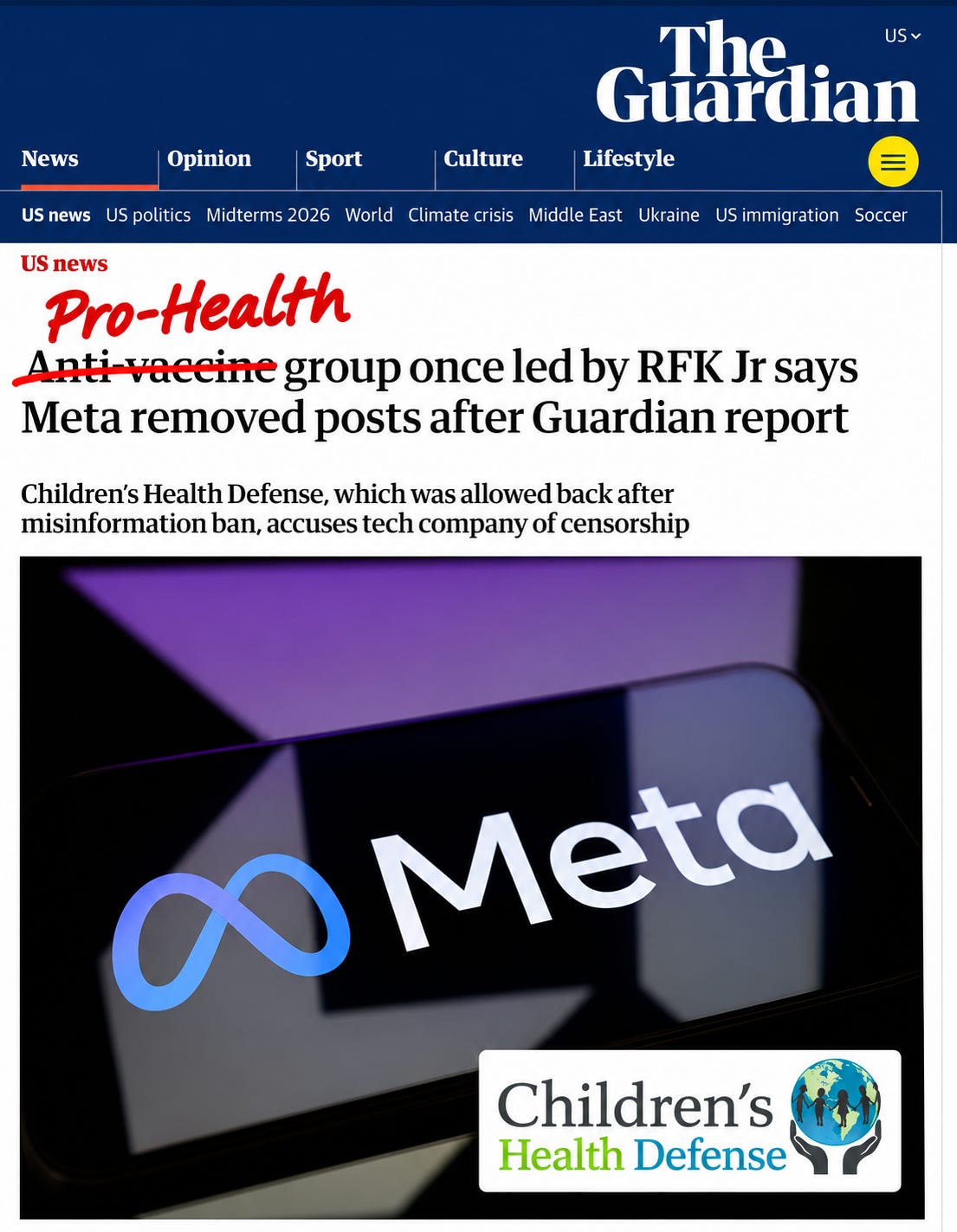
On the evening of November 18, Children’s Health Defense reported that Meta was removing its posts — within hours of a Guardian article cataloguing those exact posts. The next morning, the Guardian reported the removals under a headline that did our work for us: the group “says Meta removed posts after Guardian report.”


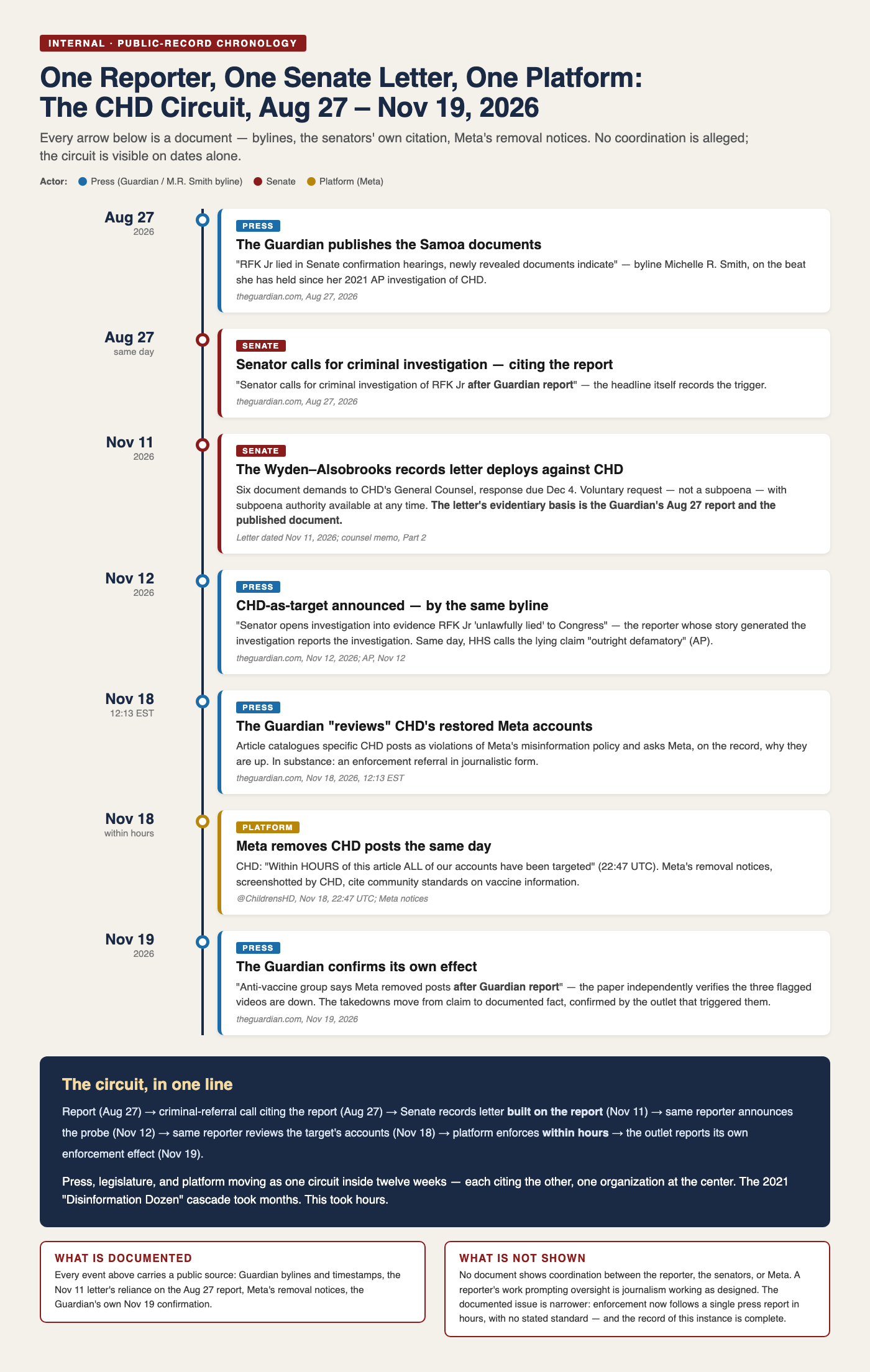
That 36-hour sequence would be worth noting on its own. But it is the closing arc of something longer and more instructive: a twelve-week circuit in which a single reporter’s output became a Senate investigation’s evidence, the Senate’s letter became the next story, the next story became a platform enforcement action, and the enforcement action became the story after that. Every link is a public document. Here is the whole of it, dates only.
The twelve weeks, row by row
August 27 — The Guardian publishes claims that Robert F. Kennedy Jr. “lied” in Senate confirmation hearings, based on documents concerning his 2019 Samoa trip. Byline: Michelle R. Smith, the Guardian’s senior science investigative reporter — who has covered Kennedy and Children’s Health Defense continuously since her 2021 investigation of the group at the Associated Press.
August 27, same day — A senator calls for a criminal investigation of Kennedy. The Guardian’s own headline records the trigger: “after Guardian report.”
November 11 — Senators Ron Wyden and Angela Alsobrooks send a records demand to Children’s Health Defense: six categories of documents, response due December 4. The letter’s stated evidentiary basis is the Guardian’s August 27 reporting. It is a voluntary request — not a subpoena — a distinction that matters and that we will see tested below.
November 12 — The investigation becomes public. The story announcing it carries the same byline that generated it: the reporter whose article produced the Senate letter reports the Senate letter.
November 18, 12:13 p.m. EST — The same reporter publishes a “review” of CHD’s restored Facebook and Instagram accounts, cataloguing specific posts as violations of Meta’s misinformation policy and asking Meta, on the record, why they remain up. Whatever the author intended, in substance this is an enforcement referral in journalistic form.
November 18, by evening — Meta removes CHD posts. The removal notices, which CHD posted as screenshots, cite the company’s community standards on vaccine information. The three videos named in the morning’s article are down by night.
November 19 — The Guardian reports the removals its own article preceded, and independently confirms the flagged videos are gone. The loop closes where it opened: same masthead, accusation to takedown to victory lap, inside 36 hours.
What this is, and what it is not
I will be clear, no document shows coordination between the reporter, the Senate offices, and Meta. A journalist’s work prompting congressional oversight is, in isolation, journalism working as designed. A platform enforcing its policies when violations are pointed out is, in isolation, moderation working as designed. That’s not what I am alleging here.
That is precisely what makes the circuit worth documenting. It needs no overt conspiracy. Each actor responds rationally to the one before it: the senator cites the article because it exists; the reporter covers the letter because it is news; the platform acts on the review because inaction is now itself a story. The system censors by relay — each hand clean, the loop closed. There is no wire to find because no wire is needed. Censorship no longer requires a smoke-filled room. It has a workflow.
And the workflow is accelerating. In 2021, the path from a privately produced list — the “Disinformation Dozen,” which named Kennedy — to platform enforcement against him and his “associated organizations” took months, and ran through a White House podium. In November 2026, the path from article to takedown took hours.
The part that should concern you regardless of your view of CHD
You may think Children’s Health Defense deserves every word of the coverage. Set that aside — the circuit doesn’t care what you think of its current target. The structural facts are these:
One reporter has held this beat across two outlets for five years. Her 2021 AP investigation of CHD won industry awards; the Guardian hired her in October 2025, by its own announcement, to cover “efforts to undermine and delegitimize science and public health.” Her Guardian byline record is public. The dedication is real, documented, and — again — not improper in itself. But when a single byline functions as the evidentiary engine for Senate action and the trigger for platform enforcement against the same organization inside one two-week window, the press is no longer observing the enforcement system. It is a component of it.
The Senate letter is voluntary, and the framing will test that. Declining or negotiating a voluntary congressional request is lawful — committees themselves acknowledge as much. Watch what happens around December 4: whether a lawful decline is reported as lawful, or as “stonewalling” that becomes the predicate for a subpoena. The choice of verb will tell you whether the circuit is still running.
The precedent transfers. Today the loop runs press → Senate → platform around an anti-vaccine group. The identical mechanics — a dedicated beat, a records letter citing the coverage, an enforcement “review,” a same-day takedown, a next-day story about the takedown — can be pointed at any organization whose speech is lawful but disfavored. That is why Restore the First exists, and why its Targeting Tracker documents this machinery from primary sources only: the question is never whether you like the current target. It is whether you consent to the machine.
What happens next — on the record, in advance
Here is something publications almost never do: state their model’s predictions before the events, in writing, where failure will be visible. We have. A prediction memo for the December 4 cycle — what gets published, when, framed how, followed by what — was hash-anchored and independently timestamped (RFC-3161) on November 19, before any of it occurs. In January we will publish the results, hits and misses both. If the circuit is a real mechanism, it will behave like one. If we are wrong, you will read that too.
That is the difference between pattern-matching and a tested claim — the standard we apply to everyone else, applied to ourselves.
SHARE THIS ON X:


The full dated record, with primary sources for every row above, is maintained at the Targeting Tracker. For the origin of the deplatforming arc — the 2021 list that named Kennedy and preceded the organizational bans — see the documented chronology there; for how the list’s author has since been rebranded and celebrated, that story is coming in December.