

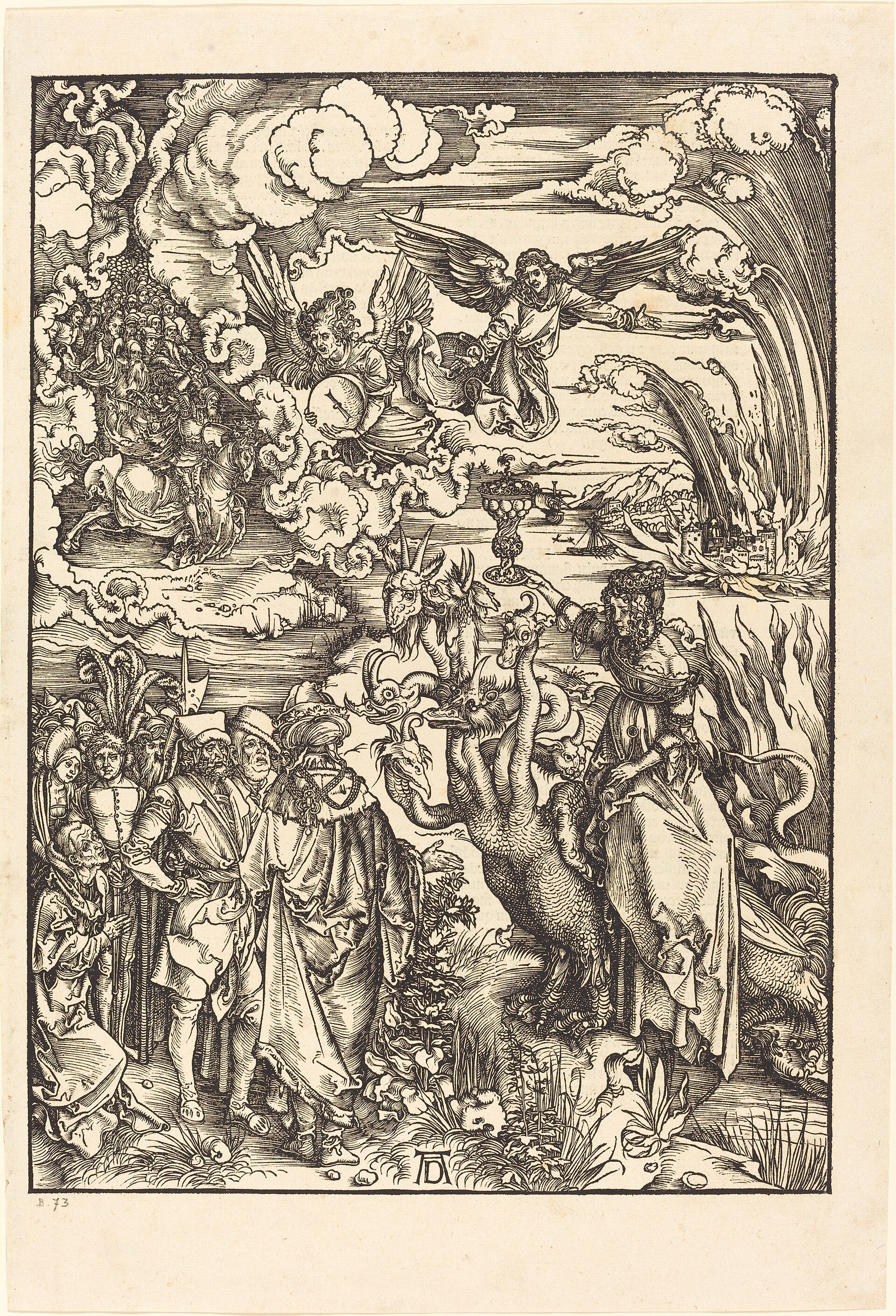
Albrecht Dürer, The Whore of Babylon, from The Apocalypse, 1498. She holds out “a golden cup full of abominations” (Rev 17:4). National Gallery of Art, via Wikimedia Commons (CC0).

The Greek word behind “pharmacy” meant remedy and poison at the same time. Revelation used it for the sorcery by which Babylon’s merchants deceived the nations. A 2018 experiment shows why the word may be more accurate than we thought: the drug we give for a “viral” fever can, at a toxic dose, make virus-sized particles that pass the injury on.
In 1793, as yellow fever swept through Philadelphia, America’s most famous physician treated his patients by bleeding them and dosing them with calomel, a mercury compound. Benjamin Rush’s methods “often were ineffective and actually brought many patients closer to their deathbeds” (Wikipedia). Some patients were “bled to faintness,” losing as much as 1.5 liters of blood (Dialogue).
Two centuries later, a quote attributed to Rush circulates in the health-freedom movement. It warns that medicine will “organize into an undercover dictatorship.” I used it myself years ago. He never wrote it. The University of Pennsylvania’s own guide to Rush mythology says plainly that it is bogus (Penn Libraries).
I start with that correction for two reasons. First, the argument that follows deserves better than an invented quote. Second, the real Rush is the better story: the man later imagined as a prophet of medical freedom was in fact the leading American practitioner of what came to be called “allopathy,” the medicine of opposing and suppressing. The myth has covered up the practice. As I will argue, that is what pharmakeia means.
A word that means both
The Greek phármakon means drug, remedy, poison, and charm, all at once. It is very old. It is already found in Mycenaean Greek, and the leading etymological dictionary of Greek classes it as “Pre-Greek,” borrowed from a language older than Greek itself (Wiktionary; Hypotheses). The classicist Jan Bremmer puts it simply: “both poison and drug were originally magical; so a pharmakon is a magical dose.” He notes that Greek dosis means “gift,” while German Gift means “poison” (Harvard Center for Hellenic Studies).
The word for “sorcery” grows from the same root. Pharmakeia has three layered meanings in the standard lexicon: (a) administering drugs, (b) poisoning, and (c) sorcery and magical arts, “often found in connection with idolatry” (Thayer’s Greek Lexicon). Plato’s Laws separates two kinds of pharmakeia: one harms the body through substances, and the other works on the mind through spells (Zichi, Lund University).
Keep both of Plato’s categories in mind. They will matter later.

Virus means poison
The vocabulary of infectious disease comes from the same place.
Virus is Latin for “poison, poisonous liquid, sap of plants, slimy liquid, a potent juice.” It entered English in the late 14th century meaning “poisonous substance” (Etymonline). It is cognate with Sanskrit viṣá- and Greek iós, all meaning “poison, venom” (Dictionary.com).
Virulent comes from Latin vīrulentus, “full of poison” (Etymonline).
Poison comes from Latin pōtiō, “a drink,” especially “a medical drink,” and later “a (magic) potion” (Etymonline).
Toxic comes from Greek tóxon, “bow.” The toxikon was the poison smeared on arrows (PMC).
So a virus is a poison, a poison is a medical drink, and a toxin is something shot into you from outside. The idea of the “invisible enemy” was in the words long before anyone had a microscope.
The oldest version of that idea is the opening of Western literature. In Book 1 of the Iliad, Apollo comes down and shoots plague into the Greek camp. The Greek word for his arrow, iós, is spelled the same as the word for poison (Liddell–Scott–Jones). Apollo was also the god of the Thargelia, the Athenian festival at which a pharmakós, a human scapegoat, was “feasted, led round the town, beaten with green twigs, and driven out or killed with stones” (Britannica). Plague, arrow, poison, and scapegoat all belong to one god.
Technical note. The “arrow” and “poison” senses of iós are homonyms with different roots. The lexicon lists them as separate entries. This is a pun the Greeks would have heard, not a shared origin. Bremmer calls the link between pharmakós(scapegoat) and phármakon (drug) “probable, but problematic.”

When poison turned into a germ
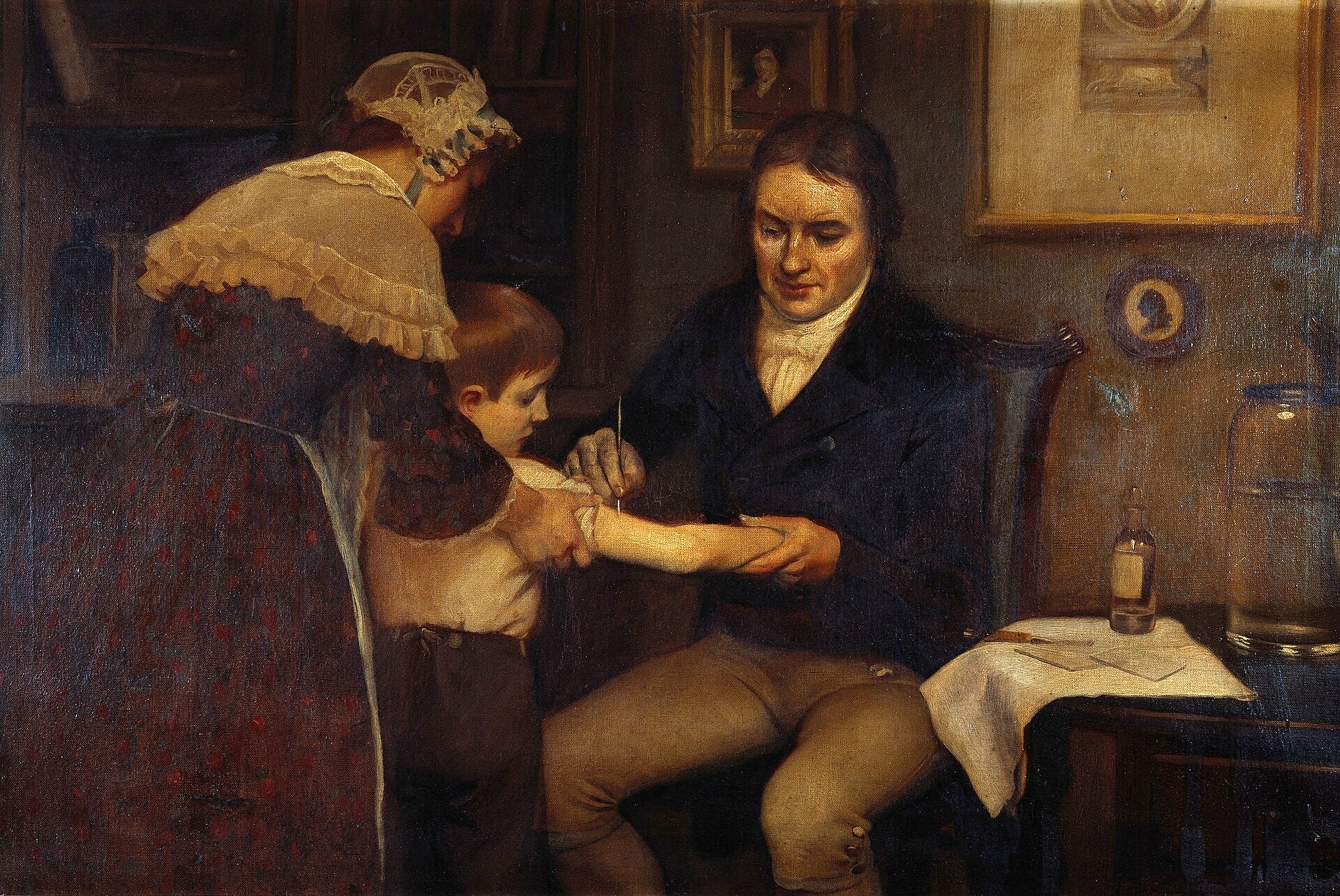
“Virus” meant poison until very recently. In Edward Jenner’s 1798 smallpox report the word was “not precise” and meant infectious matter (PMC). His cowpox lymph, which he called variolae vaccinae, “smallpox of the cow” (PMC), was a poisonous fluid given deliberately as protection. The first vaccine was a phármakon in the most literal sense.

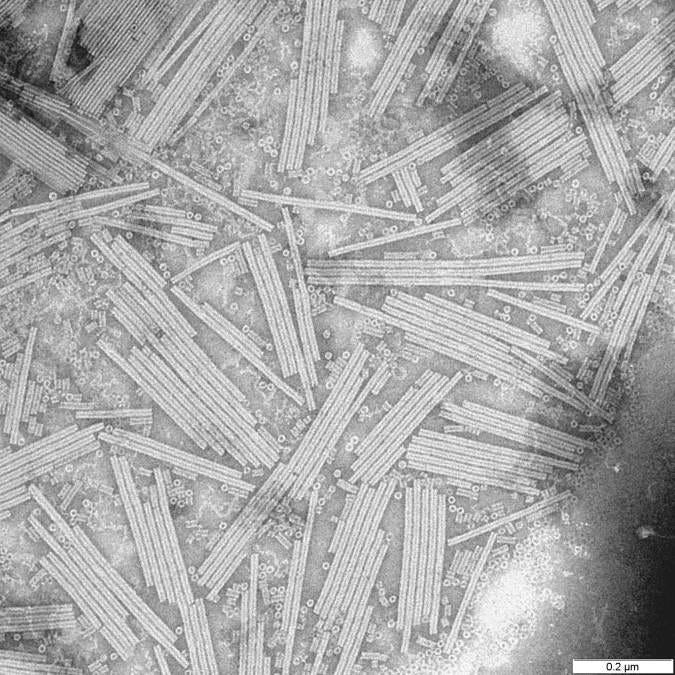
The split came in 1898. The Dutch microbiologist Martinus Beijerinck called the filterable agent of tobacco mosaic disease a contagium vivum fluidum, a “contagious living fluid.” His conclusion “established a distinction between these agents and toxins” (EBSCO). From then on, a virus was by definition not a poison. In 1937 Thomas Rivers argued that Koch’s postulates, the standard proof that a germ causes a disease, could not be applied unchanged to viruses (Journal of Bacteriology). The first electron micrographs of a virus were published in 1939 (PMC).
For about forty years the concept came before anyone saw the particle. The field kept the poison name.

The key experiment
This is the center of the argument, and the reason the old word is more than a metaphor.
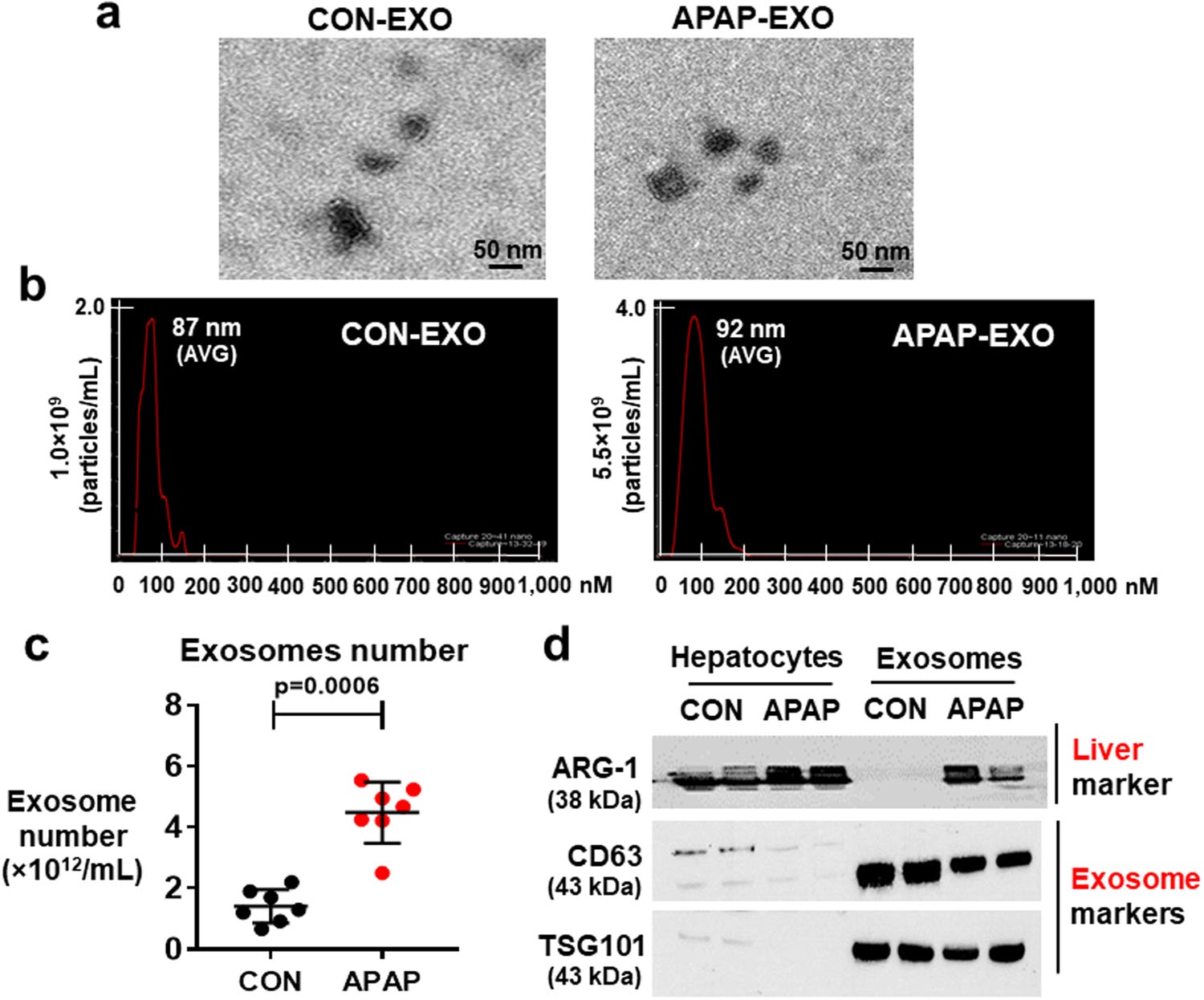
In 2018, Scientific Reports published “Exogenous exosomes from mice with acetaminophen-induced liver injury promote toxicity in the recipient hepatocytes and mice” (Scientific Reports). Here is what the researchers did:
They gave mice a toxic dose of acetaminophen (Tylenol): 300 mg/kg.
The injured livers released exosomes, tiny membrane-bound vesicles that cells use to send messages. The exosomes averaged about 92 nanometers across, the size range of many viruses. Mice given acetaminophen had roughly three times as many as controls.
The researchers isolated these exosomes and gave them to healthy liver cells and to healthy mice that never received the drug.
The recipients showed oxidative stress, the inflammatory signals TNF-α and IL-1β, activation of the cell’s self-destruct pathway (JNK, Bax, caspases 3 and 9), and “markedly elevated hepatocyte apoptosis,” meaning liver-cell death.
A separate study found that circulating vesicle counts also rise after acetaminophen overdose “in mice and humans” (PMC). Another found that exosomes from ordinary human plasma, carrying the enzyme CYP2E1, made acetaminophen toxicity in recipient cells worse (Scientific Reports, 2019).
Now look at what acetaminophen is for. It is the standard treatment for the fever and aches of influenza-like illness. A recent expert consensus recommended it unanimously (International Journal of Clinical Practice).
Put the pieces together. A fever is diagnosed as “viral.” A phármakon is given. At a toxic dose, that remedy injures cells, and the injured cells release virus-sized particles that pass the injury to tissue the drug never touched. If the patient gets worse, or the illness seems to spread through the body, the cause on record is “the virus.” A test that detects particles or genetic material was not designed to tell the difference.
This is the remedy and the poison in a single molecule, and a symptom-suppressing treatment producing a phenomenon that looks like the illness it was given for. I first wrote about this study in Reframing Viral Mechanisms, and it remains the foundation of the Poisoned, Not Infected series.
What this study shows, and what it doesn’t. It shows that vesicles released by chemically injured cells can carry an injury program to cells the toxicant never touched. It used an overdose. It has not been shown that ordinary doses produce injury-carrying vesicles; the case for ordinary doses rests on a different, well-established mechanism, glutathione depletion. In the recipient mice, the standard liver-damage blood marker (ALT) did not change at four hours. The documented effects were oxidative stress, cytokines, and cell death. Exosomes are not produced only after toxicity: healthy mice make them too. What the drug changed was how many there were and what they carried. That is actually the more striking finding: the body’s own ordinary messengers were reprogrammed into carriers of injury. Finally, being the same size as a virus is not the same as being a virus. Mainstream researchers who note the overlap, such as the Trojan exosome hypothesis and Nolte-’t Hoen’s review, treat retroviruses as real viruses that share machinery with exosomes.
Five layers, one ancient word
The Poisoned, Not Infected framework separates five things that the single word “infection” lumps together. The Greek phármakon covers all five.
1. The initiating agent. “A virus, bacterium, toxicant, drug, pollutant, contaminated product... or combination.” Note that drug and virus sit next to each other on that list. As I wrote in May, “pharmacology is a subset of toxicology, separated only by intent and dose” (How Being Poisoned Can Be Mistaken for Being Infected). Some viruses carry poisons in the most literal sense: the genes for diphtheria, cholera, and Shiga toxins are carried by bacteriophages, viruses that infect bacteria (StatPearls).
2. The receiving terrain. Dosis means gift; Gift means poison. Whether a substance heals or harms depends on the body receiving it. Melinda Beck’s research showed that in selenium-deficient hosts, oxidative stress drives “rapidly mutated benign variants of RNA viruses to virulence,” and that these mutations are “consistent, rather than stochastic” (PMC). The terrain made the virus virulent, literally “full of poison.”
3. The accumulated exposome. This is the lifetime total of chemical, pharmaceutical, dietary, and environmental exposures, a term coined by Christopher Wild in 2005 (PubMed). Read Revelation 18:11–13 as a cargo manifest: gold, cinnamon, incense, ointments, wine, oil, grain, cattle, “and slaves, and souls of men” (Rev 18:13). It is the inventory of an empire’s exposome, and it ends with the human being as a commodity.
4. The mediating signals. Cytokines, damage signals, and exosomes: the messengers in the experiment above. The “viral” is not only foreign. About 8% of the human genome is endogenous retrovirus (PMC), and syncytin, a gene captured from an ancient retrovirus, is essential for forming the placenta (PNAS). At the molecular level the virus is a full phármakon: in some settings poison, in others part of what makes mammalian birth possible.
5. The interpreted story. This is Plato’s second pharmakeia, the one that works on the mind. Our tools, as I wrote in May, “are pathogen-shaped,” and “an instrument built to find an organism will tend to return an organism or a blank, not a chemical” (Ji). The single-germ story repeats the scapegoat rite. Every shared cause, including nutrition, toxicants, poverty, and the treatment itself, is loaded onto one invader that can be named, sequenced, and driven out. Thomas Szasz made the link in 1974 in Ceremonial Chemistry, which opens with “The Scapegoat as Drug and the Drug as Scapegoat” (Syracuse University Press).
By thy sorceries were all nations deceived
The word pharmakeia appears only three times in the New Testament: Galatians 5:20, Revelation 9:21, and Revelation 18:23 (WELS). The last one reads, in the King James Version: “for thy merchants were the great men of the earth; for by thy sorceries were all nations deceived” (KJV). In the Greek, the merchants are the megistanes, the “grandees,” and the nations were eplanēthēsan, “led astray” (Bible Hub).
In earlier versions of this argument I quoted a paraphrase that put “end of times” into the verse. The actual text is stronger. In one sentence it brings together a commercial elite that has become a ruling class, pharmakeia as its method, and the deception of every nation.
Behind it lies a pattern from the Septuagint, the Greek Old Testament. Pharaoh’s pharmakoi imitate Moses’ signs (Exod 7:11). Nineveh is “the mistress of witchcrafts, that selleth nations through her whoredoms, and families through her witchcrafts” (Nah 3:4). Babylon falls “in one day” despite “many sorceries” (Isa 47:9). In each case, pharmakeia is how an empire enchants and sells nations.
Revelation also connects the potion to the plague. “Come out of her, my people, that ye be not partakers of her sins, and that ye receive not of her plagues” (Rev 18:4). After the trumpet plagues, the survivors “repented not... of their sorceries” (Rev 9:21), and here some manuscripts read pharmakōn, “drugs” (Thayer’s). The plagues fall on the empire whose potions deceive the nations.
The counter-argument, stated fairly. Mainstream biblical scholars argue that pharmakeia in Revelation “refers to sorcery... not pharmaceutical drugs” (Biblical Research Institute), and that Babylon meant first-century Rome. I agree that Revelation did not predict the pharmaceutical industry. My claim is about a pattern, not a prediction. The ancient word never separated substance from spell. Our clean distinction between “pharmaceutical” and “magical” is newer than the word, and every time the Bible uses it, it describes a commercial empire administering potions and deceiving nations.
What I am not saying
I am not saying viruses don’t exist, although I have a few colleagues who have come that conclusion, or pretty close, and I respect their views. They have been photographed since 1939, and the findings above (phage-carried toxins, endogenous retroviruses, syncytin) depend on viral genomes being real. I am not saying every illness is poisoning, or that toxic outbreaks are always missed. The investigations of EVALI and the 1989 L-tryptophan epidemic show the system can work (Ji; CDC). I am not repeating Pasteur’s supposed deathbed line, “the microbe is nothing, the terrain is everything,” because no one has found a verifiable source for it (Factually). And I am not telling anyone to withhold care from a seriously ill child. High or persistent fever, fever in an infant, lethargy, dehydration, or difficulty breathing are reasons to engage professional medical assistance.
My claim is narrower, and harder to dismiss. The ancient word for medicine never let us forget that every remedy is also a poison, and that whether it helps or harms depends on the dose, the terrain, the exposome, the body’s own signals, and the story told about it. Modern medicine divided that word into “drug” (good, given) and “germ” (evil, invading), then built instruments that can see only the second. A 2018 experiment shows what that blind spot can hide: a remedy that, at a toxic dose, produces particles that look like the illness it treats.
“Come out of her” is not a call to fear. It asks us to read every phármakon, drug or germ, with all five layers in view.
You say viruses have been photographed.
But that claim may be a false identification.
The person's naming what they observed, viruses, were looking for proof of viruses.
That they concludes what they photographed were viruses is a chicken or egg conundrum.
It is quite possible all they photographed were extracellular exosomes after a person has symptoms which were incorrectly attributed to a virus.
Now how can anyone say this?
Because every known set of symptoms attributed to any particular virus, has at least one other input which will cause ye same symotoms and extracellular exosome response.
Without an hour by hour observation of not only the exact time these “viruses” appeared, and without ruling out every other possible toxic burden, stress or malnutrition input?
These alleged photos of viruses as proof are just assumptions….a case of a claim looking fot proof, and claiming to have found it.