


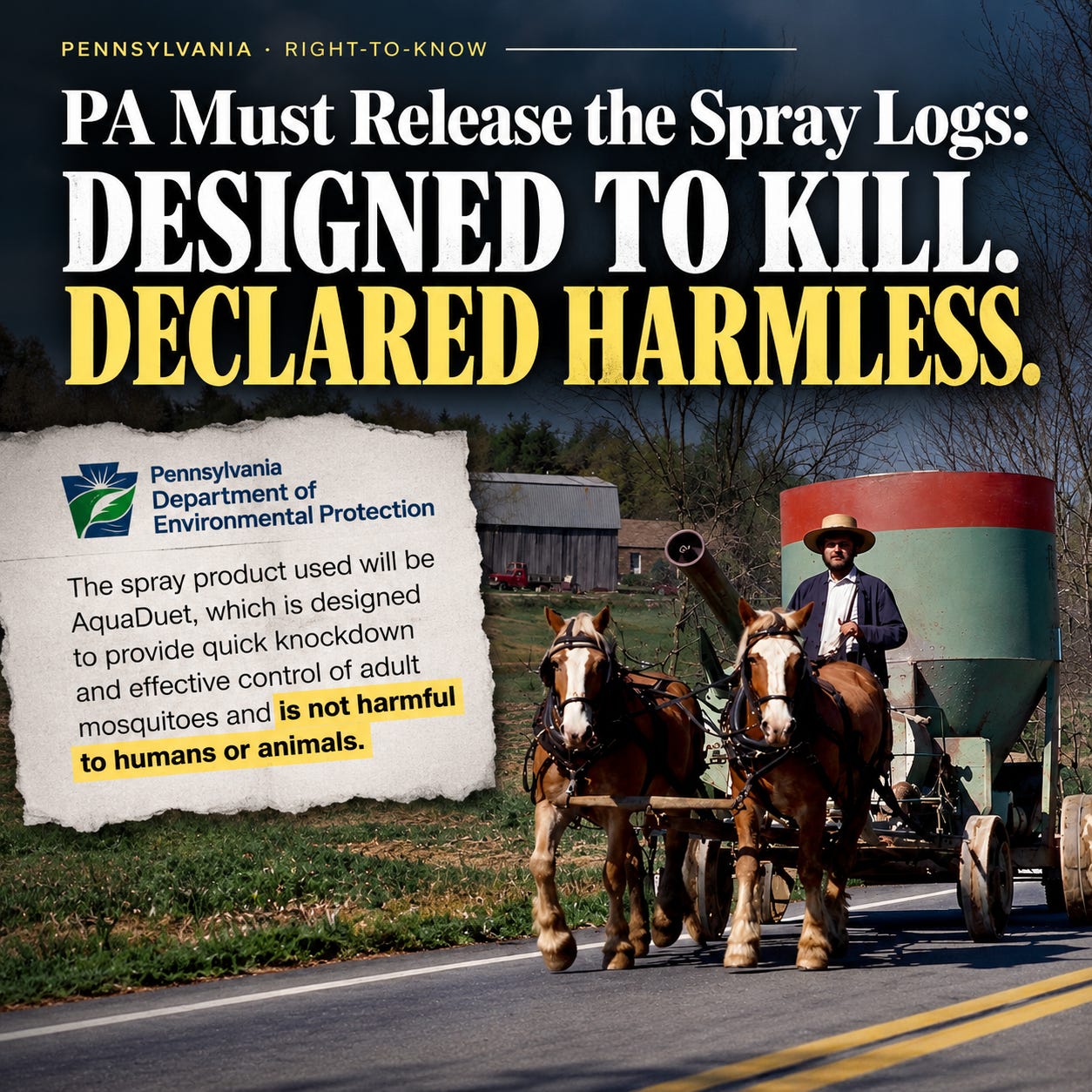
Pennsylvania says AquaDuet is “not harmful to humans or animals.” Its own Health Department says pesticides are “inherently toxic.” A Right-to-Know response just came back, and the Lancaster records are still missing.
🚨View and share the X thread 🧵
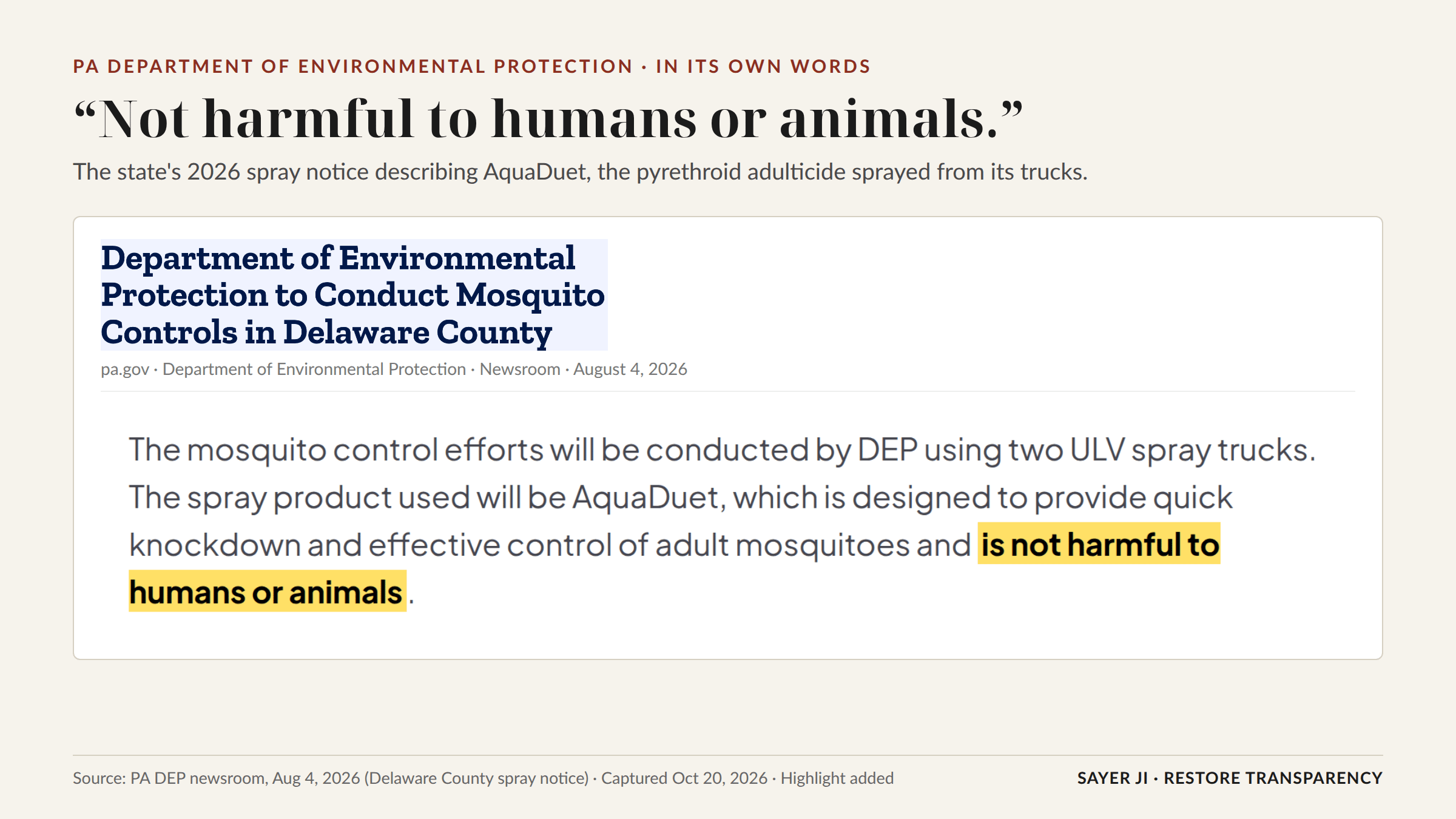
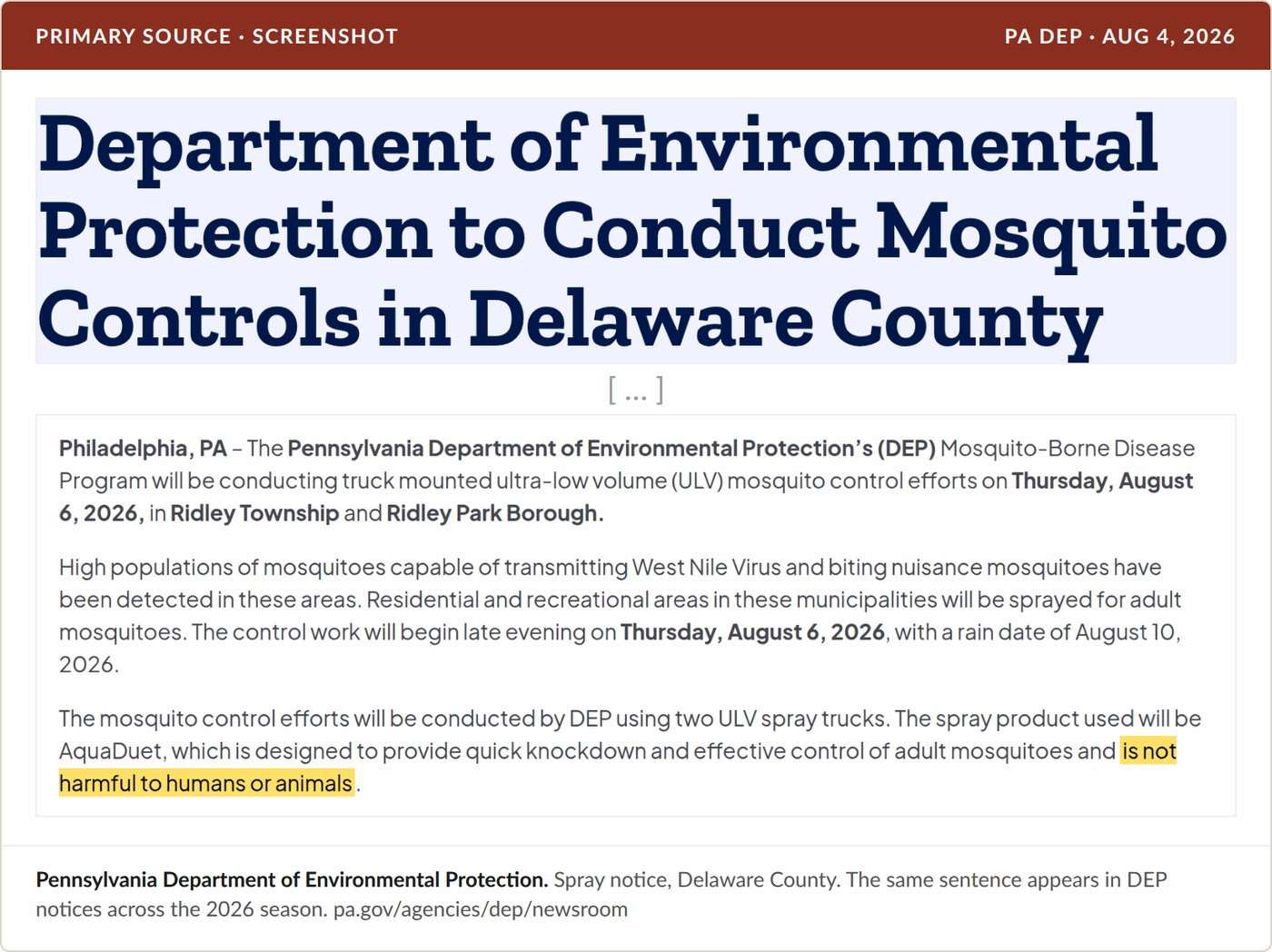
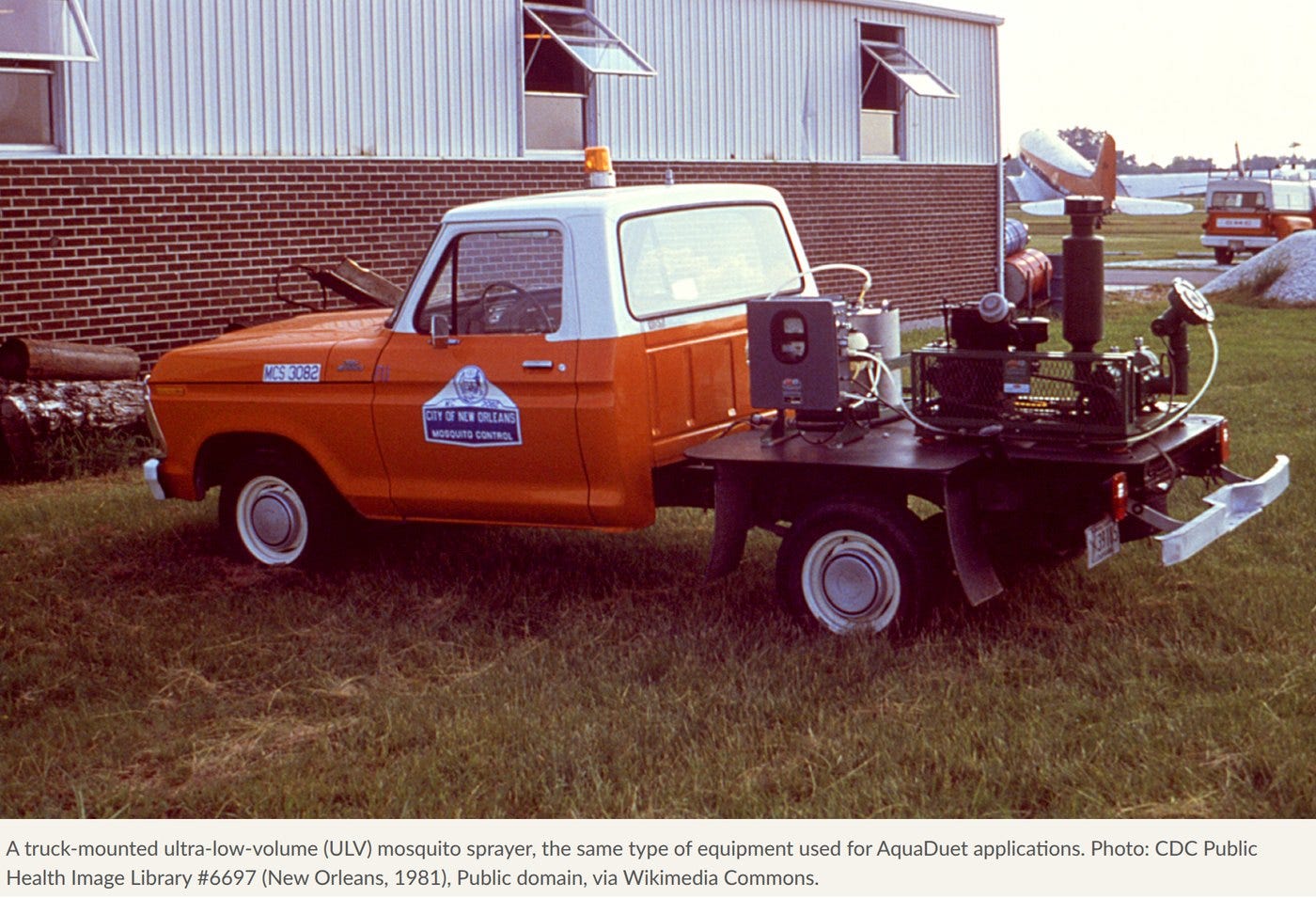
All summer, Pennsylvania has told its residents that the mosquito spray going out of its trucks is safe. The Department of Environmental Protection’s notices say the product, AquaDuet, “is not harmful to humans or animals.” The same sentence ran in July and again in September.
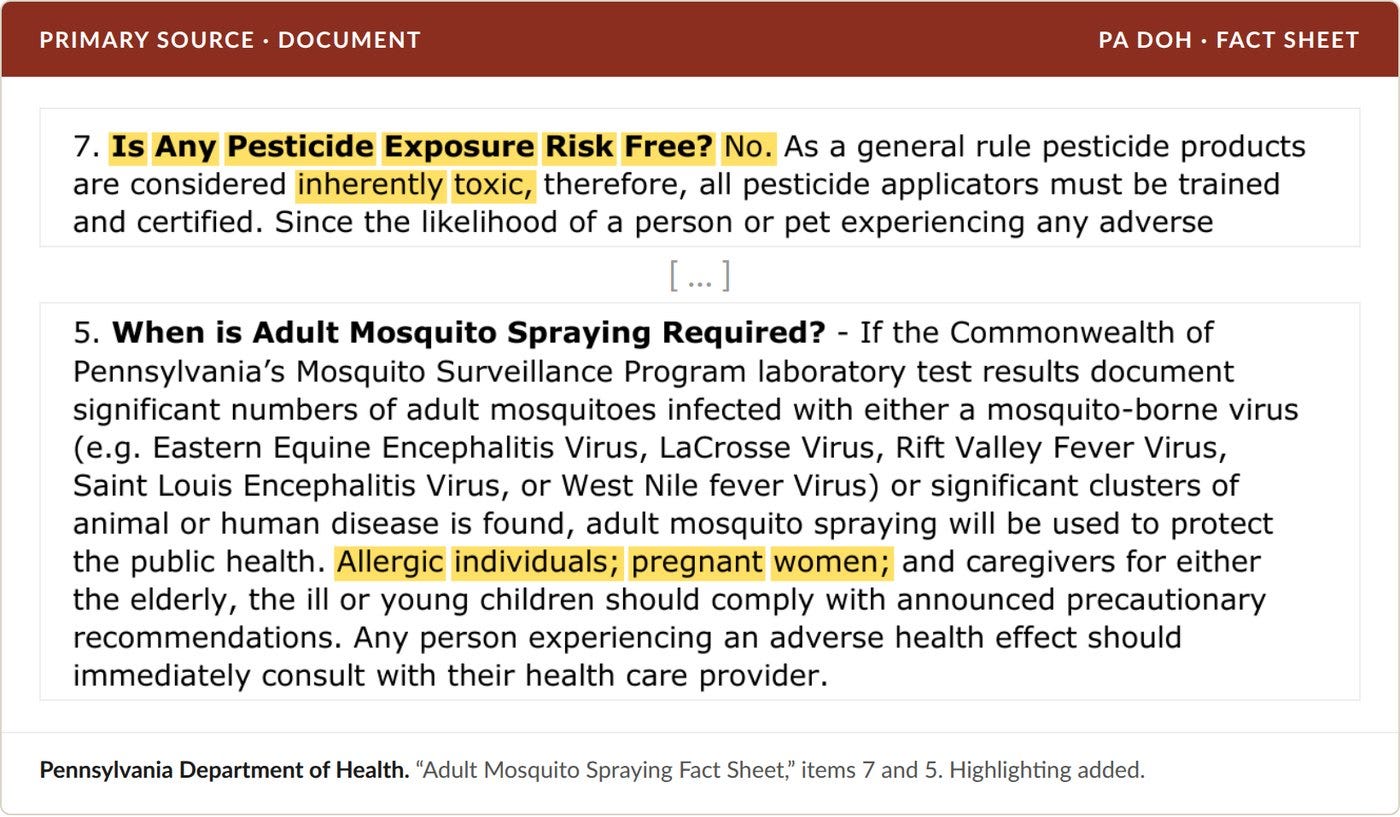
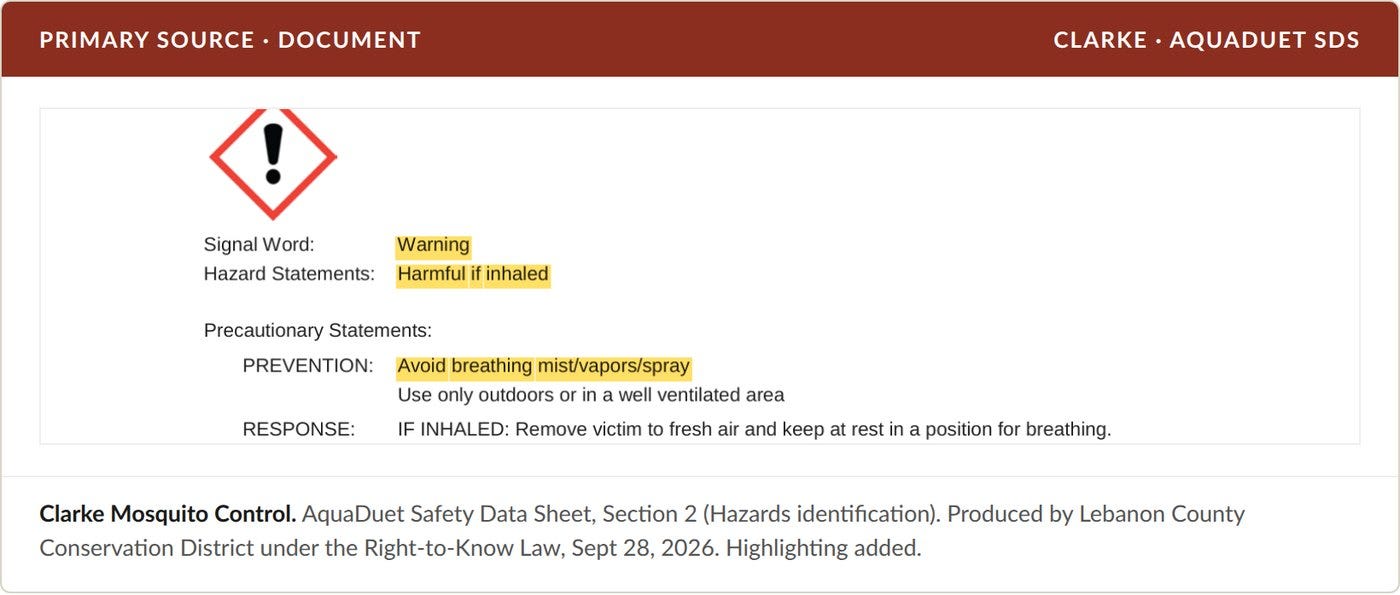
The state’s own Health Department says something different. Its spraying fact sheet asks whether any pesticide exposure is risk-free, and answers: “No. As a general rule pesticide products are considered inherently toxic.” The manufacturer’s own safety sheet for AquaDuet carries a “Warning” and the hazard statement “Harmful if inhaled.”
Both of those statements can’t be the whole truth. And this is happening in the same summer, and the same corner of Pennsylvania, as the largest measles outbreak the state has seen in decades: 1,286 cases in 42 counties as of October 19, centered on Lancaster County’s Plain community.
So a citizen did what any Pennsylvanian is allowed to do. She filed a Right-to-Know request for the spray records. The answer came back on September 28. It tells us a great deal about Lebanon County. It tells us nothing at all about Lancaster.
This piece lays out what the state has said, what the documents say, what the records show, and what Pennsylvania still hasn’t released.
Every record cited here is also on the public dashboard at restoretransparency.com, where each entry links to its original document and can be disputed.
“Not harmful,” says one agency. “Inherently toxic,” says another.
Here is the sentence, exactly as the Department of Environmental Protection published it in an August spray notice.
And here is the Pennsylvania Department of Health, on the same subject. Its fact sheet also singles out “allergic individuals; pregnant women; and caregivers for either the elderly, the ill or young children” as people who should follow precautions during spraying.
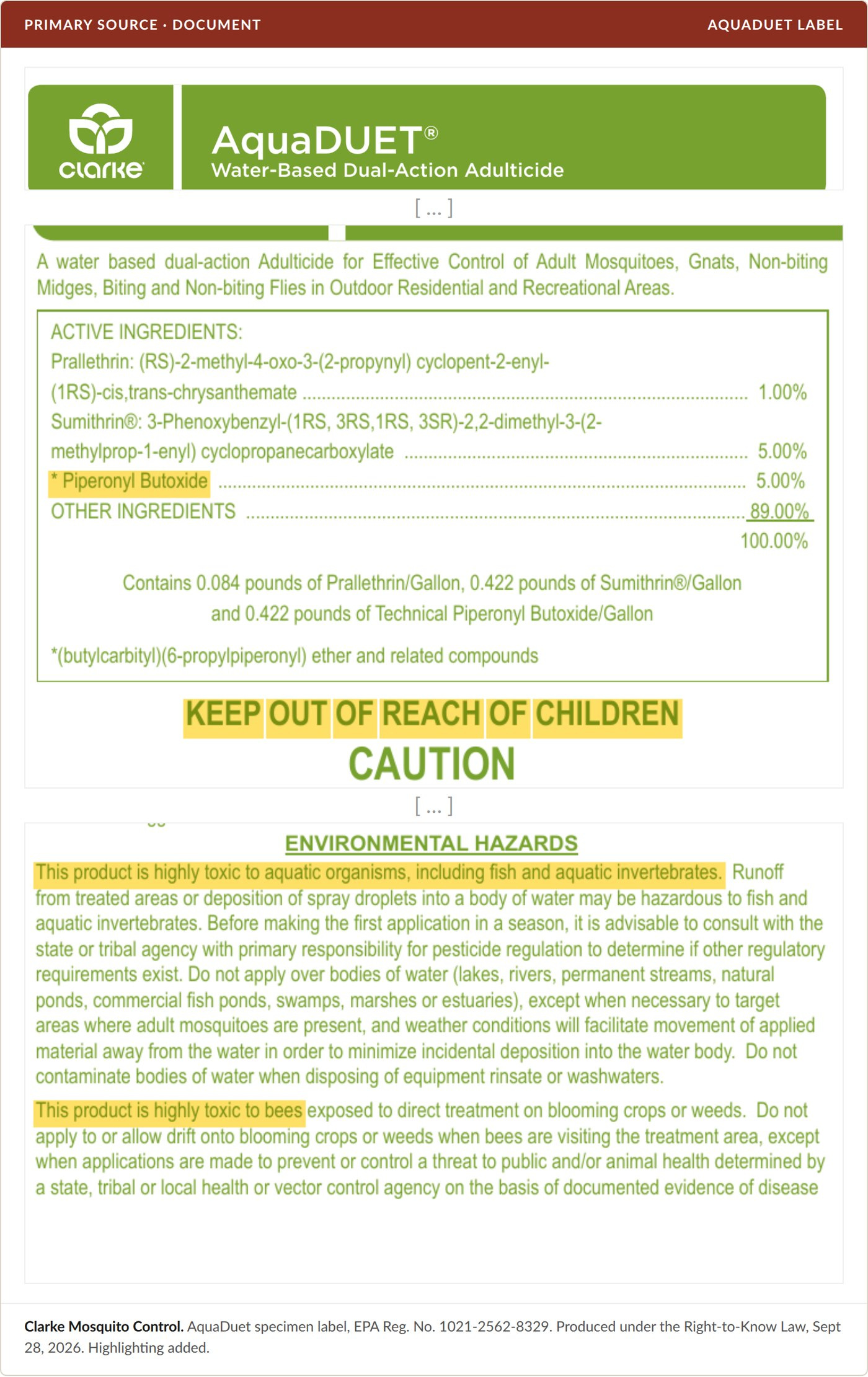
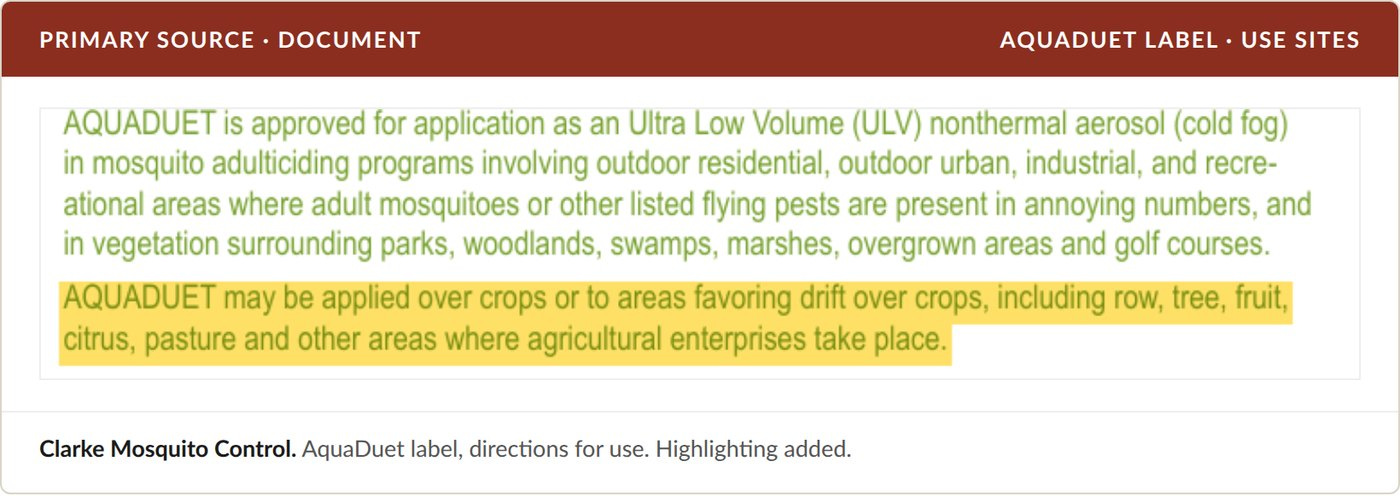
The product label tells the same story as the Health Department, not the one DEP tells. It says “KEEP OUT OF REACH OF CHILDREN” and “CAUTION.” It says the product is “highly toxic to aquatic organisms, including fish and aquatic invertebrates” and “highly toxic to bees.” And it allows the spray to be applied “over crops or to areas favoring drift over crops, including row, tree, fruit, citrus, pasture and other areas where agricultural enterprises take place.” In Lancaster County, that describes a great many homes.
The technical record
What AquaDuet is. A water-based ultra-low-volume adulticide made for Clarke Mosquito Control. It contains 1.00% prallethrin and 5.00% sumithrin (d-phenothrin), both synthetic pyrethroids, plus 5.00% piperonyl butoxide (PBO). PBO is a synergist that blocks insects’ detoxifying enzymes.
Hazard classification. The safety data sheet classifies the product as “Acute Toxicity – Inhalation (dusts/Mists): Category 4,” signal word “Warning,” hazard statement “Harmful if inhaled.” It says the product’s reproductive effects were “not tested” as a mixture. It also notes “marginally higher incidences of benign liver tumors in mice” after lifetime high-dose PBO exposure, with significance “undetermined and under review.”
What EPA actually says. EPA and CDC describe registered adulticides as posing no harm to people, pets, or the environment “when used according to product label instructions.” That is a conditional statement about labeled use. “Not harmful to humans or animals,” with no conditions, is a broader claim than the federal standard makes.
Ecotoxicity. The safety sheet lists a d-phenothrin 96-hour LC50 of 16.7 µg/L for rainbow trout and a 48-hour LC50 of 4.4 µg/L for Daphnia magna.
What the research says about these ingredients
No study I know of has measured what happens to people when an AquaDuet truck passes their house. What does exist is research on the chemical families inside it. It points in a consistent direction.
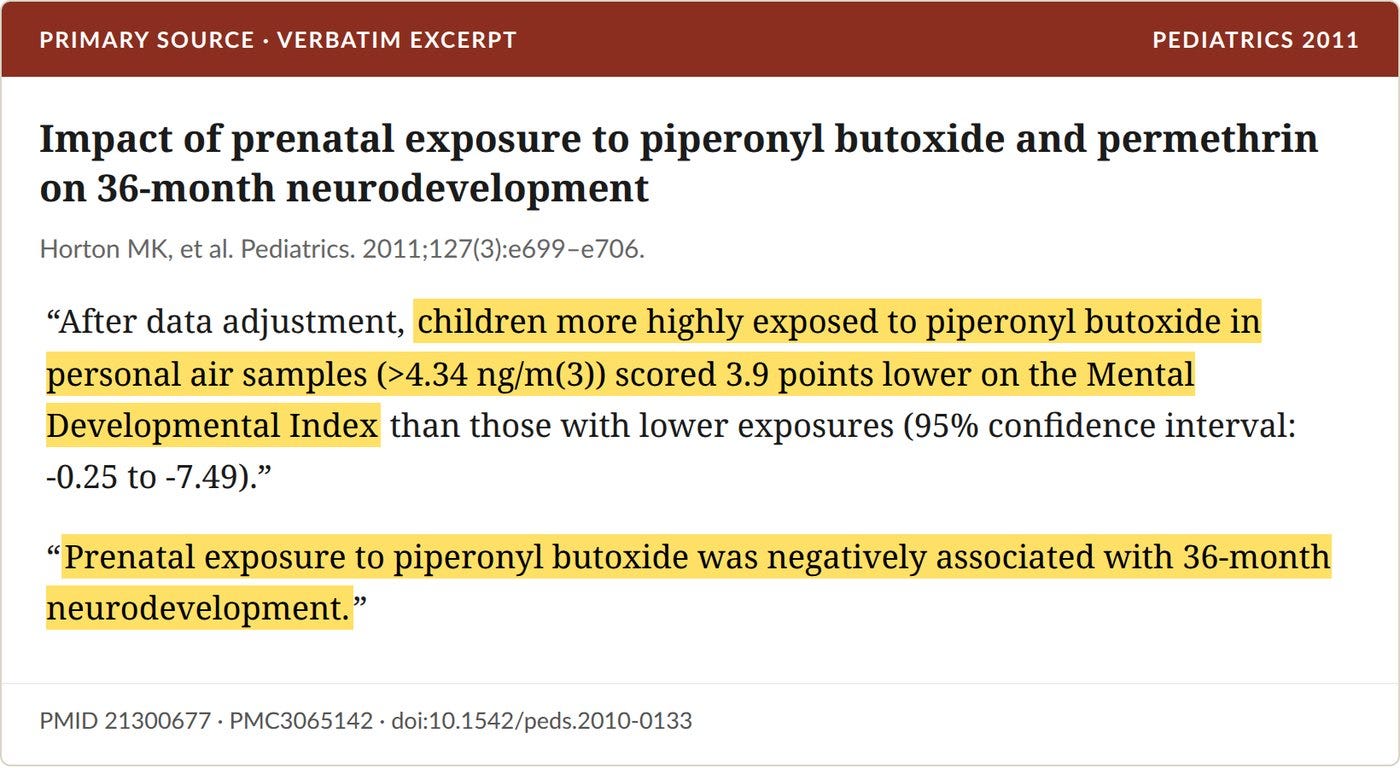
In a New York City birth cohort, children whose mothers breathed higher levels of PBO during pregnancy scored lower on a standard test of mental development at age three.
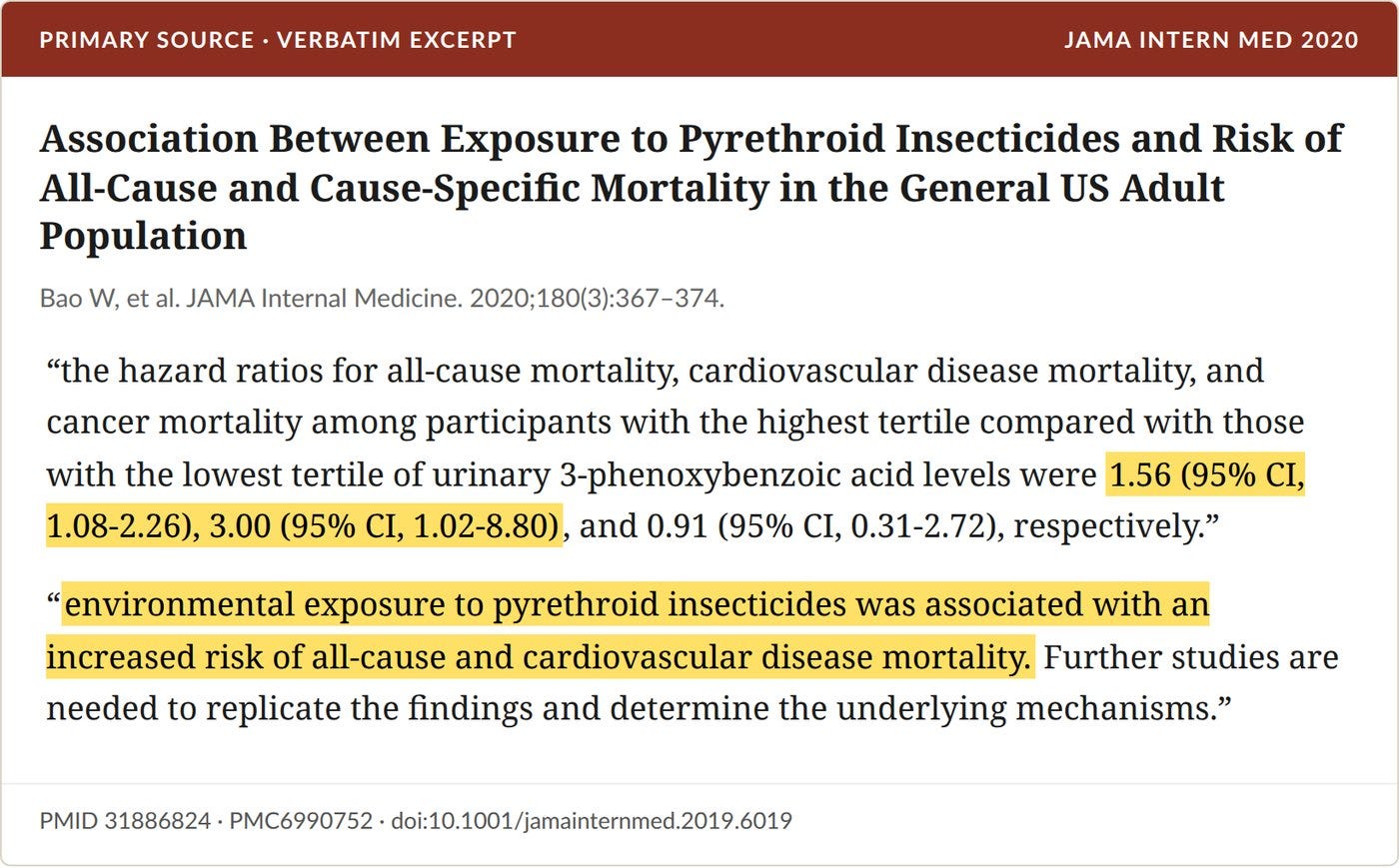
In a nationally representative sample of more than 2,000 U.S. adults, those with the highest levels of a pyrethroid breakdown product in their urine had a higher risk of death from any cause, and from cardiovascular disease, over about 14 years of follow-up.
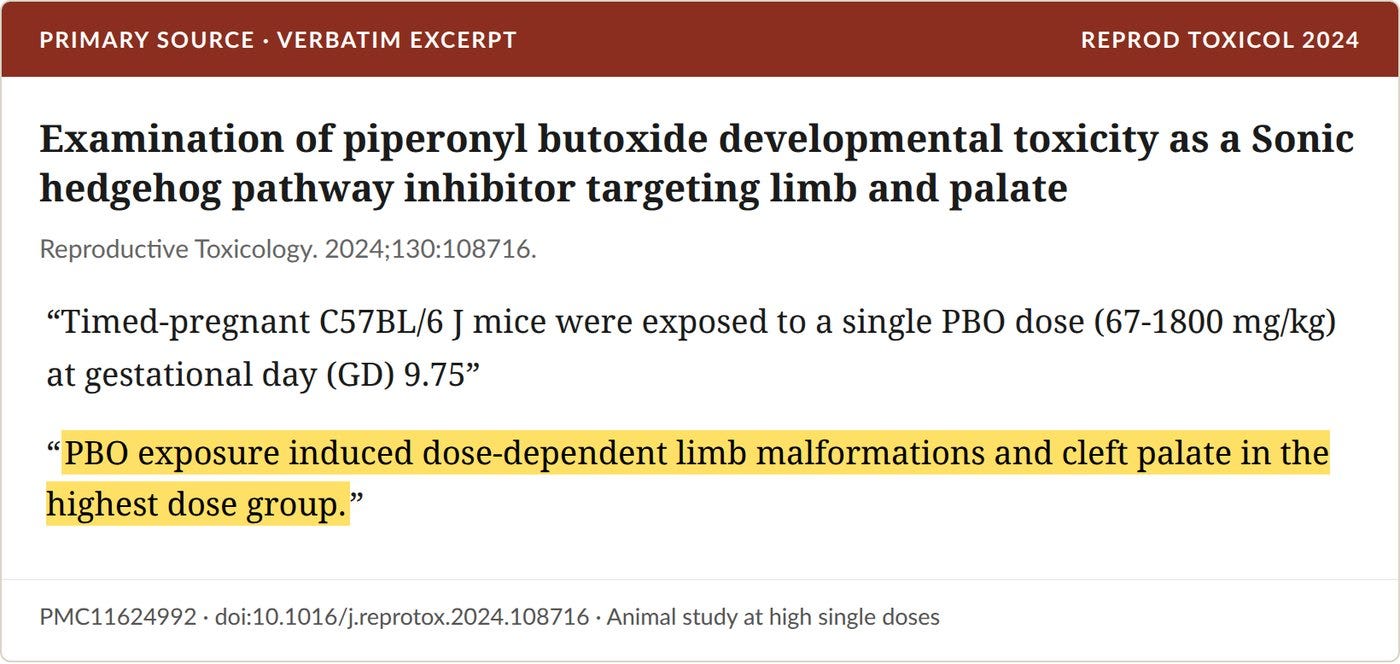
In children aged 8 to 15, detectable levels of the same pyrethroid marker were linked to roughly twice the odds of an ADHD diagnosis. And in pregnant mice, PBO, which blocks a key developmental signal called Sonic hedgehog, caused dose-dependent limb malformations and cleft palate at the highest dose.
The technical record
Horton et al. 2011. Children with prenatal personal-air PBO above 4.34 ng/m³ scored 3.9 points lower on the Bayley Mental Developmental Index (95% CI −0.25 to −7.49). Permethrin itself was not associated with either developmental score.
Bao et al. 2020. For the top versus bottom tertile of urinary 3-PBA, hazard ratios were 1.56 (95% CI 1.08–2.26) for all-cause mortality and 3.00 (1.02–8.80) for cardiovascular mortality; cancer mortality showed no association (0.91, 0.31–2.72). The authors call for replication.
Wagner-Schuman et al. 2015. Urinary 3-PBA above the detection limit was associated with ADHD, adjusted OR 2.42 (95% CI 1.06–5.57), among 687 NHANES participants aged 8 to 15.
Honest limits. These are associations in general-population exposure (diet, household products) and one animal study at high single doses (67 to 1,800 mg/kg). None measured exposure from a mosquito-spray event, and none proves the spray harmed anyone in Pennsylvania. What they do show is that “not harmful to humans or animals” is not a claim the science supports without conditions.
Subscribe to follow Restore Transparency.
What the Right-to-Know response actually produced
The request went to the Lebanon County Conservation District, which runs the joint Lebanon and Lancaster mosquito program. It asked for every 2026 adult-mosquito application, the surveillance data behind each one, the public notices, the complaints, and the communications, for January 1 through September 2.
On September 28, the district wrote back that the request was “granted in part and denied in part.” It said complaint logs, incident reports and a forward spray schedule “do not exist in the possession, custody and control” of the district.
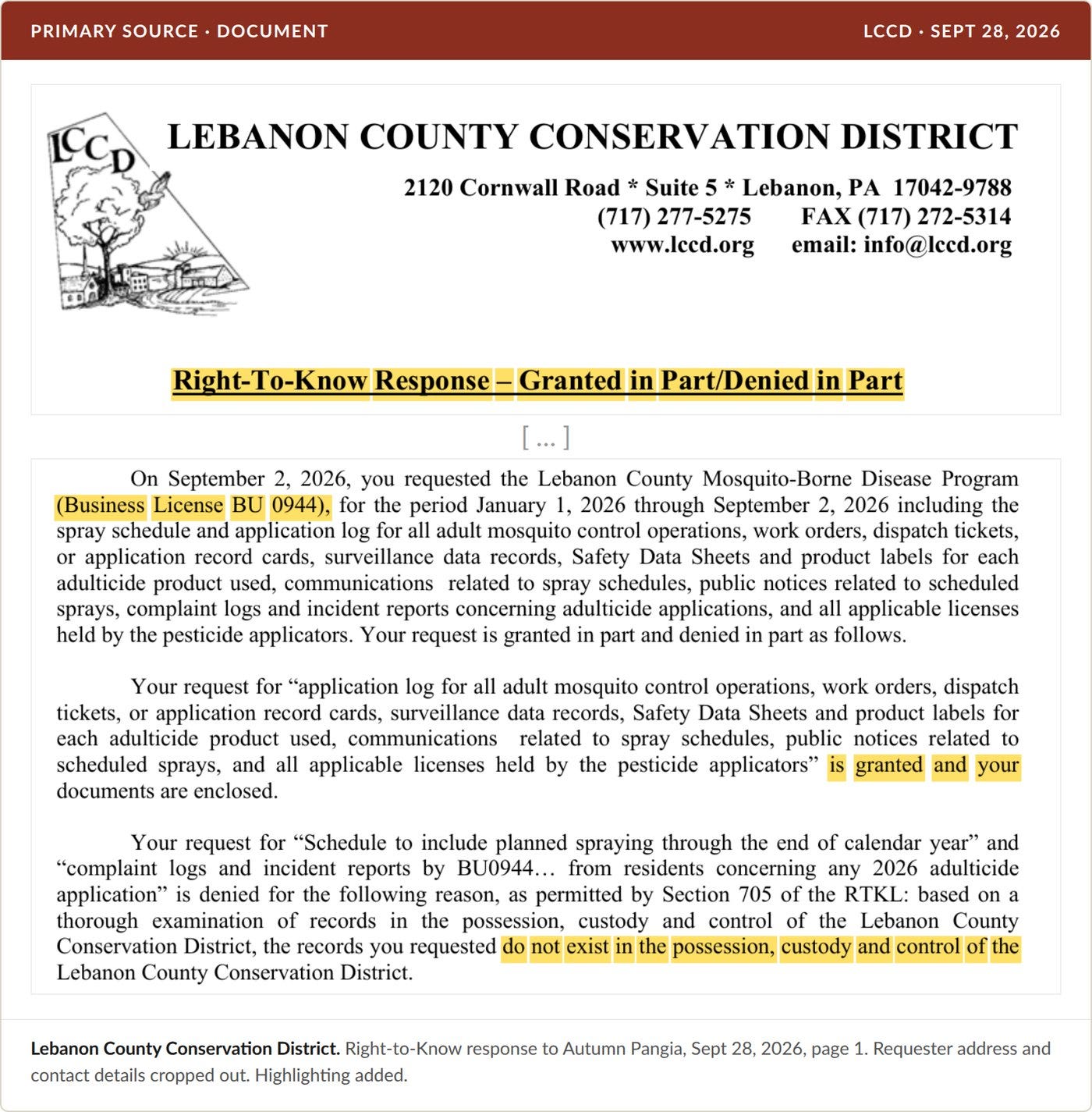
Here is what the 31 enclosed files contain.
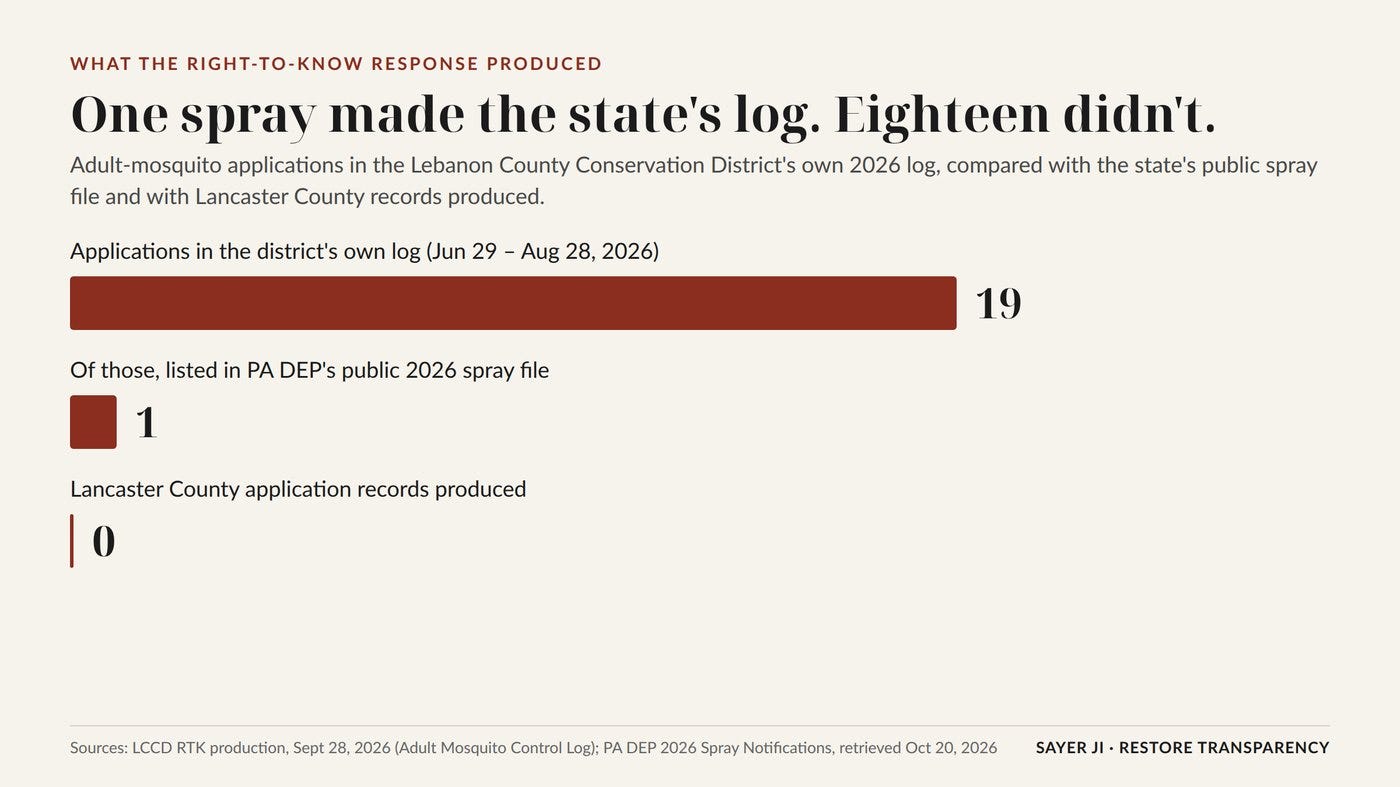
Nineteen adult-mosquito applications logged between June 29 and August 28, 2026, all in Lebanon County.
One of them was the August 24 AquaDuet truck spray in the Campbelltown area. The district’s own log puts it at 115.2 acres, from 8:10 to 8:50 p.m. The public announcement said a state DEP biologist would be on site.
Eighteen were smaller permethrin treatments covering 6.11 acres in total, using Flit 10EC and PermaSease 4-4. They were applied at sewage treatment plants, a rail corridor, a city park, a truck plaza and Palmyra.
Only the August 24 spray appears in the state’s public 2026 spray notification file. The other eighteen are not there, and no public notices for them were produced.
The paperwork also shows how the public was told about the one truck spray. It was an email from the program to township staff and four news outlets, asking them to share a press release. That release told residents to stay inside, and it noted the sprayer is switched off as it passes people, which “alters the drift of the product.”
What these records do and don’t establish
I don’t know whether small spot treatments like these must be listed in DEP’s public file. That file does list hand and backpack treatments, but only for black flies. So the eighteen missing entries are a question for DEP, not proof of a violation. The application rates I could check against the labels appear to be within label limits. The district’s surveillance records also show no positive West Nile result at the Campbelltown sites before the June 29 and July 13 treatments there. Either other data triggered those treatments, or the production is incomplete.
What is still missing: Lancaster
Lancaster County is where this outbreak is centered. The Lebanon response contains nothing about it.
The state’s public spray file for 2026 lists no mosquito-adulticide applications in Lancaster County at all. In the 2025 file, Lancaster’s sprays ran under business license BU 0944. The September 28 response names that license in its first paragraph. It produced nothing under it, and it never says whether Lancaster County records were searched. The only license it produced was BU 13818, Lebanon’s.
That leaves two possibilities. Either no adult-mosquito spraying happened anywhere in Lancaster County in 2026, in the epicenter of the outbreak, or it happened and the records haven’t been released. Both answers matter. Pennsylvania should state which one is true, on the record, with the records attached.
The original death reports
On August 25, the governor announced two measles-associated deaths in Lancaster County. Two days later, the Lancaster County coroner said the newborn in one of those deaths died of a lacerated spleen, and that measles “was not the cause of death.” He said his office still had zero measles deaths.
When the state announced a fifth death, a Lancaster County resident, the county coroner told the Associated Press that his office had not handled it and the state had given him no details. Dauphin County records later showed the 20-year-old woman died of measles pneumonia due to mixed phenotype acute leukemia. In October, the Franklin County coroner reported another death and attributed it to “a probable acute cardiac event due to possible complications of the measles.”
Pennsylvania now reports five measles-related deaths. The CDC has confirmed two in all of 2026, nationwide.
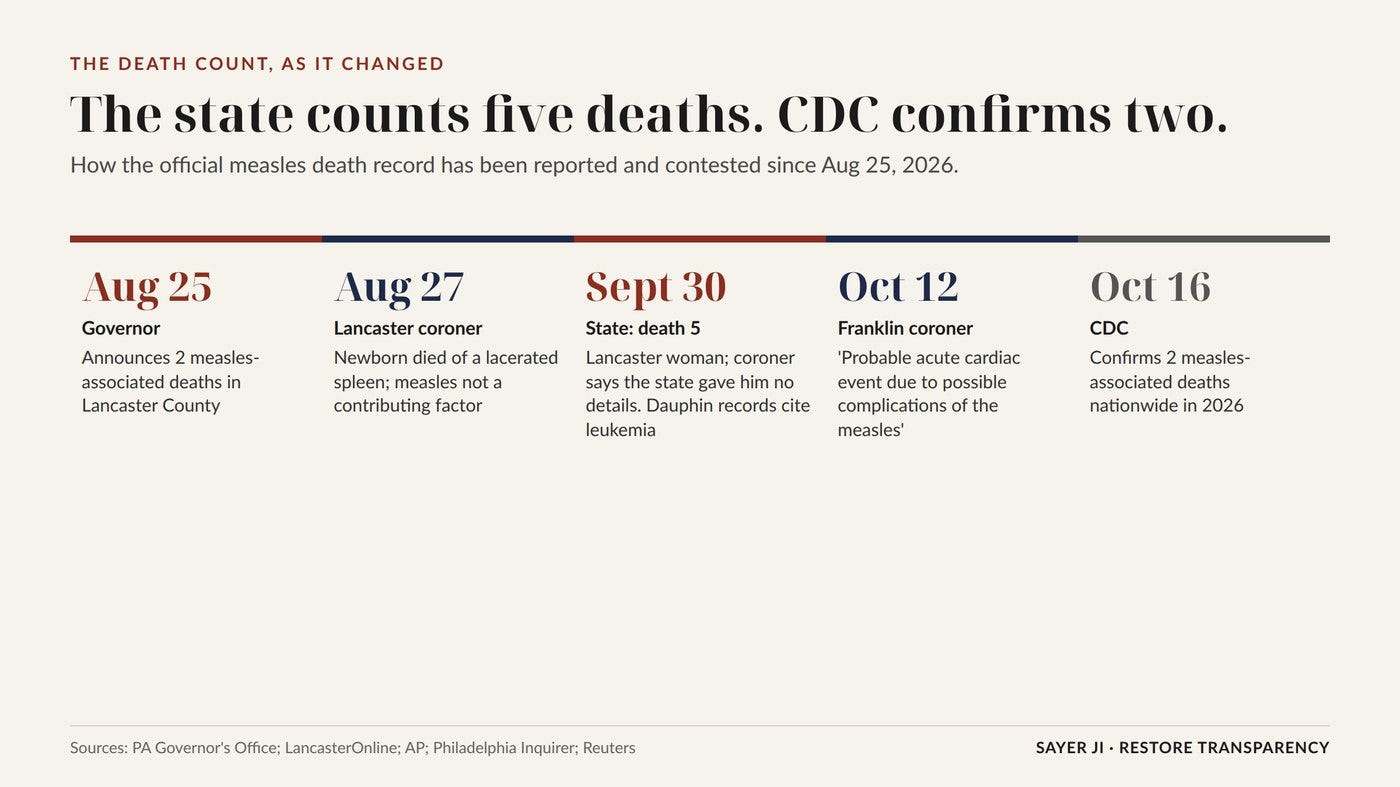
“Measles-associated” is a surveillance category, not a cause-of-death finding. That is exactly why the public needs the records behind each classification, and an explanation of why the federal count is less than half the state’s.
Why the Amish keep ending up at the center of this
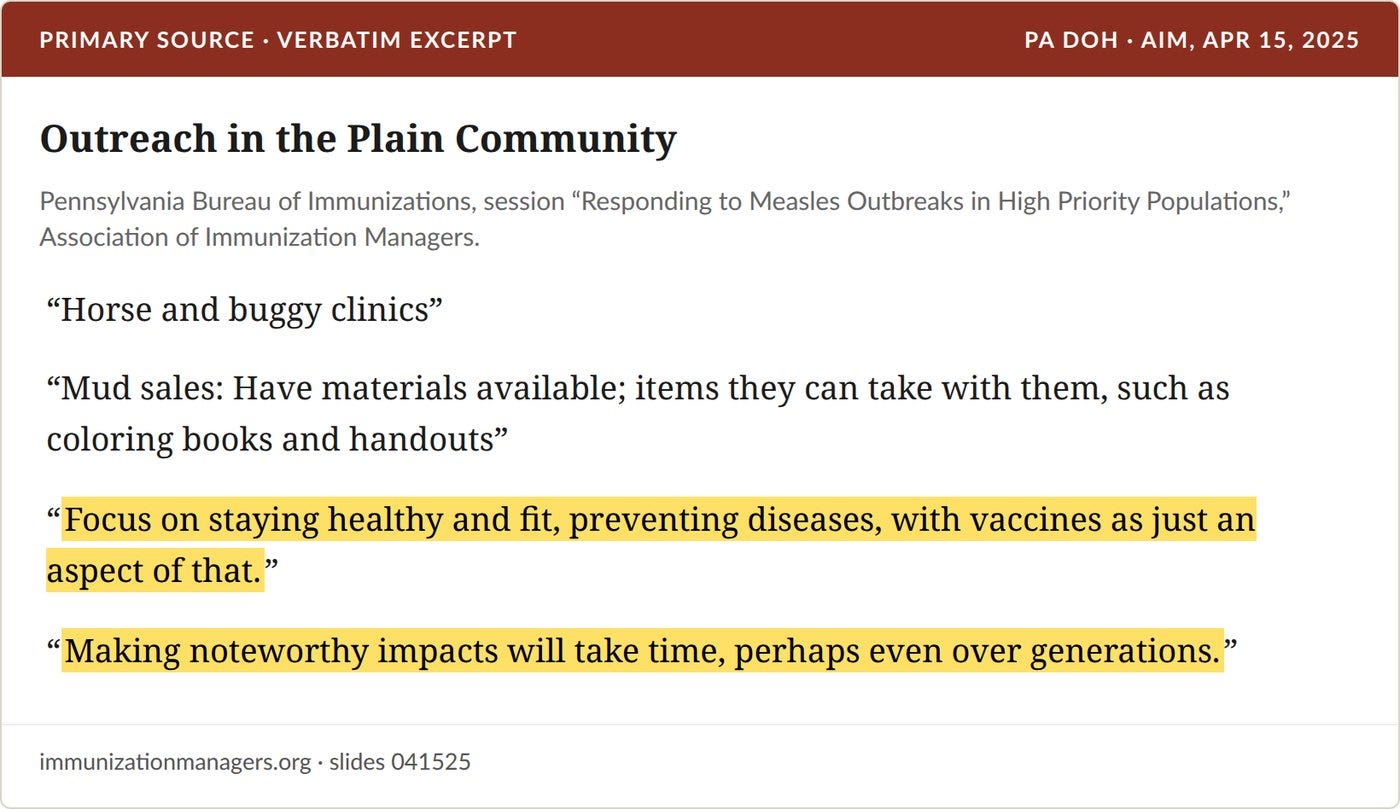
Pennsylvania’s Health Department has a name for the Plain community: a “high priority population.” In April 2025, the state’s immunization bureau presented “Outreach in the Plain Community” to the national association of immunization managers. The plan included horse-and-buggy clinics, mud sales and school visits. It advised: “Focus on staying healthy and fit, preventing diseases, with vaccines as just an aspect of that” and “Making noteworthy impacts will take time, perhaps even over generations.”
This summer, Chester County’s health director described the cases as “predominantly within the plain community.” The state has since run 212 pop-up vaccination clinics.
Now set that beside what the Health Department tells people to do when the spray trucks come. Close the windows and turn off the air conditioning. Stay inside. Bring the pets and their food and water dishes in. Cover the fish ponds, and pick ripe garden produce before the spray. That advice assumes a household with air conditioning, indoor animals and an email inbox. Many Plain households have none of those. They live with livestock, open windows, pasture and large gardens, which is exactly the setting the label allows the spray to drift over. And the one public notice in the Lebanon records went out by email and through the news media.
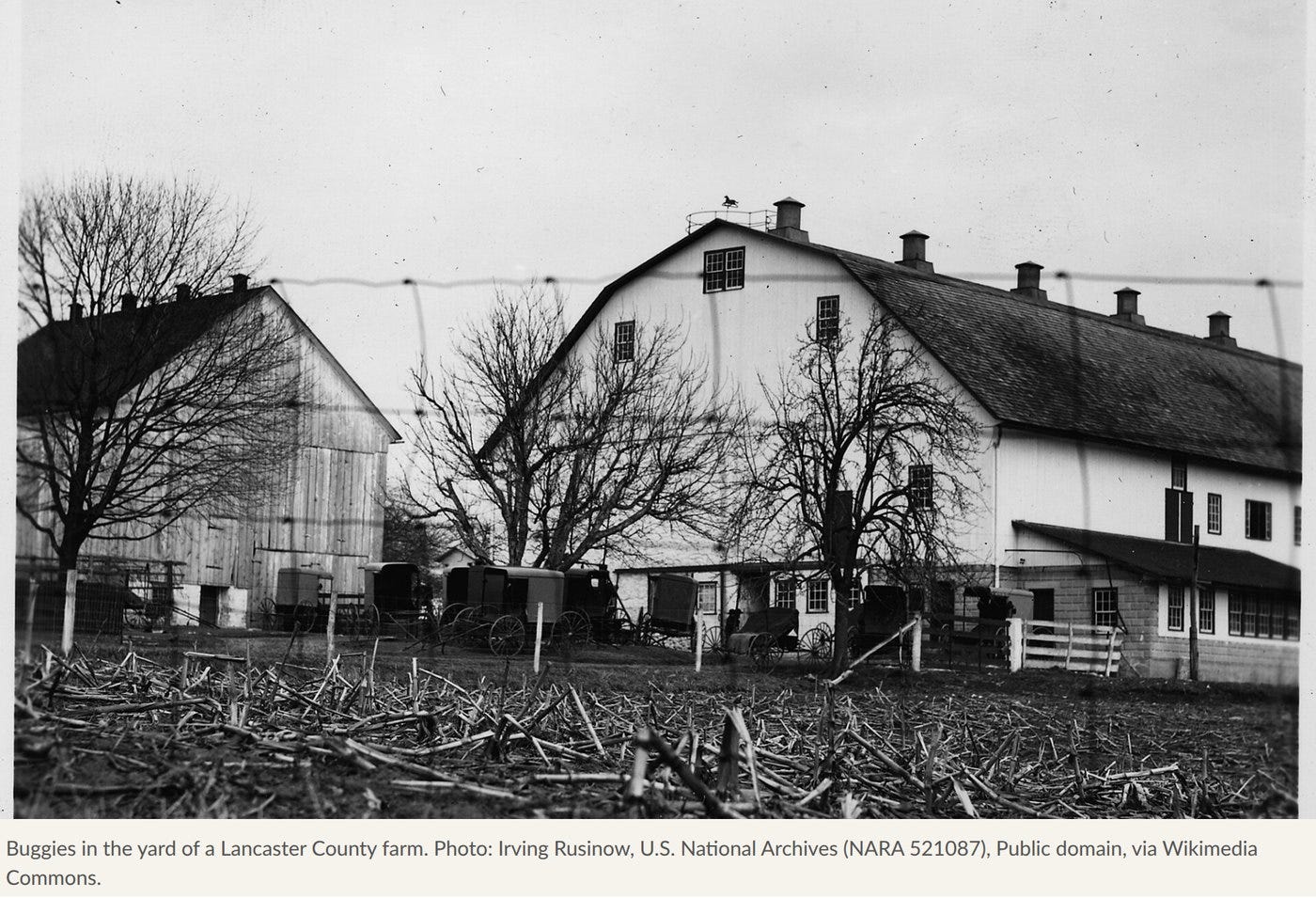
I want to be precise. The records I have do not show spray trucks being aimed at Amish farms, and I am not claiming that. What they do show is a state that treats the Plain community as a priority target for persuasion, while giving it no tailored warning about spraying and refusing to say whether its own epicenter was sprayed at all. When a community is singled out for one kind of attention and left out of another, the community deserves to know why.
A correction to my own record
Earlier reporting on this investigation, including my open letter, the GreenMedInfo exclusive and the public dashboard, cited a City of Lancaster “July 24” spray notice and a Lancaster Township “Sept 4” notice as 2026 operations. Both turned out to be older. The city notice is from 2024 and matches a row in DEP’s 2024 file; the township notice is from 2025. I have withdrawn both. That correction doesn’t settle the Lancaster question. It sharpens it: no 2026 Lancaster spray record has surfaced anywhere, from either side.
What Pennsylvania should release now
Every 2026 adult-mosquito application in Lancaster County, under any license (BU 0944 or BU 13818), including spot, barrier and backpack treatments. If there were none, the state should say so in writing.
A complete statewide list of 2026 adult-mosquito applications, including the ones not in DEP’s public file, or a written statement from DEP that its file is complete.
DEP’s basis for “not harmful to humans or animals.” The department should reconcile that sentence with the product’s label, its safety data sheet and the Health Department’s own “inherently toxic” warning, or withdraw it.
The records behind each measles-associated death classification, redacted for privacy, and an explanation of why CDC has confirmed two deaths nationwide while Pennsylvania reports five.
How Plain households without phones, email or air conditioning were warned before each spray.
Check the record yourself
We built Restore Transparency so that no one has to take our word for any of this. It puts Pennsylvania’s measles cases, its MMR clinics and the state’s own spray records on a single timeline. Every entry is dated, every entry links to the original document, and every entry has a Dispute button.
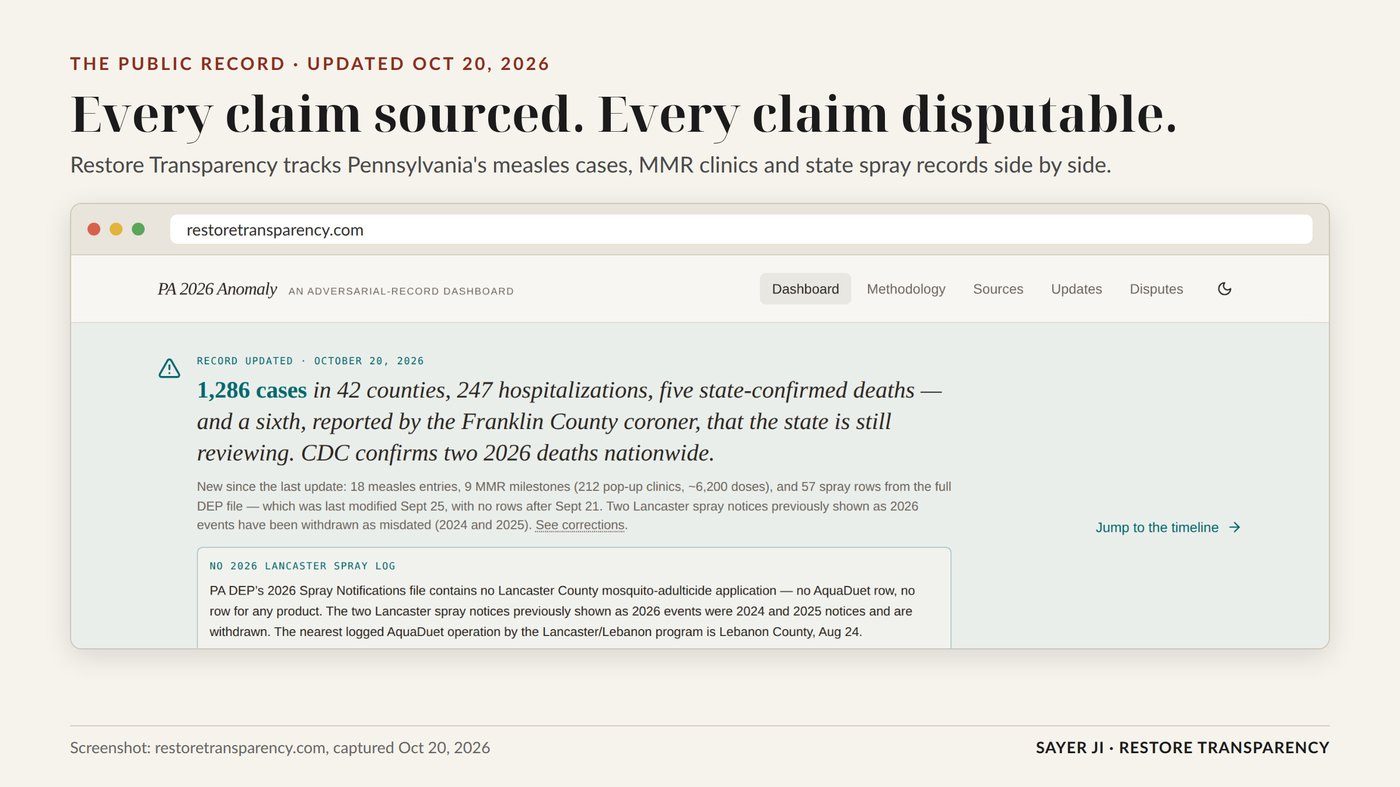
As of the October 20 update, it holds 130 dated entries drawn from 83 primary documents, plus a corrections log. If we have something wrong, tell us, and the correction goes on the record. We have already done that once. When Lancaster’s records arrive, they go there first.
How you can help
The Right-to-Know Law belongs to every Pennsylvanian, and you don’t need a lawyer to use it. Requests for Lancaster records can go to the Lancaster County Conservation District and to the County of Lancaster. If an agency denies you, you can appeal to the Office of Open Records within 15 business days. Appeals now have to be filed through its online portal.
Request text you can copy
“Under the Pennsylvania Right-to-Know Law, I request all records of adult mosquito control applications made in Lancaster County, Pennsylvania, from January 1, 2026 to the present, under any business license (including BU 0944 and BU 13818). Please include truck-mounted, ATV, backpack, barrier and hand applications; the date, location, product, rate and acreage of each; the surveillance data that triggered each application; and every public notice issued for each. Please provide the application log in its native electronic format.”
A state that says its spray is harmless should have no trouble showing where it sprayed.
“Sunlight is said to be the best of disinfectants.”
Louis D. Brandeis, Other People’s Money (1914)
This article is for educational and public-accountability purposes and is not medical or legal advice. Records quoted from the Right-to-Know production were obtained by a Pennsylvania citizen-coalition volunteer and are reproduced with the requester’s personal details removed.
🚨View and share the X thread 🧵
Sources
is not harmful to humans or animals: https://www.pa.gov/agencies/dep/newsroom/2026-08-04-dep-to-conduct-mosquito-controls-in-delaware-county
September: https://triblive.com/local/westmoreland/spray-trucks-to-target-mosquitoes-in-westmoreland/
inherently toxic: https://www.pa.gov/content/dam/copapwp-pagov/en/health/documents/topics/documents/diseases-and-conditions/Mosquito%20Spraying%20.pdf
Harmful if inhaled: https://www.clarke.com/wp-content/uploads/2022/03/aquaduet-msds.pdf
1,286 cases in 42 counties as of October 19: https://www.pa.gov/agencies/health/newsroom/pa-department-of-health-provides-statewide-update-on-measles-out11
restoretransparency.com: https://restoretransparency.com/
“KEEP OUT OF REACH OF CHILDREN” and “CAUTION.”: https://www.clarke.com/wp-content/uploads/2022/03/aquaduet.pdf
no harm to people, pets, or the environment “when used according to product label instructions.”: https://www.cdc.gov/mosquitoes/mosquito-control/adulticides.html
scored lower on a standard test of mental development at age three: https://pmc.ncbi.nlm.nih.gov/articles/PMC3065142/
a higher risk of death from any cause, and from cardiovascular disease, over about 14 years of follow-up: https://pmc.ncbi.nlm.nih.gov/articles/PMC6990752/
roughly twice the odds of an ADHD diagnosis: https://pmc.ncbi.nlm.nih.gov/articles/PMC4458051/
caused dose-dependent limb malformations and cleft palate at the highest dose: https://pmc.ncbi.nlm.nih.gov/articles/PMC11624992/
public announcement: https://lebtown.com/2026/08/21/conservation-district-to-spray-for-mosquitoes-in-campbelltown-area-monday-night/
public 2026 spray notification file: https://files.dep.state.pa.us/Water/WNV/2026_Spray_Notifications.pdf
2025 file: https://files.dep.state.pa.us/Water/WNV/2025_Spray_Notifications.pdf
two measles-associated deaths in Lancaster County: https://www.pa.gov/governor/newsroom/2026-press-releases/shapiro-administration-expands-measles-response-efforts
measles “was not the cause of death.”: https://lancasteronline.com/news/health/lancaster-county-coroner-shares-details-says-measles-didnt-contribute-to-newborns-death/article_74d23fb1-13ac-4306-a697-659ae57e96c2.html
his office had not handled it and the state had given him no details: https://apnews.com/article/measles-pennsylvania-death-vaccine-49445e58291d7b5a1520aa569ed26fe4
measles pneumonia due to mixed phenotype acute leukemia: https://www.inquirer.com/health/measles-outbreak-death-franklin-county-pennsylvania-20261012.html
has confirmed two in all of 2026, nationwide: https://www.reuters.com/legal/litigation/cdc-reports-4410-measles-cases-outbreak-grows-2026-10-16/
“Outreach in the Plain Community”: https://www.immunizationmanagers.org/content/uploads/2025/04/Responding-to-Measles-Outbreaks-in-High-Priority-Populations-slides_041525.pdf
“predominantly within the plain community.”: https://www.cityandstatepa.com/policy/2026/08/connecting-dots-pa-health-officials-battle-historic-measles-outbreak/415448/
open letter: https://read.sayerji.com/p/an-open-letter-to-president-trump
GreenMedInfo exclusive: https://greenmedinfo.com/content/exclusive-they-are-spraying-neurotoxins-over-the-outbreak-amish-counties-in-pa
DEP’s 2024 file: https://files.dep.state.pa.us/Water/WNV/2024_Spray_Notifications.pdf
corrections log: https://restoretransparency.com/#/methodology
Lancaster County Conservation District: https://lancasterconservation.org/right-to-know/
County of Lancaster: https://co.lancaster.pa.us/579/Right-to-Know
Office of Open Records: https://www.openrecords.pa.gov
Images: Carol M. Highsmith (Library of Congress), Irving Rusinow (U.S. National Archives) and CDC PHIL #6697, all public domain via Wikimedia Commons. Document images: PA DEP, PA DOH, Clarke Mosquito Control and Lebanon County Conservation District records, highlighting added.
Thank you for all the work you are doing, and exposure you are bringing, in regards to Pennsylvania and the Amish. It is very disturbing the way they are being treated!!
My thinking is that if Measles is a viral illness then my free salt water spray will kill it before it gets down into your body as the disease it becomes, I can't imagine it is a skin related disease because the skin acts as the body's armor and with clothing, etc, Measles can't get in, or any other viral infection so: Mix one heaped teaspoon of salt in a mug of clean boiled warm water or distilled water. Go into your bathroom and swallow two mouthfuls to sort out anything which has got down there, then cup a hand, pour some of the mix into your cupped hand and sniff or snort the remaining mugful up your nose, in stages until all is gone. If you have a burning sensation you have a virus and the salt water is killing the virus infection in your head. It will burn for a few minutes (but won't hurt you otherwise) and then the pain will go away, so when it does, take some toilet paper off the toilet roll and blow your nose out in it, then flush that away, washing your hands afterwards. Do this simple cure 3 times a day, or more often for a quicker result, until when you flush, it feels like you are flushing with plain water and no pain is felt - job done. I have been doing this simple cure for over 39 years and in that time I have never been ill from any virus or more lately, being shedded on by the vaccinated. The salt water goes throughout your nasal passages, behind your eyes, ears, brain bulb brain stem.
It is way to late to use my salt water cure, once you have measles - and if you have been vaccinated you really need to understand the back story relating to vaccines which are a depopulation program for some of the many: https://expose-news.com/2026/10/16/scary-truths-about-the-toxic-covid-vaccine/comment-page-1/#comment-197533