



A mechanism-of-action audit of Moderna’s newly approved mRNA flu vaccine — read the way the FDA’s own documents ask us to read it, then extended into the questions the label was never built to answer.
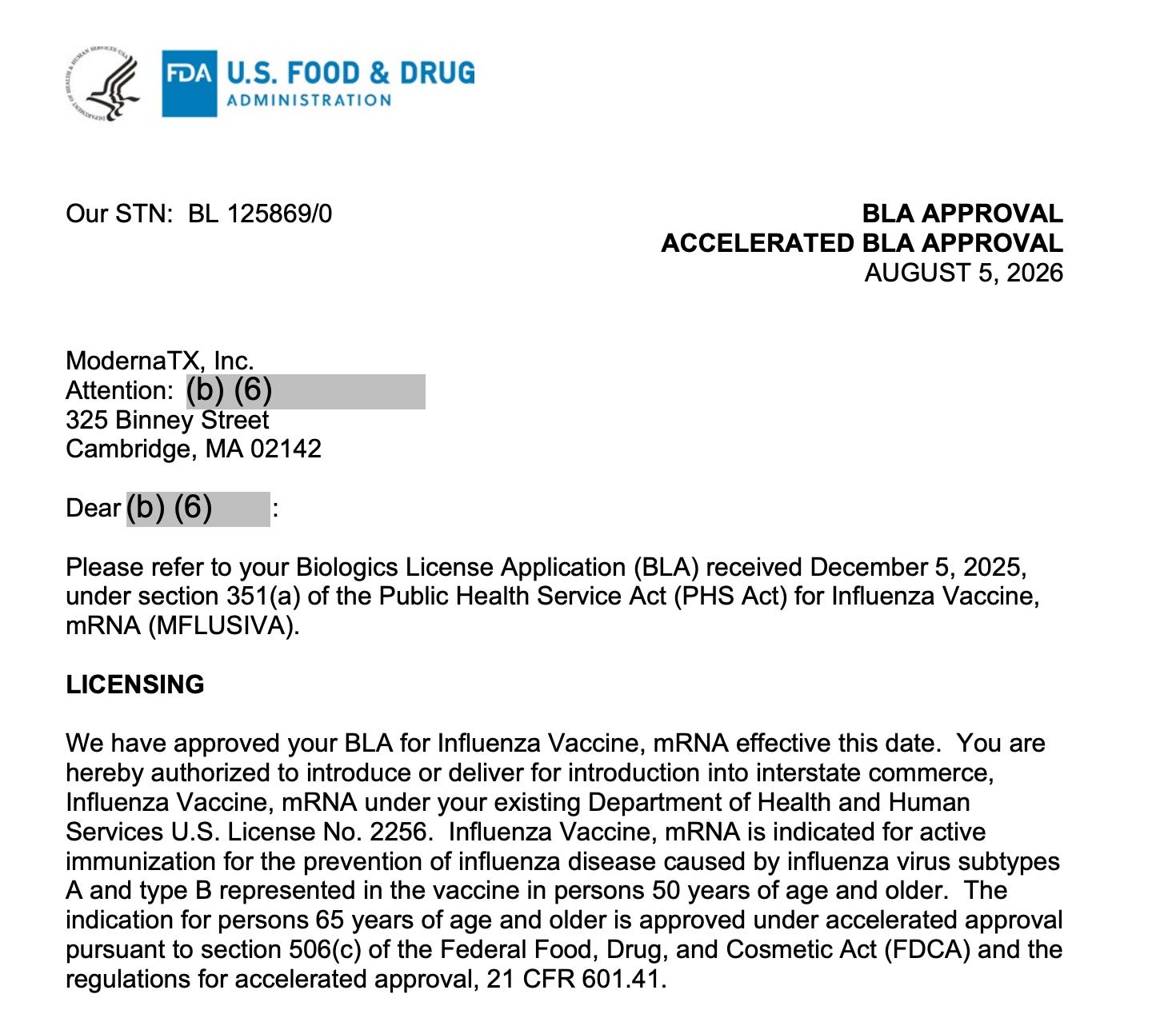
In August 2026, ModernaTX received FDA approval for MFLUSIVA, an mRNA seasonal influenza vaccine for adults 50 and older — the company’s first approved mRNA product outside the COVID-19 platform.[1] The prescribing information runs eighteen pages. Most of it is standard: dosing, contraindications, adverse-event tables. But buried inside that document — and in the gaps around it — is a genuine, defensible case for precaution that doesn’t require exaggeration to make.
This piece tries to do something the broader public conversation about mRNA products rarely does: separate what is established, what is plausible but unproven, and what is speculative — and then ask whether the distance between those categories is itself something regulators, and the public, should be more uncomfortable with than they currently are.


What MFLUSIVA actually is, in the company’s own words
MFLUSIVA contains three synthetic mRNA molecules (12.5 micrograms each), manufactured entirely outside living cells by in vitro transcription, encapsulated in lipid nanoparticles built from an ionizable lipid (SM-102), PEG-DMG, cholesterol, and DSPC.[2] Each mRNA encodes the hemagglutinin protein of a seasonal flu strain. The label’s own mechanism-of-action section states it plainly: “After delivery into cells, the mRNA serves as a template for the synthesis of the intended proteins. The expressed, membrane-bound HA glycoproteins... are recognized by immune cells as a foreign antigen, eliciting immune responses.”[2]

That sentence is doing more work than it appears to. It confirms, in the manufacturer’s own regulatory filing, that vaccination deliberately converts a subset of the recipient’s own cells into foreign-antigen-displaying targets — cells that the immune system is meant to recognize and, in the case of cytotoxic T-cell involvement, destroy. This is not a side effect; it is the stated mechanism. Whether that transient, designed alteration of “self” carries downstream costs beyond soreness and fatigue is the actual question worth asking, and it’s one the label doesn’t engage with beyond the injection-site reaction tables.
To be precise about one adjacent claim that circulates in this debate: MFLUSIVA is not transgenic. Transgenic describes stable, heritable incorporation of foreign DNA into a genome. mRNA is not designed to enter the nucleus, has no mechanism of its own to reverse-transcribe or integrate, and the manufacturer’s own biodistribution data show it clearing from tissue within days to weeks.[3] That distinction matters, and collapsing it doesn’t serve the argument. What follows are the questions that survive that clarification.
What the trials actually found — and what they were never built to look for
MFLUSIVA’s approval rests on a 40,703-person Phase 3 trial (NCT06602024) plus a related Moderna flu vaccine trial in adults 65+ (NCT05827978).[4] The safety signal is real, if modest: injection-site pain in 62–69% of recipients depending on age group, fatigue in 42–48%, myalgia in 30–41%, with one serious adverse event (syncope with fever) judged causally related to the vaccine.[2] Nothing here is hidden — it’s tabulated in the label.
What is disclosed, but easy to miss, is what wasn’t studied at all. Section 13.1 of the label states outright: “MFLUSIVA has not been evaluated for the potential to cause carcinogenicity, genotoxicity, or impairment of male fertility in animals.”[2] That is not a hidden fact — it’s printed in the prescribing information — but it is a genuine, disclosed evidentiary gap for a novel biological platform now recommended for repeated annual use.
Equally structural: the trial was never designed to detect any effect on people in close contact with the vaccinated. This is not a conspiratorial omission — Phase 3 vaccine trials monitor enrolled participants, full stop. But it means the confident public assurance that mRNA vaccination has zero effect on unvaccinated household members rests on mechanistic reasoning (no live, replicating virus, therefore no “shedding” in the classical sense)[5] rather than on any study that actually looked. The one rigorously documented transfer pathway out of a vaccinated body — trace mRNA detected in breast milk extracellular vesicles for up to 45 hours post-dose — showed no evidence of translated spike/HA protein in that transferred material.[6] That’s reassuring as far as it goes, but it’s a single, narrow data point being asked to carry the weight of a much broader reassurance.
Exosomes, “pseudocontagion,” and the shedding question
This is the section where the mechanism is real biology, but the extension to vaccines specifically is the least settled claim in this entire piece — and I want to be as careful with the reader here as I’ve tried to be everywhere else.
The foundational mechanism isn’t speculative: cells under toxic or synthetic stress package the molecular signature of that stress into extracellular vesicles (EVs), the best-characterized subclass being exosomes, and ship that cargo through the bloodstream to cells that were never directly exposed to the original insult. I’ve laid this mechanism out at length elsewhere, most fully in “Reframing Viral Mechanisms: Exosomes, Toxicity, and the Xenogen Hypothesis,” which walks through the 2018 Scientific Reports finding that exosomes isolated from acetaminophen-poisoned mice reproduced liver injury, oxidative stress, and inflammatory signaling in healthy recipient mice that were never given the drug — and in “Poisoned, Not Infected: Why Your Body’s Healing Response Looks Like Disease,” which extends that same mechanism across pesticide, heavy-metal, and pharmaceutical exposures. The synthesis piece, “How Being Poisoned Can Be Mistaken for Being Infected By ‘Germs’ and ‘Viruses’,” is the most rigorously sourced version of this argument in the archive — it walks through cadmium-to-kidney ferroptosis via exosomal miR-2137, lead-loaded EVs raising intracellular lead in never-exposed recipient cells, and the textbook radiation bystander effect, all checkable, mainstream findings that establish EVs as a real, non-viral vector for biological information to travel between cells and, in at least one documented case, between organisms.
That last point is the hinge. Applied specifically to mRNA vaccination, the same biology that lets a poisoned liver cell “broadcast” its injury to a distant kidney cell would predict that a vaccine-transfected muscle cell — now producing and displaying foreign antigen — packages some of that antigen and its associated stress signals into exosomes as well. That prediction has partial, real support: independent studies have detected circulating spike antigen in vaccinated people’s plasma,[5] measurable full-length spike protein specifically in vaccine-associated myocarditis cases (though not in asymptomatic vaccinated controls),[6] and a Yale report finding circulating spike protein in some symptomatic individuals more than 700 days after vaccination.[7] I worked through the full argument, and its citation list, in “When the Vaccinated Body Becomes the Broadcast Tower: The Shedding Paradox,” which is the piece in this series that goes furthest — and, on my own re-reading, the piece that most needs its language kept conditional. It proposes that vaccinated cells may become “broadcasters” of stress-encoded vesicles into the surrounding environment, coining the term pseudocontagion for apparent person-to-person effects that would arise from biological signaling rather than a replicating pathogen.
Here is where the honest accounting has to hold: that piece’s own text is — correctly — saturated with hedges (”if,” “may,” “potential,” “allows for the possibility”), and it states plainly that no authority has investigated whether these vesicles influence unvaccinated people, and that the possibility remains “still scarcely explored in mainstream discourse.” One citation load-bearing to that argument — a “2021 Journal of Immunology study” reported as the first direct evidence of spike-bearing exosomes detectable for at least four months — needs its full bibliographic citation confirmed before it goes back into print; I was not able to independently verify the exact paper from the title alone, and it shouldn’t be presented as settled until it is.
The mainstream counter-position deserves equal space: fact-checking organizations and infectious-disease physicians have argued there is no biological pathway for shedding from non-replicating mRNA vaccines, on the reasoning that shedding classically requires a live, self-copying pathogen, which these vaccines don’t contain.[8] That argument is mechanistically coherent as far as it goes — but it addresses classical viral shedding, not the EV-mediated informational-transfer mechanism described above, which doesn’t require replication at all. The one place this has actually been measured directly — trace vaccine mRNA detected in breast-milk extracellular vesicles for up to 45 hours post-dose — found no evidence that the transferred material was translated into spike protein in that setting.[9] That’s a genuinely reassuring, if narrow, data point. It is not the same as a study that looked for EV-borne antigen transfer via sweat, breath, or skin contact between adults, which — as far as I can find — has never been directly conducted for any mRNA vaccine.
The simplified version of this argument: EV-mediated propagation of biological signals between cells and between organisms is demonstrated, mainstream biology. Vaccination does produce circulating antigen and antigen-bearing vesicles in at least some recipients, sometimes for a very long time. Whether that translates into a detectable effect on people in close contact with the vaccinated has never been tested, in either direction, and the confident dismissals on both sides currently outrun the evidence that exists. That gap is exactly the shape of thing the precautionary principle exists to address.