



A year ago Congress ordered the Justice Department to release everything it has on Jeffrey Epstein. It released about half, blacked out much of the rest, and is still arguing with a federal judge about the remainder.
A second bill would open the full files to state prosecutors, survivors, and every member of Congress — and make hiding them a crime. The Speaker won’t bring it to a vote. A petition of 218 members can force him to. On Thursday it had 216.
On Monday at noon the House returns, and two members have promised to sign. Here is what happens next, either way.
The third piece in this series on the bill that would take the Epstein files out of the Justice Department’s sole custody. Part one read the text. Part two watched the petition open. This one is about the five weeks that decide it.
Read and share the X thread dedicated to this post.
On Thursday afternoon, two days after Democrats took both chambers, Thomas Massie posted this:

Read it once as a supporter and once as a clerk. The supporter hears a vote. The clerk hears four claims — a signature count, a guarantee, and two descriptions of what the bill does — and goes to check each one. That is what the rest of this piece does, in order, because this time the checking matters more than the cheering.
What we know on Thursday
The Clerk of the House keeps a public ledger of every discharge petition. Petition No. 27, filed by Thomas Massie on August 31 to pry H.Res. 1430 — the rule that carries the Epstein Files Transparency Act II — out of the Rules Committee, shows 216 names. Two hundred twelve Democrats. Four Republicans: Massie, Nancy Mace, Ralph Norman, and Brian Fitzpatrick, who signed on September 16, the day before the Speaker sent the House home for seven weeks.
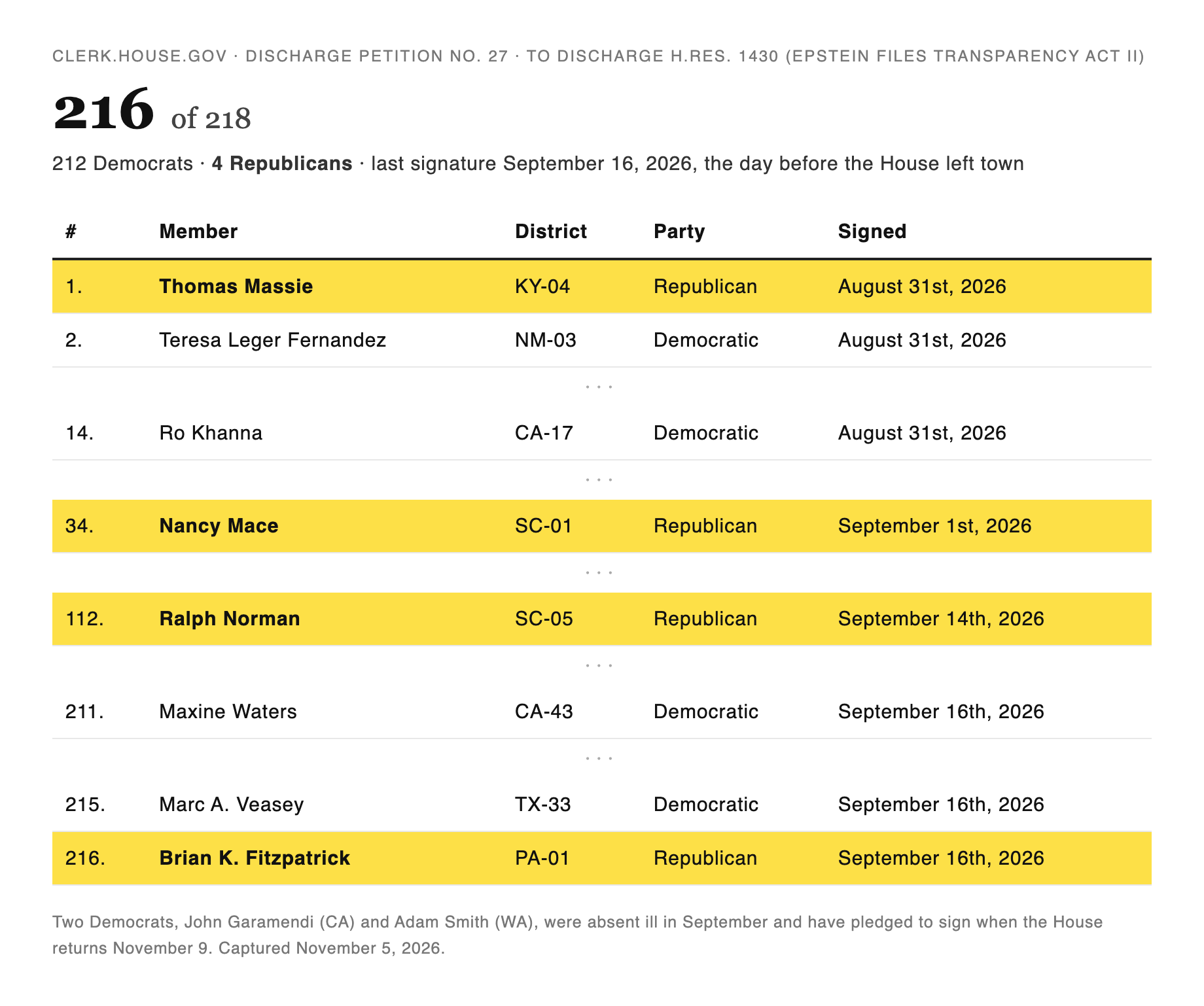
The last signature is dated September 16. Nothing has moved since, because nothing could: the petition sits at the rostrum, and members can only sign when the House is in session. The House has not been in session.
Two Democrats have not signed. John Garamendi of California and Adam Smith of Washington were ill when the chamber adjourned in September. Both have said they will sign when it returns. Massie, on Thursday: “When we return next week, we’ll get 218 signatures for Epstein Files Transparency Act II, which guarantees a vote.”
The first half is a prediction. It is a well-founded one — two pledged members, both back in Washington, both from safe seats, both on the record. But the petition does not close on a pledge. It closes when the 218th name is physically affixed, and the Clerk records it.
The House meets at noon on Monday, November 9. That is the first moment anything can change, and the first moment we will know.
What Monday decides — and what it doesn’t
If Garamendi and Smith walk to the rostrum Monday afternoon, three things happen at once. The list freezes — no name can be added or withdrawn. The motion is entered in the Journal and printed in the Congressional Record. And it is placed on the Calendar of Motions to Discharge Committees, which is where the real waiting begins.
Because 218 does not produce a vote. It produces a clock.
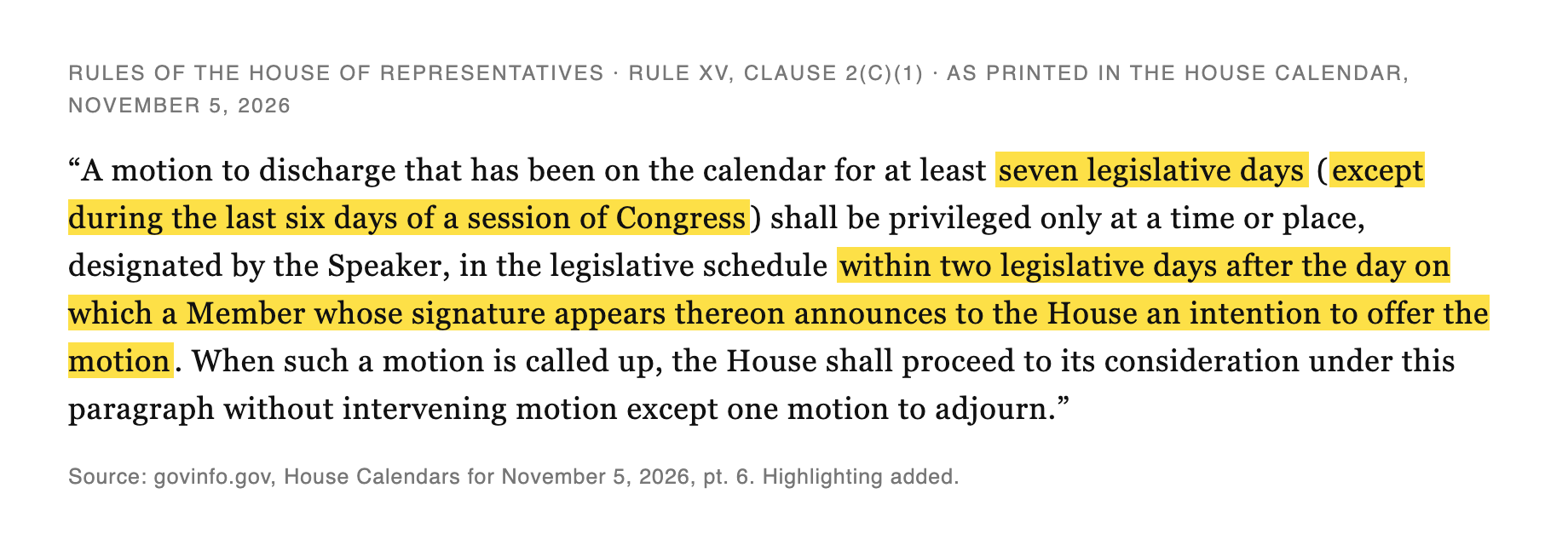
House Rule XV is written to make this slow, and it works in stages:
Seven legislative days. The motion must sit on the Discharge Calendar for seven legislative days before anyone can act on it. A legislative day is not a calendar day — it begins when the House meets after an adjournment and ends when it adjourns. Pro forma sessions count. Cancelled votes do not stop the count. What stops it is the House not meeting at all. Against the published calendar — in session November 9–12 and 16–20 — the seventh legislative day falls on November 19, or November 20 if the House does not sit on Veterans Day.
Notice, then two legislative days. Once the layover is spent, any member who signed can stand and announce an intention to offer the motion. The rule then directs the Speaker to designate “a time or place … within two legislative days after the day” of that notice. It is an obligation. It is also bounded — by the exception below, and by the House’s standing power to change its own rules.
Three votes, not one. The motion to discharge gets twenty minutes of debate. If it carries, the House takes up H.Res. 1430 and votes on adopting it. Only then does the bill itself come up — one hour of debate, no amendments, one motion to recommit, and a vote on passage. Three roll calls. Three places to lose.
So on the paper schedule, the earliest realistic passage vote is November 20 to December 1, and the first week of December is the likeliest. If Monday goes the way Massie says.

The three levers
This is the second time Massie and Khanna have reached this point. The first time — November 12, 2025 — tells you what the leadership can do when a petition closes.
Lever one: expedite and defang. Last year, once Adelita Grijalva’s signature made 218, Speaker Johnson did not fight the layover. Six days later the bill came to the floor under suspension of the rules — a two-thirds vote the leadership itself scheduled — and passed 427–1. The petitioners got their bill. The Speaker denied them the spectacle of forcing it. The Senate passed it by unanimous consent the next day, and the president signed it that same day, November 19.
Lever two: starve the calendar. The opposite move, and Johnson has used it twice. He kept the House out through all of October 2025 while the first petition sat one name short. He cancelled the last two weeks of this September while the second sat two names short. A House that does not meet accrues no legislative days, and a layover that never finishes never ends.
Lever three: the Rules Committee itself. This one the coverage has missed. If Rules reports H.Res. 1430 — favorably or adversely — the discharge petition becomes moot, and any member of the committee can call the rule up after one day’s notice. That can bring the bill to the floor faster than the petition would. It can also bring a different version. Watch Rules as closely as the rostrum.
And there is a trap at the far end. Rule XV says a discharge motion is not privileged “during the last six days of a session of Congress.” The rule says days, and they are measured from the formal adjournment — which is set by resolution, not by the Majority Leader’s calendar. Voting is scheduled to end December 17. If that becomes the sine die date, the bar covers roughly the final week. A leadership that can push the layover and the notice into mid-December has not blocked the vote. It has let the calendar do it.
Everything that matters in the House has to happen between about November 20 and the first week of December. That is the window. It is not wide.
Why this is not last November
It is tempting to assume the sequel runs like the original: 218, a quick vote, a lopsided margin, a signature. Four things argue against it.
The president’s position has inverted. In November 2025 Donald Trump reversed months of opposition two days before the vote and told Republicans to pass the bill. He could sign a disclosure law and say the files would embarrass Democrats. This bill is different in kind. Read what the resolution actually carries:
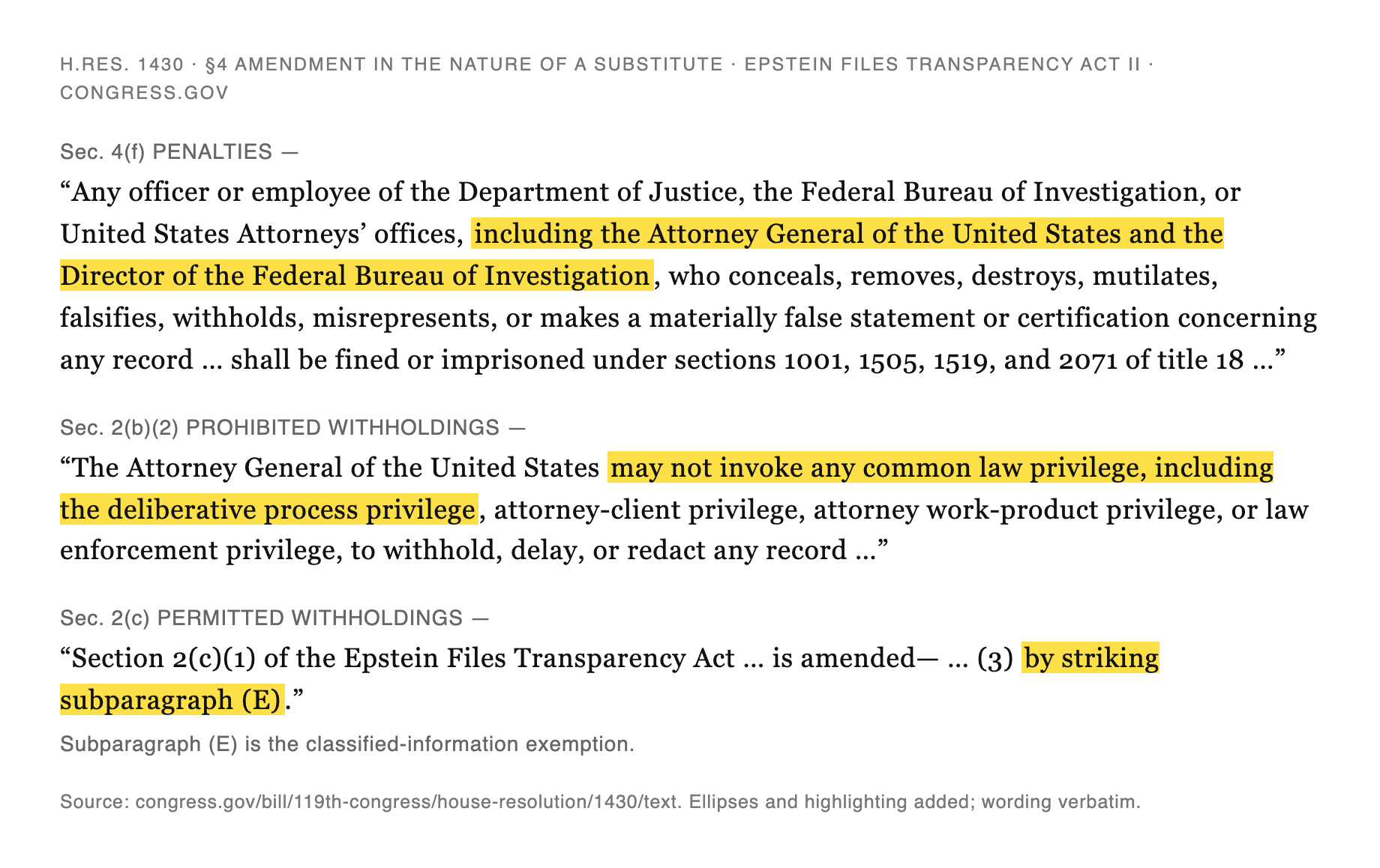
It names the Attorney General and the FBI Director, by office, in a criminal-penalty clause for any withholding or false certification after enactment. It bars the deliberative-process privilege by name — the privilege Blanche has told the sponsors he is invoking now. It strikes subparagraph (E), the classified-information shield, from the Epstein files law. It lets any single member of Congress demand unredacted access within seven days. This bill is written against the conduct of the president’s own Justice Department, and the office it names is held by the Attorney General he nominated.
The Speaker is leaving the stage. Johnson told his staff Wednesday he will not run for minority leader. A Speaker with no future in the conference has less reason to absorb the cost of obstruction — and less reason to absorb the president’s anger for failing to obstruct. Which way that cuts is genuinely open.
The petitioners are lame ducks too. Massie lost his primary in May and leaves January 3. Mace and Norman gave up their seats to run for governor and lost. Fitzpatrick lost his general election on Tuesday. All four remain full members until noon on January 3, so the petition holds. None of them will be in the next Congress. None of them owes anyone a thing. That makes them harder to pressure, not easier.
The election. Democrats won both chambers. On January 3 Hakeem Jeffries is expected to become Speaker, and Robert Garcia — who has named Epstein one of four investigative priorities — is running for the Oversight gavel. The question for the outgoing Republican majority is whether it wants its last act on this subject to be a vote it can point to, or a procedural burial that Democrats reverse under their own names.
The Senate and the desk
Suppose the House passes it in the first week of December. Three gates remain, and none of them is on Massie’s clock.
The Senate. The companion bill, S. 5005, has had one action since Merkley and Luján introduced it on July 15: referred to Judiciary. The Senate does not need it — it can take up the House-passed bill directly, as it did last year by unanimous consent once the president said he would sign. That consent dies if a single senator objects. This time the administration is the party in interest. Without UC, Majority Leader Thune would have to spend floor time and, in all likelihood, a 60-vote cloture motion on it, in a lame duck already carrying a December 11 funding deadline. Seventeen state attorneys general have asked him to. The outgoing Republican Senate is under no obligation to listen.
The veto. An override takes two-thirds of those present and voting in each chamber. Last year’s House margin, 427–1, cleared that by a mile; the Senate’s unanimous consent tells you no senator objected, not that 67 would have voted to override. If the House margin this time is anything like 427–1, a veto invites a humiliating override vote. Whether that deters a president whose Attorney General is the bill’s target is the question nobody can answer from here.
The pocket veto. This is the gate the coverage has not mentioned, and it is contested law, so precisely: the Constitution gives a president ten days, Sundays excepted, from the day a bill is presented to him. If Congress’s adjournment in that window “prevents its return,” the bill dies without a veto message and without an override vote. The Supreme Court upheld a pocket veto across an adjournment between sessions in 1929 and rejected one during a short recess in 1938; the D.C. Circuit has held that a chamber which appoints an agent to receive veto messages has not “prevented return.” The strongest case for a pocket veto is the final adjournment of a Congress — which is exactly what the 119th will do in December. The later this reaches the desk, the less a desk it is.
If it dies: January 3
The fallback is real but not free. Every pending bill and every discharge petition dies with the 119th Congress. The 120th convenes January 3 with Democratic majorities, and the bill has to be introduced again from zero. Khanna has said Democrats would “absolutely” take it up. A Democratic House can pass it quickly once it organizes — “quickly” being a prediction, not a schedule.
Then the Senate, where Democrats hold 54 and cloture needs 60. A bill with a 427–1 pedigree can plausibly draw six Republicans — or become the thing six Republicans are asked by the White House not to do. And the veto math is harder in a Senate where the president’s party, at 44 or 46 seats, can sustain a veto if it holds together.
And Massie is gone. The man who read fourteen names into the Congressional Record, who filed both petitions, who has treated this as the last thing he will do in office, will be a private citizen. The bill does not depend on him. The pressure has.
Meanwhile, the other clock
The bill is not the only timer running. In Phang v. Blanche, Judge Emmet Sullivan wrote in his June 25 preliminary-injunction opinion that “the Attorney General conceded that he is in violation” of the first act — a finding at the injunction stage, which the Department disputed and is appealing. In September he warned that contempt could become appropriate. On October 28 a D.C. Circuit panel denied Blanche’s motion to stay the order requiring him to begin reviewing foreign-language documents he has never produced. On November 2 the plaintiff asked the court to order that review complete by November 27, with weekly status reports. A request, not yet an order — but one that would land inside the House’s window.
Hold the two tracks side by side. The Department is under a federal injunction, an appellate denial, a contempt warning, and seventeen state attorneys general on the record saying it is in violation of a law it told the public it had fully obeyed. The second bill does not invent a new theory. It takes the one a single journalist has so far won on at the injunction stage and hands it to every state, every member, and every survivor — with a criminal statute attached for conduct after enactment.
Monday
So here is where this piece has to stop, because the record does.
At noon on Monday the House convenes. At some point that afternoon, two members either walk to the rostrum or they don’t. If they do, the Clerk’s page reads 218, the list freezes, the Record prints every name, and a seven-day clock starts that the Speaker cannot speed up and can only slow by refusing to meet. If they don’t — illness, absence, a change of mind, a Speaker who finds a reason to delay the day’s business — the page reads 216 and the story is a different one.
I will not pretend to know which. Neither should anyone else, including the sponsors. What can be said is that every element of what follows is already written down — in the rule, in the calendar, in the bill text, in the court docket — and that for once the thing to watch is not a tweet but a government webpage that updates once a day.
What to watch, in order
Monday, November 9, after noon. The Clerk’s petition page. Two names: Garamendi, Smith. If the count reads 218, the layover has started.
The Congressional Record for Monday. When a petition closes, every signature is printed. That list — and, read against the roster, the roughly 215 Republicans who did not sign — is the permanent record. Not signing a petition is not voting no; last year 427 voted yes after 218 signed.
The Rules Committee. If it reports H.Res. 1430, the petition is moot and the clock changes.
The Speaker’s schedule for the week of November 16. Fewer sittings means a longer layover.
The adjournment resolution. The six-day bar is measured from it. Until it exists, the hard deadline is unknown; the soft one is the first week of December.
The Majority Leader of the Senate. UC, floor time, or silence.
Judge Sullivan’s order on the November 2 joint notice.
Two Democrats have not signed. John Garamendi of California and Adam Smith of Washington were ill when the chamber adjourned in September. Both have said they will sign when it returns. “We’ll get 218,” the post says. “Which guarantees a vote.”
The first half is a prediction. It is a well-founded one — two pledged members, both back in Washington, both from safe seats, both on the record. But the petition does not close on a pledge. It closes when the 218th name is physically affixed, and the Clerk records it.
The House meets at noon on Monday, November 9. That is the first moment anything can change, and the first moment we will know.
House live floor video (Clerk’s office): https://live.house.gov — the official feed, goes live when the House convenes at noon Monday.
C-SPAN: https://www.c-span.org/networks/?channel=c-span — C-SPAN 1 carries the House floor gavel to gavel.
That is the first claim. The second — that 218 “guarantees a vote” — is where the rulebook takes over.



Sources
Discharge Petition No. 27, Office of the Clerk: https://clerk.house.gov/DischargePetition/2026083127
H.Res. 1430 (rule and substitute text): https://www.congress.gov/bill/119th-congress/house-resolution/1430/text
H.R. 9694, Epstein Files Transparency Act II: https://www.congress.gov/bill/119th-congress/house-bill/9694/text
S. 5005, Senate companion, all actions: https://www.congress.gov/bill/119th-congress/senate-bill/5005/all-actions
House Rule XV, clause 2, as printed in the House Calendar of Nov. 5, 2026: https://www.govinfo.gov/content/pkg/CCAL-119hcal-2026-11-05/html/CCAL-119hcal-2026-11-05-pt6.htm
CRS, “Discharge Procedure in the House,” R45920: https://crsreports.congress.gov/product/pdf/R/R45920
H.R. 4405 (EFTA I), all actions — petition closed Nov. 12, 2025; suspension vote Nov. 18; Senate UC and signature Nov. 19: https://www.congress.gov/bill/119th-congress/house-bill/4405/all-actions
2026 House Calendar, Office of the Majority Leader: https://www.majorityleader.gov/uploadedfiles/legislative_2026_calendar_119_house.pdf
Rep. Massie, X, Nov. 5, 2026:
Axios, Sept. 18, 2026 (218 commitments; Garamendi and Smith): https://www.axios.com/2026/09/18/epstein-files-vote-massie-khanna-support
Axios, Nov. 5, 2026 (post-midterm outlook; Garcia’s Oversight bid): https://www.axios.com/2026/11/05/epstein-files-vote-push-investigations
ABC News, Sept. 3, 2026 (House cancels September votes; Nov. 9 return): https://abcnews.com/amp/Politics/speaker-johnson-reversal-cancels-house-votes-leaving-days/story?id=136173855
State attorneys general coalition letter on EFTA II, Oct. 16, 2026: https://oag.ca.gov/system/files/attachments/press-docs/ags-letter-congress-epstein-files-transparency-act-ii.pdf
Phang v. Blanche, No. 26-cv-1417 (D.D.C.), docket: https://www.courtlistener.com/docket/73246595/phang-v-blanche/
Axios, Sept. 17, 2026 (Sullivan contempt warning): https://www.axios.com/2026/09/17/epstein-files-doj-contempt-judge-blanche
The Pocket Veto Case, 279 U.S. 655 (1929); Wright v. United States, 302 U.S. 583 (1938); Kennedy v. Sampson, 511 F.2d 430 (D.C. Cir. 1974)