

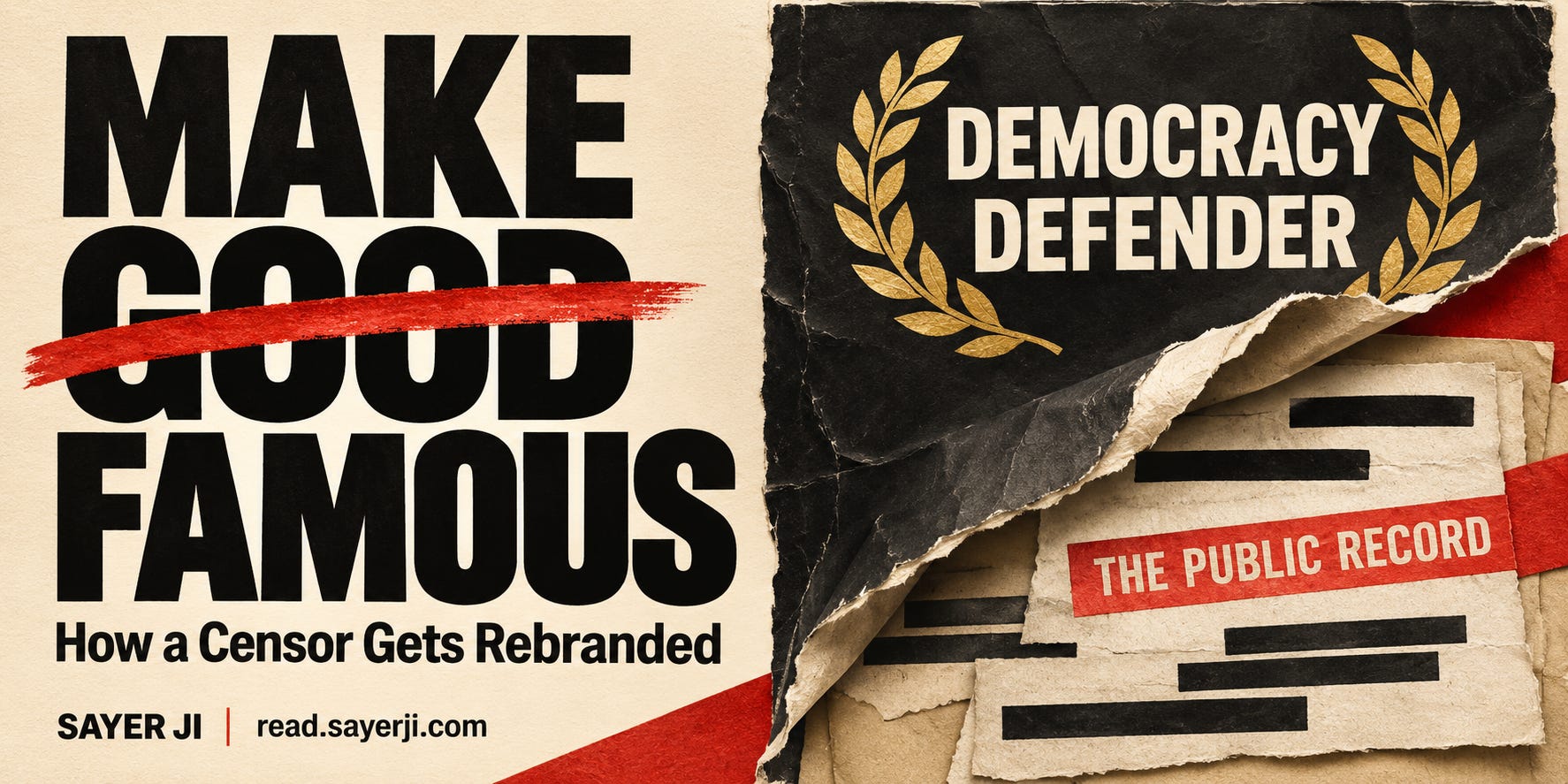
On election night, the man whose list got twelve Americans erased was premiered to a room of foundation leaders as a defender of democracy — under a new name his own filings quietly adopted three months ago.
Story at a glance
On November 4, 2026 — election night — the Elevate Prize Foundation premiered its docuseries Nevertheless: Democracy Defenders at the Franklin Institute in Philadelphia, co-hosted with the National Center for Family Philanthropy, to “foundation leaders from across the country.” Episode 2 celebrates Imran Ahmed. I know because the foundation emailed me the announcement.
The email calls his organization the “Center for Countering Digital Harm.” That is not a typo. Companies House records show the UK company (no. 11633127) was renamed from “Center for Countering Digital Hate Ltd” on August 12, 2026. The organization whose name became a liability now has a new one, and the philanthropy circuit has adopted it without a word.
The record attached to the old name, all of it public: a House Judiciary Committee subpoena (August 30, 2023, issued after CCDH’s counsel declined a voluntary request) that the Committee describes as “continuing in nature”; the Committee’s finding that a European Commission moderation handbook “contained platform policy recommendations from” CCDH; a formal complaint to the Department of Justice asking for a FARA investigation; and a State Department deportability determination against Ahmed himself (December 2025) — which, I note plainly, a federal judge enjoined, and which Ahmed is actively litigating in Ahmed v. Rubio (S.D.N.Y.).
I am one of the twelve people on the list that made this organization’s name. The “Disinformation Dozen” was cited from the White House podium in July 2021; the deplatforming followed; Meta’s own rebuttal — that the twelve accounted for a fraction of a percent of the content studied — followed the erasure, not preceded it. Every document is at the public Targeting Tracker.
This piece is not about the parents who appear in Episode 2. Families who lost children to online harms deserve nothing from me but respect, and they get it here without qualification. This piece is about the machinery that places a man under congressional subpoena next to their grief and calls the package “democracy.”
No conspiracy is required and none is alleged. What follows is a documented loop: prize money → studio → docuseries → award campaign → funder screening → more money. Its product is reputation. I am describing how the machine works, in its own word.
The email in my inbox
On November 18, the Elevate Prize Foundation sent its community newsletter. I’m on the list — a small irony I’ll return to. The subject line: “A premiere, two new episodes, and three wins 🏆.”
The lead item: on election night, “a room full of people in Philadelphia came together to watch stories of leaders around the world fighting to protect democracy.” The occasion was the premiere of all four episodes of Nevertheless: Democracy Defenders, an Elevate Studios production, screened “alongside the National Center for Family Philanthropy” for “foundation leaders from across the country” at the Franklin Institute.
Episode 2, in the newsletter’s words: “we shine a light on an underrepresented realm of democracy: the internet. We follow Imran Ahmed and the Center for Countering Digital Harm, as he and his team work alongside parents who have lost children to online harms to hold Big Tech accountable.”
The sign-off states the foundation’s mission in three words: “Make Good Famous!”
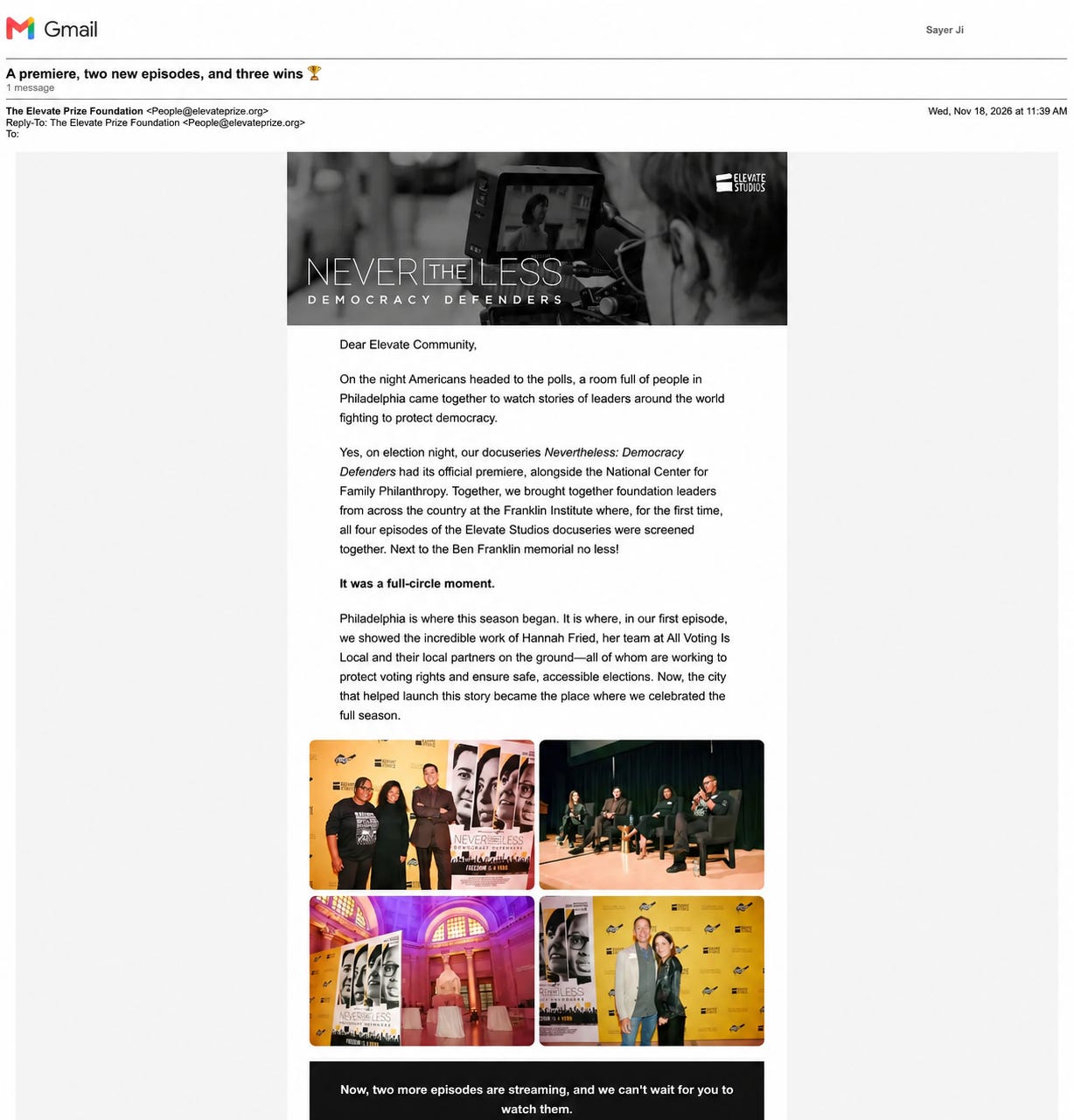
Author’s analysis: Read that mission statement literally, because it is literal. This is a fame-manufacturing operation — it says so — and the newsletter documents exactly who the fame is being manufactured for, and before whom: the donor class of American philanthropy, gathered on the night the country voted.
The name that changed when nobody was looking
The newsletter says “Center for Countering Digital Harm.” For eight years the organization was the Center for Countering Digital Hate. The UK register tells the story in two lines: Brixton Endeavours Limited, incorporated October 19, 2018; renamed Center for Countering Digital Hate Ltd in September 2019; renamed Center for Countering Digital Harm Ltd on August 12, 2026 (Companies House no. 11633127).
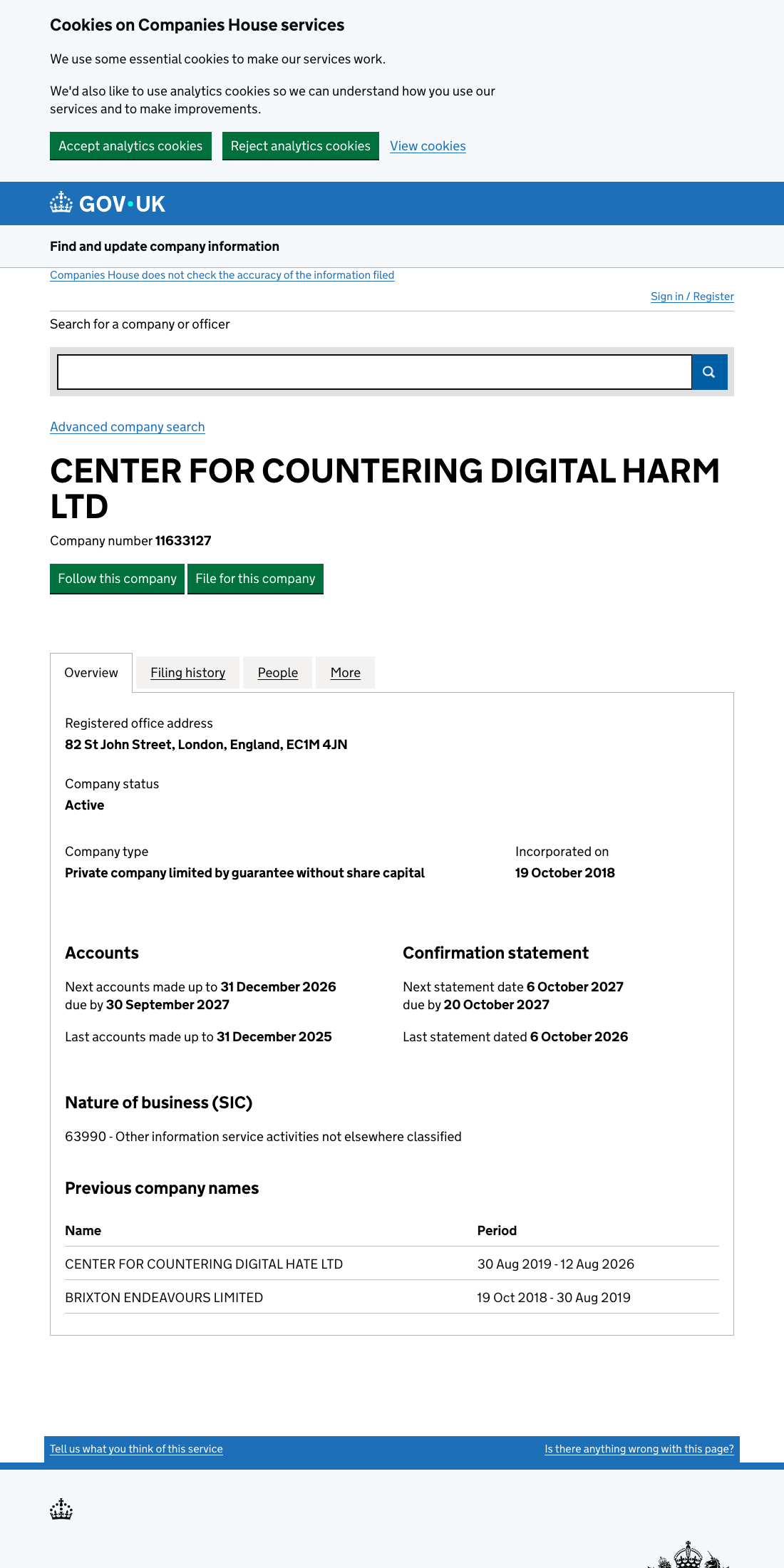
Organizations rebrand. That is not a scandal in itself. What makes this one worth your attention is what the old name had accrued by August 2026 — none of it from me, all of it from official records:
A congressional subpoena. On August 30, 2023, the House Judiciary Committee subpoenaed CCDH for documents on its communications with the U.S. government and platforms — after the organization’s outside counsel declined to produce them voluntarily. The Committee’s follow-up letter of November 7, 2024 reminded CCDH the subpoena is “continuing in nature” and demanded documents on its plans concerning “groups, accounts and channels,” citing reporting on an internal “Kill Musk’s Twitter” document.
A finding in a congressional report. The Committee’s February 2026 report on foreign censorship — built on 302 subpoenaed exhibits from ten technology companies — found that a European Commission forum’s 2023 “Handbook of Borderline Content,” which listed “populist rhetoric,” “political satire” and “meme subculture” as categories for moderation attention, “contained platform policy recommendations from” CCDH (Exhibit 38, footnote 369).
A DOJ complaint. America First Legal filed a formal complaint asking the Department of Justice to investigate CCDH under the Foreign Agents Registration Act. To be precise and fair: a complaint is an accusation, not a finding; no investigation has been announced, and none may ever be.
A State Department determination. In December 2025, the government determined Ahmed deportable. Fairness requires the full record: a federal judge enjoined his detention, Ahmed is contesting the determination in Ahmed v. Rubio (1:25-cv-10705, S.D.N.Y.), and that litigation is live. The determination is a documented government characterization, not a conviction of anything.
Author’s analysis: Each item above has an official paper behind it that you can read. None of it appears anywhere near the Elevate newsletter, the docuseries marketing, or the new name. The rebrand is legal and the omissions are legal. But a donor class being introduced to “the Center for Countering Digital Harm” is being introduced to an organization whose actual record has been laundered out of the frame — and the laundering is the story.
What the old name did — to me, and eleven others
In March 2021, under the old name, CCDH published “The Disinformation Dozen,” naming twelve Americans — I am one — as responsible for the bulk of vaccine “disinformation” online. In July 2021, the list was cited from the White House press podium. The deplatforming cascade followed.
What followed later is the part the docuseries will not mention: Meta — the platform with the data — published its own analysis stating that the twelve accounted for only about 0.05% of vaccine-related content views on its platforms, and that the report’s methodology (”just 483 pieces of content over six weeks”) “is in no way representative.” The sample-size rebuttal came from the censoring platform itself, after the damage.
Every document in that paragraph — the report, the podium transcript, Meta’s statement — is compiled with primary links at the public Targeting Tracker, which operates under one standard: primary document, or it is not here. The tracker also publishes what it could NOT establish — including, I should say plainly, that it has located no government payment to CCDH in any jurisdiction, and no record that CCDH was among the civil-society “specialists” the UK’s Counter Disinformation Cell consulted. Where the record is empty, I say it is empty. That is the difference between this piece and a smear.
Author’s analysis: I have a personal stake, disclosed here and on the tracker: I was on the list; I co-founded an organization that was deplatformed; I was a co-plaintiff in Finn v. Global Engagement Center, dismissed with prejudice on a pleading defect in July 2026. You should weigh my interest when you weigh my words. That is why this piece leans on documents rather than my testimony — the subpoena letters are not mine; Companies House is not mine; Meta’s rebuttal is certainly not mine.
The loop: how reputation gets manufactured
Here is the machine, each gear documented:
The prize. The Elevate Prize Foundation (EIN 82-4411649, Miami) — founded by Joseph Deitch, the Giving Pledge signatory who built Commonwealth Financial Network — gave Ahmed its “GET LOUD” award. Its CEO, Carolina García Jayaram, came to Elevate from the Skoll Foundation, where she was Vice President of Partnerships and Engagement. The Skoll Foundation’s grants to CCDH are on CCDH’s own funder disclosures. I am not alleging anything unlawful in any of this; I am describing a personnel and funding adjacency that the public filings show.
The studio. Elevate Studios produces Nevertheless — executive producers include Kerry Washington, Joe Deitch, and García Jayaram. The series IS the foundation’s marketing arm; the YouTube episode’s own banner reads “HOLDING BIG TECH ACCOUNTABLE.”
The awards about the marketing. The same newsletter celebrates three Anthem Awards — for, read it carefully, “our 2026 winners announcement campaign,” the “5 Year Impact Report,” and “The Elevate Prize GET LOUD Award campaign.” These are marketing awards won by marketing materials about the foundation’s own prizes. The trophy case is self-referential three layers deep.
The audience. The premiere’s co-host was the National Center for Family Philanthropy, and the room was “foundation leaders from across the country.” The docuseries’ function in that room is not entertainment; it is the reputational predicate for the next round of funding.
The closed loop. Prize elevates the man; studio films the prize; awards decorate the film’s marketing; the film screens for funders; funders sustain the apparatus. At no point does the congressional record enter the room.
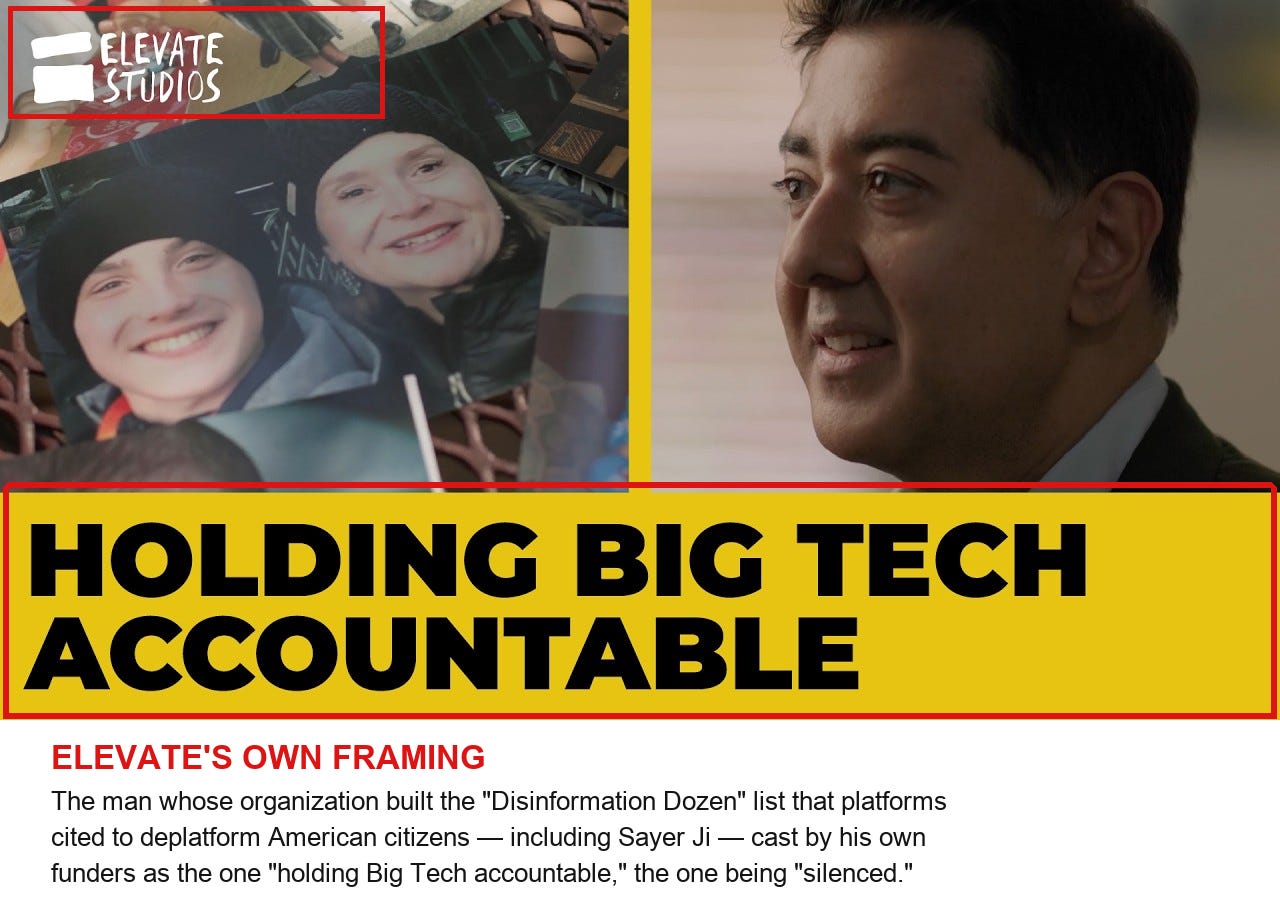
Author’s analysis — and this is opinion, labeled as such: I believe this loop, multiplied across the prize-philanthropy sector, is how a person whose organization is under a continuing congressional subpoena gets presented to American donors as a democracy defender. Not conspiracy — choreography. Everyone in the loop is doing their job; the job is fame; and fame, in this economy, is a laundering mechanism for records like the one above.
What “democracy defender” conceals
The newsletter’s closing formula: democracy “is the right to vote, to speak up, to come together.”
Read that list again. The second item — the right to speak up — is not one democratic amenity among several. It is the constitutional precondition for the other two: a vote cast without free speech is a vote cast in the dark, and assembly without speech is a crowd without a voice. The American founders did not put it first by accident. The First Amendment is not a feature of our democracy; it is the load-bearing wall.
Now set the newsletter’s formula beside the documented record of the organization being celebrated. Under its old name, CCDH built the list that got twelve Americans’ speech suppressed — on a methodology the censoring platform itself later called unrepresentative. Its policy recommendations surfaced inside a European Commission handbook that listed “political satire” and “populist rhetoric” as categories for moderation attention. When the committee of Congress charged with oversight of exactly this asked for its documents voluntarily, it declined; when subpoenaed, the subpoena had to be marked “continuing in nature.” And its own published strategy document — the one the Committee’s November 2024 letter demanded records about — was titled, per the reporting Congress cited, “Kill Musk’s Twitter”: a plan aimed at a speech platform as such.
I will say what I am in a position to say, and label it: this is my opinion, resting on the documents above. The organization now being premiered to American philanthropy as a defender of democracy spent its formative years working to narrow the one freedom that makes the others operative. I did not come to that view abstractly. Restore the First — the coalition whose Targeting Tracker documents this record — exists because of that work. It was not founded to defend a policy preference or a faction. It was founded by people who discovered, by being erased, that the constitutional floor under their speech could be removed without a hearing, a charge, or an appeal — and that the removing was done in democracy’s name. The coalition is, in the most literal sense, the measure of what was dismantled: you do not have to build a movement to restore something that is still standing.
The man is entitled to contest his legal battles, and he is winning some of them. But “the right to speak up” is an extraordinary banner for this particular record — and the contradiction is visible only if you can see both documents at once. The entire function of the rebrand, the docuseries, and the Franklin Institute screening is to ensure the donor class only ever sees one.
That is what I can prove. And this: the machine mailed its victory lap to my inbox — one of the twelve, still on the distribution list eight years after the erasure. The algorithm doesn’t know what the archive shows. It just wants me to watch the series.
The finale premieres December 2. Watch it, by all means. Then read the subpoena letters.
What this piece is not
This is not an attack on the bereaved families in Episode 2, whose grief is real and whose advocacy is theirs. It is not a claim that Elevate, its founders, or its officers have done anything unlawful — no document shows that, and I allege nothing of the kind. It is not a claim that CCDH is a government agency or an intelligence operation — the tracker’s own negative findings say no such document exists, and I follow the record. It is a documented account of how a reputation is being manufactured while a public record points the other way, written by one of the people the old reputation was built on.
Read the thread for this article on X.


Sources
Elevate Prize Foundation community email, November 18, 2026 (screenshot above)
Companies House, company no. 11633127 — name history: Brixton Endeavours Ltd → Center for Countering Digital Hate Ltd → Center for Countering Digital Harm Ltd (12 Aug 2026)
House Judiciary Committee subpoena to CCDH (Aug 30, 2023) and follow-up letter (Nov 7, 2024, “continuing in nature”)
The Foreign Censorship Threat, Part II, House Judiciary Committee interim staff report, Feb 3, 2026 — Exhibit 38 and fn. 369
America First Legal complaint to DOJ re FARA; no investigation announced
Ahmed v. Rubio, 1:25-cv-10705 (S.D.N.Y.) — docket public; preliminary injunction granted Dec 2025
Meta/Facebook, “Taking Action Against Vaccine Misinformation Superspreaders” (Aug 2021) — the 0.05% and 483-posts statements
Elevate Prize Foundation Form 990-PF (EIN 82-4411649); elevateprize.org/winners; Nevertheless S2E2, Elevate Studios (YouTube)
The Targeting Tracker — every characterization, 2013–2026, each row linked to its primary document, including the negative findings
Who funds CCDH (primary-documented): restorethe1st.com/foreign-censorship/funders.html