


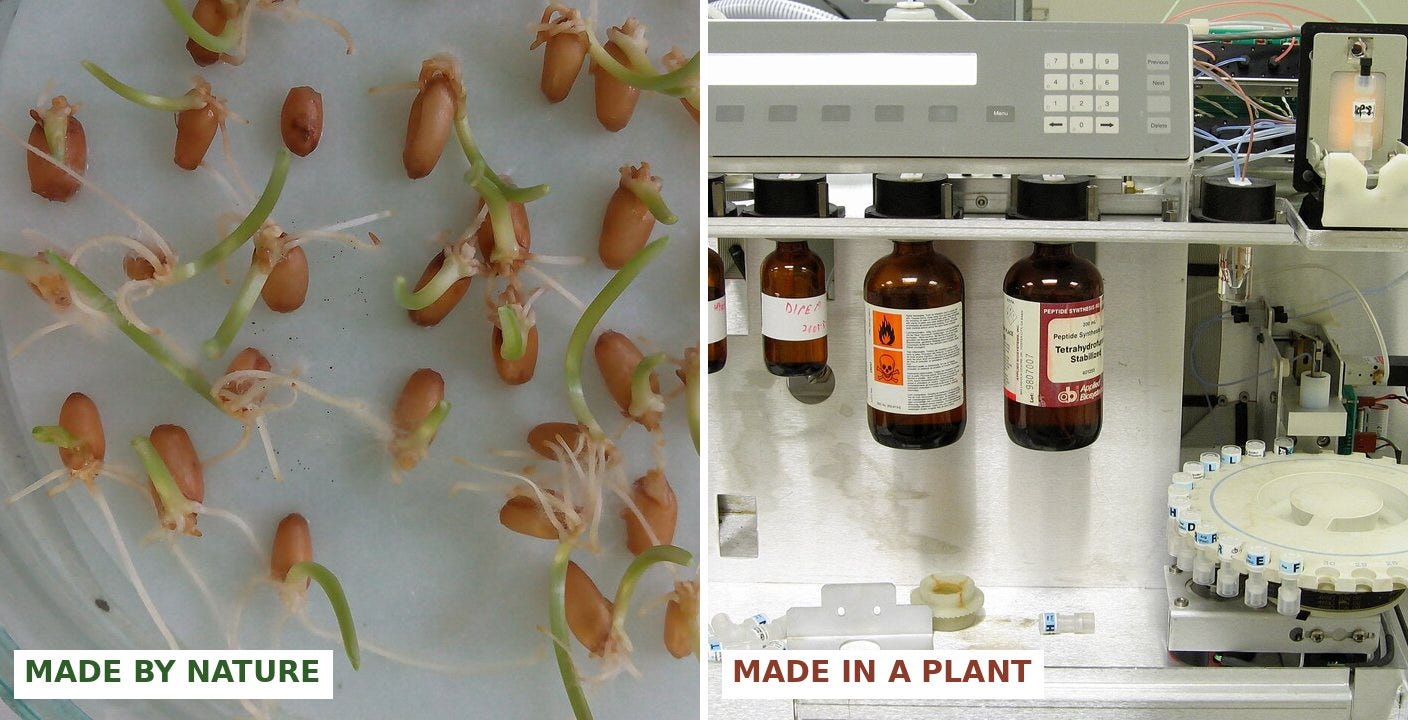
Peptides sound like nature. The ones sold in vials are built from industrial amino acids, coal-tar chemistry and a solvent Europe flags for reproductive harm. Here is the documented supply chain, and why the information they carry is not the same.
Share the X post dedicated to this article.
There is a word doing a great deal of work in the wellness world right now: peptide.
It sounds gentle. It sounds biological, like something your body already makes, something you might find in bone broth or a sprouting seed. Influencers lean into that. One of the best-known peptide sellers in the MAHA orbit told his followers, “Unlike synthetic pharmaceuticals, peptides are naturally recognized by your body” (CNN/AP).
Here is the problem. The word “peptide” names a natural class of molecules. Over 7,000 naturally occurring peptides had been identified by 2014, and your digestive system releases peptides from food every day (Nutrition Reviews). The products in the vials, BPC-157, TB-500, KPV, Semax, Epitalon, come from somewhere else entirely.
They come from a chemical plant.
For years I have argued that food is information. Read through the lens of that model, the documented record behind these vials matters a great deal. What follows traces it step by step, using the FDA’s own briefing documents, a USDA technical review, the U.S. EPA, the American Chemical Society and the peer-reviewed literature.
Food Is Information. So Is a Vial.
The idea is simple. Food is not just calories and building blocks. As I have written, food is “biological information,” a signaling system “that speaks directly to our genes, our microbiome, our immune intelligence, and our metabolic destiny” (GreenMedInfo).
Information has two dimensions. There is quantity: how much of a signal arrives, the dose. And there is quality: how faithful, complete and coherent that signal is, and what comes with it. A nutrient made by a living organism “is not merely an isolated molecule. It exists within a complex of enzymes, coenzymes, minerals, peptides, flavonoids, pigments, and countless other constituents that developed together inside a living organism. That biological context matters” (Sayer Ji).
The synthetic peptide industry deals almost entirely in quantity. It copies a short sequence, purifies it, and sells it by the milligram. Everything else, including the context, the provenance and the biological quality control, is left behind at the factory gate.
Two Ways to Make a Peptide
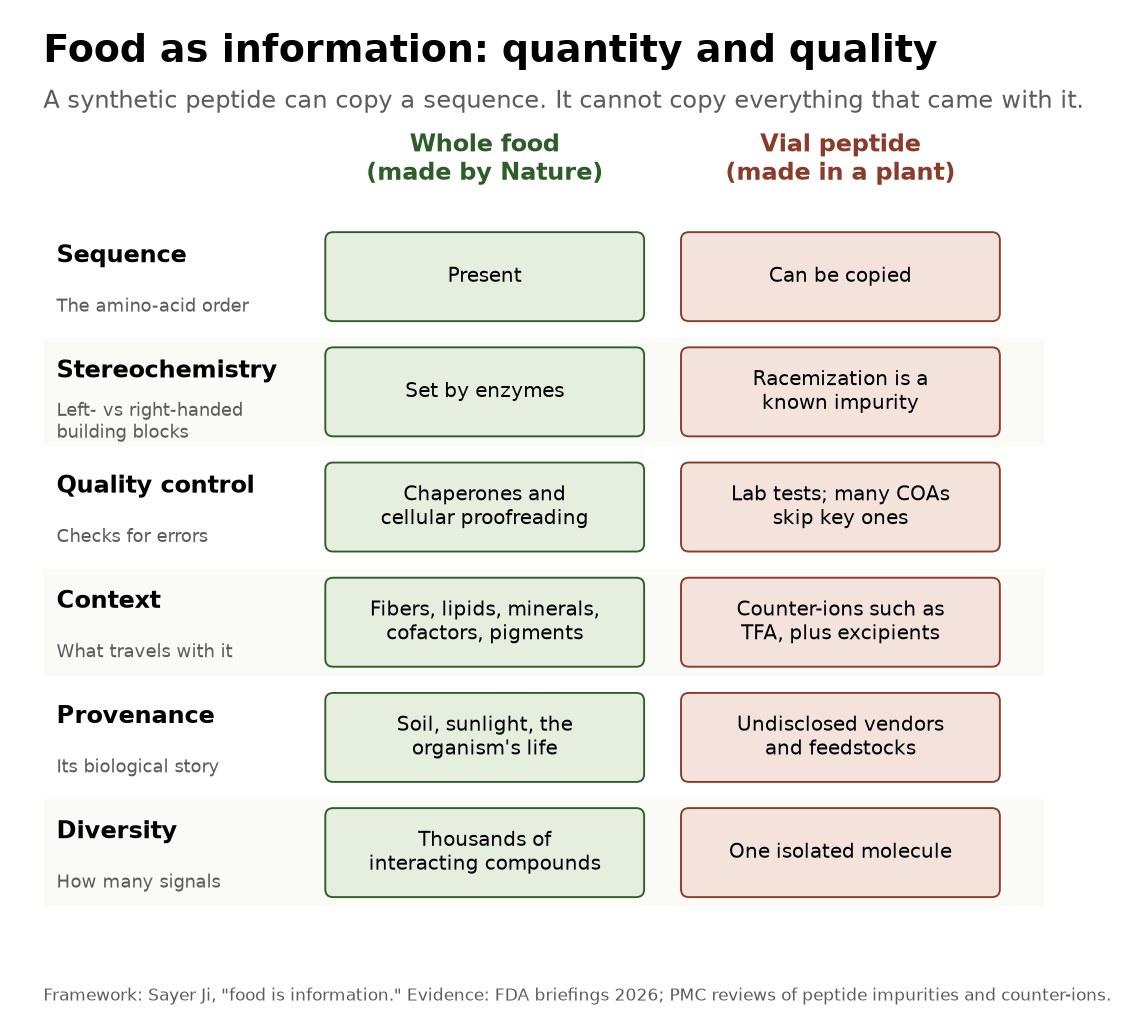
When a living cell makes a peptide, it follows a process biology spent billions of years refining.
The gene is read out by the ribosome. A built-in “zip code” in the new protein tells the cell where to send it, the discovery that won Günter Blobel the 1999 Nobel Prize: “proteins have intrinsic signals that govern their transport and localization in the cell” (Nobel Prize). Inside the cell’s protein-processing compartment, molecular chaperones help the chain fold correctly. That discovery earned Franz-Ulrich Hartl and Arthur Horwich the 2011 Lasker Award (Lasker Foundation). Quality-control systems “comprised of chaperones, folding enzymes, and degradation factors” inspect the work and destroy what fails (ER quality control review). Many active peptides are then cut out of a larger, inactive precursor and chemically finished by specialized enzymes before release (prohormone processing).
In food, those peptides arrive packaged. Casein phosphopeptides formed when milk protein is digested act as mineral carriers (Dairy Science & Technology). Wheat-sprout peptides travel in phospholipid–peptide complexes, natural packaging the researchers suggested may help explain their bioavailability (Journal of Peptide Science).
A vial peptide goes through none of this.
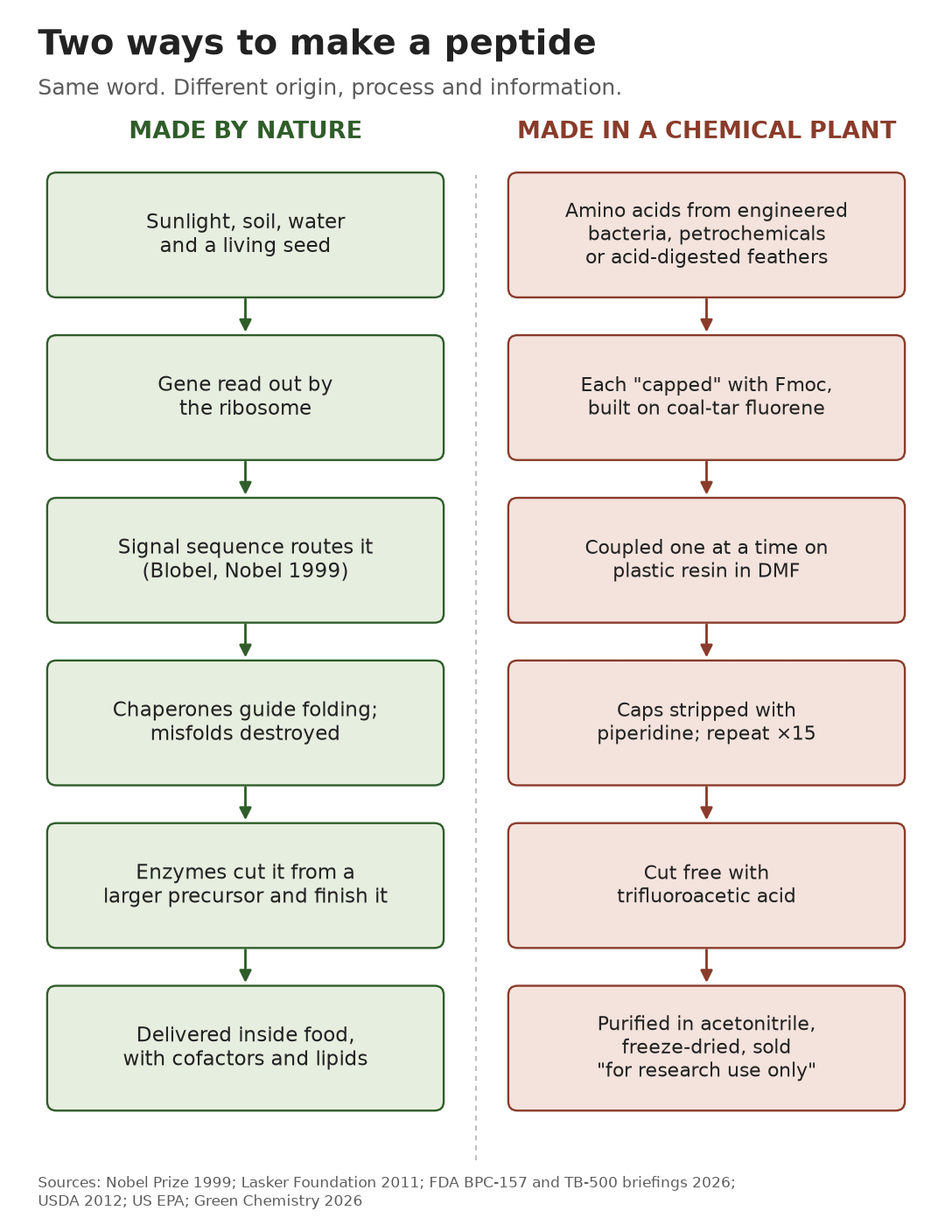
Technical callout: keeping the contrast precise. A protein’s amino-acid sequence ultimately determines its folded shape (The Cell, NCBI Bookshelf). Chaperones help proteins reach that shape and prevent clumping; they do not add new structural instructions. Very short peptides like KPV (3 amino acids) or TB-500 (7) barely fold at all. So the documented difference for these molecules is not a “missing fold.” It is the absence of biological quality control, precursor processing and food context, and the presence of synthesis impurities, leftover acid and uncertain stereochemistry.
Step One: Where the Amino Acids Come From
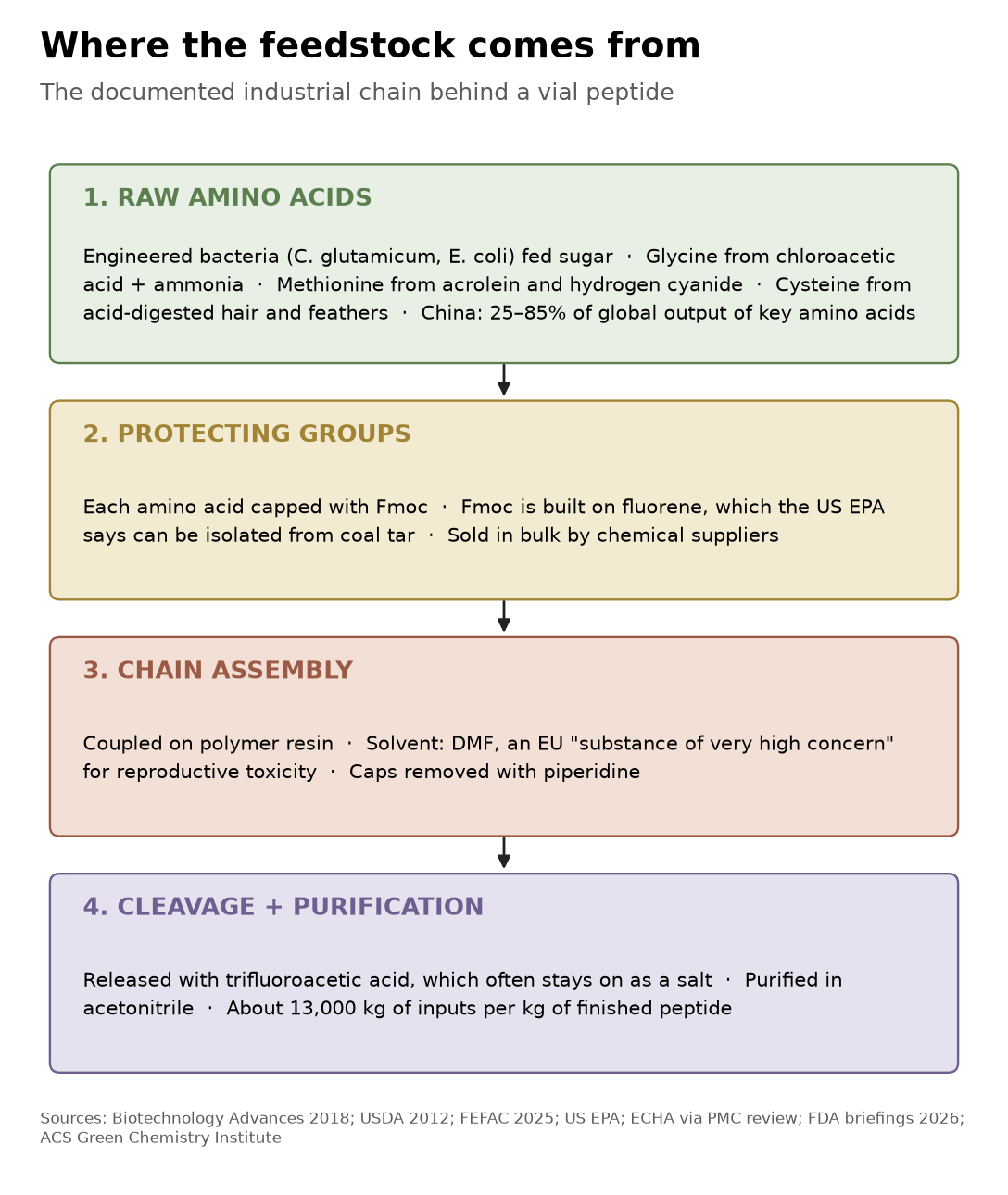
Every synthetic peptide starts as a pile of individual amino acids. The industry produces them in three main ways.
Engineered bacteria. Most amino acids are now made in fermentation tanks. A review in Biotechnology Advances explains that “fermentation with the aid of strains such as Corynebacterium glutamicum or Escherichia coli“ plays “a significant role in the industrial production of amino acids,” driven by “advances made in the genetic engineering techniques” (Biotechnology Advances).
Petrochemicals. Some are built from industrial chemicals. According to a USDA technical evaluation, DL-methionine is “usually produced entirely by chemical methods.” The documented routes include reacting acrolein with methyl mercaptan, and a process using “propylene, hydrogen sulfide, methane, and ammonia to make the intermediates acrolein, methylthiol, and hydrocyanic acid.” Hydrocyanic acid is hydrogen cyanide. The USDA’s conclusion is blunt: “the L-methionine produced from it is also synthetic” (USDA, 2012). Methionine is the first amino acid in both Semax and MOTS-c (FDA; FDA). Glycine, which appears three times in BPC-157, is mostly made commercially by reacting chloroacetic acid with ammonia (ChemicalBook; FDA).
Hair and feathers. Cysteine has long been extracted from keratin. A 2024 review describes the standard method: cystine “is extracted with activated charcoal after the acidic hydrolysis of feathers and hair,” then converted “via electrolytic reduction.” It calls this “the most common production method applied so far” (Microbial Cell Factories).
Much of this supply chain runs through one country. The European feed-industry federation reports that “China is the only country producing the 5 most essential amino acids, with a global market share between 25 and 85%” (FEFAC, 2025).

Step Two: The Coal-Tar Cap
You cannot simply stir amino acids together and get BPC-157. They would react at the wrong places. So each one is first fitted with a chemical “cap” called a protecting group. The industry standard is Fmoc, and the FDA’s own descriptions of how BPC-157 and TB-500 are made use it throughout (FDA BPC-157 briefing; FDA TB-500 briefing).
Fmoc is built on a molecule called fluorene. The U.S. EPA notes that fluorene “is a component of petroleum” and “can be isolated from coal tar by distillation and recrystallization” (U.S. EPA).
So before a single peptide bond forms, each “natural” building block has been chemically bonded to a coal-tar or petroleum-derived scaffold.
Step Three: Assembly on Plastic Beads
The chain is then built one amino acid at a time on insoluble polymer beads, a method called solid-phase peptide synthesis. It is a brilliant piece of chemistry, and it won Bruce Merrifield the 1984 Nobel Prize (Nobel Prize). It is also chemistry, not biology.
The FDA’s July 2026 briefing describes the original 1993 synthesis of BPC-157 in detail. Protected amino acids were added stepwise to “a polymeric carrier (benzhydrilaminoresin)” using “diisopropylcarbodiimide as the coupling reagent,” and at each step “the Fmoc protective group was removed with piperidine” (FDA). For TB-500, the FDA describes couplings with “HBTU activator” and “DIPEA base in a solvent such as DMF,” with caps removed using “20% (v/v) piperidine in DMF” (FDA).
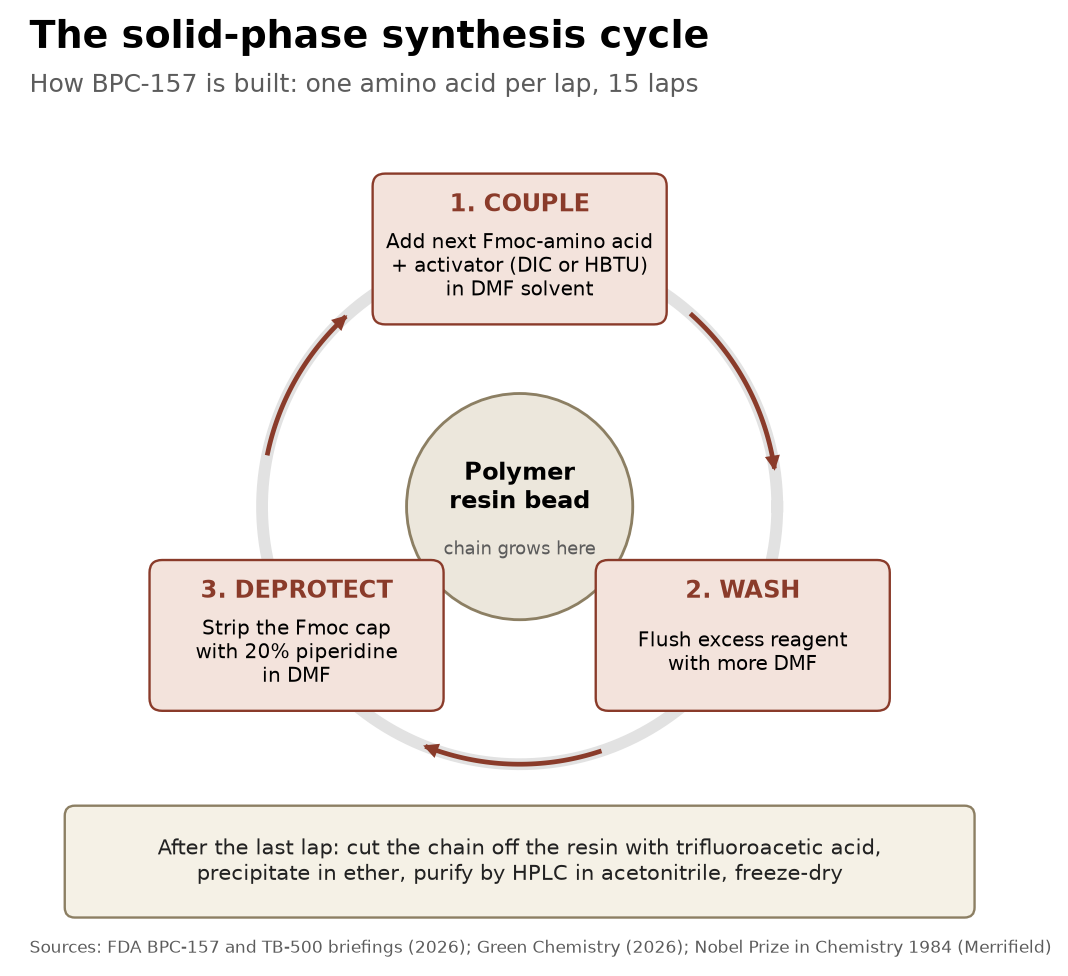
That solvent, DMF, deserves attention. A 2026 paper in Green Chemistry states that peptide synthesis “relies heavily on hazardous solvents, such as N,N′-dimethylformamide (DMF), whose substitution by green solvents is proving more challenging than expected” (Green Chemistry). The European Chemicals Agency lists DMF as a “substance of very high concern” because of “its reproductive toxicity” (PMC review). Its safety data sheet carries the hazard statement “May damage the unborn child” (Fisher Scientific SDS).
Technical callout: process is not product. Using DMF in manufacturing does not prove that a finished vial contains harmful residual DMF. Properly made pharmaceuticals are tested for residual solvents. The documented problem is that the testing is missing: the FDA found “no information about residual-solvent testing” for either form of BPC-157 in the nomination packages (FDA). For gray-market vials, the honest word is “untested,” not “contaminated.”
Step Four: Cut Free With Acid
When the chain is complete, it has to be released from the beads. The 1993 BPC-157 synthesis used “trifluoroacetic acid/trifluoromethanesulphonic acid/anisole,” followed by HPLC purification (FDA). A standard modern cleavage mix is 95% trifluoroacetic acid (Green Chemistry).
Some of that acid often stays in the product. Epitalon, for example, is sold mostly as a salt with “acetic acid or trifluoroacetic acid (TFA) counterions” (Epitalon review). Research on peptide counter-ions finds they can shift a peptide’s structure, and that the choice of counter-ion bears on toxicity risk (PMC review). Synthesis also leaves its own fingerprints. The FDA warns of “incomplete coupling reactions, truncations, or side reactions,” “isomeric impurities,” residual “solvents, coupling reagents, activators, catalysts, and scavengers,” and “peptide-related aggregates” (FDA). One recognized impurity is racemization: building blocks flipped into their mirror-image form (immunogenicity review).
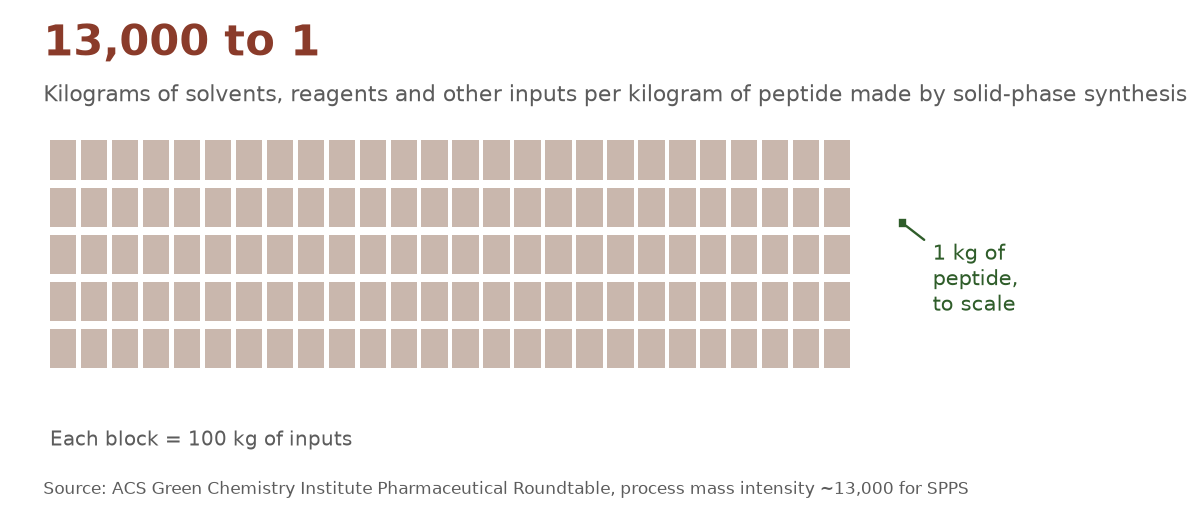
13,000 to 1
There is one more number worth knowing. The American Chemical Society’s Green Chemistry Institute reports that solid-phase peptide synthesis has a “Process Mass Intensity (PMI) of about 13,000—significantly higher than other modalities” (ACS GCI). In plain terms, about 13,000 kilograms of solvents, reagents and other inputs go in for every kilogram of peptide that comes out. Purification “generates astronomically large volumes of waste relative to the product yield” (ACS GCI).
Compare a tray of wheatgrass on a windowsill. Its inputs are sunlight, water, soil and a seed, and its “waste” is compost.
Nature’s Original Peptide: The Forgotten Aging Study That Cleared Cataracts in a Month

This year, peptides went mainstream.
Many Aren’t Natural Molecules at All
Set the factory aside for a moment. Many of the molecules themselves are not things Nature makes.
BPC-157 is a 15-amino-acid fragment of a larger gastric protein, first synthesized in Zagreb in the early 1990s (FDA). It was developed by the Croatian drug company Pliva under the code PL-14736 (PMC review). The U.S. government’s drug database calls it “a small, chemically synthesized pentadecapeptide” (NCATS). It is not a component of an approved product in any country (FDA).
TB-500 is a synthetic seven-amino-acid fragment of thymosin beta-4 with a chemical group added to one end (FDA).
Semax, in the FDA’s words, is “not a naturally occurring sequence” (FDA).
Epitalon is a synthetic tetrapeptide based on a cow pineal-gland extract. Its four amino acids allow eight mirror-image variants, and the FDA found “no clinical data to support safety in humans” (FDA; Epitalon review).
In other words, a great deal of the peptide gray market is selling fragments, analogs and shelved drug candidates as if they were nature’s own.
What Nature Actually Offers

None of this means peptides are bad. It means the source is the story.
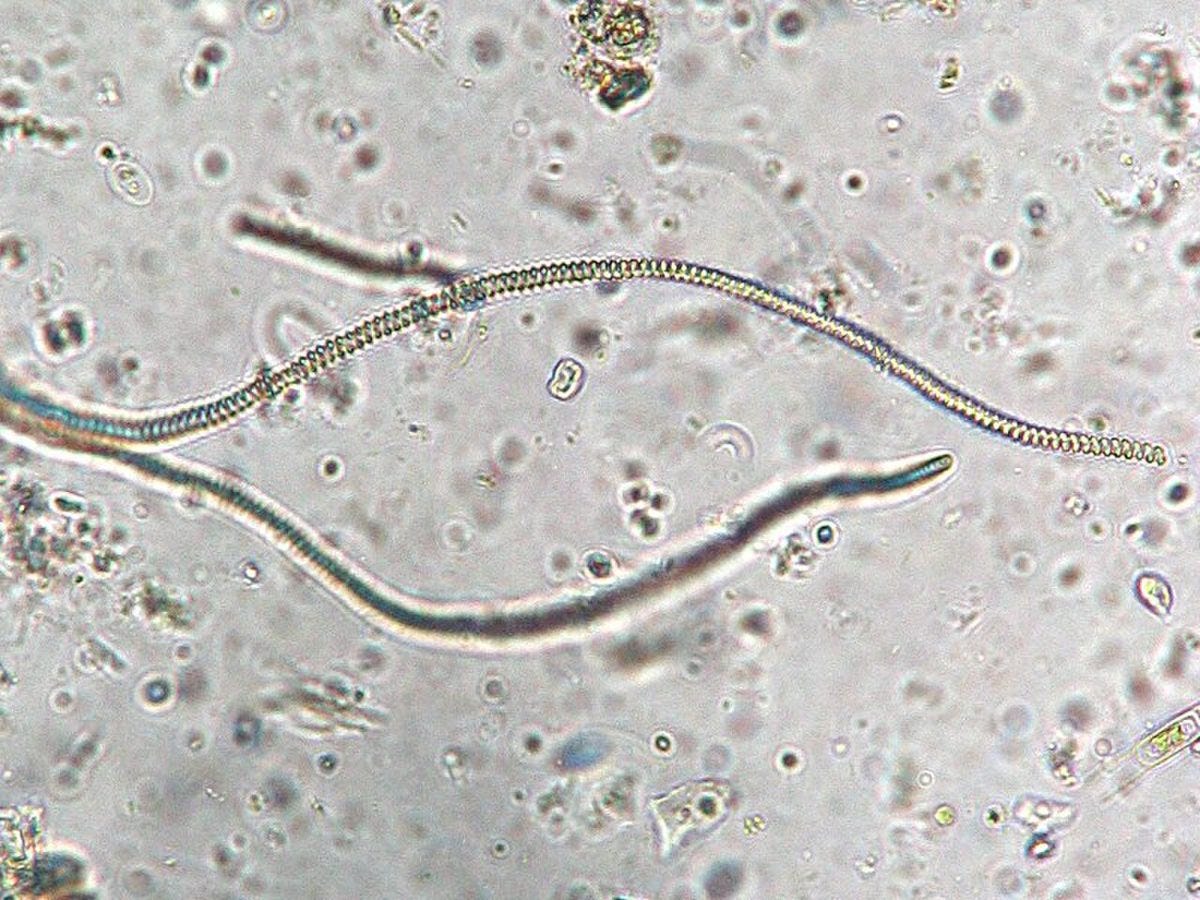
Food peptides are real and well studied. Researchers have purified an iron-binding peptide from spirulina protein (spirulina study). Peptides from milk, soy, eggs and sea cucumber have been shown to bind minerals (PMC review). The wheat-sprout research I wrote about recently came from an Italian group that went looking for the thymus’s regulatory peptides and found the same class of molecule in a sprouting grass (Calzuola et al., Peptides).
Precision matters here too. Many food-derived peptide products are made by breaking down food protein with enzymes, so “food-derived” is accurate but “untouched” often is not (Nutrients review). And not every “chelate” is natural: ferrous glycinate, a common mineral chelate, is manufactured “by reaction of reduced iron with glycine” (FAO/WHO JECFA). The line that matters is whether the information was written by a living system or assembled by a reactor.
What This Means
I support adults’ right to make informed choices about their own bodies. That is exactly why the labeling matters. “Informed” means knowing that a vial of BPC-157 is several industrial steps removed from any living food: amino acids made by engineered bacteria or petrochemical reactors, capped with a coal-tar-derived group, assembled in a reprotoxic solvent and cut free with trifluoroacetic acid.
It also means holding synthetic peptides to the evidence standard we demand of every other synthetic chemical. The FDA’s own scientists recommended against all seven peptides reviewed this summer, and four of the seven had no human safety studies at all (ITIF). A movement that rightly asks hard questions of pharmaceutical products cannot give chemical-plant peptides a pass because the word sounds green.
Peptides sound natural, and many are. Your body makes thousands of them. But the peptides in vials are chemical products. They may copy a sequence from biology, but they carry only the quantity of the signal, stripped of its quality.
Nature never makes a peptide alone. It routes it, folds it, inspects it, trims it, and delivers it inside a living matrix shaped by soil and sunlight. That is the difference between information and a copy of a single line of it.
If you want peptides, start where they have always come from: sprouts, greens, fermented foods and whole proteins. Let Nature do the chemistry.
Disclosure: I am the founder of GreenMedInfo and of Regenerate, a supplement company whose formulas use food-bound, peptide-chelated minerals and spirulina-derived ingredients. This article discusses the general science of food-derived versus synthetic peptides. It does not make claims about any Regenerate product, which require their own evidence.
Thank you for this valuable information! I have been trialing various peptides, including Mot C, Semax, selank and tirzepitide. But during this trial, I found that my heart rate at night went up and my HRV went down. It was enough to make me stop the peptides. It’s interesting that so many respected influencers in the space promote peptides.
Thank you for your information. I will pass it along to those who are using peptides.. I have no desire to use peptides...I am into nature and aware mankind lived eons of time without all the products that are available today. I am healthier and more active today than when I was thirty, because I primarily eat natural unprocessed food and do as little cooking as possible. I used to use many supplements; and have cut back immensely with good results. I also hold my hands over everything I eat and ask our Creator to bless it, because I know it really needs a blessing.today, the world is so contaminated. In 1980, I met the healthiest 50 year old man that I had ever seen...and wanted to know his secret. He was into eating raw fruit and vegetables, since he was 16,. In addition, he held his hands over his food and asked our Creator to bless it., I started to do the same 46 years ago.