

Why is everyone taking it?
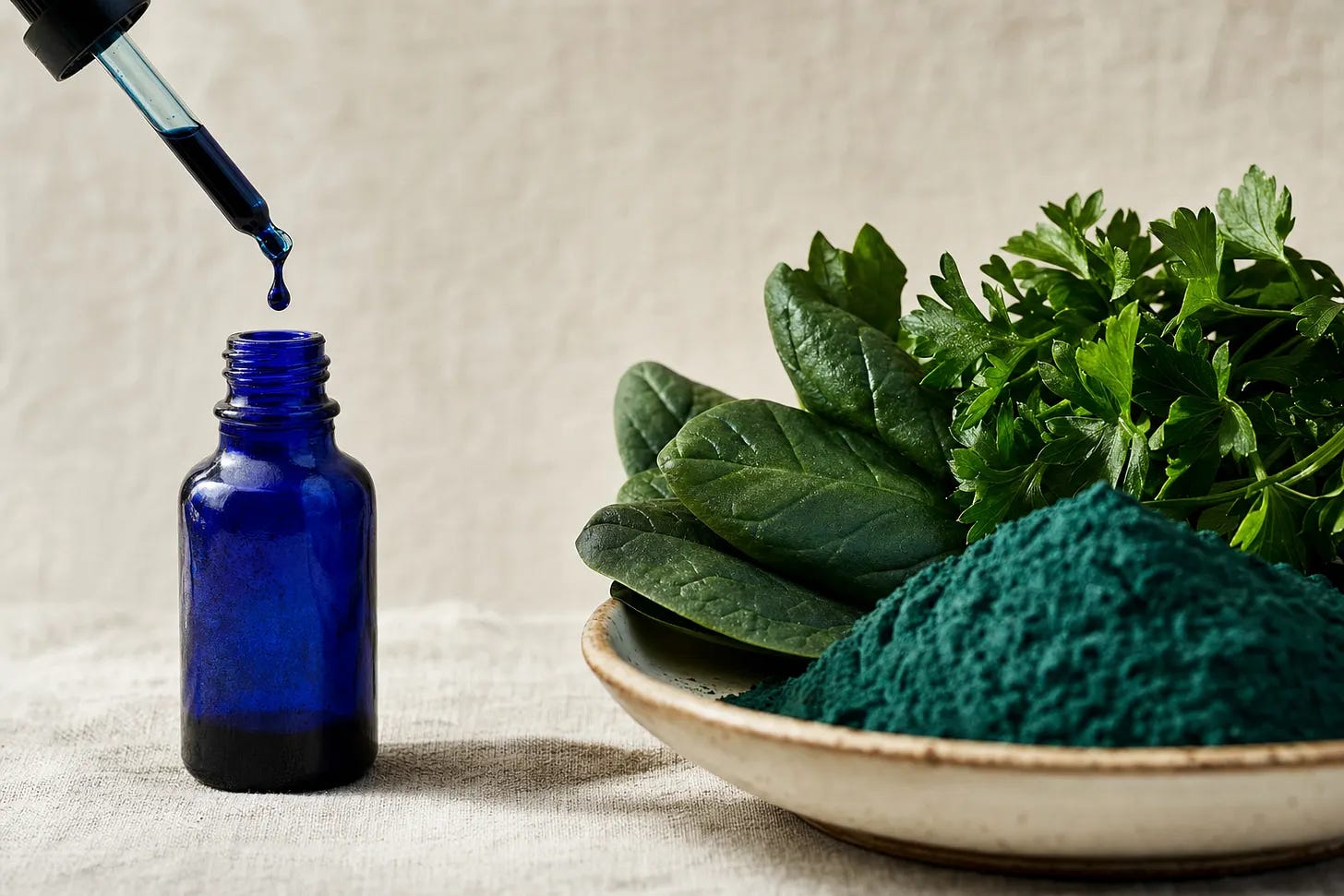
If you have spent any time in wellness circles this year, you have seen the dropper bottles of electric-blue liquid. Methylene blue has become one of the most talked-about energy and focus products online.
Its history is older than the trend. A German chemist, Heinrich Caro, first made it in 1876 as a dye for cotton. Paul Ehrlich later used it against malaria, which made it one of the first synthetic substances used to treat an infectious disease.1 Today it is an FDA-approved prescription drug for a rare blood disorder called acquired methemoglobinemia.2
The energy interest comes from real biochemistry. Your cells produce energy in the mitochondria by passing electrons down a chain of proteins. In laboratory studies, methylene blue can carry electrons around damaged links in that chain, which is why researchers have studied it for brain aging and neurodegeneration.3,4 That is a genuine mechanism, and it explains the excitement. But it’s not the whole story. In fact, in my chapter on the topic in REGNERATE I go into alternative pathways for cellular bioenergetics, including light-harvesting mechanisms, none of which conventional medicine yet acknowledges (but should).
So, is it good for you?
The honest answer is that nobody has shown it is, for everyday energy in healthy people. Four things are worth knowing before you try it.
The evidence is early. Most of the research on methylene blue and mitochondria comes from cells and animals. Whether a few drops under the tongue raise energy in a healthy adult is a different question, and it has not been answered well.3
It has a real drug interaction. In 2011 the FDA warned that methylene blue can cause serotonin syndrome in people taking certain antidepressants, including SSRIs and SNRIs, because it blocks an enzyme that breaks down serotonin.5 Most reported cases involved intravenous doses during surgery, not supplement drops.6 Still, if you take one of these medications, talk to your prescriber first.
Its legal status is murky. The FDA lists methylene blue as a prescription drug, and NPR reported last December that it is not clear it even qualifies as a dietary supplement.7
You may not know what is in the bottle. Without consistent oversight, purity and dose depend entirely on the seller.7
None of this makes methylene blue worthless. It makes it a drug, with a drug’s trade-offs, being sold as a daily tonic.
Why are you tired in the first place?
The more useful question sits underneath the trend. Why do so many people feel more tired now than they used to?
Most quick fixes act on the feeling of tiredness, not its source. Caffeine, for example, works mainly by blocking adenosine, the signal that builds up the longer you are awake.8 The signal goes quiet for a while. The machinery that makes energy is unchanged.
That machinery depends on many parts working together: mitochondria, the B vitamins that run your energy and methylation pathways, minerals such as magnesium, sleep, and the overall load of stress.
Fatigue can also point to something that needs a diagnosis, such as thyroid disease, anemia, sleep apnea, depression, or low vitamin B12. If your tiredness is new, getting worse, or has no obvious cause, start with your clinician. And then there are psychospiritual causes which no vitamin, drug, or substance of any kind can resolve on its own — and which should be treated with the same level of concern as the other strictly physiological causes.
A different approach, and what I created

Methylene blue tries to push electrons around a weak link in the energy chain. My instinct runs the other way: give the body the nutrients its own energy pathways already depend on, in forms it can use, and let its intelligence do the rest.
That is the idea behind MethylateBLUE™, which we formulated at Regenerate. It combines:
Active B vitamins. Riboflavin-5’-phosphate (B2), pyridoxal-5’-phosphate (B6), L-5-methyltetrahydrofolate (folate), and methylcobalamin (B12). These are forms the body does not have to convert first, which may matter for the estimated 10 to 15 percent of people of European descent, and more than 25 percent of Hispanic people, who carry two copies of the MTHFR C677T variant.9
Supporting minerals and nicotinamide. Peptide-bound magnesium, zinc, selenium, other trace minerals, and fermented nicotinamide (a form of B3).
A different blue. Organic blue spirulina extract, rich in phycocyanin. Spirulina has a long record as food: Spanish chroniclers described the Aztecs harvesting it from Lake Texcoco and selling it in cakes at market.10 The blue pigment is also a light-harvesting molecule, similar to chlorophyll-a, which is a unique property which may be associated with some of its known benefits.

To be clear about the evidence: these ingredients have been studied individually, and the finished formula has not been tested in a clinical trial. Phycocyanin’s anti-fatigue findings come mostly from animal studies,11 and one small human trial found spirulina raised hemoglobin without improving cycling performance.12 Phycocyanin has been tested at about 1 gram a day for two weeks without changes in blood clotting markers.13 What I can say is that the formula is built to support the system rather than override it, and that every ingredient in it is a nutrient or a food.*

*These statements have not been evaluated by the Food and Drug Administration. This product is not intended to diagnose, treat, cure, or prevent any disease.
Want to go deeper?
Dr. Joel Bohemier and I will walk through all of this live and take your questions.
Friday, October 30, 2026 · 1:00 PM ET
Free to attend · Live Q&A

For more reading on methylene blue, read my previous articles on the topic:
The Methylene Blue Mistake: How a 19th-Century Textile Dye Became a “Mitochondrial Medicine”
The Blue Brain Effect: Methylene Blue’s Dark Side & What You Should Be Using Instead
Synthetic Methylene Blues: When Biohackers Choose Petroleum Over Plants
For more reading on phycocyanin, read my previous article on this remarkable plant pigment.
Notes
Operation Supplement Safety, Methylene Blue: Ingredient Overview and Prohibited Status.
Alternative mitochondrial electron transfer for the treatment of neurodegenerative diseases and cancers: Methylene blue connects the dots, Prog Neurobiol 2017;157:273-291.
Xue H, Thaivalappil A, Cao K. The Potentials of Methylene Blue as an Anti-Aging Drug, Cells 2021.
NPR, What’s behind the wellness claims for the synthetic dye methylene blue?, December 15, 2025.
Adenosine, caffeine, and sleep-wake regulation: state of the science and perspectives.
NCBI Bookshelf, MTHFR variant information.
Mexico News Daily, Spirulina, or ‘Aztec cheese,’ is Mexico’s pre-Hispanic superfood.
Puengpan S, et al. Phycocyanin attenuates skeletal muscle damage and fatigue in exercise-induced oxidative stress in rats, PLoS ONE 2024.
Ali Y, Aubeeluck R, Gurney T. Fourteen-Days Spirulina Supplementation Increases Hemoglobin, but Does Not Provide Ergogenic Benefit in Recreationally Active Cyclists, J Diet Suppl 2023.
Clinical Safety of a High Dose of Phycocyanin-Enriched Aqueous Extract from Arthrospira platensis, J Med Food 2016;19(7):645-653.
I WAS taking it. For Long Covid symptoms. It made things worse. I would crash after taking it but it took me awhile to figure that out.
"Why is everyone taking it?" I don't know ANYONE who is taking it out of about 100 people.
"Why are you tired?" Maybe age has something to do with it. Ask yourself that question when you are 77 years old.
MB may have little or no effect on younger healthy adults. But something happens to the body when you hit mid-to-late 60's even if you're healthy, you eat right, you supplement where appropriate, you exercise, both for endurance and strength, you do everything you can to optimize sleep. And that "something" gets worse and more pronounced as you move into the 70's and mid-to-late 70's.
MB seems to have a more noticeable effect on exercise performance in people who are mid-60's or older or people who are younger with mitochondrial dysfunction. Younger healthy people--especially those whose health includes good mitochondrial health--will likely not notice a positive effect when they take MB and therefore shouldn't take it.
People older than 65 will probably notice a benefit in terms of exercise performance and/or mental acuity. Should they take it? Totally up to them. Plenty of research out there to indicate that at very low doses, 2 to 10 mg, it's not harmful and may be noticeably beneficial. However, because there are no long term studies it's probably prudent to not take it every day, maybe take it just occasionally.