

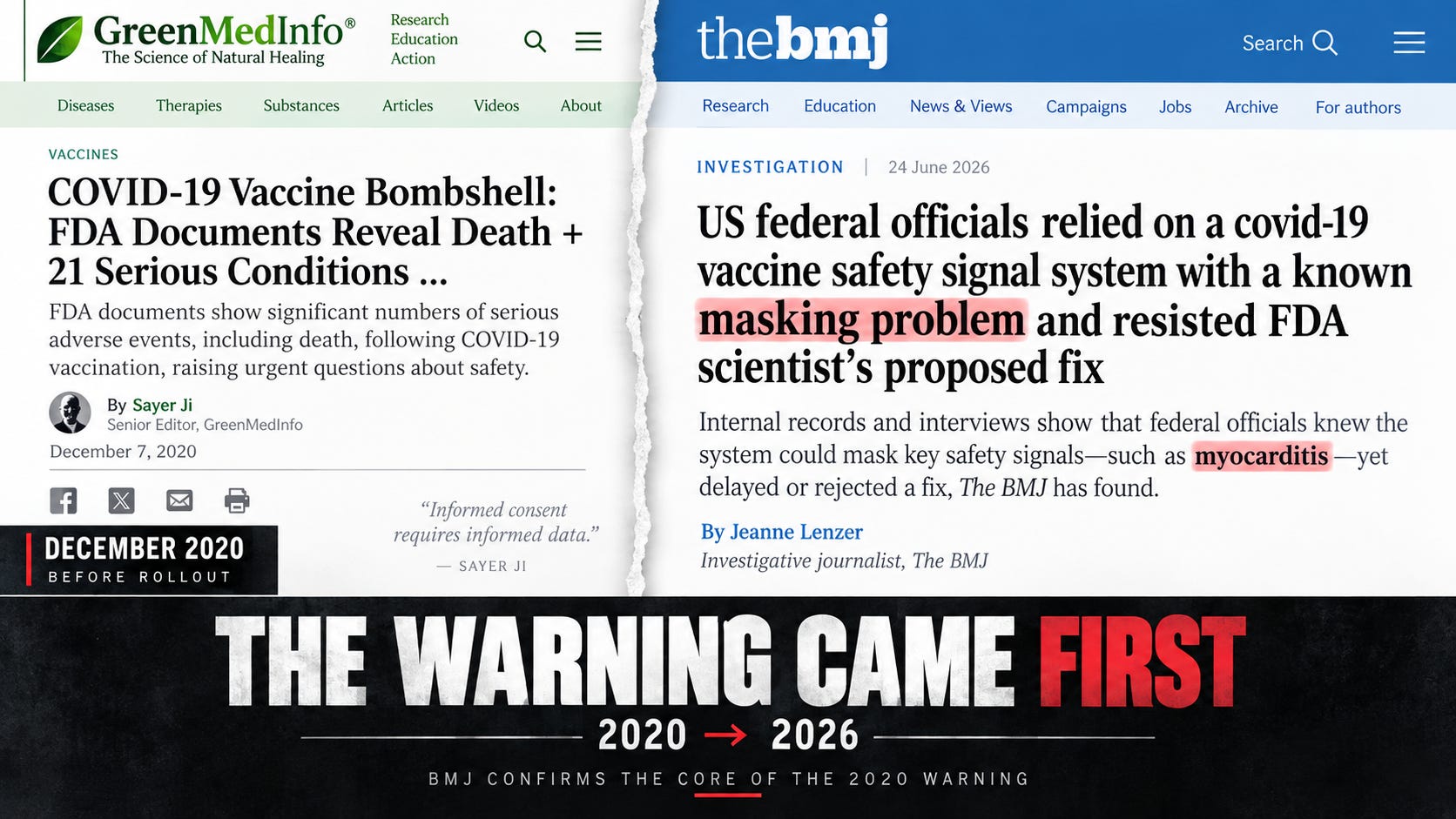
Before the first COVID shot, I warned that FDA’s own safety watchlist made rigorous post-market surveillance indispensable. We now know a key detection system had a documented blind spot. We also know senior officials were worrying about what safety caution would do to “public confidence”—and Meta records show pressure to restrict even true side-effect information. This is the record that changes the story.


On December 7, 2020—before the first COVID-19 vaccine was administered in the United States—I published an article centered on a slide the FDA had presented to its vaccine advisory committee weeks earlier.1
The slide was extraordinary. Under the heading “DRAFT Working list of possible adverse event outcomes”, FDA listed Guillain-Barré syndrome, anaphylaxis, acute myocardial infarction, myocarditis/pericarditis, thrombocytopenia, venous thromboembolism, pregnancy and birth outcomes, autoimmune disease, deaths, and other serious conditions it intended to monitor after COVID vaccination.2
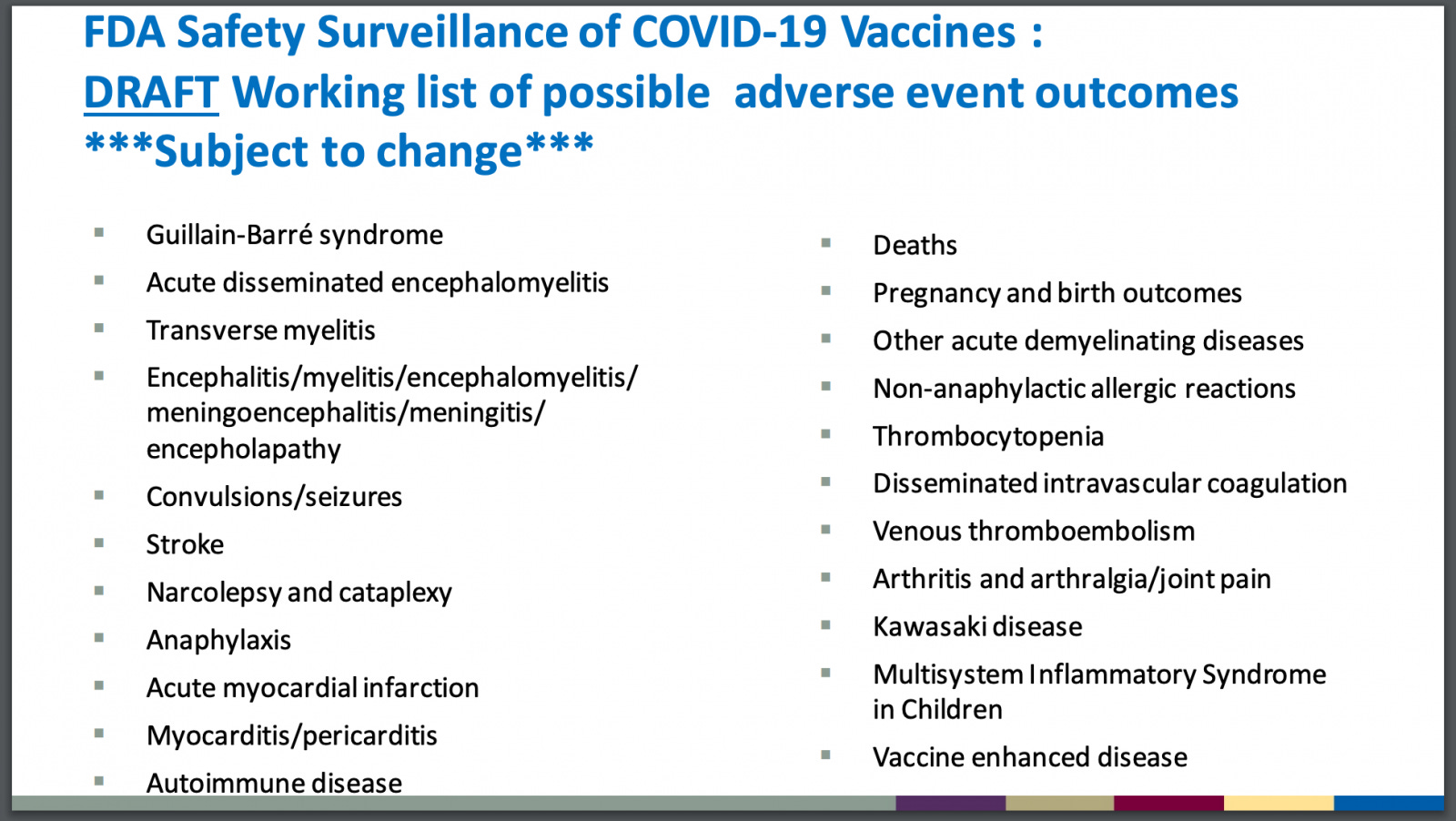
That distinction matters. The FDA slide did not establish that COVID vaccines caused every condition on the list. It established something different: regulators themselves understood that serious safety questions would have to be watched for and resolved after authorization, in the real world, at population scale.
Post-market surveillance was not peripheral to the safety case. It was the safety net.
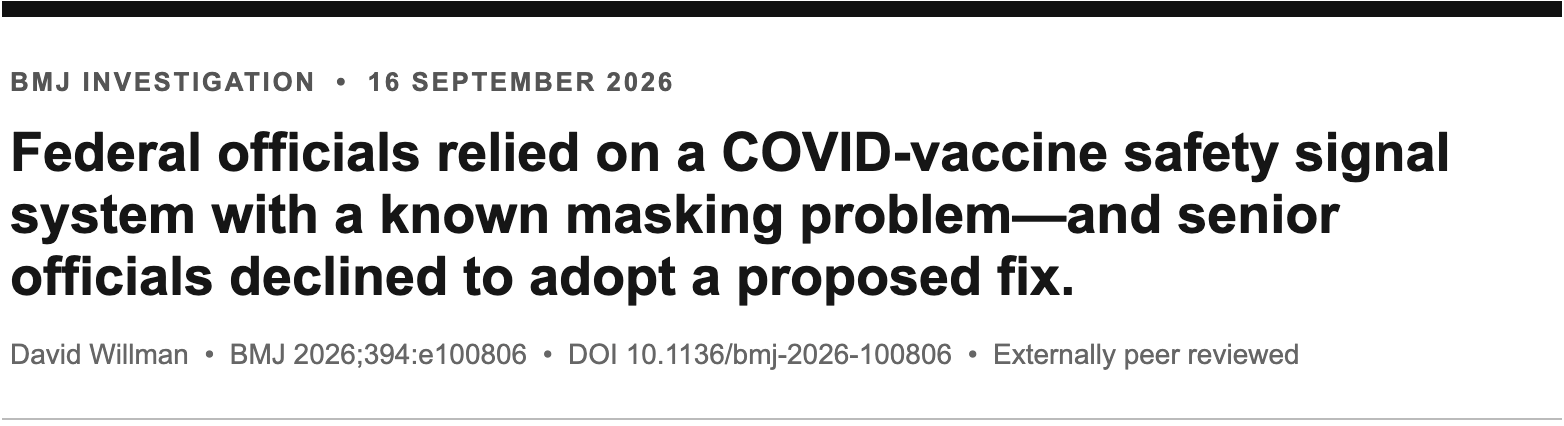
That is why a new investigation from The BMJ, published September 16, 2026, changes the retrospective record so dramatically.3
What The BMJ found
The CDC had originally planned to use two complementary statistical approaches to scan VAERS for emerging safety problems: proportional reporting ratios, or PRRs, and an empirical Bayesian data-mining method supplied by FDA. But according to the records reconstructed by The BMJ, CDC did not begin its PRR analyses until 2022. During the critical first year of rollout, both agencies relied heavily on the FDA’s Bayesian approach.3
The problem was masking. COVID vaccine reports rapidly dominated the VAERS database. When two heavily reported vaccines—Pfizer and Moderna—were both associated with the same type of report, each could inflate the statistical background against which the other was compared. A genuine signal could therefore be weakened, delayed, or disappear below the alert threshold.
The BMJ reports that FDA officials were warned internally about this limitation in early 2021, that CDC officials were also informed, and that officials nevertheless continued relying on the compromised method while the absence of automated signals was used in public reassurance.3 The BMJ Group’s summary says the algorithm failed to alert for myocarditis, pericarditis, Bell’s palsy, tinnitus, and other reported disorders because of the methodological flaw.4
This does not prove that every statistical signal represented a vaccine-caused injury. Pharmacovigilance signals are hypotheses requiring investigation, not diagnoses of causality. But that is precisely the point: if the early-warning system is losing sensitivity, then “we found no signal” cannot carry the same evidentiary weight as “a functioning system looked and found no signal.”
Myocarditis closes the loop
Myocarditis provides the cleanest test of what I was warning about in 2020 because the entire arc can now be reconstructed.
October 22, 2020: FDA places myocarditis/pericarditis on its draft post-authorization surveillance list.2
December 7, 2020: I publish the FDA list and argue that serious potential outcomes make rigorous post-market surveillance essential.1
February–April 2021: According to The BMJ, US officials receive myocarditis warnings from Israel and then hear of a cluster among US military personnel.3
Spring 2021: Federal officials publicly say they have looked for a myocarditis signal and have not seen one. Internally, a CDC official later writes that he is “perplexed” the condition is not alerting in the statistical system.3
2021 onward: FDA adds myocarditis/pericarditis warnings to mRNA vaccine labeling. FDA’s 2025 update states that myocarditis/pericarditis safety information has been included in the labeling since 2021.7
Today: CDC states that evidence from multiple safety-monitoring systems supports a causal association between mRNA COVID-19 vaccines and myocarditis/pericarditis, with the highest observed frequency in adolescent and young adult males.6
That is not merely an adverse event appearing on a speculative list. It is a watched outcome that later became a recognized causal vaccine adverse effect—and one the government’s principal automated method failed to flag at a critical point in the rollout.
The Warning Was Fact-Checked Before the First American Received the Shot
There is another part of this history that deserves to be revisited.
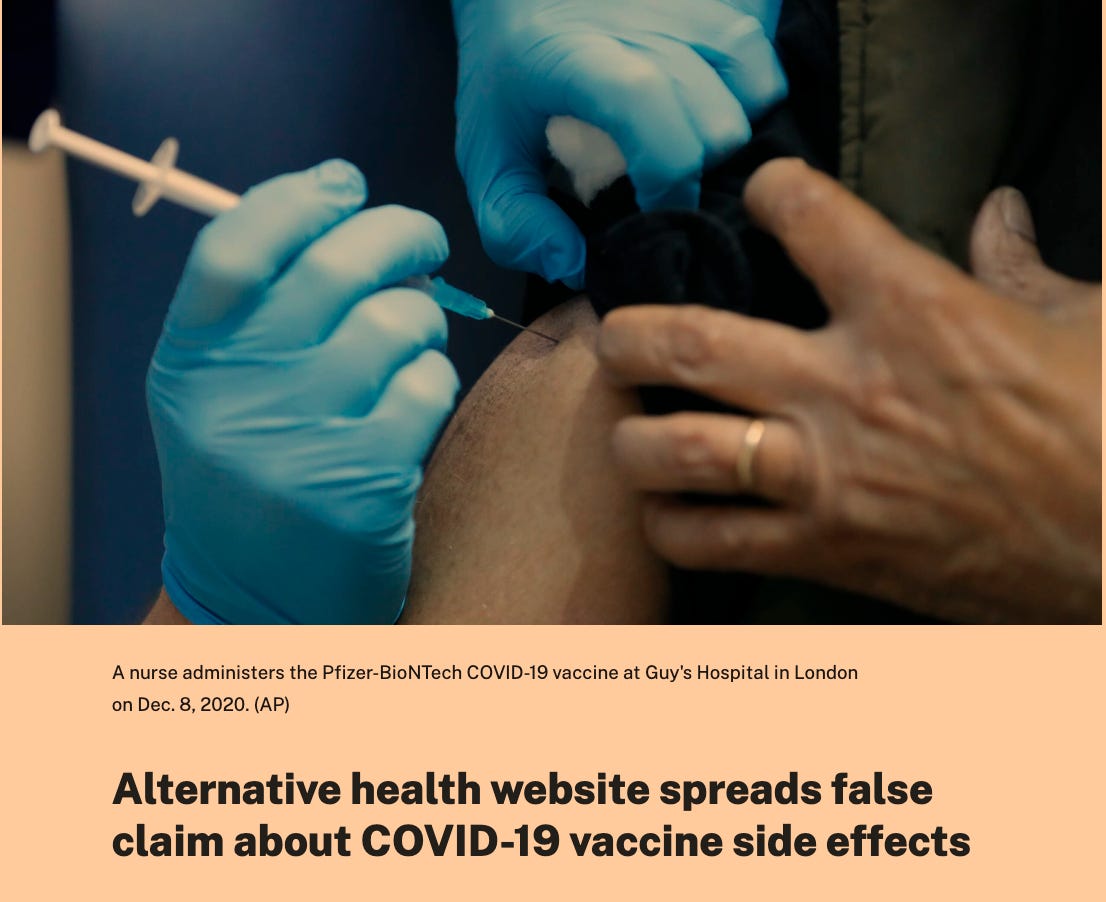
Two days after I published my warning, PolitiFact labeled it “Mostly False.”
On December 9, 2020, PolitiFact published an article headlined “Alternative health website spreads false claim about COVID-19 vaccine side effects.”
The claim it evaluated was taken directly from my article:
“The FDA knows that rushed-to-market COVID-19 vaccines may cause a wide range of life-threatening side effects, including death.”
PolitiFact acknowledged that the FDA document was real. It acknowledged that the agency’s slide contained a “working list of possible adverse event outcomes” and that the list included serious conditions and death.
Its objection was that these were possible outcomes FDA intended to monitor—not adverse effects FDA had already established were caused by the vaccines.
That distinction was legitimate.
Indeed, with six years of hindsight, I would make the same distinction more explicitly myself.
But look at what happened next.
PolitiFact’s article did not simply clarify the language. It branded the warning “Mostly False” and presented my reporting under a headline saying GreenMedInfo was spreading a false claim about vaccine side effects.
And PolitiFact disclosed something even more consequential:
My article had been flagged through Facebook’s misinformation enforcement system.
This occurred on December 9, 2020.
The first American outside a clinical trial would not receive a COVID-19 vaccination until December 14.
In other words, before post-market surveillance had even begun in the United States, a warning about the importance of that surveillance was already being treated as misinformation.
Six years later, read the fact-check again
One item on the FDA list I published was:
Myocarditis / Pericarditis.
At the time, it was only an outcome to monitor.
That is precisely why surveillance mattered.
Today, CDC states that evidence from multiple safety-monitoring systems supports a causal association between mRNA COVID-19 vaccination and myocarditis and pericarditis.
FDA says warnings about myocarditis and pericarditis have appeared in mRNA vaccine labeling since 2021.
And now The BMJ reports that the federal statistical system being relied upon during the rollout failed to alert for myocarditis because of the very masking problem FDA scientists had identified internally.
Put those facts beside the December 2020 fact-check.
The issue is not that PolitiFact should somehow have known in December 2020 that myocarditis would eventually be established as a causal adverse effect.
Nobody could responsibly have claimed that from the FDA slide alone.
The problem is the opposite.
The uncertainty was real.
That was why the FDA created the watchlist.
That was why post-market surveillance mattered.
And that was why treating a warning about those unresolved possibilities as “false” before the surveillance process had even begun was epistemically backwards.
The appropriate answer in December 2020 was not:
“False.”
It was:
“We don’t know yet. These are outcomes FDA intends to monitor, and rigorous surveillance will be necessary to determine whether any become genuine safety signals.”
That is, in substance, the argument I was making.
The label did not stay inside a fact-check
The consequences extended far beyond one article.
The Center for Countering Digital Hate later identified me as one of its so-called “Disinformation Dozen.”
In the dossier section devoted specifically to me, CCDH used this very claim as evidence:
An article on GreenMedInfo.com “falsely claimed” that the FDA knew COVID vaccines might cause serious adverse effects, including death.
That allegation would subsequently appear in material submitted to the United States Congress.
So the chronology now looks very different:
October 2020: FDA identifies myocarditis/pericarditis and other serious outcomes for post-market surveillance.
December 7, 2020: I publish the FDA document and sound the alarm about the need for rigorous safety monitoring.
December 9, 2020: PolitiFact rates the warning “Mostly False,” and the article enters Facebook’s misinformation-enforcement ecosystem.
December 14, 2020: the U.S. mass vaccination program begins.
2021: myocarditis emerges as a safety concern and FDA adds warnings.
2021: the federal signal-detection system nevertheless fails to alert for myocarditis.
2021: CCDH publicly labels my reporting false and uses it as part of the case for identifying me as one of the “Disinformation Dozen.”
2026: The BMJ reveals that officials knew the surveillance methodology had a masking problem capable of obscuring adverse-event signals.
That is a very different history from the one Americans were given in 2020 and 2021.
And it raises a question far larger than whether one fact-check deserves a correction:
What happens when institutions charged with determining what is “misinformation” become more certain than the scientific evidence itself?
The purpose of pharmacovigilance is to preserve uncertainty long enough to discover the truth.
Once uncertainty itself becomes punishable speech, the safety system acquires a second blind spot—one no statistical algorithm can correct.
The phrase that changes the story: “damaging to public confidence”
The BMJ investigation is not the only newly visible documentary record from early 2021. In August 2026, Senators Ron Johnson and Rand Paul released government-device text messages among Anthony Fauci, Rochelle Walensky, and Vivek Murthy from January 25–26, 2021.12
The context matters. Pregnant women had been excluded from the pivotal vaccine trials. In the messages, Walensky described the pregnancy evidence base at that moment as essentially data-free; Fauci raised a theoretical first-trimester concern involving fever and inflammatory responses after dose two; Murthy called the point useful. None of that established that the vaccine caused miscarriage—and later studies did not show an increased miscarriage risk. I examined that distinction at length in my August 2026 investigation, “Damaging to Public Confidence.”13
What matters here is what happened the next day. Murthy circulated the WHO’s cautious position on Moderna vaccination during pregnancy, which at that time rested on limited direct pregnancy data. His private reaction was revealing:

Vivek Murthy, in a text-message exchange released by Sens. Ron Johnson and Rand Paul. View the four-page primary-source release.
That sentence should not be made to prove more than it does. It does not prove that Murthy knew of a vaccine injury and hid it. It does not prove that WHO changed its position because Washington pressured it. And because subsequent evidence did not show an elevated miscarriage risk, pregnancy is not the example on which a vaccine-injury case should rest.
But the text does document an institutional instinct that is relevant to the BMJ story: an unresolved safety-policy disagreement was being evaluated partly through the lens of what it might do to public confidence.
Companion investigation: “Damaging to Public Confidence” reconstructs the Fauci–Murthy–Walensky texts, explains exactly what they prove and what they do not, and shows why the strongest case is the one that refuses bad statistics.
Six months later, “public confidence” became an information-control problem
By July 2021, the concern was no longer confined to how officials talked among themselves. Subpoenaed Meta records filed in federal litigation show government pressure over what users were allowed to encounter on social media.
An internal Facebook policy memorandum summarized one request this way:

The remainder of the sentence concerned side-effect posts that did not include contextual information about rarity and treatability; Meta wrote that it did not recommend adopting the removal policy. The same document says Meta was already labeling such content and demoting some of it. See the primary-source exhibit, p. 109.14
This distinction is essential. The government’s argument was not necessarily that a reported side effect was fabricated. It was that a true anecdote could still mislead if stripped of prevalence and risk-benefit context. That is a legitimate communications concern in the abstract. The constitutional and informed-consent question is what happens when the remedy becomes removal or algorithmic suppression of truthful speech rather than adding context, answering it, or allowing scientific disagreement to remain visible.
The same Meta document records discussion of vaccine-negative material that did not violate Facebook’s misinformation rules. It notes that some content was being demoted even though it was not false.14
That matters enormously when placed beside the BMJ investigation. The federal health system had an unresolved problem detecting certain adverse-event signals; yet elsewhere in that same system, officials were pushing platforms to reduce the reach of safety-related information—including information the platform itself regarded as true.
And then the government targeted the “Disinformation Dozen”
This is where the history intersects directly with me.
On July 15, 2021, Surgeon General Murthy issued his health-misinformation advisory. That same week, the White House publicly elevated the Center for Countering Digital Hate’s “Disinformation Dozen” report. I was one of the twelve people named.
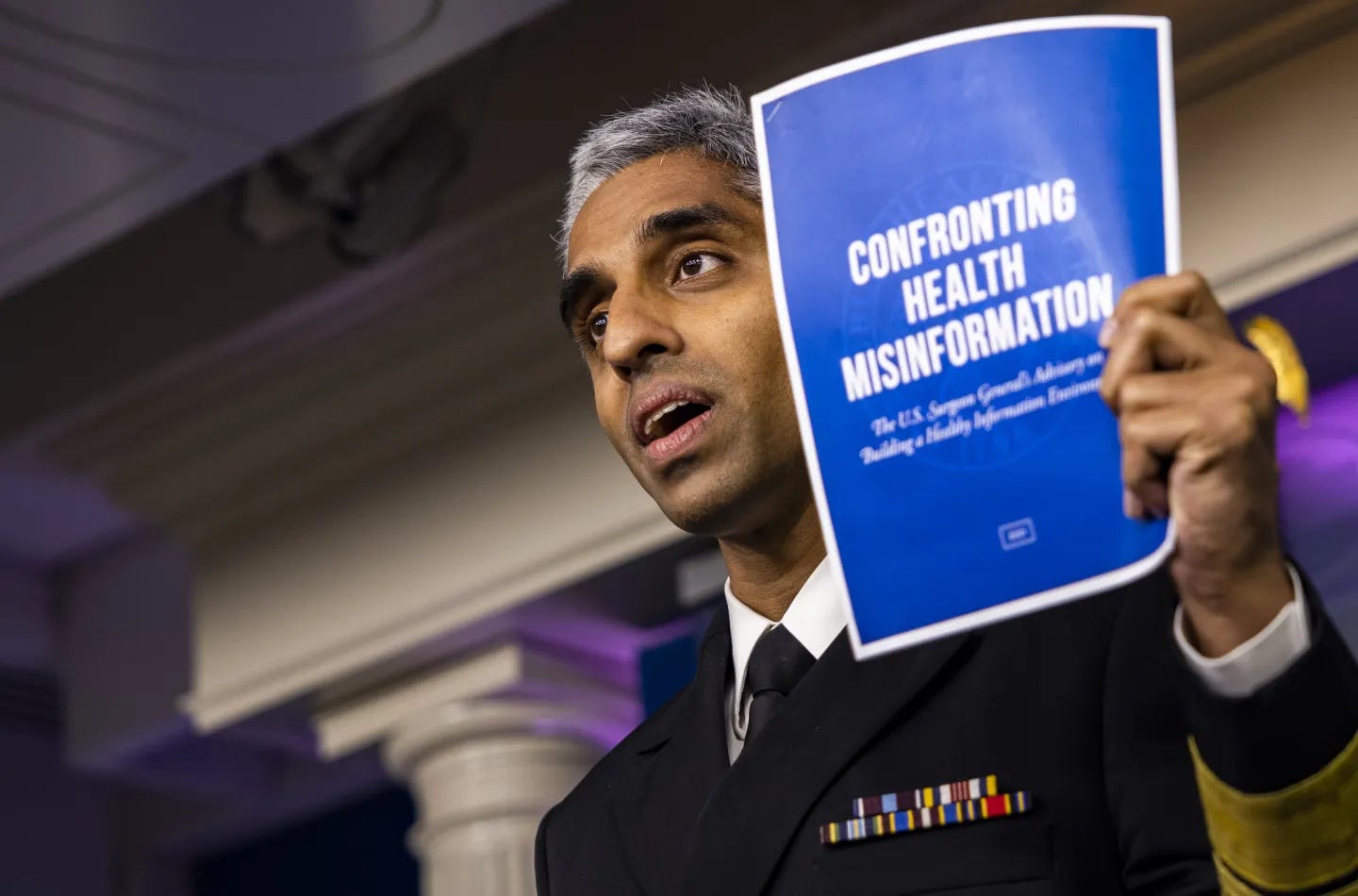
The later Fifth Circuit record is significant. In Missouri v. Biden, the court described Facebook beginning to remove information posted by the “disinfo dozen” despite the platform’s earlier representations that those users were not violating its policies.15
The legal history requires precision. In 2023 the Fifth Circuit held, at the preliminary-injunction stage, that certain White House and Surgeon General conduct likely amounted to coercion or significant encouragement. In 2024, the Supreme Court reversed because the plaintiffs had not established standing to seek an injunction; the Court began and ended its analysis with standing rather than affirming the Fifth Circuit’s merits determination.16
Earlier investigation: “Truth, Reconciliation, and the Surgeon General’s Cover-Up of Vaccine Injuries” documents the censorship timeline and the federal records concerning true side-effect information.
Three tracks, one historical problem
Put the records side by side and the story becomes more serious than a defective algorithm:
Detection: FDA’s own watchlist acknowledged that serious outcomes would need post-market surveillance. The BMJ now reports that a principal safety-signal method had a known masking problem and failed to alert for myocarditis.
Confidence: senior public-health officials were explicitly considering how caution and uncertainty might affect “public confidence” while key evidence was still developing.
Information control: Meta records show pressure from the Surgeon General’s office concerning even true side-effect information, while other non-false vaccine-negative content was being demoted.
Those tracks are documented. What has not been established is a single centrally coordinated plan in which the officials responsible for FDA pharmacovigilance secretly directed the Surgeon General’s social-media pressure campaign. I have not seen evidence that proves that connective allegation, and I will not invent it.
When does institutional failure become a cover-up?
“Cover-up” is a serious word. Used carelessly, it lets institutions evade the documentary evidence by arguing about rhetoric. So the better approach is to define the threshold and show the record.
A mere technical failure is not a cover-up.
A known technical failure that is actively investigated and candidly disclosed is not a cover-up.
But if decision-makers know a safety system can miss signals, decline a proposed correction, continue invoking the absence of those signals as reassurance, and simultaneously pressure information intermediaries over truthful safety information because of its effect on confidence, the question of concealment becomes unavoidable.
The available documents establish important pieces of that sequence. They do not, standing alone, prove every element of an intentional, centrally coordinated cover-up. But they make the weaker explanation—we simply did not know—much harder to sustain.
The historical issue is no longer just whether officials made mistakes. It is whether preserving confidence became more important than preserving the public’s ability to see uncertainty, emerging signals, and truthful adverse-event information in real time.
The masking problem was published in the scientific literature years ago
The most striking part of the story is that the masking problem did not remain an internal allegation.
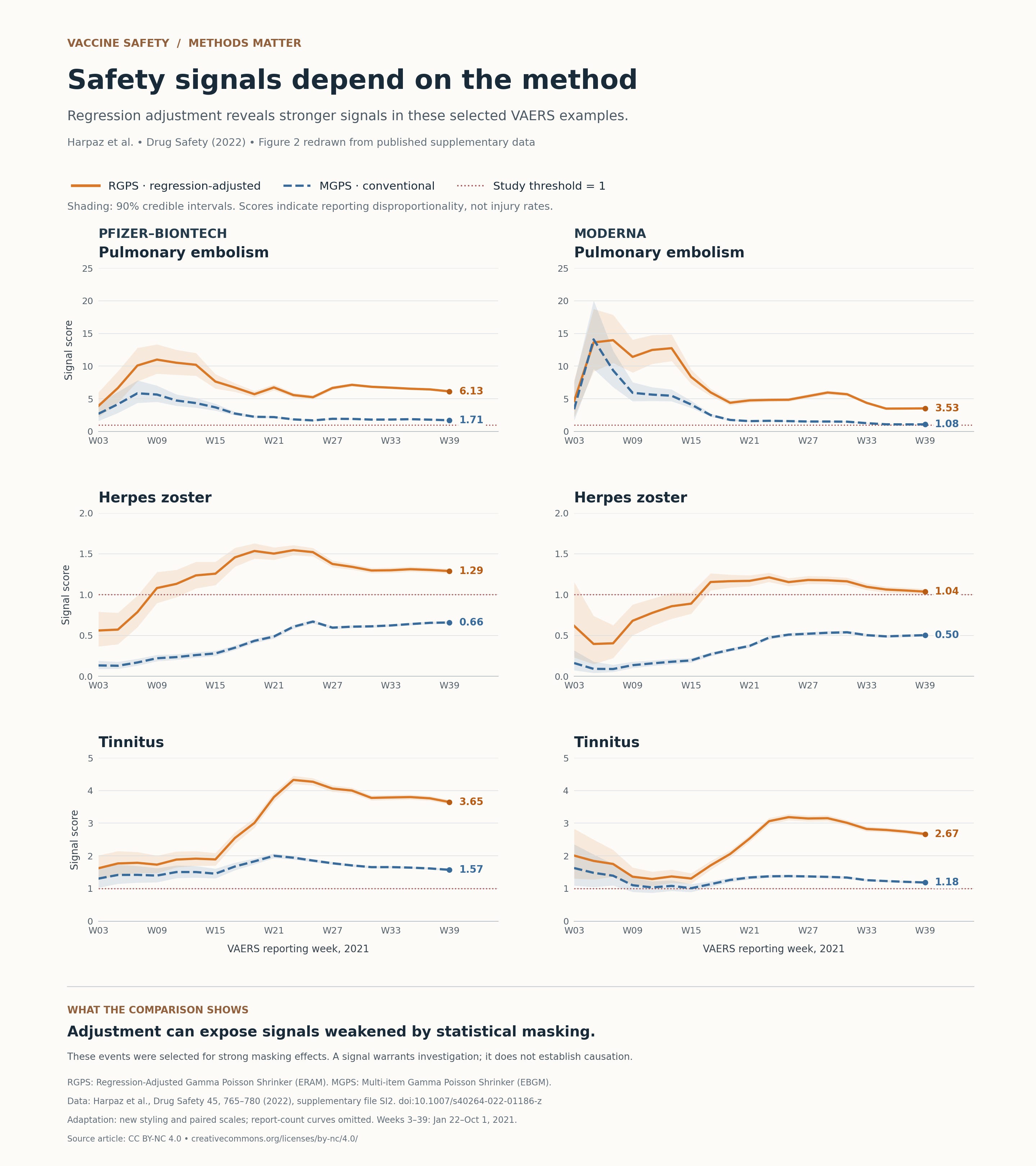
In 2022, Rave Harpaz, William DuMouchel, Robbert Van Manen, FDA medical officer Ana Szarfman, and colleagues published a peer-reviewed paper in Drug Safety examining COVID-19 vaccine signal detection using VAERS-derived data.5 Their conclusion was straightforward: under the extraordinary reporting conditions created by the COVID rollout, commonly used methods could cause adverse-event signals to be undetected or delayed, and a regression-adjusted approach could partially correct the problem.
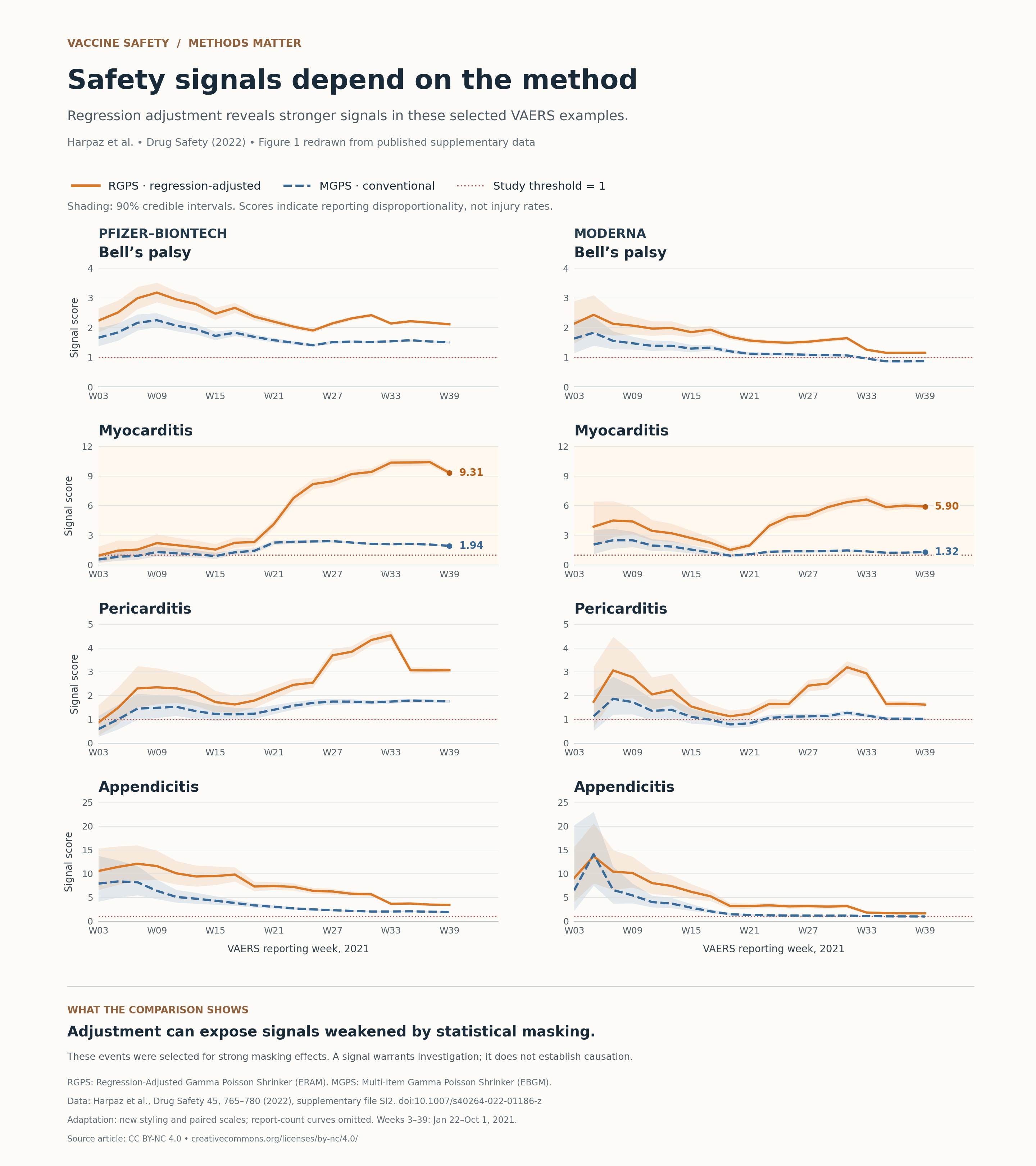
For myocarditis, the authors calculated an average masking-effect size of about 190% for Pfizer and 196% for Moderna under their defined metric.5 Those percentages are not estimates of increased medical risk; they describe how much the statistical signal could be suppressed by the masking phenomenon.
The paper also demonstrated the mechanism directly: Pfizer reports could mask Moderna’s myocarditis signal, and Moderna reports could mask Pfizer’s. When influential competing reports were removed, the proportional reporting ratios rose sharply.5
Then another country-level study reproduced the masking problem
The issue is not confined to VAERS.
In January 2026, researchers from the University of Groningen, the Netherlands Pharmacovigilance Centre Lareb, and Spain’s medicines regulator published an open-access study examining masking in two national pharmacovigilance databases.8 They concluded that the high volume of COVID-19 vaccine reporting produced substantial masking in both databases.
Depending on the unmasking method, the researchers uncovered 1,301 or 1,942 previously masked signals of disproportionate reporting in the Dutch database, and 1,453 or 1,226 in the Spanish database. Smaller subsets involved “important medical events.”8
This is critical: thousands of “unmasked signals” do not mean thousands of proven vaccine injuries. They mean the statistical landscape changes materially when masking is corrected. That independently validates the methodological concern at the center of the BMJ investigation.
Several exact items on the 2020 FDA list later became recognized vaccine risks
Again, the FDA’s 2020 slide was a watchlist, not a causality list. But the retrospective record is still significant because several of its named outcomes later became recognized, product-specific vaccine risks.
FDA’s October 2020 watchlistWhat later became establishedMyocarditis / pericarditisCDC says multiple monitoring systems support a causal association with mRNA COVID-19 vaccination; FDA labeling carries the warning.67Thrombocytopenia + venous thromboembolismCDC concluded the evidence supports a causal relationship between thrombosis with thrombocytopenia syndrome (TTS) and the Janssen vaccine.9Guillain-Barré syndromeCDC surveillance found evidence of increased GBS risk after Janssen vaccination, but not after the Pfizer or Moderna mRNA products.10AnaphylaxisRare anaphylaxis was detected immediately after rollout; CDC/FDA documented it and adapted observation and treatment guidance.11
This does not mean all of the FDA’s 2020 watchlist conditions were ultimately caused by vaccination. They were not. It means the basic premise behind the watchlist was valid: rare but serious risks would emerge, if at all, only after exposure at population scale—and the ability to detect them quickly mattered.
And then there is “death”
My December 2020 headline called particular attention to the fact that deaths appeared on FDA’s surveillance list.12
The BMJ now reports that, in July 2021, Szarfman raised an internal mortality signal generated by the alternative analysis she and DuMouchel were developing.3 That is noteworthy because it shows that changing the analytical method could surface high-consequence signals the standard approach did not.
But a mortality signal in a spontaneous-report database is not proof that the vaccines increased all-cause mortality. It is a signal requiring validation using stronger epidemiologic designs, exposure denominators, medical-record review, and control for background mortality and confounding.
The intellectually defensible point is therefore more specific—and more important: the very system intended to decide which possible harms deserved urgent follow-up could itself fail to alert.
What I would change about my 2020 wording
There is one sentence in my original article I would make more precise today.
I wrote that the FDA “knows” the vaccines may cause the listed outcomes. That phrasing can be read as though FDA had already established a causal relationship with every item. There is no evidence, as of yet, that was the case. The underlying document was explicitly labeled a draft working list of possible adverse event outcomes for surveillance.2
If I were writing that sentence today, I would say:
Before authorization, FDA had already identified death and a range of serious medical outcomes as events requiring active post-market surveillance because safety questions would remain after rollout.
That correction does not weaken the central argument. In light of the evidence now available, it strengthens it.
So: was the warning vindicated?
On the central proposition, yes.
Before rollout, I warned that FDA itself was preparing to monitor death and serious adverse outcomes and that the credibility of the safety case therefore depended on rigorous post-market detection. Several exact categories on the watchlist later became recognized, product-specific vaccine risks. Myocarditis—one of the clearest—was not initially flagged by the principal automated method. Peer-reviewed work later demonstrated how masking could suppress signals, and a 2026 European analysis found substantial masking in two national pharmacovigilance databases.
But the new record goes beyond the algorithm. We now also know that senior officials were openly considering the effect of safety caution on public confidence, and that Meta recorded pressure from the Surgeon General’s office concerning truthful side-effect information. Meanwhile, a federal appeals court later documented that Facebook began removing content from members of the “Disinformation Dozen” after previously indicating they were not violating platform policies.
That does not validate every claim made about COVID vaccines in the last six years. It does not transform every VAERS report into a confirmed injury. It does not prove that every condition on FDA’s 2020 watchlist was vaccine-caused. And it does not prove that every official involved shared a common intent.
It vindicates something more foundational:
We were right to insist that uncertainty be visible, that post-market surveillance be independently interrogated, and that truthful safety information never be subordinated to a campaign to preserve confidence.
The most disturbing fact is no longer simply that an alarm failed.
It is that, while the alarm was failing, the institutions charged with protecting the public were also debating how much uncertainty and adverse-event information the public should be allowed to hear.
That is the question a real truth-and-reconciliation process would have to confront.
Endnotes & primary sources
Ji S. “COVID-19 Vaccine Bombshell: FDA Documents Reveal DEATH + 21 Serious Conditions As Possible Adverse Outcomes.” GreenMedInfo, Dec. 7, 2020. Original article. ↩
FDA / CBER. “Plans for Monitoring COVID-19 Vaccine Safety and Effectiveness,” Vaccines and Related Biological Products Advisory Committee, Oct. 22, 2020. See the “DRAFT Working list of possible adverse event outcomes” and the near-real-time surveillance slides. FDA PDF. ↩
Willman D. BMJ investigation of the US COVID-19 vaccine safety signal algorithm. BMJ. 2026;394:e100806. DOI: 10.1136/bmj-2026-100806. BMJ article. ↩
BMJ Group. Press summary of the investigation, including the methodological findings and external peer-review status, Sept. 16, 2026. BMJ Group summary. ↩
Harpaz R, DuMouchel W, Van Manen R, et al. “Signaling COVID-19 Vaccine Adverse Events.” Drug Safety. 2022;45:765–780. PMID 35737293. DOI: 10.1007/s40264-022-01186-z. PubMed · Full text. ↩
CDC. “Clinical Considerations: Myocarditis and Pericarditis after Receipt of COVID-19 Vaccines.” CDC states that evidence from multiple monitoring systems supports a causal association between mRNA vaccination and myocarditis/pericarditis. CDC. ↩
FDA. “FDA Approves Required Updated Warning in Labeling of mRNA COVID-19 Vaccines Regarding Myocarditis and Pericarditis Following Vaccination,” June 25, 2025. FDA safety communication. ↩
Rachwal O, Gutiérrez-Lobón M, Sols Cueto N, et al. “Evaluating COVID-19 Vaccine Masking and Unmasking Methods in Two National Pharmacovigilance Databases.” Drug Safety. 2026;49:581–590. PMID 41501319. DOI: 10.1007/s40264-025-01644-4. PubMed · Full text. ↩
CDC / MMWR. Updated Janssen vaccine recommendations, Dec. 2021. CDC states that the evidence supports a causal relationship between TTS and Janssen vaccination. MMWR. ↩
CDC. COVID-19 vaccine safety / Guillain-Barré syndrome. CDC reports an increased GBS risk after Janssen vaccination but not after Pfizer-BioNTech or Moderna vaccination. CDC vaccine safety page. ↩
CDC / FDA. “Allergic Reactions Including Anaphylaxis After Receipt of the First Dose of Pfizer-BioNTech COVID-19 Vaccine,” MMWR, Jan. 15, 2021. MMWR. ↩
Johnson R, Paul R. Released text-message exchange among Anthony Fauci, Rochelle Walensky, and Vivek Murthy, Jan. 25–26, 2021; publicly released Aug. 2026. Primary-source PDF. ↩
Ji S. “Damaging to Public Confidence.” Sayer Ji’s Substack, Aug. 13, 2026. The article analyzes the released Fauci–Murthy–Walensky texts, including the pregnancy-data limitations and later evidence. Read the investigation. ↩
Internal Meta/Facebook materials reproduced in an amici filing in Missouri v. Biden, No. 23-30445. The July 2021 policy memo records the Surgeon General request concerning true side-effect information and Meta’s recommendation against removal. Primary-source exhibit, p. 109. ↩
U.S. Court of Appeals for the Fifth Circuit. Missouri v. Biden, No. 23-30445, Sept. 8, 2023. The opinion discusses government-platform communications and Facebook’s treatment of the “disinfo dozen.” Court opinion. ↩
Supreme Court of the United States. Murthy v. Missouri, 603 U.S. ___ (2024), decided June 26, 2024. The Court held that the plaintiffs lacked standing to seek the injunction and did not affirm the Fifth Circuit’s merits holding. Supreme Court opinion. ↩
I smelled a rat from the start
Sayer Ji has become globally recognized thanks to pHARMa's smear campaign. I was following him from the start. I knew better than to buy into the mainscream media hype. I trusted him and I hope he knows how many lives he may have saved thanks to his speaking up, no holds barred.