

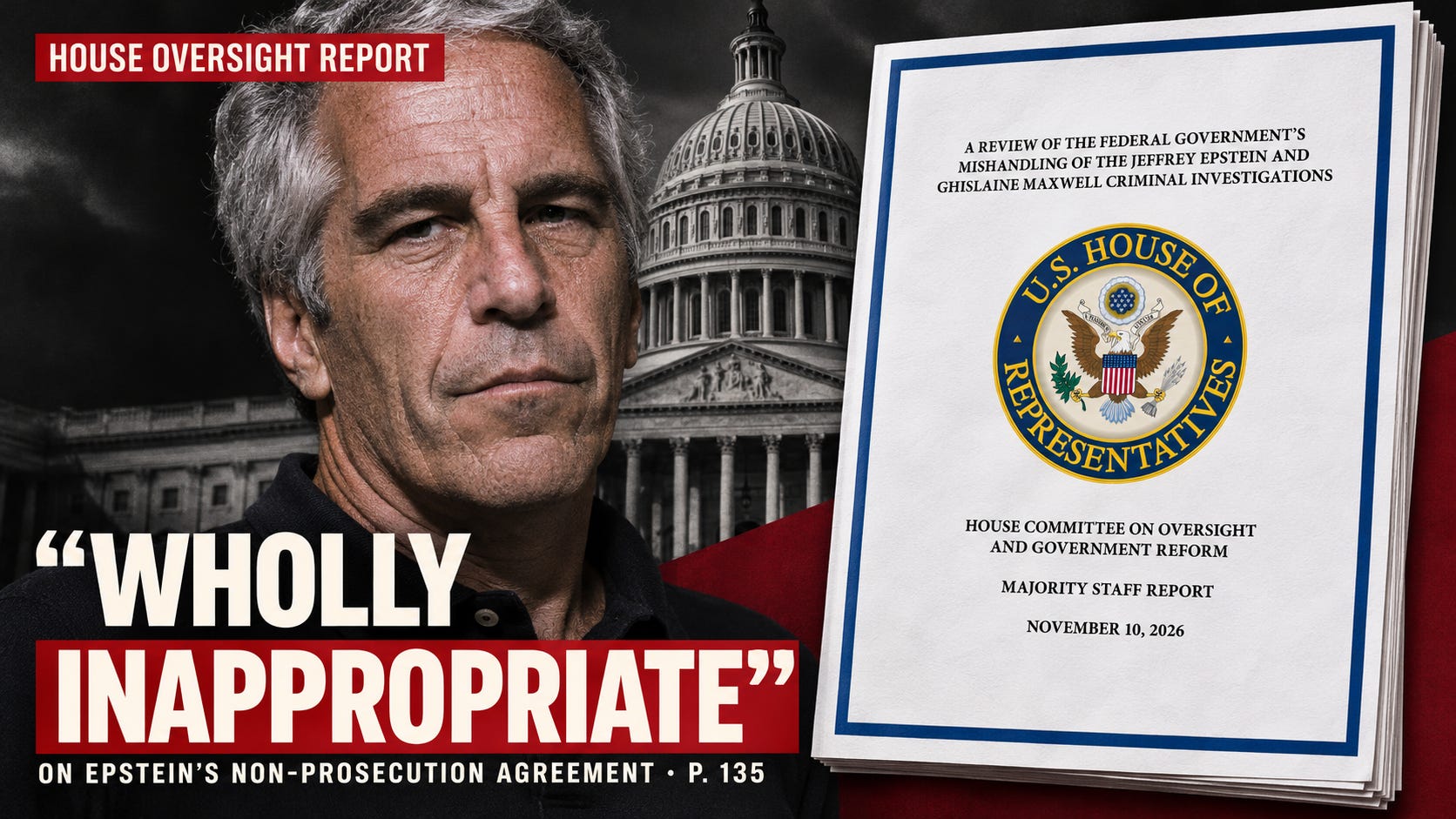
Five findings from the House Oversight Committee’s 137-page report — and the fight to force disclosure of the Epstein files still withheld.


For nearly two decades, Epstein’s 2007 non-prosecution agreement has faced scrutiny over how federal prosecutors handled his case. A 2020 Justice Department review criticized the judgment behind the deal. Now, a House Oversight majority staff report delivers an even more damning assessment.
After transcribed interviews, depositions, and subpoenas to federal agencies, banks, and Epstein’s estate, the House Oversight Committee’s majority staff report has reached its conclusion in writing.
On November 11, a discharge petition reached 218 signatures, advancing legislation that would provide new legal avenues to challenge the Justice Department’s withholding of Epstein-related records. A House vote has not yet been scheduled.

I have spent the past ten months inside the files already released — more than three million pages — writing a book about what they document. Below are the five most important findings of the Committee’s report, with the report’s own pages, and what each one means. Then the vote. Then what the report could not reach.
Story at a Glance
The Committee’s formal conclusion: the non-prosecution agreement that protected Epstein was “wholly inappropriate” (p. 135)
Epstein “had ties to lawyers from the office responsible for prosecuting him” — including a federal prosecutor whose private firm was incorporated, while he was still a prosecutor, at the same address as Epstein’s foundation (pp. 50–52, 135)
The crimes Epstein committed after 2005 “could have been prevented” (p. 46)
The banks’ required warnings “were instead made retroactively after Epstein’s arrest in 2019” (p. 136)
A subpoenaed message log shows an “urgent” call to Epstein from a former White House national security adviser eighteen days before the Palm Beach search — a tip-off question the Committee says was never investigated (p. 58)
And this week: the discharge petition for the Epstein Files Transparency Act II reached 218 signatures, forcing a House vote on whether the remaining files can be pried loose by lawsuit
1. The verdict: “wholly inappropriate”
The Committee’s own words, in its conclusions:
“The Southern District of Florida’s NPA with Epstein was wholly inappropriate.” (p. 135)
Not a journalist’s characterization. Not an advocate’s. The conclusion of a congressional majority staff report, following an extensive investigation backed by subpoena power.
What this means: The report answers one question forcefully: the agreement was inappropriate. What remains unresolved is why it happened. The question the report leaves open — the one that matters now — is why it happened. Which brings us to the second finding.
2. The shared address: A prosecutor’s private firm and Epstein’s foundation
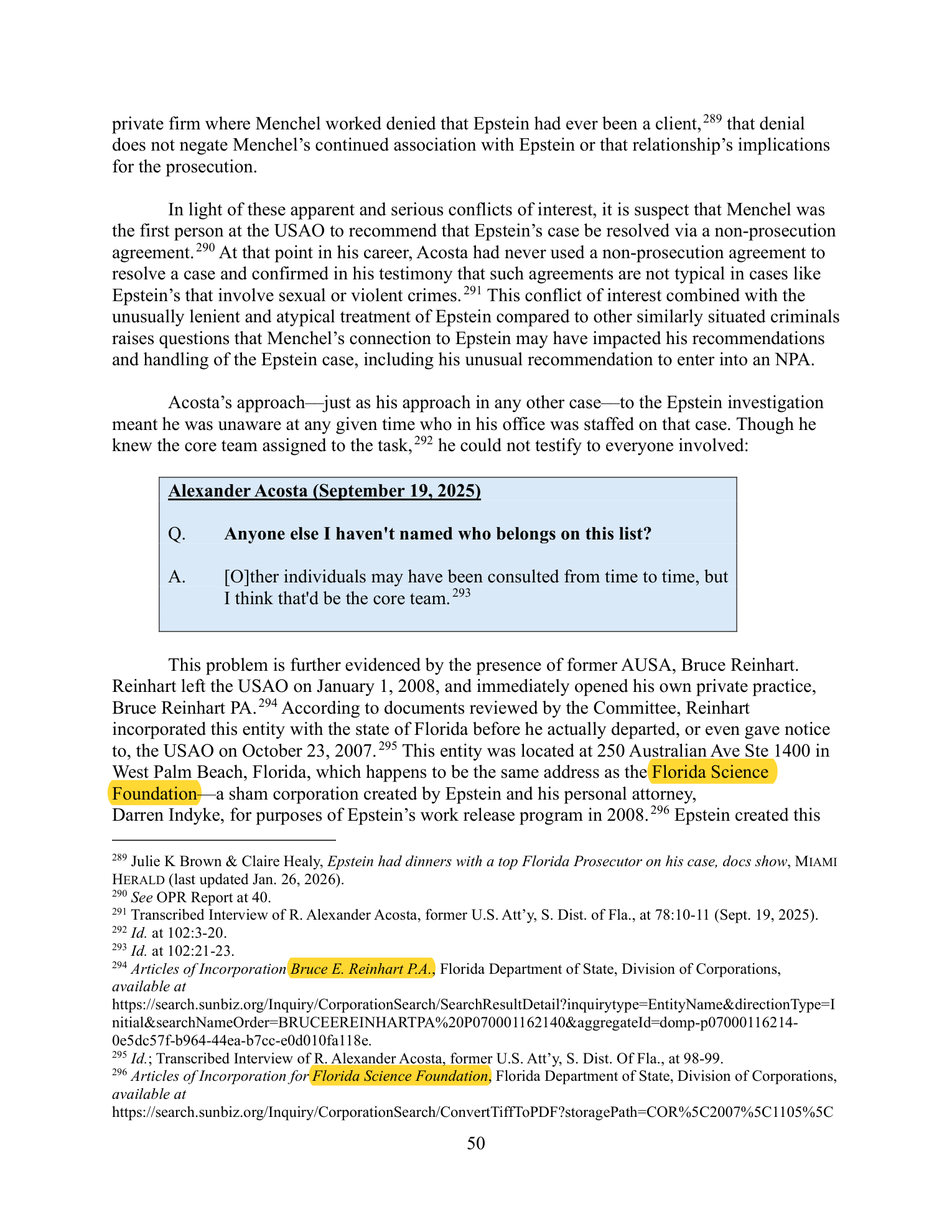
On October 23, 2007, while still employed as an assistant U.S. attorney, Bruce Reinhart incorporated a private law firm, Bruce E. Reinhart, P.A. Nine days later, Epstein’s Florida Science Foundation was incorporated. According to the House Oversight report, both entities listed the same principal business address: 250 Australian Avenue, Suite 1400, West Palm Beach, Florida.
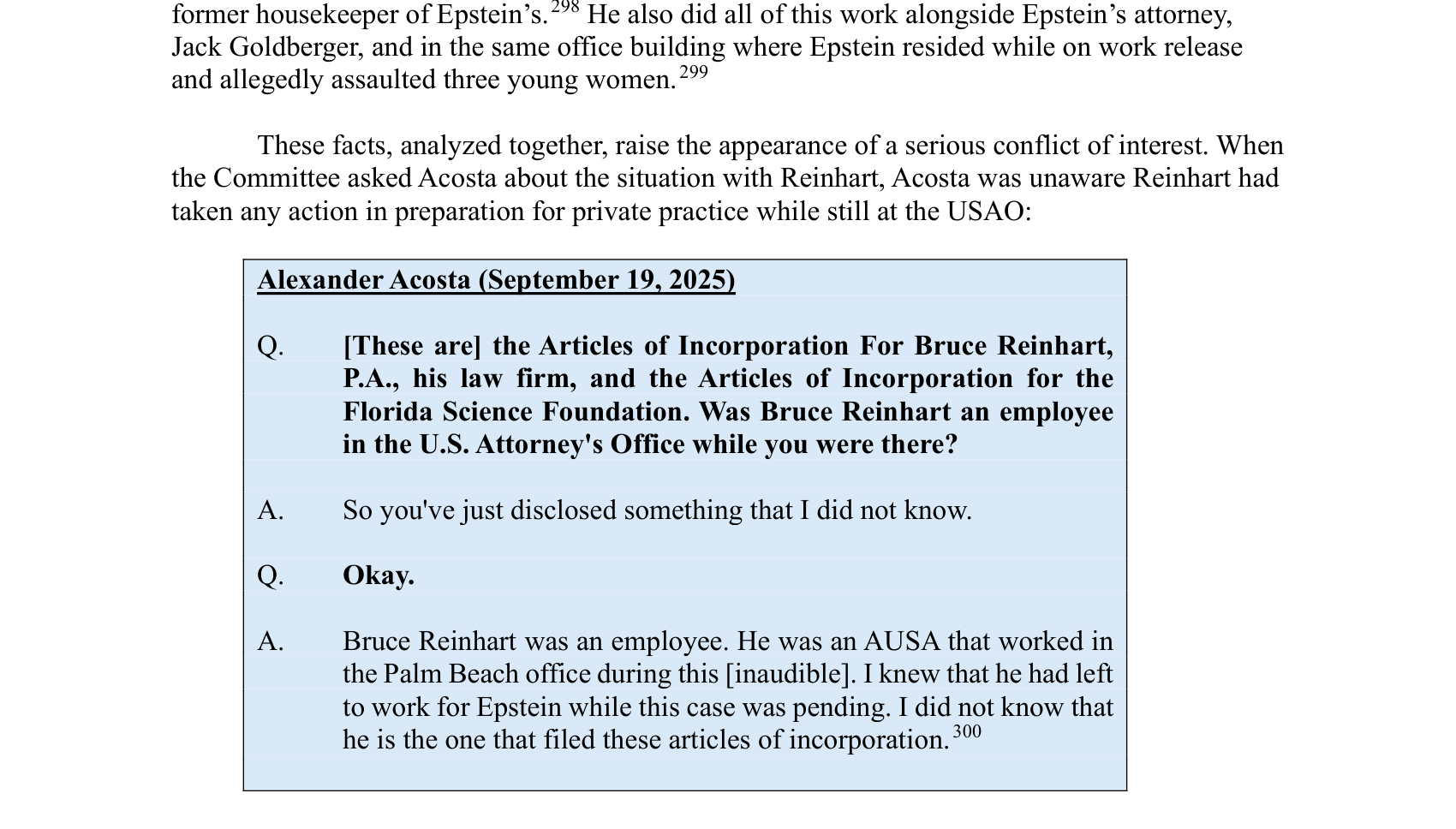
When investigators presented the incorporation records to Alexander Acosta during his September 19, 2025 transcribed interview, he responded:
“So you’ve just disclosed something that I did not know.”
Acosta said he already knew about Reinhart’s subsequent Epstein-related work, but had not known that the firm was incorporated before Reinhart left the U.S. Attorney’s Office.
The report describes these circumstances as raising the appearance of a serious conflict of interest. Acosta said Reinhart was not part of the core prosecution team and that he did not know whether Reinhart had been directly involved in the Epstein investigation.
What this means: Eighteen years after signing the deal, the man who signed it learned from Congress what had been happening inside his own office. The report also documents that Acosta’s office formally declared Epstein’s work release “a material breach of the Non-Prosecution Agreement” in a November 24, 2008 letter — and then the issue “was never resolved,” with no documented decision to decline prosecution (pp. 66–67).
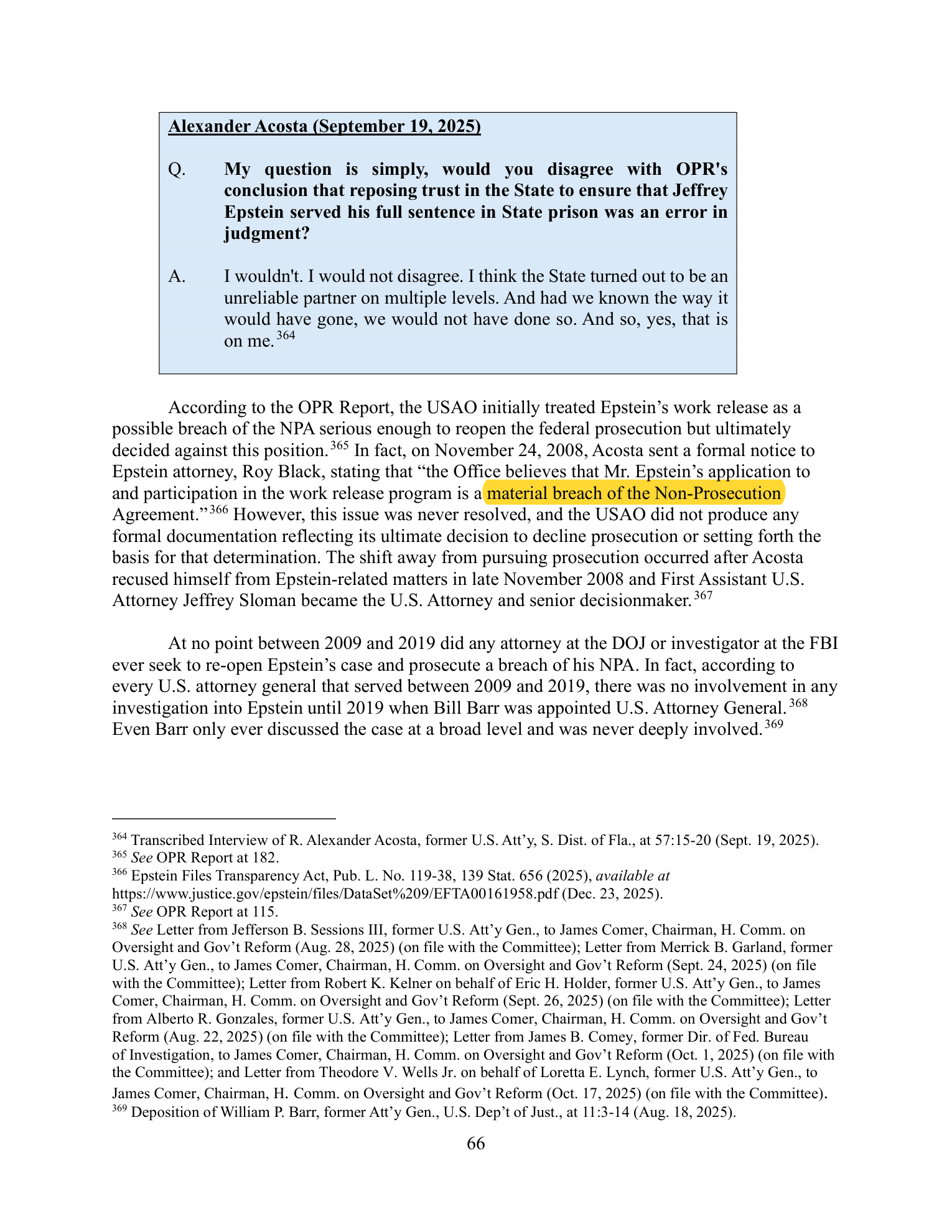
Federal prosecutors identified a potential material breach in writing, then abandoned that position without producing a documented explanation for the decision.
3. The cost: “could have been prevented”
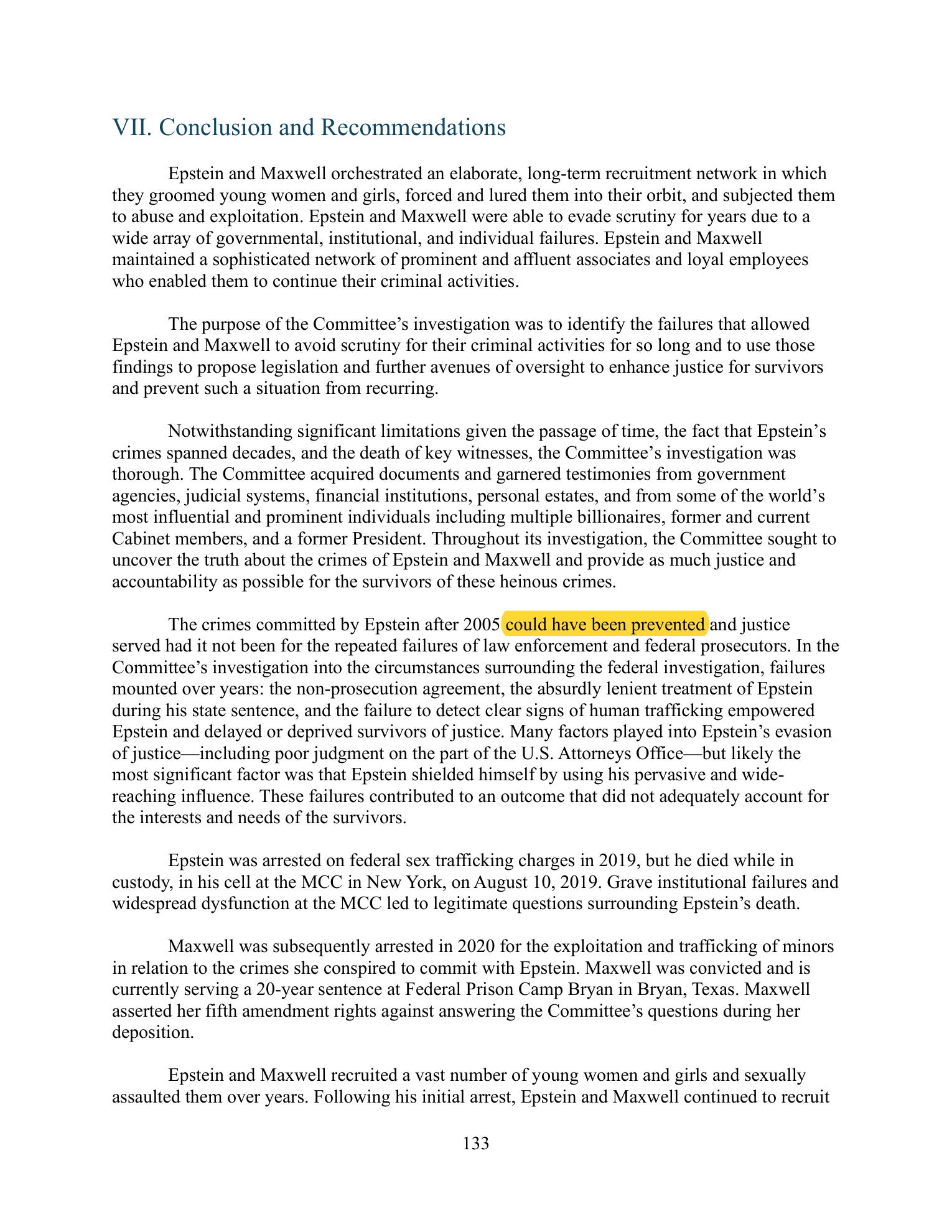
The Committee states that Epstein’s crimes after 2005 “could have been prevented” (p. 46, restated in its conclusions). The report connects preventable crimes to identifiable investigative and prosecutorial failures, including the agreement, the failure to notify victims, and the decision not to pursue the alleged breach.
What this means: This is the moral center of the report, and the Committee signed it. The abuse that continued was not fate. It was the output of choices — and the report names the people who made them.
4. The banks: warnings filed after the arrest
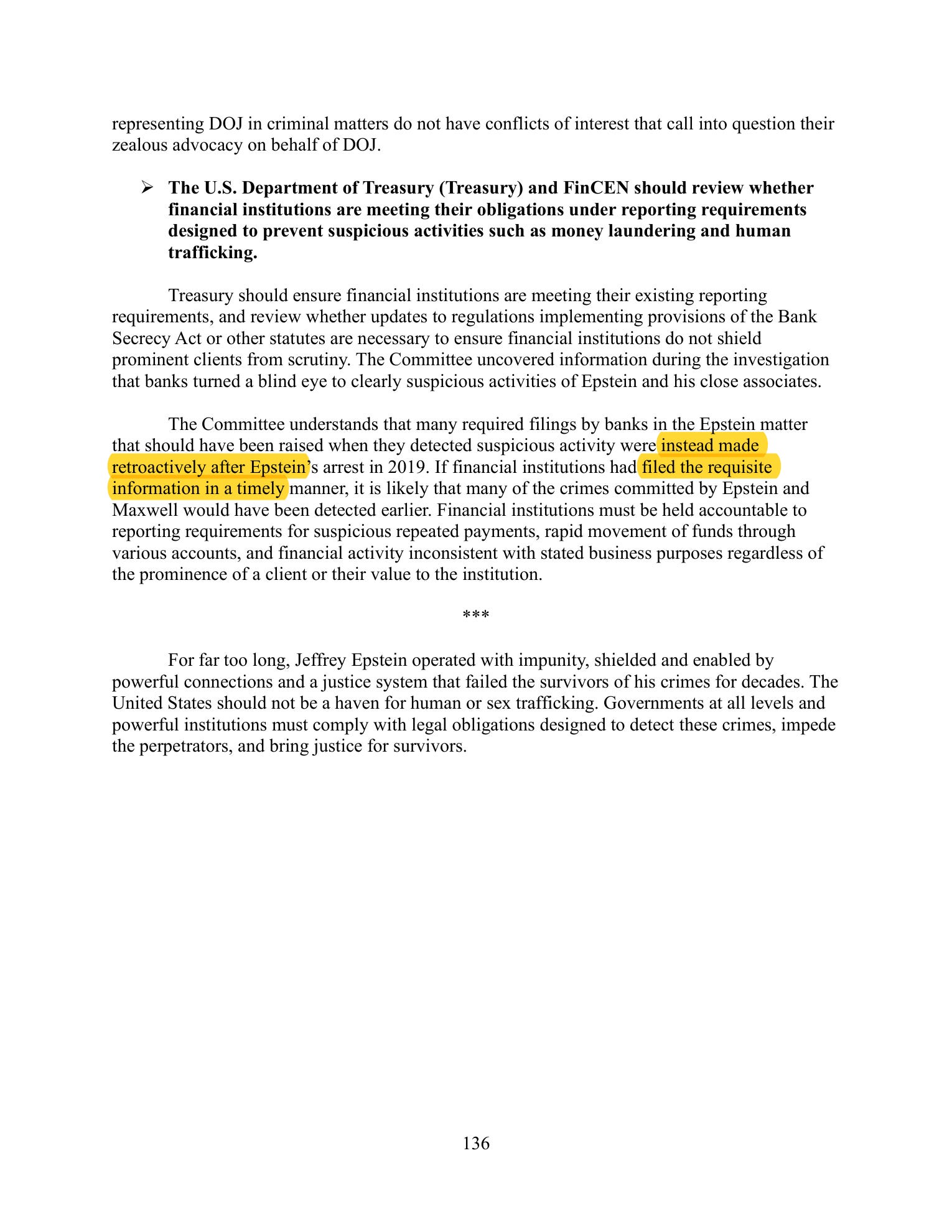
The Committee found that many required bank filings were made retroactively after Epstein’s 2019 arrest. It concluded that timely reporting likely would have led to earlier detection of crimes committed by Epstein and Maxwell (p. 136).
What this means: The compliance machinery ran backwards — paperwork after the handcuffs, accommodation before. The report examines the banks’ failures and some of Epstein’s financial relationships. But the underlying records allow those relationships to be reconstructed in greater detail, through the correspondence, transactions, and internal communications of the participants themselves.
5. The unanswered question: the urgent message
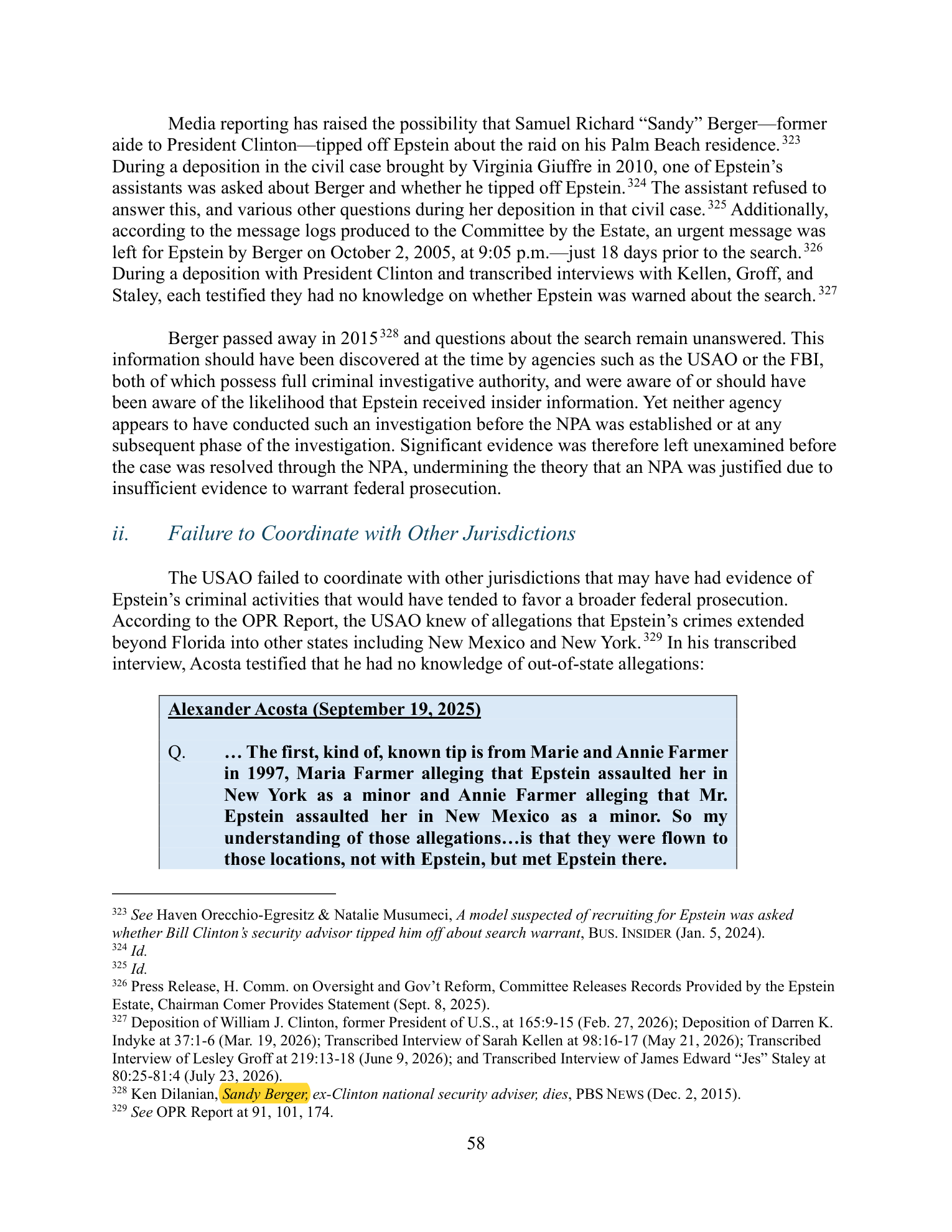
Buried at page 58, from message logs the Committee obtained by subpoena to the Epstein estate: on October 2, 2005 — eighteen days before the Palm Beach search warrant was executed — Sandy Berger, the former White House national security adviser, left Epstein a message marked “urgent.”
The Committee states that neither the U.S. Attorney’s Office nor the FBI appears to have investigated whether Epstein received advance warning of the search.
What this means: I am not telling you what that message was. Neither can the Committee — the question was never run down. That is the point. Twenty-one years later, the question remains unresolved. The report documents the urgent message, the possibility of advance warning, and an apparent failure by federal investigators to pursue the issue.
What the report does NOT say
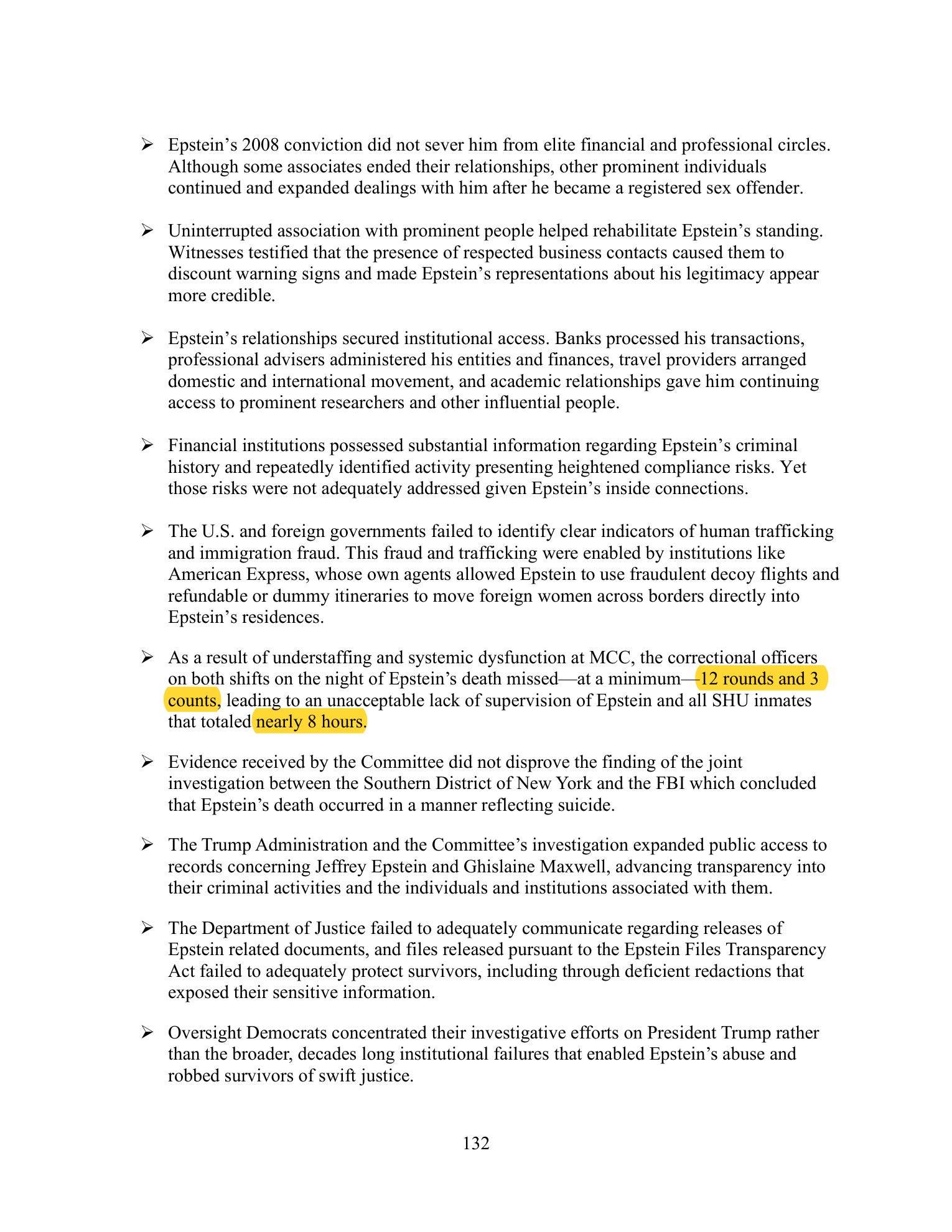
The Committee’s evidence “did not disprove” the official finding that Epstein died by suicide (pp. 7, 132–133) — anyone telling you Congress endorsed a murder theory is misreading the report. What the Committee did find is damning enough without embellishment: on the night of Epstein’s death, correctional officers missed “at a minimum — 12 rounds and 3 counts,” leaving Epstein and other inmates without adequate supervision for nearly eight hours (p. 133).
The record as it stands is sufficient. It does not need theories. It needs the rest of the files.
The next fight over the Epstein files
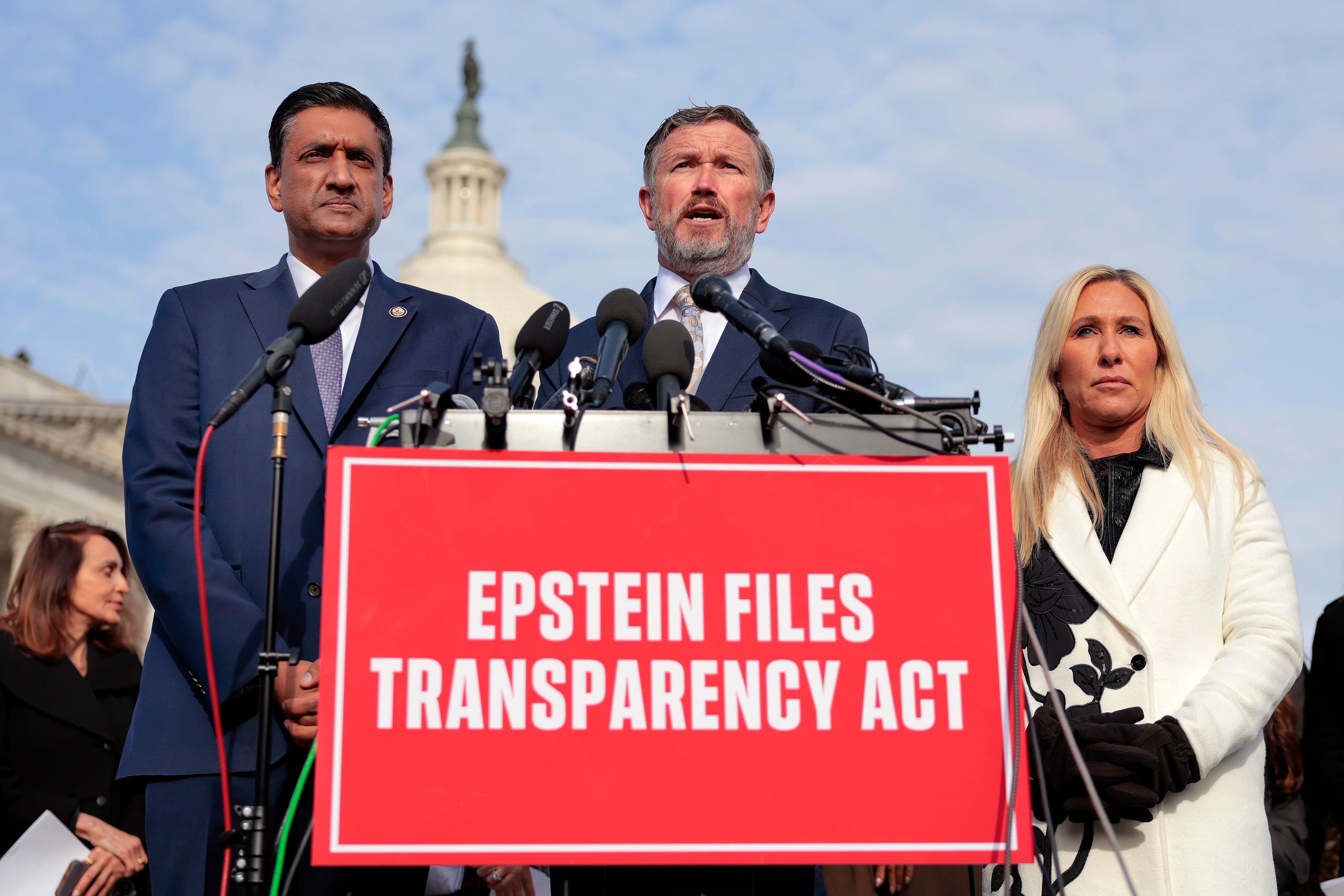
On November 11, 2026, Rep. Thomas Massie’s discharge petition for the Epstein Files Transparency Act II reached 218 signatures — all 214 House Democrats plus four Republicans (Massie, Nancy Mace, Ralph Norman, Brian Fitzpatrick). Rep. John Garamendi provided the final signature.
What the bill does: it allows Epstein’s survivors, state attorneys general, and members of Congress to sue the Justice Department for unlawfully withholding or redacting the files — and lets members of Congress demand unredacted records. It is the enforcement mechanism the first Transparency Act lacked.
What happens next: Under House rules, additional legislative-day and scheduling requirements must be met before a floor vote. Early December remains a possibility, not a confirmed date. Even if the House passes the measure, Senate approval and presidential action would still be required for it to become law.
Watch what happens next. The original Transparency Act led to the release of millions of pages, while the Oversight Committee independently obtained documents and testimony through subpoenas and interviews. The proposed legislation would create additional legal avenues to challenge records being unlawfully withheld. These findings demonstrate why access to the remaining evidence matters. Find more details on the Epstein Files Transparency Act II in my previous report.
How this was built — and what comes next
Everything quoted above traces to a page you can check: the report’s own pages, the government’s own records. That is the method, and it is the method of the book behind this piece.
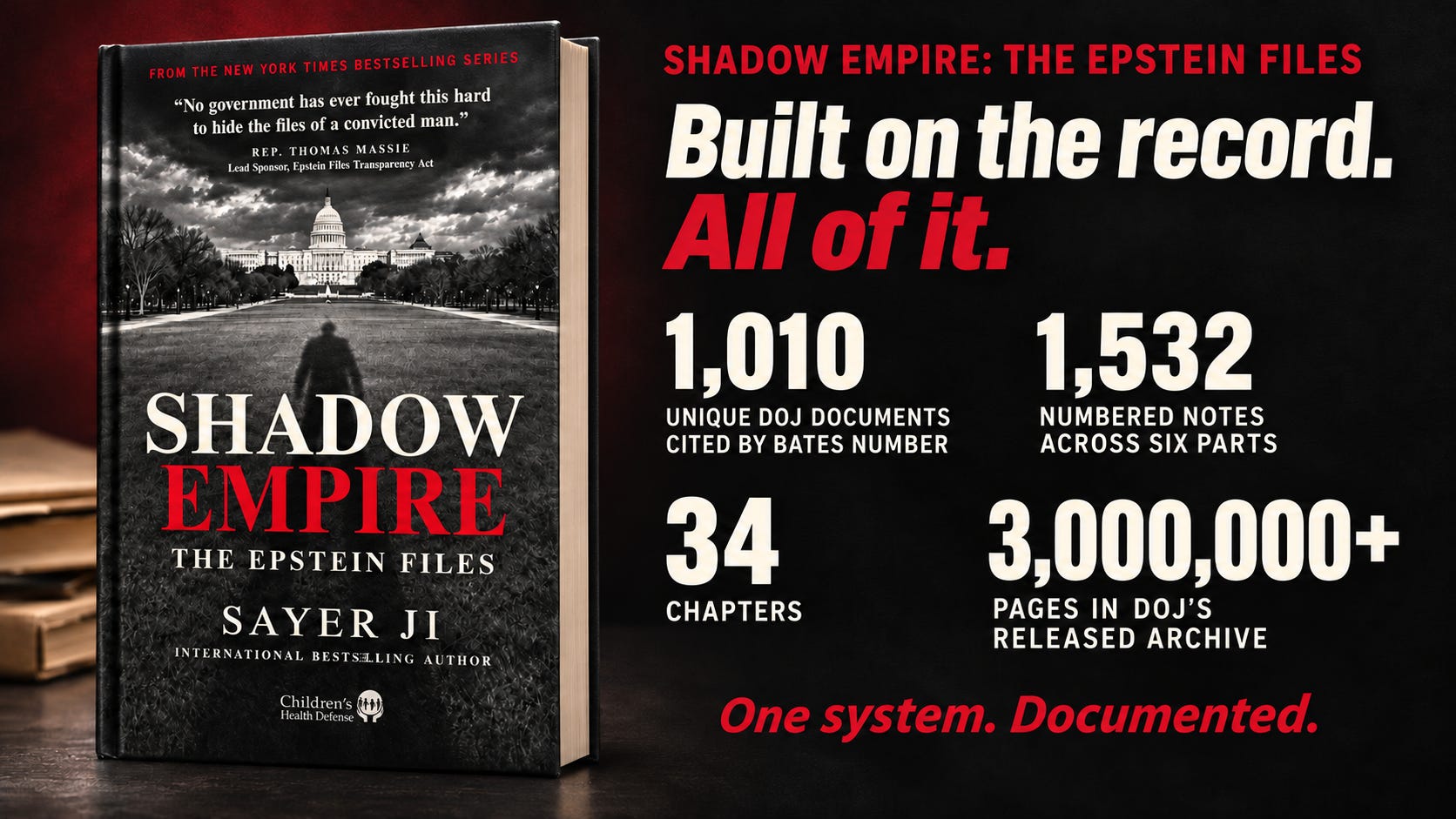
For the past ten months I have been writing Shadow Empire: The Epstein Files — an investigation drawing on the underlying DOJ records, congressional disclosures, and other public sources, extending beyond the Committee’s 137-page report:
1,010 unique DOJ documents cited by Bates number
1,532 numbered notes across six parts
34 chapters
Drawing on the DOJ’s released archive of more than three million pages
The Oversight Committee investigated failures of government accountability and examined important aspects of Epstein’s wider network. Shadow Empire follows the underlying documentary trail further, tracing connections across finance, philanthropy, science, political influence, and international relationships.
The banking relationships from the inside. The science-philanthropy machine. The reputation-laundering apparatus. The foreign contacts. The visa machinery that moved young women across borders while federal agencies renewed the paperwork.
The House report exposes failures of government accountability. The underlying records reveal a much wider architecture of power. That book is coming soon — Children’s Health Defense/Skyhorse/ Jan-Feb Hardcover Release / Pre-order
What an incredibly demanding and necessary work you are performing. Thank you.
There remains how this affects our international relations, especially with Israel and our disregard for the Rule of Law.
Sayer, are you aware of the US House of Representatives (July 25/25) 145 pages on “The foreign censorship threat. How the European Union’s digital services act compels Global censorship and infringes on American free speech. Paul Thacker.