


Toxic air, medicinal smoke, garlic chemistry, and the valerian thread in the Pied Piper legend
Publication draft. Revised October 7, 2026 to foreground toxic exposure, odor-related sickness, medicinal-smoke research, nutrition, social conditions, and the author’s environmental-health framework.
The body encounters air before anyone names a pathogen. Offensive environmental odors can provoke nausea or headaches, while sufficiently concentrated gases released from waste and decomposition can cause direct chemical injury. (New York State health guidance; UK toxicological overview)
That distinction should change how we tell the story of the plague doctor’s aromatic beak. The older idea that corrupted air could make people sick should not be dismissed wholesale simply because it did not distinguish the causes and pathways that modern investigators can now measure.
My “Poisoned, Not Infected” investigation is concerned with precisely this problem: a diagnosis centered on one detected organism can leave toxic exposure, host condition, and the wider environment underexamined. Its stated aim is not to exchange germ theory for an equally narrow toxin-only doctrine, but “to widen the field of causation.” (Poisoned, Not Infected)
Why put herbs near the nose, chew garlic, burn fragrant resins, or attempt to cleanse a sickroom? Those practices deserve examination as attempts to change an environment, not dismissal as the behavior of people incapable of observation. Their historical explanations, their biological effects, and their actual protection against a particular disease must still be investigated separately.
.png)
Bad air was not an imaginary cause of illness
Hydrogen sulfide provides a concrete example. It can be produced during decomposition and released from sewers, septic systems, wastewater facilities, and animal manure; inhalation exposure can cause symptoms ranging from irritation and nausea to severe poisoning, depending on concentration and duration. (New York State Department of Health; UK toxicological overview)
The UK toxicological account describes nausea, vomiting, neurological effects, and, at high concentrations, rapid collapse and respiratory failure. It identifies interference with cellular oxidative metabolism as a mechanism of poisoning. (UK toxicological overview)
That is illness caused by breathing a chemical exposure, not by the gas multiplying in a patient as an infectious organism. A microbial process can generate a toxic substance in the environment without an infection being the mechanism of injury to the person.
There is another route to genuine sickness: the response to the odor itself. New York’s health guidance recognizes that offensive hydrogen-sulfide odors can cause nausea or headache at low levels, with differing sensitivities among people, and ATSDR likewise distinguishes odor-related symptoms from the effects of toxic chemical concentrations. (New York guidance; ATSDR environmental-odor guidance)
Disgust is not merely an intellectual judgment about what looks unpleasant. Research describes its relationship to nausea, avoidance, characteristic facial responses, and other physiological changes; the chemical senses help people respond to potential contaminants before swallowing or closely approaching them. (Disgust review; Chemical Senses discussion)
These are different pathways that can coexist: sensory sickness, irritant or toxic injury, and exposure to infectious material. Collapsing them into one word obscures causation; dismissing them because an older observer lacked today’s terminology obscures it too.
Smell is useful, but it is not a calibrated toxicity meter. Hydrogen sulfide can be detected at concentrations far below those causing severe poisoning, and dangerous concentrations can impair the sense of smell itself. (UK toxicological overview) A pleasant fragrance also should not be mistaken for evidence that the underlying source of a harmful exposure has been removed.
The important historical distinction is therefore not “bad air versus real disease.” It is the difference between a broad environmental observation and an adequately specified account of what in the air is causing which effects.
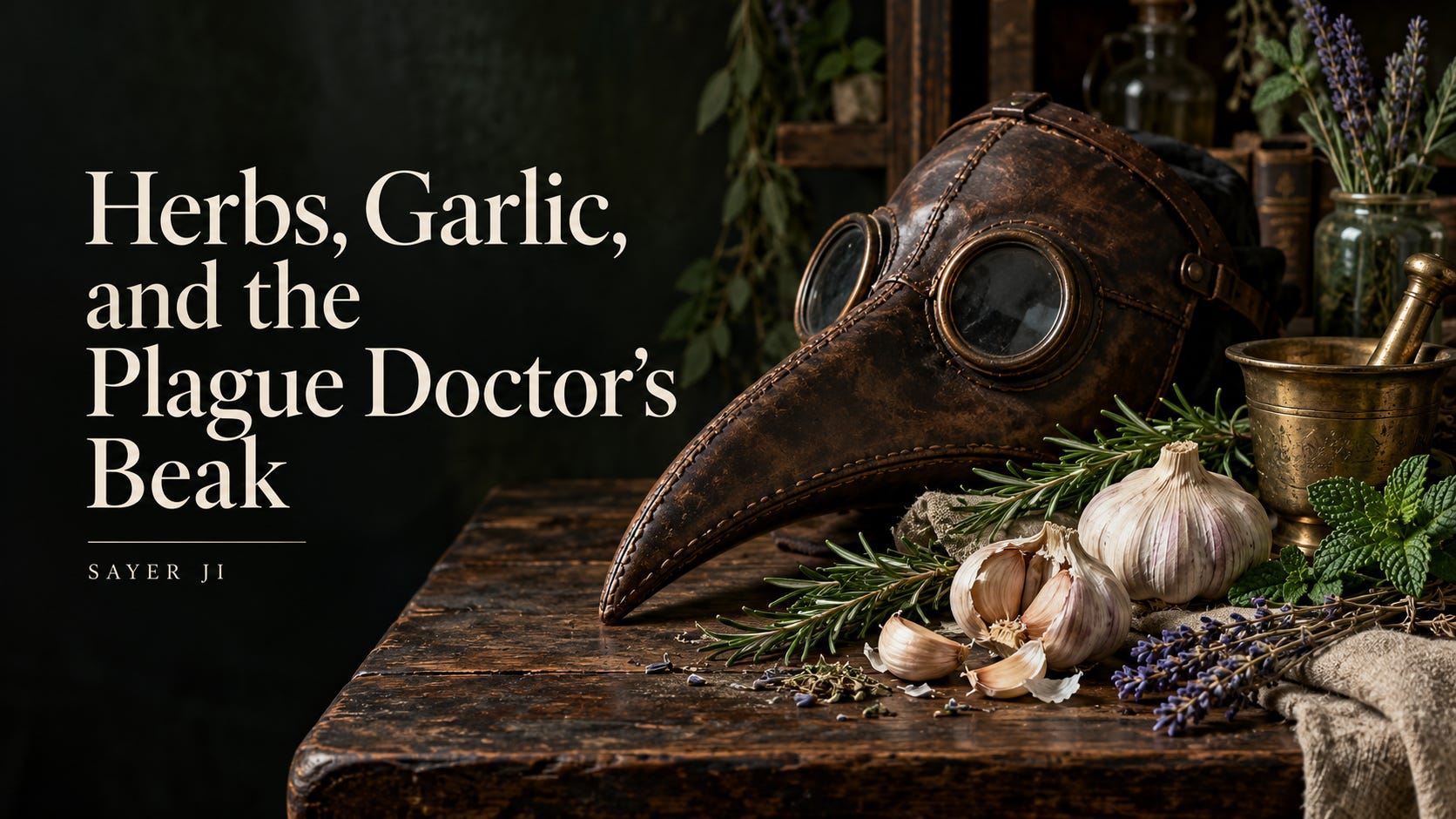
The beak was supposed to change the air
In the medical reasoning behind the aromatic beak, the problem was not simply that a sickroom smelled unpleasant. Air itself could become corrupted and dangerous, and pungent or fragrant substances were believed to counteract that danger before it entered the body. (Herbert J. Mattie’s source analysis)
The distinction matters because calling the beak an early “air filter” can smuggle a modern concept into an older one. Mattie argues that the language of “the malignancy of the air” concerned the corruption of air itself, not an understanding of infectious particles being physically removed by a tested filter. (Mattie)
A long nosepiece offered somewhere to place aromatic substances close to the nose, while allowing the wearer’s hands to remain available. (University of Münster) It can therefore be understood as a holder for a proposed medicinal atmosphere, not automatically as a respirator in the modern technical sense.
The older practice was not confined to masks. The University of Münster’s historical account describes people holding bags of aromatic herbs soaked in vinegar before their noses during the medieval plague, well before the familiar beaked figure appears in the record. (Münster historical account)
This is the basic answer to “why herbs?” The wearer was trying to make dangerous air safe, using substances believed to possess protective properties. Whether those properties worked in that setting is a separate question from whether the practice had an intelligible medical purpose.
Seeing that purpose does not require endorsing every historical explanation of plague. It requires acknowledging that an air-centered approach was asking a valid question about the conditions in which people lived, breathed, and became ill.
The first correction: this is not the uniform of the Black Death
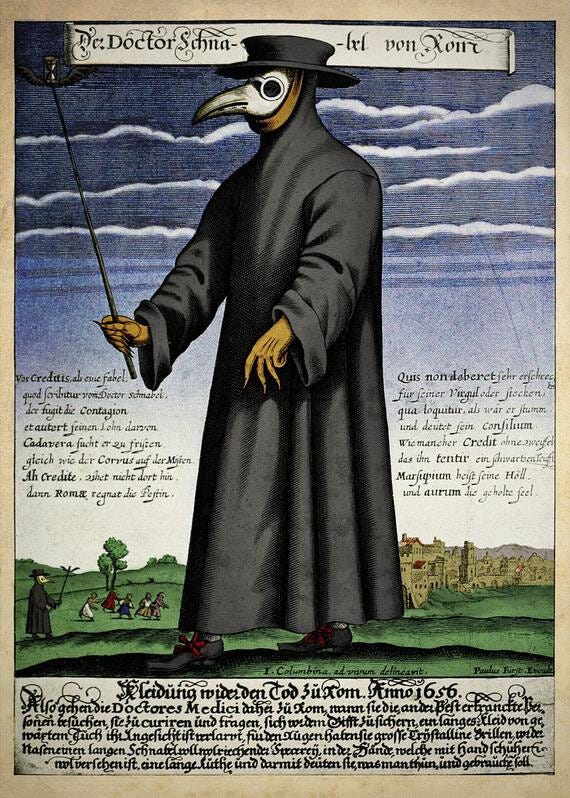
The iconic beaked doctor is routinely used to illustrate the fourteenth-century Black Death, but the evidence for the characteristic nosepiece belongs to much later plague history. Medical historian Marion Maria Ruisinger locates the earliest evidence in the mid-seventeenth century, in Italy and southern France, and finds no evidence of its use during plague outbreaks in central Europe. (Ruisinger)
The famous 1656 “Doctor Beak of Rome” prints are especially important to that visual tradition. Their captions describe aromatic contents, but the images also contain satire and allegory rather than functioning as straightforward clinical photographs. (Mattie)
There is even serious disagreement about how much real medical use lay behind the image. Ruisinger treats the beaked doctor as, at most, a marginal historical phenomenon, whereas the accessible abstract of Bruno J. Strasser and Thomas Schlich’s 2025 chapter, “The Elusive Beaked Mask,” advances the stronger argument that the familiar medical mask was a myth sustained by costumes, illustrations, and later retellings. (Ruisinger; 2025 chapter abstract)
The museum objects do not settle the matter. Ruisinger reports uncertain provenance and construction problems in the masks held in Ingolstadt and Berlin, leaving open whether they were protective equipment, historical replicas, or objects made for another purpose. (Museum-mask investigation)
The careful conclusion is not “all plague doctors wore this.” It is that a distinctive image, some descriptions, and disputed surviving objects became vastly more familiar than the evidence for their actual use.
That does not erase aromatic medicine. It prevents a vivid symbol from becoming a substitute for historical research.
Garlic belongs in the story, but not always where it is placed
Modern lists of mask ingredients often combine herbs, spices, flowers, vinegar, and garlic into one seemingly standardized recipe. The mask manufacturer Detmold Medical, for example, lists “aromatic herbs, spices, flowers and garlic,” while Britannica describes lavender, mint, myrrh, vinegar- or camphor-soaked sponges, and sometimes theriac. (Detmold’s history page; Britannica)
Those modern summaries are not inventories proving that every wearer used all those ingredients. A more revealing passage comes from the late-seventeenth-century biographer Michel de Saint-Martin, describing the physician Charles de Lorme’s alleged precautions during the Paris plague of 1619. (Mattie’s examination of Saint-Martin)
In the passage reproduced and translated by Mattie, Saint-Martin wrote that de Lorme “put garlic and rue in his mouth,” placed frankincense in his nose and ears, and covered his eyes with spectacles. (Saint-Martin passage and translation) The original phrase is particularly clear: “il mist en sa bouche de l’ail & de la ruë.” (Mattie, footnote 6)
Garlic in the mouth is not the same historical claim as garlic packed into a beak. That difference is small enough to disappear in a popular retelling and large enough to matter when we ask what was actually done.
The account also needs a credibility warning. Saint-Martin wrote decades after the alleged event, admired de Lorme extravagantly, and made claims about his medical successes that Mattie says cannot be independently corroborated. (Mattie)
We can use that passage as evidence that such protective practices were described. We should not use it as a controlled demonstration that garlic cured plague, or pretend it establishes a universal recipe.
Why the theriac story also needs care
Theriac is another ingredient that gives the mask story its almost theatrical flavor. Britannica describes it as a longstanding medicinal cure-all sometimes placed in beaks, while National Geographic’s popular account describes a complex mixture of herbs and other ingredients, including cinnamon, myrrh, honey, and powdered viper flesh. (Britannica; National Geographic)
That is useful background about what later accounts associate with the device. It is not evidence that every doctor wore a beak containing the same elaborate compound.
The need for caution becomes sharper when we follow the texts backward. Mattie shows that details commonly attributed to de Lorme were assembled from different sources, including the 1656 prints, Saint-Martin’s biography, and an illustration and description inserted into Jean-Jacques Manget’s 1721 plague treatise. (Mattie)
According to that source analysis, Manget subsequently said the publishers had added the illustration and description without his involvement, and he distanced himself from the image. (Mattie’s discussion of Manget’s 1722 clarification) Yet the apparent authority of a medical book helped the composite image acquire the status of established history.
A printed illustration can be historically valuable without being a reliable equipment specification. The same is true of a colorful ingredient list.
Garlic’s vapors are not merely symbolic
There is a further mistake in assuming that revising a historical disease theory makes its aromatic remedies biologically meaningless. Toxic air can be real, plant vapors can be active, and a particular historical device can still lack evidence of protection against plague; those propositions are compatible.
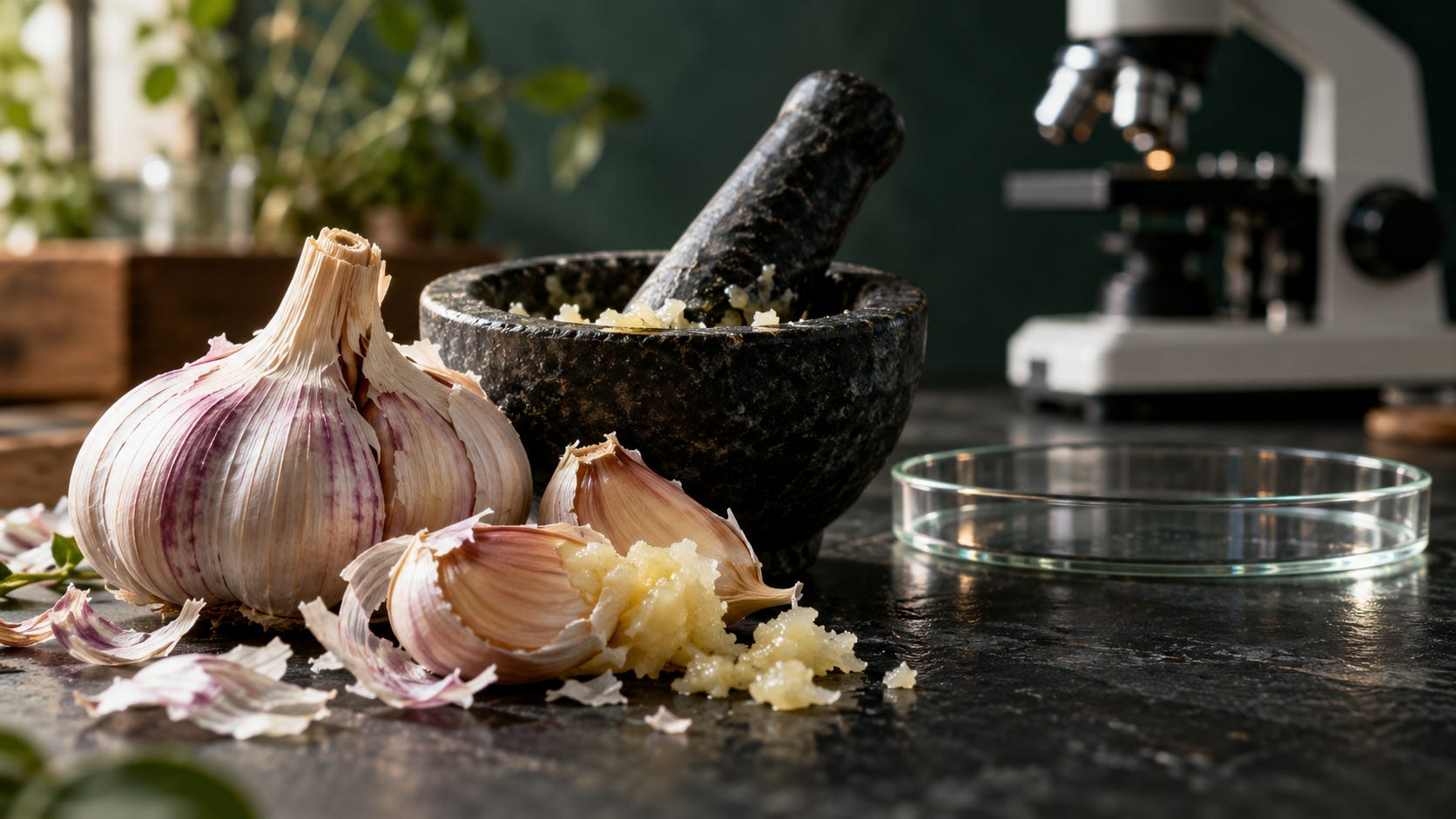
When garlic tissue is damaged, chemical reactions produce allicin, a volatile sulfur compound associated with the characteristic smell of freshly crushed garlic. Allicin can react with accessible sulfur-containing groups in proteins and has dose-dependent antimicrobial effects. (Borlinghaus and colleagues’ 2021 review)
In a 2017 study, Jana Reiter and colleagues tested purified allicin in solution and as vapor against bacterial isolates, including organisms associated with lung infections and some multidrug-resistant strains. Allicin vapor inhibited several tested organisms in laboratory plate experiments, although a highly resistant Pseudomonas aeruginosa strain was not inhibited in the vapor test. (2017 experimental study)
That is genuinely interesting. A substance whose smell once belonged to aromatic medicine can exert measurable biological effects through the gas phase. (Reiter and colleagues) The broader idea that a plant vapor might affect microorganisms is not inherently unscientific.
But the experiment did not test Yersinia pestis, did not test an herb-stuffed beak, and did not demonstrate prevention or treatment of human plague. (Study methods and organism panel) A controlled laboratory exposure to purified allicin cannot simply be relabeled as the experience of breathing through dried plants or carrying garlic.
The safety findings are just as important as the antibacterial ones. The researchers also found toxicity to mammalian cells and lung-tissue slices under experimental conditions; the 2021 review emphasizes that further research is necessary before safe human therapeutic protocols can be established. (2017 study; 2021 review)
“Natural” does not mean inactive, and it does not mean harmless at every concentration. Genuine pharmacology is precisely why preparation, exposure, dose, and safety cannot be skipped.
The defensible position is therefore neither “the herbs were useless because they were herbs” nor “modern science has proved the old masks worked.” It is that some plant compounds have demonstrable activities, while the historical use, delivery conditions, and clinical protection remain separate evidentiary questions.
Medicinal smoke has measurable effects on the air
The tradition of changing the surrounding air also has a research record beyond the contents of a beak. A 2006 ethnopharmacology review examined medicinal-smoke practices from 50 countries across five continents, including ambient smoke used as an air purifier, and called for further investigation of their active constituents and delivery mechanisms. (Medicinal smokes)
The 2007 study discussed in my GreenMedInfo article, “‘Killer Germs’ Obliterated by Medicinal Smoke,” examined smoke from wood and a mixture of odoriferous medicinal herbs known as havan samagri. Its authors reported over a 94% reduction in airborne bacterial counts after 60 minutes, with the reported air-disinfection effect maintained for up to 24 hours in a closed room. (GreenMedInfo article; original study abstract)
They also reported that several identified bacterial types were not detected in the open room after 30 days and interpreted that finding as evidence of bactericidal potential. (Original abstract) That is not the same statement as “all organisms were eliminated for a month,” or “everyone exposed became healthier.”
There are additional experimental findings worth following. A 2018 clinic-environment study reported over a 95% reduction in bacterial colony counts following a medicinal-smoke treatment, using before-and-after settle plates over a series of days. (Indian Journal of Otology study) Despite its stated aim of reducing hospital-acquired infection, the reported outcome was the environmental colony count, not a demonstrated reduction in infections among patients. (Study methods and results)
A 2023 study of frankincense oil and smoke likewise found antimicrobial activity under laboratory conditions, including inhibition of tested bacteria, yeast, and mold. (Frankincense study) Such findings make it untenable to treat every aromatic or fumigation practice as merely symbolic.
But preserving that insight requires preserving the exposure question too. The frankincense researchers measured fine smoke particles and warned of potential risks to susceptible people; an antimicrobial effect and an inhalation hazard can belong to the same preparation. (Frankincense particle findings)
An environmental-health framework should examine both sides rather than dismiss either one. The questions include which mixture was used, what changed in the microbial counts, what gases and particles were produced, how the air was exchanged, and what happened to people.
The cited 2007 abstract does not report a trial of white-sage smudging, a plague-prevention outcome, or detoxification of hydrogen sulfide. (Original abstract) Those are separate claims that cannot be supplied by attaching a broader label to the experiment.
The positive finding still stands on its own terms. A traditional intervention intended to transform the surrounding air produced a measurable change in the tested environment; that is a reason for serious investigation, not contempt.
The wider research record deserves to be taken seriously
For this piece, I also turned to GreenMedInfo’s research libraries: its garlic page lists 3,999 indexed abstracts and its valerian page lists 227, as of the review snapshot. (GreenMedInfo garlic library; GreenMedInfo valerian library) Those counts describe the database, not thousands of successful human clinical trials, and garlic’s index includes agricultural and food-science research as well as medical studies. (Garlic index)
Still, there is substantial research beyond test-tube antimicrobial activity. A comprehensive garlic meta-analysis indexed by GreenMedInfo, published in the January 2026 issue of Nutrition Reviews, included 108 randomized trials and 7,137 participants and reported improvements in several cardiovascular risk markers, including pooled reductions of 3.71 mmHg in systolic and 1.97 mmHg in diastolic blood pressure. (GreenMedInfo research record; original abstract)
These are measurable human outcomes, not an argument from antiquity. They do not establish prevention of plague, but they do make blanket dismissal of garlic as medically irrelevant difficult to defend.
Valerian’s record also includes human trials and mechanistic experiments. In a 2002 randomized, double-blind comparison involving 202 outpatients, a particular valerian extract produced sleep-questionnaire improvements comparable to oxazepam over six weeks; the trial compared two active treatments rather than including a placebo arm. (Original clinical abstract)
A newer study indexed by GreenMedInfo tested a valerian–hops combination in a placebo-controlled feasibility trial completed by 40 participants, reporting an exploratory increase in nightly sleep duration of about 22 minutes. (GreenMedInfo record; full study) Because it tested a combination and explored multiple outcomes in a small study, it cannot establish the effect of valerian alone or settle the broader insomnia question. (Study design and limitations)
The contrary evidence belongs in the account too. GreenMedInfo also indexes a 2024 umbrella review of eight eligible reviews that distinguished subjective improvements in sleep quality from a lack of demonstrated efficacy on quantitative or objective insomnia measures, emphasizing weaknesses and heterogeneity in the underlying research. (GreenMedInfo umbrella-review record; original abstract)
That is not a reason to call valerian inert. It is a reason to distinguish biological activity, an encouraging result for a particular preparation, and a sufficiently replicated clinical benefit.
The microbiome question offers another example. A 12-week aged-garlic trial completed by 49 people with uncontrolled hypertension explored changes in gut bacteria, reporting patterns of increased richness and diversity, but the full paper describes the diversity and between-group bacterial changes as statistically nonsignificant. (GarGIC trial)
That exploratory work is relevant to an ecological view of food and health, without proving that every garlic preparation benefits every microbial community or that a historical mask altered the wearer’s microbiome. The stronger argument for these plants is a specific one: investigate their many activities carefully, instead of forcing the research into either a miracle narrative or a dismissal narrative.
Could the clothing have helped for another reason?
The beak and its contents were only part of the imagined protective ensemble. Smooth robes, coverings for the eyes, and other barriers appear in accounts of plague precautions, but the full outfit should not be assumed to have been standardized or ubiquitous. (Mattie)
Britannica suggests that aspects of the clothing could have protected against infectious fluids, respiratory droplets, or flea bites. (Britannica) That is a plausible retrospective interpretation, not a quantified trial establishing how much protection the costume provided; neither accepting nor rejecting the entire historical theory settles the question of a particular barrier’s effect.
The distinction between explanation and effect is worth preserving. An intervention might have some practical benefit for reasons its user did not understand, just as a persuasive explanation might produce no useful effect at all.
For plague, the relevant modern pathways include infected flea bites, contact with infectious materials, and inhalation of respiratory particles in pneumonic disease. (WHO fact sheet) Whether any historical garment interrupted a particular pathway depends on its actual construction and use, not its frightening appearance.
The Pied Piper and valerian’s ecological possibilities
Another strand of aromatic folklore concerns valerian and the Pied Piper of Hamelin. The American Botanical Council records the belief that the Piper carried valerian in his pockets or rubbed himself with it to draw the rats away; the Plants for a Future database also reports traditional use of dried valerian root as rat bait. (American Botanical Council; Plants for a Future)
One later herbal retelling introduces a different mechanism: valerian attracted cats, which then ate the rats. (Seed Sistas’ folklore section) These are appealing naturalistic alternatives to the idea that a flute alone commanded an entire town’s rodents.
But three distinct propositions are often folded together: valerian attracts animals; valerian can have calming or sedating effects; and sleepy rats become easier prey for cats. The first two do not establish the third, and none establishes what happened in Hamelin.
There is experimental support for valerian’s effect on cats’ behavior. A 2017 study of 100 domestic cats found that 47 responded positively to valerian root, with behaviors such as sniffing, licking, rubbing, and rolling; it did not study rats, sedation of rats, or cats catching rats. (Bol and colleagues)
Valerian’s effects in rodents are also more complicated than “it makes them sleepy.” A 2021 review describes anxiety-reducing effects in some experiments and reports that one study of different Valeriana officinalis extracts found no sedative or muscle-relaxant activity at the tested limits, while other preparations and related species produced different results. (Valerianaceae research review)
There is positive sleep-related evidence as well: a 2024 study indexed by GreenMedInfo found that administered valerian extract increased sleep duration and reduced sleep latency in a pentobarbital-induced sleep model in mice. (GreenMedInfo record; full experimental paper) It did not test wild rats being drawn to an odor and becoming easier prey.
Mechanistic work also identifies a specific biological pathway: valerenic acid’s anxiety-reducing action in mice was lost when a relevant GABA receptor subunit was genetically altered. (Benke and colleagues) That helps establish that a valerian constituent can have a real nervous-system effect; it does not establish the dose, route, or outcome in the Pied Piper story.
Those studies used defined preparations and administration routes, not simply a root’s smell drifting from someone’s pockets. (Review of rodent experiments) A scent lure, an ingested preparation, and a pharmacological sedative exposure are not interchangeable.
The “valerian made the rats drowsy so cats could eat them” idea can therefore be presented as a proposed ecological explanation, not as a demonstrated historical mechanism. The sources reviewed support the existence of valerian lore and specific experimental animal responses, not that complete sequence.
There is one more historical complication: the rats themselves were not in the earliest accounts of the Pied Piper story. Cambridge University Library explains that the early tradition concerned the disappearance of children and that the rat-catching episode developed later. (Cambridge’s account of the legend)
The tradition dates the disappearance to June 26, 1284, earlier than the fourteenth-century Black Death; that chronology is another reason not to turn the story automatically into a record of plague control. (Cambridge University Library; Münster’s plague chronology) “A plague of rats” can describe an infestation without identifying infection by a particular bacterium.
The most useful version of the valerian passage is consequently modest but evocative. Perhaps later tellers used familiar observations about pungent roots and animal behavior to explain an older mystery; that is an interpretation of the retelling, not proof of what the Piper did.
The story is valuable because it draws attention to smell, plants, prey, predators, and human attempts to manage their surroundings. It becomes misleading only when an attractive possibility is promoted into an established causal history.
A plant-based story is not a plague-control prescription
The Pied Piper passage should not be mistaken for advice to attract rodents or use cats to clear an infected area. WHO recommends controlling fleas before controlling rodents because killing rodents first can cause their fleas to seek new hosts. (WHO outbreak-control guidance)
That is an important ecological complication: removing one animal from a system is not necessarily equivalent to removing the exposure pathway. A compelling folk solution can leave out the part of the biology that determines whether people become safer.
Likewise, the laboratory findings on allicin are not a recommendation to inhale garlic preparations or concentrated plant vapors. Experimental antimicrobial action and experimentally observed mammalian toxicity belong in the same account. (Reiter and colleagues)
Respecting traditional knowledge should mean investigating it carefully, not turning it into a shortcut around evidence. Respecting modern science should mean acknowledging what has actually been tested, not dismissing a substance merely because it comes from a plant.
Beauty, cleanliness, and the conditions of health
For me, beauty, cleanliness, and order belong within a fuller understanding of health, including the life of the spirit. A cared-for home, a garden, clean water, an environment freed of accumulating waste, and room to breathe are not luxuries outside the subject; they express the kind of world in which we want life to flourish.
There is research on the relationship between settings and well-being, although it should not be asked to prove more than it measures. A 2025 review of structured nature-based health interventions reported possible mental-health improvements, while rating the certainty of causal evidence very low because of methodological limitations and heterogeneity. (BMJ Open review)
That evidence is not a clinical certificate for every beautiful or orderly space. It is compatible with taking a person’s surroundings seriously instead of reducing health to the absence of a named organism.
Cleanliness need not mean sterility, and cleansing need not mean filling a room with another unmeasured exposure. The aim should be to remove hazards, care for the environment, and support the person, while asking whether a proposed remedy makes the whole situation better.
Pestilence was also a condition of life
A history concerned only with a named organism can miss the people receiving the exposure. A 2008 study of Black Death burials at East Smithfield in London, compared with a normal-mortality sample from medieval Denmark, found evidence that pre-existing physiological frailty influenced mortality during the epidemic. (DeWitte and Wood)
Its skeletal markers reflected earlier physiological stress, including possible undernutrition and disease; they were not direct measurements of what each person ate immediately before death. (DeWitte and Wood) The defensible conclusion is significant: host condition mattered, even during a catastrophic epidemic. The same study cautions that many people who were apparently otherwise healthy also died, so frailty is not a complete explanation or a guarantee that good nutrition would have prevented death. (DeWitte and Wood)
The social environment mattered too. Historical accounts of later European plague outbreaks describe poverty, crowded housing, accumulating waste, and circumstances that brought people into contact with rodents or fleas, alongside attempts to clear putrid material from streets. (Richard Evans’s historical lecture) These are reasons to investigate sanitation, housing, food security, and access to care, not to blame impoverished people for circumstances they did not choose.
“The Middle Ages” should not become shorthand for a single uniformly filthy, malnourished, sunless population. The historical and archaeological evidence varies across places, periods, and social groups, and the burial study itself compares distinct populations using imperfect retrospective markers. (DeWitte and Wood) The argument is stronger when it identifies an actual condition than when it presumes that everyone lacked every resource.
Sunlight deserves a place in the wider health discussion: skin exposure to UVB contributes to vitamin D production, and vitamin D participates in immune function. (NIH vitamin D fact sheet) That physiology is not evidence that a measured, widespread sunlight deficiency caused the Black Death, nor does it establish sunlight as a plague treatment. A model-room experiment also found that daylight altered the abundance and viability of bacteria in household dust, but it measured environmental samples, not protection of patients from plague. (Fahimipour and colleagues)
Fear and oppression belong in this account without being asked to explain everything. Nocebo research shows that negative expectations can produce measurable symptoms and physiological responses, while a meta-analysis of psychological stress found that chronic stress was associated with changes in several immune measures. (Colloca’s nocebo review; Segerstrom and Miller) Neither body of research demonstrates that fear generated the plague bacillus or caused medieval plague transmission.
Oppression also caused harms that require no speculative biological mechanism to recognize. Scholarship on the Black Death documents persecution, torture, and killings driven by unfounded accusations that Jewish communities and others had poisoned wells. (Samuel Cohn’s historical analysis) An investigation of actual environmental poisoning must never rehabilitate those accusations; authority, fear, and scapegoating can injure people independently of the initiating disease.
The lesson is not that sick people failed to think positively or maintain an ideal diet. It is that people should not be reduced to containers for a microbe, and that improving the conditions of life deserves attention alongside identifying the immediate cause of illness.
Mold, grain, and milk: separate the exposures
There is a concrete historical example of people being poisoned through staple food: ergot alkaloids produced by fungi contaminating grain, especially rye, can cause vasoconstriction and gangrene or neurological manifestations such as convulsions. (Haarmann and colleagues) In this example the cereal crop is infected by a fungus, but the person consuming its alkaloids is poisoned; the distinction is precisely why exposure history matters.
That does not make ergotism a demonstrated explanation for the Black Death. A particular fungal toxin, a particular exposure route, and a particular clinical pattern must be established rather than substituting the word “mold” for every unexplained historical illness.
Gluten-containing grains raise a different question. Wheat cultivation preceded medieval plague by thousands of years, and a clinical review distinguishes established celiac disease from other wheat-related reactions and from claims that gluten is harmful to everyone. (Raju, Rej, and Sanders) A claim that gluten was first introduced en masse during the plague era is therefore not supported by that chronology.
Dietary dependence on a staple, individual intolerance, food scarcity, and fungal contamination remain distinct questions. They can be investigated without treating all grain consumption as toxic or claiming that celiac disease explains an epidemic.
A1 beta-casein is a milk-protein variant, not a grain constituent. A systematic review found moderate-certainty evidence for some adverse digestive effects of A1-containing compared with A2-only milk, but low or very low certainty for other proposed health effects. (Milk-protein systematic review)
The historical timing should not be invented. A 2024 genetic study explicitly states that its results do not reveal exactly when or in which species the A1 allele first appeared. (Kamiński and colleagues) Neither that work nor the clinical milk review establishes a mass medieval introduction or a causal connection to plague. (Genetic study; Clinical review)
The exposome perspective is most useful when it expands the investigation without collapsing different causes into one. Contaminated grain, insufficient food, digestive susceptibility, toxic air, stress, and infection should each have their own evidence, chronology, and mechanism; association with an unhealthy setting is not proof that every factor caused the same disease.
Recovering an environmental intelligence
The aromatic beak reflects a proposed theory of protection, but even the familiar history of that device has been assembled from disputed objects, different texts, and powerful illustrations. (Ruisinger; Mattie) Garlic’s chemistry and valerian’s animal effects show that the plants in these stories need not be biologically inert, without validating every therapeutic or folkloric claim made about them. (Allicin research; Valerian cat study)
The valid environmental insight should not disappear behind debates about the beak’s history. Toxic inhalation can injure the body, offensive odors can provoke real symptoms, and plant-derived compounds or smoke can alter biological conditions in specified experiments. (Hydrogen-sulfide toxicology; odor-related symptoms; medicinal-smoke study)
There is no need to choose between contempt for the past and uncritical belief in it. We can recover the medical reasoning, investigate the compounds, and still refuse to invent outcomes the evidence does not demonstrate.
This is the strongest contribution of the “Poisoned, Not Infected” framework: reopen the investigation when an illness has been reduced too quickly to one invisible agent, and examine the initiating exposure, the receiving terrain, and the wider causal setting together. (Series framework) It is an invitation to a fuller differential diagnosis, not a requirement to deny infection or claim that all illness is poisoning.
The question worth asking is not whether a treatment looks ancient or modern, natural or technological. It is what it actually does, under which conditions, to whom, with what harms, and on what evidence.
“Bad air” was a name for a problem that has not vanished. The task is to understand that problem more precisely, not to make the people who noticed it an object of ridicule.
Editorial note: Historical quotations above are taken from Mattie’s reproduction and translation of early texts, not from an independent transcription of the original volumes. The discussion of the 2025 book chapter is limited to its accessible abstract, and the 2007 medicinal-smoke findings are checked against the original PubMed abstract rather than an independently obtained full manuscript. GreenMedInfo supplied research-discovery routes and database counts; this article is a focused synthesis of selected papers, not a review of every indexed abstract. The valerian/Pied Piper material is explicitly folklore or a proposed explanation, not proof of historical plague prevention or a recommendation for treatment. The article does not recommend inhaling concentrated plant preparations or remaining in contaminated air.