

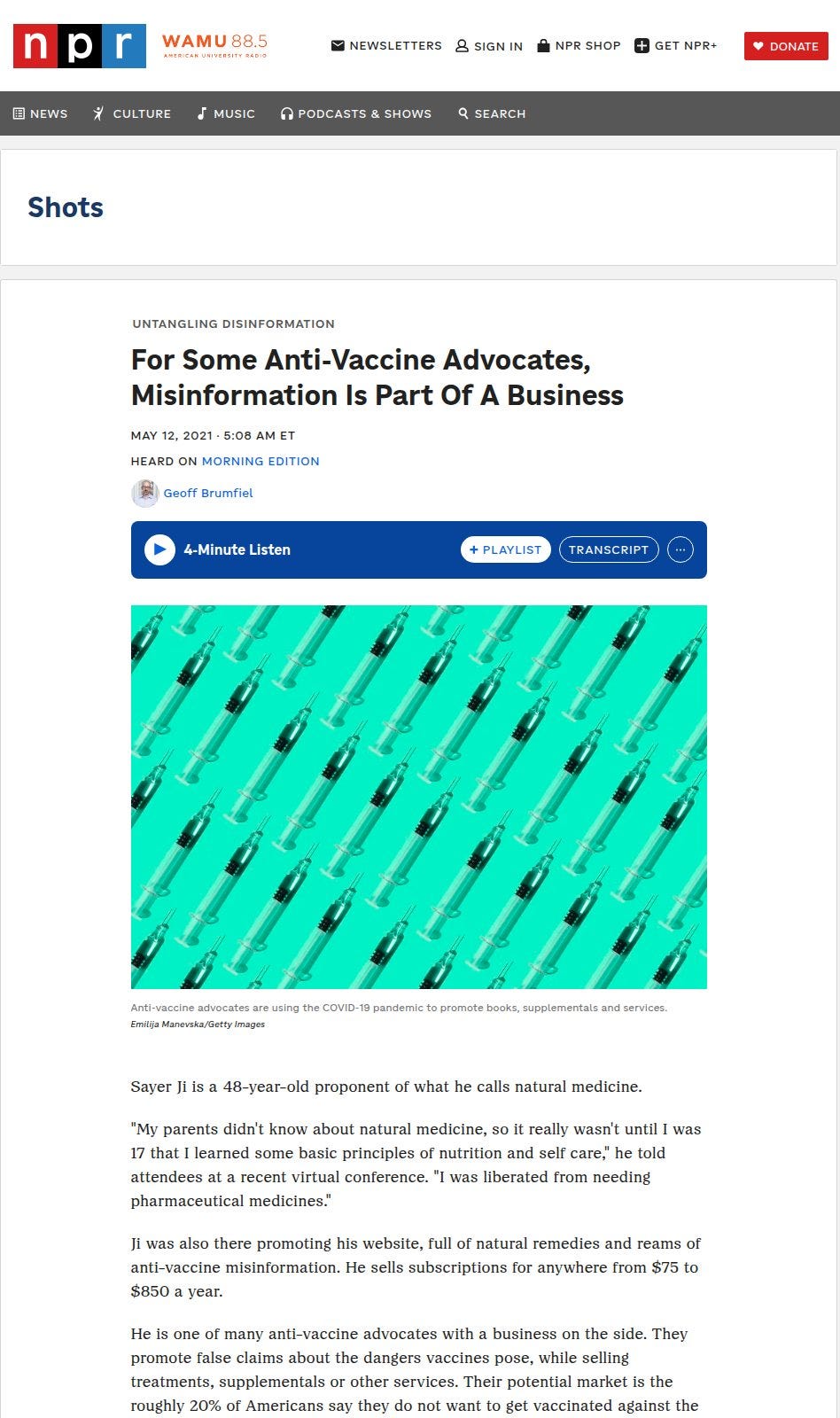
That was NPR’s headline about me in May 2021. This is the rest of the story: the emails, the report it was built on, and the funding question NPR asked of me but not of itself.
By Sayer Ji · October 2026
Disclosure. I am the subject of the NPR story discussed here. I founded GreenMedInfo, which offers paid memberships, and I have a financial interest in Regenerate Company, which sells nutritional products. I’ve stated these interests openly for years. This article publishes my full email exchange with NPR from May 4, 2021, parts of which I first published that month, and links every factual claim to a public record so readers can check it.
What NPR published
On May 12, 2021, NPR’s Morning Edition aired and published a story by senior science correspondent Geoff Brumfiel under the headline “For Some Anti-Vaccine Advocates, Misinformation Is Part Of A Business.” I was the first person named. The story described my website as “full of natural remedies and reams of anti-vaccine misinformation,” noted that it “sells subscriptions for anywhere from $75 to $850 a year,” and placed me among “anti-vaccine advocates with a business on the side” who “promote false claims about the dangers vaccines pose, while selling treatments, supplementals or other services.” (NPR, May 12, 2021)
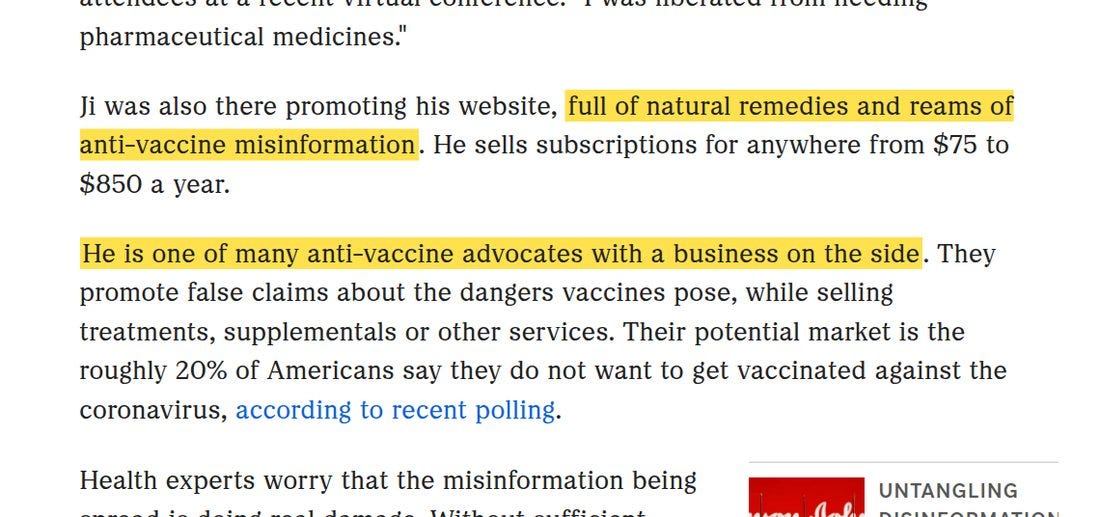
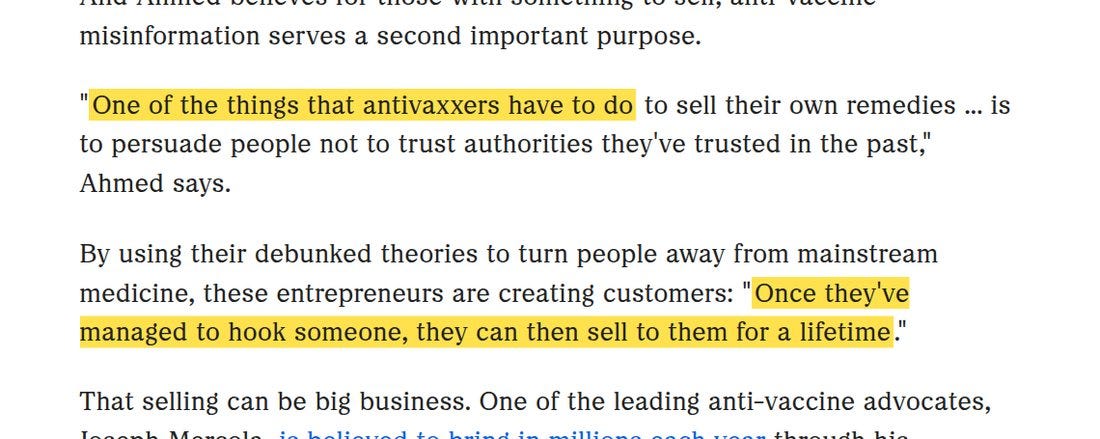
The story’s central claim, that misinformation is a sales funnel, came from one source: Imran Ahmed, chief executive of the Center for Countering Digital Hate (CCDH). “Once they’ve managed to hook someone, they can then sell to them for a lifetime,” Ahmed told NPR. (NPR)
The next day NPR ran a companion story by Shannon Bond, “Just 12 People Are Behind Most Vaccine Hoaxes On Social Media, Research Shows.” It repeated Ahmed’s figure that the “Disinformation Dozen” — a list that included me — “produce 65% of the shares of anti-vaccine misinformation on social media platforms.” (NPR, May 13, 2021)
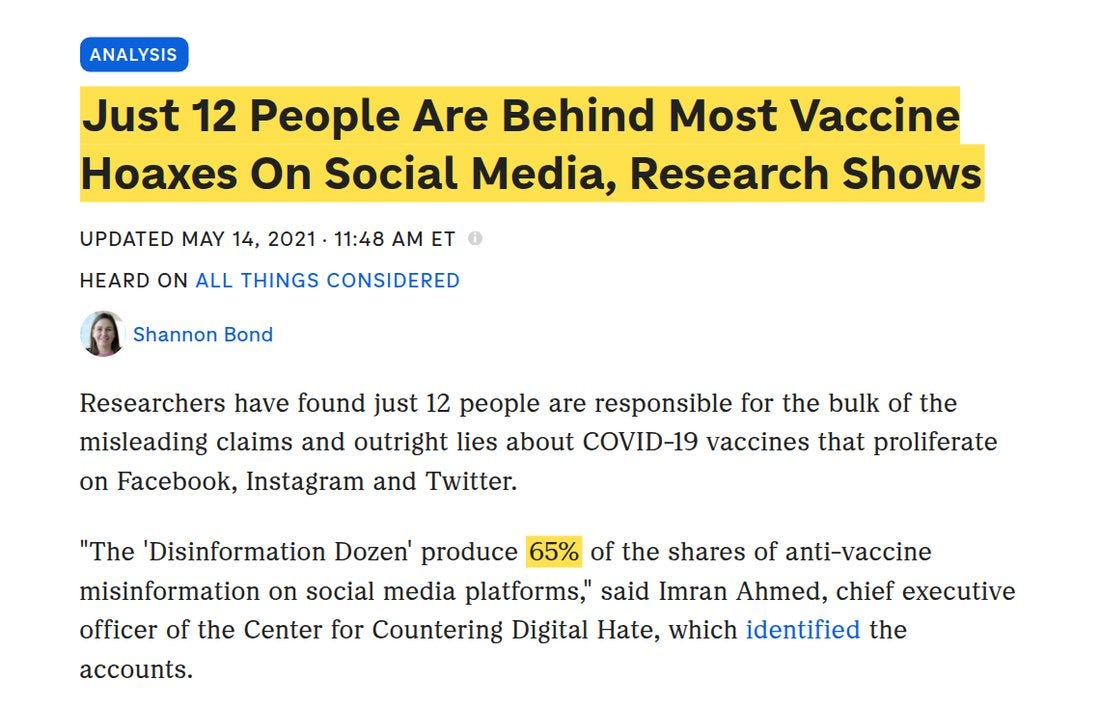
Both stories are still online, and neither carries a note about what has come out since.
The full exchange
The story didn’t begin with a tip about my business. It began with CCDH’s list. The whole exchange took place on the evening of Tuesday, May 4, 2021, eight days before the story ran. Here it is, in order and unedited, except that I’ve removed the reporter’s private email address and one aside of mine about his email provider that had nothing to do with the story.
5:10 PM — Brumfiel’s first email
Mr. Ji,
I’m a reporter with National Public Radio who’s working on a story about the business side of the anti-vaccine movement. You came to my attention because of the “Dirty Dozen” report, and I’ve become interested in your work with GreenMedInfo.com and your new non-profit.
I have several questions about the business side of GreenMedInfo and Stand For Health Freedom (whether these entities are your principal source of income, for example). I also would like your response to those who say you are using false, anti-vaccine conspiracy theories to promote your business.
You will be featured prominently in my reporting, and so I would welcome the opportunity to speak directly. If you choose to decline, I will use your online postings as best I can to represent your views.
The best way to reach me is through my encrypted account: [address removed]
Thanks very much for your time,
Geoff
Geoff Brumfiel | Senior Science Correspondent | National Public Radio
5:49 PM — My reply
Greetings Geoff,
Please feel free to send the questions, and I will consider whether a response would be appropriate at this time. My experience, thus far, with media outlets such as yours, is that both your funding sources and board members and trustees contribute directly or indirectly to the nature and type of content you publish, and which often unfairly mischaracterizes those within my community who advocate for informed consent, and for honest reporting on both the risks and benefits of medical interventions such as vaccination.
It is, therefore, with caution that I would proceed in further discussion about your intention to report on the so-called “business side of the anti-vaccine movement” -- a phrase already so loaded with bias, misunderstanding, and mischaracterization, that I hesitate to respond, as I have no desire to reify falsities implicit within the language you choose to use.
That said, I am willing to give you and NPR the benefit of the doubt, as is my inclination when a human with openness, curiosity, and perhaps a modicum of good intention reaches out.
[One sentence about the reporter’s email provider omitted.]
Best regards
9:00 PM — Brumfiel’s seven questions
Hi Sayer,
Here are the questions. As I said, it’s entirely your choice whether to answer any or all. The story will only be a few minutes of air time, so even though I’m asking a lot of questions, I’ll probably just be able to use a tiny fraction of the answers (though all will be helpful).
As it’s radio, I may have to read parts of your answers aloud, and I may still opt to use tape of you speaking from your videos. But for the web version of the story I could incorporate portions of written responses.
Do you have any stats about the scale GreenMedInfo you’d like to share? I see numbers all over the place. Some describe the revenue in the $100,000s of dollars... some in the millions... some say over a million users, though this page says 6 million. How many subscribers do you have? Do you want to give me a sense of revenue numbers?
How much of your personal income comes from GreenMedInfo and Stand For Health Freedom? At this point, is this work your main gig? Or do you have another job?
Have you seen growth in either organization during the pandemic? Would you be willing to put numbers on it?
How big a threat is deplatforming to your businesses? Are you worried at all about the personal financial hit that might come from being deplatformed by Facebook? (where, I think you have the most followers?)
A big part of this story is the accusation that anti-vaccine activists such as yourself are seeking to profit from misinformation you’re pushing online. The idea is that you use it to both alienate people from the mainstream establishment and then get them to buy into the things you’re selling or promoting. How do you respond to this allegation?
I noticed that you used to focus a lot more of your writings and work on cancer, but seem to have switched to COVID and vaccines during the pandemic. Was this a deliberate move? If so why? Were you trying to catch people’s attention? Or meeting them on the issues they were concerned with?
I’ve also noticed a lot of overlap with more right-wing conspiracies in some of the things you talk about recently. Ideas of the vaccine being exerted for global control, for example. Are you trying to appeal to a new audience? Or are you being influenced by things you see and read elsewhere?
I think that’s probably a pretty good list. If you’re interested in responding, please do so by tomorrow evening.
Thank you again for your time, Geoff
9:29 PM — My question back
Hi. I had a few minutes to look at NPR funding and sponsorship and found National Public Media has worked directly with the pharmaceutical industry trade group PhRMA:
“Through a series of Brand Soundscapes distributed in sponsorships across NPR platforms, medical researchers and patients share how what’s produced in the lab affects life outside of it.
PhRMA’s Brand Soundscapes were also featured in native integrations as part of their launch sponsorship of the NPR App. This new sponsorship format was designed by the NPM Creative team to ensure a smooth and seamless user experience.”
Given the tone and language of your inquiry, it now strikes me as odd that your media group accepts funding and even constructs integrations with your NRP [sic] App to promote their interests, rendering the pretense to conflict-of-interest free reporting null and void, from my seat.
I would like to ask you for an explanation or official response to this NPM/NPR connection with PhRMA before proceeding, and will likely be doing a report as well on the question of how NPR generates revenue from biased reporting in favor of its sponsors.
(Brumfiel’s first email, my reply, question 5 and my PhRMA question were first published at GreenMedInfo on May 13, 2021. The rest is published here for the first time, from my email archive.)
What the questions show
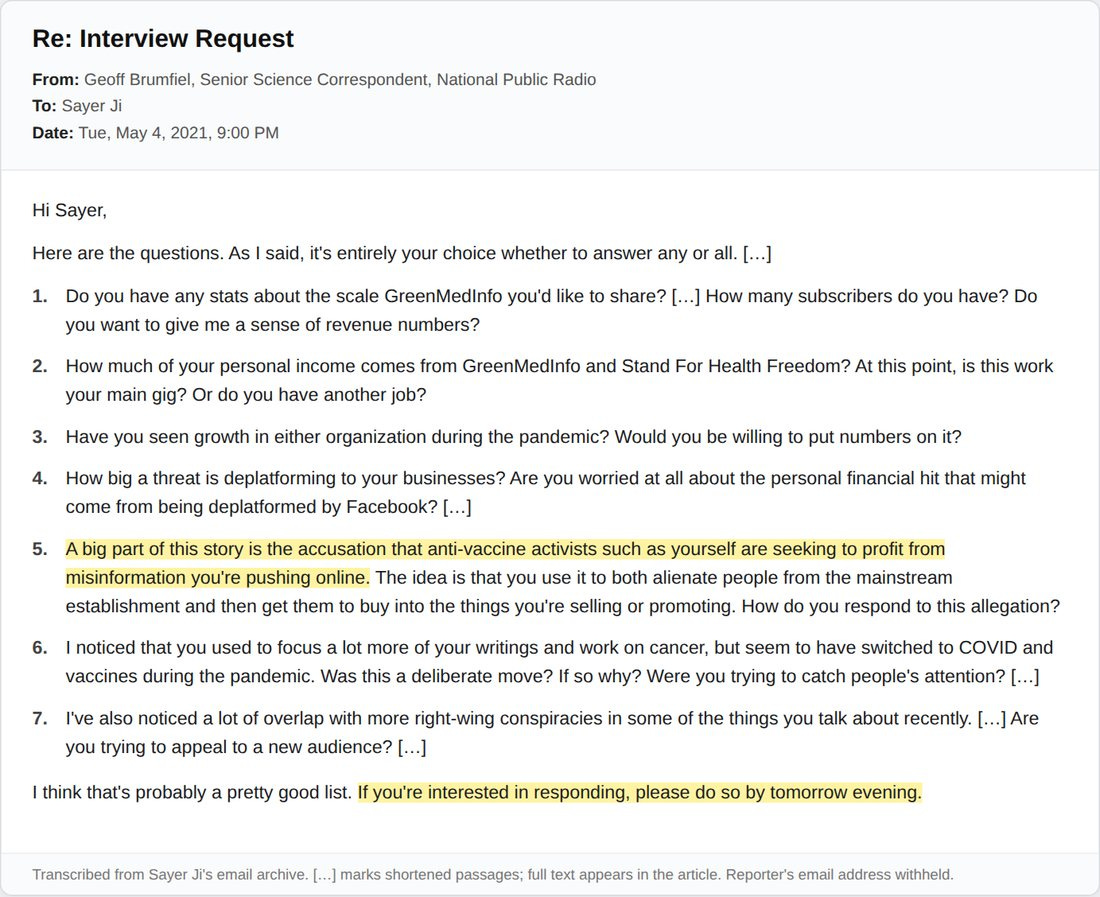
The premise came first. The “Dirty Dozen” report was CCDH’s Disinformation Dozen, published March 24, 2021. Before the first question was asked, the story was already about “the business side of the anti-vaccine movement” and I was already cast as part of it. If I declined, my “online postings” would be used to “represent” me.
Four of the seven questions were about my money. Questions 1 through 4 asked for revenue, subscriber counts, my personal income, whether this was my “main gig,” pandemic growth “numbers,” and the “personal financial hit” of being deplatformed. None asked whether anything I had published was true.
Question 5 was CCDH’s thesis, put to me as an accusation. “The idea is that you use it to both alienate people from the mainstream establishment and then get them to buy into the things you’re selling.” That is Imran Ahmed’s “hook someone... sell to them for a lifetime” argument. NPR didn’t attribute it to an independent researcher, a study of buyer behavior, or any data on my customers.
Questions 6 and 7 assumed motives. Writing about COVID during a pandemic was treated as a possible bid to “catch people’s attention,” and my views were sorted into “right-wing conspiracies.” I had written about informed consent and vaccine safety for years before COVID. NPR’s own story says so, describing me as having “spent years” on these views.
About 24 hours to answer seven questions. The questions arrived at 9:00 PM with a deadline of “tomorrow evening.” Rather than trade written answers, Brumfiel and I agreed to record a cross-interview on May 5 in which each of us questioned the other.
What the story did with it. NPR printed GreenMedInfo’s subscription prices, my statement that the site wasn’t a major source of income, my comment on deplatforming, and an excerpt from one of my Facebook videos, as Brumfiel said it might. It printed no revenue figure and no subscriber count, and nothing in it measured whether anyone had profited from misinformation. (NPR)
The question I asked back
If a reporter’s premise is that money shapes speech, the premise should apply to the reporter’s employer too. That was the point of my 9:29 PM email about PhRMA’s sponsorship. Before we spoke, I also asked when, or whether, NPR’s Gates Foundation funding had ended, and what the money paid for. (GreenMedInfo)
His answer, in full:
NPR has a pretty long list of corporate sponsors (the most recent I could find is in our 2019 annual report). Our newsroom is editorially separated from the business side of the operation. I am not in direct contact with sponsors, and they have no influence over what I write or how I write it.
As far as I know, we continue to receive funding from the Gates Foundation. It goes in part towards our global health coverage.
I appreciated that he was candid, and we went on to record a cross-interview on May 5, 2021, in which each of us questioned the other. It’s published unedited so anyone can compare what was said with what was printed.
Here is what the public record shows about the money he confirmed.
The grant in effect at the time. The Gates Foundation’s own grants database lists a $4,000,000 commitment to National Public Radio in November 2020, six months before the story, from the foundation’s “Global Policy and Advocacy” division, under the topic “Global Health and Development Public Awareness and Analysis,” with a duration of 35 months. That put it in effect when the story ran in May 2021. It lists earlier NPR grants of $3,000,000 (2018), $2,000,000 (2016), $4,500,000 and $1,800,000 (2013), and another $4,571,428 in November 2023. (Gates Foundation committed grants database)
The scale. A 2020 Columbia Journalism Review investigation found that the foundation had given NPR $17.5 million through ten grants since 2000, “all of them earmarked for coverage of global health and education, specific issues on which Gates works.” (CJR)
The foundation’s stake in vaccines. In 2020, the year of that grant, the Gates Foundation spent $220 million on vaccine development alone. (Gates Foundation 2020 Annual Report)
NPR knows how to disclose this. On its Gates-funded global health coverage, NPR states that “NPR receives financial support for this coverage from the Gates Foundation.” (NPR, About Goats and Soda)
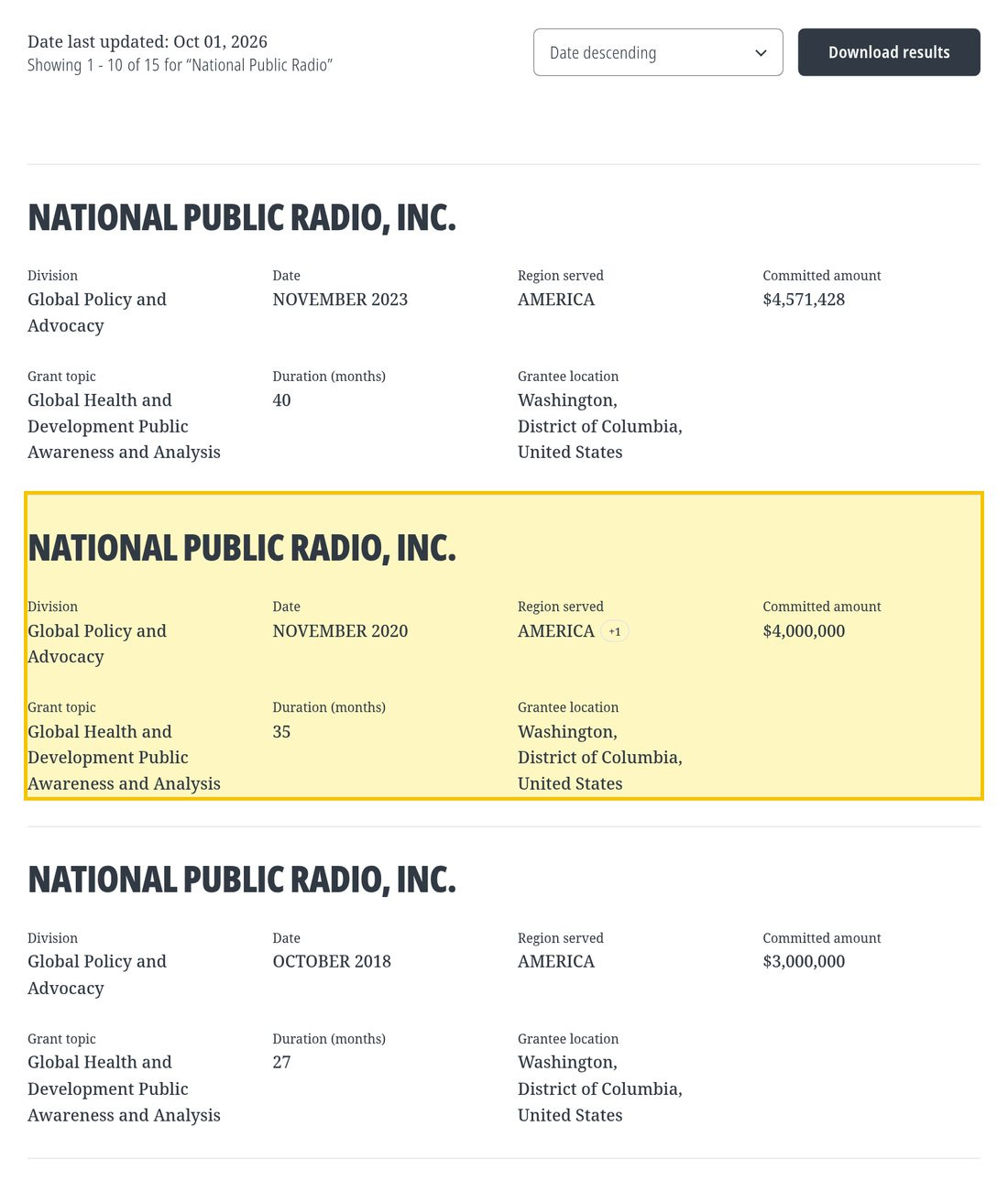
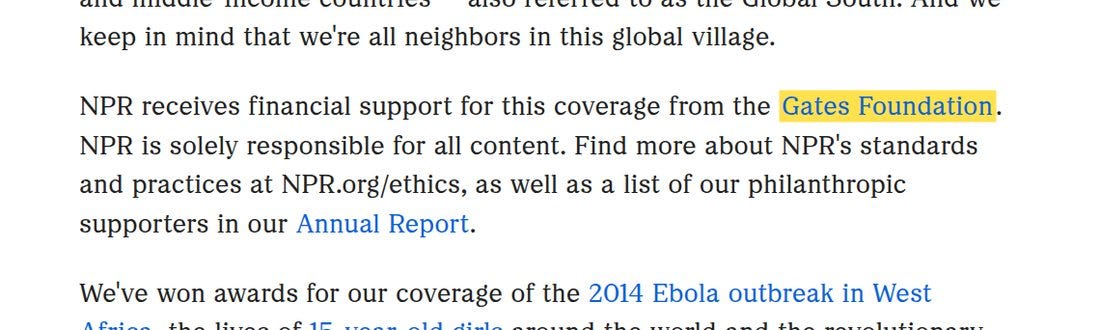
To be precise about what this does and doesn’t show: I have no evidence that Gates money paid for this particular story, which ran in NPR’s Shots health section rather than its Gates-funded global health blog. NPR says its newsroom is editorially independent. Its footer — “NPR does not offer or accept money for coverage or interviews” — refers to paying for individual stories, and foundation grants that underwrite whole coverage areas are a different arrangement.
That distinction is exactly my point. NPR’s story didn’t show that my writing was bought, either. It showed that I have a business, and then invited readers to assume the business explains the writing. If having a commercial interest that touches your subject is enough to make your speech suspect, the same test applies to a newsroom funded to cover global health by one of the world’s largest vaccine funders, reporting on people who question vaccines. NPR applied the test to me and not to itself.
You can watch my full “cross interview” with Geoff below.
The report underneath the story
NPR’s business story relied on CCDH for three things: the source list, the growth statistic, and the profit thesis.
The growth figure. NPR reported that “147 key anti-vaccination accounts have managed to grow their followings by at least 25% since the start of the pandemic.” (NPR) That number comes from CCDH’s Anti-Vaxx Playbook, which counts 10.1 million new followers across 147 accounts “since 2019.” (CCDH, The Anti-Vaxx Playbook) Gaining followers is not evidence of misinformation, and it says nothing about income.
The “65%” figure. Three months after NPR ran it, Meta published the most detailed public critique of CCDH’s method. Monika Bickert, Meta’s vice president of content policy, wrote:
The report upon which the faulty narrative is based analyzed only a narrow set of 483 pieces of content over six weeks from only 30 groups, some of which are as small as 2,500 users. They are in no way representative of the hundreds of millions of posts that people have shared about COVID-19 vaccines in the past months on Facebook.
Further, there is no explanation for how the organization behind the report identified the content they describe as “anti-vax” or how they chose the 30 groups they included in their analysis.
Meta also reported that the twelve people “are responsible for about just 0.05% of all views of vaccine-related content on Facebook,” counting true and false posts alike. (Meta, August 18, 2021)
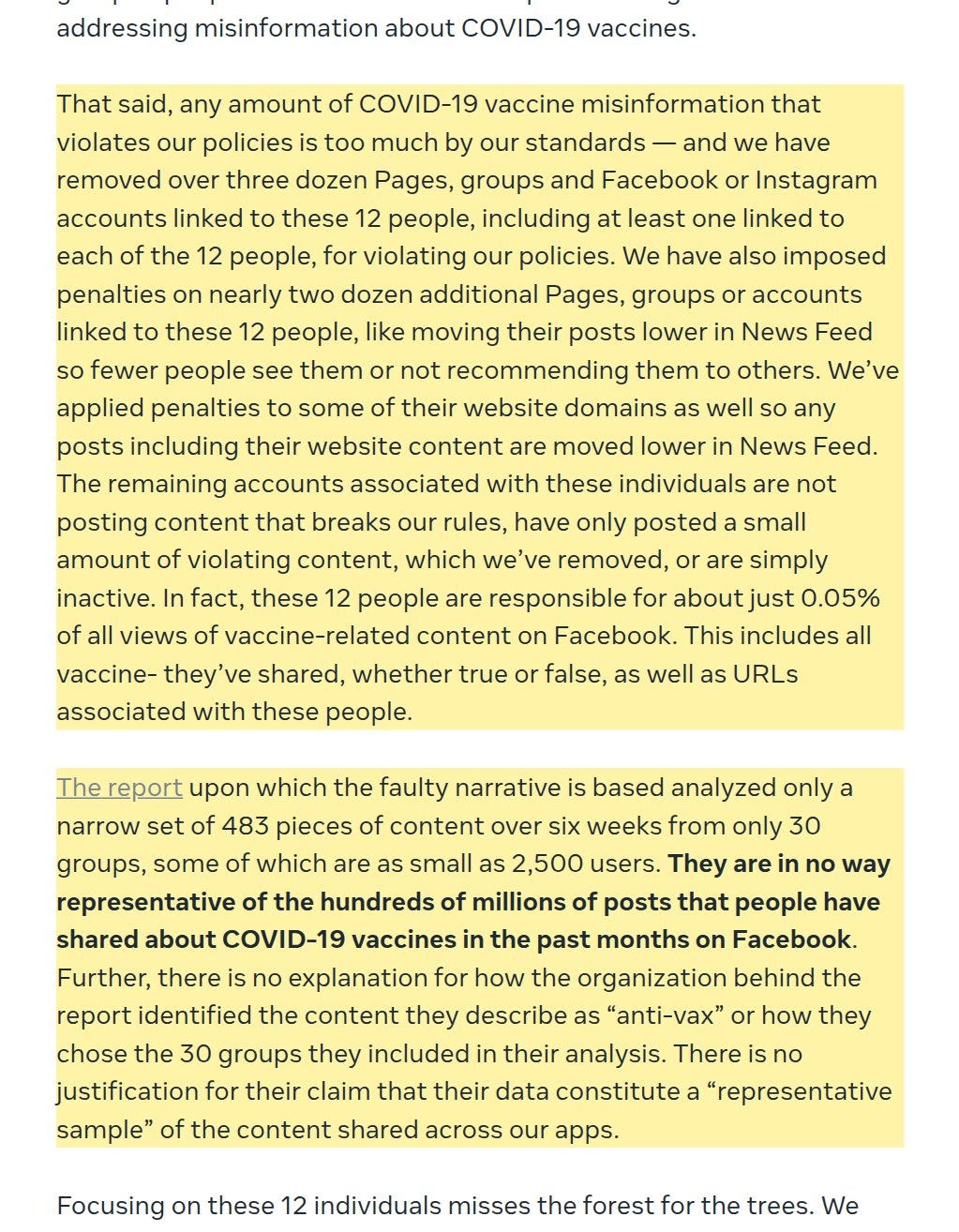
In fairness, Meta’s 0.05% and CCDH’s 65% measure different things. One is a share of all vaccine-related views; the other is a share of a sample CCDH labeled anti-vaccine. I’ve seen the gap between them described as a “1,300-fold error,” and I won’t repeat that, because the comparison doesn’t hold. The defensible point is Meta’s methodological one: a sample of 483 posts from 30 groups, with no stated criteria, couldn’t support a national claim. In the same statement Meta said it had removed “over three dozen Pages, groups and Facebook or Instagram accounts linked to these 12 people.” I include that too, because a record that leaves out the unfavorable parts isn’t a record.
The profit thesis. Three weeks after NPR’s story, CCDH published Pandemic Profiteers, claiming an “Anti-Vaxx Industry” with “annual revenues of at least $36 million.” (CCDH, June 1, 2021) By CCDH’s own description to the UK Parliament, that figure was “based on a limited view of their finances based on self-reported filings and publicly available revenue estimates for 22 organizations.” (CCDH submission to UK Parliament) NPR’s story previewed that thesis before the report supporting it had been published.
Where the figure went next
On July 15, 2021, White House Press Secretary Jen Psaki told reporters: “There’s about 12 people who are producing 65% of anti-vaccine misinformation on social media platforms. All of them remain active on Facebook.” CNN confirmed the statistic came from CCDH. (CNN, July 16, 2021) In the same remarks, the White House said it was “flagging problematic posts for Facebook.” (Reason)
Three years later, Mark Zuckerberg wrote to the House Judiciary Committee that “in 2021, senior officials from the Biden administration, including the White House, repeatedly pressured our teams for months to censor certain COVID-19 content.” He added: “I believe the government pressure was wrong and I regret that we were not more outspoken about it.” He also wrote that the decisions were Meta’s own. (AP via PBS, August 27, 2024)
So a statistic that a nonprofit generated, that NPR amplified, and that the platform it described disputed, became the White House’s talking point for pressuring that platform — pressure the platform’s chief executive later called wrong. NPR covered each step as it happened. It has never gone back to its May 2021 stories to tell readers how the figure at their center held up.
Point by point
NPR said: My site is “full of natural remedies and reams of anti-vaccine misinformation.”
The record: The story cited no specific false statement from GreenMedInfo. The site indexes published, peer-reviewed study abstracts by topic, including research on vaccine adverse effects. It is a deliberately curated index, not a systematic review, and I say so publicly. PolitiFact rated one GreenMedInfo vaccine claim “Mostly False” in December 2020 (PolitiFact), and that’s a fair criticism I’ve had to own. But one disputed claim isn’t “reams,” and NPR didn’t name even that one.
NPR said: I have “spent years pushing scientifically disproven views about vaccines and other conventional medical treatments.”
The record: The story didn’t name one study, claim or treatment that had been “disproven.” The only words of mine it quoted on vaccines were political, not scientific: a warning about “medical apartheid” and “biosegregation” in vaccine-passport policy.
NPR said: I’m among advocates who “promote false claims... while selling treatments, supplementals or other services.”
The record: GreenMedInfo offers paid memberships, and I’ve never hidden it. NPR’s own story quotes me denying the site was a major source of income and says my “primary motive is to provide information.” Having a business is not evidence that the information is false.
NPR said: Misinformation is used to “hook someone” and “sell to them for a lifetime.”
The record: This is Imran Ahmed’s assertion. NPR presented no data on any customer of mine. Its other expert, Kolina Koltai of the University of Washington, said she “believes that many are sincere in their beliefs about vaccines.” (NPR)
NPR said: My Instagram account “was suspended in April after he repeatedly posted misleading and false information.”
The record: The suspension happened. It came weeks after CCDH publicly demanded that platforms remove the twelve people it listed. In 2025, after YouTube changed its policy, both of my YouTube channels were restored (AP).
NPR said: “147 key anti-vaccination accounts” grew their followings by “at least 25%.”
The record: That’s CCDH’s follower count (CCDH). Audience growth during a pandemic shows that people were looking for information. It doesn’t show that the information was false or that anyone profited.
What has changed, and what hasn’t
Other outlets have added context to their coverage. In September 2024 The Guardian added a footnote saying Facebook “disputed the study’s methodology and findings,” while also noting that Facebook had removed accounts linked to the twelve (The Guardian). The Independent added an update in August 2024 saying Meta had “disputed the claims contained and the methodology used.” (The Independent) These weren’t retractions, and I don’t claim they were. They are what responsible publishers do when a source they relied on is seriously challenged.
NPR has added nothing. Its May 12 and May 13, 2021 stories still present CCDH’s work without Meta’s critique, and the business story still names no funder relationship of its own.
What I’m asking NPR to do
Not a retraction. Two editor’s notes:
On both May 2021 stories: a note that in August 2021 Meta publicly disputed the methodology of CCDH’s Disinformation Dozen report, the report on which the stories relied, with a link to Meta’s statement.
On the business story: a disclosure that at the time of publication NPR received Gates Foundation funding for global health coverage, plus a link to the full, unedited cross-interview, so listeners can hear my answers in context.
Both are small, accurate and checkable. They are the standard NPR applied to me: follow the money, and tell the audience what you find.
Frequently asked questions
Who wrote “For Some Anti-Vaccine Advocates, Misinformation Is Part Of A Business”? Geoff Brumfiel, NPR’s senior science correspondent. It was published May 12, 2021 and aired on Morning Edition. A companion story by Shannon Bond, “Just 12 People Are Behind Most Vaccine Hoaxes On Social Media,” ran the next day.
What did NPR ask Sayer Ji? Seven written questions, sent at 9:00 PM on May 4, 2021, with a deadline of the next evening. Four were about revenue, subscribers and personal income. One asked how I responded to “the accusation that anti-vaccine activists such as yourself are seeking to profit from misinformation.” Two asked whether my focus on COVID and my views reflected attention-seeking or “right-wing conspiracies.” The full text is above.
What report was the NPR story based on? Brumfiel’s first email to me said I “came to [his] attention because of the ‘Dirty Dozen’ report,” meaning CCDH’s Disinformation Dozen (March 2021). The story’s growth statistic came from CCDH’s Anti-Vaxx Playbook, and its profit thesis came from CCDH’s chief executive, Imran Ahmed.
Did Meta dispute the Disinformation Dozen report? Yes. On August 18, 2021, Meta said the report “analyzed only a narrow set of 483 pieces of content over six weeks from only 30 groups” and that the twelve people accounted for “about just 0.05% of all views of vaccine-related content on Facebook.” Meta also said it had removed accounts linked to all twelve.
Does NPR receive Gates Foundation funding? Yes. The Gates Foundation’s database lists grants to NPR, including $4 million in November 2020 for global health coverage. When I asked in May 2021, Brumfiel confirmed that NPR “continue[s] to receive funding from the Gates Foundation” and that it “goes in part towards our global health coverage.” There is no evidence that the grant paid for this particular story.
Is Sayer Ji anti-vaccine? I advocate for informed consent and for honest reporting of both the risks and the benefits of medical interventions, vaccines included. I co-founded Stand for Health Freedom to defend people’s right to choose, whichever choice they make.
Sources are linked inline. My May 2021 correspondence with NPR and the full cross-interview video were first published at GreenMedInfo and read.sayerji.com. For corrections, write to sayerji@greenmedinfo.com.