


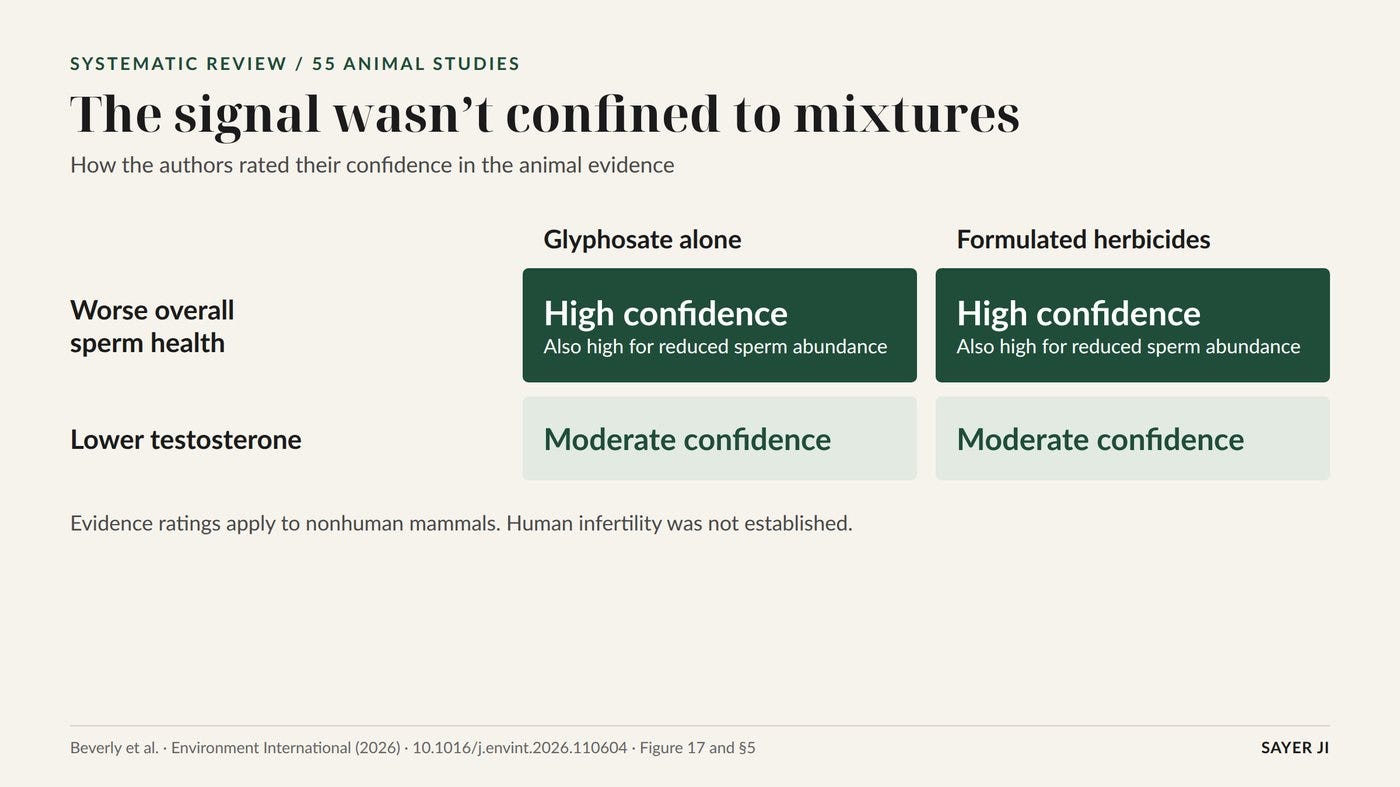
The sperm-health finding wasn’t confined to commercial weed killers. The researchers found high-confidence evidence of harm in animals exposed to glyphosate alone, too.
Under Secretary Robert F. Kennedy Jr.’s leadership, HHS asked federal scientists to examine whether glyphosate might harm male reproductive health. The first phase is now out: a systematic review of 55 studies in nonhuman mammals, led by researchers at the National Institute of Environmental Health Sciences in response to an HHS request.
The authors found high-confidence evidence of worse overall sperm health and reduced sperm abundance after exposure to both glyphosate alone and glyphosate-based herbicides, the products that mix the active ingredient with other ingredients. That is an animal finding, not a diagnosis of infertility in men. But it matters that the signal showed up with the active ingredient alone, not just with commercial mixtures (Beverly et al., §§4.4 and 5).
EPA is asking the public to flag evidence for its glyphosate reassessment. The deadline is Monday, November 23. This is a chance to put the paper in front of the agency and ask how it will weigh it (EPA’s call for studies; Federal Register deadline).
What the researchers actually found
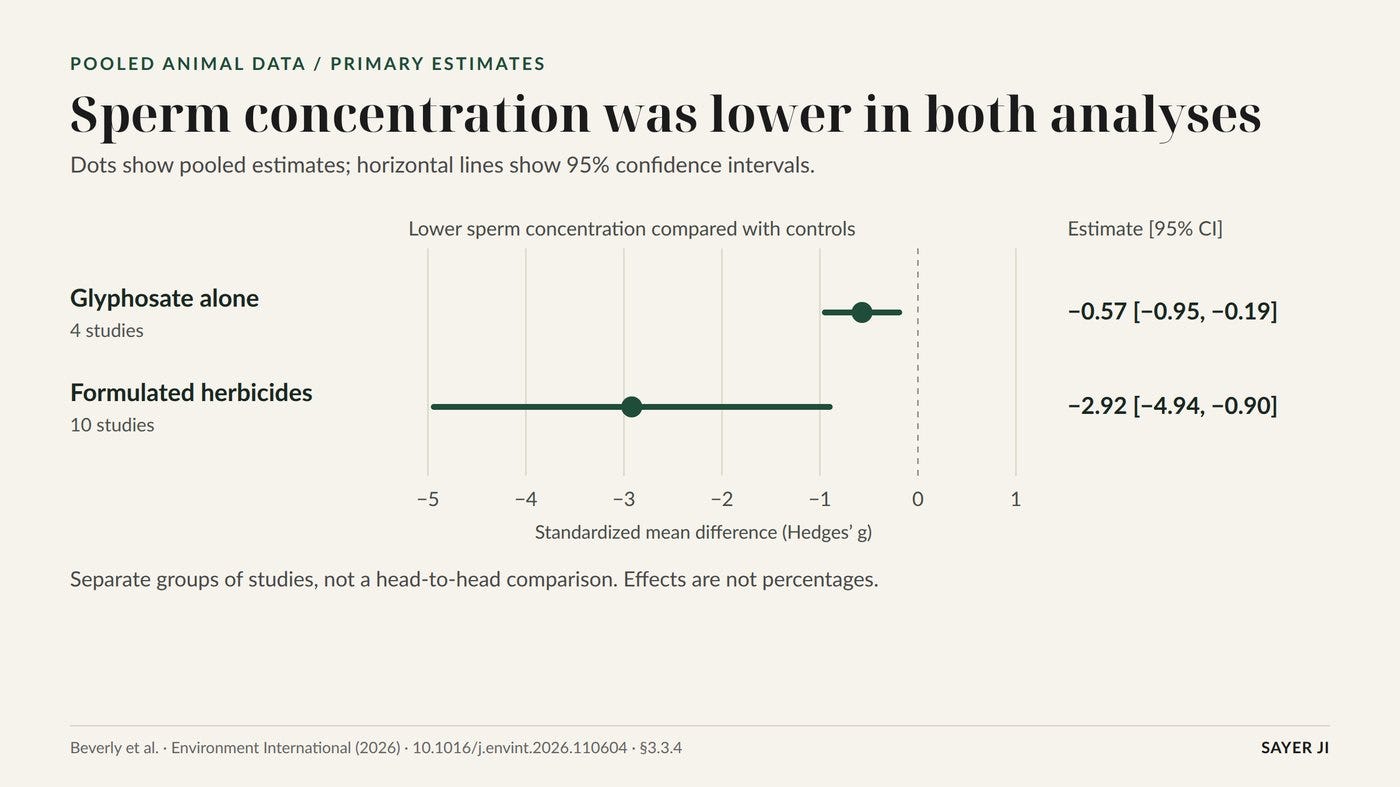
The headline result is sperm concentration. It was lower in the pooled analyses for both glyphosate alone and the formulated products. Total sperm count also trended lower, but neither primary pooled estimate for total count was statistically significant. The authors’ high-confidence rating for overall sperm health reflects the evidence across several measures, not a finding that every individual measure changed in every experiment (paper, §§3.3.4–3.3.5 and Figure 17).
THE TECHNICAL RECORD
For sperm concentration, the pooled standardized mean difference was −0.57 (95% CI −0.95 to −0.19; 4 studies) for glyphosate alone and −2.92 (95% CI −4.94 to −0.90; 10 studies) for formulations. These are standardized effects, not percentage declines. The separate estimates are not a head-to-head comparison of how toxic the two exposures are (paper, §3.3.4).
Testosterone is a secondary finding. Both pooled estimates showed reductions even after potential outliers were removed, but the authors rated the evidence moderate confidence. The pattern was steadier when exposure began in juvenile or adult animals than when it began during gestation (paper, §§3.4.4–3.4.5 and 4.2).
What this does not tell us about people
Some experiments reported changes at doses that numerically overlapped regulatory reference values; others found no effect at similar doses. For example, several studies reported more abnormally shaped sperm around 1.75–2 mg/kg per day, while another found no effect at a comparable dose. The animals, routes, timing and duration weren’t interchangeable. An administered animal dose is not a measurement of what a person takes in from food or water (paper, §§4.3 and 4.5.3).
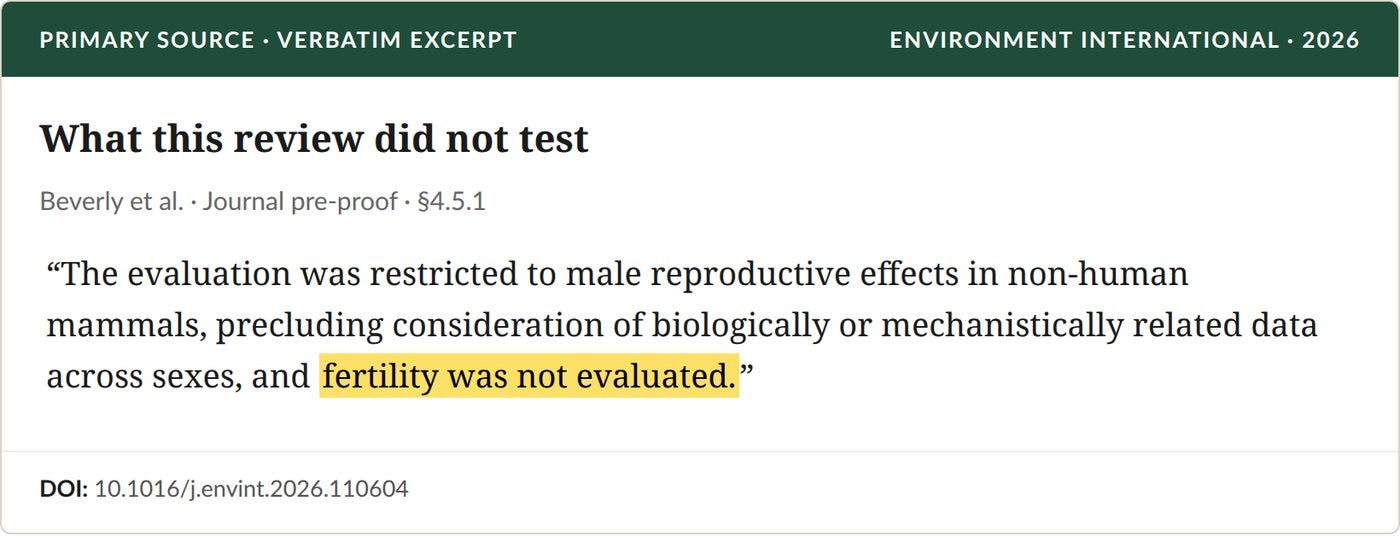
The review did not evaluate fertility itself or determine the risk to men at real-world exposure levels. The authors also did not have access to unpublished pesticide-registration data and could not determine how much individual co-formulants contributed. NIEHS plans to review human and mechanistic evidence in the next phase; the current study’s extraction and quality assessments are available in the public HAWC record (paper, §4.5; NIEHS protocol).
Put it on the record
EPA released its literature search in August, before this paper appeared, and asked for specific studies it might have missed. In September, Kennedy and EPA Administrator Lee Zeldin signed an agreement committing EPA to assess relevant new research, including on reproductive outcomes, and show how it evaluates the evidence (EPA’s August notice; signed HHS–EPA agreement).
The ask: Add Beverly et al. to the record. Explain separately how the agency weighs the findings for glyphosate and for formulated products, and what evidence it needs to assess real-world human risk. Submit a comment through the Federal Register notice by November 23, 2026, citing EPA-HQ-OPP-2009-0361 and DOI 10.1016/j.envint.2026.110604.
The animal data don’t settle the question for people. They make it a question EPA should answer in public.


Sources
systematic review of 55 studies in nonhuman mammals: https://doi.org/10.1016/j.envint.2026.110604
an HHS request: https://www.niehs.nih.gov/research/atniehs/labs/iha/projects/glygbh
EPA’s call for studies: https://www.epa.gov/pesticides/epa-releases-glyphosate-human-health-open-literature-search-document-public-feedback
Federal Register deadline: https://www.federalregister.gov/d/2026-19775
the public HAWC record: https://hawcproject.org/assessment/1592/
NIEHS protocol: https://www.niehs.nih.gov/research/atniehs/labs/iha/projects/glygbh/mrdata
signed HHS–EPA agreement: https://www.hhs.gov/sites/default/files/hhs-mou-hhs-epa.pdf