


An open letter to Springer Nature, ACM, Sage, and The BMJ, exposing discrepancies between their published claims and editorial correction policies—with highlighted policy-versus-passage exhibits and a demand for stronger scientific accountability and the issuance of formal corrections.
Share the X thread for this open letter.
This investigation is part of a broader effort to establish accountability for the use of misinformation designations against identifiable Americans.
In September 2026, we launched Restore the First, a national citizens’ coalition bringing together 20 organizations and eight independent media outlets to address censorship, government accountability, and enforceable protections for First Amendment rights.
The coalition was convened by six Americans named in the original “Disinformation Dozen” report. Our work now extends beyond the conduct of government agencies and technology platforms to a question of scientific accountability: What happens when published research perpetuates inaccurate or unsupported allegations against the very people targeted for censorship?
We are calling on scientific publishers to examine the documented discrepancies, correct consequential errors, and strengthen their correction policies so that no individual is denied an impartial review because of their views or reputation.
The institutions that claim authority to identify misinformation must themselves be accountable for the accuracy of their claims.
The Organization Behind the Blacklist Now Faces Federal Scrutiny
In a striking development, Imran Ahmed, CEO of the Center for Countering Digital Hate—the organization responsible for the original “Disinformation Dozen” campaign—is now the subject of U.S. government deportation proceedings. In September 2026, a federal district court dismissed his lawsuit challenging the government’s actions, and Ahmed appealed.
Although these immigration proceedings do not constitute a judicial finding that CCDH’s research was false, they place renewed scrutiny on an organization whose allegations helped shape media coverage, government pressure, and subsequent academic publications.
The question for scientific publishers is unavoidable: Did they independently scrutinize CCDH’s evidence before lending their institutional authority to allegations against identifiable Americans?
The credibility of a scientific claim must rest on its evidence—not on the influence or perceived authority of the organization promoting it.
Ahmed v. Rubio — Federal appellate docket
To the editorial leadership and research-integrity offices of ACM, Springer Nature, Sage, and BMJ:
I am asking you to review specific claims associated with the Disinformation Dozen report and adopt a stronger correction policy for consequential statements about identifiable people.
This is not a request that you agree with my views on medicine, public policy, or freedom of expression. It is a demand that the statements you publish be supported by the evidence you cite—and that material errors be addressed through a timely, impartial, visible process.
A person should not have to win an argument about their entire worldview before a journal will correct an inaccurate statement about them.
CCDH’s original report named me among the people it recommended removing from social media platforms. Its recommendations extended to associated organizations and backup accounts. The intended consequences were explicit, not incidental. [1]
On March 24, 2021, the New York Attorney General’s office repeated a 65% assertion in a coalition call for stronger platform enforcement. That documents a connection between the claim and demands affecting public communication. It does not establish that this report caused every later restriction. [2]
Where accusations may be used to justify exclusion, reputational injury, or official intervention, accuracy is not an optional refinement.
The author of the blacklist now faces his own federal reckoning.
There is another extraordinary dimension to this story. Imran Ahmed, the CEO of the Center for Countering Digital Hate—the organization behind the “Disinformation Dozen” campaign—is himself the subject of a U.S. government deportation initiative. On September 8, 2026, a federal judge dismissed his lawsuit challenging the government’s actions, and the case proceeded to appeal.
This development does not establish that CCDH’s research was false, nor is an immigration action a scientific finding. But it underscores the controversy surrounding an organization whose allegations were repeatedly cited by media outlets, public officials, and scientific publications.
The deeper question for those institutions is whether they independently scrutinized the evidence before lending their own authority to accusations against identifiable Americans.
The credibility of a scientific claim must rest on its evidence—not on the prestige, influence, or political standing of the organization promoting it.
Sources: Federal district court judgment, September 10, 2026 · Second Circuit appeal, Ahmed v. Rubio, No. 26-2509
The policy versus the published passage
These cases are not interchangeable. Some raise direct source-accuracy questions; others require clarification of context or inference. The requested remedy must follow the evidence, not a predetermined verdict.
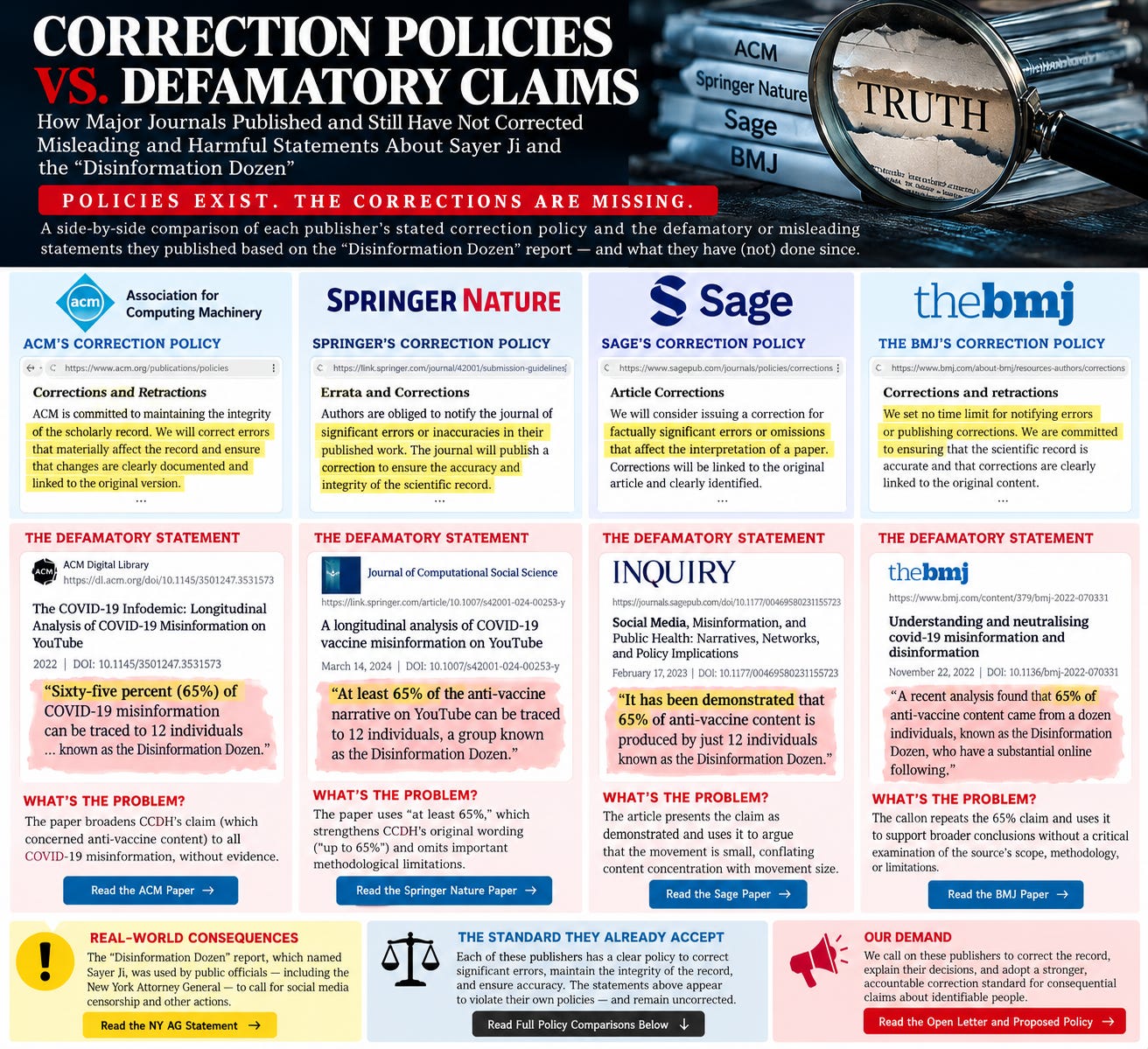
How to read the exhibits: The panels below reproduce short, checked excerpts with emphasis added. They are typeset source excerpts, not screenshots of the original websites. Each has direct source links. The commentary is an editorial assessment, not a court finding of defamation or a publisher’s misconduct determination.
1. ACM: the category became broader
The 2022 WebSci abstract describes the estimate as applying to pandemic misinformation generally, while the underlying report concerns the narrower category of anti-vaccine material. The broader wording is confirmed in the authors’ institutional repository. [6]
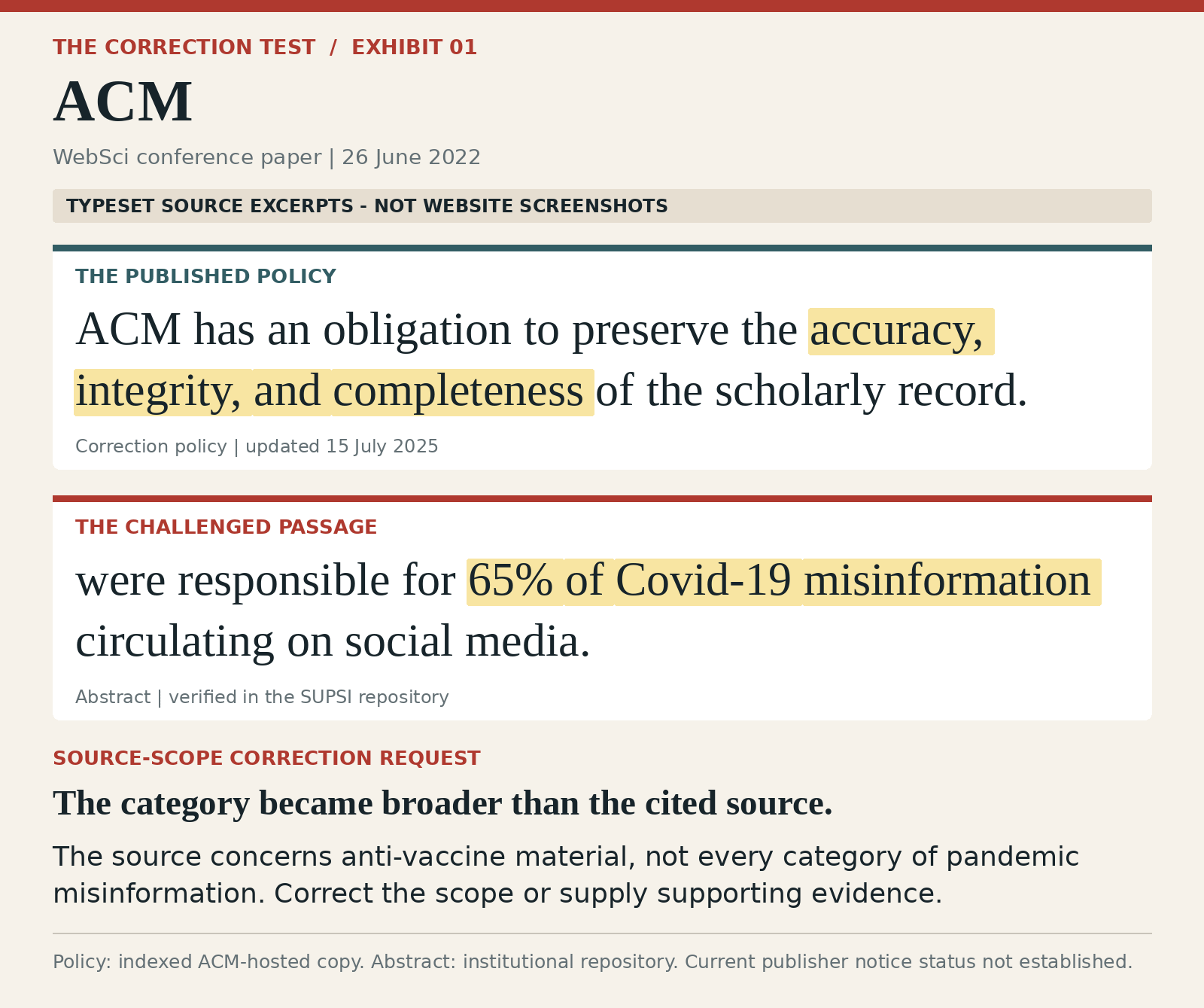
The request: identify evidence for the broader category or correct the abstract and every affected passage. ACM’s policy provides a framework for correcting the scholarly record without automatically retracting otherwise useful research. [3] [4]
Current publisher notices remain incompletely verified. The repository establishes the wording; it does not, by itself, establish what ACM has done in response to a complaint. [5]
2. Springer Nature: the qualification requires an answer
The Telegram paper uses a lower-bound formulation where CCDH’s relevant heading uses an upper-limit formulation. That is an attribution concern requiring a specific explanation, not a reason to dismiss the paper’s entire Telegram analysis. [8]
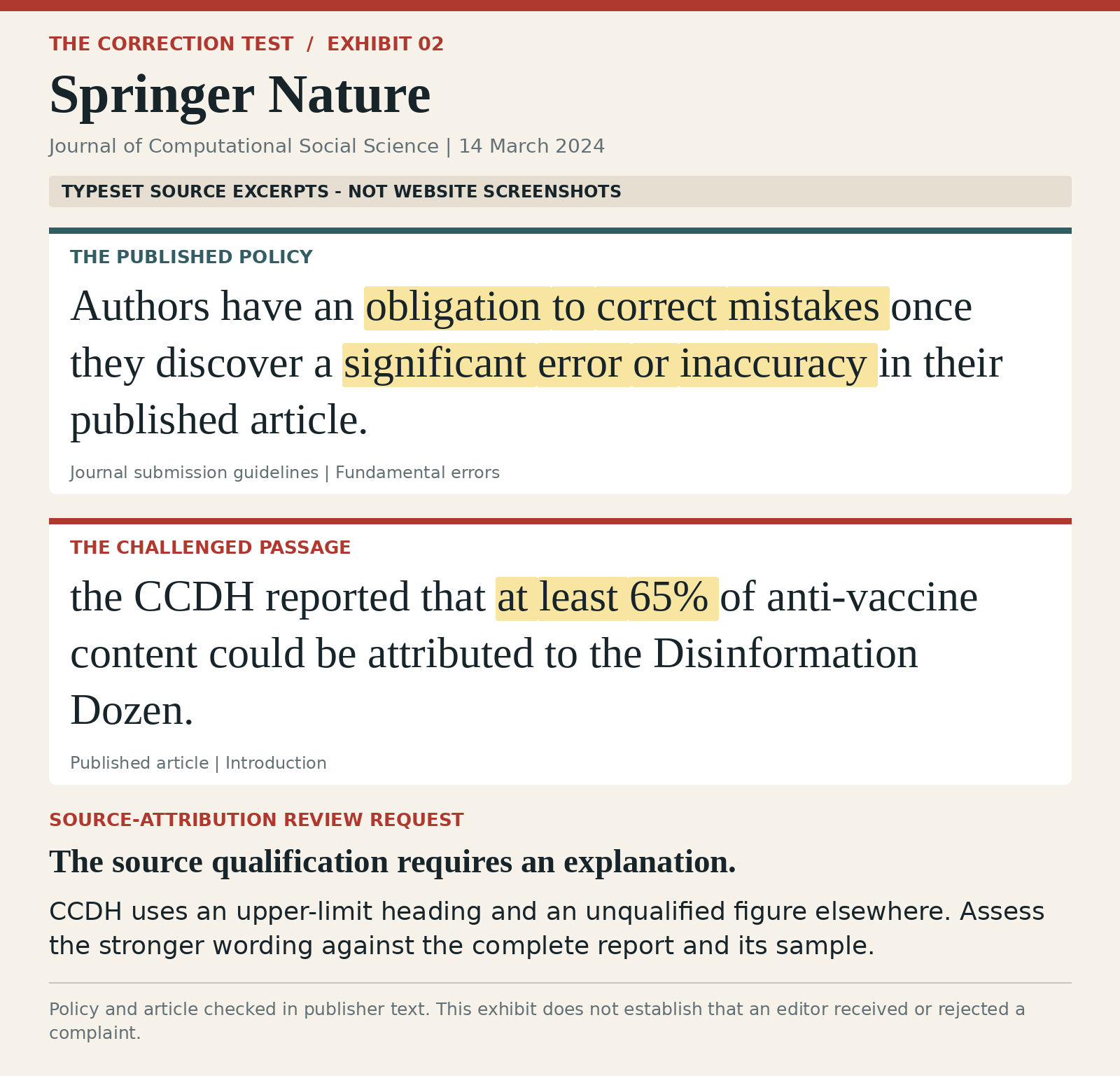
The request: explain the basis for the stronger wording or revise it, preserving the original measurement’s limits. The journal’s own significant-error provision is directly relevant. [7]
There is an important qualification: CCDH also states the percentage without the upper-limit wording elsewhere. The assessment must address the full report, not just one heading. Its Facebook method begins with 483 linked content items from 30 groups and examines their circulation; a large circulation count is not automatically a representative sample of an entire information environment. [1]
3. Sage / INQUIRY: concentration is not movement size
The article repeats the percentage as an established finding, then infers that the movement’s core is relatively small. Concentration of circulation among a few sources does not, by itself, establish the number of participants in a movement. [10]
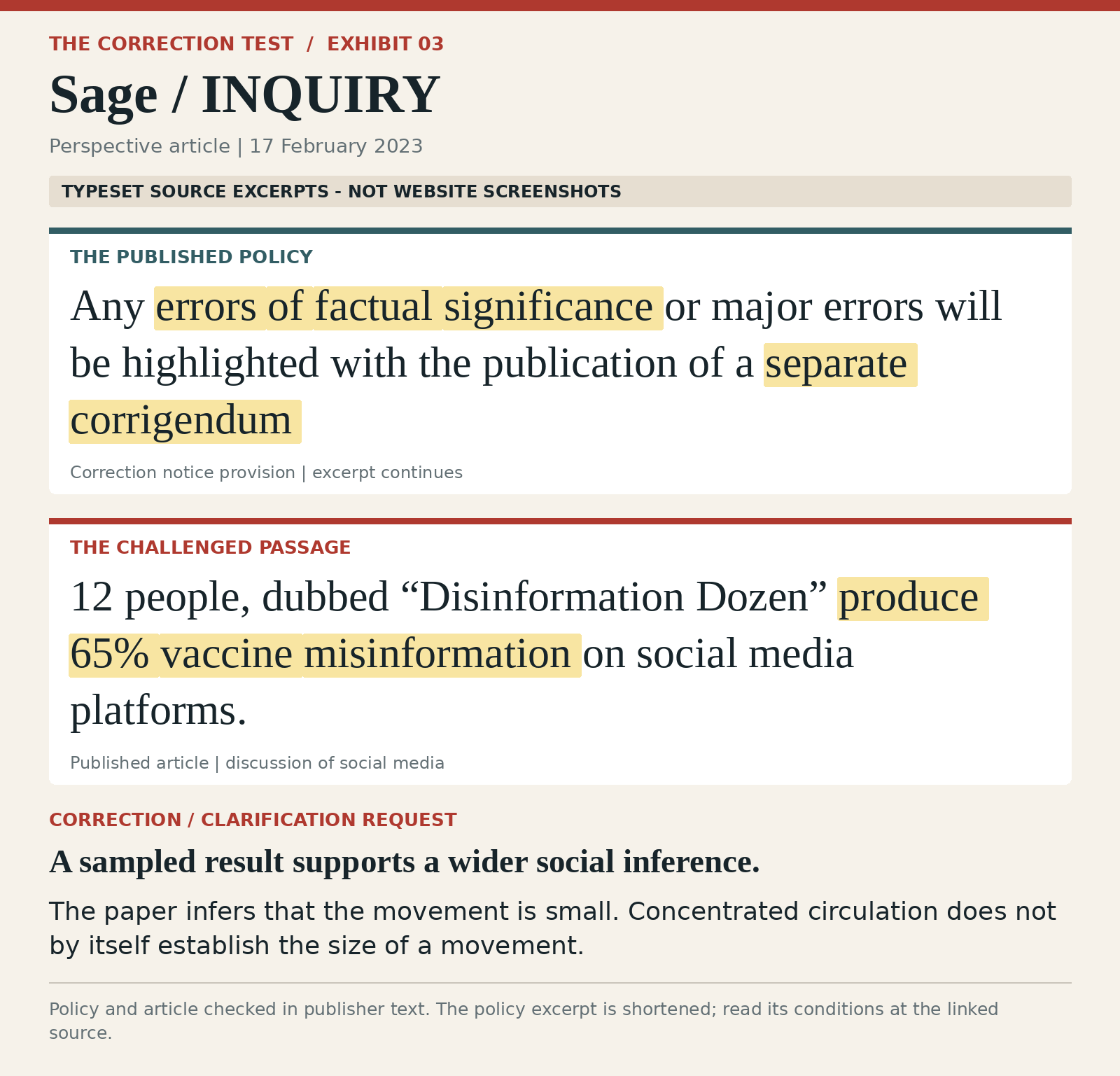
The request: review the factual scope separately from the inference. Correct or clarify an overgeneralized premise; substantiate, revise, or allow a published challenge to the interpretation. Sage’s policy distinguishes significant factual errors from changes that would undermine the work’s overall validity. [9]
The absence of an established data-fabrication allegation does not dispose of a source-accuracy complaint. Honest error can still require a visible remedy.
4. The BMJ: attribution does not eliminate context
The BMJ article attributes the estimate to CCDH. That matters: this is not a claim that the authors invented the number. The question is whether the presentation adequately conveys the selection and measurement limits. The excerpt below was checked against an author-uploaded copy; the current publisher notice history remains incompletely verified. [12] [13]
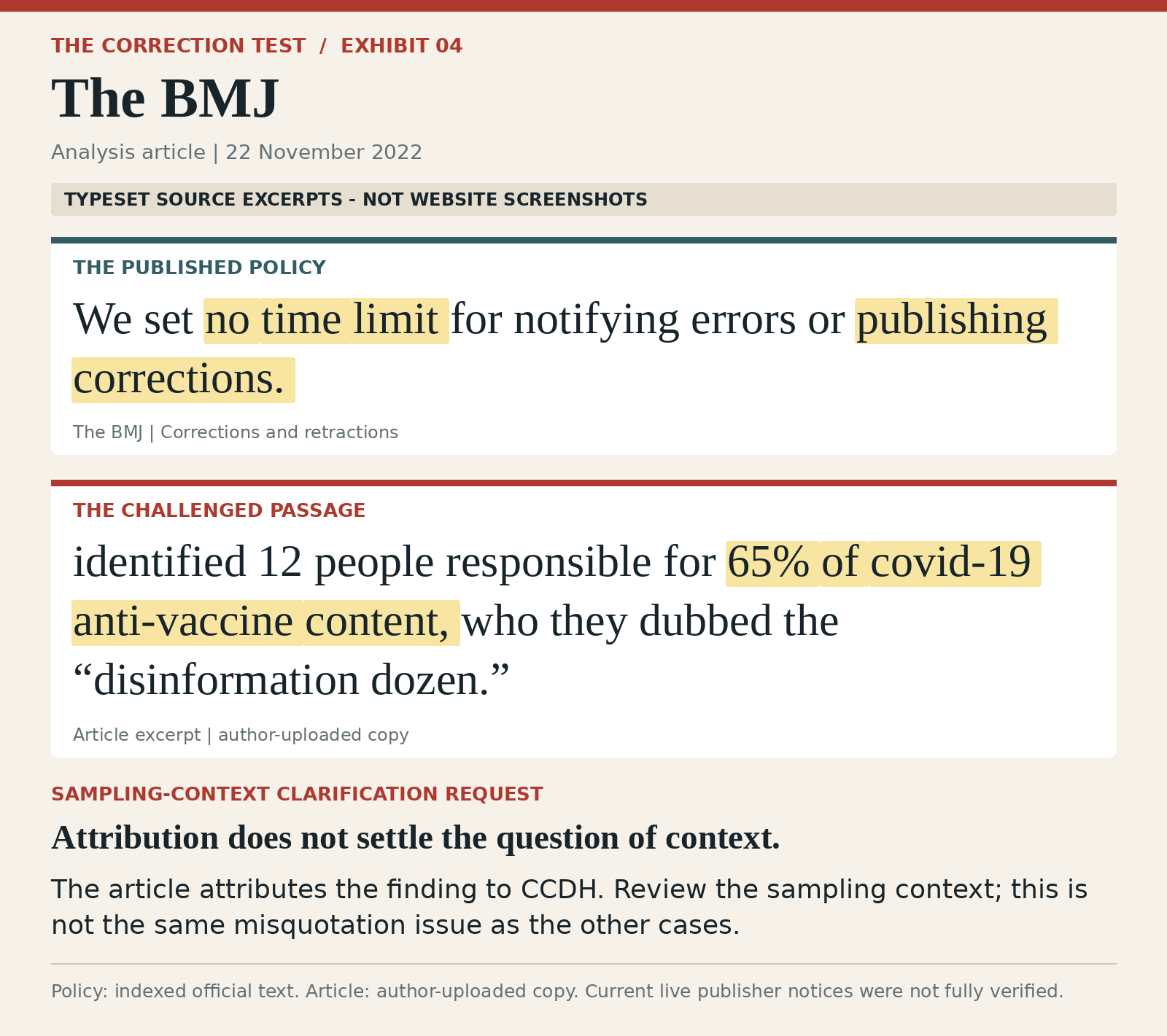
The request: assess whether the wording could reasonably be read as a broadly representative finding and clarify the sampling context where needed. The BMJ’s policy does not impose a time limit for reporting errors, so publication age is not, by itself, an answer to this request. [11]
This is a contextual-accuracy review, not the same source-scope problem as the ACM abstract. The journal also provides a rapid-response channel; a reader response and a formal correction are different outcomes. [19]
The standard must apply to our criticism, too
Facebook’s rebuttal supplies a percentage based on views of all vaccine-related content. That denominator is different from CCDH’s selected anti-vaccine material. Presenting the two percentages as a direct numerical disproof would overstate the evidence. Neither an advocacy organization nor a platform earns automatic evidentiary deference. [16]
Nor should every citation be treated as the same error. The relevant statement in Social Media + Society is attributed and qualified. The JMIR paper cites CCDH without repeating the percentage. Citation alone does not establish that either publication must correct or retract its own analysis. [17] [18]
A correction test must allow an institution to pass. A substantiated correction, a persuasive explanation, or evidence that changes this assessment should be recorded fairly. No claim is made here that every recipient has already received or rejected these requests.
What we ask you to do now
Open a claim-specific review. Assign a case number and responsible office. Preserve the relevant versions, source material, and editorial records.
Answer the evidence. For each challenged passage, state whether it accurately represents its source, whether a generalization is justified, and what action is warranted.
Repair the record wherever you control it. An inaccurate abstract should not remain unchanged while a correction sits elsewhere. Publisher publicity should not continue circulating a claim that the corrected article no longer supports.
Adopt the proposed standard below, or publish an alternative offering equivalent accountability. A policy must identify who acts, by when, how a contested decision can be reviewed, and what happens when the process fails.
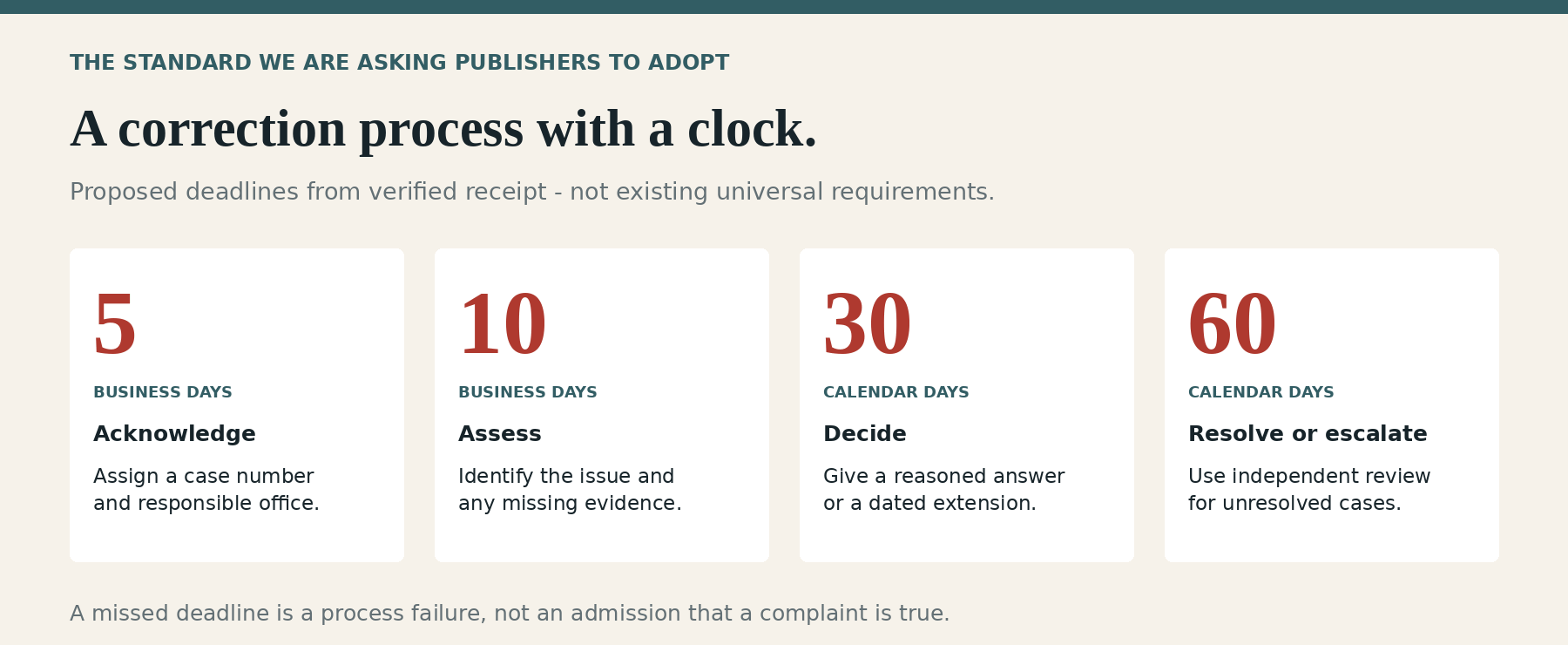
Within five business days, acknowledge the request and identify the responsible office. Within ten business days, complete initial assessment and identify genuinely missing information. Within 30 calendar days, provide a reasoned decision or a dated extension. By 60 calendar days, resolve the matter or escalate it to independent review with a specific timetable. Complete publisher-controlled corrective actions within 30 calendar days of a corrective decision.
These are proposed commitments. A missed deadline is a process fact, not an admission that every allegation is true.
The Precedent Is Already Established: Major Publishers Have Corrected the Record
The scientific journals being called upon to act are not being asked to establish an unprecedented standard. Other major publishers have already revisited their coverage of the same “Disinformation Dozen” allegations.
In 2024, following challenges to the underlying report, several prominent media organizations added qualifications or updates to their original publications.
The Independent — August 7, 2024
The newspaper updated its March 26, 2021 article, Study names 12 most dangerous anti-vaxxers in America, acknowledging Meta’s subsequent objections to the CCDH study’s findings and methodology.
Forbes — August 17, 2024
Steven Salzberg’s article, De-platform The Disinformation Dozen, was updated to address Meta’s objections and CCDH’s response. The original article had advocated removing the designated individuals from social media platforms.
The Guardian — September 17, 2024
The Guardian added a footnote to its July 17, 2021 article, Majority of Covid misinformation came from 12 people, report finds, acknowledging Facebook’s published dispute with CCDH’s methodology and findings.
Read the article and its September 2024 footnote
McGill University
GreenMedInfo’s October 2024 account also documents McGill University’s addition of a pinned comment to an associated educational video acknowledging Meta’s methodological challenge. That reported change should be distinguished from a formal correction to a peer-reviewed paper.
Read GreenMedInfo’s correction chronology
These actions were not universal retractions or admissions that every original allegation was false. They were, however, meaningful acknowledgments that the public record required additional context.
This raises an uncomfortable question for the scientific publishing establishment: If major news organizations can revisit consequential claims arising from the CCDH report, why should scientific journals be less accountable for accurately representing the same evidence?
Indeed, the obligation is especially important when inaccuracies are preserved in scholarly databases, cited by subsequent researchers, and potentially incorporated into public policy.
The distinction is between correcting the record and defending institutional prestige.
Springer Nature, ACM, Sage, and The BMJ each maintain editorial mechanisms intended to protect the accuracy of their publications. We are asking them to use those mechanisms to review the specific discrepancies documented in this investigation—and explain their decisions publicly.
The precedents exist. The correction standards exist. The disputed passages have been identified.
Now the publishers must answer.
Additional documentation:
Editorial authority must come with ownership
Not every board member handled these papers, and individual responsibility should not be invented. Institutional responsibility, however, cannot disappear because nobody accepts ownership of the correction process.
Identify who decides, which standard applies, and how the decision is reviewed. Authors must have a fair opportunity to respond. A complainant’s reputation must not substitute for examining their evidence.
An institution does not discredit itself by acknowledging an error. It risks discrediting itself when preserving authority becomes more important than correcting the record.
I invite researchers, editors, librarians, publication-ethics specialists, and organizations concerned with scientific integrity to endorse this standard. Endorsement would support accurate attribution, fair review, timely correction, and transparent accountability—not every medical or political view held by me or anyone named in the original report.
Correct what the evidence shows to be wrong. Explain what you believe remains defensible. Make the process accountable to the public whose trust you invoke.
Sayer Ji
An open letter issued in connection with the Restore the First accountability initiative
Restore the First — National Coalition
Coalition organizations retain their independence. Inclusion in the coalition does not imply that every partner has individually reviewed or endorsed this letter.
Disclosure: I was named in CCDH’s report and have a direct interest in the accuracy of statements derived from it. The evidence should be evaluated independently of that interest.


COMPANION POLICY / PROPOSED FOR INSTITUTIONAL ADOPTION
Consequential Claims and Correction Accountability Standard
This is a proposed governance policy for journals, conference publishers, learned societies, and research publishers. Its requirements are not presented as existing universal legal duties.
When credible evidence identifies a material inaccuracy in a published claim about an identifiable person or organization, the publisher shall conduct a timely, impartial review and issue a reasoned decision. Where an error is established, it shall correct the record visibly, proportionately, and across the channels within its control.
A materially inaccurate accusation shall not be deemed immaterial solely because correcting it would leave the paper’s principal findings unchanged.
1. Scope and materiality
The standard shall cover research, reviews, analyses, editorials, conference proceedings, abstracts, supplements, and publisher-controlled publicity. Priority review shall apply where a factual claim could reasonably affect reputation, employment, platform access, professional standing, or treatment by public authorities.
Material issues include mistaken identification, inaccurate attribution, altered qualifications, unsupported expansion of a statistic, and omissions that substantially change how an allegation is understood. Neither the complainant’s unpopularity nor editorial agreement with the broader argument shall determine materiality.
2. A fair, evidence-based trigger
A submission shall identify the publication, disputed passage, supporting evidence, and requested remedy or review question. Unsupported or duplicative complaints may be rejected with specific reasons. Credentials, legal representation, proof of motive, and quantified financial loss shall not be prerequisites for assessing a documented accuracy concern.
The publisher shall distinguish factual error from methodological disagreement. That distinction is also recognized by ICMJE, whose recommendations provide separate routes for corrections and scholarly debate. [14]
3. Independent responsibility and appeal
Each accepted case shall have an identified responsible office. Authors and editors involved in the original publication may supply evidence but shall not be the sole decision-makers on a contested complaint about their own work or conduct. Relevant conflicts shall be disclosed and managed.
Where the issue exceeds the reviewing editor’s expertise, an independent specialist shall assess it. Both sides shall receive the reasons for the decision and may seek one independent appeal within 30 calendar days. Appeals shall ordinarily be decided within a further 30 calendar days, with reasoned extensions where necessary.
4. Deadlines and proportionate interim notices
The institution shall adopt the timetable above or publish a comparably specific alternative. Information requests shall explain why the information is necessary and shall not repeatedly restart the clock. An independently established error shall not wait indefinitely for every broader dispute to be resolved.
An interim notice shall require an initial finding of a credible, substantial concern, not merely receipt of an allegation. It shall describe what remains under review without implying a final finding. After independent escalation, unresolved cases shall receive status updates at least every 30 calendar days.
5. Visible correction, not silent revision
A correction shall explain what was wrong, what changed, and whether interpretation or conclusions are affected. It shall reach affected HTML, PDF, abstract, supplementary material, metadata, and publisher-controlled publicity. Material factual amendments shall not be disguised as stylistic changes.
Prior versions shall be preserved appropriately while respecting legitimate privacy protections. Author disagreement shall not create an indefinite veto over an independently established correction. Retraction shall be proportionate to the reliability problem, not a punishment for unpopular speech.
6. Correction must follow the claim
The publisher shall update channels it controls and notify relevant indexing services, repositories, and partners. Where a consequential error has identifiable downstream uses, it shall make a documented, reasonable effort to notify those responsible, distinguishing notification from confirmed action.
Crossmark, where used, shall reflect relevant updates. The service helps readers discover registered changes; it is not a guarantee that every accuracy issue has been resolved. [15] No publisher shall claim power to rewrite another institution’s record or presume every downstream citation invalid.
7. Safeguards for consequential classifications
Before publication, consequential factual allegations about identifiable people shall receive a documented source check. Authors shall distinguish an independent finding from an allegation, an advocacy designation, a sampling rule, and an interpretation.
Non-peer-reviewed evidence shall not be presumed invalid, but its status and relevant limitations shall be clear. Peer review shall not substitute for checking whether a citation supports the sentence attached to it. A prior designation alone shall not establish that a particular statement by a named person is false. When deliberate deception is implied, the definition and supporting evidence shall be explained.
8. Public governance and consequences for process failure
The publisher shall maintain a privacy-protective register of material concerns, dates, status, decisions, corrective actions, appeals, and missed deadlines. Public entries shall distinguish allegations from findings; raw complaints shall not automatically be published.
Repeated unjustified delay, unmanaged conflicts, or failure to implement an established correction shall trigger independent governance review. Substantiated process failures shall require corrective action and, where warranted, reassignment of correction responsibility under institutional rules.
Neither author disagreement, passage through peer review, nor preservation of the principal findings shall alone answer a demonstrated material inaccuracy. Publication age alone shall not bar review of a continuing consequential claim; genuine evidentiary limitations shall be explained.
Institutions that publish consequential claims must also maintain a consequential correction process.
Scope, sources, and publication status
This is an editorial assessment and proposed policy, not a finding issued by a court or publisher. It does not establish that each recipient has been notified or refused to act. These policy comparisons concern currently available text, not every historical policy version.
The four visual exhibits are deliberately labeled typeset excerpts. No reconstructed publisher page is represented as an original.
Linked source register
[1] CCDH: The Disinformation Dozen, March 2021
[2] New York Attorney General: platform-enforcement statement, 24 March 2021
[3] ACM: correction, retraction, and removal policy
[4] ACM policy: indexed ACM-hosted copy
[5] Nogara et al., ACM WebSci 2022: publisher record
[6] Nogara et al.: institutional abstract, SUPSI
[7] Springer journal: submission guidelines, Fundamental errors
[8] Ng et al.: Telegram article, 14 March 2024
[9] Sage: corrections and retractions policy
[10] Westhoff et al., INQUIRY, 17 February 2023
[11] The BMJ: corrections and retractions policy
[12] Wang et al., The BMJ, 22 November 2022
[13] Wang et al.: author-uploaded article copy
[14] ICMJE: corrections and version control
[15] Crossref: Crossmark documentation
[16] Facebook: methodology rebuttal, 18 August 2021
[17] Baker and Walsh, Social Media + Society, 28 January 2024
[18] Pierri et al., JMIR, 24 February 2023
[19] The BMJ: rapid responses to the article
The Correction Test · Publication package · 8 October 2026