


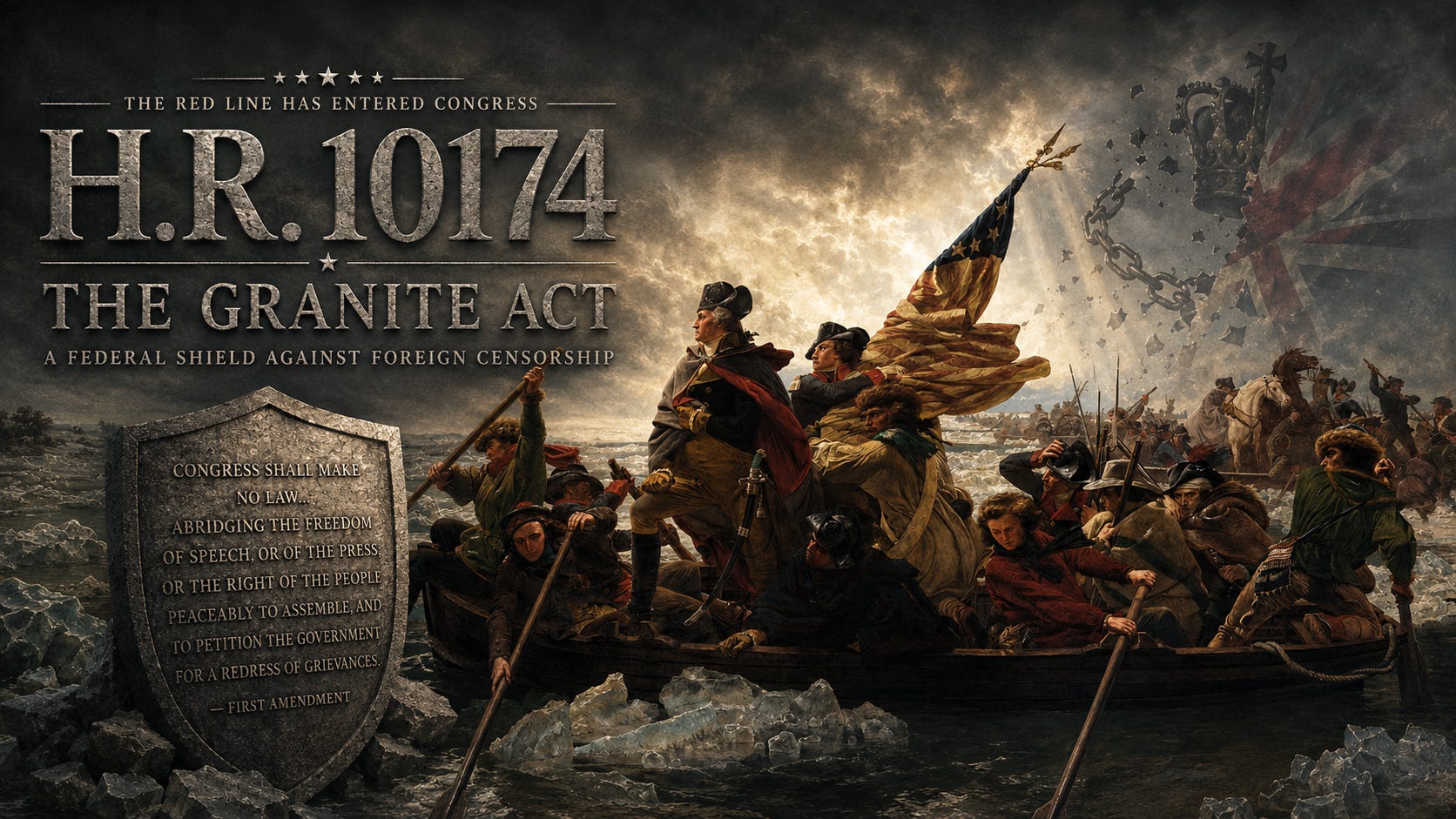
Rep. Michael Rulli has introduced H.R. 10174, a federal shield designed to prevent foreign censorship judgments, fines, orders, and demands from acquiring force in American courts.


Last December, in The Red Line, I wrote that the United States had finally drawn a diplomatic boundary against foreign governments attempting to regulate American speech. In January, in Don’t Tread on the First Amendment, I examined Preston Byrne’s proposed answer: the GRANITE Act, a legal architecture designed to stop foreign speech codes from crossing into American constitutional territory. Then, in They Came for Twelve Americans First, I explained why this question had become personal.
Yesterday, the missing piece arrived.
On August 27, Representative Michael Rulli of Ohio introduced H.R. 10174, the Guaranteeing Rights Against Novel International Tyranny and Extortion Act—the federal GRANITE Act. The bill has been referred to the House Judiciary Committee. Preston Byrne, whose work originated the GRANITE blueprint, describes it as the first federal foreign-censorship shield bill in American history.


What the Bill Would Actually Do
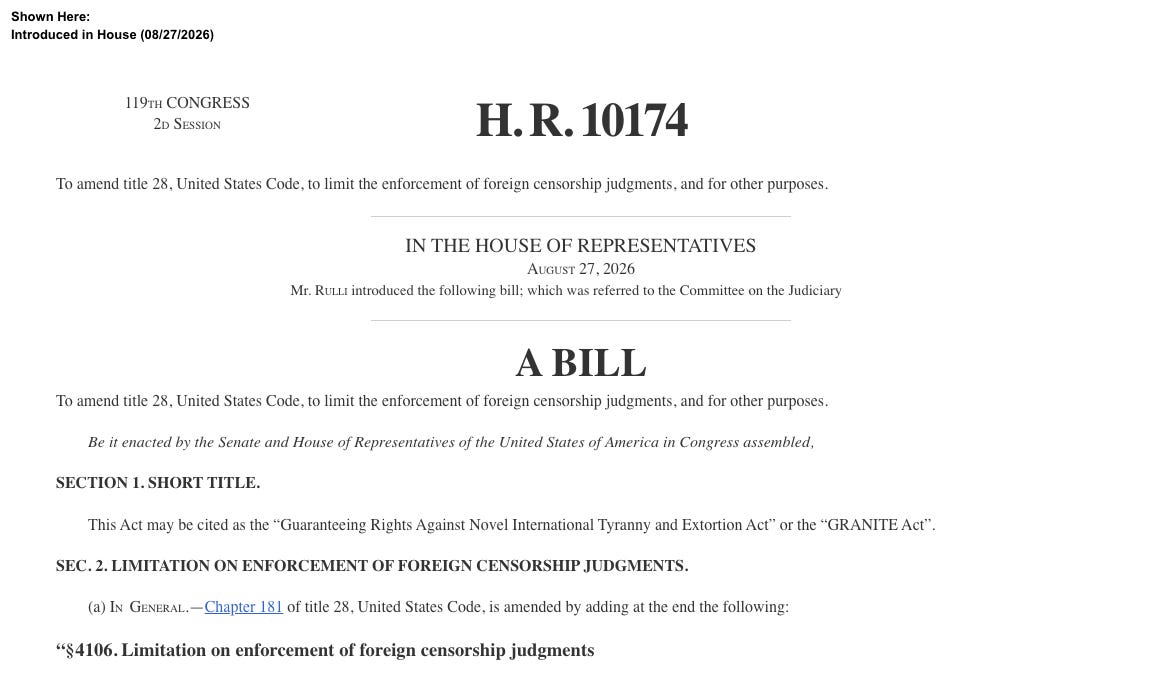
At only a few pages, H.R. 10174 is remarkably direct.
It would prohibit any American court from recognizing or enforcing a foreign judgment, fine, order, or demand that gives effect to a foreign censorship law. It would allow a U.S. person targeted or purportedly served with such a measure to enter federal court and seek a declaration that it is unenforceable. Most consequentially, it would amend the Foreign Sovereign Immunities Act so that a foreign government or instrumentality could not simply invoke sovereign immunity to escape that challenge.
The bill defines a foreign censorship law as one that restricts or penalizes expression, targets speech according to its content, viewpoint, or speaker, or compels disclosure likely to chill expression—and that would conflict with the First Amendment if recognized here.
Byrne describes the underlying GRANITE architecture as a shield, a sword, and definitions. The shield prevents American courts from enforcing foreign censorship measures. The sword gives the targeted American access to a federal courtroom. The definitions ensure that the statute applies to censorship accomplished through administrative demands and regulatory threats, not merely conventional court judgments.
This is defensive legislation, not an attempt to dictate what Britain or any other country may regulate within its own territory. It says something much narrower and more fundamentally American: foreign governments may govern their own jurisdictions, but American courts will not become the enforcement arms of foreign speech codes that violate the First Amendment.
From One Lawyer’s Blueprint to Congress
Preston Byrne’s achievement deserves to be understood in full.
After years representing American companies facing foreign censorship demands, Byrne published the first GRANITE proposal on October 18, 2025. He then worked with Wyoming Deputy Secretary of State Colin Crossman and Representative Daniel Singh to develop the Wyoming GRANITE Act. That bill passed the Wyoming House by 46–12 in February before stalling in the Senate during the state’s short budget session. In July, the American Legislative Exchange Council adopted GRANITE as model policy. Now, barely ten months after Byrne published the original concept, its essential architecture has reached Congress.
That is an extraordinary progression: a working lawyer encounters a structural defect in American law, publishes a remedy based on firsthand experience, converts it into state legislation, and watches the idea become a federal bill within a year.
The federal proposal is more restrained than Wyoming’s original version. It offers declaratory relief rather than the substantial statutory damages contemplated by the state bill. But it tackles the central federal problem directly by removing sovereign immunity in precisely these cases. Byrne supports Rulli’s bill “without reservation,” writing that it gives American lawyers the tools they need to win.
Why This Is Personal
I have publicly documented how my lawful U.S.-based speech entered a UK criminal proceeding to which I was neither a party nor a witness. I later learned that a foreign court had been asked, without notice to me, to authorize my immediate arrest, even though I had not been accused of any crime.
I do not presume to state how H.R. 10174 would apply to any pending individual matter. Its relevance is nevertheless unmistakable. My experience exposed the same constitutional gap Byrne has spent years trying to close: American speech now crosses borders instantly, while the First Amendment and American due process do not automatically travel with it.
A foreign legal process can therefore be used to reinterpret, burden, or chill American expression long before an American court is ever asked whether the underlying demand is constitutionally legitimate. GRANITE would, for the first time at the federal level, create a clear forum in which the targeted American could answer that pressure under American law.
The Red Line Must Now Become Law
H.R. 10174 has only been introduced. It must pass through the House Judiciary Committee, attract co-sponsors, survive both chambers of Congress, and receive the President’s signature.
But introduction matters. Washington is no longer merely discussing whether foreign censorship poses a threat to American sovereignty. A concrete statutory answer is now before Congress.
This should not be a partisan question. Whatever one thinks about X, 4chan, health speech, political dissent, or any particular platform, no foreign government should be permitted to make the First Amendment disappear merely because American speech can be viewed overseas.
Ten months ago, GRANITE was one lawyer’s blueprint.
Today, it is H.R. 10174.
The red line has entered Congress. Now Congress must fortify it in law.
The Restore the First Coalition has formally added the GRANITE Act to its supported bills at restorethe1st.com/blueprint.html#speech