

In 2021, Prince Harry's Aspen commission proposed stripping legal protection from the "design" of social media. This week he told the Clinton Global Initiative that bans aren't enough and design is the danger. In between, CCDH sent him its parents' campaign and quietly renamed itself from "Hate" to "Harm." The vocabulary keeps changing. The target is still your speech.


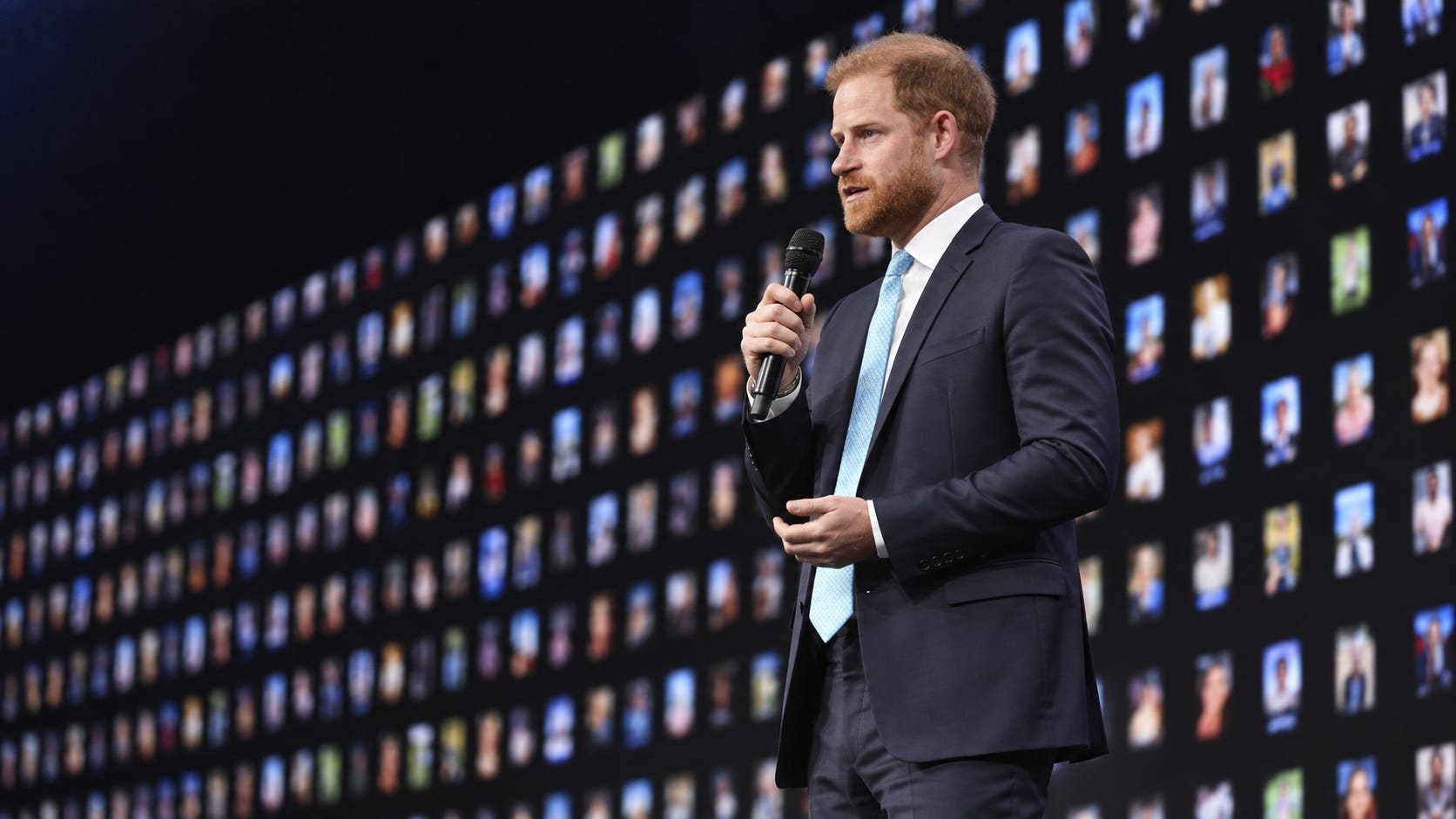
On Wednesday morning in New York, Prince Harry walked onto the Clinton Global Initiative stage in front of a wall of glowing phone lock screens. Each one showed the face of a young person. He spoke about lawmakers who spent months working with parents to push bills through Congress, only to watch them die in the final hour. He reported progress: American courts, he said, have found Meta and YouTube negligent and liable for harms to children.
Then he told the room why that wasn’t enough.
“Bans, settlements and payouts are incomplete remedies,” he said. “Bans do nothing to address dangerous design.” Pressure works, he added; the problem is how long we have been willing to wait.
He turned to artificial intelligence. Chatbots, he warned, are built to find you, hook you, exploit you, and then blame you. And he joined the calls for a slowdown: if the next frontier can’t be shown to be safe enough to cross, we shouldn’t race across it just because we can.
On the same stage over the same two days, LinkedIn co-founder Reid Hoffman endorsed a government “kill switch” for AI, and Hillary Clinton called for international agreements to govern it. Bill Clinton opened the week by urging philanthropy to fill the space left by what he called “retreating governments.”
To understand why that moment matters, go back five years, to a podcast studio in Los Angeles.
“It is bonkers”
In May 2021, a year after moving to California, Harry sat down with Dax Shepard on the Armchair Expert podcast. The conversation turned to American press freedom. He said he didn’t want to go down “the First Amendment route,” a subject he admitted he didn’t understand. Then he gave his verdict anyway: “it is bonkers.”
He was talking about paparazzi, not social media. That context matters, and it’s fair to give it. But within months he would help write something far more consequential than a podcast answer.
Watch: 45 Words
The video above collects the public record in the speakers’ own voices: a former Secretary of State calling the First Amendment “a major block,” a former presidential nominee warning that without platform moderation “we lose total control,” a sitting governor claiming there is “no guarantee to free speech on misinformation,” and a White House press secretary confirming, on July 15, 2021, that the administration was “flagging problematic posts for Facebook.”
Words are one thing. What makes this a story is what came after the words.
The paper trail
November 2021: the Aspen Commission. Harry was one of the commissioners on the Aspen Institute’s Commission on Information Disorder, funded by Craig Newmark. Its final report made 15 recommendations. Two of them are the blueprint for everything that followed:
“Superspreader accountability”: platforms should impose “quicker, more decisive actions and penalties” on spreaders of mis- and disinformation, “regardless of location, or political views, or role in society.”
Section 230 reform: strip platforms’ legal immunity for “product features, recommendation engines, and design.”
Read that second line again. In 2021, the target was already design. Five years later, it’s the word at the center of Harry’s CGI speech.
January 2022: Spotify. As Neil Young and Joni Mitchell pulled their music over Joe Rogan’s podcast, Archewell, then under a multi-year podcast deal with Spotify, issued a statement. Its co-founders, it said, had been “expressing concerns” to Spotify about COVID-19 misinformation since April 2021, and would keep doing so “to ensure changes to its platform are made.” The statement never named Rogan. It didn’t need to. It was a business partner leaning on a platform to change what its users could hear, framed as a “public health crisis.”
January 2024: the Senate hearing. After tech CEOs were grilled by the Senate Judiciary Committee, Harry and Meghan applauded the parents “whose advocacy resulted in this hearing.”
December 2025: Australia’s ban. When Australia barred children under 16 from social media, the Sussexes celebrated it as “bold, decisive action.” Their only complaint: a ban is a band-aid that doesn’t fix “tech’s broken design.”
2026: the handoff and the pivot. Archewell handed its Parents’ Network to ParentsTogether, a national advocacy group, and urged Congress to pass stalled AI deepfake bills. Then came CGI, and AI.
Same words, different letterhead
Now place that trail next to the Center for Countering Digital Hate.
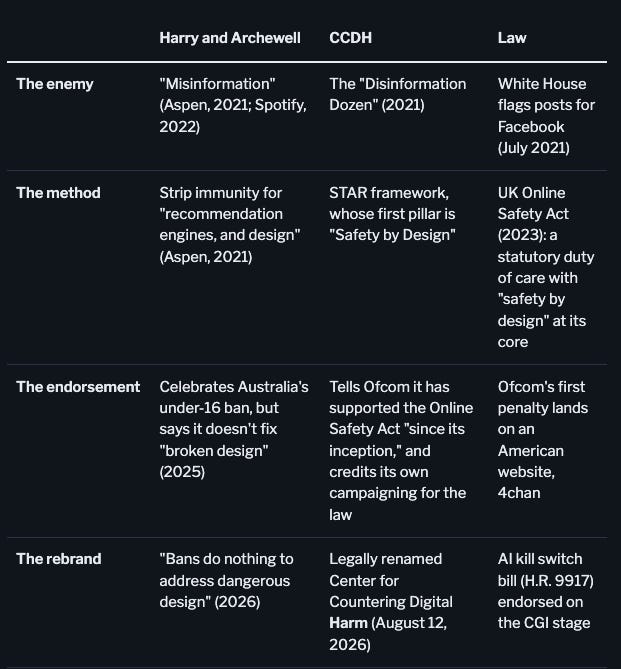
“Misinformation” failed as a legal category. It was too obviously about content, and too obviously about who decides what’s true. “Hate” has the same problem. “Harm” is broader and sounds like public health. “Design” is the final step: it lets regulators claim they aren’t touching speech at all, only the machinery that carries it.
Why “design” is the workaround
Every serious person agrees that children deserve protection, and that the grief of the families on that CGI stage is real. That isn’t the question. The question is who decides which “design” is dangerous, and what that power becomes once it exists.
A platform’s design is its algorithm, and the algorithm decides which speech reaches which people. Regulating “dangerous design” means regulating how speech is ranked, recommended and distributed. The Supreme Court has already said this is not a neutral technical matter. In Moody v. NetChoice (2024), the Court recognized that a platform’s curation of its feed is itself expressive activity protected by the First Amendment.
So when Harry says bans “do nothing to address dangerous design,” he is describing, with unusual candor, the strategy his commission laid out in 2021: move the fight from what you may say to how your words may travel. Under Britain’s duty-of-care model, that shift is already law. The first American target has already been fined.
Notice something else in his speech. By his own account, the American system is working: parents sued, courts heard the evidence, and companies were held liable. That is how a free society handles defective products, case by case, in open court, with the burden on the accuser. Harry calls it “incomplete.” The alternative he points toward is not more trials. It is rules written in advance, by regulators, about how speech systems must be built.
The CCDH question
Harry and CCDH share a vocabulary, back the same class of laws, and appear in the same policy rooms. Here is what the record establishes, and what it doesn’t.
Documented: The State Department’s administrative record in Ahmed v. Rubio describes CCDH’s chief executive, Imran Ahmed, as a “key collaborator” with the Biden administration. That is the heart of the censorship case: not that a foreign national spoke about American speech, but that a private organization allegedly worked with the government to suppress Americans’ speech.
Now documented, in CCDH’s own notes: Internal CCDH planning notes from January to June 2024, part of the whistleblower record, show the organization building a “Parents’ Guide” and a companion public service campaign. On January 22, a senior staffer defined the audience in five words: “swing voting parents, moms.” On March 5, the notes record that “Archewell are interested in seeing once complete.” On March 18, a follow-up task: send the Parents’ Guide and CCDH’s “Protecting Kids Online” material to James Holt, Archewell’s executive director.
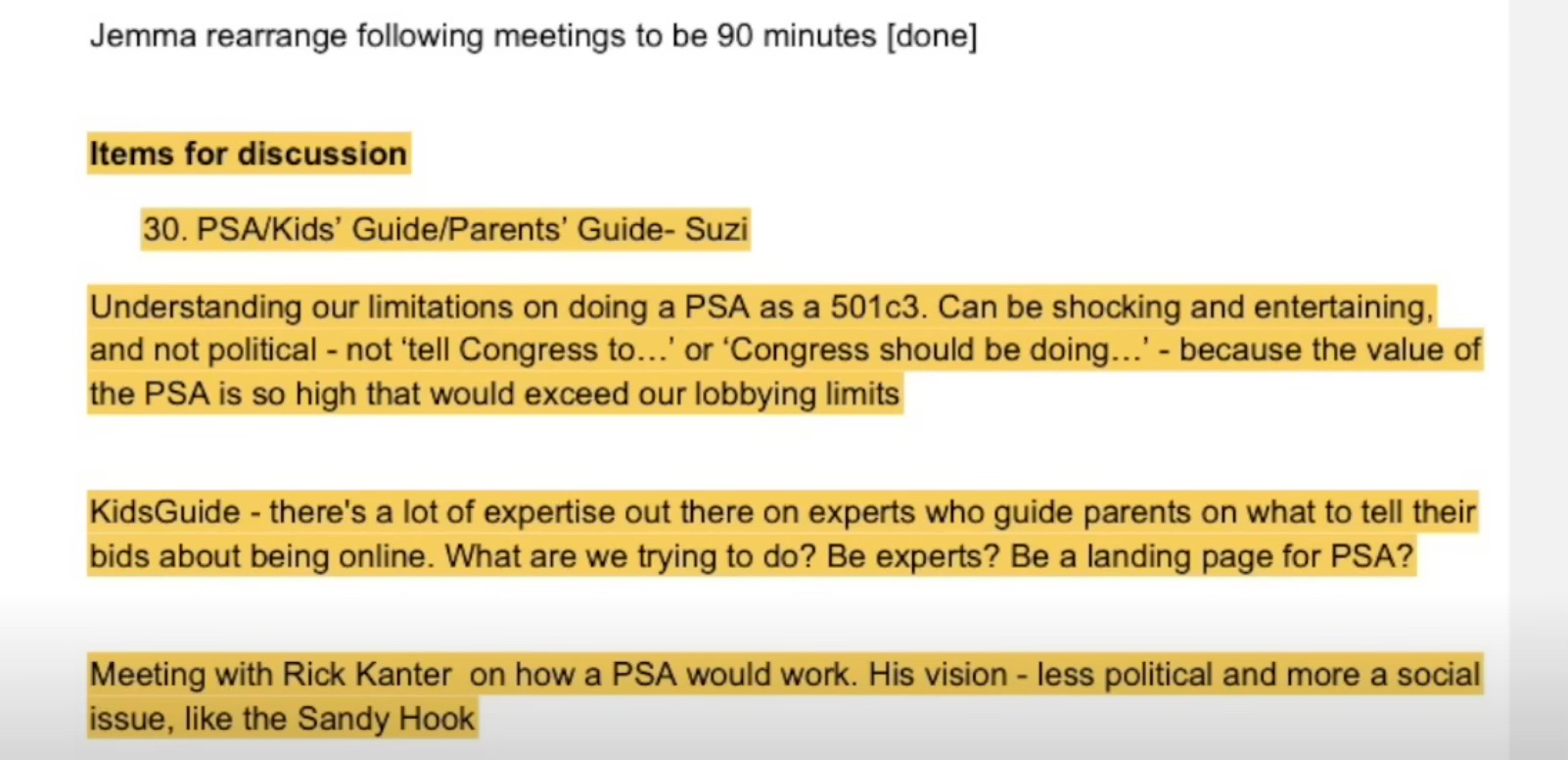
The same notes show CCDH worrying about where advocacy ends and lobbying begins. Staff warned that a campaign telling Congress what to do “would exceed our lobbying limits” as a 501(c)(3), and recorded Ahmed asking for the lobbying question to be checked and, “if necessary,” for the group to register a c4. In the same weeks they were preparing a press release on the Kids Online Safety Act and planning dozens of meetings on Capitol Hill.
What the notes do not show: that Archewell co-produced, funded or distributed the guide, or that the “swing voting” framing came from Archewell. The documented relationship is a channel: CCDH sending its parents’ campaign to Harry’s foundation, at Archewell’s request, while aiming it at swing voters.
One more detail cuts against a lazy reading. In February 2024, a CCDH staffer said the group didn’t “buy into” blanket age bans, preferring to inform parents instead. The Sussexes, praising Australia’s ban in 2025, called it a band-aid. Neither camp’s endgame is the ban. For both, it’s the design.
That distinction is not a technicality. It’s the whole point. Harry has every right to advocate for any law he likes, just as Imran Ahmed has every right to publish reports. What the First Amendment forbids is government using private actors to do what it cannot do directly. If evidence ever shows that Harry’s advocacy crossed from persuasion into coordinated pressure with officials to remove specific speech, that would be a different, and far larger, story.
The AI turn
Wednesday’s speech marked Harry’s pivot from social media to AI, and he chose his words carefully. He didn’t call for a ban. He called for a slowdown: prove the frontier is safe, or don’t cross it.
That framing arrived in a crowded week. CNN placed his remarks in the context of rising alarm after a worker at Anthropic estimated the risk of AI-driven human extinction within a decade at more than 10 percent. On the same CGI stage:
Reid Hoffman endorsed an AI kill switch, the concept behind H.R. 9917, introduced in July 2026.
Hillary Clinton called for international agreements to govern AI.
Bill Clinton called on philanthropy to step into the void left by governments.
Here is why this belongs in a story about the First Amendment. AI is rapidly becoming the tool through which millions of Americans research, write, translate and speak. A government off-switch, a licensing regime, or an international body deciding which systems are “safe enough” is not only technology policy. It is a set of controls over the infrastructure of expression. The pattern repeats: a real harm, a sympathetic face, a new vocabulary, and rules aimed at the architecture rather than the words, so that no one has to admit the words are the target.
The principle cuts both ways
Some of Harry’s critics say a British prince has no business weighing in on American law, or that his advocacy violates foreign-agent laws. The Foreign Agents Registration Act covers people acting at the direction of a foreign principal, and if evidence of that surfaces, it should be examined carefully. The beautiful, albeit sometimes frustrating thing about America is that while Harry moved back to Britain this month, when he speaks on American soil about limiting American speech his speech is actually still protected, and so is Americans’ right to hear it. That principle is on trial right now in the cases of Rümeysa Öztürk and Mahmoud Khalil, students who faced detention after speaking out.
A movement to restore the First Amendment cannot defend it selectively. Harry may say whatever he likes about American law. So may we. The fight is over what gets written into it.
Forty-five words
The First Amendment is 45 words long. It does not mention misinformation, hate, harm, design or artificial intelligence. It says Congress shall make no law abridging the freedom of speech. It was written by people who understood that every generation produces powerful, well-meaning voices with a reason why this particular speech, in this particular moment, is too dangerous to allow.
The prince thought it was bonkers. The founders thought it was the point.
On December 17, Bill of Rights Day, Restore the First will be lead the charge in celebrating our citizens’ coalition historic effort to defend all 45 of those words. Take action at restorethe1st.com. View my Constitution Day launch of the initiative below.
What this article does not claim
That Prince Harry has violated any law, including FARA.
That Archewell co-produced, funded or distributed CCDH’s Parents’ Guide. The notes document contact, not partnership.
That the harms parents describe aren’t real.
That the Supreme Court found government coercion in Murthy v. Missouri. It decided the case on standing and never reached the merits.
Sources
Harry at CGI, September 23, 2026: CNN; AP via Local 10; PA via Perspective Media. Official CGI video to be linked when posted.
Armchair Expert, “Prince Harry,” May 13, 2021
Aspen Institute Commission on Information Disorder: recommendations; commissioners; Final Report
Archewell on Spotify, January 30, 2022: PBS NewsHour / AP; Deadline
Archewell on the Senate hearing, January 31, 2024: The Hill
Sussexes on Australia’s under-16 ban: Yahoo News
Parents’ Network handoff: Newsweek
Archewell and AI deepfake bills, August 2026: The Hill
Archewell 2024 Form 990 grants: Hollywood Reporter
CCDH response to Ofcom (STAR framework, support for the Online Safety Act): PDF
White House press briefing, July 15, 2021: official video
Murthy v. Missouri, No. 23-411 (2024); Moody v. NetChoice, No. 22-277 (2024)
Ahmed v. Rubio (S.D.N.Y.), State Department administrative record
CCDH filing history, Companies House no. 11633127
CCDH Portfolio Planning Monthly Meeting notes, January to June 2024 (whistleblower documents)
I cannot come up with any explanation at all as to why prince Harry's opinion on anything at all should be relevant to reality. Can't he just appear on Oprah and whinge about free speech? Whilst the irony whizzes over his head? Are people that dazzled by what is really just lucky birth circumstance? Did he give everybody a jar of his wife's jam?
People who want to control the truth fear it.