


Editor’s Update | October 25, 2026
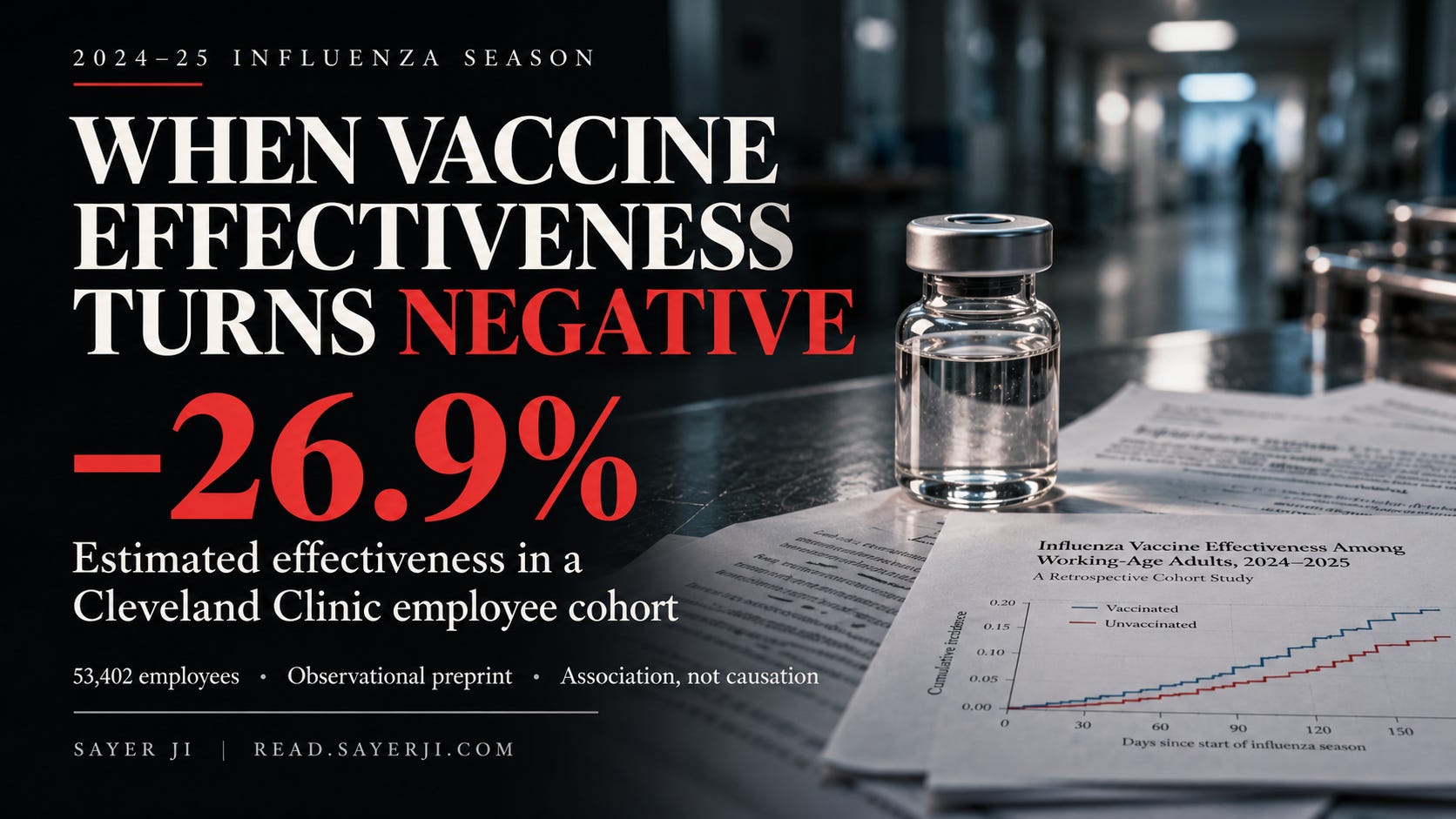
This article was originally published in April 2025, following a Cleveland Clinic preprint reporting an estimated −26.9% influenza vaccine effectiveness among working-age employees during the 2024–25 season.
Since then, the researchers have revised their analysis, extending follow-up to 33 weeks and accounting for differences in influenza activity over time. Their updated October 2025 preprint continued to report a statistically significant association between vaccination and increased influenza incidence—but specifically during periods of high influenza circulation.
The finding deserves continued scrutiny. It does not, by itself, establish that vaccination caused additional infections, nor can it be generalized to every population or influenza season.
The original reporting below has been updated to reflect these developments and the evidence available as the 2026–27 influenza season begins.
In April 2025, a Cleveland Clinic study reported a striking finding: employees who received the seasonal influenza vaccine experienced a higher observed rate of laboratory-diagnosed influenza than their unvaccinated colleagues. Its estimated vaccine effectiveness of −26.9% challenged expectations and drew attention to an important question about how reliably seasonal influenza vaccines perform in real-world settings.
Now, as the 2026–27 influenza season gets underway, the story warrants another look - not merely because of that original number, but because of what happened afterward.
The researchers subsequently expanded and revised their prospective cohort analysis, which followed 53,402 Cleveland Clinic employees in Ohio. Their updated results continued to show an elevated influenza hazard associated with vaccination during periods of peak influenza activity, while other U.S. studies reported protective vaccine effectiveness.
That apparent contradiction, and how it should be interpreted, is the central question today.
The prospective cohort study, titled "Effectiveness of the Influenza Vaccine During the 2024–2025 Respiratory Viral Season," analyzed health outcomes among 53,402 employees of the Cleveland Clinic Health System in Ohio. The study covered the 25-week period beginning October 1, 2024, and tracked influenza incidence among vaccinated and unvaccinated individuals.
Key Findings
53,402 employees were included in the Cleveland Clinic cohort.
43,920 employees (82.2%) had received influenza vaccination by the conclusion of the revised 33-week study.
1,130 influenza infections (2.12%) were recorded.
During periods of high influenza activity, vaccinated employees had a higher observed influenza hazard (HR 1.33; 95% CI 1.07–1.64; P = 0.009).
During periods of low or medium influenza activity, differences between vaccinated and unvaccinated employees were not statistically significant.
The original April 2025 analysis reported an estimated vaccine effectiveness of −26.9%. The October 2025 revision changed the primary analysis to account for influenza activity over time; that original percentage should therefore be understood as a historical finding rather than the revised study’s principal estimate.

Study Strengths and Limitations
The Cleveland Clinic analysis has several important strengths, including its large employee cohort, longitudinal follow-up, and treatment of vaccination status as a time-dependent variable. Its revised analysis also attempted to address variation in influenza circulation over time.
However, observational studies remain vulnerable to confounding, including differences in testing behavior, prior immunity, exposure, and healthcare-seeking patterns. Prospective cohort studies and test-negative studies have different strengths and limitations; neither design automatically establishes causation or provides a universally superior measure of vaccine effectiveness.
However, the study is limited in its scope to:
Predominantly healthy, working-age adults
Use of a single vaccine formulation (inactivated trivalent)
No analysis of influenza severity, hospitalization, or mortality
Exclusion of home testing and non-Cleveland Clinic data sources
The study was observational, not randomized, and could not establish whether vaccination caused the observed difference in infections.
Its results should not be extrapolated to the 2026–27 vaccine, other formulations, or populations not adequately represented in the cohort.
What Happened After the Original Findings?
The Cleveland Clinic study did not exist in isolation. Other research evaluating the same 2024–25 influenza season reported substantially different results.
A peer-reviewed U.S. Flu Vaccine Effectiveness Network study published in Clinical Infectious Diseases in July 2026 found an estimated 33% effectiveness against medically attended outpatient influenza across its study population (95% CI 24–41%).
These findings cannot be compared as though they measured precisely the same outcome in the same population. The Cleveland Clinic analysis evaluated diagnosed infections in a healthcare workforce, while the national study examined outpatient medically attended illness across multiple states.
Nevertheless, the divergent findings raise legitimate methodological questions. How much do population characteristics, testing patterns, infection exposure, influenza subtype, vaccine timing, and study design influence estimates of effectiveness?
The scientific response should be to examine those differences—not to treat either result as beyond scrutiny. [Study link]
Implications
This research challenges the assumption of consistent annual effectiveness of seasonal influenza vaccines. It calls into question public health policies that promote or mandate influenza vaccination without annual evidence of benefit. According to the authors, it may be unreasonable to expect high efficacy year after year given the evolving nature of influenza viruses and the months-long lead time required for vaccine development.
While the authors caution against generalizing beyond the studied population, they emphasize the importance of conducting rigorous, real-time evaluations of vaccine performance—especially when vaccines are being promoted as a cornerstone of public health strategy.
Why This Matters as the 2026–27 Flu Season Begins
Another influenza season is beginning, and the underlying questions remain important.
During the 2025–26 season, interim CDC estimates showed influenza vaccine effectiveness among adults of approximately 22–34% against influenza-associated outpatient visits and 30% against influenza-associated hospitalization.
For 2026–27, federal regulators updated all three influenza vaccine virus components. Meanwhile, CDC surveillance published October 23, 2026, shows that influenza activity remains relatively low nationally but is already increasing.
The results from 2024–25 cannot tell us how well the newly formulated 2026–27 vaccines will perform.
But the Cleveland Clinic findings remain relevant because they illustrate why vaccine performance should be independently evaluated each season, across different populations, formulations, and clinical outcomes.
The question is not simply whether a vaccine works. It is how well it works, for whom, against which outcomes, under what conditions—and whether unfavorable findings receive the same scrutiny as favorable ones.
CDC 2025–26 effectiveness estimates
CDC weekly influenza surveillance
Conclusion
Looking back at the Cleveland Clinic findings, the most important lesson is not that one study settled the question of influenza vaccination. It is that vaccine effectiveness is variable, context-dependent, and impossible to reduce to a permanent, universally applicable percentage.
The revised Cleveland Clinic preprint retained an association between vaccination and higher influenza incidence during peak circulation, while broader studies reported protective associations against medically attended illness and hospitalization.
These findings deserve to be examined together, not selectively.
As the 2026–27 season unfolds, independent, transparent, real-time evaluation of vaccine effectiveness should be the standard—not an exception reserved for when unexpected results appear.
Scientific credibility depends not on protecting a preferred conclusion, but on subjecting every conclusion to the same standard of evidence.
Original study: Cleveland Clinic preprint, April 4, 2025 (Version 3)
Revised study: Cleveland Clinic preprint, October 11, 2025 (Version 4)
Share this post on X, and elsewhere…
X Post: https://x.com/sayerjigmi/status/1909251641599017370
Telegram: https://t.me/sayeregengmi/9060
Instagram: https://www.instagram.com/share/_3L-SGlgc
Facebook: https://www.facebook.com/share/p/15ZiTBFwfX/?mibextid=wwXIfr


Before 2019 had the flu every year, for years thought it was from working as a RN, then retired in 2014, and still got sick with respiratory illnesses, bronchitis, treated with antibiotics, inhalers, codeine, doc even thought maybe some COPD. I have not taken the flu shot since 2019 and I have not been ill once, not even a cold. Had chest X-ray done for a cough I developed as side effect of withdrawing from Effexor, perfectly clear, no sign of disease. I will never, ever have a flu shot and neither will my family. The flu shot was directly related to all my years of illnesses.
I experienced immune exhaustion after reacting to a hospital mandated flu vaccine in 2012. About a month later I was down and out of work from pneumonia.
It was a very bad policy imo and exemptions, mine was denied, were narrowly defined. Vaccines should never be mandated by any agency or organization.