

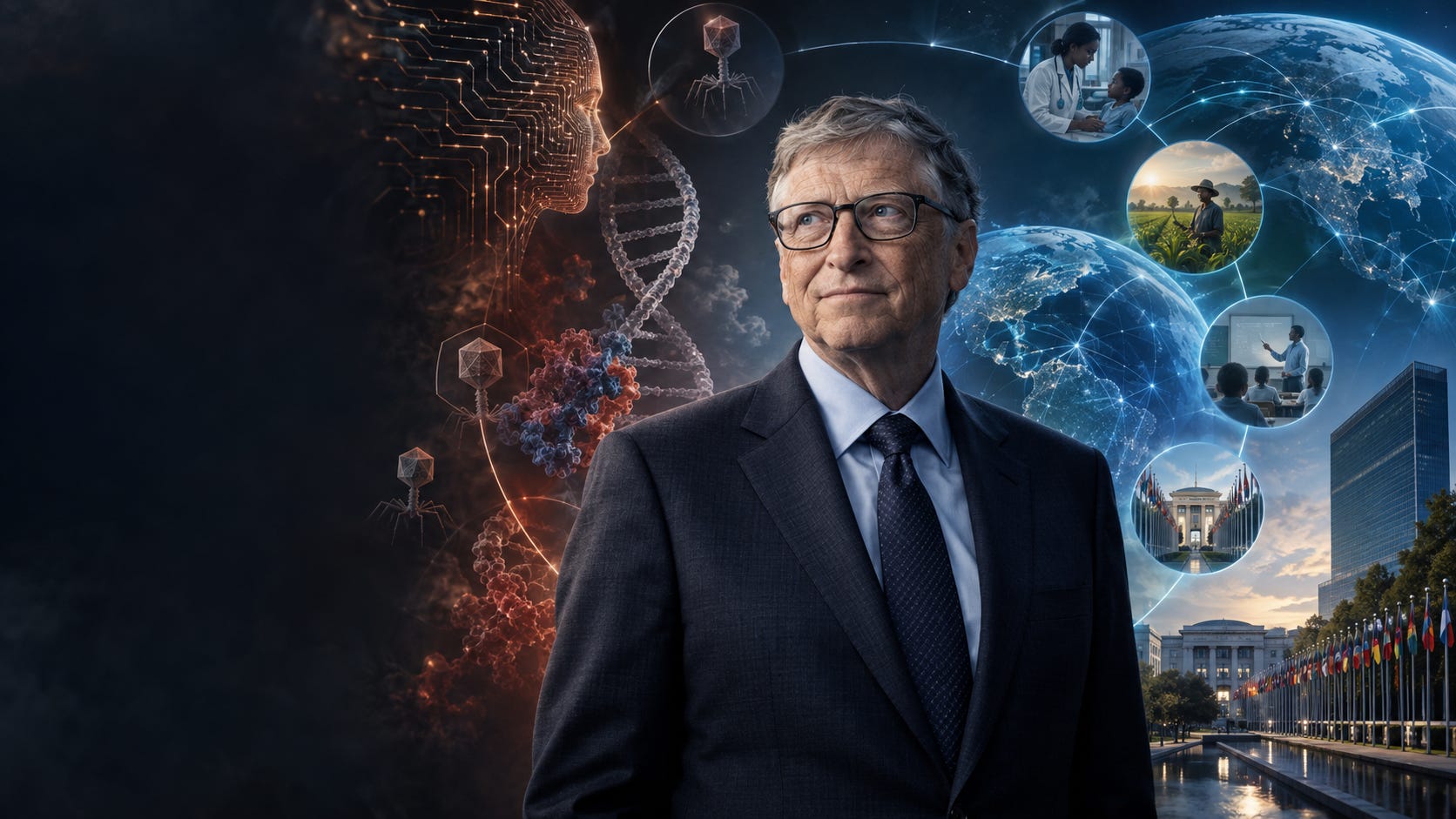
Bill Gates published a 6,000-word essay warning that AI “will make it easier to design a deadly new disease.” Nineteen days later his foundation pledged a billion dollars to AI. This is what fits inside those nineteen days — and what does not.

This is Piece 7 in a six-part series. Piece 1 documented the CCDH rebrand. Piece 2 documented ControlAI’s role in Bernie Sanders’s AI bill. Piece 3 documented Obama’s endorsement of a manufactured panic. Piece 4 documented the London drafting of the Sanders bill. Piece 5 documented the eight-year transatlantic pipeline. Piece 6: documented the elite ratification stage. This piece looks at one funder standing beside all of it.
The Warning. The Billion. Nineteen Days.
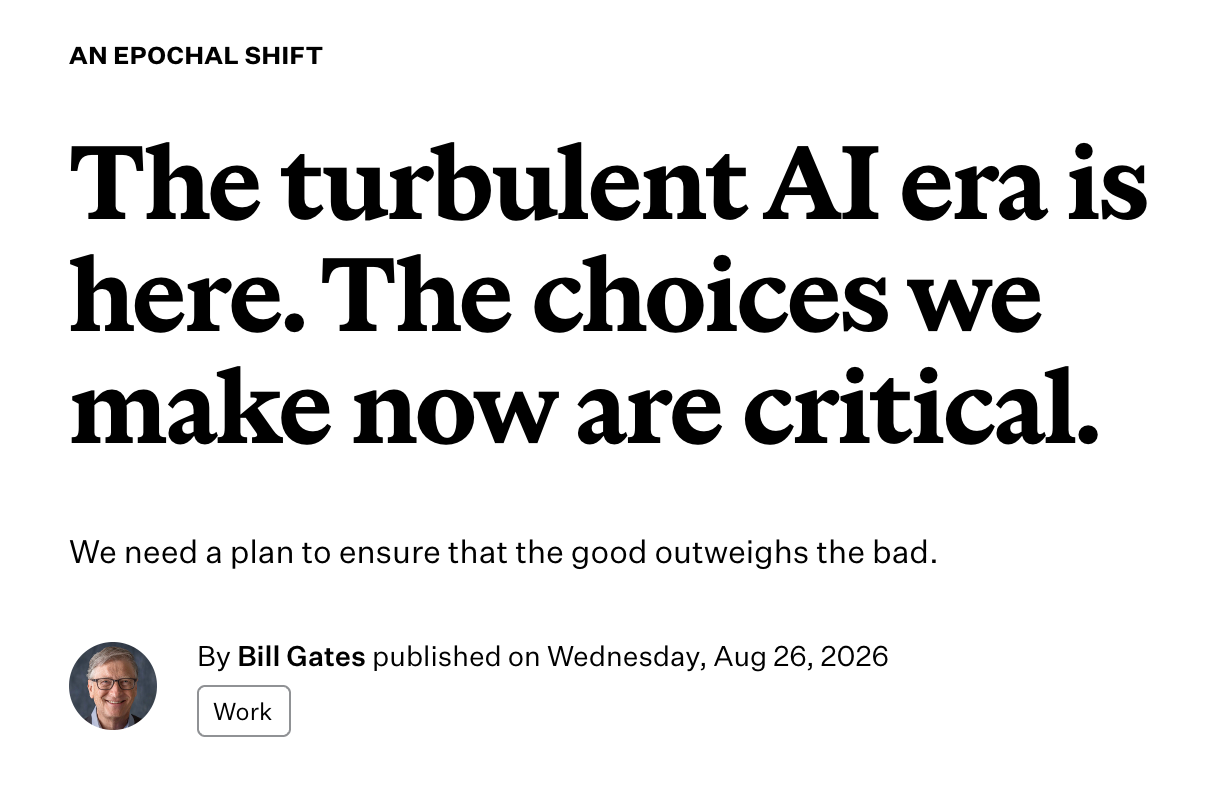
At approximately 9:00 a.m. Eastern time on Wednesday, August 26, 2026, Bill Gates published a 6,000-word essay on gatesnotes.com titled “The turbulent AI era is here. The choices we make now are critical.” The essay closes with a warning that AI “will make it easier to design a deadly new disease” and an argument that the world needs “a new global organization for AI” modeled on nuclear weapons inspections, international aviation regulation, and ozone-layer treaties (Bill Gates, gatesnotes.com; CNBC, August 26, 2026; The Guardian, August 26, 2026; Metro.co.uk, August 26, 2026).
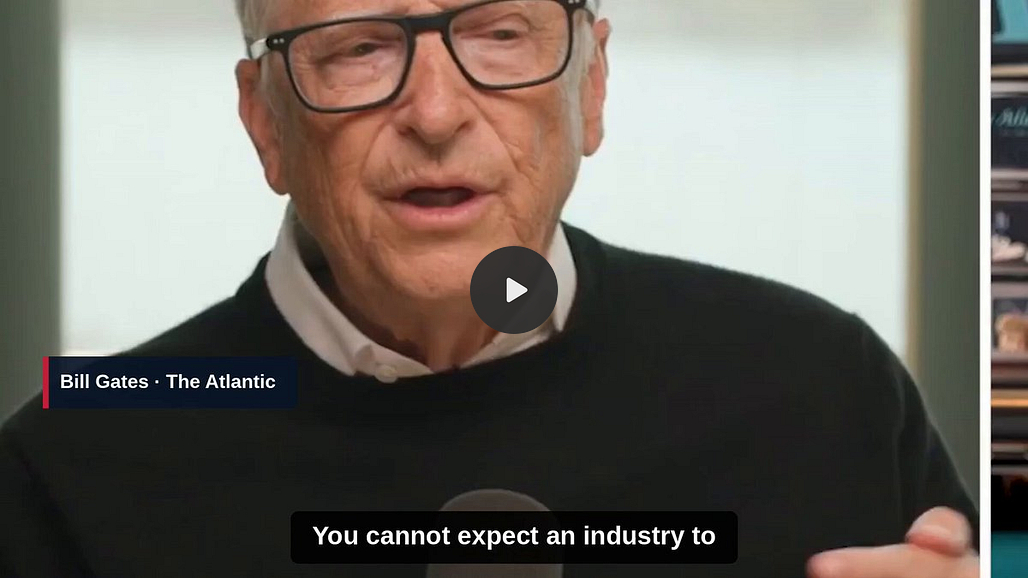
That evening he sat for an exclusive interview with CNN’s Anderson Cooper. CNN’s own summary of his statement: AI models are “now capable of causing cyberattack risk, bioterrorism risk, and psychosocial risk” (CNN, August 26, 2026).
Nineteen days later, on the evening of Monday, September 14, 2026, the Gates Foundation released its 10th annual Goalkeepers Report — an event that has been anchored to United Nations General Assembly week for a decade and whose date is therefore structurally determined rather than chosen against any single news event. Tucked inside the 2026 report was the Foundation’s largest single AI commitment on record: at least $1 billion over two years on AI for global health, agriculture, and education (GeekWire, September 15, 2026). Foundation CEO Mark Suzman called the figure a “down payment.”
To Reuters, the same day, Bill Gates said: “I don’t think any government is nearly as deep on this as they have to be. Governments are way behind on this one” (Reuters, September 15, 2026).
Nineteen days. From “there is no plan to ease the entry into the AI era” to a billion dollars deployed, and the observation that governments are behind.
That interval — the essay, the CNN interview, the Reuters interview, and the Goalkeepers commitment — is the entire argument of this piece. Each of the four is documented by a primary source. None of the four is contested. What they add up to is a question every reader is entitled to weigh: when the largest philanthropic actor on AI in global health simultaneously (a) warns that AI can now be misused to design pathogens, (b) calls for a mandatory international regulatory architecture, and (c) deploys another billion dollars into the deployment surface those regulations will govern, who is positioned to shape the rules?
This piece does not accuse Bill Gates of coordinating the timing of any external event, and this piece does not claim that any specific Gates Foundation grant funded any specific bioweapon-adjacent research. Both are important. The stronger and more defensible case rests on what Gates himself put in writing, in an essay he signed with his own name, alongside the funding decisions his foundation made and disclosed in public — nothing more.
The Warning, in Gates’s Own Words
The most noteworthy passages of “The turbulent AI era is here” are these. They are Gates’s exact words, in the order he published them.
On dual-use bio capabilities:
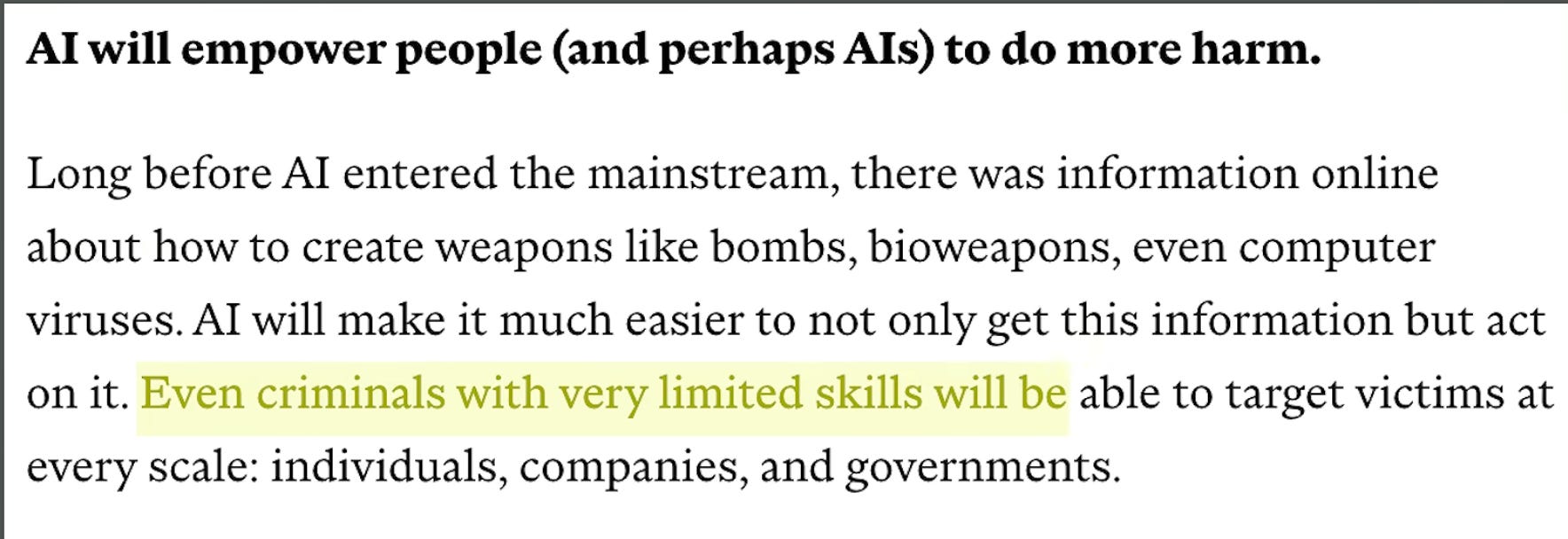
“Long before AI entered the mainstream, there was information online about how to create weapons like bombs, bioweapons, even computer viruses. AI will make it much easier to not only get this information but act on it. Even criminals with very limited skills will be able to target victims at every scale: individuals, companies, and governments” (gatesnotes.com).
On bioterrorism as a threshold risk:
“The same goes for bioterrorism. Although AI will lead to lifesaving advances in drugs and vaccines, it will also make it easier to design a deadly new disease. Again, the positive capabilities are hard to separate from the dangerous ones. This is a global problem” (gatesnotes.com; Metro.co.uk, August 26, 2026).
On non-state actors:
“Today, an even greater risk than a naturally caused pandemic is that a non-government group will use open source AI tools to design a bioterrorism weapon” (gatesnotes.com).
On the absence of a plan:
“Unfortunately, right now we are not preparing for it. I don’t see evidence that leaders, experts, and communities are confronting the challenges adequately. There is no plan to ease the entry into the AI era” (CNBC, August 26, 2026).
On the proposed governance response:
“The highest priority is a monumental task: creating a domestic and international framework for dealing with AI” (The Guardian, August 26, 2026).
“But even a country that gets its own house in order will still be exposed to risks that cross borders. This is why an international organization will need to be built in parallel. A new global organization for AI will need elements of all three and more” (CNBC, August 26, 2026).
To MIT Technology Review the same day, in wording that the outlet paraphrased rather than quoted directly: Gates argued that any AI model capable of designing novel molecules should be subject to mandatory monitoring, because the same capability that discovers new drugs could inform the design of new pathogens (Tech Times summary of MIT Technology Review, August 28, 2026).
To the New York Post, verbatim: “Self-regulation on the most dangerous tool ever invented? No, thanks!” (NY Post, August 26, 2026).
These are the direct-quote foundations. Any characterization elsewhere in this piece that goes further — “most dangerous tool ever invented” attached to Gates rather than to the NY Post headline, or the phrase “bioterrorism threshold” — is paraphrase, not verbatim; this piece uses paraphrase only in unquoted narration.
The Money Was Already Moving
The essay is inseparable from three funding decisions the Gates Foundation had already announced, publicly and on the record, before Gates picked up his pen on August 26. Each is documented at the level of a foundation press release, a partner’s own announcement, or Gates’s own signed essay.
The Anthropic partnership — May 14, 2026. The Gates Foundation and Anthropic jointly announced a four-year, $200 million commitment. The commitment is not $200 million of Gates Foundation cash: roughly half is grant funding from the Foundation, and roughly half is Anthropic-side technical staff time and Claude usage credits. Reuters, citing officials, confirmed this structure the same day (Reuters, May 14, 2026; Forbes, May 14, 2026).
Anthropic’s own announcement described the partnership’s largest single pillar as global health and life sciences, with a specific commitment to use Claude to “screen potential drug and vaccine candidates” and to “advance research on high-burden and neglected diseases, starting with polio, HPV, and eclampsia/preeclampsia,” together with an integration with the Gates Foundation’s Institute for Disease Modeling for outbreak forecasting (Anthropic, May 14, 2026).
Anthropic is the disclosure worth naming here on both sides of the argument. It is the AI lab whose CEO has become the most publicly aggressive advocate for AI-safety regulation. It is also the AI lab the Gates Foundation chose as the anchor partner for its largest single AI-in-biology commitment on record. This piece treats the partnership as documented at the level of both principals’ own announcements; a reader who wants to weigh whether Gates capital flowing to the loudest AI-doom messenger’s own firm is a coincidence or a structural fact is entitled to draw their own conclusion.
Horizon 1000 — announced by Gates in “The Year Ahead 2026.” In his own signed essay of January 2026, Gates disclosed a joint initiative with OpenAI called Horizon 1000, focused on African health-care systems: “Together, the Gates Foundation and OpenAI are committing $50 million in funding, technology, and technical support to back their work” (Bill Gates, “The Year Ahead 2026,” gatesnotes.com). The $50 million is a combined Gates-and-OpenAI figure; Gates’s own share is not stated in the announcement.
Intercept — June 24, 2026. A $500 million nonprofit fund named Intercept launched with the stated objective of eliminating respiratory infections including the common cold and influenza, with the long-term goal of eliminating respiratory viruses entirely. The Intercept coalition, according to an Intercept spokesperson, pools resources from Stripe, Anthropic, the OpenAI Foundation, Flu Lab, Bill Gates, and traders at the quantitative investment firm Jane Street Capital (Trial MedPath report of Intercept launch, June 24, 2026). Bill Gates is one of several named backers; his personal contribution is not disclosed. The $500 million is the fund’s aggregate size, not the Gates share of it, and it is a personal contribution from Gates and not a Gates Foundation grant.
The Goalkeepers pledge — September 14, 2026. Announced the evening of September 14, tied to the Foundation’s tenth annual Goalkeepers Report, the Foundation committed at least $1 billion over two years to AI in health workers, farmers, and teachers, largely in the world’s poorest countries. The stated allocation is 40 percent education, 40 percent health care, 10 percent agriculture, and 10 percent digital infrastructure (GeekWire, September 15, 2026). Foundation CEO Mark Suzman called the number a “down payment” and told GeekWire he expected the figure to grow.
The four disclosures, tallied honestly:
CommitmentAnnouncedStructureGates cashAnthropic partnershipMay 14, 2026$200M over 4 yrs; ~half BMGF grant, half Anthropic credits/staff time~$100M over 4 yrsHorizon 1000 (with OpenAI)Jan 2026$50M combined “funding, technology and technical support”; Gates share not statedUndisclosedInterceptJune 24, 2026$500M coalition fund; Bill Gates is one of six named backers alongside Stripe, Anthropic, OpenAI Foundation, Flu Lab, and Jane Street traders; personal contribution not disclosedUndisclosed personal, not BMGFGoalkeepers AI pledgeSept 14, 2026≥$1B over 2 yrs; 40% education / 40% health / 10% agriculture / 10% digital infrastructure≥$1B (all categories), of which ≥$400M is health
The honest floor for identifiable Gates cash directed at AI-in-biology in this window is on the order of $500 million — the health share of Goalkeepers plus the Gates-side share of the Anthropic partnership, before any personal contribution to Intercept or any share of Horizon 1000. That is smaller than the number I circulated in an earlier draft, and it is still large enough — by orders of magnitude, and against any comparable private funder — to carry the argument of this piece.
The larger number I circulated (roughly $1.95 billion) added categories that a hostile reader would rightly strike out: Claude credits are not Gates cash, Horizon 1000 is not disaggregated, Intercept is a coalition fund and not a Gates Foundation grant, and 40 percent of the Goalkeepers pledge is education. That reader would be right. The floor above is the number that survives.
Sixteen AI-Designed Viruses—and What the Funding Record Actually Shows
On August 6, 2026, researchers at Stanford University and the Arc Institute — Samuel H. King, Claudia L. Driscoll, David B. Li, Daniel Guo, Aditi T. Merchant, Garyk Brixi, Max E. Wilkinson, and Brian L. Hie — published a paper on the generative design of complete bacteriophage genomes using the Evo 1 and Evo 2 genome-language models. The paper reports 16 AI-designed bacteriophages that, when synthesized, self-replicated inside E. coli bacteria and killed their bacterial hosts (Science, doi 10.1126/science.aec2657; bioRxiv preprint doi 10.1101/2025.09.12.675911).

The bioRxiv preprint’s acknowledgments section, verbatim on the relevant funder, reads:
“B.L.H. acknowledges funding support from Arc Institute, the Gates Foundation, Stanford Institute for Human-Centered Artificial Intelligence (HAI) Hoffman-Yee Research Grants, V. Gupta, and R. Tonsing.”
This is what the acknowledgments say, and this is what they do not say.
They say the Gates Foundation provided funding support to Brian Hie, the paper’s senior author, at the individual-author level. They list the Gates Foundation alongside Arc Institute, Stanford HAI’s Hoffman-Yee Research Grants, and two named individuals as sources of B.L.H.’s support. They do not say the Gates Foundation funded this specific project at the project level, they do not disclose an amount or a grant identifier attaching Gates money to this specific line of work, and they do not name the Foundation in a project-level funding statement.
That distinction matters. An author-level disclosure of the kind that appears here — the Foundation is one of several sources of a senior author’s ongoing support — is a real and reportable fact. It is not the same as project-level funding of the specific research described, and the difference is exactly the kind of thing a hostile fact-checker will cite to invalidate a piece that treats the two as interchangeable. I circulated an earlier draft that repeated the framing from a paragraph by Nicolas Hulscher at Focal Points on August 7, 2026, that has since been syndicated verbatim through Global Research, SGT Report, Todayville, FreeRepublic, The Most Revolutionary Act and Plato’s Cave, and quoted in IBTimes (Focal Points, August 7, 2026; Global Research, August 9, 2026). The eight outlets look like eight independent confirmations. They are one source, repeated eight times. This piece separates that citation from the paper’s own acknowledgments and uses only the acknowledgments.
The paper also includes a biosafety statement worth quoting in full, because it is exculpatory in ways the Focal Points chain elided:
“The capability to generate novel genomes with AI systems also raises important biosafety considerations. In line with longstanding precedent for conducting biological research within established biosafety levels (Berg et al., 1975), we performed all experiments at the biosafety level appropriate for research with bacteriophages and their non-pathogenic bacterial hosts, alongside supplementary precautions… we have previously shown that data exclusions successfully prevent the Evo 2 models from designing eukaryotic viruses, including pathogenic human viruses.”
Two independent researchers writing in a Science Perspective published alongside the paper — Thomas Inglesby and Moritz Hanke of the Johns Hopkins Center for Health Security — drew the line clearly: the ability to compose viral genomes using generative AI now exists, the governance to safely steer it does not, and the method should not be extended to viruses that infect humans, animals, or plants.
The honest statement is this. The senior author of the paper that established, in scientific print, the first generative AI design of viable bacteriophages is a scientist the Gates Foundation acknowledges as one of its funded researchers. The paper studies bacteriophages that target E. coli — not human, animal, or plant pathogens — and the authors performed the experiments at appropriate biosafety levels and imposed data exclusions on the underlying model to prevent generalization to human viruses. The independent biosecurity commentary published alongside the paper agrees that this capability class now exists and requires governance that does not.
That statement is enough. Enough to establish that the AI-in-biology capability Gates warned about on August 26 exists in the scientific literature, that the senior author of the paper demonstrating it is a scientist whose ongoing support includes Gates Foundation funding, and that the Foundation’s own signature partner in AI-for-health, Anthropic, is at the center of the AI-doom advocacy that the same essay endorsed. No stronger claim is needed and no stronger claim is made here.
The Pattern Runs Deeper
The AI-in-biology line above is one strand. Two others — deeper, older, and better documented at the primary-source level — sit alongside it and are not repeated in the Hie paragraph.
Gene drives. The Gates Foundation is, on the public record, the largest single private funder of the gene-drive research line — the deliberate engineering of self-propagating genetic edits into wild populations. The Foundation’s $35 million commitment to the Target Malaria consortium at Imperial College London in September 2016 was reported at the time by MIT Technology Review, which quoted a Foundation spokesperson confirming the award; cumulative Gates-associated funding of the field ran into nine figures by late 2017 (MIT Technology Review, September 6, 2016; Gene Drive Files, December 2017). DARPA created its “Safe Genes” program with $65 million over four years in July 2017 to address deliberate or accidental misuse of gene editing — a public defense-agency classification of the capability class the Gates Foundation is the principal private funder of. In August 2025, the Government of Burkina Faso ordered a halt of all genetically-modified mosquito activity in-country and the destruction of remaining samples, in what was reported as an effective termination of Target Malaria’s West African field arm.
AI protein design. AI protein design. The University of Washington Institute for Protein Design, led by Nobel laureate David Baker, includes the Gates Foundation among the funders of its recent output at the level of grant IDs printed directly on peer-reviewed papers. Two back-to-back papers published in Nature in August 2026, led by UW’s Institute for Protein Design with collaborators at NYU Langone Health and POSTECH, describe “large, viruslike protein cages” built from scratch using computational protein design — cages that, per the University of Washington’s own release, “span the size range of many natural viruses” and reach more than 200 nanometers across, containing hundreds to thousands of protein subunits (University of Washington Medicine, August 21, 2026). The paper’s own funding acknowledgment names “Gates Foundation (INV-043758, OPP1156262)” alongside the U.S. Defense Threat Reduction Agency (grant HDTRA1-19-1-0003), the Howard Hughes Medical Institute, the Audacious Project, the National Institutes of Health, and Microsoft. That the same paper is co-funded by the Gates Foundation and by a U.S. Department of Defense agency whose stated mission includes deterring weapons of mass destruction is not, by itself, a claim of misuse — the paper describes protein cages, not viruses, and the cages are not viruses. What it does document is that Gates Foundation capital sits, at grant-ID level, on peer-reviewed output in the AI-adjacent protein-design capability class that Microsoft’s own chief scientist Eric Horvitz and biosecurity co-authors, in a separate Science paper published October 2, 2025, showed can be redirected — with existing DNA-synthesis screening software missing many redesigns — to produce structural mimics of 72 recognized “proteins of concern” including ricin and botulinum neurotoxin. Neither of these facts implies the other has occurred. Both fit inside the capability class Gates himself flagged as a bioterrorism threshold on August 26, 2026.
The Convergence: One Actor and Four Positions.
I have used the word “convergence” throughout this piece and not the word “coordination.” That is deliberate.
Convergence describes a documented temporal pattern in which multiple actions by the same actor and by other actors point in a common direction inside a narrow window. It is a factual observation. This piece documents a convergence.
Coordination describes a stronger claim: that these actions are jointly planned or steered by a common hand. Nothing in this piece supports that stronger claim, and this piece does not make it. I said in an earlier draft that what is documented here amounts to “a coordinated regulatory-capture architecture.” That sentence was overreach against my own evidence. I have removed it.
What is documented is a convergence. Bill Gates, in his own signed essay of August 26, 2026, wrote that AI is now a threshold risk for bioterrorism and demanded a mandatory international regulatory architecture. He did so at a moment when his own foundation had just entered its largest partnership on record with the AI lab whose CEO is the most public advocate of AI-safety regulation, when the Foundation’s cumulative disclosed AI-in-biology commitments in 2026 alone ran well into nine figures of Gates cash, and when the paper that established the first generative AI design of viable bacteriophages named the Gates Foundation among the funders of its senior author. Nineteen days after the essay, the Foundation deployed at least another billion dollars into the AI deployment surface that the mandatory regulatory architecture Gates was calling for would govern.
That is a structural position — not a coordinated act. The distinction matters and I mean to preserve it.
It is a structural position in which the same actor is simultaneously a leading funder of the capability class, a leading warner about the capability class, a leading advocate for the international regulatory architecture that would govern the capability class, and the largest philanthropic deployer of the capability class into the countries where the regulation will be pilot-tested. That combination in one actor is unusual and deserves reporting on its own merits. It does not require intent — and this piece does not assert intent — to be a fact worth naming.
Where the Evidence Ends
This piece does not claim that the AI-designed bacteriophages in the King et al. Science paper are themselves bioweapons; they target E. coli, were designed with data exclusions preventing generalization to human pathogens, and were tested at the biosafety level appropriate for non-pathogenic bacterial hosts. The generic dual-use classification comes from Inglesby and Hanke’s Science Perspective published alongside the paper.
This piece does not claim that the Gates Foundation funded the King et al. research project at the project level. The Foundation is disclosed in the bioRxiv preprint acknowledgments as one of several ongoing sources of senior author Brian Hie’s individual research support. That distinction is preserved wherever the paper is cited above.
This piece does not claim that Bill Gates or the Gates Foundation directed the timing of the Netflix release of The AI Doc, the September 12 House AI Task Force report, the September 14 TIME100 AI Impact Dinner, or any other external event in the September 2026 AI-regulation news cycle. The 2026 Goalkeepers Report is a scheduled annual publication anchored to UNGA week, and its date is structurally determined.
This piece does not claim that Anthropic, OpenAI, Stripe, the OpenAI Foundation, Flu Lab, Jane Street, Stanford, Arc Institute, the University of Washington Institute for Protein Design, or Brian Hie personally acted improperly by accepting or participating in Gates Foundation or Bill Gates personal funding. Each was operating within its ordinary institutional norms.
This piece does not claim that AI-driven drug discovery, disease modeling, biosurveillance, or phage therapy for antibiotic-resistant infections are improper uses of philanthropic capital. Reasonable people disagree, in good faith, on which specific AI-in-biology research programs philanthropic capital should fund and which it should not.
What this piece claims is stated in the section immediately above.
The Source Ledger
Each cited claim above links to a primary source in-line. The full ledger:
Bill Gates, “The turbulent AI era is here. The choices we make now are critical,” gatesnotes.com, August 26, 2026. gatesnotes.com
CNBC, Hugh Leask, “Bill Gates warns ‘there is no plan’ for the ‘upheaval’ AI will cause,” August 26, 2026. cnbc.com
The Guardian, Mark Sweney, “Bill Gates calls for ‘human-reserved’ jobs in face of AI takeover,” August 26, 2026. theguardian.com
Metro.co.uk, Barney Davis, “Bill Gates warns ‘insane’ AI could create ‘bioterror weapon’ and destroy jobs,” August 26, 2026. metro.co.uk
New York Post, Ariel Zilber, “Bill Gates sounds alarm on AI-fueled mass unemployment, bioterrorism: ‘Most dangerous tool ever invented,’” August 26, 2026. nypost.com
CNN, “Bill Gates warns ‘the turbulent AI era is here’” (Anderson Cooper 360), August 26, 2026. cnn.com
Tech Times, Kyle Belmonte, “Gates Reverses on AI Regulation…” (summary of MIT Technology Review), August 28, 2026. techtimes.com
Anthropic, “Anthropic partners with the Gates Foundation,” May 14, 2026. anthropic.com
Reuters, Jeffrey Dastin, “Anthropic, Gates Foundation launch $200 million partnership for AI in health, education,” May 14, 2026. reuters.com
Forbes, Conor Murray, “Anthropic And Gates Foundation Sign $200 Million Partnership For AI Use In Health, Education, Agriculture,” May 14, 2026. forbes.com
Bill Gates, “The Year Ahead 2026: Optimism with Footnotes,” gatesnotes.com. gatesnotes.com
Trial MedPath, “Stripe, Anthropic, and OpenAI Back $500 Million Intercept Fund to Eliminate Respiratory Viruses,” June 24, 2026. trial.medpath.com
GeekWire, Todd Bishop, “Gates Foundation bets $1B on AI to boost global health, agriculture and education,” September 15, 2026. geekwire.com
Reuters, Jennifer Rigby, “Governments worldwide are way behind on AI, says Bill Gates,” September 15, 2026. reuters.com
Samuel H. King et al., “Generative design of complete bacteriophage genomes,” Science, DOI 10.1126/science.aec2657, published August 6, 2026; bioRxiv preprint DOI 10.1101/2025.09.12.675911 (preprint posted September 17, 2025). Acknowledgments section quoted verbatim above.
Inglesby & Hanke, Science Perspective accompanying the King et al. paper, Johns Hopkins Center for Health Security, August 6, 2026.
Focal Points (Courageous Discourse™), Nicolas Hulscher, MPH, “BREAKING: Gates Foundation Funds First-Ever Creation of 16 Synthetic Viruses Using AI,” August 7, 2026 — cited only to document the origin of the syndicated framing this piece revises. thefocalpoints.com
MIT Technology Review, “Bill Gates doubles his bet on wiping out mosquitoes with gene editing,” September 6, 2016, citing Foundation spokesperson Bryan Callahan.
Gene Drive Files release, synbiowatch.org, December 2017.
Horvitz, Wittmann, et al., “Strategies to enhance biosecurity in an age of generative protein design,” Science, DOI 10.1126/science.adu8578, October 2, 2025.
Related pieces in this series
Piece 1: The CCDH Rebrand Nobody Noticed
Piece 2: Bernie’s “Anti-Oligarch” Bill Was Written by the Oligarchs
Piece 3: Obama Just Endorsed a Manufactured Panic (Act Four)
Piece 4: Exclusive: The AI Bill Bernie Sanders Introduced Was Drafted in London
Piece 5: The Eight-Year Influence Operation
Corrections and primary-source documents to sayerji@substack.com.
© 2026 Sayer Ji. All rights reserved. Republication permitted with attribution and unaltered source citations.
why is this evil demon still walking around. he needs to be locked up for life. or worse
His org GAVI is a "market maker". He's not fixing problems. He's making markets for products he already has so he can have unlimited income potential. He already has international diplomatic immunity considering where GAVI is HQ and how it has immunity from police investigation and prosecution with the government. Diplomatic status was extended to all GAVI leadership. WHO supported the entire plan and codified it.
Gates is a eugenicist.