

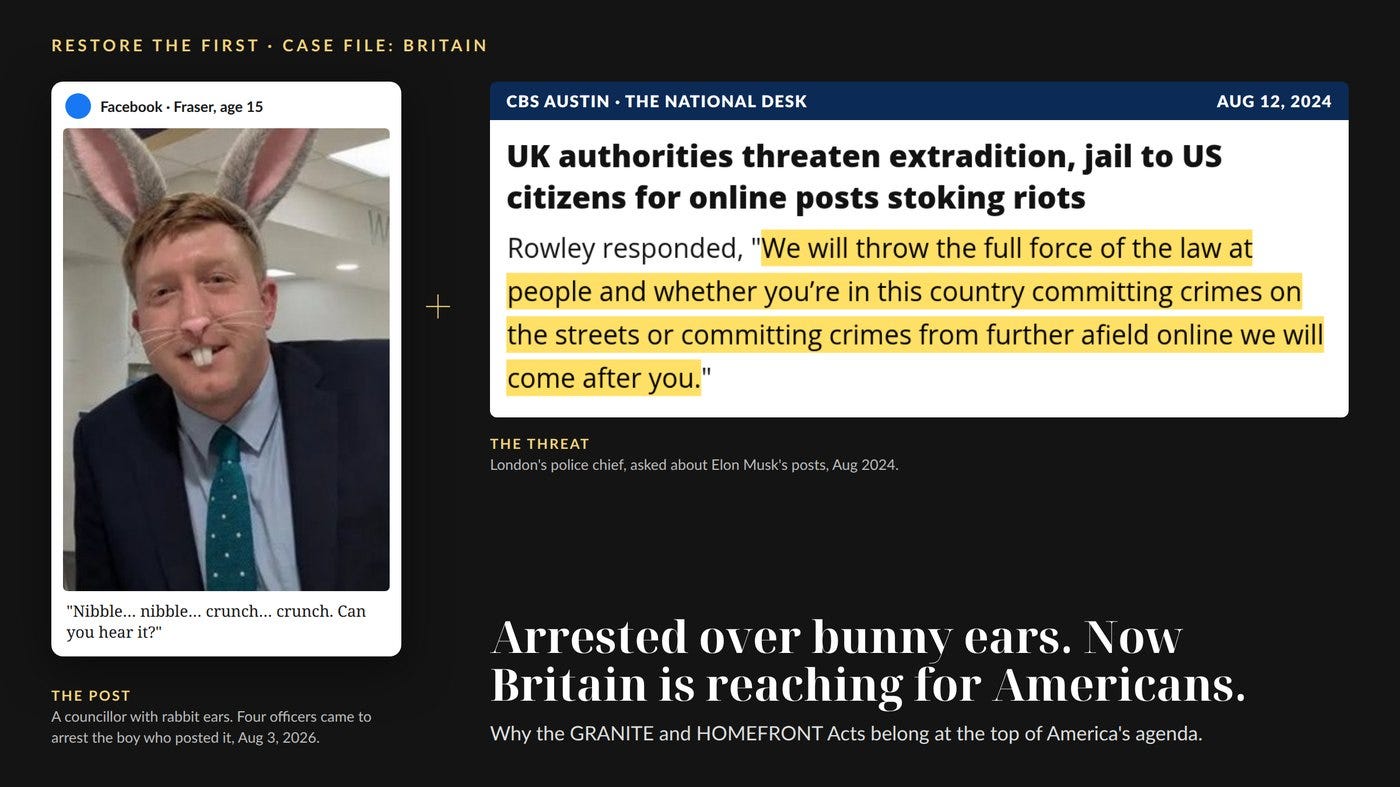
A 15-year-old was hauled from his bed over Facebook jokes. The same ‘online safety’ model, and the people pushing it, have Americans and Elon Musk’s X in their sights. The GRANITE and HOMEFRONT Acts are the firewall.


Fraser was asleep. It was 8:30 in the morning on the first day of the summer holidays, and the 15-year-old had come home late the night before from knocking on doors for Nigel Farage. When he opened his eyes, four uniformed police officers were standing around his bed.
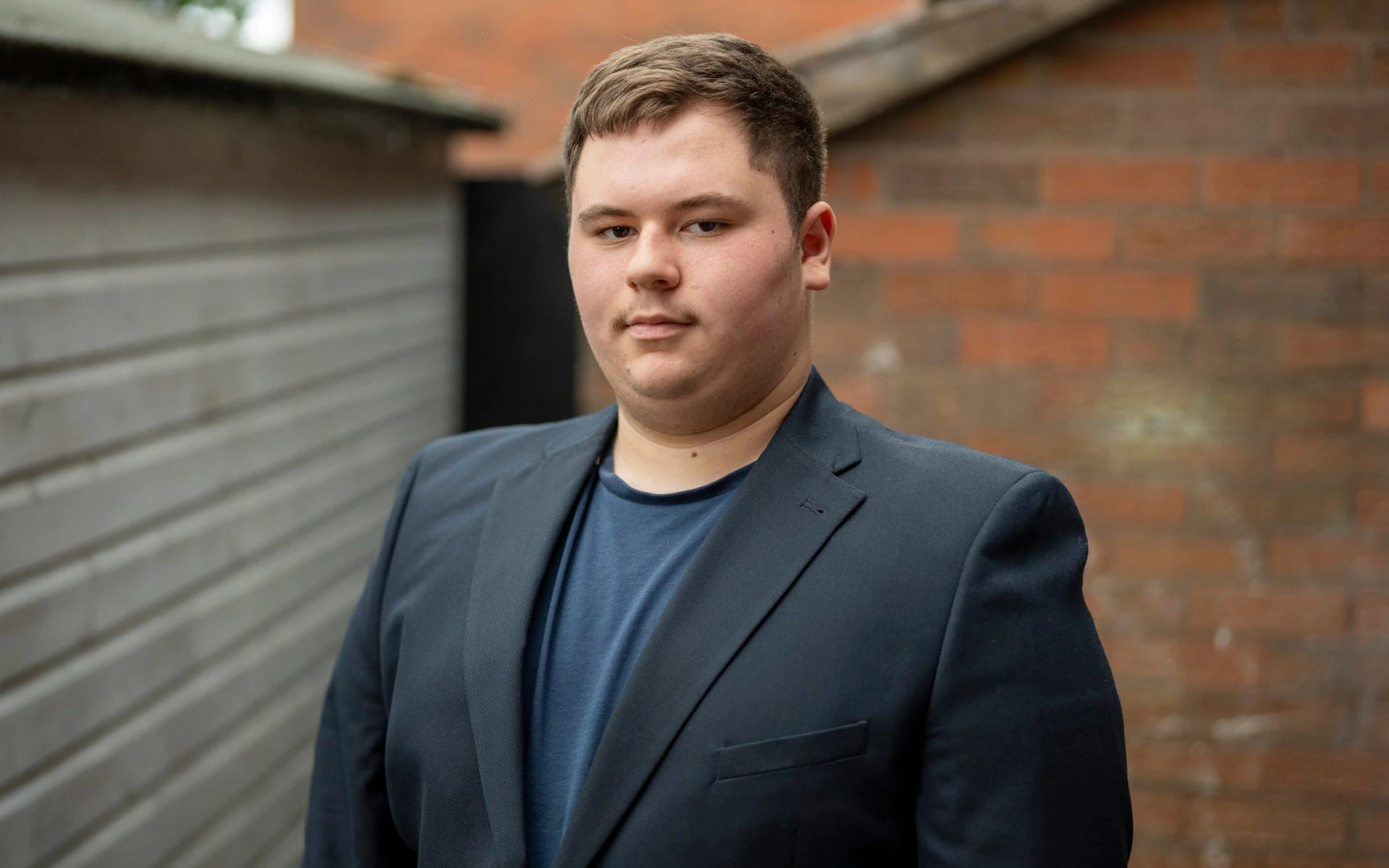
Fraser, of Walsall in the West Midlands. Credit: Andrew Fox
His crime, as far as anyone has been able to tell him, was a handful of Facebook posts mocking a local Conservative councillor. One complained that the man wore shorts and trainers to a committee meeting. One put rabbit ears on his photo with the caption, “Nibble… nibble… crunch… crunch. Can you hear it? That’s the sound of a rabbit devouring the last remaining shreds of Wolverhampton Conservatives’ credibility.” The New York Post picked up the story on October 21.
Officers searched him in the street in front of his neighbors. At the station they took his fingerprints, his DNA and his mugshot, removed his shoes, and left him alone in what he called a “freezing cold cell.” They took his phone and laptop and kept the phone for a month. He was bailed and banned from attending council meetings, which, for a boy who spends his evenings watching local democracy, was the cruelest part.
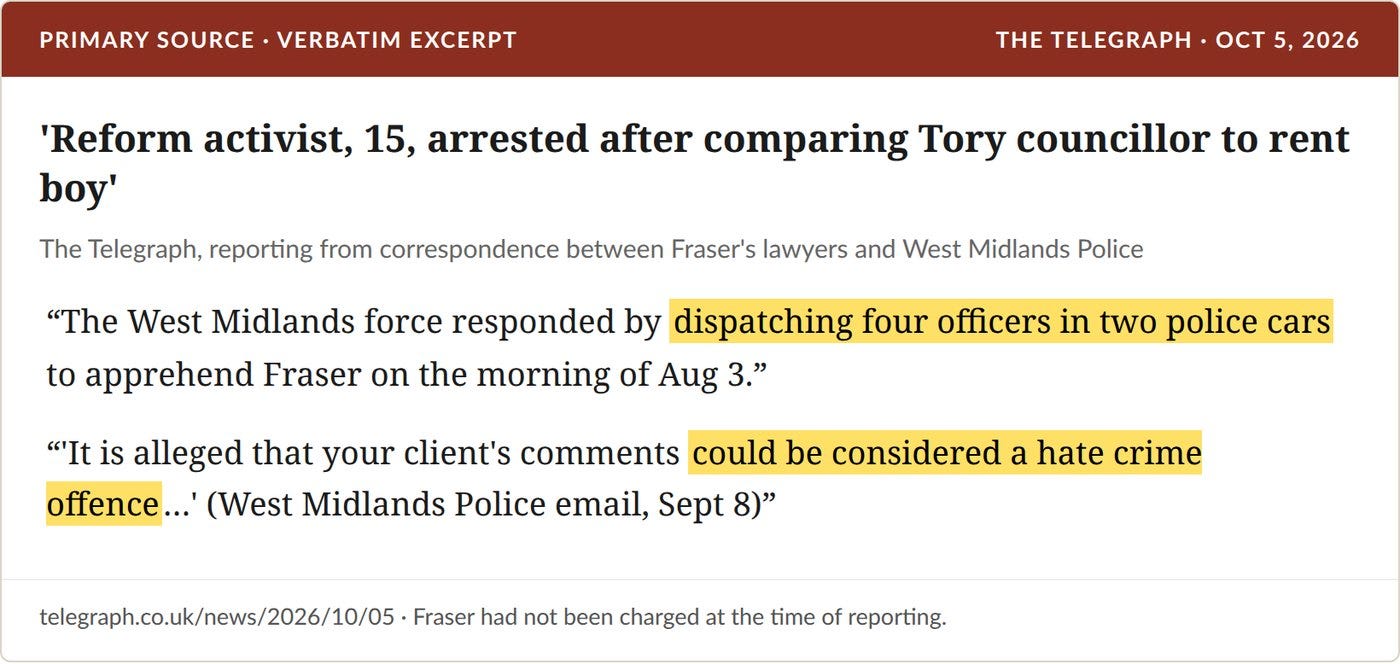
Months later, nobody has told him whether he will be charged. The only written explanation came in a police email to his lawyer: “It is alleged that your client’s comments could be considered a hate crime offence.”
THE FULL RECORD, INCLUDING THE WORST POST
Fairness requires the whole picture. In a now-deleted post, Fraser wrote that the councillor, Simon Bennett, was thankfully “not looking like a rent boy” when he wore a suit. The Telegraph reports this was likely the tipping point for the complaint. Bennett says the posts were part of a pattern, that some images were AI-generated, and that the council advised him to go to the police. He told the paper, “The police have not arrested for no reason.” West Midlands Police declined to give the grounds for the arrest. Fraser denies any offence, and the Free Speech Union is preparing a wrongful-arrest claim.
A crude insult aimed at a public official is exactly the kind of speech the First Amendment exists to protect. In the United States, the answer to it is a reply, not a squad car.
This is not a glitch. It is the system working.
It would be comforting to call Fraser’s case an overreaction by one police force. The numbers say otherwise.
Big Brother Watch sent Freedom of Information requests to every police force in the United Kingdom. Its September report, Britain’s Free Speech Problem, counted at least 62,199 arrests for “communications offences” from 2021 to 2025. That is about 34 people a day, every day, for five years.
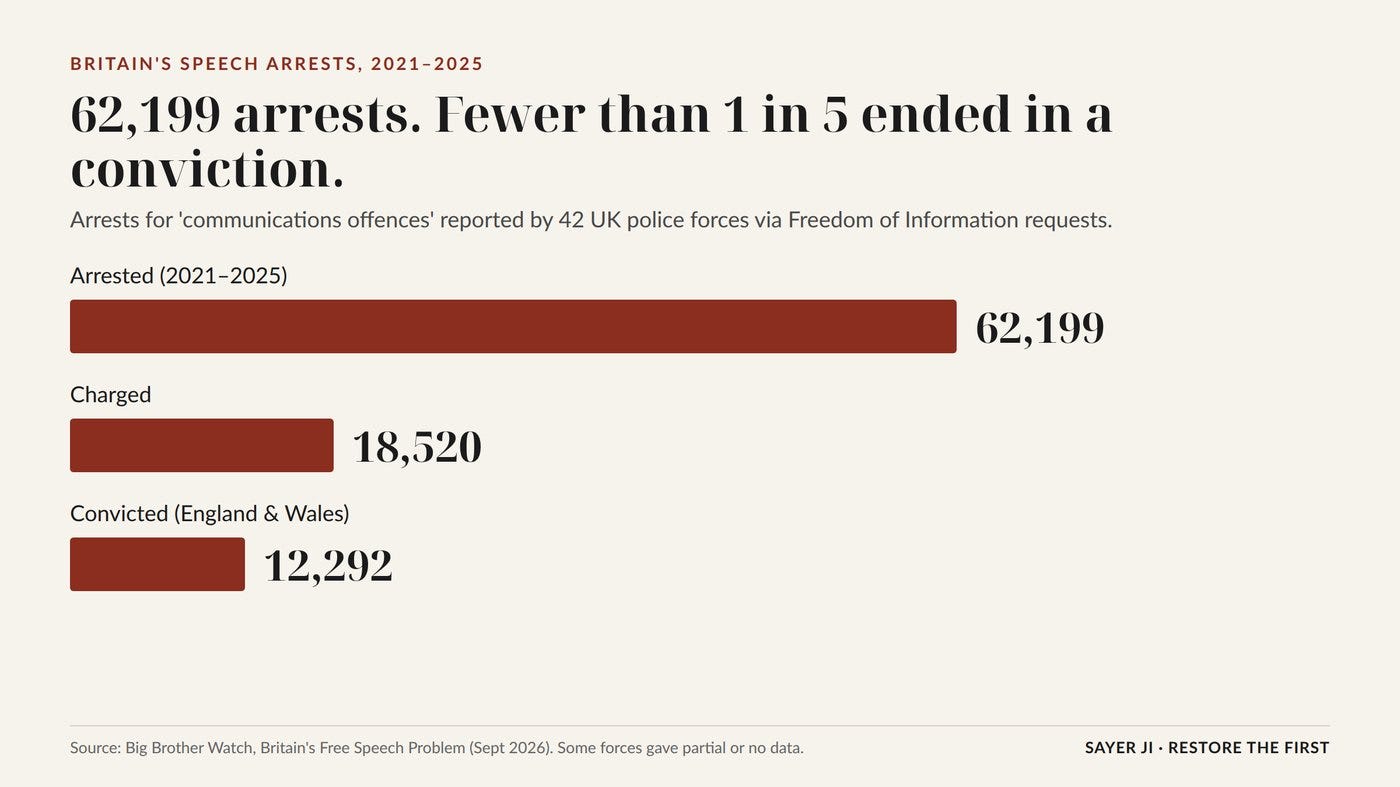
Most of those arrests went nowhere. Fewer than one in three led to a charge, and fewer than one in five to a conviction. But the arrest is the punishment. The dawn knock, the cell, the DNA swab, the seized phone, the months of bail conditions and silence: all of it lands whether or not a court ever hears the case.
THE NUMBERS, CHECKED
You may have seen a claim that 65,000 Britons were arrested for posts “last year.” That is not what the record shows, and we should not repeat it. The accurate figures:
Five-year total: at least 62,199 arrests, 18,520 charges and 12,292 convictions (England and Wales), 2021–2025. Big Brother Watch estimates the true total is about 73,023 once missing forces are filled in with national averages, as reported here.
Single year: 12,183 arrests in 2023 under section 127 of the Communications Act 2003 and section 1 of the Malicious Communications Act 1988, from 37 forces, up from 7,734 in 2019, according to custody data obtained by The Times. The House of Lords Library cites the same “over 12,000 arrests a year.”
Limits: these offences also cover genuine threats and harassment, not only political speech. Some forces refused or gave partial data, and no government department publishes the arrest total, a gap noted by independent analysts.
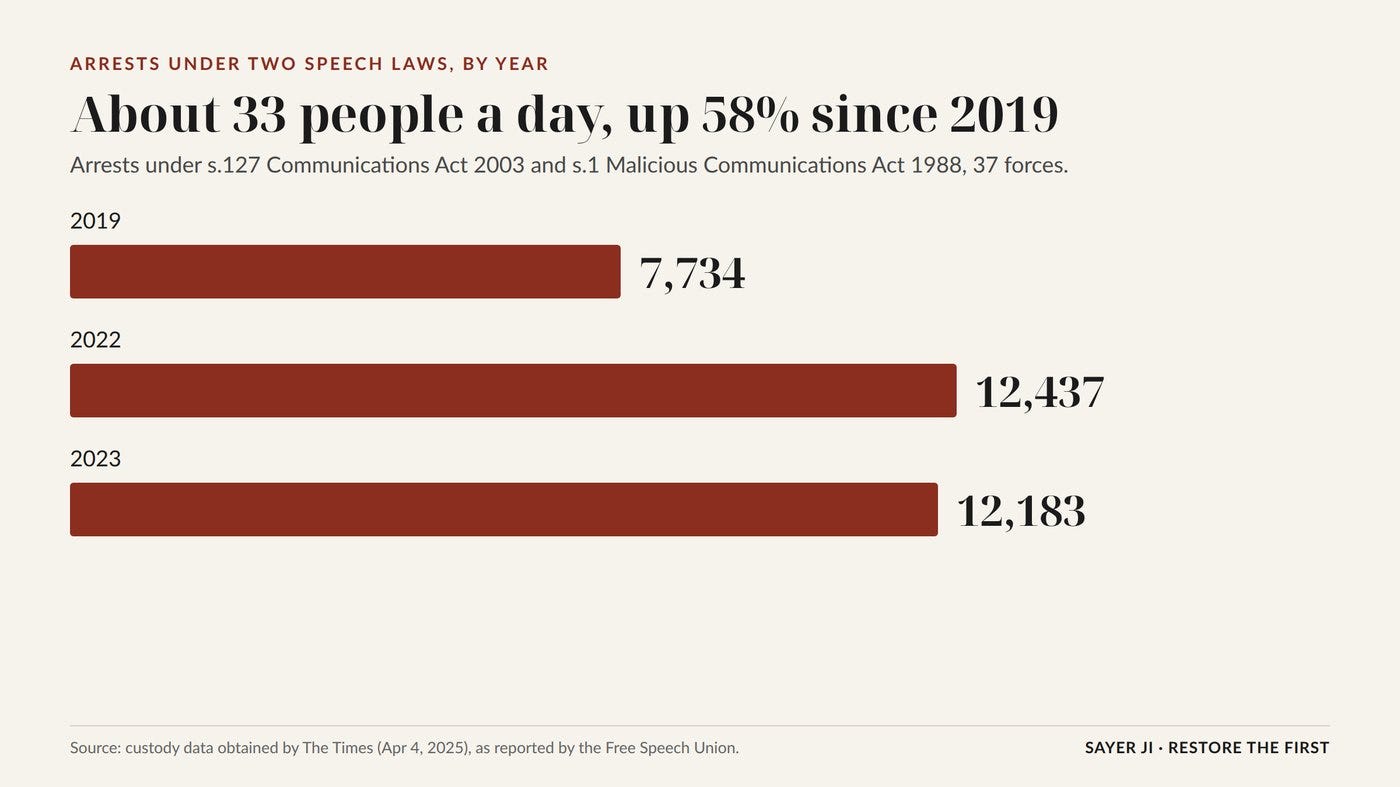
The laws used are breathtakingly vague. Section 127 makes it a crime to send a message that is “grossly offensive,” and the older Malicious Communications Act targets messages meant to cause “distress or anxiety.” The European Parliament has been asked about the same pattern of arrests over messages causing “annoyance,” “inconvenience” or “anxiety.” When the offence is a feeling, the person with the most power to report a feeling, a politician, a council, a well-connected complainant, gets to decide who goes to the cell.
“We think the UK has the highest number of speech arrests on Earth, including Russia and Belarus,” the Free Speech Union’s Sam Armstrong told the Post.
Subscribe to follow Restore the First.
The model has a name: “online safety”
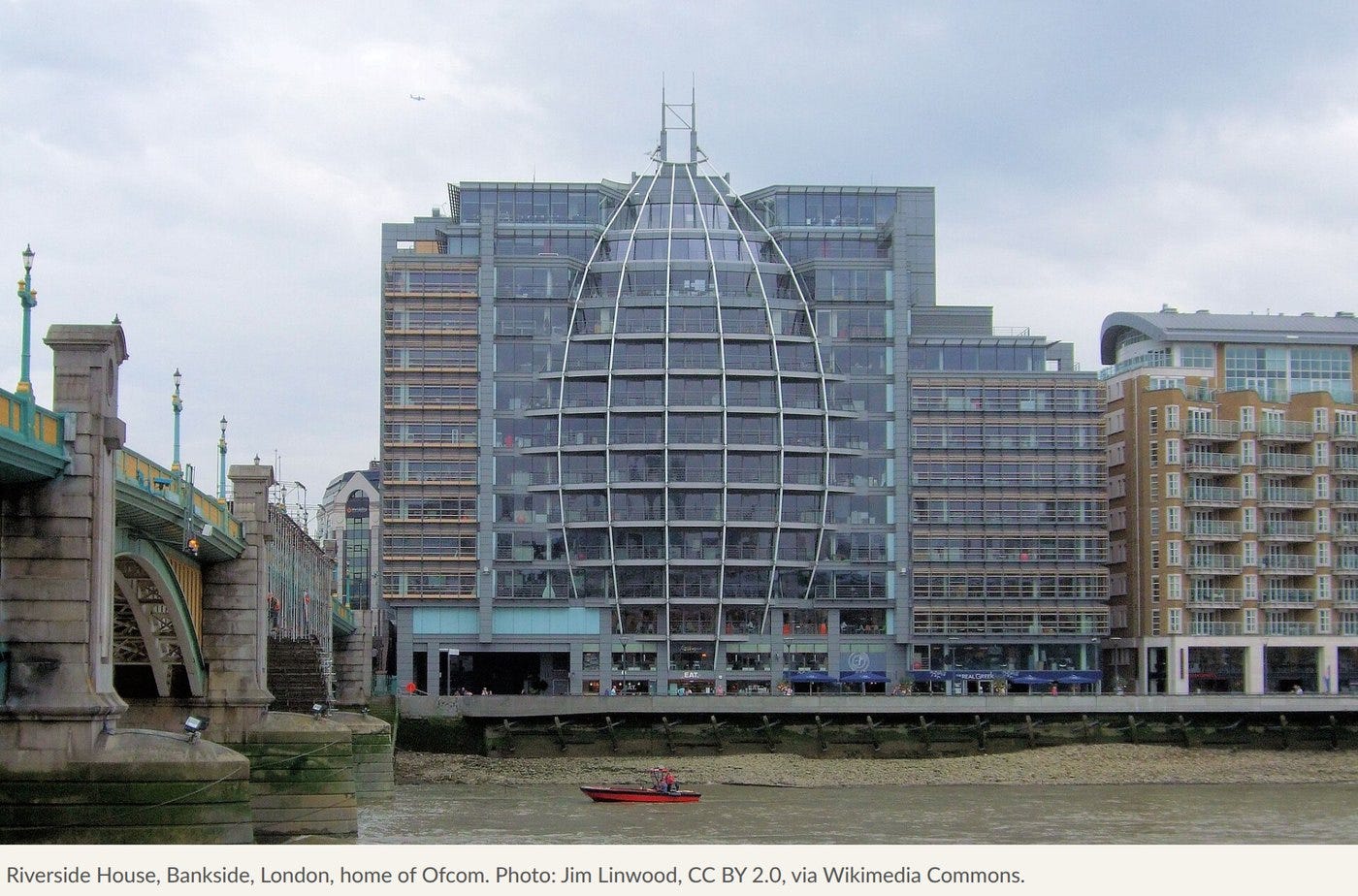
In 2023 Britain passed the Online Safety Act. It was sold as a law to protect children. What it actually built is a permanent regulator, Ofcom, with power to demand data from any platform with British users, to threaten fines of up to 10 percent of global turnover, and to hold named senior managers criminally responsible.
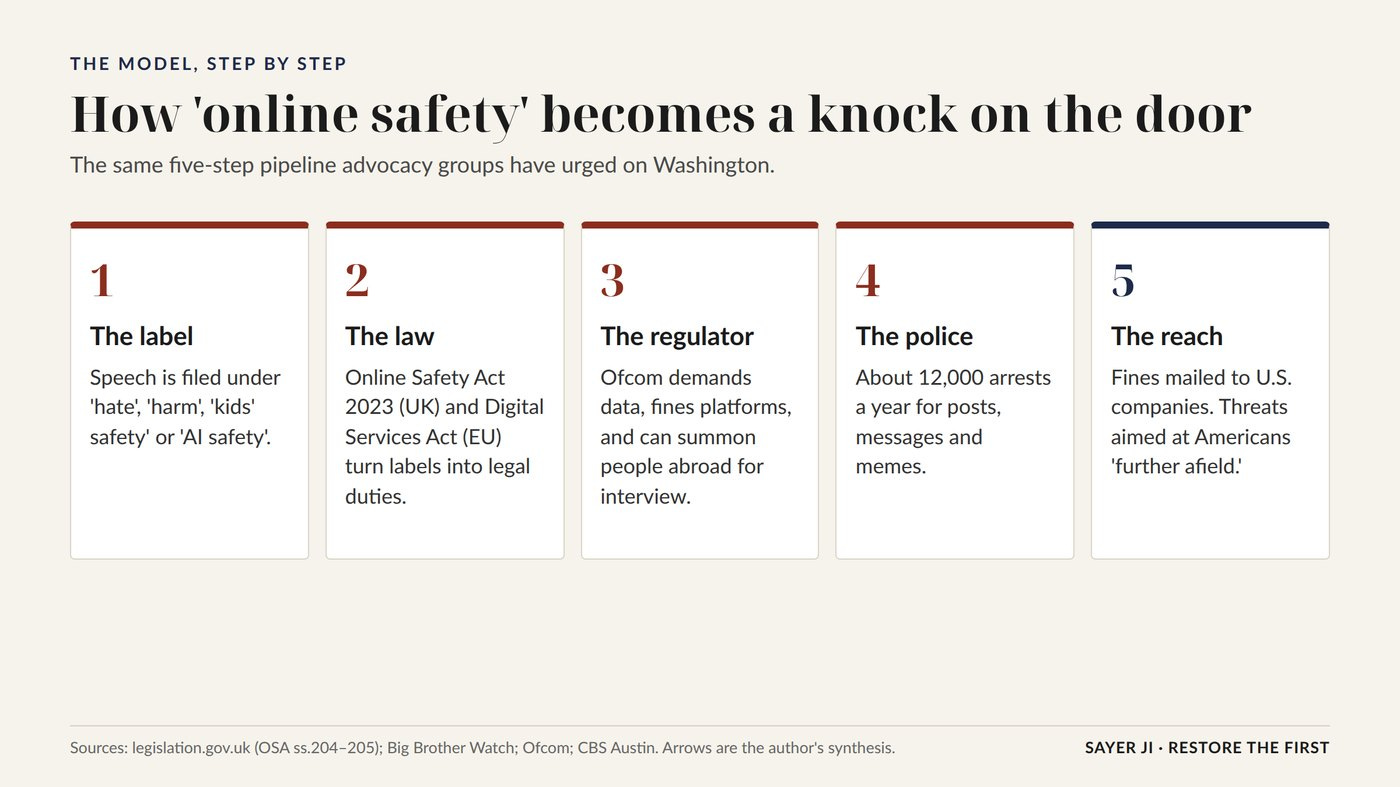
And it does not stop at Britain’s shores. Read the Act’s own text on extra-territorial application. Section 204 says Ofcom’s powers reach services “provided from outside the United Kingdom,” include documents “held outside the United Kingdom,” and include the power to “require the attendance for interview of an individual who is outside the United Kingdom.” Section 205 says the senior-manager offences apply to acts done “in the United Kingdom or elsewhere.”
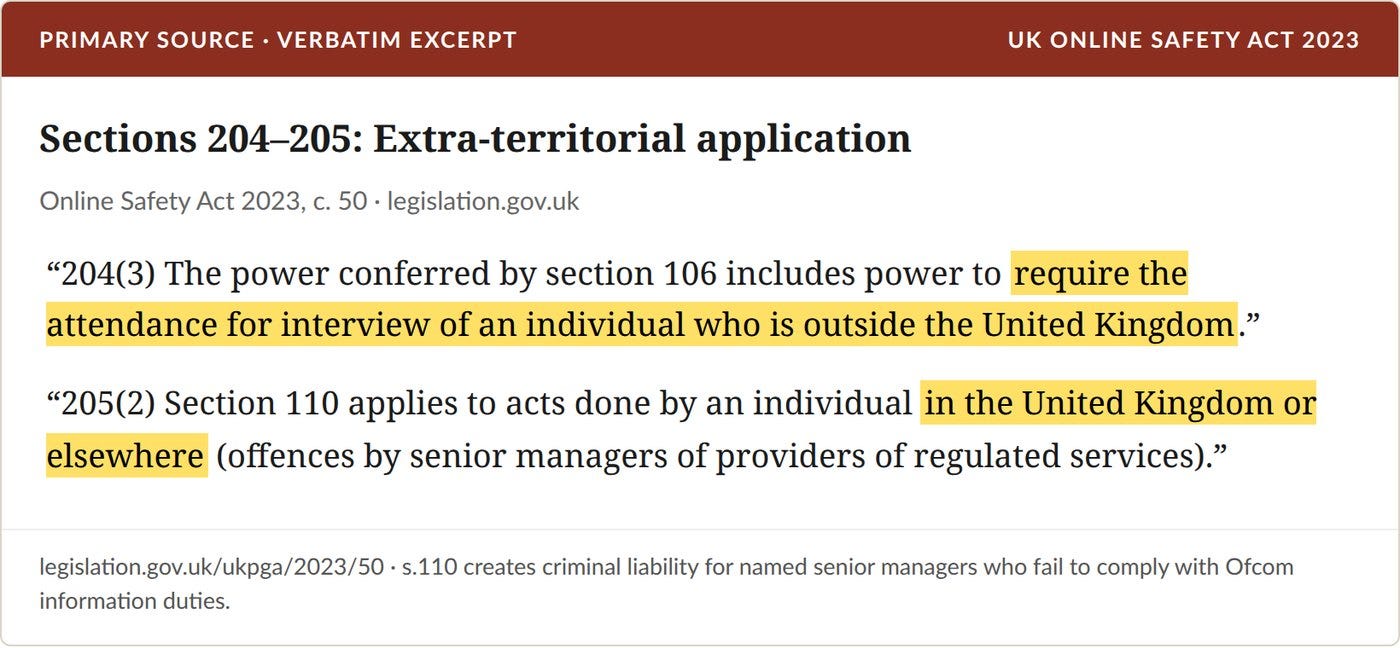
That is the “extradition clause” people are talking about, and it is worth being precise about it. The Act does not contain a sentence that says “extradite Americans.” What it does is make certain failures to obey Ofcom into crimes that can be committed from anywhere, by anyone running a service that British users can reach. Once something is a crime that can be committed abroad, the machinery of arrest warrants, travel risk and extradition requests is available to whoever wants to use it.
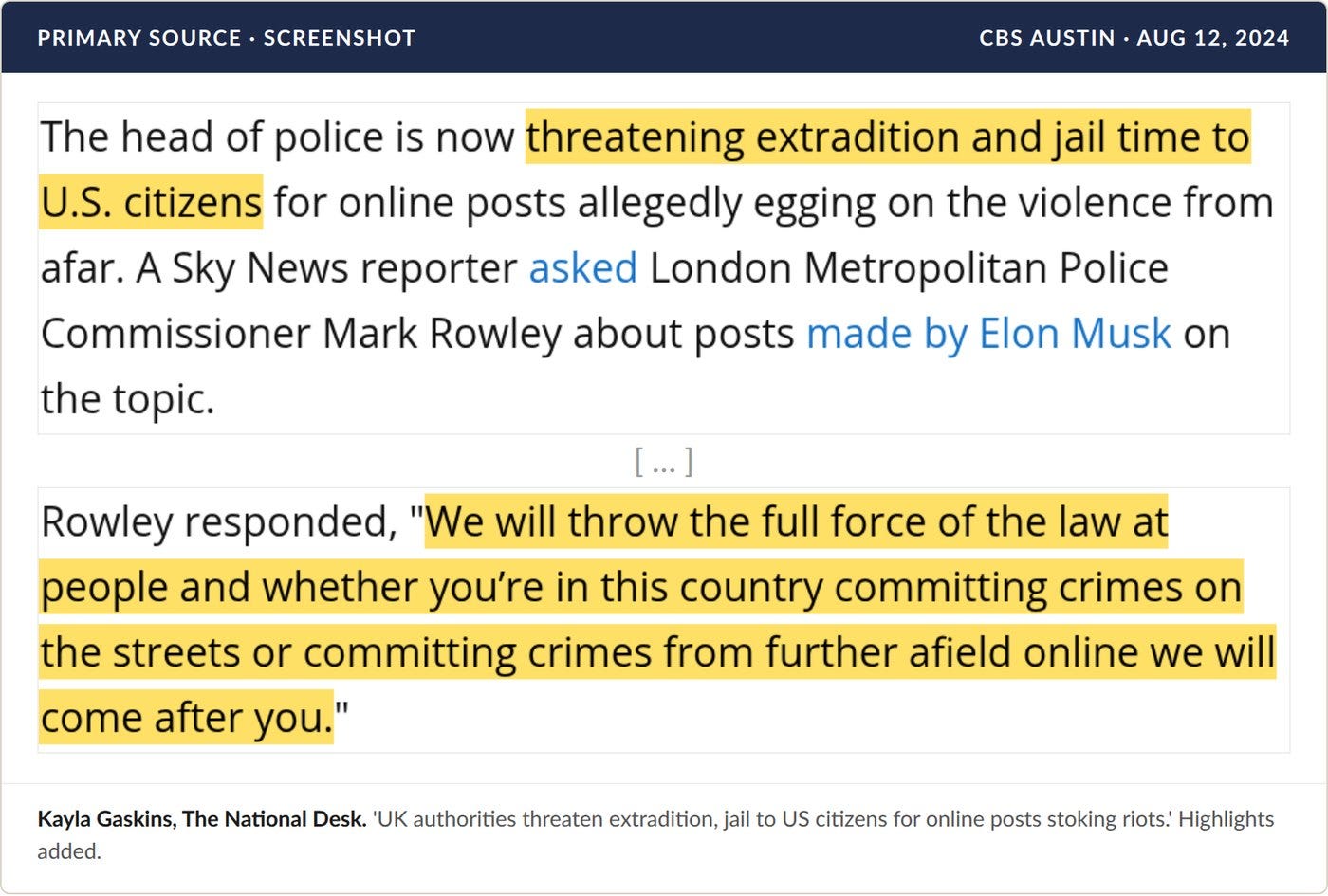
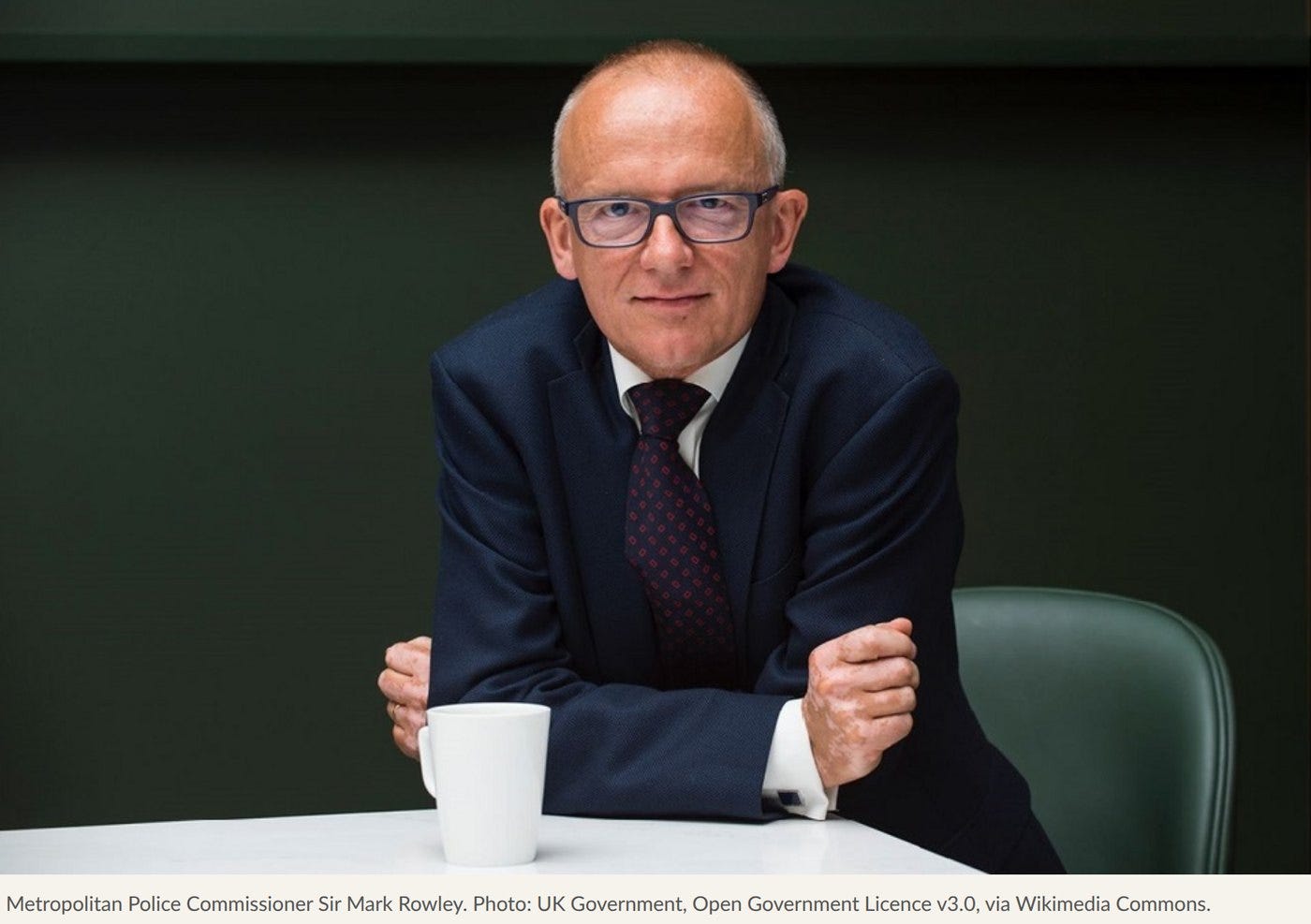
Britain’s top police officer already told us how he would like to use it. In August 2024, during the Southport riots, a Sky News reporter asked Metropolitan Police Commissioner Mark Rowley about posts by Elon Musk. His answer, reported by CBS Austin under the headline “UK authorities threaten extradition, jail to US citizens for online posts”: “Whether you’re in this country committing crimes on the streets or committing crimes from further afield online, we will come after you.”
WHERE EXTRADITION LAW ACTUALLY STANDS
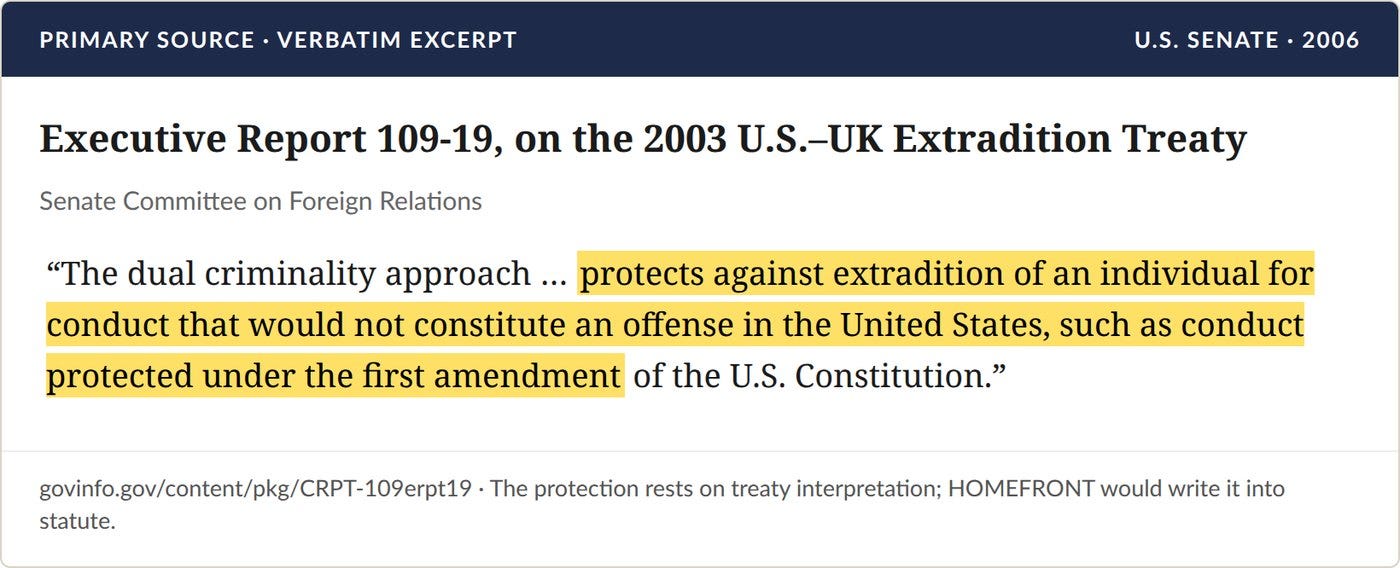
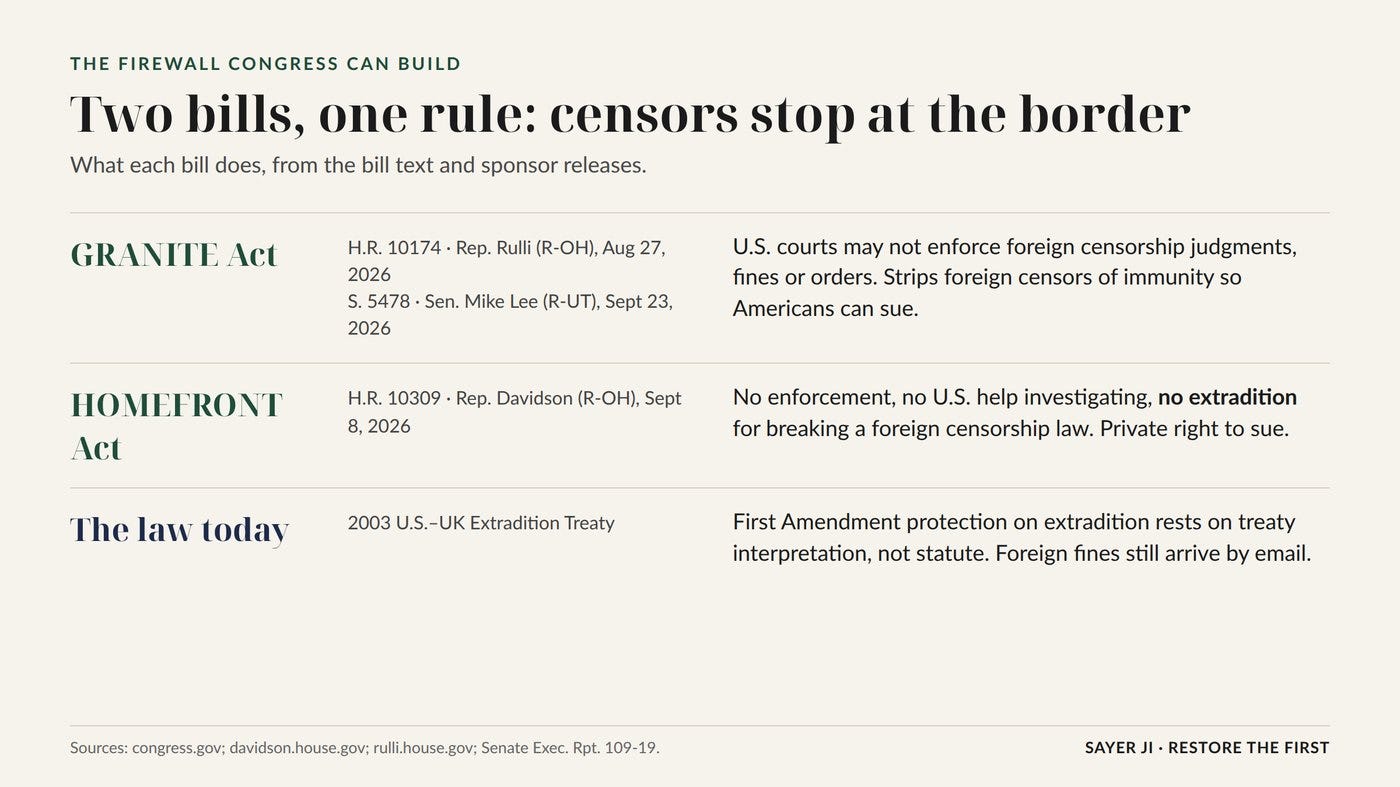
Today, the main shield is the 2003 U.S.–UK Extradition Treaty, which only covers conduct “punishable under the laws in both States” by a year or more in prison. When the Senate ratified it, the Foreign Relations Committee wrote that this “protects against extradition of an individual for conduct that would not constitute an offense in the United States, such as conduct protected under the first amendment.”
That is real protection, and CBS itself noted it is “highly unlikely” British authorities would pursue U.S. posters. But it is a committee’s reading of a treaty, not a statute. It does nothing about fines, data demands, executive liability, or what happens to an American who changes planes at Heathrow.
The fines have already crossed the Atlantic
This is not hypothetical. Ofcom has been emailing orders to American websites with no British staff, servers or assets. Its first Online Safety Act fine, in October 2025, hit 4chan. By March 2026, the total demanded from that one American forum had reached £520,000.
4chan and Kiwi Farms went to federal court in Washington to ask a simple question: can a British regulator conscript Americans this way? In September, Judge Rudolph Contreras dismissed the case without answering it. Ofcom, he ruled, is immune from suit under the Foreign Sovereign Immunities Act. In other words, a foreign censor can send demands into the United States, and the American on the receiving end cannot even get into a U.S. courtroom to challenge them first.
That ruling is the single best argument for the bills now in Congress. Ofcom’s chief executive has since conceded to MPs that it may never collect from companies that refuse. Of its 11 online safety fines, only two have been paid. But a smaller company with a UK office, a founder who travels, or an investor who flinches will not wait to find out.
Who is pushing this model on America
The British state did not invent the “safety” frame alone. Advocacy groups on both sides of the Atlantic have spent years building it, and one of them left a paper trail.
In October 2024, internal planning notes from the Center for Countering Digital Hate, the London- and Washington-based group run by Imran Ahmed, were leaked and reported by UnHerd and others. I covered them at the time in The ‘Kill Musk’s Twitter’ Directive. I have the documents. Here is what they say, in their own words.

The first annual priority, above everything else, is “Kill Musk’s Twitter.” The second is “Advertising focus,” the pressure campaign on brands. The third is “Trigger EU & UK regulatory action.” The fourth is “Progress towards change in USA and support for STAR,” CCDH’s model law for platform regulation.
Read that list as a sequence and it is the playbook in this article. Name a platform. Squeeze its revenue. Get European and British regulators to act. Then import the result to the United States.
The notes also show how “kids” works inside that playbook. In one meeting, Ahmed says sustained pressure on platforms over “kids/harms” can “drive the accountability agenda,” and asks why there is “no legislation that can be used to hold them accountable.” A colleague answers that “since this falls under OSA, this will help us inch towards our goal of regulatory action.”
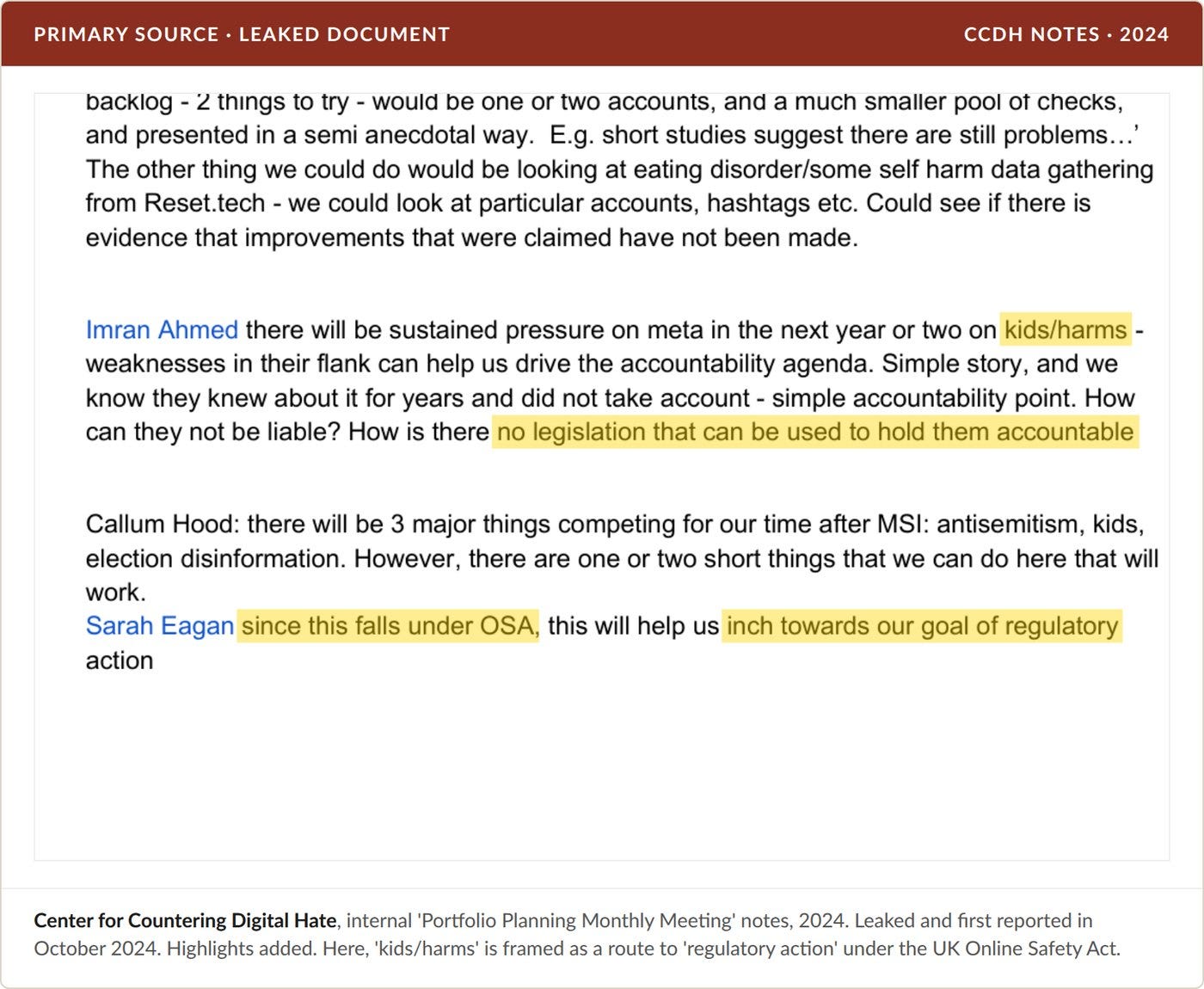
Protecting children is a real and serious goal. That is exactly why it works as a vehicle. Elsewhere in the same file, a “Children” agenda item proposes a partner letter “calling to deplatform Libs of TikTok,” a conservative commentary account. Another entry plans a “Press release on KOSA,” the U.S. Kids Online Safety Act.
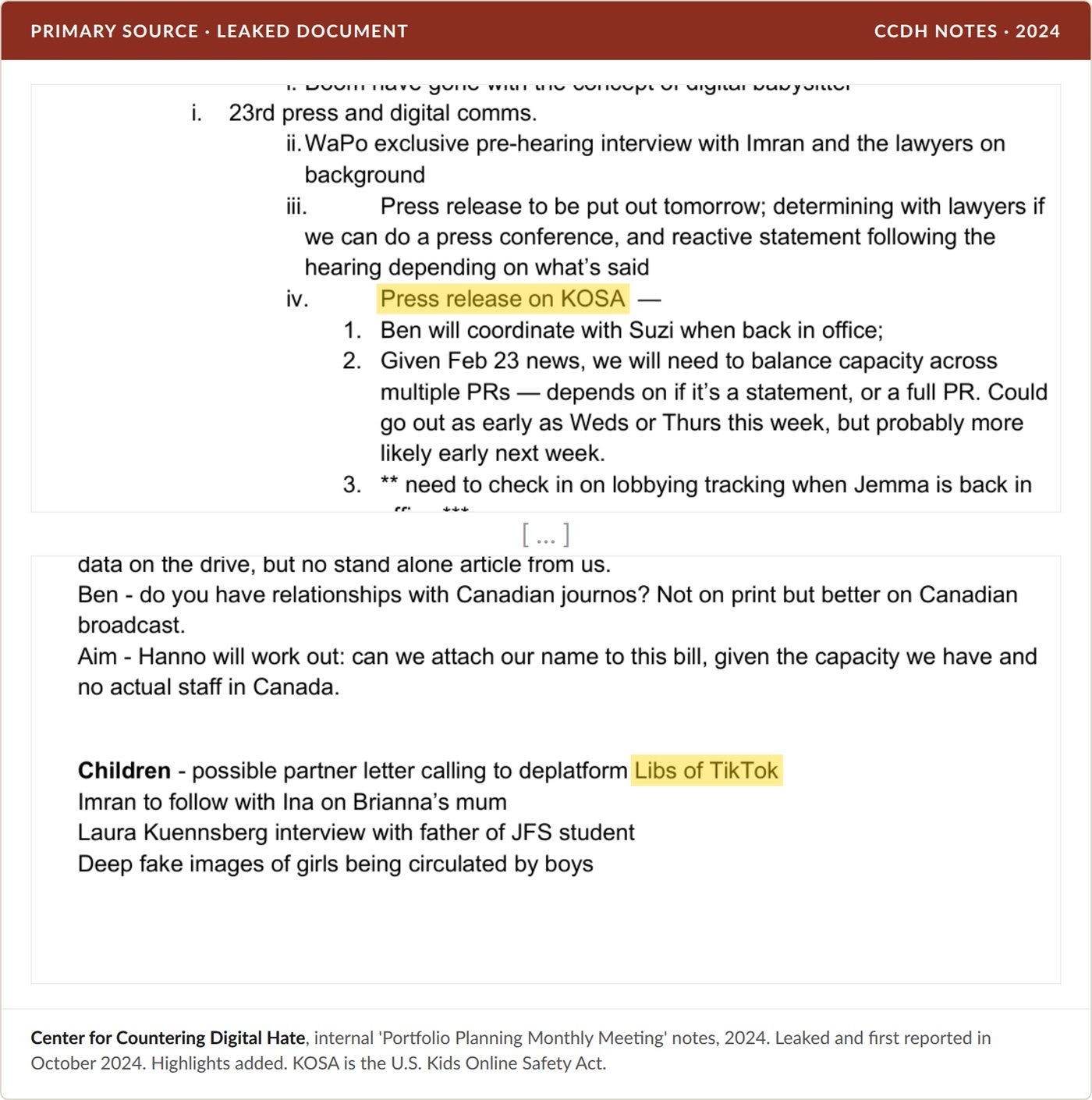
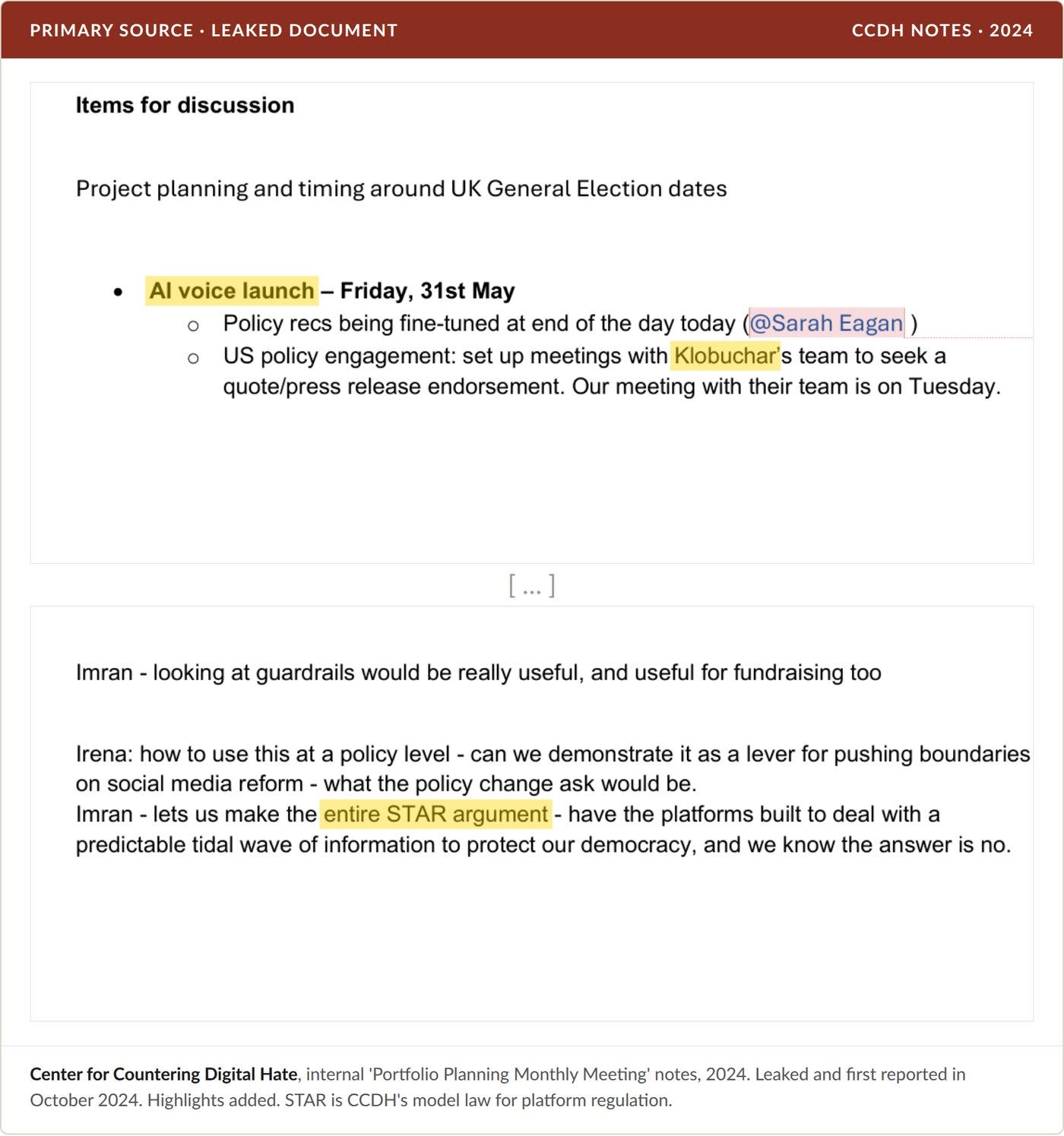
The same notes track an “AI voice launch,” with a plan to “set up meetings with Klobuchar’s team to seek a quote/press release endorsement,” and a staff update about meeting “16 congressional offices” to brief them on the Musk lawsuit and tech policy priorities. Ahmed says AI-election work “lets us make the entire STAR argument.” Safety for kids, safety from AI, safety from “hate”: the label changes, the destination does not.
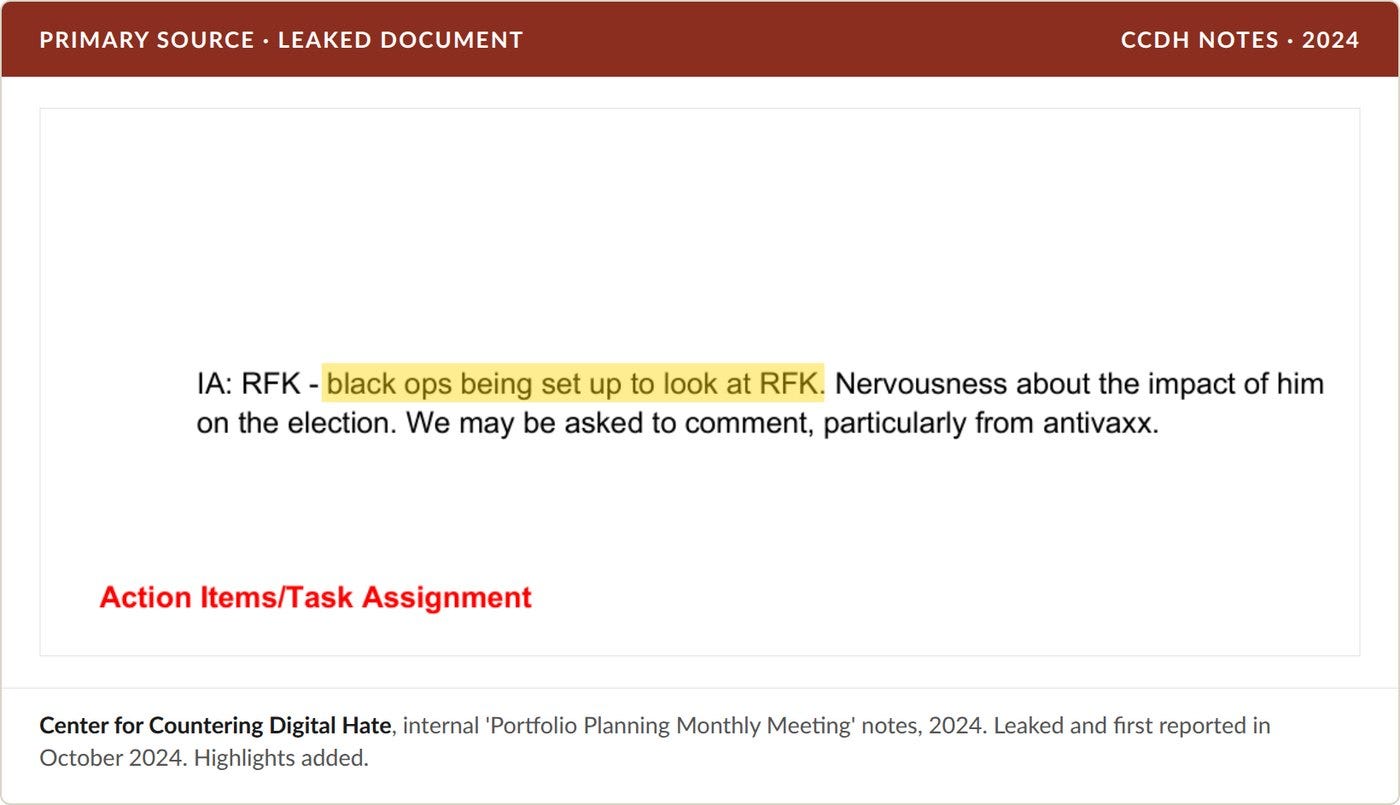
And the notes record this line, attributed to “IA”: “RFK - black ops being set up to look at RFK.”
These organizations are not marginal. Morgan McSweeney, who went on to become Keir Starmer’s chief of staff, served as a director of the group Ahmed founded. In my 2024 report on the transatlantic coordination files obtained by America First Legal, CCDH appeared alongside the U.S. and UK governments in the same counter-disinformation networks.
THE OTHER SIDE OF THE LEDGER
CCDH says it advocates for government action against hate and disinformation, and Ahmed, a U.S. permanent resident, has called U.S. sanctions against him “retribution” for holding platforms accountable. In December 2025 the State Department barred him from entering the U.S., accusing him of seeking to “coerce” American platforms; a federal judge then temporarily blocked his detention.
X sued CCDH in 2023 over its data collection and reports. A federal judge dismissed the suit in March 2024; the Ninth Circuit heard X’s appeal on September 30, 2026, and a decision is pending.
The leaked notes are internal meeting minutes, not finished policy. They show priorities and plans in the group’s own words; they do not by themselves show what was carried out.
Why they want X dead
“Kill Musk’s Twitter” was not a slip of the keyboard. It was the top line of a strategy, and every lever in that strategy has since been pulled on X.
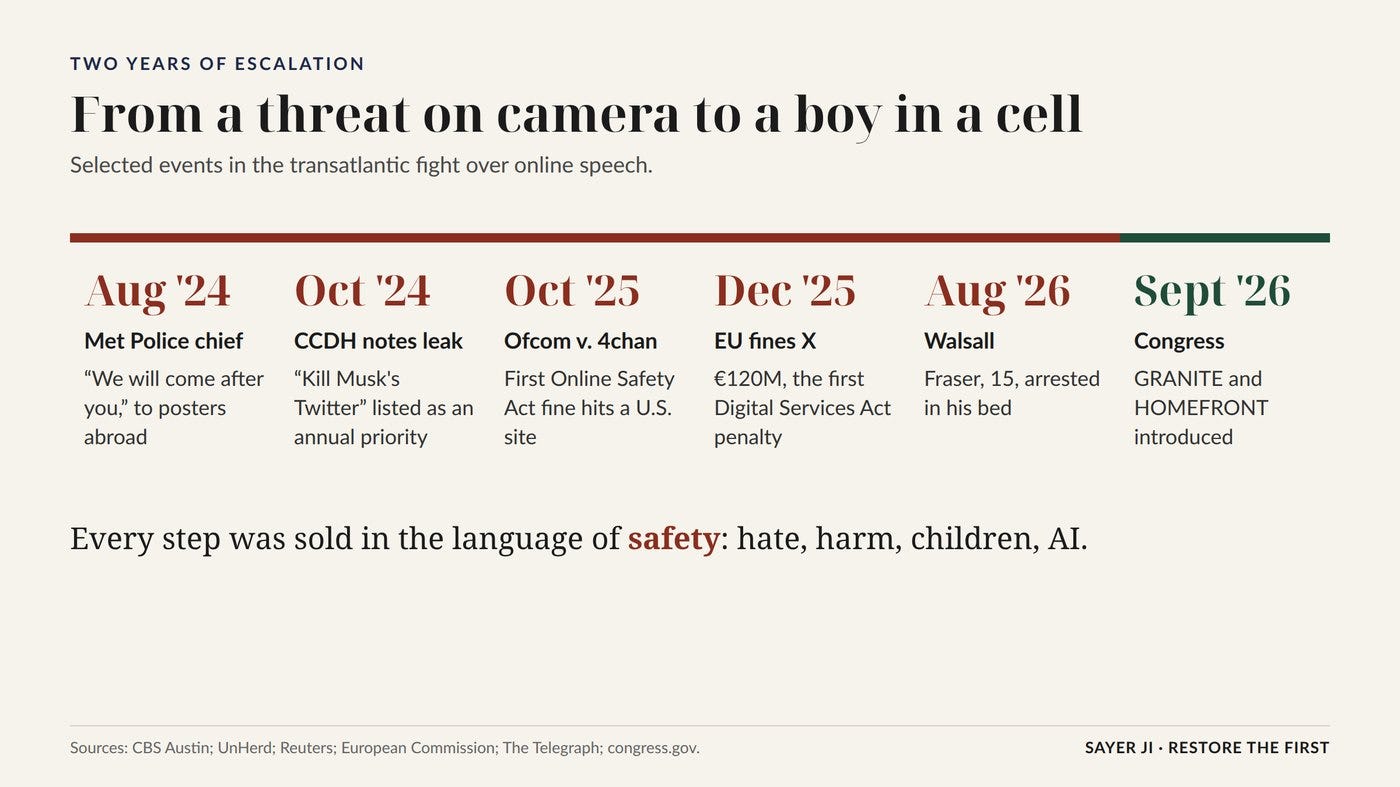
The advertiser pressure came first; X’s lawsuit alleges CCDH’s reports helped drive brands away. Then the European Commission issued the first-ever fine under its Digital Services Act, €120 million against X in December 2025. One part of that fine was for X’s “failure to provide access to public data for researchers,” including X’s terms barring independent “scraping.” That is the same activity X sued CCDH over.
Then Britain moved. In January 2026, after reports that X’s Grok AI had been used to make sexualized deepfakes, Ofcom opened a formal investigation, and ministers confirmed a possible ban on the platform in the UK. This month Ofcom said it still has “ongoing concerns” about how X handles “hate and terror content” and is monitoring X’s quarterly takedown data.
Let me be clear about Grok: nonconsensual sexual images, especially of children, are a genuine crime, and X has restricted the tool in response. But notice the shape of it. An AI-safety scandal became the doorway to an open-ended “hate content” supervision regime over the one major platform that would not play along. That is what “inch towards our goal of regulatory action” looks like in practice.
Why X? Because it is the last mass platform where a story like Fraser’s can still go viral before anyone decides whether it should. It is where the CBS clip, the leaked notes, and the 62,199 figure have circulated to millions without a regulator’s permission. Every other large platform has learned to pre-comply. X is the one that keeps saying no, in court and in public. Kill that, and the five-step model in this article has no witness.
Why this is the #1 issue for Americans
Inflation, borders and wars all matter. But every one of those debates depends on one thing: the ability to say what you think about them without a knock on the door. Lose that, and you lose the means to fight for anything else. That is why the First Amendment comes first.
Today the barrier between Fraser’s bedroom and yours is a constitutional tradition, a committee report on a 2003 treaty, and the stubbornness of a few platform owners. That is not enough when foreign regulators can email orders into the country and hide behind sovereign immunity, and when American advocacy groups are working to bring the same model home.
Two bills would close the gap.
The GRANITE Act (H.R. 10174, Rep. Michael Rulli; S. 5478, Sen. Mike Lee) bars U.S. courts from enforcing any foreign censorship judgment, fine or order that would violate the First Amendment, and strips foreign governments of sovereign immunitywhen they try, so Americans can go to federal court for protection. It is the direct fix for the 4chan ruling. Rep. Thomas Massie is its first cosponsor.
The HOMEFRONT Act (H.R. 10309, Rep. Warren Davidson) goes further. It bars extradition from the United States for violating a foreign censorship law, bars any U.S. government cooperation in enforcing or investigating one, and gives Americans a private right to sue the foreign regulator.
Together they turn “highly unlikely” into “illegal.” They take Rowley’s threat and make it unenforceable on American soil.
What you can do this week
Call your representative and ask them to cosponsor H.R. 10174 (GRANITE) and H.R. 10309 (HOMEFRONT). Call both senators about S. 5478.
Use the one-click action at Restore the First to send the message in under a minute.
Share Fraser’s story. Share the leaked notes. The model depends on Americans not noticing until it is already here.
A boy in Walsall lost his phone, his DNA and his summer over a pair of bunny ears. Here, it still ends with a laugh. Let’s keep it that way.
“…the freedom of Speech may be taken away, and, dumb and silent we may be led, like sheep, to the Slaughter.”
George Washington, Newburgh Address, March 15, 1783
Sources
four uniformed police officers were standing around his bed: https://www.telegraph.co.uk/news/2026/10/05/reform-teenager-arrest-tory-wolverhampton-council-leader/
The New York Post: https://nypost.com/2026/10/21/opinion/a-uk-teen-made-fun-of-a-politician-then-cops-showed-up-at-his-door/
Britain’s Free Speech Problem: https://bigbrotherwatch.org.uk/wp-content/uploads/2026/09/Britains-Free-Speech-Problem-070926.pdf
as reported here: https://www.noticer.news/uk-police-arrest-60000-speech-crimes/
The Times: https://freespeechunion.org/archive/police-make-30-arrests-a-day-for-offensive-online-messages
House of Lords Library: https://lordslibrary.parliament.uk/select-communications-offences-and-concerns-over-free-speech/
independent analysts: https://britishresilienceindex.com/deep-dive/communications-offences
Section 127: https://www.legislation.gov.uk/ukpga/2003/21/section/127
European Parliament: https://www.europarl.europa.eu/doceo/document/E-10-2025-002239_EN.html
threaten fines of up to 10 percent: https://dailycaller.com/2026/10/22/united-kingdom-online-safety-act-digital-services-european-union-free-speech-elon-musk-preston-byrne-jeremy-tedesco-alliance-defending-freedom/
extra-territorial application: https://www.legislation.gov.uk/ukpga/2023/50/part/11/crossheading/extraterritorial-application/2023-11-22
“punishable under the laws in both States”: https://assets.publishing.service.gov.uk/media/5a7b82f240f0b62826a040d3/7146.pdf
“protects against extradition of an individual for conduct that would not constitute an offense in the United States, such as conduct protected under the first amendment.”: https://www.govinfo.gov/content/pkg/CRPT-109erpt19/html/CRPT-109erpt19.htm
emailing orders to American websites: https://www.reuters.com/legal/government/us-court-dismisses-4chans-case-against-britains-media-regulator-2026-09-16/
£520,000: https://www.lawcommentary.com/articles/4chan-kiwi-farms-uk-online-safety-act-us-court
immune from suit under the Foreign Sovereign Immunities Act: https://www.law.ox.ac.uk/content/news/dphil-candidate-christian-bale-helps-ofcom-defeat-us-lawsuit
may never collect: https://www.dexerto.com/entertainment/ofcom-admits-it-may-never-collect-4chans-fines-after-ai-hamster-trolling-3420509/
reported by UnHerd: https://unherd.com/newsroom/inside-the-center-for-countering-digital-hates-plan-to-kill-x/
The ‘Kill Musk’s Twitter’ Directive: https://greenmedinfo.com/content/kill-musk-s-twitter-directive-modern-1776-stand-against-global-plot-censorship2
served as a director: https://www.bbc.co.uk/news/articles/cp39kngz008o
transatlantic coordination files: https://greenmedinfo.com/content/breaking-international-governments-are-criminalizing-free-speech-through-glo-3
“retribution”: https://www.dawn.com/news/1964814
temporarily blocked his detention: https://www.nbcnews.com/tech/misinformation/judge-blocks-trump-administration-detaining-british-anti-disinformatio-rcna251016
Ninth Circuit heard X’s appeal: https://knightcolumbia.org/cases/x-corp-v-center-for-countering-digital-hate
€120 million against X: https://digital-strategy.ec.europa.eu/en/news/commission-fines-x-eu120-million-under-digital-services-act
confirmed a possible ban: https://www.whmi.com/news/fox/uk-targets-elon-musks-x-fines-possible-ban-over-grok-deepfake-abuse
“ongoing concerns”: https://www.ofcom.org.uk/online-safety/illegal-and-harmful-content/ofcom-update-monitoring-xs-response-to-hate-and-terror-content-and-grok-investigation-latest
H.R. 10174: https://www.congress.gov/bill/119th-congress/house-bill/10174/text
strips foreign governments of sovereign immunity: https://rulli.house.gov/2026/09/16/rulli-introduces-bill-to-prevent-foreign-censors-from-infringing-on-first-amendment/
first cosponsor: https://restorethe1st.com/media/features/thomas-massie/
H.R. 10309: https://www.congress.gov/bill/119th-congress/house-bill/10309/all-info
bars extradition: https://davidson.house.gov/media/press-releases/davidson-introduces-bill-to-block-enforcement-of-foreign-censorship-orders-against-americans
Restore the First:
https://restorethe1st.com/
Images: hero composite uses the Facebook image published by The Telegraph and New York Post, and a CBS Austin screenshot; CCDH documents from leaked 2024 meeting notes; photos via Wikimedia Commons (UK Government OGL v3.0; U.S. Air Force/Trevor Cokley, public domain; Jim Linwood, CC BY 2.0). Charts: Sayer Ji / Restore the First.