


While the country agrees on almost nothing, it agrees the Epstein files must be fully released. But the intense fight over their release has hidden a simpler problem: almost no one has read and put into a comprehensive framework the ones we already have.
Americans agree on almost nothing anymore. We disagree about elections, vaccines, war, the economy, and what happened last week. But there is one question on which the country is nearly unanimous.
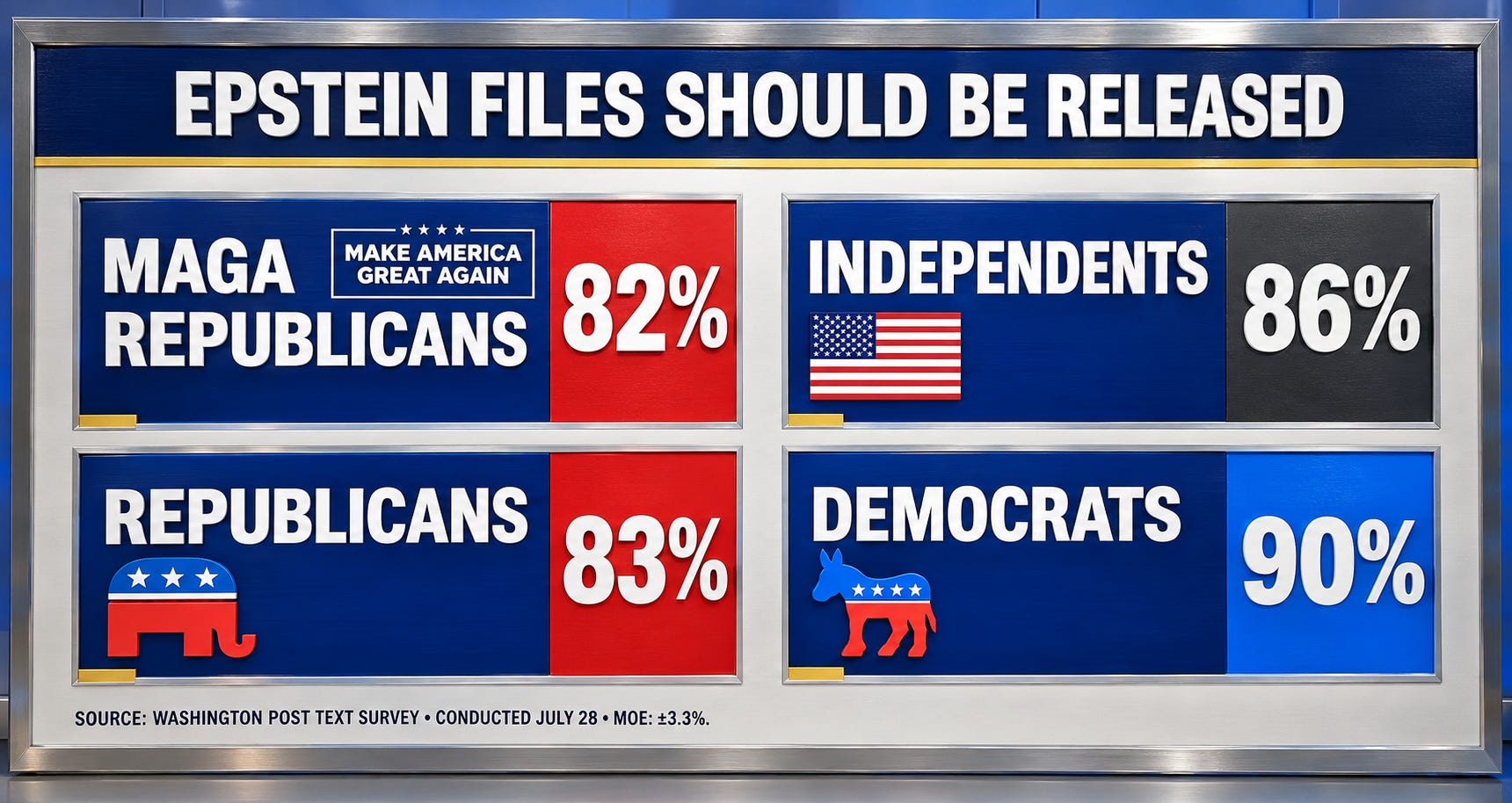
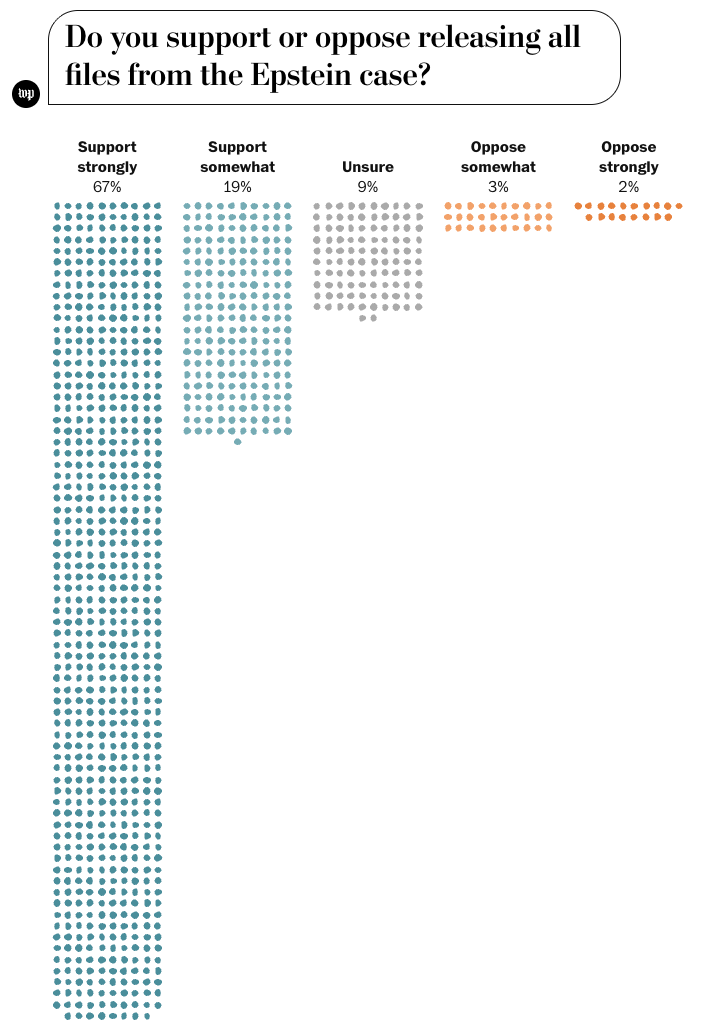
When the Washington Post asked Americans last summer whether all the files in the Epstein case should be released, 86% said yes. Two-thirds said so strongly. The support held across every line that usually divides us: 90% of Democrats, 86% of independents, 83% of Republicans.
That consensus is why the Epstein Files Transparency Act passed the House 427 to 1. It is why, this January, the Justice Department published nearly 3.5 million pages, more than 2,000 videos, and 180,000 images at justice.gov/epstein. And it is why the argument continues now, as Rep. Thomas Massie, the Act’s lead sponsor, presses on what is still being withheld.
Massie has already taken that fight to the House floor, reading fourteen names into the Congressional Record and launching a discharge petition to force a vote on the Epstein Files Transparency Act II. I covered that development here. It gives the 86% a concrete question to put to their representatives: Have you signed? The demand for transparency needs to become pressure for action.
That fight matters. So does understanding what the government has already released.
The files are public. They are not read.
Nearly 3.5 million pages is not a document. It is a landscape. Read at a page a minute, eight hours a day, it would take one person almost twenty years.
So the record is public, and for most practical purposes it is still sealed. The names get headlines for a day. The structure underneath them, who asked Epstein for what, and what they built together, stays buried in the sheer volume of paper.
This is a pattern I know well. For eighteen years my work has been about the difference between evidence that exists and evidence people can actually see. A study sitting in a journal no one reads does not change anyone’s mind. A record no one reads does not hold anyone accountable.
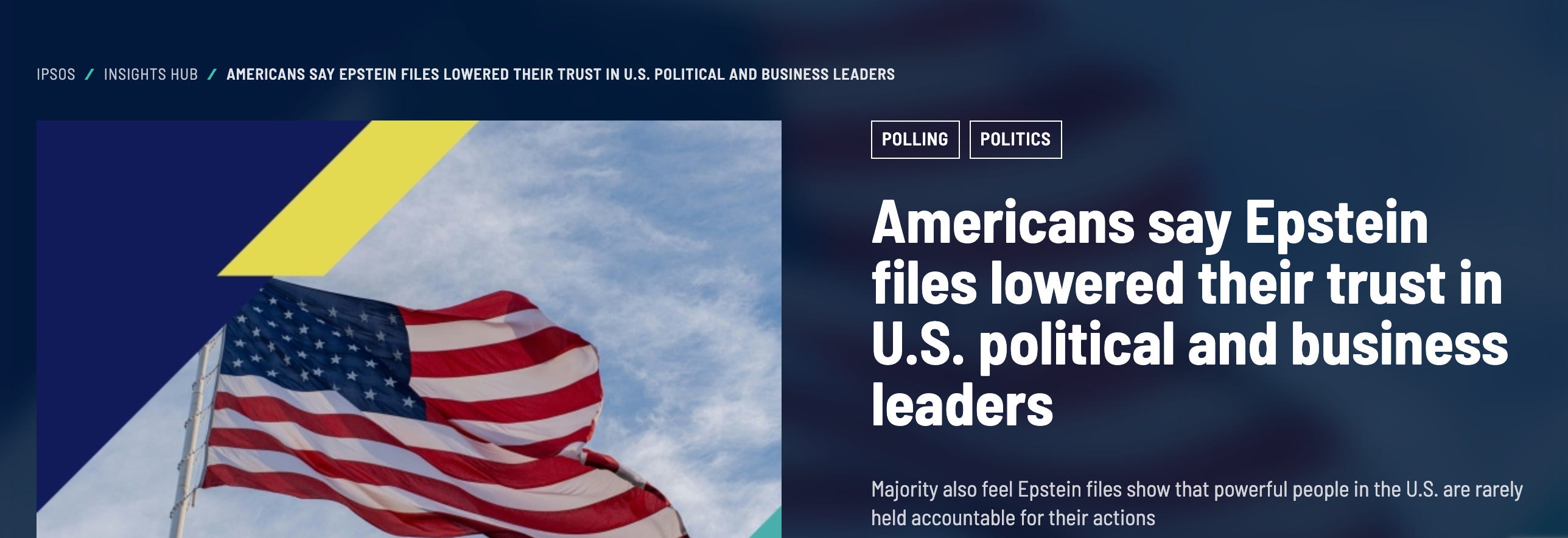
Americans seem to sense this. In a Reuters/Ipsos poll this February, 69% said the Epstein files “show that powerful people in the U.S. are rarely held accountable for their actions.” Majorities of Democrats, independents, and Republicans agreed.
People want the files because they want accountability. But accountability does not come from a download. It comes from someone reading the record, organizing it, and showing what it establishes.
The war with Iran pushed the Epstein files out of the headlines. Attention flatlined. The unanswered questions remained. As I posted on X, I believe a second wave of scrutiny is coming—and its force will depend on how clearly we can show what the documents establish.


What I found when I read them
The day the files opened, I started reading. I have not stopped since. Since February I have published a series of investigations on what the documents show, each one sourced to file numbers you can check. That work became a book.
What the records show is not mainly a story about one man’s crimes, though those are documented and they are monstrous. It is a story about how finance, philanthropy, science, and state power came to operate as one, how the shadow network and no longer the nation-state is the fundametnal unit of power, and how a convicted predator sat at the switchboard of that arrangement for a decade after his 2008 conviction, because he was useful to it.
A few examples from the public record:
Epstein set in motion plans for a proposed $100 billion philanthropic fund, and a major U.S. bank drafted its structure. That fund never launched. A parallel one did, anchored by a global philanthropy. The U.S. government signed a ten-year agreement with it, and a cabinet secretary issued it operational instructions in 2025.
In the correspondence, an offshore arm of the planned fund is described as “especially for vaccines.”
In a separate document, a “strain pandemic simulation” appears as a Gates private-office deliverable, dated three years before the pandemic.
Epstein’s jet had its visa waiver authority renewed five months after his pilot told Customs that Epstein was a registered sex offender.
A prince asked him to help draft Buckingham Palace’s denial of a survivor’s accusation.
A million dollars of Epstein’s money now sits in an emergency-call company inside American 911 centers.
And this is only about 1% of what I have documented within the files.
And most all of it came after his conviction. Removing him did not remove the arrangement around him; one could argue they became more entrenched, and even more hidden.
Why a book is the answer

The 86% are asking for the files. What they need is a way through them.
That is what Shadow Empire: The Epstein Files is built to be. Thirty-four chapters that trace the money, the projects, and the relationships documented in the federal record, in the order they happened, with every claim footnoted to a specific document at justice.gov/epstein and its federal Bates number.
I did not write it to ask for your trust. I wrote it so you would not need to give it. Every footnote is an invitation to go read the page yourself. Check the argument. Don’t trust it.
Dennis Kucinich, who read it in manuscript, put it this way:
“We cannot avert our eyes without staining our souls. Sayer Ji did not avert his. He went into the federal record and came back with the architecture of a soul-searing scandal, and every claim carries a reader-accessible document.”
The fight to release what is still withheld should continue. But the pages already public are a record of how power worked, and continues to work, when it thought no one was looking. Reading them is how the 86% get what they were actually asking for.
Get the best-selling book
Shadow Empire: The Epstein Files is published by Skyhorse Publishing under the Children’s Health Defense imprint. It reached #1 in Amazon’s Law Witnesses category before publication.

If you want to start reading now, the full investigation series is here: The Epstein Files series.
Let there be light.
Sayer

The US has started foreign wars for power and profit, for over 100 years. Nothing changes,an embodiment of a gangster-cowboy frontiersman mentality. Sadly, innocent bystanders/ children needlessly die, but that means little to them. We British weren't anybetter, if at all..India,East Timor,the empire etc. we all need to evolve more spiritually on this planet
Thank you, Sayer Ji. Just simply thank you.